Freud’s psychosexual sequence—oral, anal, phallic, latency, genital—historically tied personality to conflict and fixation; its specific mechanisms have limited empirical support.
Compare historical theories of psychosexual, social, moral, and gender development
Freud’s psychosexual sequence—oral, anal, phallic, latency, genital—historically tied personality to conflict and fixation; its specific mechanisms have limited empirical support. Erikson emphasized psychosocial tensions: trust, autonomy, initiative, industry, identity, intimacy, generativity, and integrity across the lifespan. Kohlberg described moral reasoning from preconventional consequences to conventional rules and postconventional principles; reasoning level need not predict behavior, and cultural and care-based critiques limit universal interpretation. Gender-development accounts include social learning through models and reinforcement, cognitive development of gender concepts, and gender schemas that organize attention. Historical binary assumptions should not be treated as exhaustive descriptions of gender diversity.
Imitation copies another’s behavior and can precede explicit role understanding. Cooley’s looking-glass self describes self-evaluation based on how people imagine others see and judge them; the imagined judgment can be inaccurate. Mead emphasized taking others’ perspectives: play involves specific roles, games coordinate several roles, and the generalized other represents broader community expectations. Reference groups provide standards for comparison, whether or not a person belongs to them. Upward comparison can inspire effort or reduce satisfaction; downward comparison can protect self-evaluation. Distinguish another person’s actual feedback from the interpretation through which it influences identity.
Identity develops through participation in families, schools, communities, and institutions rather than solely through internal maturation. Cultural models differ in emphasis on independence, interdependence, duties, and personal choice, with large variation within any group. Migration or changing social settings can require negotiating multiple identities rather than replacing one culture entirely. Socialization includes reinforcement, narratives, language, ritual, and institutional opportunities; individuals can reinterpret or resist these influences. Identity development is therefore context-sensitive and ongoing. A difference between two groups may reflect opportunity, discrimination, or measurement assumptions, not an inherent difference in maturity.
Worked question. A trainee feels incompetent because they assume respected peers view them negatively, although the peers report confidence in them. Which concept best captures the mechanism? How could a reference group matter?
The looking-glass self emphasizes imagined evaluations, so the trainee’s interpretation can affect self-concept even when inaccurate. Comparing themselves only with highly experienced specialists may also set an unusually demanding reference standard. Collect actual peer feedback and the trainee’s estimates separately to distinguish social evaluation from perceived evaluation.
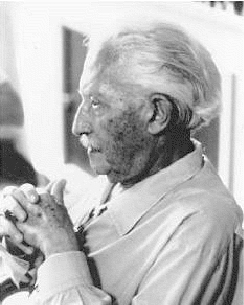
Figure 9.4 Erik Erikson proposed the psychosocial theory of development. In each stage of Erikson’s theory, there is a psychosocial task that we must master in order to feel a sense of competence.
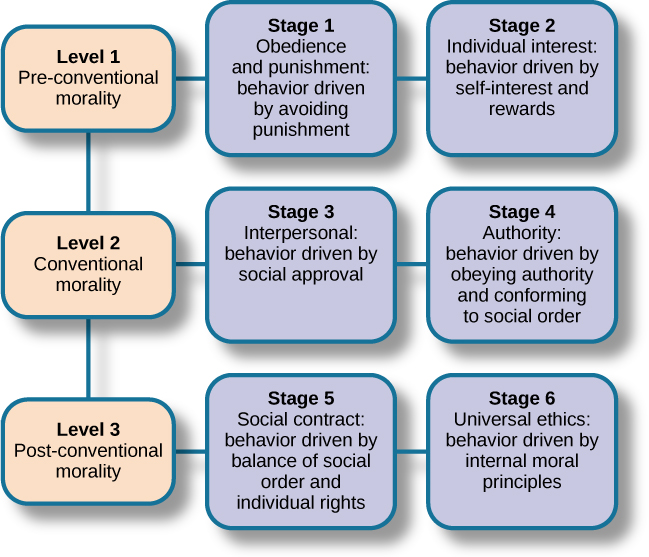
Figure 9.6 Kohlberg identified three levels of moral reasoning: pre-conventional, conventional, and post-conventional: Each level is associated with increasingly complex stages of moral development.
11.2 Freud and the Psychodynamic Perspective — figures and tables
Figure 11.5 — 11.2 Freud and the Psychodynamic Perspective
Figure 11.5 Freud believed that we are only aware of a small amount of our mind’s activities and that most of it remains hidden from us in our unconscious. The information in our unconscious affects our behavior, although we are unaware of it.
Rose M. Spielman, William J. Jenkins, and Marilyn D. Lovett, Psychology 2E, OpenStax. · CC BY-NC-SA 4.0
· Original image ↗ · Access for free ↗Figure 11.6 — 11.2 Freud and the Psychodynamic Perspective
Figure 11.6 The job of the ego, or self, is to balance the aggressive/pleasure-seeking drives of the id with the moral control of the superego.
Rose M. Spielman, William J. Jenkins, and Marilyn D. Lovett, Psychology 2E, OpenStax. · CC BY-NC-SA 4.0
· Original image ↗ · Access for free ↗Figure 11.7 — 11.2 Freud and the Psychodynamic Perspective
Figure 11.7 Defense mechanisms are unconscious protective behaviors that work to reduce anxiety.
5.4 Socialization Across the Life Course — figures and tables
Figure 5.8 — 5.4 Socialization Across the Life Course
Figure 5.8 In basic training, members of the Air Force are taught to walk, move, and look like each other. (Credit: Staff Sergeant Desiree N. Palacios, U.S. Air Force/Wikimedia Commons)
12.1 Sex, Gender, Identity, and Expression — figures and tables
Figure 12.2 — 12.1 Sex, Gender, Identity, and Expression
Figure 12.2 While the biological differences between males and females are fairly straightforward, the social and cultural aspects of being a man or woman can be complicated. (Credit: Mapbox Uncharted ERG /flickr)
Tonja R. Conerly, Kathleen Holmes, and Asha Lal Tamang, Introduction Sociology 3E, OpenStax. · CC BY-NC-SA 4.0
· Original image ↗ · Access for free ↗Figure 12.3 — 12.1 Sex, Gender, Identity, and Expression
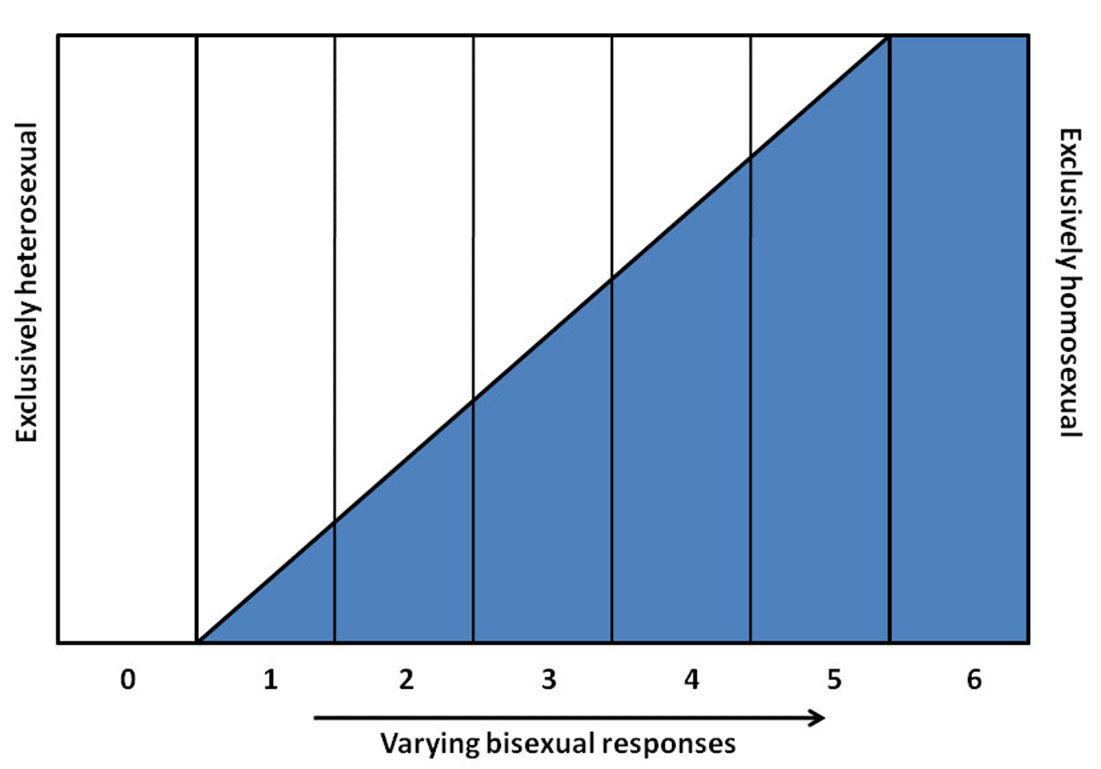
Figure 12.3 The Kinsey scale was one of the first attempts to frame the diversity of human sexual orientation.
Tonja R. Conerly, Kathleen Holmes, and Asha Lal Tamang, Introduction Sociology 3E, OpenStax. · CC BY-NC-SA 4.0
· Original image ↗ · Access for free ↗Figure 12.4 — 12.1 Sex, Gender, Identity, and Expression
Figure 12.4 Childhood activities and instruction, like this father-daughter duck-hunting trip, can influence people's lifelong views on gender roles. (Credit: Tim Miller, USFWS Midwest Region/flickr)
Tonja R. Conerly, Kathleen Holmes, and Asha Lal Tamang, Introduction Sociology 3E, OpenStax. · CC BY-NC-SA 4.0
· Original image ↗ · Access for free ↗Figure 12.5 — 12.1 Sex, Gender, Identity, and Expression
Figure 12.5 Actress Laverne Cox is the first openly transgender person to play a transgender character on a major show. She won a producing Emmy and was nominated four times for the Best Actress Emmy. She is also an advocate for LGBTQ issues outside of her career, such as in this "Ain't I a Woman?" speaking tour. (Credit: modification of work by "KOMUnews_Flickr"/Flickr)
Tonja R. Conerly, Kathleen Holmes, and Asha Lal Tamang, Introduction Sociology 3E, OpenStax. · CC BY-NC-SA 4.0
· Original image ↗ · Access for free ↗Figure 12.6 — 12.1 Sex, Gender, Identity, and Expression
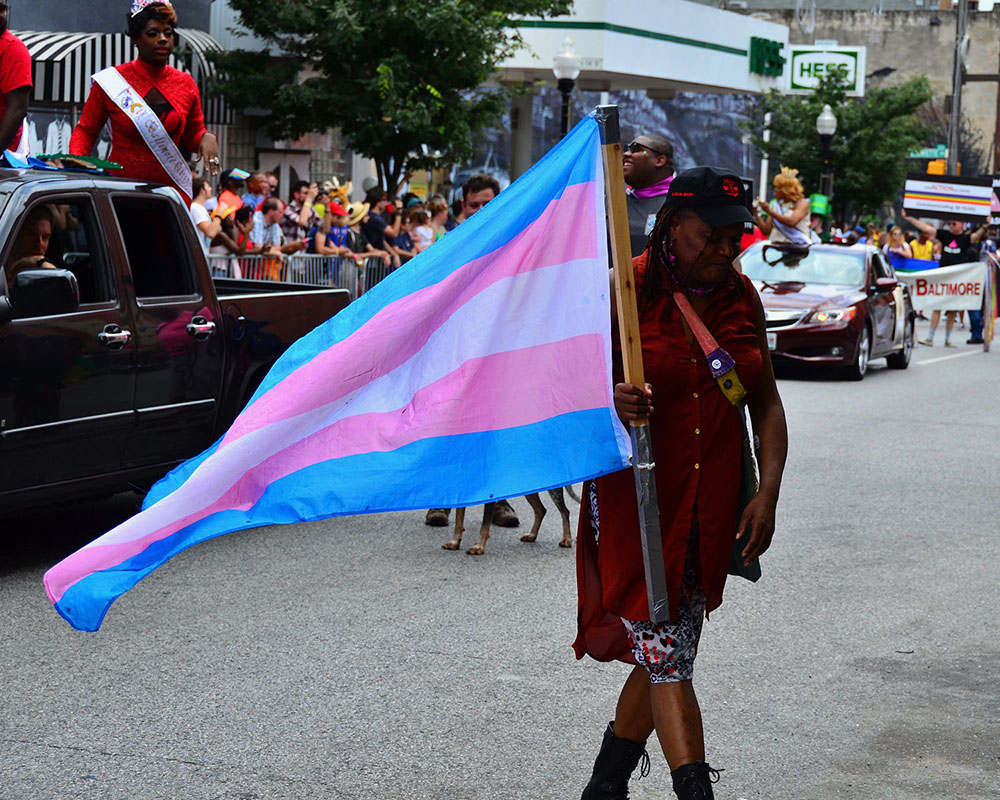
Figure 12.6 The most widely known transgender pride flag was designed by transgender woman and U.S. Navy veteran Monica Helms. Other designers have different interpretation of the transgender flag, and other groups within the LGBTQ community have their own flags and symbols. Interestingly, Gilbert Baker, the designer of the first widely adopted pride flag, made a point to avoid trademark or other limits on the flag, so that it could be reinterpreted and reused by others. (Credit: crudmucosa/flickr)
Tonja R. Conerly, Kathleen Holmes, and Asha Lal Tamang, Introduction Sociology 3E, OpenStax. · CC BY-NC-SA 4.0
· Original image ↗ · Access for free ↗Figure 12.7 — 12.1 Sex, Gender, Identity, and Expression
Figure 12.7 Hashtags, pride parades, and other activism are important elements of supporting LGBTQ people, but most experts and advocates agree that some of the most important steps are ones taken internally to better educate ourselves, and on interpersonal levels with friends, coworkers, and family members. (Credit: Lars Verket/flickr)
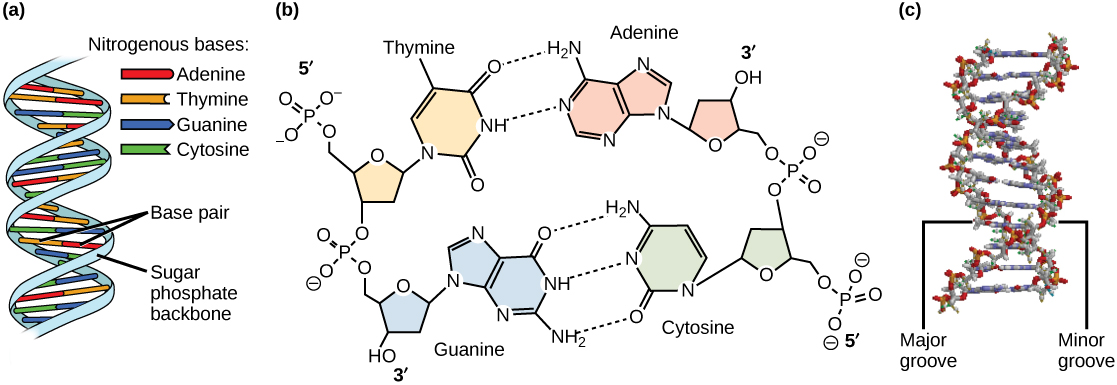
Figure 14.7 DNA has (a) a double helix structure and (b) phosphodiester bonds; the dotted lines between Thymine and Adenine and Guanine and Cytosine represent hydrogen bonds. The (c) major and minor grooves are binding sites for DNA binding proteins during processes such as transcription (the copying of RNA from DNA) and replication.
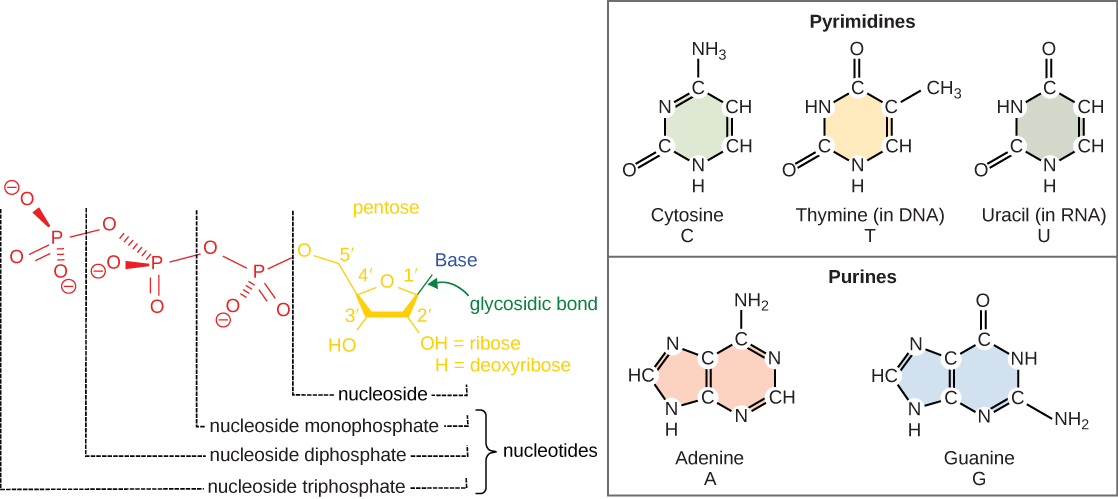
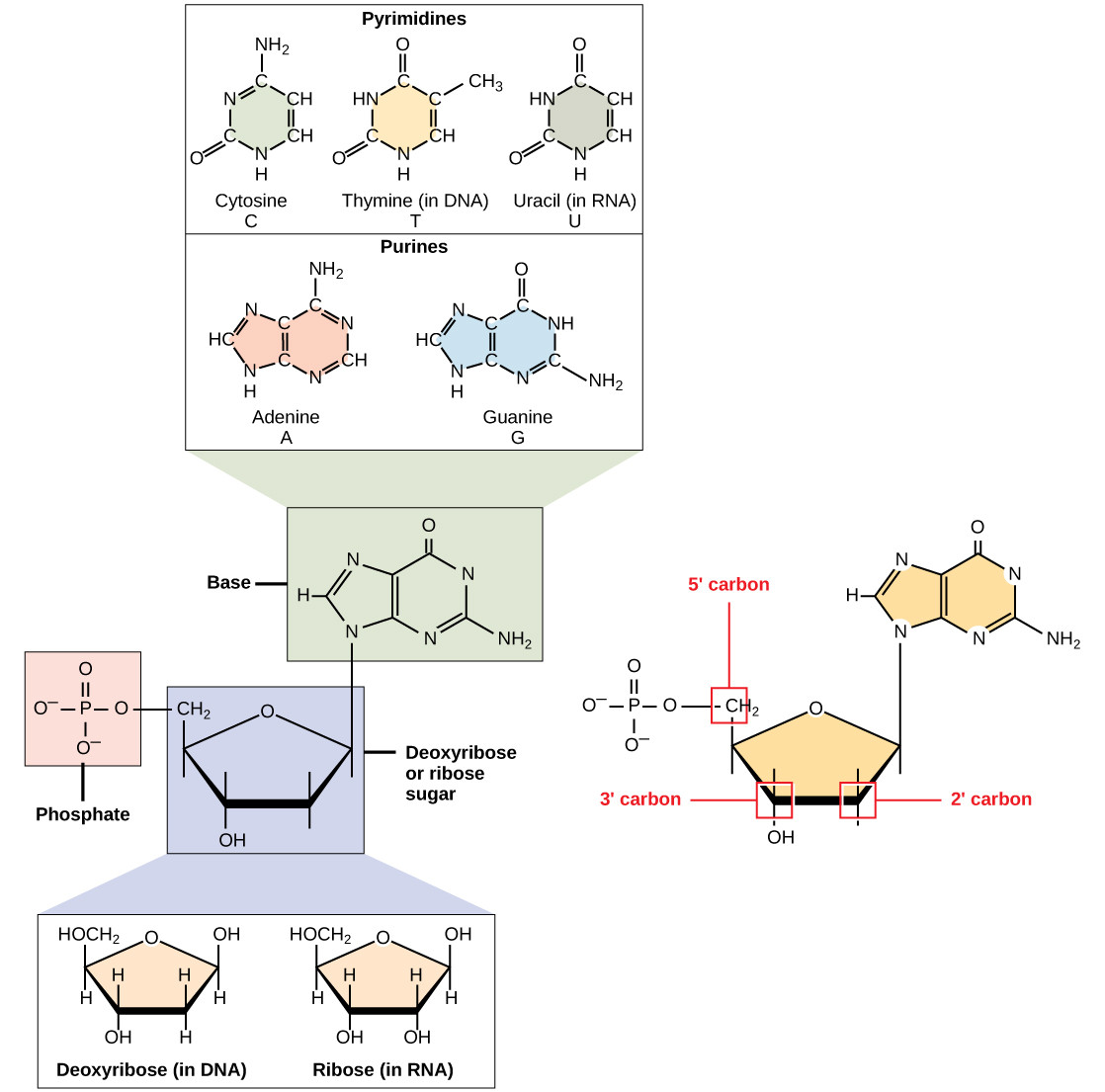
Figure 14.5 The purines have a double ring structure with a six-membered ring fused to a five-membered ring. Pyrimidines are smaller in size; they have a single six-membered ring structure.
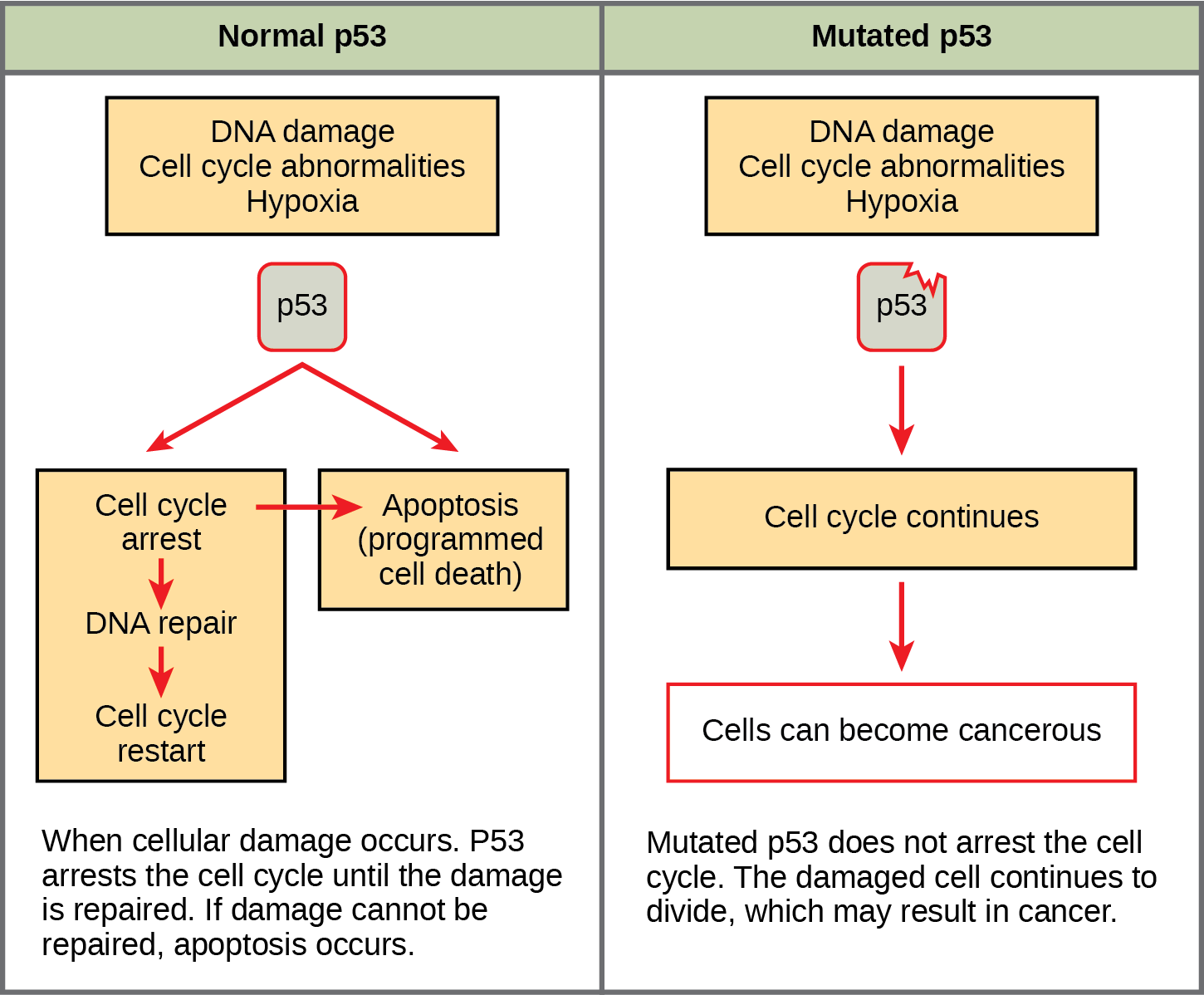
Figure 10.16 The role of normal p53 is to monitor DNA and the supply of oxygen (hypoxia is a condition of reduced oxygen supply). If damage is detected, p53 triggers repair mechanisms. If repairs are unsuccessful, p53 signals apoptosis. A cell with an abnormal p53 protein cannot repair damaged DNA and thus cannot signal apoptosis. Cells with abnormal p53 can become cancerous. (credit: modification of work by Thierry Soussi)
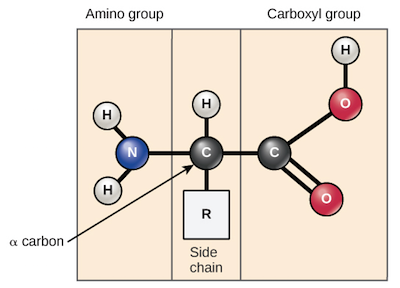
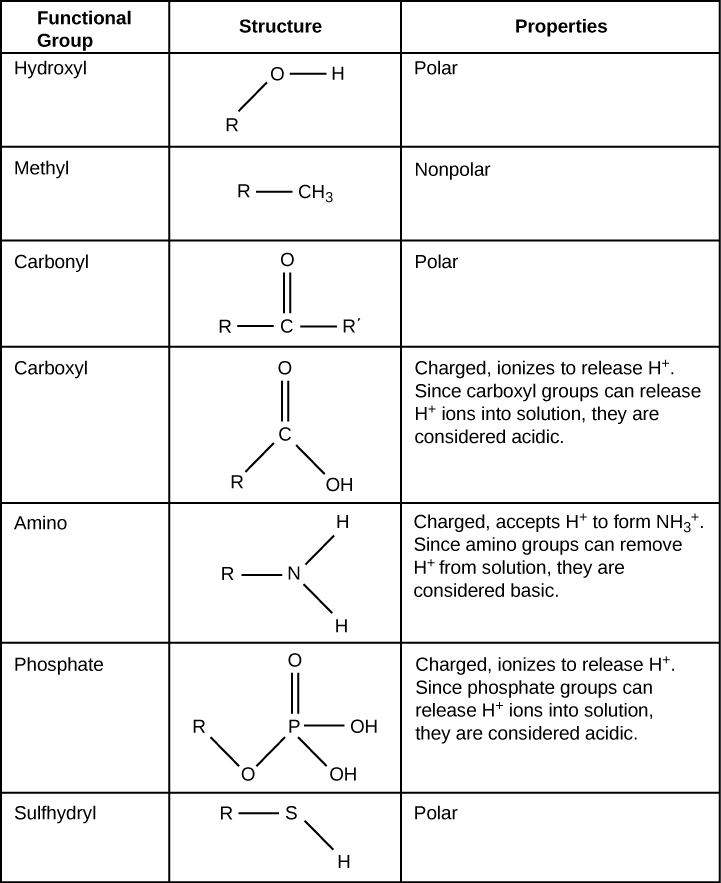
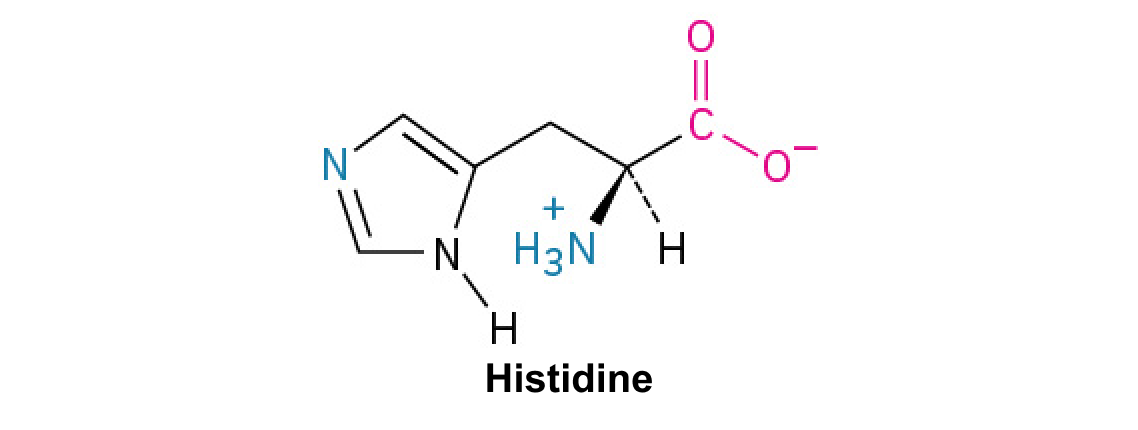
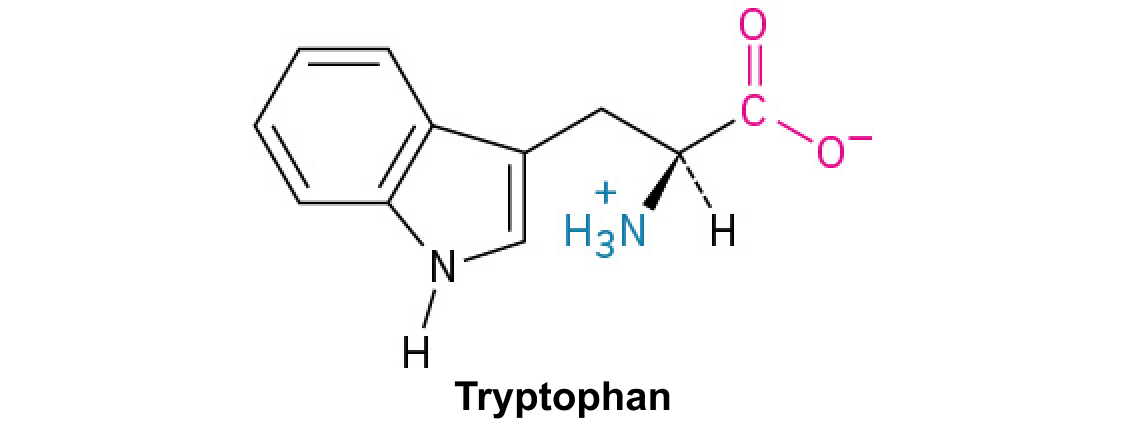
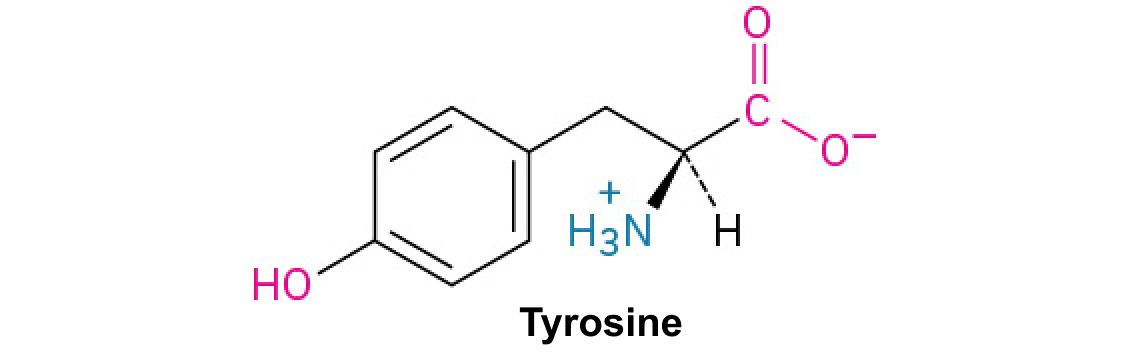
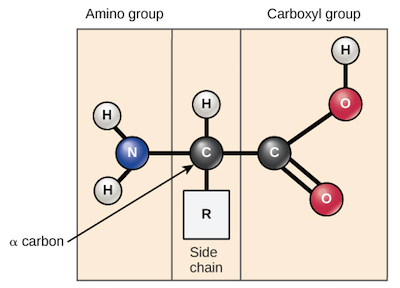
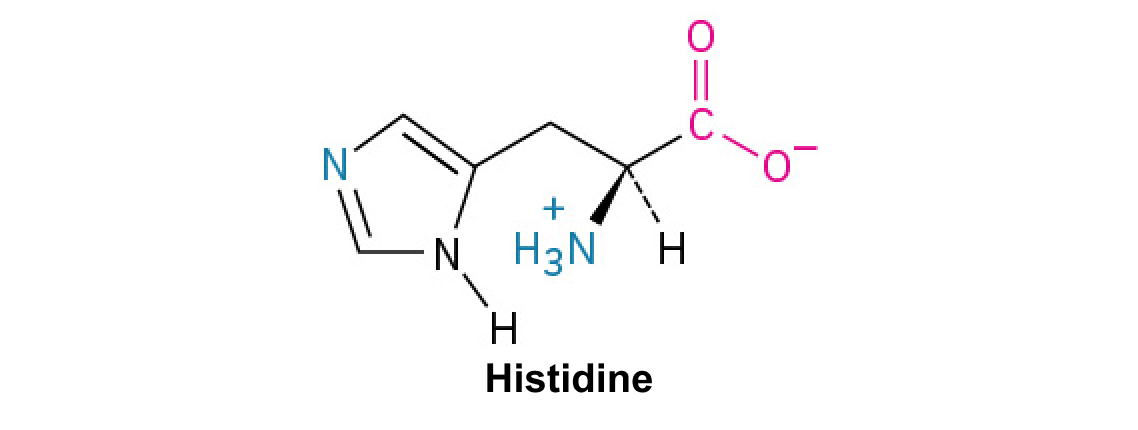
A nitrogen-containing functional group. A free amino acid’s amino group is typically protonated (NH₃⁺) near physiological pH; proline’s ring nitrogen is an exception to this formula.
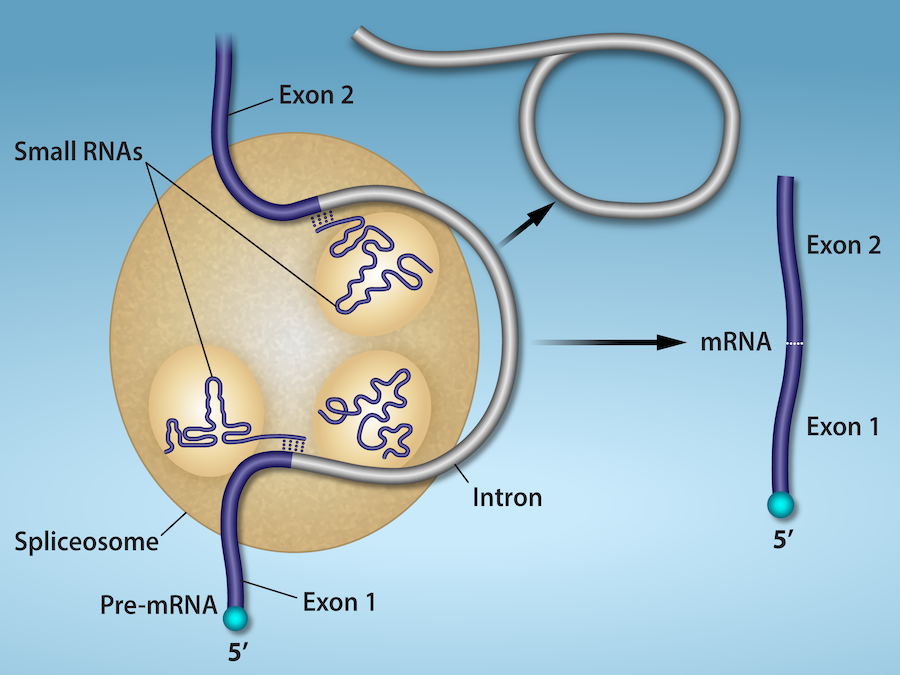
Figure 15.13 Pre-mRNA splicing involves the precise removal of introns from the primary RNA transcript. The splicing process is catalyzed by protein complexes called spliceosomes that are composed of proteins and RNA molecules called small nuclear RNAs (snRNAs). Spliceosomes recognize sequences at the 5' and 3' end of the intron. Rao, A. and Ryan, K. Department of Biology, Texas A&M University.
Rao, A. and Ryan, K. Department of Biology, Texas A&M University.; Mary Ann Clark, Matthew Douglas, and Jung Choi, Biology 2e, OpenStax. · CC BY-NC-SA 4.0
· Original image ↗ · Access for free ↗
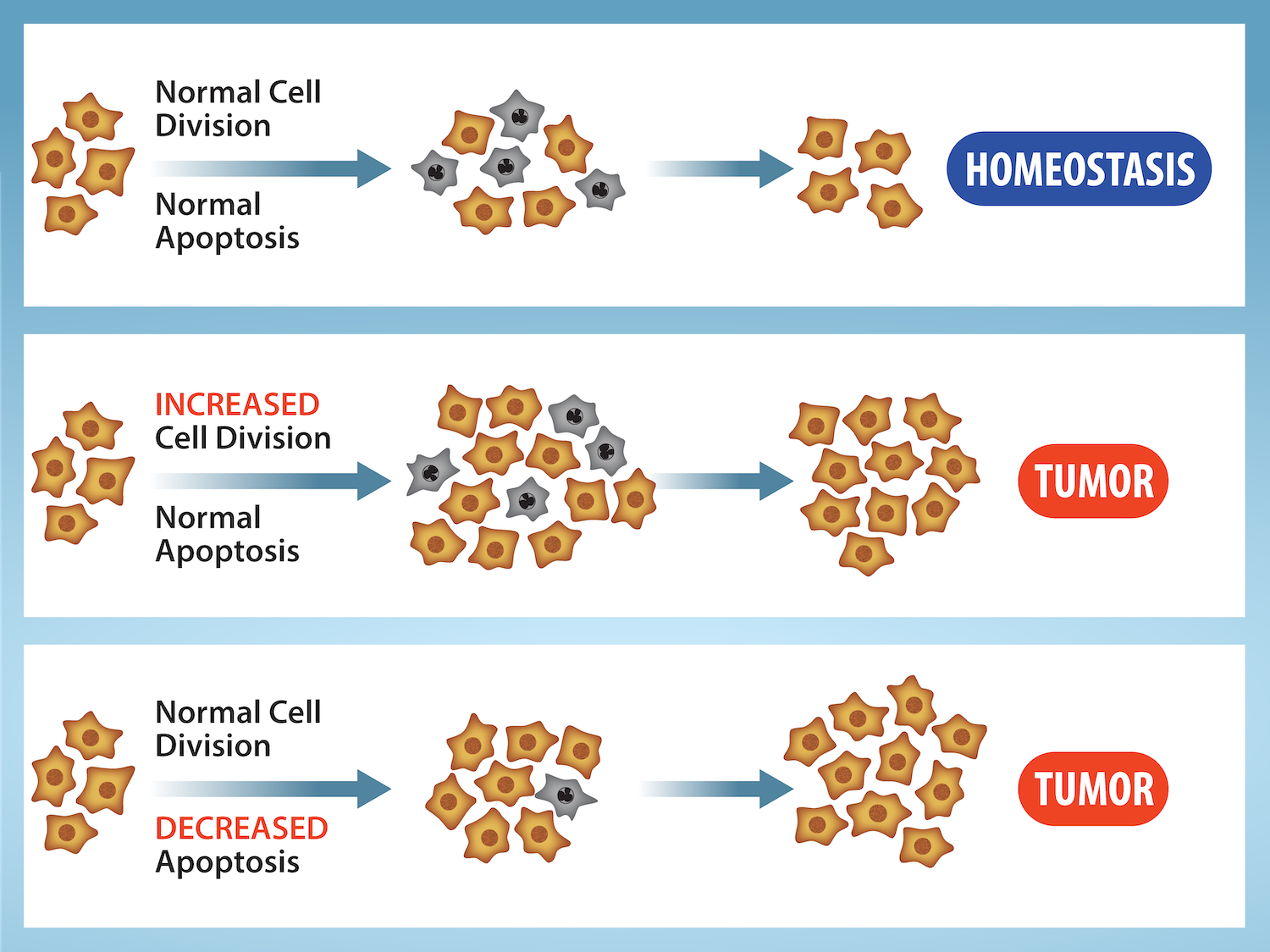
Figure 10.15 Cell Division and Apoptosis. In an adult organism, normal cell division is balanced by apoptosis (programmed cell death) to maintain a constant cell number in homeostasis. Either an increase in cell division or a decrease in apoptosis leads an increase in the number of cells and tumor formation. Credit: Rao, A. and Ryan, K. Department of Biology, Texas A&M University.
Rao, A. and Ryan, K. Department of Biology, Texas A&M University. Mary Ann Clark, Matthew Douglas, and Jung Choi, Biology 2e, OpenStax. · CC BY-NC-SA 4.0
· Original image ↗ · Access for free ↗
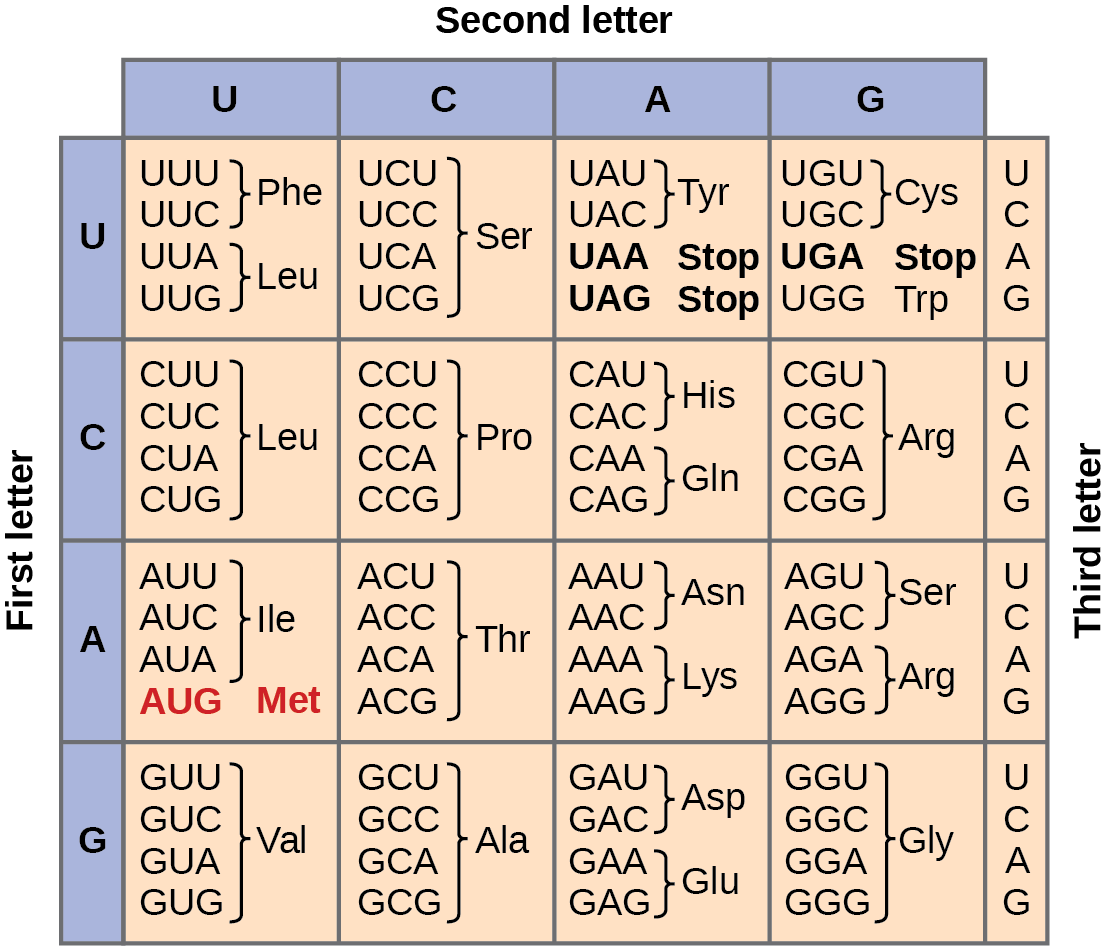
Figure 15.4 This figure shows the genetic code for translating each nucleotide triplet in mRNA into an amino acid or a termination signal in a protein. (credit: modification of work by NIH)
Figure 9.6 Kohlberg identified three levels of moral reasoning: pre-conventional, conventional, and post-conventional: Each level is associated with increasingly complex stages of moral development.
Figure 14.5 The purines have a double ring structure with a six-membered ring fused to a five-membered ring. Pyrimidines are smaller in size; they have a single six-membered ring structure.
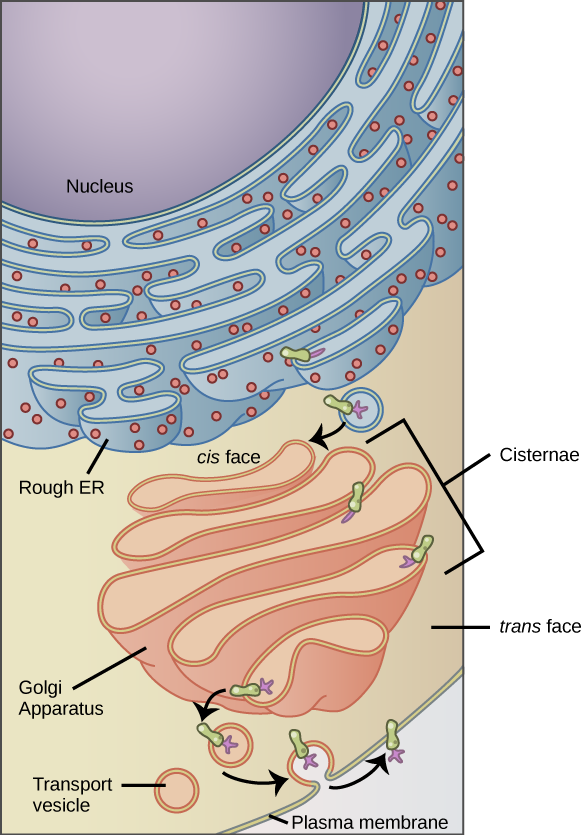
Figure 4.18 Membrane and secretory proteins are synthesized in the rough endoplasmic reticulum (RER). The RER also sometimes modifies proteins. In this illustration, a (green) integral membrane protein is modified by attachment of a (purple) carbohydrate in the ER. Vesicles with the integral protein bud from the ER and fuse with the Golgi apparatus' cis face. As the protein passes along the Golgi’s cisternae, the addition of more carbohydrates further modifies it. After its synthesis is complete, it exits as an integral membrane protein of the vesicle that buds from the Golgi’s trans face. When the vesicle fuses with the cell membrane, the protein becomes an integral portion of that cell membrane. (credit: modification of work by Magnus Manske)
Figure 12.4 In the P generation, pea plants that are true-breeding for the dominant yellow phenotype are crossed with plants with the recessive green phenotype. This cross produces F 1 heterozygotes with a yellow phenotype. Punnett square analysis can be used to predict the genotypes of the F 2 generation.
An electrical property that can be positive or negative. Opposite charges attract and like charges repel; net charge is the sum of all charges on a particle.
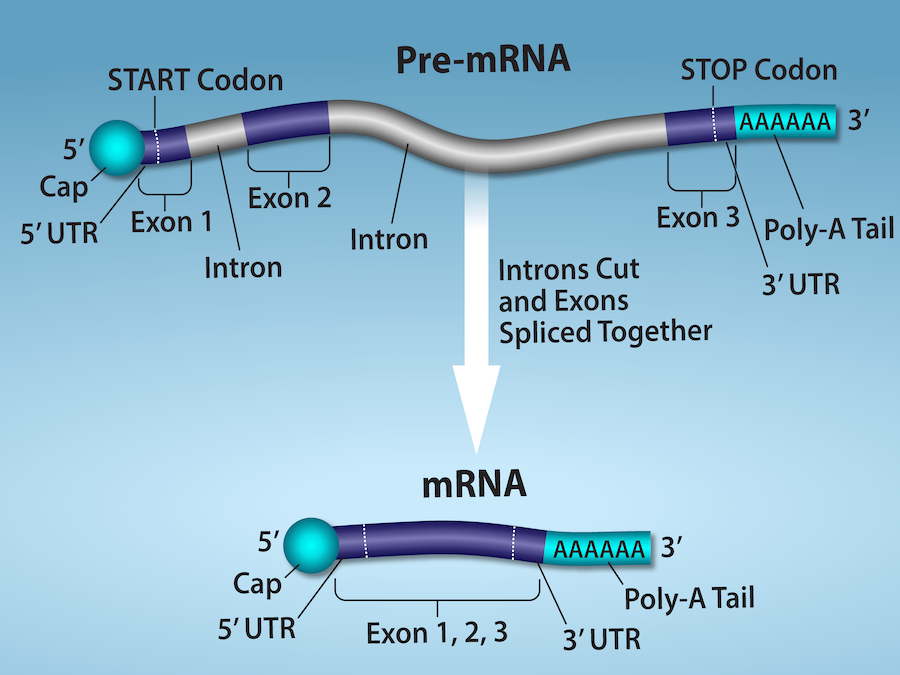
Figure 15.11 Eukaryotic pre-mRNA processing. In addition to 5’ Cap and 3’ Poly-A Tail addition, introns must be precisely removed and exons joined to generate a functional mRNA. Nucleotides upstream (towards the 5’cap) of the translation START codon are part of the 5’ untranslated region (5’ UTR). Nucleotides downstream (towards 3’end) of the STOP codon form the 3’ UTR. Both 5’ and 3’ UTRs are important for regulating translation initiation and mRNA stability. Credit: Rao, A., Ryan, K. Fletcher, S. and Tag, A. Department of Biology, Texas A&M University.
Rao, A., Ryan, K. Fletcher, S. and Tag, A. Department of Biology, Texas A&M University.; Mary Ann Clark, Matthew Douglas, and Jung Choi, Biology 2e, OpenStax. · CC BY-NC-SA 4.0
· Original image ↗ · Access for free ↗
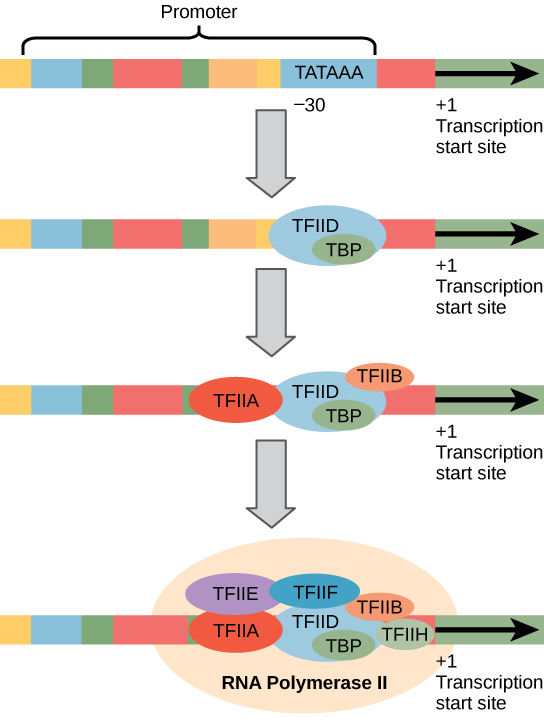
Figure 15.10 A generalized promoter of a gene transcribed by RNA polymerase II is shown. Transcription factors recognize the promoter. RNA polymerase II then binds and forms the transcription initiation complex.
Figure 12.4 In the P generation, pea plants that are true-breeding for the dominant yellow phenotype are crossed with plants with the recessive green phenotype. This cross produces F 1 heterozygotes with a yellow phenotype. Punnett square analysis can be used to predict the genotypes of the F 2 generation.
Figure 14.5 The purines have a double ring structure with a six-membered ring fused to a five-membered ring. Pyrimidines are smaller in size; they have a single six-membered ring structure.
Figure 12.4 In the P generation, pea plants that are true-breeding for the dominant yellow phenotype are crossed with plants with the recessive green phenotype. This cross produces F 1 heterozygotes with a yellow phenotype. Punnett square analysis can be used to predict the genotypes of the F 2 generation.
Figure 15.11 Eukaryotic pre-mRNA processing. In addition to 5’ Cap and 3’ Poly-A Tail addition, introns must be precisely removed and exons joined to generate a functional mRNA. Nucleotides upstream (towards the 5’cap) of the translation START codon are part of the 5’ untranslated region (5’ UTR). Nucleotides downstream (towards 3’end) of the STOP codon form the 3’ UTR. Both 5’ and 3’ UTRs are important for regulating translation initiation and mRNA stability. Credit: Rao, A., Ryan, K. Fletcher, S. and Tag, A. Department of Biology, Texas A&M University.
Rao, A., Ryan, K. Fletcher, S. and Tag, A. Department of Biology, Texas A&M University.; Mary Ann Clark, Matthew Douglas, and Jung Choi, Biology 2e, OpenStax. · CC BY-NC-SA 4.0
· Original image ↗ · Access for free ↗
Figure 15.13 Pre-mRNA splicing involves the precise removal of introns from the primary RNA transcript. The splicing process is catalyzed by protein complexes called spliceosomes that are composed of proteins and RNA molecules called small nuclear RNAs (snRNAs). Spliceosomes recognize sequences at the 5' and 3' end of the intron. Rao, A. and Ryan, K. Department of Biology, Texas A&M University.
Rao, A. and Ryan, K. Department of Biology, Texas A&M University.; Mary Ann Clark, Matthew Douglas, and Jung Choi, Biology 2e, OpenStax. · CC BY-NC-SA 4.0
· Original image ↗ · Access for free ↗
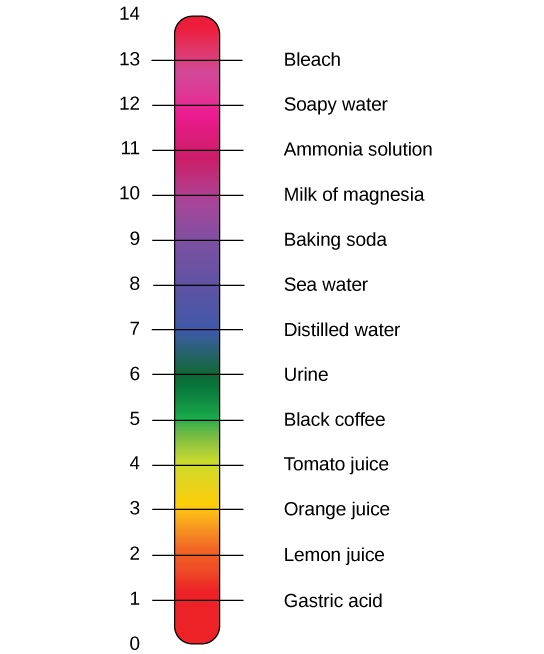
The exponent needed to obtain a number from a chosen fixed number. For decimal logarithms, log₁₀(100) = 2 because 10² = 100; pH uses the negative decimal logarithm of hydrogen ion activity.
Figure 4.18 Membrane and secretory proteins are synthesized in the rough endoplasmic reticulum (RER). The RER also sometimes modifies proteins. In this illustration, a (green) integral membrane protein is modified by attachment of a (purple) carbohydrate in the ER. Vesicles with the integral protein bud from the ER and fuse with the Golgi apparatus' cis face. As the protein passes along the Golgi’s cisternae, the addition of more carbohydrates further modifies it. After its synthesis is complete, it exits as an integral membrane protein of the vesicle that buds from the Golgi’s trans face. When the vesicle fuses with the cell membrane, the protein becomes an integral portion of that cell membrane. (credit: modification of work by Magnus Manske)
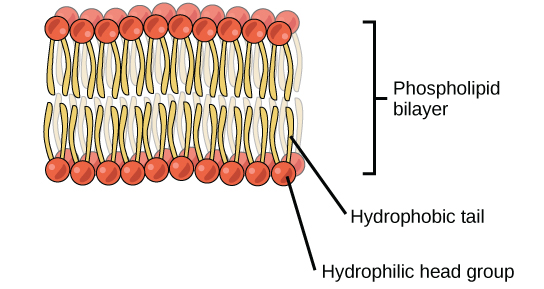
A thin boundary or sheet. Cell membranes are lipid bilayers containing proteins; blotting membranes are synthetic supports that hold proteins or nucleic acids for detection.
Figure 15.11 Eukaryotic pre-mRNA processing. In addition to 5’ Cap and 3’ Poly-A Tail addition, introns must be precisely removed and exons joined to generate a functional mRNA. Nucleotides upstream (towards the 5’cap) of the translation START codon are part of the 5’ untranslated region (5’ UTR). Nucleotides downstream (towards 3’end) of the STOP codon form the 3’ UTR. Both 5’ and 3’ UTRs are important for regulating translation initiation and mRNA stability. Credit: Rao, A., Ryan, K. Fletcher, S. and Tag, A. Department of Biology, Texas A&M University.
Rao, A., Ryan, K. Fletcher, S. and Tag, A. Department of Biology, Texas A&M University.; Mary Ann Clark, Matthew Douglas, and Jung Choi, Biology 2e, OpenStax. · CC BY-NC-SA 4.0
· Original image ↗ · Access for free ↗
Figure 4.18 Membrane and secretory proteins are synthesized in the rough endoplasmic reticulum (RER). The RER also sometimes modifies proteins. In this illustration, a (green) integral membrane protein is modified by attachment of a (purple) carbohydrate in the ER. Vesicles with the integral protein bud from the ER and fuse with the Golgi apparatus' cis face. As the protein passes along the Golgi’s cisternae, the addition of more carbohydrates further modifies it. After its synthesis is complete, it exits as an integral membrane protein of the vesicle that buds from the Golgi’s trans face. When the vesicle fuses with the cell membrane, the protein becomes an integral portion of that cell membrane. (credit: modification of work by Magnus Manske)
Figure 12.4 In the P generation, pea plants that are true-breeding for the dominant yellow phenotype are crossed with plants with the recessive green phenotype. This cross produces F 1 heterozygotes with a yellow phenotype. Punnett square analysis can be used to predict the genotypes of the F 2 generation.
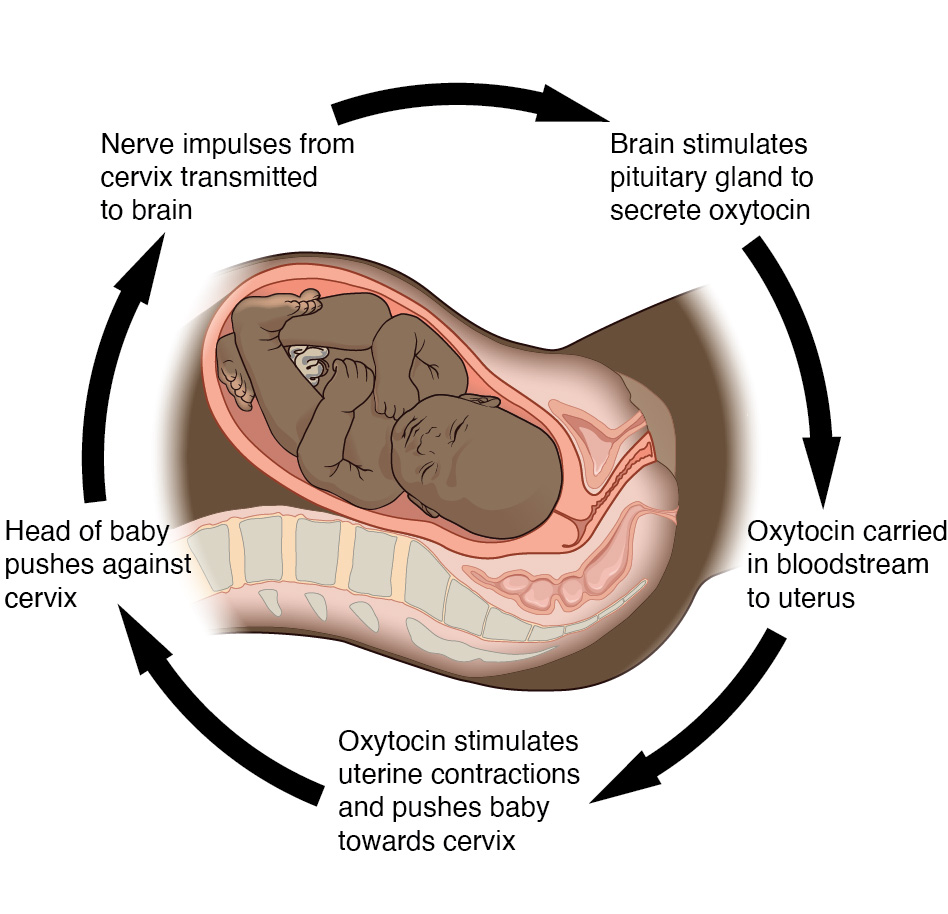
Figure 1.11 Positive Feedback Loop Normal childbirth is driven by a positive feedback loop. A positive feedback loop results in a change in the body’s status, rather than a return to homeostasis.
Figure 14.5 The purines have a double ring structure with a six-membered ring fused to a five-membered ring. Pyrimidines are smaller in size; they have a single six-membered ring structure.
Figure 14.5 The purines have a double ring structure with a six-membered ring fused to a five-membered ring. Pyrimidines are smaller in size; they have a single six-membered ring structure.
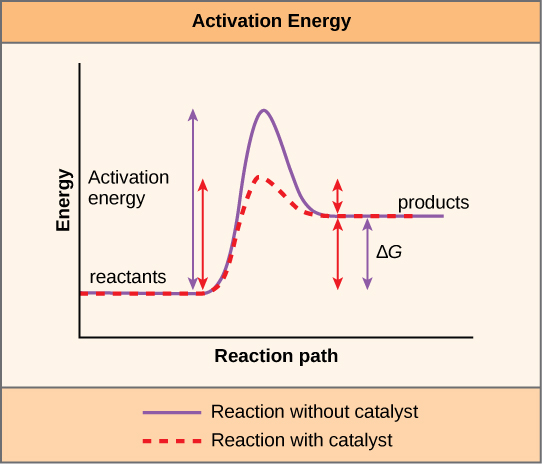
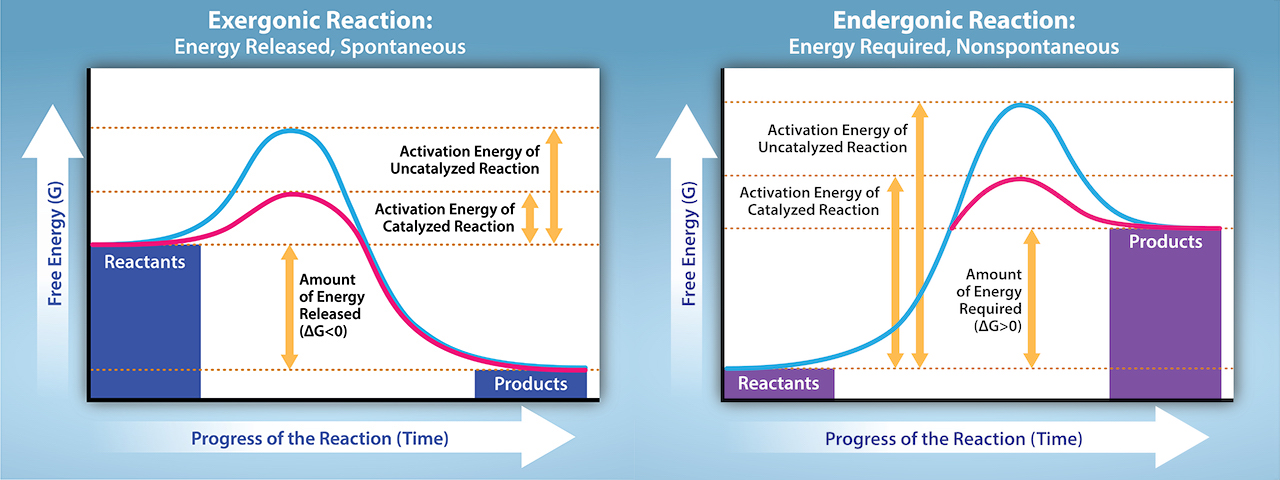
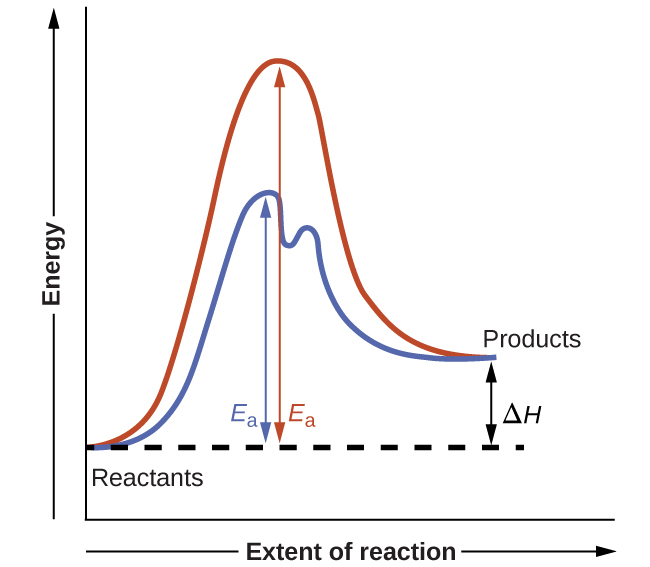
Figure 12.19 Reaction diagrams for an endothermic process in the absence (red curve) and presence (blue curve) of a catalyst. The catalyzed pathway involves a two-step mechanism (note the presence of two transition states) and an intermediate species (represented by the valley between the two transitions states).
Figure 15.13 Pre-mRNA splicing involves the precise removal of introns from the primary RNA transcript. The splicing process is catalyzed by protein complexes called spliceosomes that are composed of proteins and RNA molecules called small nuclear RNAs (snRNAs). Spliceosomes recognize sequences at the 5' and 3' end of the intron. Rao, A. and Ryan, K. Department of Biology, Texas A&M University.
Rao, A. and Ryan, K. Department of Biology, Texas A&M University.; Mary Ann Clark, Matthew Douglas, and Jung Choi, Biology 2e, OpenStax. · CC BY-NC-SA 4.0
· Original image ↗ · Access for free ↗
role taking
Adopting another person’s perspective to understand social expectations.
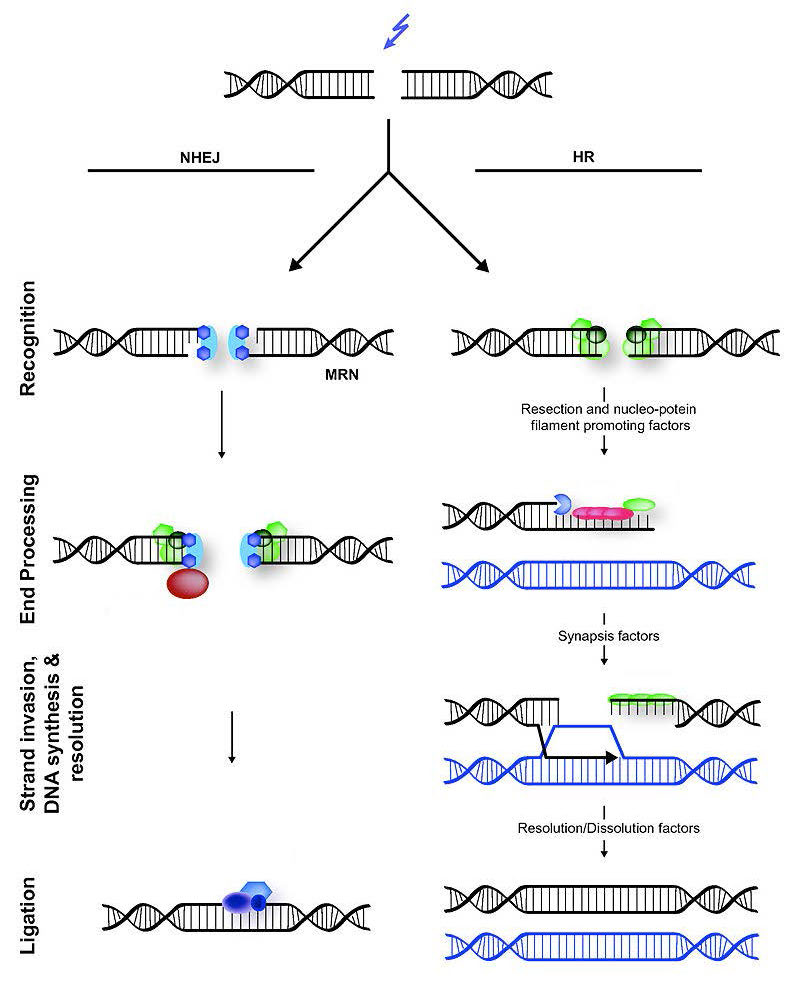
Figure 7.45 - Non-homologous end joining (left) versus homologous recombination (right) - Wikipedia
Wikipedia, as credited by Kevin Ahern, Indira Rajagopal, and Taralyn Tan, Biochemistry Free For All, Oregon State University, via Biology LibreTexts. · Source attribution
· Original image ↗ · Access for free ↗
The amount of a substance that can dissolve in a solvent under specified conditions. Soluble means able to dissolve; insoluble means only very slightly soluble in that solvent.
Figure 14.5 The purines have a double ring structure with a six-membered ring fused to a five-membered ring. Pyrimidines are smaller in size; they have a single six-membered ring structure.
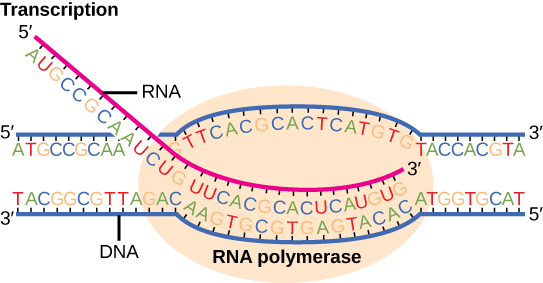
Figure 15.7 Messenger RNA is a copy of protein-coding information in the coding strand of DNA, with the substitution of U in the RNA for T in the coding sequence. However, new RNA nucleotides base pair with the nucleotides of the template strand. RNA is synthesized in its 5'-3' direction, using the enzyme RNA polymerase. As the template is read, the DNA unwinds ahead of the polymerase and then rewinds behind it.
A fleeting, high-energy arrangement at a reaction barrier. It is an energy maximum along the reaction path, rather than a stable reaction intermediate.
Figure 12.19 Reaction diagrams for an endothermic process in the absence (red curve) and presence (blue curve) of a catalyst. The catalyzed pathway involves a two-step mechanism (note the presence of two transition states) and an intermediate species (represented by the valley between the two transitions states).
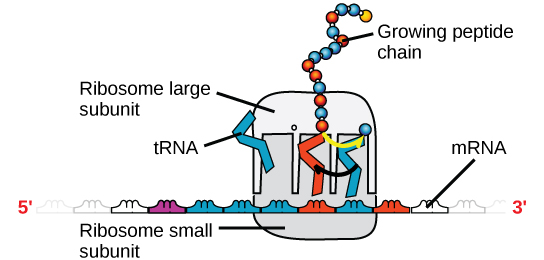
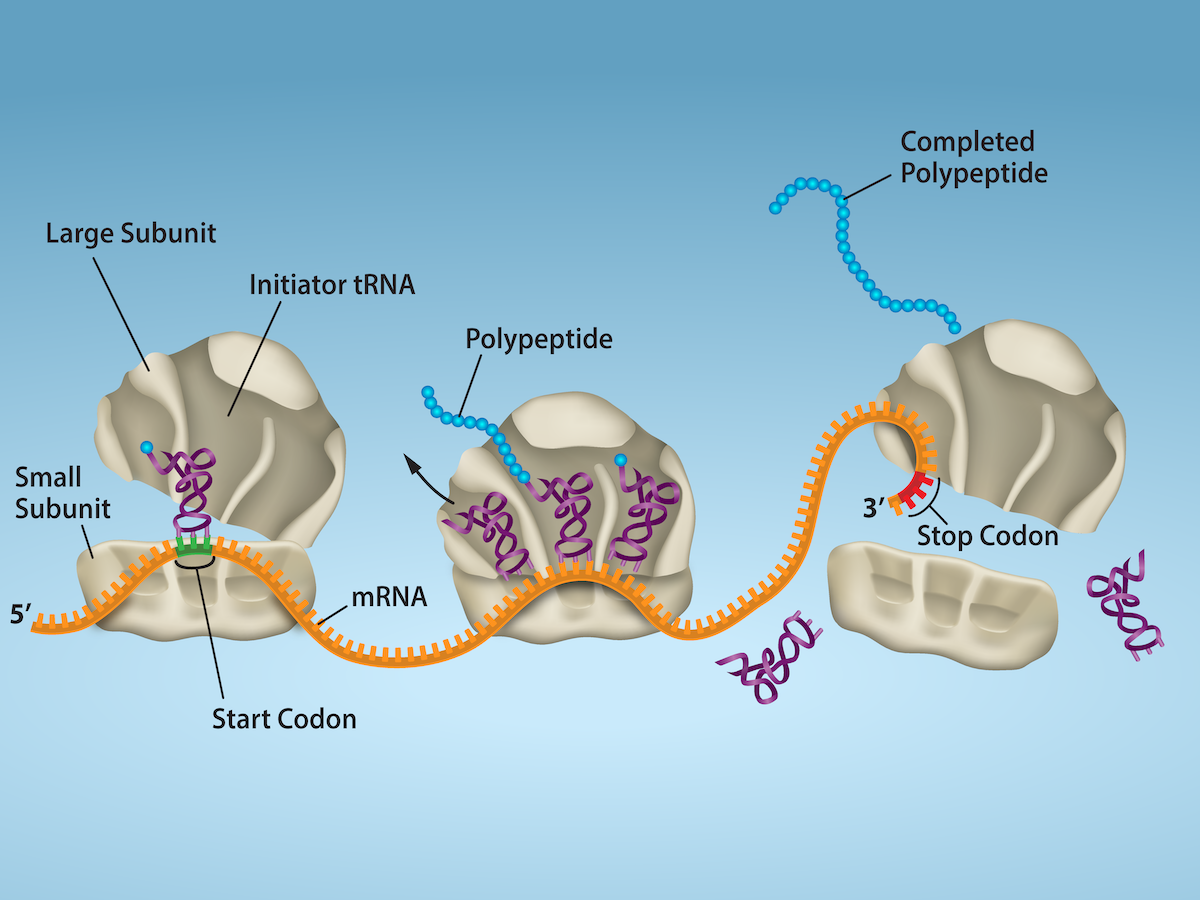
Figure 15.18 Translation begins when an initiator tRNA anticodon recognizes a start codon on mRNA bound to a small ribosomal subunit. The large ribosomal subunit joins the small subunit, and a second tRNA is recruited. As the mRNA moves relative to the ribosome, successive tRNAs move through the ribosome and the polypeptide chain is formed. Entry of a release factor into the A site terminates translation and the components dissociate.
Figure 14.5 The purines have a double ring structure with a six-membered ring fused to a five-membered ring. Pyrimidines are smaller in size; they have a single six-membered ring structure.
No matching terms. Try a different name or abbreviation.
9.2 Lifespan Theories
OpenStax · 9.2 Lifespan Theories ↗ Instructional page including learning objectives, examples, figures, source tables and questions. Site navigation and embedded media players are omitted; source media links remain available.
Learning Objectives
By the end of this section, you will be able to:
Discuss Freud’s theory of psychosexual development
Discuss Piaget’s view of cognitive development and apply the stages to understanding childhood cognition
Describe Kohlberg’s theory of moral development
Compare and contrast the strengths and weaknesses of major developmental theories
There are many theories regarding how babies and children grow and develop into happy, healthy adults. We explore several of these theories in this section.
Psychosexual Theory of Development
Sigmund Freud (1856–1939) believed that personality develops during early childhood. For Freud, childhood experiences shape our personalities and behavior as adults. Freud viewed development as discontinuous; he believed that each of us must pass through a series of stages during childhood, and that if we lack proper nurturance and parenting during a stage, we may become stuck, or fixated, in that stage. Freud’s stages are called the stages of psychosexual development. According to Freud, children’s pleasure-seeking urges are focused on a different area of the body, called an erogenous zone, at each of the five stages of development: oral, anal, phallic, latency, and genital.
While most of Freud’s ideas have not found support in modern research, we cannot discount the contributions that Freud has made to the field of psychology. Psychologists today dispute Freud's psychosexual stages as a legitimate explanation for how one's personality develops, but what we can take away from Freud’s theory is that personality is shaped, in some part, by experiences we have in childhood. These stages are discussed in detail in the chapter on personality.
Psychosocial Theory of Development
Erik Erikson (1902–1994) (Figure 9.4), another stage theorist, took Freud’s theory and modified it as psychosocial theory. Erikson’s psychosocial developmenttheory emphasizes the social nature of our development rather than its sexual nature. While Freud believed that personality is shaped only in childhood, Erikson proposed that personality development takes place all through the lifespan. Erikson suggested that how we interact with others is what affects our sense of self, or what he called the ego identity.
Figure 9.4 — 9.2 Lifespan Theories
Figure 9.4 Erik Erikson proposed the psychosocial theory of development. In each stage of Erikson’s theory, there is a psychosocial task that we must master in order to feel a sense of competence.
Erikson proposed that we are motivated by a need to achieve competence in certain areas of our lives. According to psychosocial theory, we experience eight stages of development over our lifespan, from infancy through late adulthood. At each stage there is a conflict, or task, that we need to resolve. Successful completion of each developmental task results in a sense of competence and a healthy personality. Failure to master these tasks leads to feelings of inadequacy.
According to Erikson (1963), trust is the basis of our development during infancy (birth to 12 months). Therefore, the primary task of this stage is trust versus mistrust. Infants are dependent upon their caregivers, so caregivers who are responsive and sensitive to their infant’s needs help their baby to develop a sense of trust; their baby will see the world as a safe, predictable place. Unresponsive caregivers who do not meet their baby’s needs can engender feelings of anxiety, fear, and mistrust; their baby may see the world as unpredictable.
As toddlers (ages 1–3 years) begin to explore their world, they learn that they can control their actions and act on the environment to get results. They begin to show clear preferences for certain elements of the environment, such as food, toys, and clothing. A toddler’s main task is to resolve the issue of autonomy versus shame and doubt, by working to establish independence. This is the “me do it” stage. For example, we might observe a budding sense of autonomy in a 2-year-old child who wants to choose her clothes and dress herself. Although her outfits might not be appropriate for the situation, her input in such basic decisions has an effect on her sense of independence. If denied the opportunity to act on her environment, she may begin to doubt her abilities, which could lead to low self-esteem and feelings of shame.
Once children reach the preschool stage (ages 3–6 years), they are capable of initiating activities and asserting control over their world through social interactions and play. According to Erikson, preschool children must resolve the task of initiative versus guilt. By learning to plan and achieve goals while interacting with others, preschool children can master this task. Those who do will develop self-confidence and feel a sense of purpose. Those who are unsuccessful at this stage—with their initiative misfiring or stifled—may develop feelings of guilt. How might over-controlling parents stifle a child’s initiative?
During the elementary school stage (ages 7–11), children face the task of industry versus inferiority. Children begin to compare themselves to their peers to see how they measure up. They either develop a sense of pride and accomplishment in their schoolwork, sports, social activities, and family life, or they feel inferior and inadequate when they don’t measure up. What are some things parents and teachers can do to help children develop a sense of competence and a belief in themselves and their abilities?
In adolescence (ages 12–18), children face the task of identity versus role confusion. According to Erikson, an adolescent’s main task is developing a sense of self. Adolescents struggle with questions such as “Who am I?” and “What do I want to do with my life?” Along the way, most adolescents try on many different selves to see which ones fit. Adolescents who are successful at this stage have a strong sense of identity and are able to remain true to their beliefs and values in the face of problems and other people’s perspectives. What happens to apathetic adolescents, who do not make a conscious search for identity, or those who are pressured to conform to their parents’ ideas for the future? These teens will have a weak sense of self and experience role confusion. They are unsure of their identity and confused about the future.
People in early adulthood (ages 19–29) are concerned with intimacy versus isolation. After we have developed a sense of self in adolescence, we are ready to share our life with others. Erikson said that we must have a strong sense of self before developing intimate relationships with others. Adults who do not develop a positive self-concept in adolescence may experience feelings of loneliness and emotional isolation.
When people reach 30, they enter the time known as middle adulthood, which extends to age 64. The social task of middle adulthood is generativity versus stagnation. Generativity involves finding your life’s work and contributing to the development of others, through activities such as volunteering, mentoring, and raising children. Those who do not master this task may experience stagnation, having little connection with others and little interest in productivity and self-improvement.
From age 65 to the end of life, we are in the period of development known as late adulthood. Erikson’s task at this stage is called integrity versus despair. He said that people in late adulthood reflect on their lives and feel either a sense of satisfaction or a sense of failure. People who feel proud of their accomplishments feel a sense of integrity, and they can look back on their lives with few regrets. However, people who are not successful at this stage may feel as if their life has been wasted. They focus on what “would have,” “should have,” and “could have” been. They face the end of their lives with feelings of bitterness, depression, and despair. Table 9.1 summarizes the stages of Erikson’s theory.
Erikson’s Psychosocial Stages of Development
Stage
Age (years)
Developmental Task
Description
1
0–1
Trust vs. mistrust
Trust (or mistrust) that basic needs, such as nourishment and affection, will be met
2
1–3
Autonomy vs. shame/doubt
Develop a sense of independence in many tasks
3
3–6
Initiative vs. guilt
Take initiative on some activities—may develop guilt when unsuccessful or boundaries overstepped
4
7–11
Industry vs. inferiority
Develop self-confidence in abilities when competent or sense of inferiority when not
5
12–18
Identity vs. confusion
Experiment with and develop identity and roles
6
19–29
Intimacy vs. isolation
Establish intimacy and relationships with others
7
30–64
Generativity vs. stagnation
Contribute to society and be part of a family
8
65–
Integrity vs. despair
Assess and make sense of life and meaning of contributions
Table
9.1
Cognitive Theory of Development
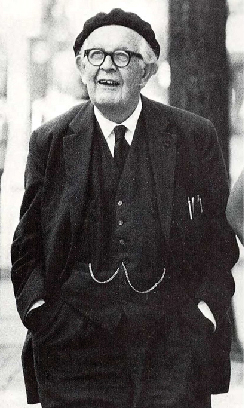
Jean Piaget (1896–1980) is another stage theorist who studied childhood development (Figure 9.5). Instead of approaching development from a psychoanalytical or psychosocial perspective, Piaget focused on children’s cognitive growth. He believed that thinking is a central aspect of development and that children are naturally inquisitive. However, he said that children do not think and reason like adults (Piaget, 1930, 1932). His theory of cognitive development holds that our cognitive abilities develop through specific stages, which exemplifies the discontinuity approach to development. As we progress to a new stage, there is a distinct shift in how we think and reason.
Figure 9.5 — 9.2 Lifespan Theories
Figure 9.5 Jean Piaget spent over 50 years studying children and how their minds develop.
Piaget said that children develop schemata to help them understand the world. Schemata are concepts (mental models) that are used to help us categorize and interpret information. By the time children have reached adulthood, they have created schemata for almost everything. When children learn new information, they adjust their schemata through two processes: assimilation and accommodation. First, they assimilate new information or experiences in terms of their current schemata: assimilation is when they take in information that is comparable to what they already know. Accommodation describes when they change their schemata based on new information. This process continues as children interact with their environment.
For example, 2-year-old Abdul learned the schema for dogs because his family has a Labrador retriever. When Abdul sees other dogs in his picture books, he says, “Look mommy, dog!” Thus, he has assimilated them into his schema for dogs. One day, Abdul sees a sheep for the first time and says, “Look mommy, dog!” Having a basic schema that a dog is an animal with four legs and fur, Abdul thinks all furry, four-legged creatures are dogs. When Abdul’s mom tells him that the animal he sees is a sheep, not a dog, Abdul must accommodate his schema for dogs to include more information based on his new experiences. Abdul’s schema for dog was too broad, since not all furry, four-legged creatures are dogs. He now modifies his schema for dogs and forms a new one for sheep.
Like Freud and Erikson, Piaget thought development unfolds in a series of stages approximately associated with age ranges. He proposed a theory of cognitive development that unfolds in four stages: sensorimotor, preoperational, concrete operational, and formal operational (Table 9.2).
The first stage is the sensorimotor stage, which lasts from birth to about 2 years old. During this stage, children learn about the world through their senses and motor behavior. Young children put objects in their mouths to see if the items are edible, and once they can grasp objects, they may shake or bang them to see if they make sounds. Between 5 and 8 months old, the child develops object permanence, which is the understanding that even if something is out of sight, it still exists (Bogartz, Shinskey, & Schilling, 2000). According to Piaget, young infants do not remember an object after it has been removed from sight. Piaget studied infants’ reactions when a toy was first shown to an infant and then hidden under a blanket. Infants who had already developed object permanence would reach for the hidden toy, indicating that they knew it still existed, whereas infants who had not developed object permanence would appear confused.
In Piaget’s view, around the same time children develop object permanence, they also begin to exhibit stranger anxiety, which is a fear of unfamiliar people. Babies may demonstrate this by crying and turning away from a stranger, by clinging to a caregiver, or by attempting to reach their arms toward familiar faces such as parents. Stranger anxiety results when a child is unable to assimilate the stranger into an existing schema; therefore, she can’t predict what her experience with that stranger will be like, which results in a fear response.
Piaget’s second stage is the preoperational stage, which is from approximately 2 to 7 years old. In this stage, children can use symbols to represent words, images, and ideas, which is why children in this stage engage in pretend play. A child’s arms might become airplane wings as they zoom around the room, or a child with a stick might become a brave knight with a sword. Children also begin to use language in the preoperational stage, but they cannot understand adult logic or mentally manipulate information (the term operational refers to logical manipulation of information, so children at this stage are considered to be pre-operational). Children’s logic is based on their own personal knowledge of the world so far, rather than on conventional knowledge. For example, dad gave a slice of pizza to 10-year-old Keiko and another slice to her 3-year-old brother, Kenny. Kenny’s pizza slice was cut into five pieces, so Kenny told his sister that he got more pizza than she did. Children in this stage cannot perform mental operations because they have not developed an understanding of conservation, which is the idea that even if you change the appearance of something, it is still equal in size as long as nothing has been removed or added.
During this stage, we also expect children to display egocentrism, which means that the child is not able to take the perspective of others. A child at this stage thinks that everyone sees, thinks, and feels just as they do. Let’s look at Kenny and Keiko again. Keiko’s birthday is coming up, so their mom takes Kenny to the toy store to choose a present for his sister. He selects an Iron Man action figure for her, thinking that if he likes the toy, his sister will too. An egocentric child is not able to infer the perspective of other people and instead attributes his own perspective.
Link to Learning
Piaget developed the Three-Mountain Task to determine the level of egocentrism displayed by children. Children view a 3-dimensional mountain scene from one viewpoint, and are asked what another person at a different viewpoint would see in the same scene. Watch this short video of the Three Mountain Task in action from the University of Minnesota and the Science Museum of Minnesota.
Piaget’s third stage is the concrete operational stage, which occurs from about 7 to 11 years old. In this stage, children can think logically about real (concrete) events; they have a firm grasp on the use of numbers and start to employ memory strategies. They can perform mathematical operations and understand transformations, such as addition is the opposite of subtraction, and multiplication is the opposite of division. In this stage, children also master the concept of conservation: Even if something changes shape, its mass, volume, and number stay the same. For example, if you pour water from a tall, thin glass to a short, fat glass, you still have the same amount of water. Remember Keiko and Kenny and the pizza? How did Keiko know that Kenny was wrong when he said that he had more pizza?
Children in the concrete operational stage also understand the principle of reversibility, which means that objects can be changed and then returned back to their original form or condition. Take, for example, water that you poured into the short, fat glass: You can pour water from the fat glass back to the thin glass and still have the same amount (minus a couple of drops).
The fourth, and last, stage in Piaget’s theory is the formal operational stage, which is from about age 11 to adulthood. Whereas children in the concrete operational stage are able to think logically only about concrete events, children in the formal operational stage can also deal with abstract ideas and hypothetical situations. Children in this stage can use abstract thinking to problem solve, look at alternative solutions, and test these solutions. In adolescence, a renewed egocentrism occurs. For example, a 15-year-old with a very small pimple on her face might think it is huge and incredibly visible, under the mistaken impression that others must share her perceptions.
Beyond Formal Operational Thought
As with other major contributors of theories of development, several of Piaget’s ideas have come under criticism based on the results of further research. For example, several contemporary studies support a model of development that is more continuous than Piaget’s discrete stages (Courage & Howe, 2002; Siegler, 2005, 2006). Many others suggest that children reach cognitive milestones earlier than Piaget describes (Baillargeon, 2004; de Hevia & Spelke, 2010).
According to Piaget, the highest level of cognitive development is formal operational thought, which develops between 11 and 20 years old. However, many developmental psychologists disagree with Piaget, suggesting a fifth stage of cognitive development, known as the postformal stage (Basseches, 1984; Commons & Bresette, 2006; Sinnott, 1998). In postformal thinking, decisions are made based on situations and circumstances, and logic is integrated with emotion as adults develop principles that depend on contexts. One way that we can see the difference between an adult in postformal thought and an adolescent in formal operations is in terms of how they handle emotionally charged issues.
It seems that once we reach adulthood our problem solving abilities change: As we attempt to solve problems, we tend to think more deeply about many areas of our lives, such as relationships, work, and politics (Labouvie-Vief & Diehl, 1999). Because of this, postformal thinkers are able to draw on past experiences to help them solve new problems. Problem-solving strategies using postformal thought vary, depending on the situation. What does this mean? Adults can recognize, for example, that what seems to be an ideal solution to a problem at work involving a disagreement with a colleague may not be the best solution to a disagreement with a significant other.
Connect the Concepts
Neuroconstructivism
The genetic environmental correlation you’ve learned about concerning the bidirectional influence of genes and the environment has been explored in more recent theories (Newcombe, 2011). One such theory, neuroconstructivism, suggests that neural brain development influences cognitive development. Experiences that a child encounters can impact or change the way that neural pathways develop in response to the environment. An individual’s behavior is based on how one understands the world. There is interaction between neural and cognitive networks at and between each level, consisting of these:
These interactions shape mental representations in the brain and are dependent on context that individuals actively explore throughout their lifetimes (Westermann, Mareschal, Johnson, Sirois, Spratling, & Thomas, 2007).
An example of this would be a child who may be genetically predisposed to a difficult temperament. They may have parents who provide a social environment in which they are encouraged to express themselves in an optimal manner. The child's brain would form neural connections enhanced by that environment, thus influencing the brain. The brain gives information to the body about how it will experience the environment. Thus, neural and cognitive networks work together to influence genes (i.e., attenuating temperament), body (i.e., may be less prone to high blood pressure), and social environment (i.e., may seek people who are similar to them).
SOCIOCULTURAL THEORY OF DEVELOPMENT
Lev Vygotsky was a Russian psychologist who proposed a sociocultural theory of development. He suggested that human development is rooted in one’s culture. A child’s social world, for example, forms the basis for the formation of language and thought. The language one speaks and the ways a person thinks about things are dependent on one’s cultural background. Vygotsky also considered historical influences as key to one’s development. He was interested in the process of development and the individual’s interactions with their environment (John-Steiner & Mahn, 1996).
Moral Theory Of Development
A major task beginning in childhood and continuing into adolescence is discerning right from wrong. Psychologist Lawrence Kohlberg (1927–1987) extended upon the foundation that Piaget built regarding cognitive development. Kohlberg believed that moral development, like cognitive development, follows a series of stages. To develop this theory, Kohlberg posed moral dilemmas to people of all ages, and then he analyzed their answers to find evidence of their particular stage of moral development. Before reading about the stages, take a minute to consider how you would answer one of Kohlberg's best-known moral dilemmas, commonly known as the Heinz dilemma:
In Europe, a woman was near death from a special kind of cancer. There was one drug that the doctors thought might save her. It was a form of radium that a druggist in the same town had recently discovered. The drug was expensive to make, but the druggist was charging ten times what the drug cost him to make. He paid $200 for the radium and charged $2,000 for a small dose of the drug. The sick woman's husband, Heinz, went to everyone he knew to borrow the money, but he could only get together about $1,000, which is half of what it cost. He told the druggist that his wife was dying and asked him to sell it cheaper or let him pay later. But the druggist said: “No, I discovered the drug and I'm going to make money from it.” So Heinz got desperate and broke into the man's store to steal the drug for his wife. Should the husband have done that? (Kohlberg, 1969, p. 379)
How would you answer this dilemma? Kohlberg was not interested in whether you answer yes or no to the dilemma: Instead, he was interested in the reasoning behind your answer.
After presenting people with this and various other moral dilemmas, Kohlberg reviewed people’s responses and placed them in different stages of moral reasoning (Figure 9.6). According to Kohlberg, an individual progresses from the capacity for pre-conventional morality (before age 9) to the capacity for conventional morality (early adolescence), and toward attaining post-conventional morality (once formal operational thought is attained), which only a few fully achieve. Kohlberg placed in the highest stage responses that reflected the reasoning that Heinz should steal the drug because his wife’s life is more important than the pharmacist making money. The value of a human life overrides the pharmacist’s greed.
Figure 9.6 — 9.2 Lifespan Theories
Figure 9.6 Kohlberg identified three levels of moral reasoning: pre-conventional, conventional, and post-conventional: Each level is associated with increasingly complex stages of moral development.
It is important to realize that even those people who have the most sophisticated, post-conventional reasons for some choices may make other choices for the simplest of pre-conventional reasons. Many psychologists agree with Kohlberg's theory of moral development but point out that moral reasoning is very different from moral behavior. Sometimes what we say we would do in a situation is not what we actually do in that situation. In other words, we might “talk the talk,” but not “walk the walk.”
How does this theory apply to people of different genders? Kohlberg (1969) felt that more men than women move past stage four in their moral development. He went on to note that women seem to be deficient in their moral reasoning abilities. These ideas were not well received by Carol Gilligan, a research assistant of Kohlberg, who consequently developed her own ideas of moral development. In her groundbreaking book, In a Different Voice: Psychological Theory and Women’s Development, Gilligan (1982) criticized her former mentor’s theory because it was based only on upper class White men and boys. She argued that women are not deficient in their moral reasoning—she proposed that different genders reason differently. Girls and women focus more on staying connected and the importance of interpersonal relationships. Therefore, in the Heinz dilemma, many girls and women respond that Heinz should not steal the medicine. Their reasoning is that if he steals the medicine, is arrested, and is put in jail, then he and his wife will be separated, and she could die while he is still in prison.
11.2 Freud and the Psychodynamic Perspective
OpenStax · 11.2 Freud and the Psychodynamic Perspective ↗ Instructional page including learning objectives, examples, figures, source tables and questions. Site navigation and embedded media players are omitted; source media links remain available.
Learning Objectives
By the end of this section, you will be able to:
Describe the assumptions of the psychodynamic perspective on personality development
Define and describe the nature and function of the id, ego, and superego
Define and describe the defense mechanisms
Define and describe the psychosexual stages of personality development
Sigmund Freud (1856–1939) is probably the most controversial and misunderstood psychological theorist. When reading Freud’s theories, it is important to remember that he was a medical doctor, not a psychologist. There was no such thing as a degree in psychology at the time that he received his education, which can help us understand some of the controversy over his theories today. However, Freud was the first to systematically study and theorize the workings of the unconscious mind in the manner that we associate with modern psychology.
In the early years of his career, Freud worked with Josef Breuer, a Viennese physician. During this time, Freud became intrigued by the story of one of Breuer’s patients, Bertha Pappenheim, who was referred to by the pseudonym Anna O. (Launer, 2005). Anna O. had been caring for her dying father when she began to experience symptoms such as partial paralysis, headaches, blurred vision, amnesia, and hallucinations (Launer, 2005). In Freud’s day, these symptoms were commonly referred to as hysteria. Anna O. turned to Breuer for help. He spent 2 years (1880–1882) treating Anna O. and discovered that allowing her to talk about her experiences seemed to bring some relief of her symptoms. Anna O. called his treatment the “talking cure” (Launer, 2005). Despite the fact that Freud never met Anna O., her story served as the basis for the 1895 book, Studies on Hysteria, which he co-authored with Breuer. Based on Breuer’s description of Anna O.’s treatment, Freud concluded that hysteria was the result of sexual abuse in childhood and that these traumatic experiences had been hidden from consciousness. Breuer disagreed with Freud, which soon ended their work together. However, Freud continued to work to refine talk therapy and build his theory on personality.
Levels of Consciousness
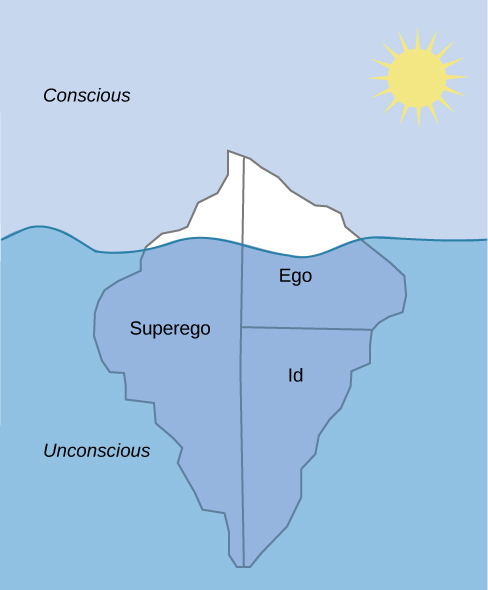
To explain the concept of conscious versus unconscious experience, Freud compared the mind to an iceberg (Figure 11.5). He said that only about one-tenth of our mind is conscious, and the rest of our mind is unconscious. Our unconscious refers to that mental activity of which we are unaware and are unable to access (Freud, 1923). According to Freud, unacceptable urges and desires are kept in our unconscious through a process called repression. For example, we sometimes say things that we don’t intend to say by unintentionally substituting another word for the one we meant. You’ve probably heard of a Freudian slip, the term used to describe this. Freud suggested that slips of the tongue are actually sexual or aggressive urges, accidentally slipping out of our unconscious. Speech errors such as this are quite common. Seeing them as a reflection of unconscious desires, linguists today have found that slips of the tongue tend to occur when we are tired, nervous, or not at our optimal level of cognitive functioning (Motley, 2002).
Figure 11.5 — 11.2 Freud and the Psychodynamic Perspective
Figure 11.5 Freud believed that we are only aware of a small amount of our mind’s activities and that most of it remains hidden from us in our unconscious. The information in our unconscious affects our behavior, although we are unaware of it.
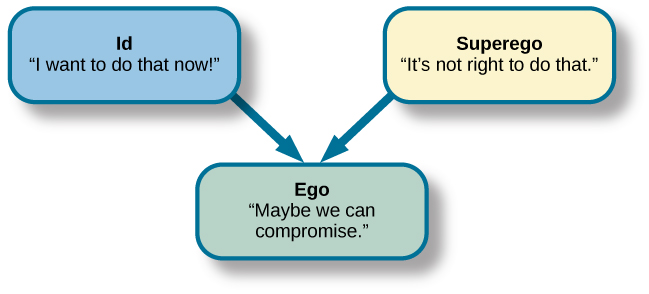
According to Freud, our personality develops from a conflict between two forces: our biological aggressive and pleasure-seeking drives versus our internal (socialized) control over these drives. Our personality is the result of our efforts to balance these two competing forces. Freud suggested that we can understand this by imagining three interacting systems within our minds. He called them the id, ego, and superego (Figure 11.6).
Figure 11.6 — 11.2 Freud and the Psychodynamic Perspective
Figure 11.6 The job of the ego, or self, is to balance the aggressive/pleasure-seeking drives of the id with the moral control of the superego.
The unconscious id contains our most primitive drives or urges, and is present from birth. It directs impulses for hunger, thirst, and sex. Freud believed that the id operates on what he called the “pleasure principle,” in which the id seeks immediate gratification. Through social interactions with parents and others in a child’s environment, the ego and superego develop to help control the id. The superego develops as a child interacts with others, learning the social rules for right and wrong. The superego acts as our conscience; it is our moral compass that tells us how we should behave. It strives for perfection and judges our behavior, leading to feelings of pride or—when we fall short of the ideal—feelings of guilt. In contrast to the instinctual id and the rule-based superego, the ego is the rational part of our personality. It’s what Freud considered to be the self, and it is the part of our personality that is seen by others. Its job is to balance the demands of the id and superego in the context of reality; thus, it operates on what Freud called the “reality principle.” The ego helps the id satisfy its desires in a realistic way.
The id and superego are in constant conflict, because the id wants instant gratification regardless of the consequences, but the superego tells us that we must behave in socially acceptable ways. Thus, the ego’s job is to find the middle ground. It helps satisfy the id’s desires in a rational way that will not lead us to feelings of guilt. According to Freud, a person who has a strong ego, which can balance the demands of the id and the superego, has a healthy personality. Freud maintained that imbalances in the system can lead to neurosis (a tendency to experience negative emotions), anxiety disorders, or unhealthy behaviors. For example, a person who is dominated by their id might be narcissistic and impulsive. A person with a dominant superego might be controlled by feelings of guilt and deny themselves even socially acceptable pleasures; conversely, if the superego is weak or absent, a person might become a psychopath. An overly dominant superego might be seen in an over-controlled individual whose rational grasp on reality is so strong that they are unaware of their emotional needs, or, in a neurotic who is overly defensive (overusing ego defense mechanisms).
Defense Mechanisms
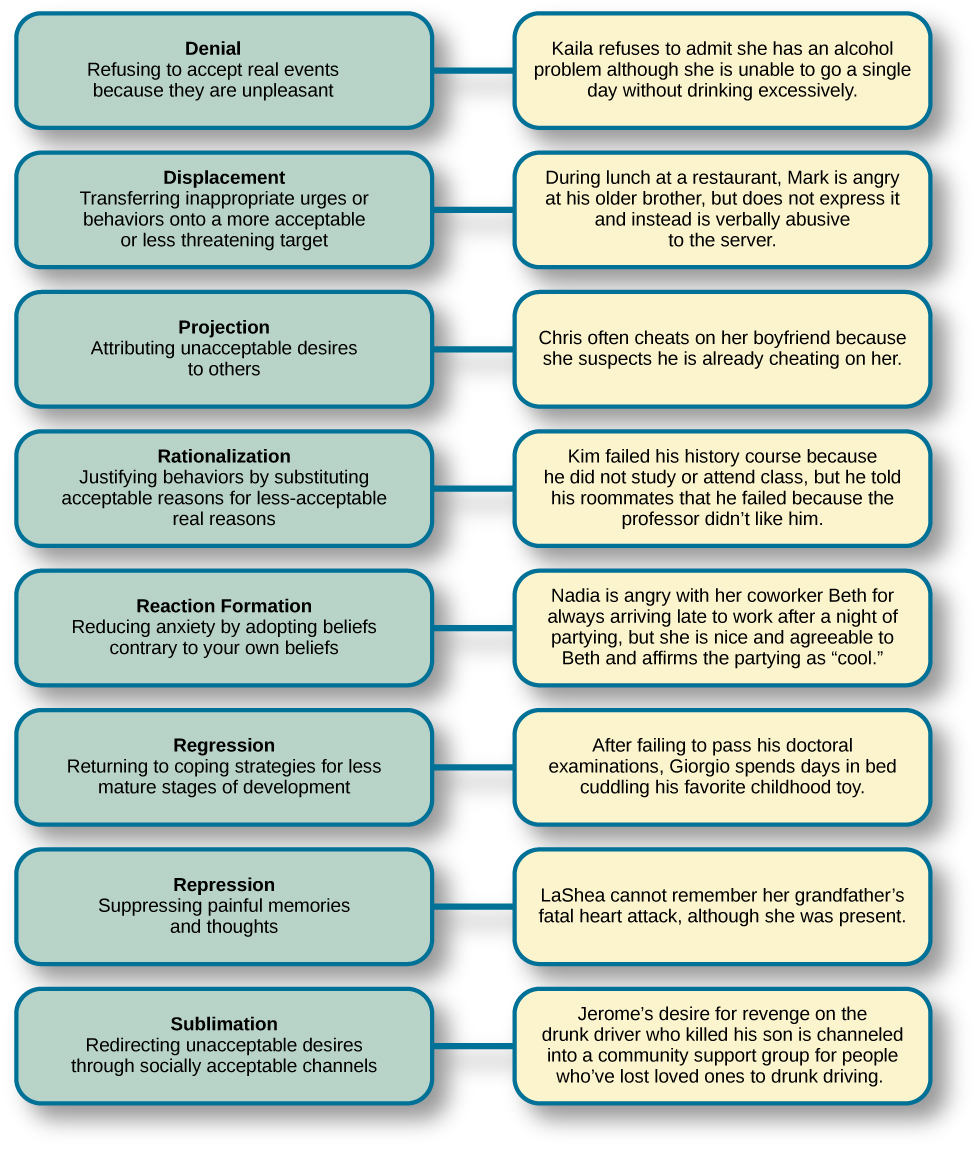
Freud believed that feelings of anxiety result from the ego’s inability to mediate the conflict between the id and superego. When this happens, Freud believed that the ego seeks to restore balance through various protective measures known as defense mechanisms (Figure 11.7). When certain events, feelings, or yearnings cause an individual anxiety, the individual wishes to reduce that anxiety. To do that, the individual’s unconscious mind uses ego defense mechanisms, unconscious protective behaviors that aim to reduce anxiety. The ego, usually conscious, resorts to unconscious strivings to protect the ego from being overwhelmed by anxiety. When we use defense mechanisms, we are unaware that we are using them. Further, they operate in various ways that distort reality. According to Freud, we all use ego defense mechanisms.
Figure 11.7 — 11.2 Freud and the Psychodynamic Perspective
Figure 11.7 Defense mechanisms are unconscious protective behaviors that work to reduce anxiety.
While everyone uses defense mechanisms, Freud believed that overuse of them may be problematic. For example, let’s say Joe is a high school football player. Deep down, Joe feels sexually attracted to males. His conscious belief is that being gay is immoral and that if he were gay, his family would disown him and he would be ostracized by his peers. Therefore, there is a conflict between his conscious beliefs (being gay is wrong and will result in being ostracized) and his unconscious urges (attraction to males). The idea that he might be gay causes Joe to have feelings of anxiety. How can he decrease his anxiety? Joe may find himself acting very “macho,” making gay jokes, and picking on a school peer who is gay. This way, Joe’s unconscious impulses are further submerged.
There are several different types of defense mechanisms. For instance, in repression, anxiety-causing memories from consciousness are blocked. As an analogy, let’s say your car is making a strange noise, but because you do not have the money to get it fixed, you just turn up the radio so that you no longer hear the strange noise. Eventually you forget about it. Similarly, in the human psyche, if a memory is too overwhelming to deal with, it might be repressed and thus removed from conscious awareness (Freud, 1920). This repressed memory might cause symptoms in other areas.
Another defense mechanism is reaction formation, in which someone expresses feelings, thoughts, and behaviors opposite to their inclinations. In the above example, Joe made fun of a gay peer while himself being attracted to males. In regression, an individual acts much younger than their age. For example, a four-year-old child who resents the arrival of a newborn sibling may act like a baby and revert to drinking out of a bottle. In projection, a person refuses to acknowledge her own unconscious feelings and instead sees those feelings in someone else. Other defense mechanisms include rationalization, displacement, and sublimation.
Freud believed that personality develops during early childhood: Childhood experiences shape our personalities as well as our behavior as adults. He asserted that we develop via a series of stages during childhood. Each of us must pass through these childhood stages, and if we do not have the proper nurturing and parenting during a stage, we will be stuck, or fixated, in that stage, even as adults.
In each psychosexual stage of development, the child’s pleasure-seeking urges, coming from the id, are focused on a different area of the body, called an erogenous zone. The stages are oral, anal, phallic, latency, and genital (Table 11.1).
Freud’s psychosexual development theory is quite controversial. To understand the origins of the theory, it is helpful to be familiar with the political, social, and cultural influences of Freud’s day in Vienna at the turn of the 20th century. During this era, a climate of sexual repression, combined with limited understanding and education surrounding human sexuality, heavily influenced Freud’s perspective. Given that sex was a taboo topic, Freud assumed that negative emotional states (neuroses) stemmed from suppression of unconscious sexual and aggressive urges. For Freud, his own recollections and interpretations of patients’ experiences and dreams were sufficient proof that psychosexual stages were universal events in early childhood.
Freud’s Stages of Psychosexual Development
Stage
Age (years)
Erogenous Zone
Major Conflict
Adult Fixation Example
Oral
0–1
Mouth
Weaning off breast or bottle
Smoking, overeating
Anal
1–3
Anus
Toilet training
Neatness, messiness
Phallic
3–6
Genitals
Oedipus/Electra complex
Vanity, overambition
Latency
6–12
None
None
None
Genital
12+
Genitals
None
None
Table
11.1
Oral Stage
In the oral stage (birth to 1 year), pleasure is focused on the mouth. Eating and the pleasure derived from sucking (nipples, pacifiers, and thumbs) play a large part in a baby’s first year of life. At around 1 year of age, babies are weaned from the bottle or breast, and this process can create conflict if not handled properly by caregivers. According to Freud, an adult who smokes, drinks, overeats, or bites her nails is fixated in the oral stage of her psychosexual development; she may have been weaned too early or too late, resulting in these fixation tendencies, all of which seek to ease anxiety.
Anal Stage
After passing through the oral stage, children enter what Freud termed the anal stage (1–3 years). In this stage, children experience pleasure in their bowel and bladder movements, so it makes sense that the conflict in this stage is over toilet training. During this stage of development, children work to master control of themselves. Freud suggested that success at the anal stage depended on how parents handled toilet training. Parents who offer praise and rewards encourage positive results and can help children feel competent. Parents who are harsh in toilet training can cause a child to become so fearful of soiling that they over-control and become fixated at the anal stage, leading to the development of an anal-retentive personality. The anal-retentive personality is stingy and stubborn, has a compulsive need for order and neatness, and might be considered a perfectionist. If parents are too lenient in toilet training, the child may fail to develop sufficient self-control, become fixated at this stage, and develop an anal-expulsive personality. The anal-expulsive personality is messy, careless, disorganized, and prone to emotional outbursts.
Phallic Stage
Freud’s third stage of psychosexual development is the phallic stage (3–6 years), corresponding to the age when children become aware of their bodies and recognize the differences between boys and girls. The erogenous zone in this stage is the genitals. Conflict arises when the child feels a desire for the opposite-sex parent, and jealousy and hatred toward the same-sex parent. For boys, this is called the Oedipus complex, involving a boy's desire for his mother and his urge to replace his father who is seen as a rival for the mother’s attention. The Oedipus complex is named for the Greek myth of Oedipus, who unwittingly kills his biological father and marries his biological mother. According to Freud, the boy is afraid his father will punish him for his feelings, so he experiences castration anxiety. The Oedipus complex is successfully resolved when the boy begins to identify with his father as an indirect way to have the mother. Failure to resolve the Oedipus complex may result in fixation and development of a personality that might be described as vain and overly ambitious.
Freud described penis envy, which he alleged girls experience because they do not have a penis. Girls also experience the Electra complex. The Electra complex, while often attributed to Freud, was actually proposed by Freud’s protégé, Carl Jung (Jung & Kerenyi, 1963). A girl desires the attention of her father and wishes to take her mother’s place. While Freud initially embraced the Electra complex as a parallel to the Oedipus complex, he later rejected it, yet it remains as a cornerstone of Freudian theory, thanks in part to academics in the field (Freud, 1931/1968; Scott, 2005).
Latency Period
Following the phallic stage of psychosexual development is a period known as the latency period (6 years to puberty). This period is not considered a stage, because sexual feelings are dormant as children focus on other pursuits, such as school, friendships, hobbies, and sports. Children generally engage in activities with peers of the same sex, which serves to consolidate a child’s gender-role identity.
Genital Stage
The final stage is the genital stage (from puberty on). In this stage, there is a sexual reawakening as the incestuous urges resurface. The young person redirects these urges to other, more socially acceptable partners (who often resemble the other-sex parent). People in this stage have mature sexual interests, which for Freud meant a strong desire for the opposite sex. Individuals who successfully completed the previous stages, reaching the genital stage with no fixations, are said to be well-balanced, healthy adults.
While most of Freud’s ideas have not found support in modern research, and several contemporary researchers rejected his premises, we cannot discount the contributions that Freud has made to the field of psychology. It was Freud who pointed out that a large part of our mental life is influenced by the experiences of early childhood and takes place outside of our conscious awareness; his theories paved the way for others.
While Freud's focus on biological drives led him to emphasize the impact of sociocultural factors on personality development, his followers quickly realized that biology alone could not account for the diversity they encountered as the practice of psychoanalysis spread during the time of the Nazi Holocaust. The antisemitism which was prevalent during this period of time may have led mainstream psychoanalysts to focus primarily on the universality of the psychological structures of the mind.
5.1 Theories of Self-Development
OpenStax · 5.1 Theories of Self-Development ↗ Instructional page including learning objectives, examples, figures, source tables and questions. Site navigation and embedded media players are omitted; source media links remain available.
Learning Objectives
By the end of this section, you should be able to:
Differentiate psychological and sociological theories of self-development
Explain the process of moral development
When we are born, we have a genetic makeup and biological traits. However, who we are as human beings develops through social interaction. Many scholars, both in the fields of psychology and in sociology, have described the process of self-development as a precursor to understanding how that “self” becomes socialized.
Psychological Perspectives on Self-Development
Psychoanalyst Sigmund Freud (1856–1939) was one of the most influential modern scientists to put forth a theory about how people develop a sense of self. He divided the maturation process into stages, and posited that people’s self-development is closely linked to their early stages of development.
According to Freud, failure to properly engage in or disengage from a specific stage results in emotional and psychological consequences throughout adulthood.
Psychologist Erik Erikson (1902–1994) created a theory of personality development based, in part, on the work of Freud. However, Erikson believed the personality continued to change over time and was never truly finished. His theory includes eight stages of development, beginning with birth and ending with death. According to Erikson, people move through these stages throughout their lives. In contrast to Freud’s focus on psychosexual stages and basic human urges, Erikson’s view of self-development gave credit to more social aspects, like the way we negotiate between our own base desires and what is socially accepted (Erikson 1982).
Jean Piaget (1896–1980) was a psychologist who focused on the role of social interactions in child development. He recognized that the development of self evolved through a negotiation between the world as it exists in one’s mind and the world that exists as it is experienced socially (Piaget 1954). All three of these thinkers have contributed to our modern understanding of self-development.
Psychologist Harry Harlow (1905–1981) is known for studying the role of social relationships in human development by observing the impact of isolation and maternal deprivation on the development of young rhesus monkeys. Harlow found that the monkeys, when subjected to isolation, exhibit disturbed behaviors, including self-harm, and had a difficult time integrating when reconnected with other monkeys. Harlow also introduced isolated monkeys to simulated surrogate mothers, some that were covered in cloth while others were constructed out of wire. Based on observed behaviors, the young monkeys appeared to develop attachment with the cloth mothers and lean on them for emotional support. More than seven decades later, this experiment continues to inform the research of psychologists, sociologists, and those interested in human development.
Sociological Research
Sociology or Psychology: What’s the Difference?
You might be wondering: if sociologists and psychologists are both interested in people and their behavior, how are these two disciplines different? What do they agree on, and where do their ideas diverge? The answers are complicated, but the distinction is important to scholars in both fields.
As a general difference, we might say that while both disciplines are interested in human behavior, psychologists are focused on how the mind influences that behavior, while sociologists study the role of society in shaping behavior. Psychologists are interested in people’s mental development and how their minds process their world. Sociologists are more likely to focus on how different aspects of society contribute to an individual’s relationship with his world. Another way to think of the difference is that psychologists tend to look inward (mental health, emotional processes), while sociologists tend to look outward (social institutions, cultural norms, interactions with others) to understand human behavior.
Émile Durkheim (1858–1917) was the first to make this distinction in research, when he attributed differences in suicide rates among people to social causes (religious differences) rather than to psychological causes (like their mental wellbeing) (Durkheim 1897). Today, we see this same distinction. For example, a sociologist studying how a couple gets to the point of their first kiss on a date might focus her research on cultural norms for dating, social patterns of sexual activity over time, or how this process is different for seniors than for teens. A psychologist would more likely be interested in the person’s earliest sexual awareness or the mental processing of sexual desire.
Sometimes sociologists and psychologists have collaborated to increase knowledge. In recent decades, however, their fields have become more clearly separated as sociologists increasingly focus on large societal issues and patterns, while psychologists remain honed in on the human mind. Both disciplines make valuable contributions through different approaches that provide us with different types of useful insights.
Sociological Theories of Self-Development
One of the pioneering contributors to sociological perspectives was Charles Cooley (1864–1929). He asserted that people’s self understanding is constructed, in part, by their perception of how others view them—a process termed “the looking glass self” (Cooley 1902).
Later, George Herbert Mead (1863–1931) studied the self, a person’s distinct identity that is developed through social interaction. In order to engage in this process of “self,” an individual has to be able to view him or herself through the eyes of others. That’s not an ability that we are born with (Mead 1934). Through socialization we learn to put ourselves in someone else's shoes and look at the world through their perspective. This assists us in becoming self-aware, as we look at ourselves from the perspective of the "other."
How do we go from being newborns to being humans with “selves?” Mead believed that there is a specific path of development that all people go through. During the preparatory stage, children are only capable of imitation: they have no ability to imagine how others see things. They copy the actions of people with whom they regularly interact, such as their caregivers. This is followed by the play stage, during which children begin to take on the role that one other person might have. Thus, children might try on a parent’s point of view by acting out “grownup” behavior, like playing dress-up and acting out the “mom” role, or talking on a toy telephone the way they see adults do.
During the game stage, children learn to consider several roles at the same time and how those roles interact with each other. They learn to understand interactions involving different people with a variety of purposes. For example, a child at this stage is likely to be aware of the different responsibilities of people in a restaurant who together make for a smooth dining experience (someone seats you, another takes your order, someone else cooks the food, while yet another clears away dirty dishes).
Finally, children develop, understand, and learn the idea of the generalized other, the common behavioral expectations of general society. By this stage of development, an individual is able to imagine how he or she is viewed by one or many others—and thus, from a sociological perspective, to have a “self” (Mead 1934; Mead 1964).
Kohlberg’s Theory of Moral Development
Moral development is an important part of the socialization process. The term refers to the way people learn what society considers to be “good” and “bad,” which is important for a smoothly functioning society. Moral development prevents people from acting on unchecked urges, instead considering what is right for society and good for others. Lawrence Kohlberg (1927–1987) was interested in how people learn to decide what is right and what is wrong. To understand this topic, he developed a theory of moral development that includes three levels: preconventional, conventional, and postconventional.
In the preconventional stage, young children, who lack a higher level of cognitive ability, experience the world around them only through their senses. It isn’t until the teen years that the conventional theory develops, when youngsters become increasingly aware of others’ feelings and take those into consideration when determining what’s “good” and “bad.” The final stage, called postconventional, is when people begin to think of morality in abstract terms, such as Americans believing that everyone has the right to life, liberty, and the pursuit of happiness. At this stage, people also recognize that legality and morality do not always match up evenly (Kohlberg 1981). When hundreds of thousands of Egyptians turned out in 2011 to protest government corruption, they were using postconventional morality. They understood that although their government was legal, it was not morally correct.
Gilligan’s Theory of Moral Development and Gender
Another sociologist, Carol Gilligan (1936–), recognized that Kohlberg’s theory might show gender bias since his research was only conducted on male subjects. Would females study subjects have responded differently? Would a female social scientist notice different patterns when analyzing the research? To answer the first question, she set out to study differences between how boys and girls developed morality. Gilligan’s research suggested that boys and girls do have different understandings of morality. Boys appeared to have a justice perspective, by placing emphasis on rules and laws. Girls, on the other hand, seem to have a care and responsibility perspective; they consider people’s reasons behind behavior that seems morally wrong.
While Gilligan is correct that Kohlberg’s research should have included both male and female subjects, her study has been scientifically discredited due to its small sample size. The results Gilligan noted in this study also have not been replicated by subsequent researchers. The differences Gilligan observed were not an issue of the development of morality, but an issue of socialization. Differences in behavior between males and females is the result of gender socialization that teaches boys and girls societal norms and behaviors expected of them based on their sex (see “What a Pretty Little Lady”).
Gilligan also recognized that Kohlberg’s theory rested on the assumption that the justice perspective was the right, or better, perspective. Gilligan, in contrast, theorized that neither perspective was “better”: the two norms of justice served different purposes. Ultimately, she explained that boys are socialized for a work environment where rules make operations run smoothly, while girls are socialized for a home environment where flexibility allows for harmony in caretaking and nurturing (Gilligan 1982; Gilligan 1990).
Sociology in the Real World
What a Pretty Little Lady!
“What a cute dress!” “I like the ribbons in your hair.” “Wow, you look so pretty today.”
According to Lisa Bloom, author of Think: Straight Talk for Women to Stay Smart in a Dumbed Down World, most of us use pleasantries like these when we first meet little girls. “So what?” you might ask.
Bloom asserts that we are too focused on the appearance of young girls, and as a result, our society is socializing them to believe that how they look is of vital importance. And Bloom may be on to something. How often do you tell a little boy how attractive his outfit is, how nice looking his shoes are, or how handsome he looks today? To support her assertions, Bloom cites, as one example, that about 50 percent of girls ages three to six worry about being fat (Bloom 2011). We’re talking about kindergarteners who are concerned about their body image. Sociologists are acutely interested in of this type of gender socialization, by which societal expectations of how boys and girls should be—how they should behave, what toys and colors they should like, and how important their attire is—are reinforced.
One solution to this type of gender socialization is being experimented with at the Egalia preschool in Sweden, where children develop in a genderless environment. All the children at Egalia are referred to with neutral terms like “friend” instead of “he” or “she.” Play areas and toys are consciously set up to eliminate any reinforcement of gender expectations (Haney 2011). Egalia strives to eliminate all societal gender norms from these children’s preschool world.
Extreme? Perhaps. So what is the middle ground? Bloom suggests that we start with simple steps: when introduced to a young girl, ask about her favorite book or what she likes. In short, engage with her mind … not her outward appearance (Bloom 2011).
5.4 Socialization Across the Life Course
OpenStax · 5.4 Socialization Across the Life Course ↗ Instructional page including learning objectives, examples, figures, source tables and questions. Site navigation and embedded media players are omitted; source media links remain available.
Learning Objectives
By the end of this section, you should be able to:
Explain how socialization occurs and recurs throughout life
Apply socialization to age-related transition points
Socialization isn’t a one-time or even a short-term event. We aren’t “stamped” by some socialization machine as we move along a conveyor belt and thereby socialized once and for all. In fact, socialization is a lifelong process.
In the United States, socialization throughout the life course is determined greatly by age norms and “time-related rules and regulations” (Settersten 2002). As we grow older, we encounter age-related transition points that require socialization into a new role, such as becoming school age, entering the workforce, or retiring. For example, the U.S. government mandates that all children attend school. Child labor laws, enacted in the early twentieth century, nationally declared that childhood be a time of learning, not of labor. In countries such as Niger and Sierra Leone, however, child labor remains common and socially acceptable, with little legislation to regulate such practices (UNICEF 2012).
Big Picture
Life After High School Around the World
In the United States, recent high school graduates have increasingly been focusing on college attendance. In recent years, about two-thirds of high school graduates are enrolled in college between their teen years and age twenty-four. About one-third of the same population primarly participates in the work force, meaning that they are employed or are looking for employment (Bureau of Labor Statistics 2020). Of those who attend college, most (about 69 percent) are considered immediate enrollers, meaning that they begin college in the first fall academic term immediately after their high school graduation (NCES 2020).
Other countries, especially high-income nations in Western Europe, have similar trends in college education, but fewer students start immediately. Gap years, overseas experiences, or mandatory wait times all lead students to a wide array of pre-college destinations. In Denmark, for example numbers of students who take a "year out" are so high that the government has sought to give students cash bonuses for attending immediately (Anderson 2009). For several decades, only about 25 percent of Denmark's high school graduates enrolled in college right away, and that number continued to drop in the 2010s, with a record low of only 15 percent in 2018 (Ritzau 2019). Compare that to the U.S. numbers mentioned above, where over two thirds of the students enroll in college immediately. And note that in Denmark, college is almost universally free.
In the United States, this life transition point is socialized quite differently. Taking a year off is much less common than in some other countries, but has certainly picked up in recent years. In most cases, U.S. youth are encouraged to select a few target colleges or potential workforce options by their late teens, and to get started on those pathways soon after high school. As mentioned above, many U.S. students do not attend college, but most of those students are in the workforce (including the military).
Other nations have entirely different approaches based on available educational institutions, financial circumstances, and family needs. In some nations, students often go to college soon after high school, but do so in other countries (including the U.S.). Dozens of nations require military conscription—military service—for men, and a few (such as Sweden, Israel, Norway, Eritrea, and Venezuela) for women as well.
How might your life be different if you lived in one of these other countries? Can you think of similar social norms—related to life age-transition points—that vary from country to country?
Many of life’s social expectations are made clear and enforced on a cultural level. Through interacting with others and watching others interact, the expectation to fulfill roles becomes clear. While in elementary or middle school, the prospect of having a boyfriend or girlfriend may have been considered undesirable. The socialization that takes place in high school changes the expectation. By observing the excitement and importance attached to dating and relationships within the high school social scene, it quickly becomes apparent that one is now expected not only to be a child and a student, but also a significant other. Graduation from formal education—high school, vocational school, or college—involves socialization into a new set of expectations.
Educational expectations vary not only from culture to culture, but also from class to class. While middle- or upper-class families may expect their daughter or son to attend a four-year university after graduating from high school, other families may expect their child to immediately begin working full-time, as many within their family have done before.
Sociology in the Real World
The Long Road to Adulthood for Millennials
Socialization differences also vary by generation. As you will see in the chapter on Aging and the Elderly, Millennials (those born from the early 1980's to the middle 1990's) have very different attitudes about when childhood ends, the prime of life begins, and when people become "old." (Preview: Millennials thought childhood ended later and people became old earlier than did Baby Boomers and Gen Xers at the same age.)
Millennials were deeply affected by the financial Recession in 2008. While the recession was in full swing, many were in the process of entering, attending, or graduating from high school and college. With employment prospects at historic lows, large numbers of graduates were unable to find work, sometimes moving back in with their parents and struggling to pay back student loans.
According to the New York Times, this economic stall caused the Millennials to postpone what most Americans consider to be adulthood: “The traditional cycle seems to have gone off course, as young people remain untethered to romantic partners or to permanent homes, going back to school for lack of better options, traveling, avoiding commitments, competing ferociously for unpaid internships or temporary (and often grueling) Teach for America jobs, forestalling the beginning of adult life” (Henig 2010). The term Boomerang Generation describes recent college graduates, for whom lack of adequate employment upon college graduation often leads to a return to the parental home (Davidson, 2014).
The five milestones that define adulthood, Henig writes, are “completing school, leaving home, becoming financially independent, marrying, and having a child” (Henig 2010). These social milestones are taking longer for Millennials to attain, if they’re attained at all. Sociologists wonder what long-term impact this generation’s situation may have on society as a whole.
In the process of socialization, adulthood brings a new set of challenges and expectations, as well as new roles to fill. As the aging process moves forward, social roles continue to evolve. Pleasures of youth, such as wild nights out and serial dating, become less acceptable in the eyes of society. Responsibility and commitment are emphasized as pillars of adulthood, and men and women are expected to “settle down.” During this period, many people enter into marriage or a civil union, bring children into their families, and focus on a career path. They become partners or parents instead of students or significant others.
Just as young children pretend to be doctors or lawyers, play house, and dress up, adults also engage in anticipatory socialization, the preparation for future life roles. Examples would include a couple who cohabitate before marriage or soon-to-be parents who read infant care books and prepare their home for the new arrival. As part of anticipatory socialization, adults who are financially able begin planning for their retirement, saving money, and looking into future healthcare options. The transition into any new life role, despite the social structure that supports it, can be difficult.
About a decade after the nation began to recover from the Recession, it was hit by another. Millennials, who had entered a very challenging employment situation, were saddled with debt and had very little in savings. By July 2020, the Millennial unemployment rate was 11.5 percent, which was actually higher than their unemployment rate during the 2008 Recession. Gen Z, the group of people born after the Millennials, fared even worse—with an 18 percent unemployment rate (Hoffower 2020). The cycle of financial insecurity and the potential socialization impacts may happen again in this decade.
In the process of resocialization, old behaviors that were helpful in a previous role are removed because they are no longer of use. Resocialization is necessary when a person moves to a senior care center, goes to boarding school, or serves a sentence in the prison system. In the new environment, the old rules no longer apply. The process of resocialization is typically more stressful than normal socialization because people have to unlearn behaviors that have become customary to them. While resocialization has a specific meaning, many organizations consider their training or retraining processes to embody elements of resocialization.
The most common way resocialization occurs is in a total institution where people are isolated from society and are forced to follow someone else’s rules. A ship at sea is a total institution, as are religious convents, prisons, or some cult organizations. They are places cut off from a larger society. The 2.2 million Americans who lived in prisons and penitentiaries at the end of 2012 are also members of this type of institution (U.S. Department of Justice 2012).
Many individuals are resocialized into an institution through a two-part process. First, members entering an institution must leave behind their old identity through what is known as a degradation ceremony. In a degradation ceremony, new members lose the aspects of their old identity and are given new identities. The process is sometimes gentle. To enter a senior care home, an elderly person often must leave a family home and give up many belongings which were part of his or her long-standing identity. Though caretakers guide the elderly compassionately, the process can still be one of loss. In many cults, this process is also gentle and happens in an environment of support and caring.
In other situations, the degradation ceremony can be more extreme. New prisoners lose freedom, rights (including the right to privacy), and personal belongings. When entering the military, soldiers have their hair cut short. Their old clothes are removed, and they wear matching uniforms. These individuals must give up any markers of their former identity in order to be resocialized into an identity as a “soldier.”
Figure 5.8 — 5.4 Socialization Across the Life Course
Figure 5.8 In basic training, members of the Air Force are taught to walk, move, and look like each other. (Credit: Staff Sergeant Desiree N. Palacios, U.S. Air Force/Wikimedia Commons)
After new members of an institution are stripped of their old identity, they build a new one that matches the new society. In the military, soldiers go through basic training together, where they learn new rules and bond with one another. They follow structured schedules set by their leaders. Soldiers must keep their areas clean for inspection, learn to march in correct formations, and salute when in the presence of superiors.
Learning to deal with life after having lived in a total institution requires yet another process of resocialization. In the U.S. military, soldiers learn discipline and a capacity for hard work. They set aside personal goals to achieve a mission, and they take pride in the accomplishments of their units. Many soldiers who leave the military transition these skills into excellent careers. Others have significant challenges upon leaving, uncertain about the outside world and what to do next. The process of resocialization to civilian life is not a simple one.
Other types of organizations may utilize or extend the concept of resocialization with regard to changing people's behaviors. Corporate trainers (and training researchers) sometimes emphasize the need for trainees to shed their old behaviors and adopt entirely new ones. When the people return to their jobs after training, they may be called to leave their old behaviors behind. Similarly, if an entire team goes for training, they may be called to leave their culture behind (Weinbauer-Heidel 2019). Not all such training would apply the resocialization metaphor, but behavioral or personal-professional areas such as stress management or priority/project management might borrow from resocialization principles in order to make the training effective.
12.1 Sex, Gender, Identity, and Expression
OpenStax · 12.1 Sex, Gender, Identity, and Expression ↗ Instructional page including learning objectives, examples, figures, source tables and questions. Site navigation and embedded media players are omitted; source media links remain available.
Learning Objectives
By the end of this section, you should be able to:
Distinguish the meanings of different sexual orientations, gender identities, and gender expressions
Figure 12.2 — 12.1 Sex, Gender, Identity, and Expression
Figure 12.2 While the biological differences between males and females are fairly straightforward, the social and cultural aspects of being a man or woman can be complicated. (Credit: Mapbox Uncharted ERG /flickr)
When filling out a document such as a job application or school registration form, you are often asked to provide your name, address, phone number, birth date, and sex or gender. But have you ever been asked to provide your sex and your gender? Like most people, you may not have realized that sex and gender are not the same. However, sociologists and most other social scientists view them as conceptually distinct. Sex refers to physical or physiological differences between males and females, including both primary sex characteristics (the reproductive system) and secondary characteristics such as height and muscularity. Gender refers to behaviors, personal traits, and social positions that society attributes to being female or male.
A person’s sex, as determined by their biology, does not always correspond with their gender. Therefore, the terms sex and gender are not interchangeable. A baby who is born with male genitalia will most likely be identified as male. As a child or adult, however, they may identify with the feminine aspects of culture. Since the term sex refers to biological or physical distinctions, characteristics of sex will not vary significantly between different human societies. Generally, persons of the female sex, regardless of culture, will eventually menstruate and develop breasts that can lactate. Characteristics of gender, on the other hand, may vary greatly between different societies. For example, in U.S. culture, it is considered feminine (or a trait of the female gender) to wear a dress or skirt. However, in many Middle Eastern, Asian, and African cultures, sarongs, robes, or gowns are considered masculine. The kilt worn by a Scottish man does not make him appear feminine in that culture.
The dichotomous or binary view of gender (the notion that someone is either male or female) is specific to certain cultures and is not universal. In some cultures gender is viewed as fluid. In the past, some anthropologists used the term berdache to refer to individuals who occasionally or permanently dressed and lived as a different gender. The practice has been noted among certain Native American tribes (Jacobs, Thomas, and Lang 1997). Samoan culture accepts what Samoans refer to as a “third gender.” Fa’afafine, which translates as “the way of the woman,” is a term used to describe individuals who are born biologically male but embody both masculine and feminine traits. Fa’afafines are considered an important part of Samoan culture. Individuals from other cultures may mislabel their sexuality because fa’afafines have a varied sexual life that may include men and women (Poasa 1992).
Social Policy and Debate
The Legalese of Sex and Gender
The terms sex and gender have not always been differentiated in the English language. It was not until the 1950s that U.S. and British psychologists and other professionals formally began distinguishing between sex and gender. Since then, professionals have increasingly used the term gender (Moi 2005). By the end of the twenty-first century, expanding the proper usage of the term gender to everyday language became more challenging—particularly where legal language is concerned. In an effort to clarify usage of the terms sex and gender, U.S. Supreme Court Justice Antonin Scalia wrote in a 1994 briefing, “The word gender has acquired the new and useful connotation of cultural or attitudinal characteristics (as opposed to physical characteristics) distinctive to the sexes. That is to say, gender is to sex as feminine is to female and masculine is to male” (J.E.B. v. Alabama, 144 S. Ct. 1436 [1994]). Supreme Court Justice Ruth Bader Ginsburg had a different take, however. She freely swapped them in her briefings so as to avoid having the word “sex” pop up too often. Ginsburg decided on this approach earlier in her career while she was arguing before the Supreme Court; her Columbia Law School secretary suggested it to Ginsburg, saying that when “those nine men” (the Supreme Court justices), “hear that word and their first association is not the way you want them to be thinking” (Block 2020).
More recently, the word “sex” was a key element of the landmark Supreme Court case affirming that the Civil Rights Act's workplace protections applied to LGBTQ people. Throughout the case documents and discussions, the term and its meanings are discussed extensively. In his decision statement, Justice Neil Gorsuch wrote, “It is impossible to discriminate against a person for being homosexual or transgender without discriminating ... based on sex” (Supreme Court 2020). Dissenting justices and commentators felt that Gorsuch and the other justices in the majority were recalibrating the original usage of the term. The arguments about the language itself, which occupy much of the Court's writings on the matter, are further evidence of the evolving nature of the words, as well as their significance.
A person's sexuality is their capacity to experience sexual feelings and attraction. Studying sexual attitudes and practices is a particularly interesting field of sociology because sexual behavior and attitudes about sexual behavior have cultural and societal influences and impacts. As you will see in the Relationships, Marriage, and Family chapter, each society interprets sexuality and sexual activity in different ways, with different attitudes about premarital sex, the age of sexual consent, homosexuality, masturbation, and other sexual behaviors (Widmer 1998).
A person’s sexual orientation is their physical, mental, emotional, and sexual attraction to a particular sex (male and/or female). Sexual orientation is typically divided into several categories: heterosexuality, the attraction to individuals of the other sex; homosexuality, the attraction to individuals of the same sex; bisexuality, the attraction to individuals of either sex; asexuality, a lack of sexual attraction or desire for sexual contact; pansexuality, an attraction to people regardless of sex, gender, gender identity, or gender expression; omnisexuality, an attraction to people of all sexes, genders, gender identities, and gender expressions that considers the person's gender, and queer, an umbrella term used to describe sexual orientation, gender identity or gender expression. Other categories may not refer to a sexual attraction, but rather a romantic one. For example, an aromantic person does not experience romantic attraction; this is different from asexuality, which refers to a lack of sexual attraction. And some sexual orientations do not refer to gender in their description, though those who identify as having that orientation may feel attraction to a certain gender. For example, demisexual refers to someone who feels a sexual attraction to someone only after they form an emotional bond; the term itself doesn't distinguish among gender identities, but the person may feel attraction based on gender (PFLAG 2021). It is important to acknowledge and understand that many of these orientations exist on a spectrum, and there may be no specific term to describe how an individual feels. Some terms have been developed to address this—such as graysexual or grayromantic—but their usage is a personal choice (Asexual Visibility and Education Network 2021).
People who are attracted to others of a different gender are typically referred to as "straight," and people attracted to others of the same gender are typically referred to as "gay" for men and "lesbian" for women. As discussed, above, however, there are many more sexual and romantic orientations, so the term "gay," for example, should not be used to describe all of them. Proper terminology includes the acronyms LGBT and LGBTQ, which stands for “Lesbian, Gay, Bisexual, Transgender” (and “Queer” or “Questioning” when the Q is added). In other cases, people and organizations may add "I" to represent Intersex people (described below), and "A" for Asexual or Aromantic people (or sometimes for "Allies"), as well as one "P" to describe Pansexual people and sometimes another "P" to describe Polysexual people. Finally, some people and organizations add a plus sign (+) to represent other possible identities or orientations. Sexuality and gender terminology are constantly changing, and may mean different things to different people; they are not universal, and each individual defines them for themselves (UC Davis LGBTQIA Resource Center 2020). Finally, a person who does not fully understand all of these terms can still be supportive of people who have those orientations or others; in fact, advocacy and support organizations indicate it is much better to admit you don't know something than to make assumptions or apply an incorrect label to someone (GLAAD 2021).
While the descriptions above are evidence of a vast degree of diversity, the United States and many other countries are heteronormative societies, meaning many people assume heterosexual orientation is biologically determined and is the default or normal type of orientation. While awareness and acceptance of different sexual orientations and identities seems to be increasing, the influence of a heteronormative society can lead LGBTQ people to be treated like "others," even by people who do not deliberately seek to cause them harm. This can lead to significant distress (Boyer 2020). Causes of these heteronormative behaviors and expectations are tied to implicit biases; they can be especially harmful for children and young adults (Tompkins 2017).
There is not a wealth of research describing exactly when people become aware of their sexual orientation. According to current scientific understanding, individuals are usually aware of their sexual orientation between middle childhood and early adolescence (American Psychological Association 2008). They do not have to participate in sexual activity to be aware of these emotional, romantic, and physical attractions; people can be celibate and still recognize their sexual orientation, and may have very different experiences of discovering and accepting their sexual orientation. Some studies have shown that a percentage of people may start to have feelings related to attraction or orientation at ages nine or ten, even if these feelings are not sexual (Calzo 2018). At the point of puberty, some may be able to announce their sexual orientation, while others may be unready or unwilling to make their sexual orientation or identity known since it goes against society’s historical norms (APA 2008). And finally, some people recognize their true sexual orientation later in life—in their 30s, 40s, and beyond.
There is no scientific consensus regarding the exact reasons why an individual holds a specific sexual orientation. Research has been conducted to study the possible genetic, hormonal, developmental, social, and cultural influences on sexual orientation, but there has been no evidence that links sexual orientation to one factor (APA 2008). Alfred Kinsey was among the first to conceptualize sexuality as a continuum rather than a strict dichotomy of gay or straight. He created a six-point rating scale that ranges from exclusively heterosexual to exclusively homosexual. See the figure below. In his 1948 work Sexual Behavior in the Human Male, Kinsey writes, “Males do not represent two discrete populations, heterosexual and homosexual. The world is not to be divided into sheep and goats … The living world is a continuum in each and every one of its aspects” (Kinsey 1948). Many of Kinsey's specific research findings have been criticized or discredited, but his influence on future research is widely accepted.
Figure 12.3 — 12.1 Sex, Gender, Identity, and Expression
Figure 12.3 The Kinsey scale was one of the first attempts to frame the diversity of human sexual orientation.
Later scholarship by Eve Kosofsky Sedgwick expanded on Kinsey’s notions. She coined the term “homosocial” to oppose “homosexual,” describing nonsexual same-sex relations. Sedgwick recognized that in U.S. culture, males are subject to a clear divide between the two sides of this continuum, whereas females enjoy more fluidity. This can be illustrated by the way women in the United States can express homosocial feelings (nonsexual regard for people of the same sex) through hugging, handholding, and physical closeness. In contrast, U.S. males refrain from these expressions since they violate the heteronormative expectation that male sexual attraction should be exclusively for females. Research suggests that it is easier for women to violate these norms than men, because men are subject to more social disapproval for being physically close to other men (Sedgwick 1985).
Because of the deeply personal nature of sexual orientation, as well as the societal biases against certain orientations, many people may question their sexual orientation before fully accepting it themselves. In a similar way, parents may question their children's sexual orientation based on certain behaviors. Simply viewing the many web pages and discussion forums dedicated to people expressing their questions makes it very clear that sexual orientation is not always clear. Feelings of guilt, responsibility, rejection, and simple uncertainty can make the process and growth very challenging. For example, a woman married to a man who recognizes that she is asexual, or a man married to a woman who recognizes that he is attracted to men, may both have extreme difficulty coming to terms with their sexuality, as well as disclosing it to others. At younger ages, similarly challenging barriers and difficulties exist. For example, adolescence can be a difficult and uncertain time overall, and feelings of different or changing orientation or nonconformity can only add to the challenges (Mills-Koonce 2018).
Gender Roles
As we grow, we learn how to behave from those around us. In this socialization process, children are introduced to certain roles that are typically linked to their biological sex. The term gender role refers to society’s concept of how men and women are expected to look and how they should behave. These roles are based on norms, or standards, created by society. In U.S. culture, masculine roles are usually associated with strength, aggression, and dominance, while feminine roles are usually associated with passivity, nurturing, and subordination. Role learning starts with socialization at birth. Even today, our society is quick to outfit male infants in blue and girls in pink, even applying these color-coded gender labels while a baby is in the womb.
One way children learn gender roles is through play. Parents typically supply boys with trucks, toy guns, and superhero paraphernalia, which are active toys that promote motor skills, aggression, and solitary play. Daughters are often given dolls and dress-up apparel that foster nurturing, social proximity, and role play. Studies have shown that children will most likely choose to play with “gender appropriate” toys (or same-gender toys) even when cross-gender toys are available because parents give children positive feedback (in the form of praise, involvement, and physical closeness) for gender normative behavior (Caldera, Huston, and O’Brien 1998). As discussed in the Socialization chapter, some parents and experts become concerned about young people becoming too attached to these stereotypical gender roles.
Figure 12.4 — 12.1 Sex, Gender, Identity, and Expression
Figure 12.4 Childhood activities and instruction, like this father-daughter duck-hunting trip, can influence people's lifelong views on gender roles. (Credit: Tim Miller, USFWS Midwest Region/flickr)
The drive to adhere to masculine and feminine gender roles continues later in life, in a tendency sometimes referred to as "occupational sorting" (Gerdeman 2019). Men tend to outnumber women in professions such as law enforcement, the military, and politics. Women tend to outnumber men in care-related occupations such as childcare, healthcare (even though the term “doctor” still conjures the image of a man), and social work. These occupational roles are examples of typical U.S. male and female behavior, derived from our culture’s traditions. Adherence to these roles demonstrates fulfillment of social expectations but not necessarily personal preference (Diamond 2002); sometimes, people work in a profession because of societal pressure and/or the opportunities afforded to them based on their gender.
Historically, women have had difficulty shedding the expectation that they cannot be a "good mother" and a "good worker" at the same time, which results in fewer opportunities and lower levels of pay (Ogden 2019). Generally, men do not share this difficulty. Since the assumed role of men as fathers does not seem to conflict with their perceived work role, men who are fathers (or who are expected to become fathers) do not face the same barriers to employment or promotion (González 2019). This is sometimes referred to as the "motherhood penalty" versus the "fatherhood premium," and is prevalent in many higher income countries (Bygren 2017). These concepts and their financial and societal implications will be revisited later in the chapter.
U.S. society allows for some level of flexibility when it comes to acting out gender roles. To a certain extent, men can assume some feminine roles and women can assume some masculine roles without interfering with their gender identity. Gender identity is a person’s deeply held internal perception of one's gender.
Transgender people's sex assigned at birth and their gender identity are not necessarily the same. A transgender woman is a person who was assigned male at birth but who identifies and/or lives as a woman; a transgender man was assigned female at birth but lives as a man. While determining the size of the transgender population is difficult, it is estimated that 1.4 million adults (Herman 2016) and 2 percent of high school students in the U.S. identify as transgender (Johns 2019). The term "transgender" does not indicate sexual orientation or a particular gender expression, and we should avoid making assumptions about people's sexual orientation based on knowledge about their gender identity (GLAAD 2021).
Figure 12.5 — 12.1 Sex, Gender, Identity, and Expression
Figure 12.5 Actress Laverne Cox is the first openly transgender person to play a transgender character on a major show. She won a producing Emmy and was nominated four times for the Best Actress Emmy. She is also an advocate for LGBTQ issues outside of her career, such as in this "Ain't I a Woman?" speaking tour. (Credit: modification of work by "KOMUnews_Flickr"/Flickr)
Some transgender individuals may undertake a process of transition, in which they move from living in a way that is more aligned with the sex assigned at birth to living in a way that is aligned with their gender identity. Transitioning may take the form of social, legal or medical aspects of someone's life, but not everyone undertakes any or all types of transition. Social transition may involve the person's presentation, name, pronouns, and relationships. Legal transition can include changing their gender on government or other official documents, changing their legal name, and so on. Some people may undergo a physical or medical transition, in which they change their outward, physical, or sexual characteristics in order for their physical being to better align with their gender identity (UCSF Transgender Care 2019). Not all transgender individuals choose to alter their bodies: many will maintain their original anatomy but may present themselves to society as another gender. This is typically done by adopting the dress, hairstyle, mannerisms, or other characteristic typically assigned to another gender. It is important to note that people who cross-dress, or wear clothing that is traditionally assigned to a gender different from their biological sex, are not necessarily transgender. Cross-dressing is typically a form of self-expression or personal style, and it does not indicate a person's gender identity or that they are transgender (TSER 2021).
Figure 12.6 — 12.1 Sex, Gender, Identity, and Expression
Figure 12.6 The most widely known transgender pride flag was designed by transgender woman and U.S. Navy veteran Monica Helms. Other designers have different interpretation of the transgender flag, and other groups within the LGBTQ community have their own flags and symbols. Interestingly, Gilbert Baker, the designer of the first widely adopted pride flag, made a point to avoid trademark or other limits on the flag, so that it could be reinterpreted and reused by others. (Credit: crudmucosa/flickr)
There is no single, conclusive explanation for why people are transgender. Transgender expressions and experiences are so diverse that it is difficult to identify their origin. Some hypotheses suggest biological factors such as genetics or prenatal hormone levels as well as social and cultural factors such as childhood and adulthood experiences. Most experts believe that all of these factors contribute to a person’s gender identity (APA 2008).
Intersex is a general term used to describe people whose sex traits, reproductive anatomy, hormones, or chromosomes are different from the usual two ways human bodies develop. Some intersex traits are recognized at birth, while others are not recognizable until puberty or later in life (interACT 2021). While some intersex people have physically recognizable features that are described by specific medical terms, intersex people and newborns are healthy. Most in the medical and intersex community reject unnecessary surgeries intended to make a baby conform to a specific gender assignment; medical ethicists indicate that any surgery to alter intersex characteristics or traits—if desired—should be delayed until an individual can decide for themselves (Behrens 2021). If a physical trait or medical condition prohibits a baby from urinating or performing another bodily function (which is very rare), then a medical procedure such as surgery will be needed; in other cases, hormonal issues related to intersex characteristics may require medical intervention. Intersex and transgender are not interchangeable terms; many transgender people have no intersex traits, and many intersex people do not consider themselves transgender. Some intersex people believe that intersex people should be included within the LGBTQ community, while others do not (Koyama n.d.).
Those who identify with the sex they were assigned at birth are often referred to as cisgender, utilizing the Latin prefix "cis," which means "on the same side." (The prefix "trans" means "across.") Because they are in the majority and do not have a potential component to transition, many cisgender people do not self-identify as such. As with transgender people, the term or usage of cisgender does not indicate a person's sexual orientation, gender, or gender expression (TSER 2021). And as many societies are heteronormative, they are also cisnormative, which is the assumption or expectation that everyone is cisgender, and that anything other than cisgender is not normal.
When individuals do not feel comfortable identifying with the gender associated with their biological sex, then they may experience gender dysphoria. Gender dysphoria is a diagnostic category in the fifth edition of the Diagnostic and Statistical Manual of Mental Disorders (DSM-5) that describes a deep sense of unease, anxiety, or discomfort that may occur in people whose gender does not align with their sex assigned at birth. This dysphoria must persist for at least six months and result in significant distress or dysfunction to meet DSM-5 diagnostic criteria. In order for people to be assigned this diagnostic category, they must verbalize their desire to become the other gender. It is important to note that not all transgender people experience gender dysphoria, and that its diagnostic categorization is not universally accepted. For example, in 2019, the World Health Organization reclassified “gender identity disorder” as “gender incongruence,” and categorized it under sexual health rather than a mental disorder in order to reduce the potential for negative stigma. However, health and mental health professionals indicate that the presence of the diagnostic category does assist in supporting those who need treatment or help.
People become aware that they may be transgender at different ages. Even if someone does not have a full (or even partial) understanding of gender terminology and its implications, they can still develop an awareness that their gender assigned at birth does not align with their gender identity. Society, particularly in the United States, has been reluctant to accept transgender identities at any age, but we have particular difficulty accepting those identities in children. Many people feel that children are too young to understand their feelings, and that they may "grow out of it." And it is true that some children who verbalize their identification or desire to live as another gender may ultimately decide to live in alignment with their assigned gender. But if a child consistently describes themself as a gender (or as both genders, without binary gender, or another expression of their gender) and/or expresses themself as that gender over a long period of time, their feelings cannot be attributed to going through a "phase" (Mayo Clinic 2021).
Some children, like many transgender people, may feel pressure to conform to social norms, which may lead them to suppress or hide their identity. Experts find evidence of gender dysphoria—the long-term distress associated with gender identification—in children as young as seven (Zaliznyak 2020). Again, most children have a limited understanding of the social and societal impacts of being transgender, but they can feel strongly that they are not aligned with their assigned sex. And considering that many transgender people do not come out or begin to transition until much later in life—well into their twenties—they may live for a long time under that distress.
Recall from the chapter on Crime and Deviance that the FBI's hate crime data indicates that crimes against LGBTQ people have been increasing, and that those crimes account for nearly one in five hate crimes committed in the United States (FBI 2020). While many anti-LGBTQ laws in the United States have been repealed or declared unconstitutional, that hasn’t eliminated societal prejudice and discrimination or necessarily reduced government or law enforcement oppression and abuse. In other countries, LGBTQ people can face even more danger. Reports from the United Nations, Human Rights Watch, and the International Lesbian, Gay, Trans, and Intersex Association (ILGA) indicate that many countries impose penalties for same-sex relationships, gender noncomformity, and other acts deemed opposed to the cultural or religious observances of the nation. As of 2020, six United Nations members imposed the death penalty for consensual same-sex acts, and another 61 countries penalized same sex acts, through jail time, corporal punishment (such as lashing), or other measures. These countries include prominent United States allies such as the United Arab Emirates and Saudi Arabia (both of which can legally impose the death penalty for same-sex acts). Some nearby nations criminalize same-sex relations: Barbados can impose lifetime imprisonment for same-sex acts, and Jamaica, St. Kitts and Nevis, and Saint Lucia have lesser penalties, though Saint Lucia's government indicates it does not enforce those laws (ILGA 2020). Even when the government criminal code does not formalize anti-LGBTQ penalties, local ordinances or government agents may have wide discretion. For example, many people fleeing Central American countries do so as a result of anti-LGBTQ violence, sometimes at the hands of police (Human Rights Watch 2020).
Such severe treatment at the hands of the government is no longer the case in the United States. But until the 1960s and 1970s, every state in the country criminalized same-sex acts, which allowed the military to dishonorably discharge gay veterans (stripping them of all benefits) and law enforcement agencies to investigate and detain people suspected of same-sex acts. Police regularly raided bars and clubs simply for allowing gay and lesbian people to dance together. Public decency laws allowed police to arrest people if they did not wear clothing aligning with the typical dress for their biological sex. Criminalization of same-sex acts began to unravel at the state level in the 1960s and 1970s, and was fully invalidated in a 2003 Supreme Court decision.
Hate crimes and anti-LGBTQ legislation are overt types of discrimination, but LGBTQ people are also treated differently from straight and cisgender people in schools, housing, and in healthcare. This can have effects on mental health, employment and financial opportunities, and relationships. For example, more than half of LGBTQ adults and 70 percent of those who are transgender or gender nonconforming report experiencing discrimination from a health care professional; this leads to delays or reluctance in seeking care or preventative visits, which has negative health outcomes (American Heart Association 2020). Similarly, elderly LGBTQ people are far less likely to come out to healthcare professionals, which may also lead to healthcare issues at an age that is typically highly reliant on medical care (Foglia 2014).
Much of this discrimination is based on stereotypes and misinformation. Some is based on heterosexism, which Herek (1990) suggests is both an ideology and a set of institutional practices that privilege straight people and heterosexuality over other sexual orientations. Much like racism and sexism, heterosexism is a systematic disadvantage embedded in our social institutions, offering power to those who conform to heterosexual orientation while simultaneously disadvantaging those who do not. Homophobia, an extreme or irrational aversion to gay, lesbian, bisexual, or all LGBTQ people, which often manifests as prejudice and bias. Transphobia is a fear, hatred, or dislike of transgender people, and/or prejudice and discrimination against them by individuals or institutions.
Figure 12.7 — 12.1 Sex, Gender, Identity, and Expression
Figure 12.7 Hashtags, pride parades, and other activism are important elements of supporting LGBTQ people, but most experts and advocates agree that some of the most important steps are ones taken internally to better educate ourselves, and on interpersonal levels with friends, coworkers, and family members. (Credit: Lars Verket/flickr)
Major policies to prevent discrimination based on sexual orientation have not come into effect until recent years. In 2011, President Obama overturned “don’t ask, don’t tell,” a controversial policy that required gay and lesbian people in the US military to keep their sexuality undisclosed. In 2015, the Supreme Court ruled in the case of Obgerfell vs. Hodges that the right to civil marriage was guaranteed to same-sex couples. And, as discussed above, the landmark 2020 Supreme Court decision added sexual orientation and gender identity as categories protected from employment discrimination by the Civil Rights Act. At the same time, laws passed in several states permit some level of discrimination against same-sex couples and other LGBTQ people based on a person's individual religious beliefs or prejudices.
Supporting LGTBQ people requires effort to better understand them without making assumptions. Understand people by listening, respecting them, and by remembering that every person—LGBTQ or otherwise— is different. Being gay, lesbian, bisexual, transgender, queer, intersex, or asexual is not a choice, but the way a person expresses or reveals that reality is their choice. Your experience or knowledge of other LGBTQ people (even your own experience if you are LGBTQ) cannot dictate how another person feels or acts. Finally, as discussed in the Race and Ethnicity chapter, intersectionality means that people are defined by more than their gender identity and sexual orientation. People from different age groups, races, abilities, and experiences within the LGTBQ community have different perspectives and needs.
While each individual has their own perspective, respecting their feelings and protecting their equality and wellbeing does have some common elements. These include referring to a person as they would like to be referred to, including the avoidance of abbreviations or slang terms unless you are sure they accept them. For example, many people and organizations (including those referenced in this chapter) use the abbreviation "trans" to represent transgender people, but a non-transgender person should not use that abbreviation unless they know the person or subject is comfortable with it. Respect also includes people's right to privacy: One person should never out a person to someone else or assume that someone is publicly out. LGBTQ allies can support everyone's rights to be equal and empowered members of society, including within organizations, institutions, and even individual classrooms.
Supporting others may require a change in mindset and practice. For example, if a transgender person wants to be referred to by a different name, or use different pronouns, it might take some getting used to, especially if you have spent years referring to the person by another name or by other pronouns. However, making the change is worthwhile and not overly onerous.
Language is an important part of culture, and it has been evolving to better include and describe people who are not gender-binary. In many languages, including English, pronouns are gendered. That is, pronouns are intended to identify the gender of the individual being referenced. English has traditionally been binary, providing only “he/him/his,” for male subjects and “she/her/hers,” for female subjects.
This binary system excludes those who identify as neither male nor female. The word “they,” which was used for hundreds of years as a singular pronoun, is more inclusive. As a result, in fact, Merriam Webster selected this use of “they” as Word of the Year for 2019. “They” and other pronouns are now used to reference those who do not identify as male or female on the spectrum of gender identities.
Gender inclusive language has impacts beyond personal references. In biology, anatomy, and healthcare, for example, people commonly refer to organs or processes with gender associations. However, more accurate and inclusive language avoids such associations. For example, women do not produce eggs; ovaries produce eggs. Men are not more likely to be color-blind; those with XY chromosomes are more likely to be color blind (Gender Inclusive Biology 2019).
Beyond the language of gender, the language of society and culture itself can be either a barrier or an opening to inclusivity. Societal norms are important sociological concepts, and behaviors outside of those norms can lead to exclusion. By disassociating gender identity, gender expression, and sexual orientation from the concept of norms, we can begin to eliminate the implicit and explicit biases regarding those realities. In everyday terms, this can take the form of avoiding references to what is normal or not normal in regard to sexuality or gender (Canadian Public Health Association 2019).