Energy methods relate initial and final states without requiring every intermediate acceleration.
Work measures force along displacement
For a constant force, W = Fd cos θ, measured in joules (1 J = 1 N·m). A perpendicular force does no translational work. For a changing force, work is the signed area under its force–displacement graph. An ideal machine trades force for distance: Finput dinput = Foutput doutput, so mechanical advantage Foutput/Finput = dinput/doutput. Real machines dissipate energy; efficiency Wuseful/Winput is at most one. A larger mechanical advantage does not create energy.
Source: College Physics 2E 7 — Section Summary · 9.5 Simple Machines
Account for every energy store
The work–energy theorem states Wnet = ΔK, with K = ½mv². Near Earth, gravitational potential energy changes by mgΔh; an ideal spring stores U = ½kx² and exerts F = −kx. For conservative forces alone, K + U is constant. Friction converts mechanical energy into thermal energy; it does not destroy total energy. Use Kᵢ + Uᵢ + Wnonconservative = Kf + Uf, keeping work on the selected system and changes in its potential energy distinct.
Source: College Physics 2E 7 — Section Summary · 9.5 Simple Machines
Rate and path dependence
A conservative force has path-independent work and zero work around a closed loop; its work equals −ΔU. Friction is nonconservative. Power is the rate of energy transfer: average P = W/Δt and instantaneous P = F·v. Its unit is the watt, 1 W = 1 J/s. Two motors may perform the same work but have different power because their completion times differ. In a steady-speed climb, zero net work on kinetic energy does not imply zero input power: the motor supplies gravitational energy.
Source: College Physics 2E 7 — Section Summary · 9.5 Simple Machines
Apply it
Try before revealing the answer. A 2 kg object starts from rest and drops 5 m without drag. Use g = 10 m/s². Find its final speed, energy transferred by gravity, and average power if the fall lasts 1 s.
Worked answer
Gravity transfers mgh = 100 J. Thus ½ × 2 × v² = 100 and v = 10 m/s. Average power is 100 J/1 s = 100 W. Instantaneous power immediately before impact is mgv = 200 W, so it differs from the average.
Source: College Physics 2E 7 — Section Summary · 9.5 Simple Machines
9.5 Simple Machines — figures and tables
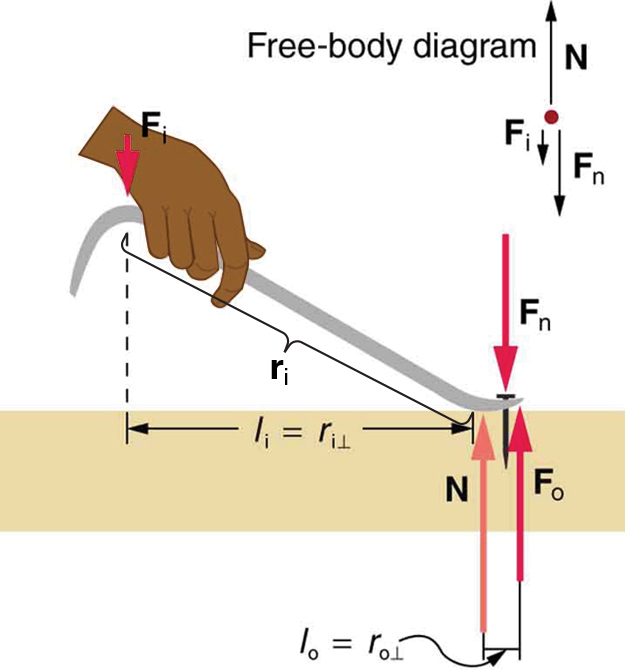
Figure 9.21 A nail puller is a lever with a large mechanical advantage. The external forces on the nail puller are represented by solid arrows. The force that the nail puller applies to the nail ( F o F o ) is not a force on the nail puller. The reaction force the nail exerts back on the puller ( F n F n ) is an external force and is equal and opposite to F o F o . The perpendicular lever arms of the input and output forces are l i l i and l o l o .
Paul Peter Urone and Roger Hinrichs, College Physics 2E, OpenStax. · CC BY-NC-SA 4.0 · Original image ↗ · Access for free ↗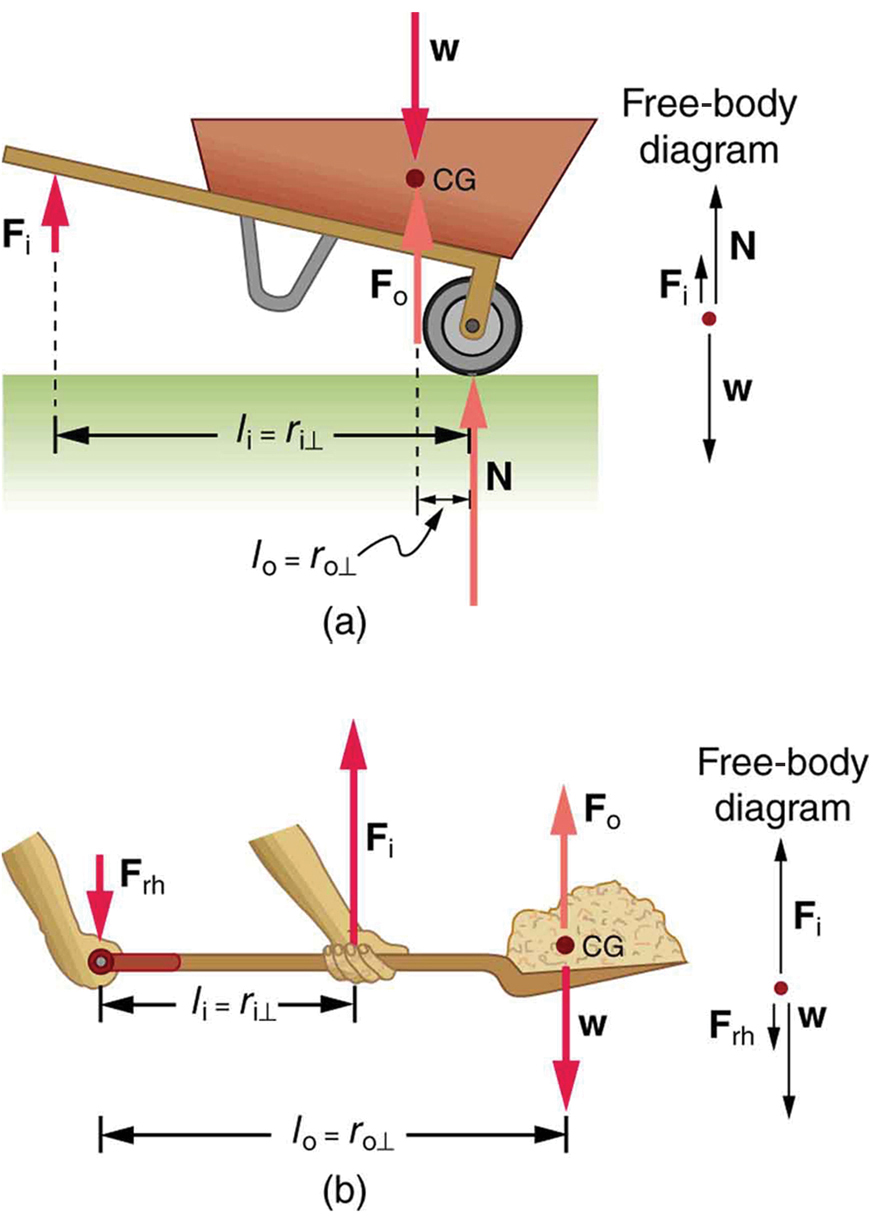
Figure 9.22 (a) In the case of the wheelbarrow, the output force or load is between the pivot and the input force. The pivot is the wheel’s axle. Here, the output force is greater than the input force. Thus, a wheelbarrow enables you to lift much heavier loads than you could with your body alone. (b) In the case of the shovel, the input force is between the pivot and the load, but the input lever arm is shorter than the output lever arm. The pivot is at the handle held by the right hand. Here, the output force (supporting the shovel’s load) is less than the input force (from the hand nearest the load), because the input is exerted closer to the pivot than is the output.
Paul Peter Urone and Roger Hinrichs, College Physics 2E, OpenStax. · CC BY-NC-SA 4.0 · Original image ↗ · Access for free ↗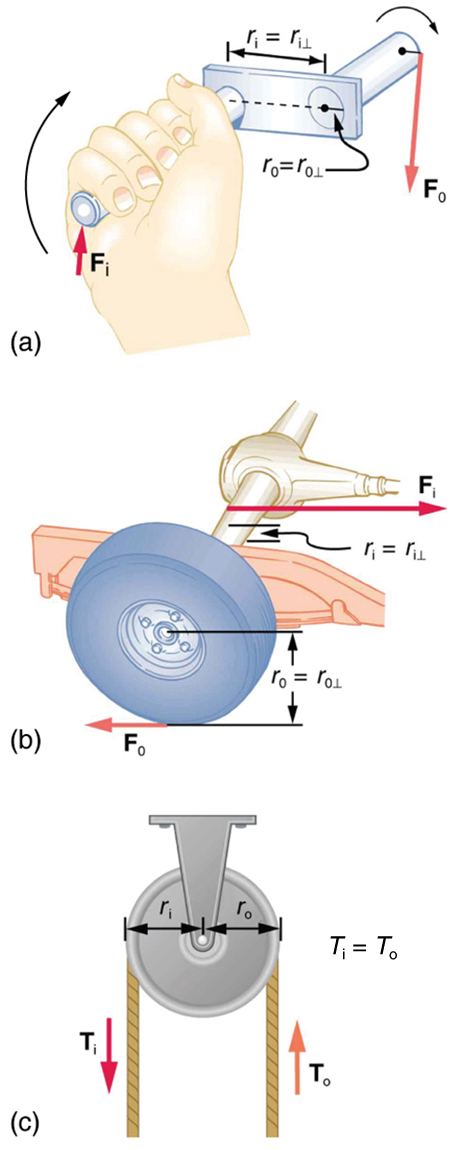
Figure 9.23 (a) A crank is a type of lever that can be rotated 360º 360º about its pivot. Cranks are usually designed to have a large MA. (b) A simplified automobile axle drives a wheel, which has a much larger diameter than the axle. The MA is less than 1. (c) An ordinary pulley is used to lift a heavy load. The pulley changes the direction of the force T T exerted by the cord without changing its magnitude. Hence, this machine has an MA of 1.
Paul Peter Urone and Roger Hinrichs, College Physics 2E, OpenStax. · CC BY-NC-SA 4.0 · Original image ↗ · Access for free ↗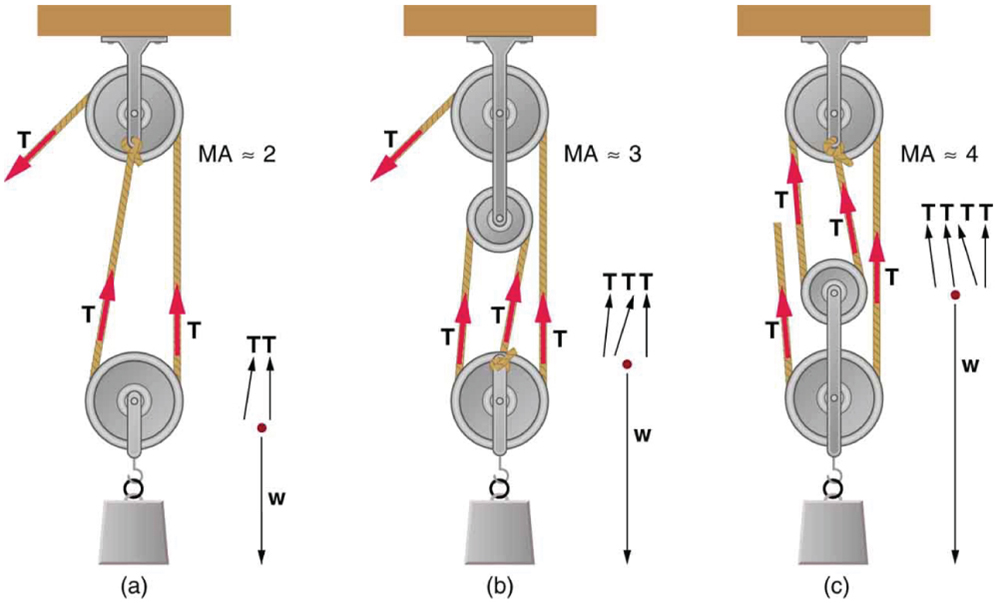
Figure 9.24 (a) The combination of pulleys is used to multiply force. The force is an integral multiple of tension if the pulleys are frictionless. This pulley system has two cables attached to its load, thus applying a force of approximately 2 T 2 T . This machine has MA ≈ 2 MA ≈ 2 . (b) Three pulleys are used to lift a load in such a way that the mechanical advantage is about 3. Effectively, there are three cables attached to the load. (c) This pulley system applies a force of 4 T 4 T , so that it has MA ≈ 4 MA ≈ 4 . Effectively, four cables are pulling on the system of interest.
Paul Peter Urone and Roger Hinrichs, College Physics 2E, OpenStax. · CC BY-NC-SA 4.0 · Original image ↗ · Access for free ↗Source: 9.5 Simple Machines