Foundation 4 · 4A · Motion, forces, and energy

Forces and

Sources ↗

Force balance prevents translational ; balance prevents angular .

Choose the body and draw external forces

Newton’s first law states that zero net external force preserves constant , including rest. The second law is ΣF = ma for constant mass; is resistance to and increases with mass. Weight is mg, not mass itself. The third law pairs equal and opposite forces on different bodies, so the pair does not cancel on one . A acts perpendicular to contact and need not equal mg; tension acts along an ideal taut cord.

Source: College Physics 2E 4 — Section Summary · 5.1 Friction · 9.2 The Second Condition for Equilibrium

Friction and the

adjusts to prevent relative sliding: |fₛ| ≤ μₛN. Its maximum is μₛN; do not use that maximum unless slipping is imminent. Sliding friction is approximately fₖ = μₖN opposite relative motion. Both empirical coefficients are dimensionless. The satisfies xCM = Σmᵢxᵢ/Σmᵢ. In uniform gravity, weight effectively acts through that point. A body tips when its center-of-mass projection moves outside its support region, even if its material does not deform.

Source: College Physics 2E 4 — Section Summary · 5.1 Friction · 9.2 The Second Condition for Equilibrium

Balance torques as well as forces

magnitude is τ = sin θ = Fd⊥, where d⊥ is the perpendicular distance from the pivot to the force’s line of action. Units are N·m. Static requires ΣFₓ = ΣFᵧ = 0 and Στ = 0. Choose clockwise or counterclockwise as positive consistently. Place the pivot at an unknown support force to remove its from the equation, then use force balance to determine that support . A long reduces the force needed for a specified .

Source: College Physics 2E 4 — Section Summary · 5.1 Friction · 9.2 The Second Condition for Equilibrium

Apply it

Try before revealing the answer. A horizontal forearm supports a downward 40 N load 0.30 m from the elbow. Ignore forearm weight. An upward muscle force acts perpendicular to the forearm, 0.04 m from the elbow. What force balances the load?

Worked answer

Balance elbow torques: F × 0.04 = 40 × 0.30, so F = 300 N. Vertical force balance then requires the joint force on the forearm to be 260 N downward if the muscle force is upward. A small muscle requires a large force.

Source: College Physics 2E 4 — Section Summary · 5.1 Friction · 9.2 The Second Condition for Equilibrium

5.1 Friction — figures and tables
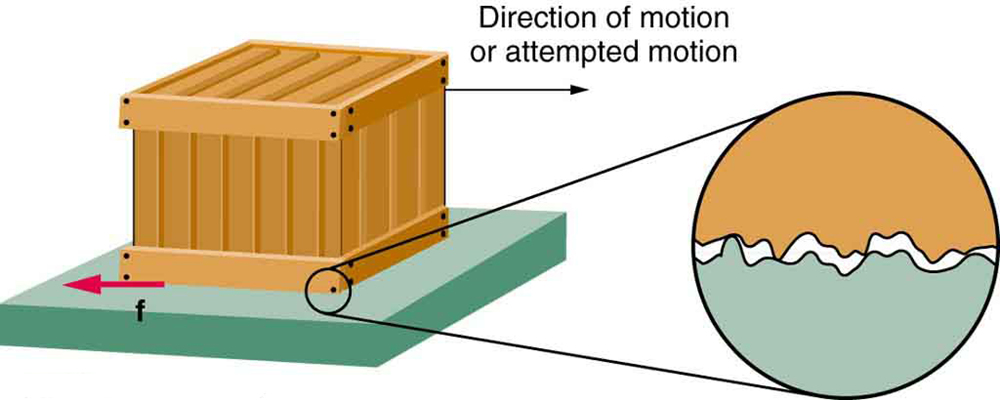
The figure shows a crate on a flat surface, and a magnified view of a bottom corner of the crate and the supporting surface. The magnified view shows that there is roughness in the two surfaces in contact with each other. A black arrow points toward the right, away from the crate, and it is labeled as the direction of motion or attempted motion. A red arrow pointing toward the left is located near the bottom left corner of the crate, at the interface between that corner and the supporting surface. The red arrow is labeled as f, representing friction between the two surfaces in contact with each other.
Figure 5.2 — 5.1 Friction

Figure 5.2 Frictional forces, such as f f , always oppose motion or attempted motion between surfaces in contact. Friction arises in part because of the roughness of the surfaces in contact, as seen in the expanded view. In order for the object to move, it must rise to where the peaks can skip along the bottom surface. Thus a force is required just to set the object in motion. Some of the peaks will be broken off, also requiring a force to maintain motion. Much of the friction is actually due to attractive forces between molecules making up the two objects, so that even perfectly smooth surfaces are not friction-free. Such adhesive forces also depend on the substances the surfaces are made of, explaining, for example, why rubber-soled shoes slip less than those with leather soles.

Paul Peter Urone and Roger Hinrichs, College Physics 2E, OpenStax. · CC BY-NC-SA 4.0 · Original image ↗ · Access for free ↗
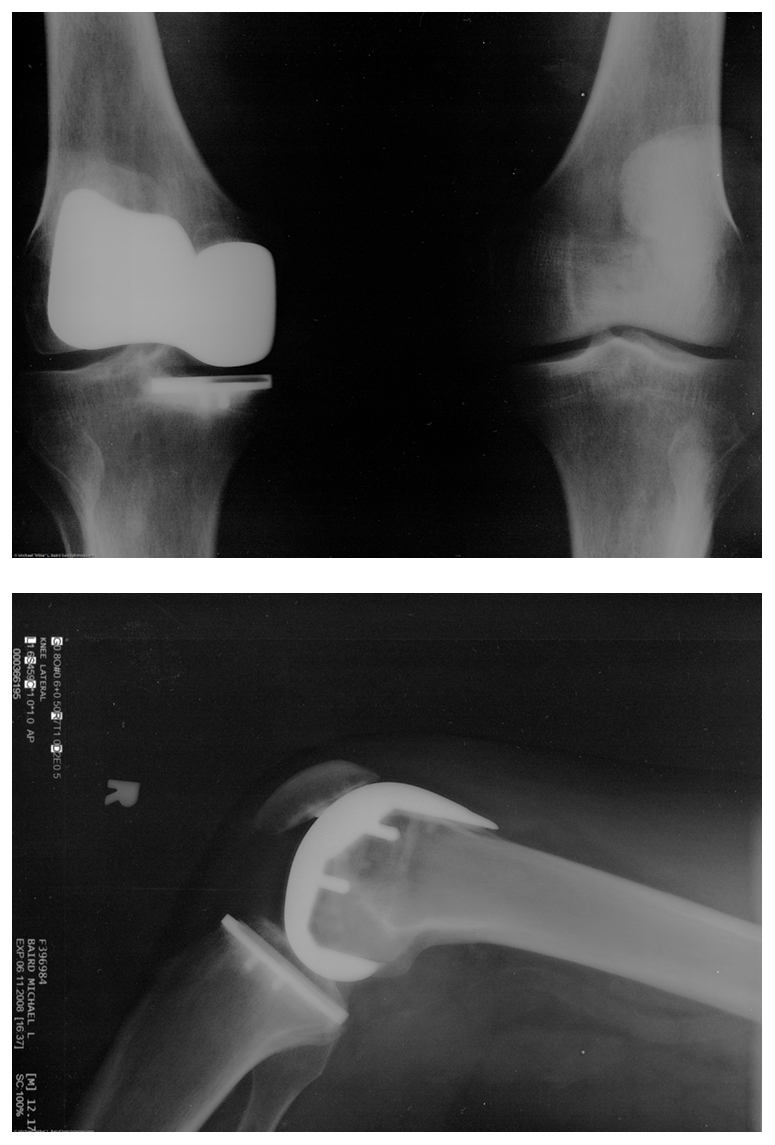
Two X-x rays of an artificial knee replacement are shown.
Figure 5.3 — 5.1 Friction

Figure 5.3 Artificial knee replacement is a procedure that has been performed for more than 20 years. In this figure, we see the post-op X-rays of the right knee joint replacement. (credit: Mike Baird, Flickr)

Paul Peter Urone and Roger Hinrichs, College Physics 2E, OpenStax. (credit: Mike Baird, Flickr) · CC BY-NC-SA 4.0 · Original image ↗ · Access for free ↗
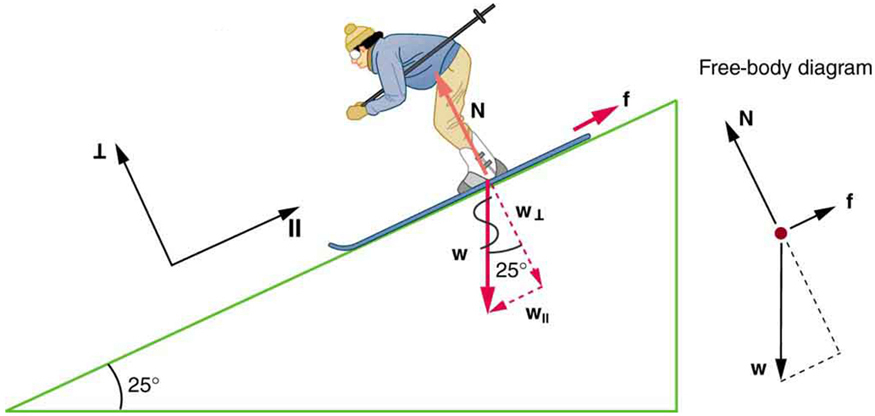
The figure shows a skier going down a slope that forms an angle of 25 degrees with the horizontal. The weight of the skier, labeled w, is represented by a red arrow pointing vertically downward. This weight is divided into two components, w perpendicular is perpendicular to the slope, and w parallel is parallel to the slope. The normal force, labeled N, is also perpendicular to the slope, equal in magnitude but opposite in direction to w perpendicular. The friction, f, is represented by a red arrow pointing upslope. In addition, the figure shows a free body diagram that shows the relative magnitudes and directions of w, f, and N.
Figure 5.4 — 5.1 Friction

Figure 5.4 The motion of the skier and friction are parallel to the slope and so it is most convenient to project all forces onto a coordinate system where one axis is parallel to the slope and the other is perpendicular (axes shown to left of skier). N N (the normal force) is perpendicular to the slope, and f f (the friction) is parallel to the slope, but w w (the skier’s weight) has components along both axes, namely w ⊥ w ⊥ and W // W // . N N is equal in magnitude to w ⊥ w ⊥ , so there is no motion perpendicular to the slope. However, f f is less than W // W // in magnitude, so there is acceleration down the slope (along the x -axis).

Paul Peter Urone and Roger Hinrichs, College Physics 2E, OpenStax. · CC BY-NC-SA 4.0 · Original image ↗ · Access for free ↗
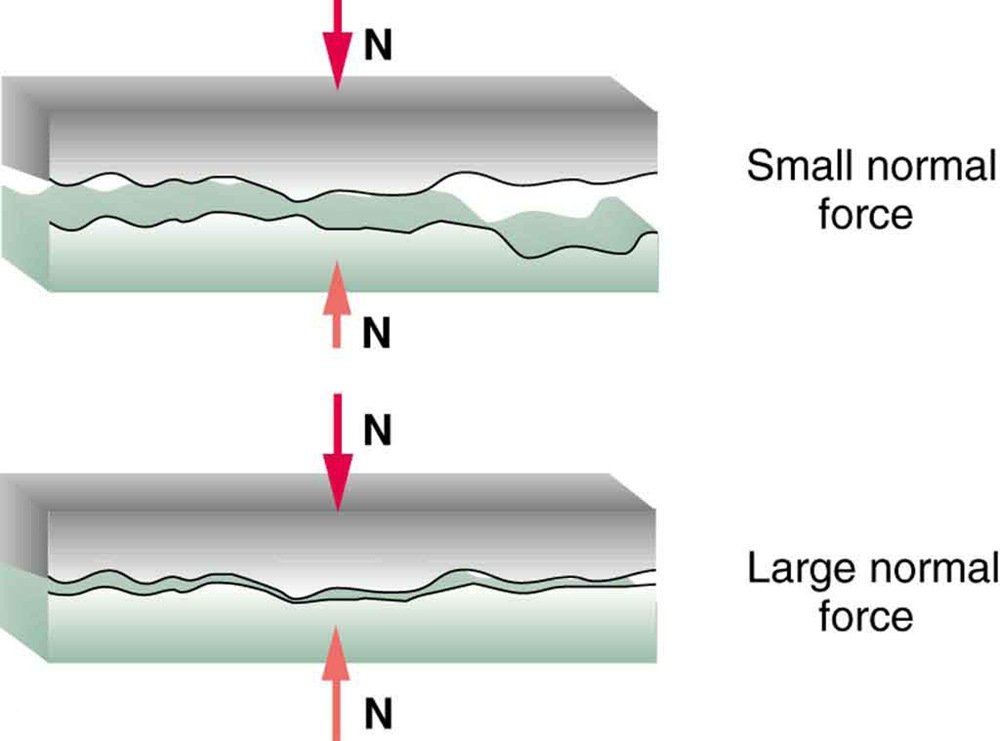
This figure has two parts, each of which shows two rough surfaces in close proximity to each other. In the first part, the normal force is small, so that the area of contact between the two surfaces is much smaller than their total area. In the second part, the normal force is large, so that the area of contact between the two surfaces has increased. As a result, the friction between the two surfaces in the second part is also greater than the friction in the first part.
Figure 5.5 — 5.1 Friction

Figure 5.5 Two rough surfaces in contact have a much smaller area of actual contact than their total area. When there is a greater normal force as a result of a greater applied force, the area of actual contact increases as does friction.

Paul Peter Urone and Roger Hinrichs, College Physics 2E, OpenStax. · CC BY-NC-SA 4.0 · Original image ↗ · Access for free ↗
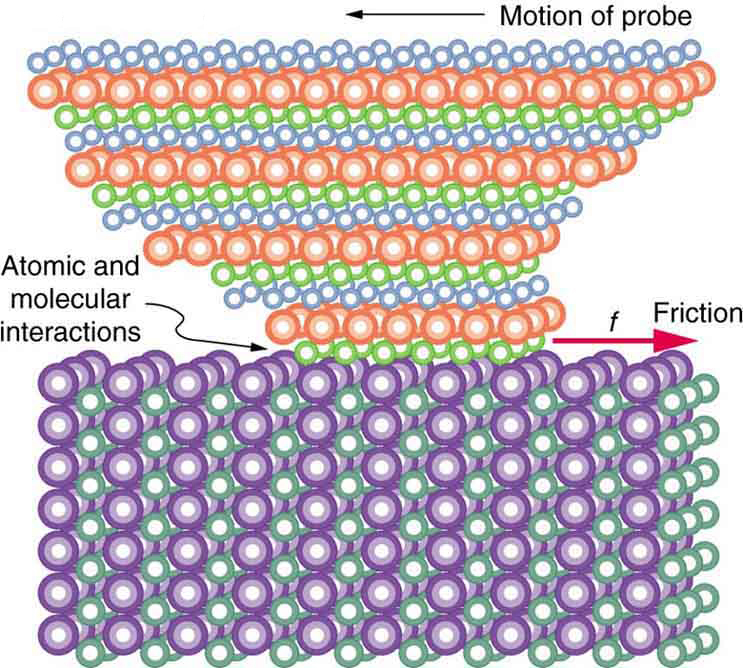
This figure shows a molecular model of a probe that is dragged over the surface of a substrate. The substrate is represented by a rectangular prism, made up of a grid of small spheres, each sphere representing an atom. The probe, made up of a different grid of small spheres, is in the form of an inverted pyramid with a flattened peak. The pyramid is somewhat distorted because of friction.
Figure 5.6 — 5.1 Friction

Figure 5.6 The tip of a probe is deformed sideways by frictional force as the probe is dragged across a surface. Measurements of how the force varies for different materials are yielding fundamental insights into the atomic nature of friction.

Paul Peter Urone and Roger Hinrichs, College Physics 2E, OpenStax. · CC BY-NC-SA 4.0 · Original image ↗ · Access for free ↗
System μs μk
Rubber on dry concrete 1.0 0.7
Rubber on wet concrete 0.7 0.5
Wood on wood 0.5 0.3
Waxed wood on wet snow 0.14 0.1
Metal on wood 0.5 0.3
Steel on steel (dry) 0.6 0.3
Steel on steel (oiled) 0.05 0.03
Teflon on steel 0.04 0.04
Bone lubricated by synovial fluid 0.016 0.015
Shoes on wood 0.9 0.7
Shoes on ice 0.1 0.05
Ice on ice 0.1 0.03
Steel on ice 0.04 0.02

Table 5.1 Coefficients of Static and Kinetic Friction. Paul Peter Urone and Roger Hinrichs, College Physics 2E, OpenStax.

Source: 5.1 Friction

9.2 The Second Condition for — figures and tables

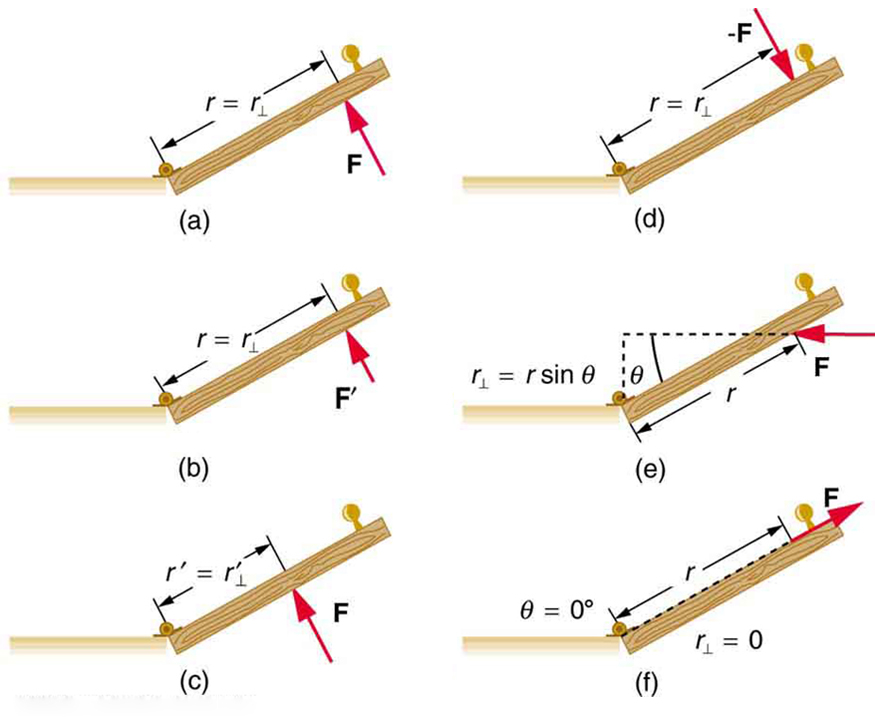
In the figure, six top views of a door are shown. In the first figure, a force vector is shown in the North West direction. The perpendicular distance of the force from the point of rotation is r. In the second figure, a force is applied in the opposite direction at the same distance from the hinges. In the third figure, a smaller force in applied at the same point. In the next figure, a horizontal force is applied at the same point. In this case, the perpendicular distance from the hinges is shown as r sin theta. In the next figure, force is applied at a distance near the hinges. In the final figure, the force is shown along the direction of hinges toward the handle of the door.
Figure 9.6 — 9.2 The Second Condition for

Figure 9.6 Torque is the turning or twisting effectiveness of a force, illustrated here for door rotation on its hinges (as viewed from overhead). Torque has both magnitude and direction. (a) Counterclockwise torque is produced by this force, which means that the door will rotate in a counterclockwise due to F F . Note that r ⊥ r ⊥ is the perpendicular distance of the pivot from the line of action of the force. (b) A smaller counterclockwise torque is produced by a smaller force F′ F′ acting at the same distance from the hinges (the pivot point). (c) The same force as in (a) produces a smaller counterclockwise torque when applied at a smaller distance from the hinges. (d) The same force as in (a), but acting in the opposite direction, produces a clockwise torque. (e) A smaller counterclockwise torque is produced by the same magnitude force acting at the same point but in a different direction. Here, θ θ is less than 90º 90º . (f) Torque is zero here since the force just pulls on the hinges, producing no rotation. In this case, θ = 0º θ = 0º .

Paul Peter Urone and Roger Hinrichs, College Physics 2E, OpenStax. · CC BY-NC-SA 4.0 · Original image ↗ · Access for free ↗
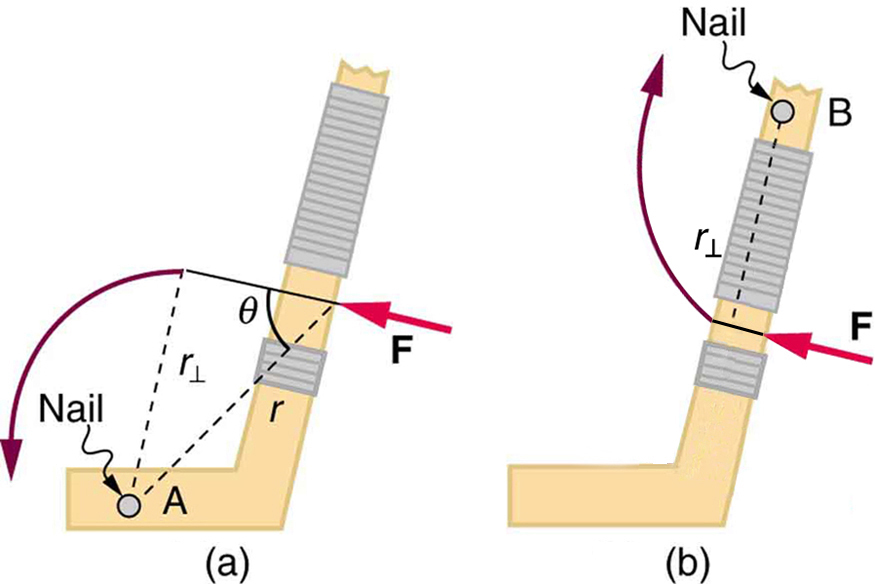
In the first part of the figure, a hockey stick is shown. At a point A near the bottom, a nail is fixed. A force is applied at a point near the holding grip of the hockey stick. A quarter circular arrow shows that the stick rotates in the counterclockwise direction. The perpendicular distance between the pivot point and the force vector direction is labeled as r-perpendicular, and the angle between the direction of force and the line joining the pivot A to the point of application of force is given as theta. In the second part of the figure, the pivot point is near the top of the stick and the point of application of the force is about the same as that in the first part of the figure. An upward quarter circle arrow shows that the stick rotates in the clockwise direction.
Figure 9.7 — 9.2 The Second Condition for

Figure 9.7 A force applied to an object can produce a torque, which depends on the location of the pivot point. (a) The three factors r r , F F , and θ θ for pivot point A on a body are shown here— r r is the distance from the chosen pivot point to the point where the force F F is applied, and θ θ is the angle between F F and the vector directed from the point of application to the pivot point. If the object can rotate around point A, it will rotate counterclockwise. This means that torque is counterclockwise relative to pivot A. (b) In this case, point B is the pivot point. The torque from the applied force will cause a clockwise rotation around point B, and so it is a clockwise torque relative to B.

Paul Peter Urone and Roger Hinrichs, College Physics 2E, OpenStax. · CC BY-NC-SA 4.0 · Original image ↗ · Access for free ↗
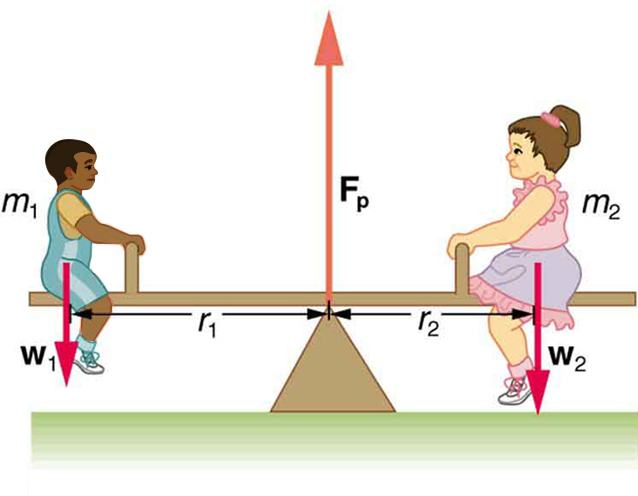
Two children are sitting on a seesaw. On the left side, a lighter child is sitting and on the right, a heavier one. The distance of the lighter child from the fulcrum is more than that of heavier child. At the fulcrum, an upward force vector labeled as F-p is shown. The weights of the two children, w-one and w-two, are shown as vectors in the downward direction, and the force at the fulcrum, F-p, is shown as a vector in the upward direction.
Figure 9.8 — 9.2 The Second Condition for

Figure 9.8 Two children balancing a seesaw satisfy both conditions for equilibrium. The lighter child sits farther from the pivot to create a torque equal in magnitude to that of the heavier child.

Paul Peter Urone and Roger Hinrichs, College Physics 2E, OpenStax. · CC BY-NC-SA 4.0 · Original image ↗ · Access for free ↗

Source: 9.2 The Second Condition for Equilibrium

134 terms, alphabetically ordered

acceleration

Rate of change of , measured in m/s².

Read explanation · OpenStax ↗
Acid · ·

In the Brønsted–Lowry model, a substance that can donate a . Acidic have a higher activity than water.

Read explanation · OpenStax ↗
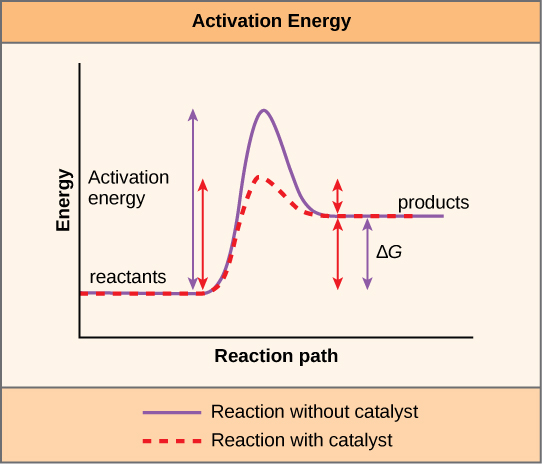
Activation energy ·

The energy barrier that must overcome to reach a and undergo .

Read explanation · OpenStax ↗
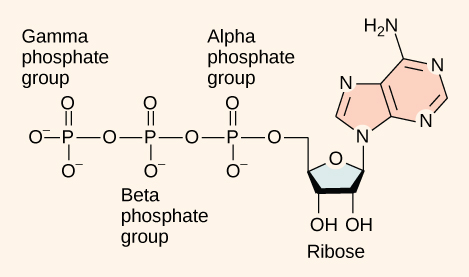
Adenosine triphosphate

An energy-carrying ; its powers many cellular processes, including cycles.

Read explanation · OpenStax ↗
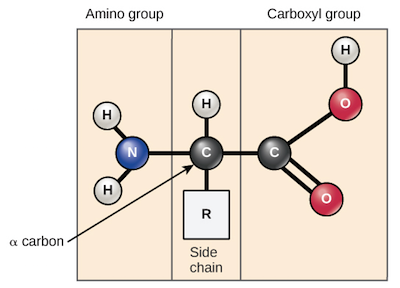
Alpha carbon · ·

The central carbon next to the carboxyl carbon. In a standard it binds an , hydrogen, and .

Read explanation · OpenStax ↗
Amide · · ·

A group containing a carbon bonded to nitrogen. are amide linkages.

Read explanation · OpenStax ↗
Amino acid

A building block containing amino and and a characteristic .

Read explanation · OpenStax ↗
Amino acid residue · ·

The part of an incorporated into a chain. Residue can also describe another building block within a larger .

Read explanation · OpenStax ↗
Amino group · · ·

A nitrogen-containing . A free ’s amino group is typically (NH₃⁺) near physiological ; ’s ring nitrogen is an exception to this formula.

Read explanation · OpenStax ↗
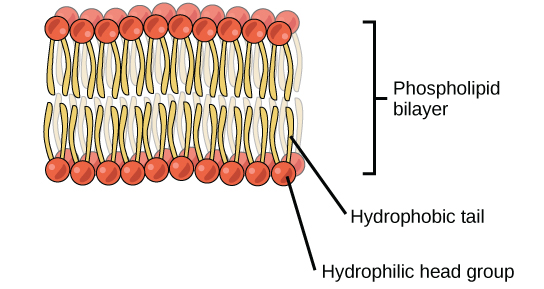
Amphipathic

Having both a region and a region, as in a or .

Read explanation · OpenStax ↗
amplitude

Maximum from an oscillation’s position.

Read explanation · OpenStax ↗
Analytical standard ·

A material with a known identity or amount used to compare or calibrate measurements.

Read explanation · Agilent ↗
Antibody

An that recognizes a specific region () on an . Antibodies help immune defenses and are used as detection tools in .

Read explanation · OpenStax ↗
Antigen

A or molecular structure specifically recognized by an or other adaptive immune .

Read explanation · OpenStax ↗
Aqueous solution ·

A in which water is the .

Read explanation · OpenStax ↗
Assay

A procedure used to detect a substance or measure its amount, activity, or another property.

Read explanation · Thermo Fisher ↗
Atom

The smallest unit of an element that retains its chemical identity; it has a surrounded by .

Read explanation · OpenStax ↗
Biomolecule

A made by or involved in living systems, including , , , and .

Read explanation · OpenStax ↗
Blotting ·

Transfer of separated or to a so a specific target can be detected.

Read explanation · Thermo Fisher ↗
Brønsted–Lowry base · · · · · · · · · · ·

In the Brønsted–Lowry model, a substance that can accept a . Basic solutions have lower activity than water.

Read explanation · OpenStax ↗
Carbohydrate

A class of including sugars and their , used for energy storage, structure, and recognition.

Read explanation · OpenStax ↗
Carbonyl group · ·

A carbon double-bonded to oxygen, C=O; present in and many other .

Read explanation · OpenStax ↗
Carboxyl group · ·

An , COOH. In free it is usually to COO⁻ near physiological .

Read explanation · OpenStax ↗
Catalyst · ·

A substance that speeds a by providing a pathway with lower and is regenerated rather than consumed overall.

Read explanation · OpenStax ↗
center of mass

Mass-weighted average position of a system.

Read explanation · OpenStax ↗
Centimeter

A unit of length equal to one hundredth of a meter.

Read explanation · NIST ↗
Chemical reaction ·

A process that rearranges and chemical bonds, converting into .

Read explanation · OpenStax ↗
Chromatin

The complex of and associated , including , in .

Read explanation · OpenStax ↗
Chromatography

Separation of mixture components by their different interactions with a and a moving .

Read explanation · Waters ↗
Chromosome ·

An organized with associated that carries . A replicated chromosome has two .

Read explanation · OpenStax ↗
Codon

A sequence of three that specifies an or a stop signal.

Read explanation · OpenStax ↗
Concentration

The amount of a substance in a specified volume or mass of mixture.

Read explanation · OpenStax ↗
Covalent bond · ·

A bond in which share pairs. and are covalent.

Read explanation · OpenStax ↗
Cysteine ·

An with a . Two cysteines can form a .

Read explanation · OpenStax ↗
Deoxyribonucleic acid

The that stores genetic information used to specify and sequences.

Read explanation · OpenStax ↗
Deprotonation

Removal of a from a or group; this changes its by minus one.

Read explanation · OpenStax ↗
Detergent

An substance that can associate with both water and material; detergents can disrupt or interactions.

Read explanation · Thermo Fisher ↗
Disulfide bond · · ·

A covalent sulfur–sulfur bond formed by of two , which can stabilize structure.

Read explanation · NCBI Bookshelf ↗
DNA replication

Copying so genetic information can be passed to daughter cells. Each guides a complementary new strand.

Read explanation · OpenStax ↗
Electric charge · · ·

An electrical property that can be positive or negative. Opposite charges attract and like charges repel; net charge is the sum of all charges on a particle.

Read explanation · OpenStax ↗
Electron

A negatively subatomic particle. Electron sharing and transfer determine much of chemical bonding.

Read explanation · OpenStax ↗
Epitope

The particular part of an recognized by an or immune .

Read explanation · OpenStax ↗
Equilibrium

A state where opposing processes occur at equal rates, so macroscopic or other properties remain constant.

Read explanation · OpenStax ↗
Eukaryote ·

An organism whose cells have a -enclosed ; animals, plants, fungi, and protists are eukaryotes.

Read explanation · OpenStax ↗
FACT complex ·

A -associated complex that helps machinery traverse and supports reorganization.

Read explanation · OpenStax ↗
Fraction · ·

A portion of a sample collected during a separation, such as the fluid leaving a column during a time interval.

Read explanation · Waters ↗
free-body diagram

Drawing showing all external forces on one selected object or system.

Read explanation · OpenStax ↗
Functional group

A group of whose chemical behavior gives a characteristic and properties.

Read explanation · OpenStax ↗
Gene

A sequence that contributes to a functional or , together with the information needed to express it.

Read explanation · OpenStax ↗
Gene expression

Production of a functional from a , including and, for -coding , .

Read explanation · NCBI Bookshelf ↗
Histone

A -associated rich in . Core histones form the around which nucleosomal wraps.

Read explanation · OpenStax ↗
Hydrogen ion · ·

A positively hydrogen species. H⁺ denotes a , which is hydrated in water; its activity determines .

Read explanation · OpenStax ↗
Hydrolysis

Breaking a chemical bond by adding water. hydrolysis separates .

Read explanation · OpenStax ↗
Hydrophilic

Interacting favorably with water, typically because a group is or .

Read explanation · OpenStax ↗
Hydrophobic

Interacting poorly with water. often gather in a ’s interior.

Read explanation · OpenStax ↗
Hydroxide ion ·

The negatively OH⁻. Basic contain a higher hydroxide ion activity than water at the same temperature.

Read explanation · OpenStax ↗
Immunoglobulin

An or the -bound form of the same type of -binding .

Read explanation · OpenStax ↗
inertia

Resistance of an object to a change in ; mass quantifies translational inertia.

Read explanation · OpenStax ↗
Ion · ·

An or with a net because its numbers of and do not balance.

Read explanation · OpenStax ↗
kinematics

Description of motion without specifying its causes.

Read explanation · OpenStax ↗
kinetic friction

Contact force opposing sliding between surfaces.

Read explanation · OpenStax ↗
lever arm

Perpendicular distance between a pivot and a force’s line of action.

Read explanation · OpenStax ↗
linkage

A tendency of nearby on the same to be inherited together.

Read explanation · OpenStax ↗
Lipid

A broad class of largely or , including fats, , and steroids.

Read explanation · OpenStax ↗
locus

The specific position of a or other feature.

Read explanation · OpenStax ↗
Logarithm · · ·

The exponent needed to obtain a number from a chosen fixed number. For decimal logarithms, log₁₀(100) = 2 because 10² = 100; uses the negative decimal logarithm of activity.

Read explanation · OpenStax ↗
mechanical equilibrium

State with zero net external force and zero net external .

Read explanation · OpenStax ↗
mechanical power

Rate of energy transfer, measured in watts.

Read explanation · OpenStax ↗
mechanical work

Energy transferred by a force acting through ; the force component parallel to motion contributes.

Read explanation · OpenStax ↗
Membrane · · · ·

A thin boundary or sheet. Cell membranes are bilayers containing ; membranes are synthetic supports that hold or for detection.

Read explanation · OpenStax ↗
Messenger RNA ·

An that carries coding information used by to synthesize a .

Read explanation · OpenStax ↗
Mobile phase

The moving fluid that carries a sample through a system.

Read explanation · Waters ↗
modeling

Learning or performing behavior based on observing a model.

Read explanation · OpenStax ↗
Molecular chaperone · ·

A that assists other in folding or prevents , without specifying their sequence.

Read explanation · NCBI Bookshelf ↗
Molecule

Two or more joined by . A molecule may be electrically or carry a .

Read explanation · OpenStax ↗
Neutral

Having no net . For a , neutral instead means equal and activities; its is about 7 at 25 °C.

Read explanation · OpenStax ↗
Nitrogenous base · · ·

A nitrogen-containing ring component of ; its pairing interactions help specify sequences.

Read explanation · OpenStax ↗
Nonpolar ·

Lacking a substantial separation of . Nonpolar groups generally interact poorly with water.

Read explanation · OpenStax ↗
normal force

Contact force perpendicular to the surface of contact.

Read explanation · OpenStax ↗
Normal-phase chromatography

with a and a less . More strongly adsorbed components are retained longer.

Read explanation · Waters ↗
Nucleic acid

A of , such as or , used in information storage, expression, and other cellular functions.

Read explanation · OpenStax ↗
Nucleosome

The basic unit of : wrapped around a .

Read explanation · OpenStax ↗
Nucleotide

A joined to a sugar and one or more .

Read explanation · OpenStax ↗
Nucleus ·

A -enclosed compartment containing most of a cell’s .

Read explanation · OpenStax ↗
Octamer

A complex made of eight . A core contains eight .

Read explanation · OpenStax ↗
oscillation frequency ·

Number of repeated cycles per unit time, measured in hertz.

Read explanation · OpenStax ↗
oscillation phase ·

Position within an oscillatory cycle relative to a reference.

Read explanation · OpenStax ↗
Oxidation ·

Loss of or an increase in oxidation state. Oxidizing two can form a .

Read explanation · OpenStax ↗
Peptide

A chain of joined by ; the term commonly describes chains shorter than a typical .

Read explanation · OpenStax ↗
Peptide bond ·

A covalent between the carboxyl carbon of one and the amino nitrogen of the next.

Read explanation · OpenStax ↗
pH

A measure of , defined as the negative of activity. Lower pH means greater ; pH influences .

Read explanation · OpenStax ↗
Phosphate group ·

A phosphorus-containing group bonded to oxygens; phosphate groups occur in , , and modified .

Read explanation · OpenStax ↗
Phospholipid

An with a -containing region and tails; a major component of cellular .

Read explanation · OpenStax ↗
physical displacement ·

Signed or difference between final and initial position.

Read explanation · OpenStax ↗
Polar

Having an uneven distribution of . Polar groups often interact favorably with water.

Read explanation · OpenStax ↗
Polymer

A large made from many linked molecular building blocks.

Read explanation · OpenStax ↗
Polypeptide

A chain of connected by . A functional can contain one or several such chains.

Read explanation · OpenStax ↗
Probe

A used to detect a target by binding to it. In , a labeled or probe binds a complementary sequence; arrays can use or other binding .

Read explanation · NHGRI ↗
Proline ·

An whose loops back to the nitrogen, restricting rotation and often creating bends.

Read explanation · OpenStax ↗
Protein

One or more folded chains that perform biological roles such as , transport, signaling, or structural support.

Read explanation · OpenStax ↗
Protein aggregation · ·

Association of into larger clusters, often when exposed surfaces of unfolded stick together.

Read explanation · NCBI Bookshelf ↗
Protein backbone ·

The repeating nitrogen–alpha-carbon– chain of a , excluding its variable .

Read explanation · OpenStax ↗
Proton

A positively subatomic particle. In – chemistry, donating a proton means transferring a .

Read explanation · OpenStax ↗
Protonation

Addition of a to an , , or ; this changes its by plus one.

Read explanation · OpenStax ↗
R group · ·

The variable side chain attached to an ’s . It determines identity, , , and chemical behavior.

Read explanation · OpenStax ↗
Reactant

A starting substance transformed during a .

Read explanation · OpenStax ↗
Reaction intermediate · ·

A species formed in one step and consumed in another. It occupies a local energy minimum between .

Read explanation · OpenStax ↗
Reaction product ·

A substance formed by a .

Read explanation · OpenStax ↗
Receptor

A that recognizes a particular signal and helps produce a cellular response.

Read explanation · OpenStax ↗
Retention factor · · ·

In , the distance traveled by a sample spot divided by the distance traveled by the , both measured from the origin. RfC, RfA, and RfB denote the values for components C, A, and B.

Read explanation · Waters ↗
Ribonucleic acid ·

A with roles in , regulation, and ; carries -coding information.

Read explanation · OpenStax ↗
Ribosome ·

A complex of and that translates into a .

Read explanation · OpenStax ↗
Silica

Silicon dioxide; a solid commonly used as a in .

Read explanation · Waters ↗
Sister chromatid

One of the two copies of a produced by . An intact sister chromatid can supply a template for accurate repair.

Read explanation · Biology LibreTexts / Oregon State University ↗
Solubility ·

The amount of a substance that can dissolve in a under specified conditions. Soluble means able to dissolve; insoluble means only very slightly soluble in that .

Read explanation · OpenStax ↗
Solute

A dissolved component of a .

Read explanation · OpenStax ↗
Solution

A homogeneous mixture in which are dissolved in a .

Read explanation · OpenStax ↗
Solvent

The component of a that dissolves other substances, usually the component present in the greatest amount.

Read explanation · OpenStax ↗
Solvent front

The furthest point reached by the mobile- along a plate or paper.

Read explanation · Waters ↗
spatial vector ·

Quantity with both magnitude and direction, combined by adding components.

Read explanation · OpenStax ↗
standing wave

Stationary interference pattern with fixed and antinodes.

Read explanation · OpenStax ↗
static friction

Adjustable contact force opposing impending relative sliding, up to a limiting value.

Read explanation · OpenStax ↗
Stationary phase

The material that remains fixed in a system.

Read explanation · Waters ↗
Subunit ·

An individual chain within a containing multiple chains.

Read explanation · OpenStax ↗
Template strand · · ·

A preexisting strand whose sequence guides complementary nucleic- synthesis.

Read explanation · OpenStax ↗
Thin layer chromatography ·

A method that separates sample spots as moves along a thin stationary layer, often , on a plate.

Read explanation · Waters ↗
Thiol group · · · ·

A sulfur bonded to hydrogen, –SH. thiols can form through .

Read explanation · OpenStax ↗
torque

Turning effect of a force about an axis, equal in magnitude to force times perpendicular .

Read explanation · OpenStax ↗
Transcription

Synthesis of using a template.

Read explanation · OpenStax ↗
Transition state

A fleeting, high-energy arrangement at a barrier. It is an energy maximum along the path, rather than a stable .

Read explanation · OpenStax ↗
Translation ·

Synthesis of a on a using the sequence of in .

Read explanation · OpenStax ↗
velocity

Rate of change of position, including direction.

Read explanation · OpenStax ↗
wave intensity ·

crossing unit area, measured in W/m².

Read explanation · OpenStax ↗
wave node ·

Point of zero in a .

Read explanation · OpenStax ↗

College Physics 2E 4 — Section Summary

OpenStax · College Physics 2E 4 — Section Summary ↗
Instructional page including learning objectives, examples, figures, source tables and questions. Site navigation and embedded media players are omitted; source media links remain available.

4.1 Development of Force Concept

  • Dynamics is the study of how forces affect the motion of objects.
  • Force is a push or pull that can be defined in terms of various , and it is a having both magnitude and direction.
  • External forces are any outside forces that act on a body. A is a drawing of all external forces acting on a body.

4.2 Newton’s First Law of Motion: Inertia

  • Newton’s first law of motion states that a body at rest remains at rest, or, if in motion, remains in motion at a constant unless acted on by a net external force. This is also known as the law of .
  • is the tendency of an object to remain at rest or remain in motion. is related to an object’s mass.
  • Mass is the quantity of matter in a substance.

4.3 Newton’s Second Law of Motion: Concept of a System

  • , a, is defined as a change in , meaning a change in its magnitude or direction, or both.
  • An external force is one acting on a system from outside the system, as opposed to internal forces, which act between components within the system.
  • Newton’s second law of motion states that the of a system is directly proportional to and in the same direction as the net external force acting on the system, and inversely proportional to its mass.
  • In equation form, Newton’s second law of motion is a=Fnetm.
  • This is often written in the more familiar form: Fnet=ma.
  • The weight w of an object is defined as the force of gravity acting on an object of mass m. The object experiences an due to gravity g:
    w = mg .
  • If the only force acting on an object is due to gravity, the object is in free fall.
  • Friction is a force that opposes the motion past each other of objects that are touching.

4.4 Newton’s Third Law of Motion: Symmetry in Forces

  • Newton’s third law of motion represents a basic symmetry in nature. It states: Whenever one body exerts a force on a second body, the first body experiences a force that is equal in magnitude and opposite in direction to the force that the first body exerts.
  • A thrust is a force that pushes a body forward in response to a backward force. Rockets, airplanes, and cars are pushed forward by a thrust force.

4.5 Normal, Tension, and Other Examples of Forces

  • When objects rest on a surface, the surface applies a force to the object that supports the weight of the object. This supporting force acts perpendicular to and away from the surface. It is called a , N.
  • When objects rest on a non-accelerating horizontal surface, the magnitude of the is equal to the weight of the object:
    N=mg.
  • When objects rest on an inclined plane that makes an angle θ with the horizontal surface, the weight of the object can be resolved into components that act perpendicular (w⊥) and parallel (w∥ ) to the surface of the plane. These components can be calculated using:
    w∥ =wsin(θ)=mgsin(θ)
    w⊥=wcos(θ)=mgcos(θ).
  • The pulling force that acts along a stretched flexible connector, such as a rope or cable, is called tension, T. When a rope supports the weight of an object that is at rest, the tension in the rope is equal to the weight of the object:
    T=mg.
  • In any inertial frame of reference (one that is not accelerated or rotated), Newton’s laws have the simple forms given in this chapter and all forces are real forces having a physical origin.

4.6 Problem-Solving Strategies

  • To solve problems involving Newton’s laws of motion, follow the procedure described:
    1. Draw a sketch of the problem.
    2. Identify known and unknown quantities, and identify the system of interest. Draw a , which is a sketch showing all of the forces acting on an object. The object is represented by a dot, and the forces are represented by extending in different directions from the dot. If act in directions that are not horizontal or vertical, resolve the into horizontal and vertical components and draw them on the .
    3. Write Newton’s second law in the horizontal and vertical directions and add the forces acting on the object. If the object does not accelerate in a particular direction (for example, the x-direction) then Fnetx=0. If the object does accelerate in that direction, Fnet x=ma.
    4. Check your answer. Is the answer reasonable? Are the units correct?

4.7 Further Applications of Newton’s Laws of Motion

  • Newton’s laws of motion can be applied in numerous situations to solve problems of motion.
  • Some problems will contain multiple force acting in different directions on an object. Be sure to draw diagrams, resolve all force into horizontal and vertical components, and draw a . Always analyze the direction in which an object accelerates so that you can determine whether Fnet=ma or Fnet=0 .
  • The on an object is not always equal in magnitude to the weight of the object. If an object is accelerating, the will be less than or greater than the weight of the object. Also, if the object is on an inclined plane, the will always be less than the full weight of the object.
  • Some problems will contain various physical quantities, such as forces, , , or position. You can apply concepts from and dynamics in order to solve these problems of motion.

4.8 Extended Topic: The Four Basic Forces—An Introduction

  • The various types of forces that are categorized for use in many applications are all manifestations of the four basic forces in nature.
  • The properties of these forces are summarized in Table 4.1.
  • Everything we experience directly without sensitive instruments is due to either electromagnetic forces or gravitational forces. The forces are responsible for the submicroscopic structure of matter, but they are not directly sensed because of their short ranges. Attempts are being made to show all four forces are different manifestations of a single unified force.
  • A force field surrounds an object creating a force and is the of that force.

5.1 Friction

OpenStax · 5.1 Friction ↗
Instructional page including learning objectives, examples, figures, source tables and questions. Site navigation and embedded media players are omitted; source media links remain available.

Learning Objectives

By the end of this section, you will be able to:

  • Discuss the general characteristics of friction.
  • Describe the various types of friction.
  • Calculate the magnitude of static and .

Friction is a force that is around us all the time that opposes relative motion between surfaces in contact but also allows us to move (which you have discovered if you have ever tried to walk on ice). While a common force, the behavior of friction is actually very complicated and is still not completely understood. We have to rely heavily on observations for whatever understandings we can gain. However, we can still deal with its more elementary general characteristics and understand the circumstances in which it behaves.

Friction

Friction is a force that opposes relative motion between surfaces in contact.

One of the simpler characteristics of friction is that it is parallel to the contact surface between surfaces and always in a direction that opposes motion or attempted motion of the systems relative to each other. If two surfaces are in contact and moving relative to one another, then the friction between them is called . For example, friction slows a hockey puck sliding on ice. But when objects are stationary, can act between them; the is usually greater than the between the surfaces.

If two surfaces are in contact and moving relative to one another, then the friction between them is called .

Imagine, for example, trying to slide a heavy crate across a concrete floor—you may push harder and harder on the crate and not move it at all. This means that the responds to what you do—it increases to be equal to and in the opposite direction of your push. But if you finally push hard enough, the crate seems to slip suddenly and starts to move. Once in motion it is easier to keep it in motion than it was to get it started, indicating that the force is less than the force. If you add mass to the crate, say by placing a box on top of it, you need to push even harder to get it started and also to keep it moving. Furthermore, if you oiled the concrete you would find it to be easier to get the crate started and keep it going (as you might expect).

Figure 5.2 is a crude pictorial representation of how friction occurs at the interface between two objects. Close-up inspection of these surfaces shows them to be rough. So when you push to get an object moving (in this case, a crate), you must raise the object until it can skip along with just the tips of the surface hitting, break off the points, or do both. A considerable force can be resisted by friction with no apparent motion. The harder the surfaces are pushed together (such as if another box is placed on the crate), the more force is needed to move them. Part of the friction is due to adhesive forces between the surface of the two objects, which explain the dependence of friction on the nature of the substances. Adhesion varies with substances in contact and is a complicated aspect of surface physics. Once an object is moving, there are fewer points of contact (fewer adhering), so less force is required to keep the object moving. At small but nonzero speeds, friction is nearly independent of speed.

The figure shows a crate on a flat surface, and a magnified view of a bottom corner of the crate and the supporting surface. The magnified view shows that there is roughness in the two surfaces in contact with each other. A black arrow points toward the right, away from the crate, and it is labeled as the direction of motion or attempted motion. A red arrow pointing toward the left is located near the bottom left corner of the crate, at the interface between that corner and the supporting surface. The red arrow is labeled as f, representing friction between the two surfaces in contact with each other.
Figure 5.2 — 5.1 Friction

Figure 5.2 Frictional forces, such as f f , always oppose motion or attempted motion between surfaces in contact. Friction arises in part because of the roughness of the surfaces in contact, as seen in the expanded view. In order for the object to move, it must rise to where the peaks can skip along the bottom surface. Thus a force is required just to set the object in motion. Some of the peaks will be broken off, also requiring a force to maintain motion. Much of the friction is actually due to attractive forces between molecules making up the two objects, so that even perfectly smooth surfaces are not friction-free. Such adhesive forces also depend on the substances the surfaces are made of, explaining, for example, why rubber-soled shoes slip less than those with leather soles.

Paul Peter Urone and Roger Hinrichs, College Physics 2E, OpenStax. · CC BY-NC-SA 4.0 · Original image ↗ · Access for free ↗
The magnitude of the frictional force has two forms: one for static situations (), the other for when there is motion ().

When there is no motion between the objects, the magnitude of f s is

fs≤μsN,
5.1

where μs is the coefficient of and N is the magnitude of the (the force perpendicular to the surface).

Magnitude of

Magnitude of fs is

fs≤μsN,
5.2

where μs is the coefficient of and N is the magnitude of the .

The symbol ≤ means less than or equal to, implying that can have a minimum and a maximum value of μsN. is a responsive force that increases to be equal and opposite to whatever force is exerted, up to its maximum limit. Once the applied force exceeds fs(max), the object will move. Thus

fs(max)=μsN.
5.3

Once an object is moving, the magnitude of f k is given by

fk=μkN,
5.4

where μk is the coefficient of . A system in which fk=μkNis described as a system in which friction behaves simply.

Magnitude of

The magnitude of fk is given by

fk=μkN,
5.5

where μk is the coefficient of .

As seen in Table 5.1, the coefficients of are less than their static counterparts. That values of μ in Table 5.1 are stated to only one or, at most, two digits is an indication of the approximate description of friction given by the above two equations.

System μs μk
Rubber on dry concrete 1.0 0.7
Rubber on wet concrete 0.7 0.5
Wood on wood 0.5 0.3
Waxed wood on wet snow 0.14 0.1
Metal on wood 0.5 0.3
Steel on steel (dry) 0.6 0.3
Steel on steel (oiled) 0.05 0.03
Teflon on steel 0.04 0.04
Bone lubricated by synovial fluid 0.016 0.015
Shoes on wood 0.9 0.7
Shoes on ice 0.1 0.05
Ice on ice 0.1 0.03
Steel on ice 0.04 0.02
Table 5.1 Coefficients of Static and

The equations given earlier include the dependence of friction on materials and the . The direction of friction is always opposite that of motion, parallel to the surface between objects, and perpendicular to the . For example, if the crate you try to push (with a force parallel to the floor) has a mass of 100 kg, then the would be equal to its weight, W=mg=(100 kg)(9.80m/s2)=980 N, perpendicular to the floor. If the coefficient of is 0.45, you would have to exert a force parallel to the floor greater than fs(max)=μsN= 0.45(980N)=440Nto move the crate. Once there is motion, friction is less and the coefficient of might be 0.30, so that a force of only 290 N (fk=μkN=0.30980N=290N) would keep it moving at a constant speed. If the floor is lubricated, both coefficients are considerably less than they would be without lubrication. Coefficient of friction is a unitless quantity with a magnitude usually between 0 and 1.0. The coefficient of the friction depends on the two surfaces that are in contact.

Take-Home Experiment

Find a small plastic object (such as a food container) and slide it on a kitchen table by giving it a gentle tap. Now spray water on the table, simulating a light shower of rain. What happens now when you give the object the same-sized tap? Now add a few drops of (vegetable or olive) oil on the surface of the water and give the same tap. What happens now? This latter situation is particularly important for drivers to note, especially after a light rain shower. Why?

Many people have experienced the slipperiness of walking on ice. However, many parts of the body, especially the joints, have much smaller coefficients of friction—often three or four times less than ice. A joint is formed by the ends of two bones, which are connected by thick tissues. The knee joint is formed by the lower leg bone (the tibia) and the thighbone (the femur). The hip is a ball (at the end of the femur) and socket (part of the pelvis) joint. The ends of the bones in the joint are covered by cartilage, which provides a smooth, almost glassy surface. The joints also produce a fluid (synovial fluid) that reduces friction and wear. A damaged or arthritic joint can be replaced by an artificial joint (Figure 5.3). These replacements can be made of metals (stainless steel or titanium) or plastic (polyethylene), also with very small coefficients of friction.

Two X-x rays of an artificial knee replacement are shown.
Figure 5.3 — 5.1 Friction

Figure 5.3 Artificial knee replacement is a procedure that has been performed for more than 20 years. In this figure, we see the post-op X-rays of the right knee joint replacement. (credit: Mike Baird, Flickr)

Paul Peter Urone and Roger Hinrichs, College Physics 2E, OpenStax. (credit: Mike Baird, Flickr) · CC BY-NC-SA 4.0 · Original image ↗ · Access for free ↗

Other natural lubricants include saliva produced in our mouths to aid in the swallowing process, and the slippery mucus found between organs in the body, allowing them to move freely past each other during heartbeats, during breathing, and when a person moves. Artificial lubricants are also common in hospitals and doctor’s clinics. For example, when ultrasonic imaging is carried out, the gel that couples the transducer to the skin also serves to lubricate the surface between the transducer and the skin—thereby reducing the coefficient of friction between the two surfaces. This allows the transducer to move freely over the skin.

Example 5.1

Skiing Exercise

A skier with a mass of 62 kg is sliding down a snowy slope. Find the coefficient of for the skier if friction is known to be 45.0 N.

Strategy

The magnitude of was given in to be 45.0 N. is related to the N as fk=μkN; thus, the coefficient of can be found if we can find the of the skier on a slope. The is always perpendicular to the surface, and since there is no motion perpendicular to the surface, the should equal the component of the skier’s weight perpendicular to the slope. (See the skier and in Figure 5.4.)

The figure shows a skier going down a slope that forms an angle of 25 degrees with the horizontal. The weight of the skier, labeled w, is represented by a red arrow pointing vertically downward. This weight is divided into two components, w perpendicular is perpendicular to the slope, and w parallel is parallel to the slope. The normal force, labeled N, is also perpendicular to the slope, equal in magnitude but opposite in direction to w perpendicular. The friction, f, is represented by a red arrow pointing upslope. In addition, the figure shows a free body diagram that shows the relative magnitudes and directions of w, f, and N.
Figure 5.4 — 5.1 Friction

Figure 5.4 The motion of the skier and friction are parallel to the slope and so it is most convenient to project all forces onto a coordinate system where one axis is parallel to the slope and the other is perpendicular (axes shown to left of skier). N N (the normal force) is perpendicular to the slope, and f f (the friction) is parallel to the slope, but w w (the skier’s weight) has components along both axes, namely w ⊥ w ⊥ and W // W // . N N is equal in magnitude to w ⊥ w ⊥ , so there is no motion perpendicular to the slope. However, f f is less than W // W // in magnitude, so there is acceleration down the slope (along the x -axis).

Paul Peter Urone and Roger Hinrichs, College Physics 2E, OpenStax. · CC BY-NC-SA 4.0 · Original image ↗ · Access for free ↗
That is,

N=w⊥=wcos25º=mgcos25º.
5.6

Substituting this into our expression for , we get

fk=μkmgcos25º,
5.7

which can now be solved for the coefficient of μk.

Solving for μk gives

μk=fkN=fkwcos25º=fkmgcos25º.
5.8

Substituting known values on the right-hand side of the equation,

μk=45.0 N(62 kg)(9.80 m/s2)(0.906)=0.082.
5.9

Discussion

This result is a little smaller than the coefficient listed in Table 5.1 for waxed wood on snow, but it is still reasonable since values of the coefficients of friction can vary greatly. In situations like this, where an object of mass m slides down a slope that makes an angle θ with the horizontal, friction is given by fk=μkmgcosθ. All objects will slide down a slope with constant under these circumstances. Proof of this is left for this chapter’s Problems and Exercises.

Take-Home Experiment

An object will slide down an inclined plane at a constant if the net force on the object is zero. We can use this to measure the coefficient of between two objects. As shown in Example 5.1, the on a slope fk=μkmgcosθ. The component of the weight down the slope is equal to mgsinθ (see the in Figure 5.4). These forces act in opposite directions, so when they have equal magnitude, the is zero. Writing these out:

f k = mg x
5.10
μkmgcosθ=mgsinθ.
5.11

Solving for μk, we find that

μk=mgsinθmgcosθ=tanθ.
5.12

Put a coin on a book and tilt it until the coin slides at a constant down the book. You might need to tap the book lightly to get the coin to move. Measure the angle of tilt relative to the horizontal and find μk. Note that the coin will not start to slide at all until an angle greater than θ is attained, since the coefficient of is larger than the coefficient of . Discuss how this may affect the value for μk and its uncertainty.

We have discussed that when an object rests on a horizontal surface, there is a supporting it equal in magnitude to its weight. Furthermore, simple friction is always proportional to the .

Making Connections: Submicroscopic Explanations of Friction

The simpler aspects of friction dealt with so far are its macroscopic (large-scale) characteristics. Great strides have been made in the atomic-scale explanation of friction during the past several decades. Researchers are finding that the atomic nature of friction seems to have several fundamental characteristics. These characteristics not only explain some of the simpler aspects of friction—they also hold the potential for the development of nearly friction-free environments that could save hundreds of billions of dollars in energy which is currently being converted (unnecessarily) to heat.

Figure 5.5 illustrates one macroscopic characteristic of friction that is explained by microscopic (small-scale) research. We have noted that friction is proportional to the , but not to the area in contact, a somewhat counterintuitive notion. When two rough surfaces are in contact, the actual contact area is a tiny of the total area since only high spots touch. When a greater is exerted, the actual contact area increases, and it is found that the friction is proportional to this area.

This figure has two parts, each of which shows two rough surfaces in close proximity to each other. In the first part, the normal force is small, so that the area of contact between the two surfaces is much smaller than their total area. In the second part, the normal force is large, so that the area of contact between the two surfaces has increased. As a result, the friction between the two surfaces in the second part is also greater than the friction in the first part.
Figure 5.5 — 5.1 Friction

Figure 5.5 Two rough surfaces in contact have a much smaller area of actual contact than their total area. When there is a greater normal force as a result of a greater applied force, the area of actual contact increases as does friction.

Paul Peter Urone and Roger Hinrichs, College Physics 2E, OpenStax. · CC BY-NC-SA 4.0 · Original image ↗ · Access for free ↗
But the atomic-scale view promises to explain far more than the simpler features of friction. The mechanism for how heat is generated is now being determined. In other words, why do surfaces get warmer when rubbed? Essentially, are linked with one another to form lattices. When surfaces rub, the surface adhere and cause atomic lattices to vibrate—essentially creating sound waves that penetrate the material. The sound waves diminish with distance and their energy is converted into heat. Chemical that are related to frictional wear can also occur between and on the surfaces. Figure 5.6 shows how the tip of a drawn across another material is deformed by atomic-scale friction. The force needed to drag the tip can be measured and is found to be related to shear stress, which will be discussed later in this chapter. The variation in shear stress is remarkable (more than a factor of 10 12 ) and difficult to predict theoretically, but shear stress is yielding a fundamental understanding of a large-scale phenomenon known since ancient times—friction.

This figure shows a molecular model of a probe that is dragged over the surface of a substrate. The substrate is represented by a rectangular prism, made up of a grid of small spheres, each sphere representing an atom. The probe, made up of a different grid of small spheres, is in the form of an inverted pyramid with a flattened peak. The pyramid is somewhat distorted because of friction.
Figure 5.6 — 5.1 Friction

Figure 5.6 The tip of a probe is deformed sideways by frictional force as the probe is dragged across a surface. Measurements of how the force varies for different materials are yielding fundamental insights into the atomic nature of friction.

Paul Peter Urone and Roger Hinrichs, College Physics 2E, OpenStax. · CC BY-NC-SA 4.0 · Original image ↗ · Access for free ↗
PhET Explorations

Forces and Motion

Explore the forces at when you try to push a filing cabinet. Create an applied force and see the resulting friction force and total force acting on the cabinet. Charts show the forces, position, , and vs. time. Draw a of all the forces (including gravitational and normal forces).

9.2 The Second Condition for Equilibrium

OpenStax · 9.2 The Second Condition for Equilibrium ↗
Instructional page including learning objectives, examples, figures, source tables and questions. Site navigation and embedded media players are omitted; source media links remain available.

Learning Objectives

By the end of this section, you will be able to:

  • State the second condition that is necessary to achieve .
  • Explain and the factors on which it depends.
  • Describe the role of in rotational mechanics.

The second condition necessary to achieve involves avoiding accelerated rotation (maintaining a constant angular ). A rotating body or system can be in if its rate of rotation is constant and remains unchanged by the forces acting on it. To understand what factors affect rotation, let us think about what happens when you open an ordinary door by rotating it on its hinges.

Several familiar factors determine how effective you are in opening the door. See Figure 9.6. First of all, the larger the force, the more effective it is in opening the door—obviously, the harder you push, the more rapidly the door opens. Also, the point at which you push is crucial. If you apply your force too close to the hinges, the door will open slowly, if at all. Most people have been embarrassed by making this mistake and bumping up against a door when it did not open as quickly as expected. Finally, the direction in which you push is also important. The most effective direction is perpendicular to the door—we push in this direction almost instinctively.

In the figure, six top views of a door are shown. In the first figure, a force vector is shown in the North West direction. The perpendicular distance of the force from the point of rotation is r. In the second figure, a force is applied in the opposite direction at the same distance from the hinges. In the third figure, a smaller force in applied at the same point. In the next figure, a horizontal force is applied at the same point. In this case, the perpendicular distance from the hinges is shown as r sin theta. In the next figure, force is applied at a distance near the hinges. In the final figure, the force is shown along the direction of hinges toward the handle of the door.
Figure 9.6 — 9.2 The Second Condition for

Figure 9.6 Torque is the turning or twisting effectiveness of a force, illustrated here for door rotation on its hinges (as viewed from overhead). Torque has both magnitude and direction. (a) Counterclockwise torque is produced by this force, which means that the door will rotate in a counterclockwise due to F F . Note that r ⊥ r ⊥ is the perpendicular distance of the pivot from the line of action of the force. (b) A smaller counterclockwise torque is produced by a smaller force F′ F′ acting at the same distance from the hinges (the pivot point). (c) The same force as in (a) produces a smaller counterclockwise torque when applied at a smaller distance from the hinges. (d) The same force as in (a), but acting in the opposite direction, produces a clockwise torque. (e) A smaller counterclockwise torque is produced by the same magnitude force acting at the same point but in a different direction. Here, θ θ is less than 90º 90º . (f) Torque is zero here since the force just pulls on the hinges, producing no rotation. In this case, θ = 0º θ = 0º .

Paul Peter Urone and Roger Hinrichs, College Physics 2E, OpenStax. · CC BY-NC-SA 4.0 · Original image ↗ · Access for free ↗
The magnitude, direction, and point of application of the force are incorporated into the definition of the physical quantity called . is the rotational equivalent of a force. It is a measure of the effectiveness of a force in changing or accelerating a rotation (changing the angular over a period of time). In equation form, the magnitude of is defined to be

τ = rF sin θ
9.3

where τ (the Greek letter tau) is the symbol for , r is the distance from the pivot point to the point where the force is applied, F is the magnitude of the force, and θ is the angle between the force and the directed from the point of application to the pivot point, as seen in Figure 9.6 and Figure 9.7. An alternative expression for is given in terms of the perpendicular r⊥ as shown in Figure 9.6 and Figure 9.7, which is defined as

r⊥=rsinθ
9.4

so that

τ=r⊥F.
9.5
In the first part of the figure, a hockey stick is shown. At a point A near the bottom, a nail is fixed. A force is applied at a point near the holding grip of the hockey stick. A quarter circular arrow shows that the stick rotates in the counterclockwise direction. The perpendicular distance between the pivot point and the force vector direction is labeled as r-perpendicular, and the angle between the direction of force and the line joining the pivot A to the point of application of force is given as theta. In the second part of the figure, the pivot point is near the top of the stick and the point of application of the force is about the same as that in the first part of the figure. An upward quarter circle arrow shows that the stick rotates in the clockwise direction.
Figure 9.7 — 9.2 The Second Condition for

Figure 9.7 A force applied to an object can produce a torque, which depends on the location of the pivot point. (a) The three factors r r , F F , and θ θ for pivot point A on a body are shown here— r r is the distance from the chosen pivot point to the point where the force F F is applied, and θ θ is the angle between F F and the vector directed from the point of application to the pivot point. If the object can rotate around point A, it will rotate counterclockwise. This means that torque is counterclockwise relative to pivot A. (b) In this case, point B is the pivot point. The torque from the applied force will cause a clockwise rotation around point B, and so it is a clockwise torque relative to B.

Paul Peter Urone and Roger Hinrichs, College Physics 2E, OpenStax. · CC BY-NC-SA 4.0 · Original image ↗ · Access for free ↗
The perpendicular r⊥ is the shortest distance from the pivot point to the line along which F acts; it is shown as a dashed line in Figure 9.6 and Figure 9.7. Note that the line segment that defines the distance r⊥ is perpendicular to F, as its name implies. It is sometimes easier to find or visualize r⊥ than to find both r and θ. In such cases, it may be more convenient to use τ=r⊥F rather than τ=rFsinθ for , but both are equally valid.

The SI unit of is newtons times meters, usually written as N·m. For example, if you push perpendicular to the door with a force of 40 N at a distance of 0.800 m from the hinges, you exert a of 32 N·m(0.800 m × 40 N × sin 90º) relative to the hinges. If you reduce the force to 20 N, the is reduced to 16 N·m, and so on.

The is always calculated with reference to some chosen pivot point. For the same applied force, a different choice for the location of the pivot will give you a different value for the , since both r and θ depend on the location of the pivot. Any point in any object can be chosen to calculate the about that point. The object may not actually pivot about the chosen “pivot point.”

Note that for rotation in a plane, has two possible directions. is either clockwise or counterclockwise relative to the chosen pivot point, as illustrated for points B and A, respectively, in Figure 9.7. If the object can rotate about point A, it will rotate counterclockwise, which means that the for the force is shown as counterclockwise relative to A. But if the object can rotate about point B, it will rotate clockwise, which means the for the force shown is clockwise relative to B. Also, the magnitude of the is greater when the is longer.

Now, the second condition necessary to achieve is that the net external on a system must be zero. An external is one that is created by an external force. You can choose the point around which the is calculated. The point can be the physical pivot point of a system or any other point in space—but it must be the same point for all torques. If the second condition (net external on a system is zero) is satisfied for one choice of pivot point, it will also hold true for any other choice of pivot point in or out of the system of interest. (This is true only in an inertial frame of reference.) The second condition necessary to achieve is stated in equation form as

net τ = 0
9.6

where net means total. Torques, which are in opposite directions are assigned opposite signs. A common convention is to call counterclockwise (ccw) torques positive and clockwise (cw) torques negative.

When two children balance a seesaw as shown in Figure 9.8, they satisfy the two conditions for . Most people have perfect intuition about seesaws, knowing that the lighter child must sit farther from the pivot and that a heavier child can keep a lighter one off the ground indefinitely.

Two children are sitting on a seesaw. On the left side, a lighter child is sitting and on the right, a heavier one. The distance of the lighter child from the fulcrum is more than that of heavier child. At the fulcrum, an upward force vector labeled as F-p is shown. The weights of the two children, w-one and w-two, are shown as vectors in the downward direction, and the force at the fulcrum, F-p, is shown as a vector in the upward direction.
Figure 9.8 — 9.2 The Second Condition for

Figure 9.8 Two children balancing a seesaw satisfy both conditions for equilibrium. The lighter child sits farther from the pivot to create a torque equal in magnitude to that of the heavier child.

Paul Peter Urone and Roger Hinrichs, College Physics 2E, OpenStax. · CC BY-NC-SA 4.0 · Original image ↗ · Access for free ↗
Example 9.1

She Saw Torques On A Seesaw

The two children shown in Figure 9.8 are balanced on a seesaw of negligible mass. (This assumption is made to keep the example simple—more involved examples will follow.) The first child has a mass of 26.0 kg and sits 1.60 m from the pivot.(a) If the second child has a mass of 32.0 kg, how far is she from the pivot? (b) What is Fp, the supporting force exerted by the pivot?

Strategy

Both conditions for must be satisfied. In part (a), we are asked for a distance; thus, the second condition (regarding torques) must be used, since the first (regarding only forces) has no distances in it. To apply the second condition for , we first identify the system of interest to be the seesaw plus the two children. We take the supporting pivot to be the point about which the torques are calculated. We then identify all external forces acting on the system.

(a)

The three external forces acting on the system are the weights of the two children and the supporting force of the pivot. Let us examine the produced by each. is defined to be

τ=rFsinθ.
9.7

Here θ=90º, so that sinθ=1 for all three forces. That means r⊥=r for all three. The torques exerted by the three forces are first,

τ 1 = r 1 w 1
9.8

second,

τ 2 = – r 2 w 2
9.9

and third,

τp = rpFp = 0⋅Fp = 0.
9.10

Note that a minus sign has been inserted into the second equation because this is clockwise and is therefore negative by convention. Since Fp acts directly on the pivot point, the distance rp is zero. A force acting on the pivot cannot cause a rotation, just as pushing directly on the hinges of a door will not cause it to rotate. Now, the second condition for is that the sum of the torques on both children is zero. Therefore

τ2=–τ1,
9.11

or

r2w2=r1w1.
9.12

Weight is mass times the due to gravity. Entering mg for w, we get

r2 m2g=r1 m1g.
9.13

Solve this for the unknown r2:

r2=r1m1m2.
9.14

The quantities on the right side of the equation are known; thus, r2 is

r2=1.60 m26.0 kg32.0 kg=1.30 m.
9.15

As expected, the heavier child must sit closer to the pivot (1.30 m versus 1.60 m) to balance the seesaw.

(b)

This part asks for a force Fp. The easiest way to find it is to use the first condition for , which is

net F=0.
9.16

The forces are all vertical, so that we are dealing with a one-dimensional problem along the vertical axis; hence, the condition can be written as

net F y = 0
9.17

where we again call the vertical axis the y-axis. Choosing upward to be the positive direction, and using plus and minus signs to indicate the directions of the forces, we see that

Fp–w1–w2=0.
9.18

This equation yields what might have been guessed at the beginning:

Fp=w1+w2.
9.19

So, the pivot supplies a supporting force equal to the total weight of the system:

Fp=m1g+m2g.
9.20

Entering known values gives

Fp = 26.0 kg9.80 m/s2+ 32.0 kg 9.80 m/s2 = 568 N.
9.21

Discussion

The two results make intuitive sense. The heavier child sits closer to the pivot. The pivot supports the weight of the two children. Part (b) can also be solved using the second condition for , since both distances are known, but only if the pivot point is chosen to be somewhere other than the location of the seesaw’s actual pivot!

Several aspects of the preceding example have broad implications. First, the choice of the pivot as the point around which torques are calculated simplified the problem. Since Fp is exerted on the pivot point, its is zero. Hence, the exerted by the supporting force Fp is zero relative to that pivot point. The second condition for holds for any choice of pivot point, and so we choose the pivot point to simplify the of the problem.

Second, the due to gravity canceled in this problem, and we were left with a ratio of masses. This will not always be the case. Always enter the correct forces—do not jump ahead to enter some ratio of masses.

Third, the weight of each child is distributed over an area of the seesaw, yet we treated the weights as if each force were exerted at a single point. This is not an approximation—the distances r1 and r2 are the distances to points directly below the center of gravity of each child. As we shall see in the next section, the mass and weight of a system can act as if they are located at a single point.

Finally, note that the concept of has an importance beyond static . plays the same role in rotational motion that force plays in linear motion. We will examine this in the next chapter.

Take-Home Experiment

Take a piece of clay and put it on a table, then mash a cylinder down into it so that a ruler can balance on the round side of the cylinder while everything remains still. Put a penny 8 away from the pivot. Where would you need to put two pennies to balance? Three pennies?