Foundation 4 · 4A · Motion, forces, and energy

and translational motion

Sources ↗

Choose a coordinate system first; signs describe direction, and graph slopes and areas have physical meaning.

Resolve a before adding it

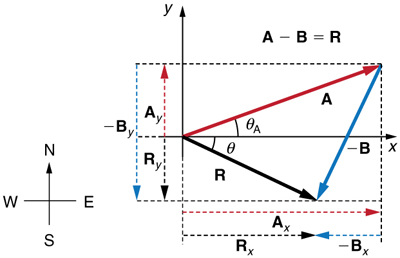
A has magnitude; a also has direction. For a A at angle θ from +x, Aₓ = A cos θ and Aᵧ = A sin θ. Add components separately, then recover magnitude √(Aₓ² + Aᵧ²); use component signs to select the direction quadrant. Subtracting a means adding its negative. Convert units before calculation: 1 = 10⁻² m. can reject an equation, but cannot determine dimensionless numerical factors.

Source: College Physics 2E 2 — Section Summary · 3.3 Vector Addition and Subtraction: Analytical Methods

Read motion from slopes and areas

Δx is signed final minus initial position; distance counts the entire path. Average is Δx/Δt, whereas average speed is distance/time. Instantaneous is the tangent slope of position versus time. is the slope of versus time; signed area under gives . For constant only, v = + at, Δx = v₀t + ½at², and v² = v₀² + 2aΔx. In free fall near Earth, is approximately 9.8 m/s² downward even at the trajectory’s highest point.

Source: College Physics 2E 2 — Section Summary · 3.3 Vector Addition and Subtraction: Analytical Methods

Apply it

Try before revealing the answer. A runner moves 30 m east and 40 m north in 10 s. Find distance, magnitude, average speed, and average magnitude.

Worked answer

Distance = 70 m; magnitude = √(30² + 40²) = 50 m. Average speed = 7 m/s, but average magnitude = 5 m/s, directed 53° north of east. The components are 3 m/s east and 4 m/s north.

Source: College Physics 2E 2 — Section Summary · 3.3 Vector Addition and Subtraction: Analytical Methods

3.3 Addition and Subtraction: Analytical Methods — figures and tables

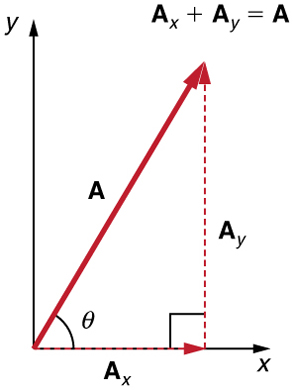
In the given figure a dotted vector A sub x is drawn from the origin along the x axis. From the head of the vector A sub x another vector A sub y is drawn in the upward direction. Their resultant vector A is drawn from the tail of the vector A sub x to the head of the vector A sub y at an angle theta from the x axis. On the graph a vector A, inclined at an angle theta with x axis is shown. Therefore vector A is the sum of the vectors A sub x and A sub y.
Figure 3.24 — 3.3 Addition and Subtraction: Analytical Methods

Figure 3.24 The vector A A , with its tail at the origin of an x , y -coordinate system, is shown together with its x - and y -components, A x A x and A y A y . These vectors form a right triangle. The analytical relationships among these vectors are summarized below.

Paul Peter Urone and Roger Hinrichs, College Physics 2E, OpenStax. · CC BY-NC-SA 4.0 · Original image ↗ · Access for free ↗
]A dotted vector A sub x whose magnitude is equal to A cosine theta is drawn from the origin along the x axis. From the head of the vector A sub x another vector A sub y whose magnitude is equal to A sine theta is drawn in the upward direction. Their resultant vector A is drawn from the tail of the vector A sub x to the head of the vector A-y at an angle theta from the x axis. Therefore vector A is the sum of the vectors A sub x and A sub y.
Figure 3.25 — 3.3 Addition and Subtraction: Analytical Methods

Figure 3.25 The magnitudes of the vector components A x A x and A y A y can be related to the resultant vector A A and the angle θ θ with trigonometric identities. Here we see that A x = A cos θ A x = A cos θ and A y = A sin θ A y = A sin θ .

Paul Peter Urone and Roger Hinrichs, College Physics 2E, OpenStax. · CC BY-NC-SA 4.0 · Original image ↗ · Access for free ↗
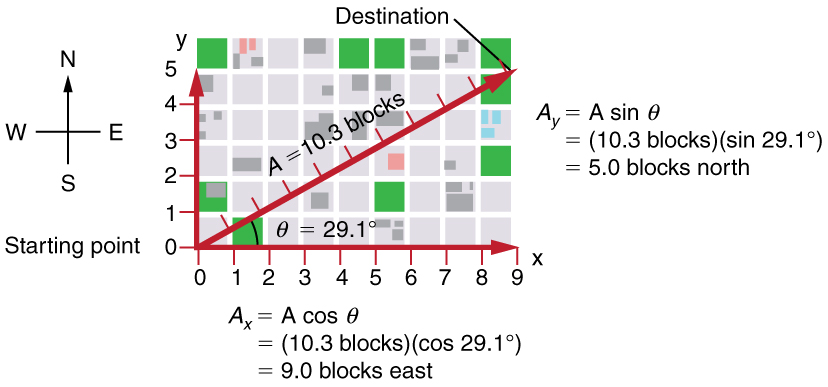
In the given figure a vector A of magnitude ten point three blocks is inclined at an angle twenty nine point one degrees to the positive x axis. The horizontal component A sub x of vector A is equal to A cosine theta which is equal to ten point three blocks multiplied to cosine twenty nine point one degrees which is equal to nine blocks east. Also the vertical component A sub y of vector A is equal to A sin theta is equal to ten point three blocks multiplied to sine twenty nine point one degrees,  which is equal to five point zero blocks north.
Figure 3.26 — 3.3 Addition and Subtraction: Analytical Methods

Figure 3.26 We can use the relationships A x = A cos θ A x = A cos θ and A y = A sin θ A y = A sin θ to determine the magnitude of the horizontal and vertical component vectors in this example.

Paul Peter Urone and Roger Hinrichs, College Physics 2E, OpenStax. · CC BY-NC-SA 4.0 · Original image ↗ · Access for free ↗
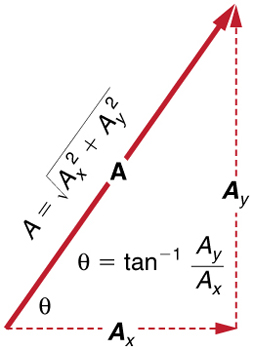
Vector A is shown with its horizontal and vertical components A sub x and A sub y respectively. The magnitude of vector A is equal to the square root of A sub x squared plus A sub y squared. The angle theta of the vector A with the x axis is equal to inverse tangent of A sub y over A sub x
Figure 3.27 — 3.3 Addition and Subtraction: Analytical Methods

Figure 3.27 The magnitude and direction of the resultant vector can be determined once the horizontal and vertical components A x A x and A y A y have been determined.

Paul Peter Urone and Roger Hinrichs, College Physics 2E, OpenStax. · CC BY-NC-SA 4.0 · Original image ↗ · Access for free ↗
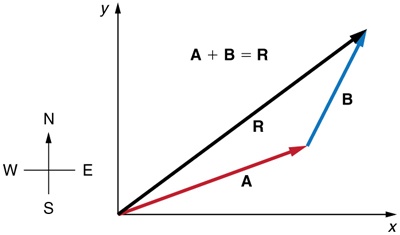
Two vectors A and B are shown. The tail of vector B is at the head of vector A and the tail of the vector A is at origin. Both the vectors are in the first quadrant. The resultant R of these two vectors extending from the tail of vector A to the head of vector B is also shown.
Figure 3.28 — 3.3 Addition and Subtraction: Analytical Methods

Figure 3.28 Vectors A A and B B are two legs of a walk, and R R is the resultant or total displacement. You can use analytical methods to determine the magnitude and direction of R R .

Paul Peter Urone and Roger Hinrichs, College Physics 2E, OpenStax. · CC BY-NC-SA 4.0 · Original image ↗ · Access for free ↗
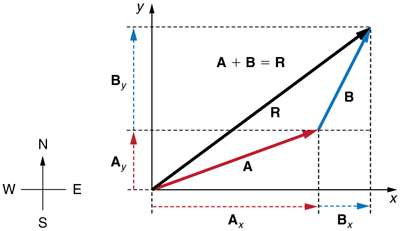
Two vectors A and B are shown. The tail of the vector B is at the head of vector A and the tail of the vector A is at origin. Both the vectors are in the first quadrant. The resultant R of these two vectors extending from the tail of vector A to the head of vector B is also shown. The horizontal and vertical components of the vectors A and B are shown with the help of dotted lines. The vectors labeled as A sub x and A sub y are the components of vector A, and B sub x and B sub y as the components of vector B..
Figure 3.29 — 3.3 Addition and Subtraction: Analytical Methods

Figure 3.29 To add vectors A A and B B , first determine the horizontal and vertical components of each vector. These are the dotted vectors A x A x , A y A y , B x B x and B y B y shown in the image.

Paul Peter Urone and Roger Hinrichs, College Physics 2E, OpenStax. · CC BY-NC-SA 4.0 · Original image ↗ · Access for free ↗
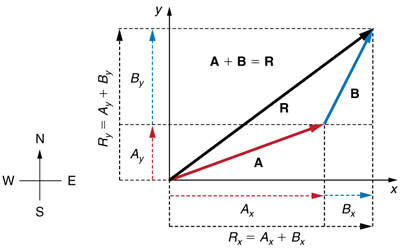
Two vectors A and B are shown. The tail of vector B is at the head of vector A and the tail of the vector A is at origin. Both the vectors are in the first quadrant. The resultant R of these two vectors extending from the tail of vector A to the head of vector B is also shown. The vectors A and B are resolved into the horizontal and vertical components shown as dotted lines parallel to x axis and y axis respectively. The horizontal components of vector A and vector B are labeled as A sub x and B sub x and the horizontal component of the resultant R is labeled at R sub x and is equal to A sub x plus B sub x. The vertical components of vector A and vector B are labeled as A sub y and B sub y and the vertical components of the resultant R is labeled as R sub y is equal to A sub y plus B sub y.
Figure 3.30 — 3.3 Addition and Subtraction: Analytical Methods

Figure 3.30 The magnitude of the vectors A x A x and B x B x add to give the magnitude R x R x of the resultant vector in the horizontal direction. Similarly, the magnitudes of the vectors A y A y and B y B y add to give the magnitude R y R y of the resultant vector in the vertical direction.

Paul Peter Urone and Roger Hinrichs, College Physics 2E, OpenStax. · CC BY-NC-SA 4.0 · Original image ↗ · Access for free ↗
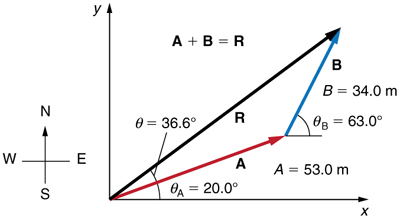
Two vectors A and B are shown. The tail of the vector A is at origin. Both the vectors are in the first quadrant. Vector A is of magnitude fifty three units and is inclined at an angle of twenty degrees to the horizontal. From the head of the vector A another vector B of magnitude 34 units is drawn and is inclined at angle sixty three degrees with the horizontal. The resultant of two vectors is drawn from the tail of the vector A to the head of the vector B.
Figure 3.31 — 3.3 Addition and Subtraction: Analytical Methods

Figure 3.31 Vector A A has magnitude 53 . 0 m 53 . 0 m and direction 20 . 0 º 20 . 0 º north of the x -axis. Vector B B has magnitude 34 . 0 m 34 . 0 m and direction 63 . 0 º 63 . 0 º north of the x -axis. You can use analytical methods to determine the magnitude and direction of R R .

Paul Peter Urone and Roger Hinrichs, College Physics 2E, OpenStax. · CC BY-NC-SA 4.0 · Original image ↗ · Access for free ↗
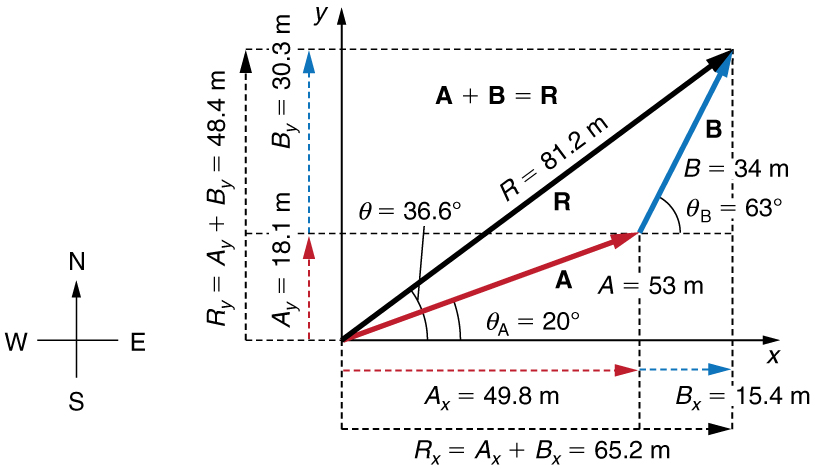
The addition of two vectors A and B is shown. Vector A is of magnitude fifty three units and is inclined at an angle of twenty degrees to the horizontal. Vector B is of magnitude thirty four units and is inclined at angle sixty three degrees to the horizontal. The components of vector A are shown as dotted vectors A X is equal to forty nine point eight meter along x axis and A Y is equal to eighteen point one meter along Y axis. The components of vector B are also shown as dotted vectors B X is equal to fifteen point four meter and B Y is equal to thirty point three meter. The horizontal component of the resultant R X is equal to A X plus B X is equal to sixty five point two meter. The vertical component of the resultant R Y is equal to A Y plus B Y is equal to forty eight point four meter. The magnitude of the resultant of two vectors is eighty one point two meters. The direction of the resultant R is in thirty six point six degree from the vector A in anticlockwise direction.
Figure 3.32 — 3.3 Addition and Subtraction: Analytical Methods

Figure 3.32 Using analytical methods, we see that the magnitude of R R is 81 . 2 m 81 . 2 m and its direction is 36 . 6º 36 . 6º north of east.

Paul Peter Urone and Roger Hinrichs, College Physics 2E, OpenStax. · CC BY-NC-SA 4.0 · Original image ↗ · Access for free ↗
In this figure, the subtraction of two vectors A and B is shown. A red colored vector A is inclined at an angle theta A to the positive of x axis. From the head of vector A a blue vector negative B is drawn. Vector B is in west of south direction. The resultant of the vector A and vector negative B is shown as a black vector R from the tail of vector A to the head of vector negative B. The resultant R is inclined to x axis at an angle theta below the x axis. The components of the vectors are also shown along the coordinate axes as dotted lines of their respective colors.
Figure 3.33 — 3.3 Addition and Subtraction: Analytical Methods

Figure 3.33 The subtraction of the two vectors shown in Figure 3.28 . The components of –B –B are the negatives of the components of B B . The method of subtraction is the same as that for addition.

Paul Peter Urone and Roger Hinrichs, College Physics 2E, OpenStax. · CC BY-NC-SA 4.0 · Original image ↗ · Access for free ↗

Source: 3.3 Vector Addition and Subtraction: Analytical Methods

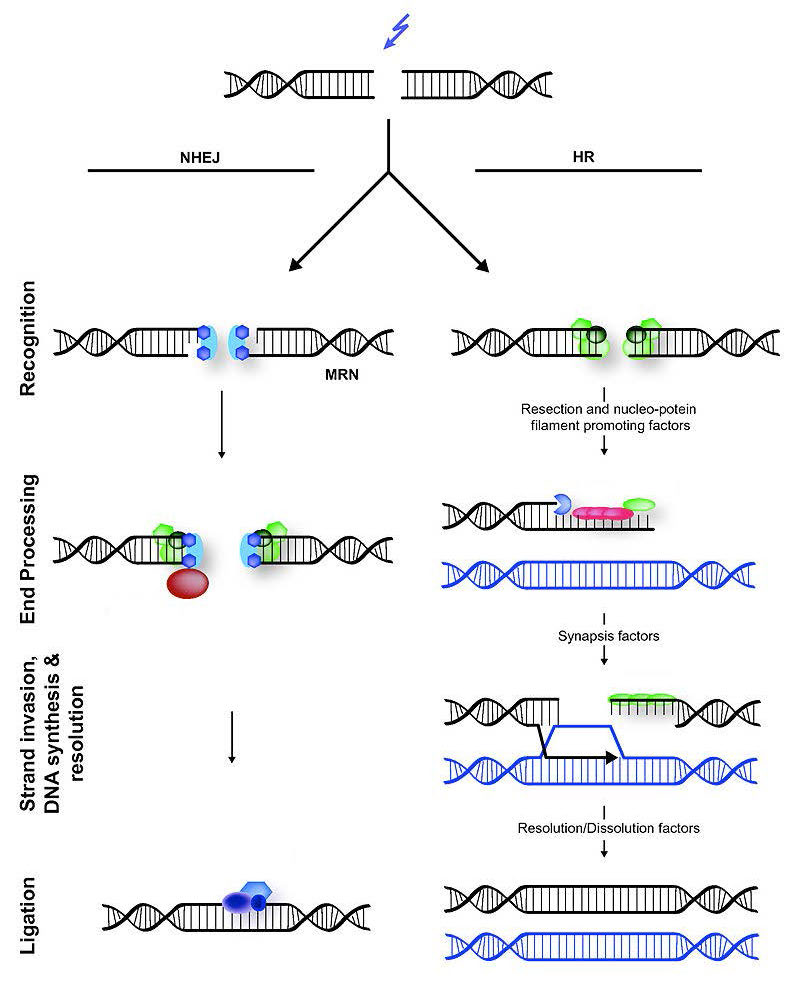
106 terms, alphabetically ordered

acceleration

Rate of change of , measured in m/s².

Read explanation · OpenStax ↗
Acid · ·

In the Brønsted–Lowry model, a substance that can donate a . Acidic have a higher activity than water.

Read explanation · OpenStax ↗
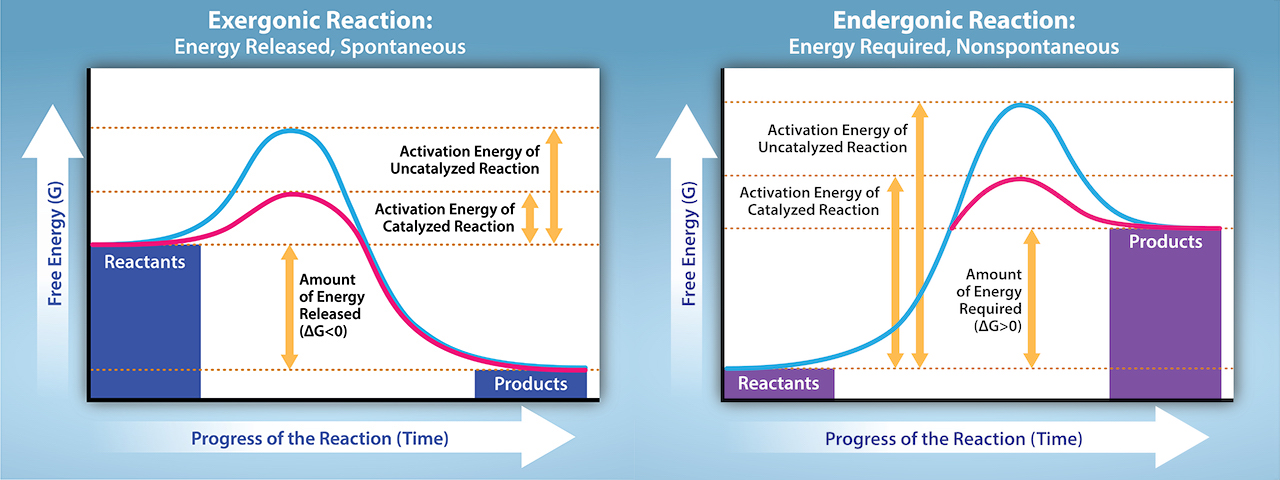
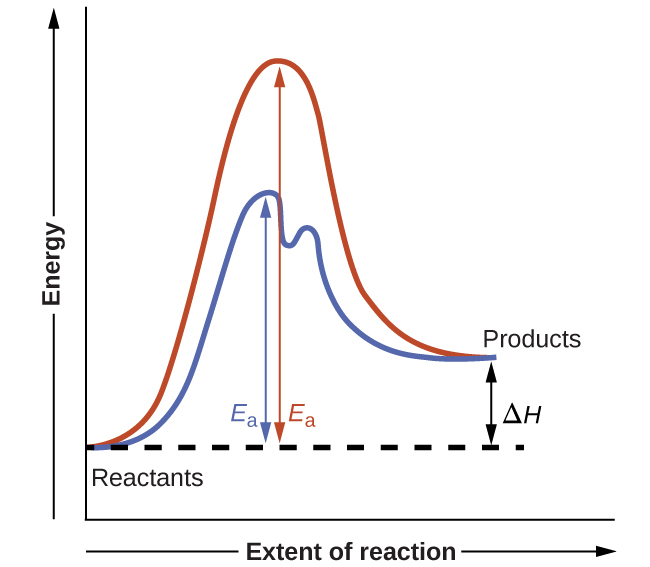
Activation energy ·

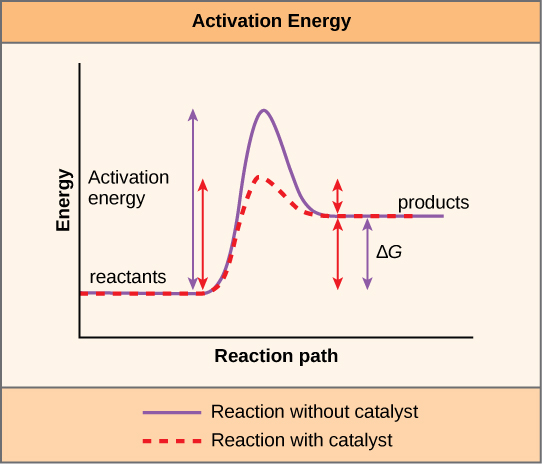
The energy barrier that must overcome to reach a and undergo .

Read explanation · OpenStax ↗
Adenosine triphosphate

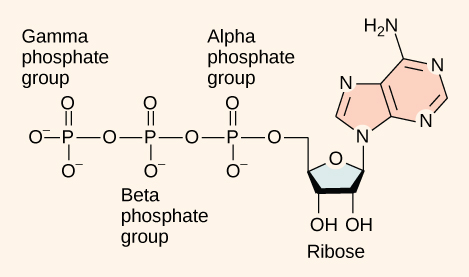
An energy-carrying ; its powers many cellular processes, including cycles.

Read explanation · OpenStax ↗
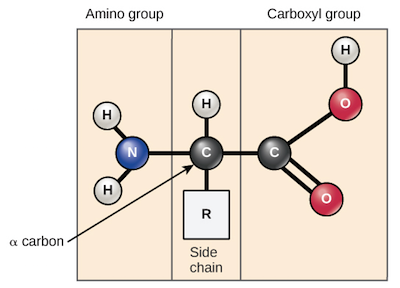
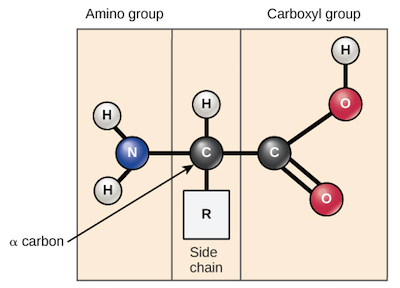
Alpha carbon · ·

The central carbon next to the carboxyl carbon. In a standard it binds an , hydrogen, and .

Read explanation · OpenStax ↗
Amide · · ·

A group containing a carbon bonded to nitrogen. are amide linkages.

Read explanation · OpenStax ↗
Amino acid

A building block containing amino and and a characteristic .

Read explanation · OpenStax ↗
Amino acid residue · ·

The part of an incorporated into a chain. Residue can also describe another building block within a larger .

Read explanation · OpenStax ↗
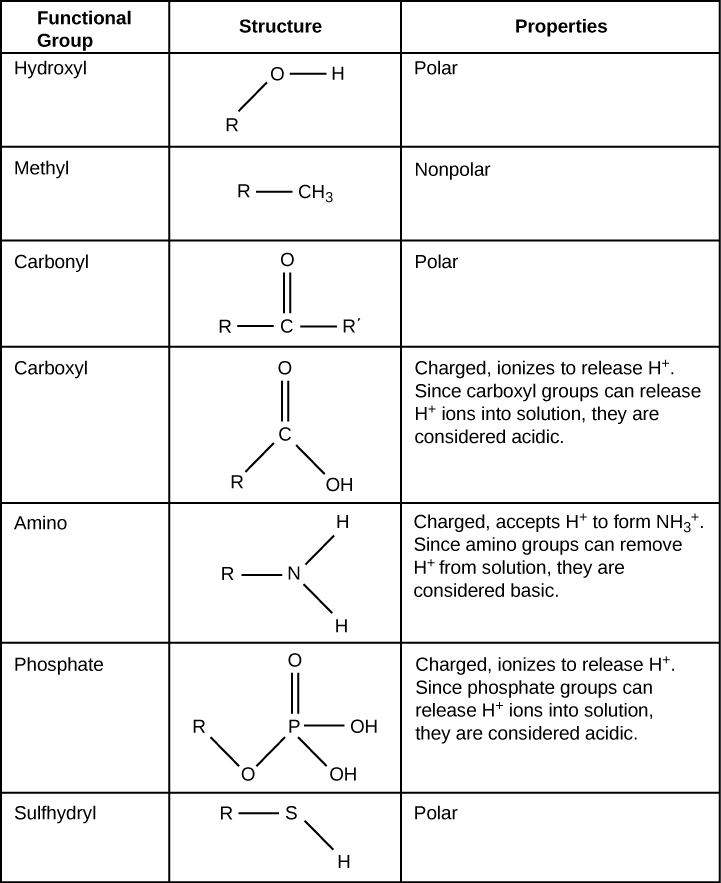
Amino group · · ·

A nitrogen-containing . A free ’s amino group is typically (NH₃⁺) near physiological ; ’s ring nitrogen is an exception to this formula.

Read explanation · OpenStax ↗
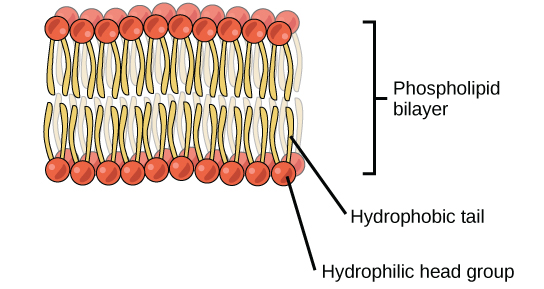
Amphipathic

Having both a region and a region, as in a or .

Read explanation · OpenStax ↗
amplitude

Maximum from an oscillation’s position.

Read explanation · OpenStax ↗
Aqueous solution ·

A in which water is the .

Read explanation · OpenStax ↗
Atom

The smallest unit of an element that retains its chemical identity; it has a surrounded by .

Read explanation · OpenStax ↗
Biomolecule

A made by or involved in living systems, including , , , and .

Read explanation · OpenStax ↗
Blotting ·

Transfer of separated or to a so a specific target can be detected.

Read explanation · Thermo Fisher ↗
Brønsted–Lowry base · · · · · · · · · · ·

In the Brønsted–Lowry model, a substance that can accept a . Basic solutions have lower activity than water.

Read explanation · OpenStax ↗
Carbohydrate

A class of including sugars and their , used for energy storage, structure, and recognition.

Read explanation · OpenStax ↗
Carbonyl group · ·

A carbon double-bonded to oxygen, C=O; present in and many other .

Read explanation · OpenStax ↗
Carboxyl group · ·

An , COOH. In free it is usually to COO⁻ near physiological .

Read explanation · OpenStax ↗
Catalyst · ·

A substance that speeds a by providing a pathway with lower and is regenerated rather than consumed overall.

Read explanation · OpenStax ↗
Centimeter

A unit of length equal to one hundredth of a meter.

Read explanation · NIST ↗
Chemical reaction ·

A process that rearranges and chemical bonds, converting into .

Read explanation · OpenStax ↗
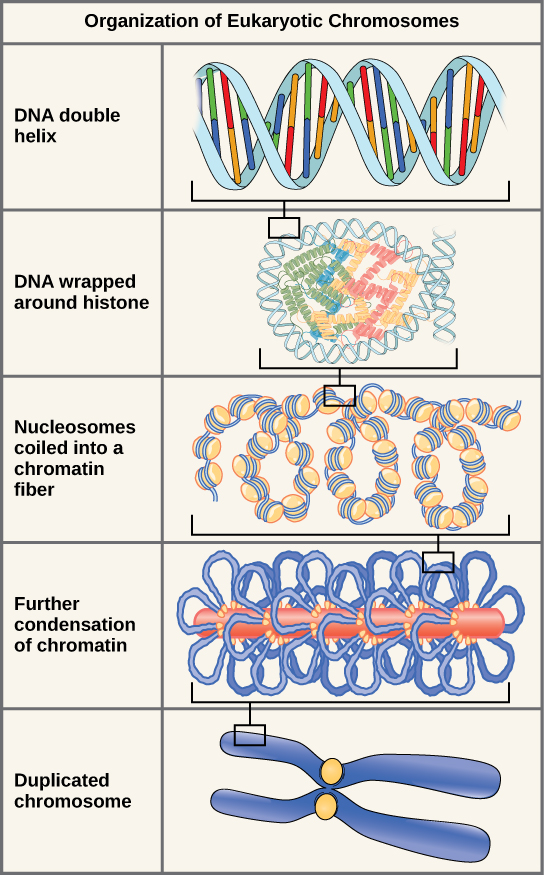
Chromosome ·

An organized with associated that carries . A replicated chromosome has two .

Read explanation · OpenStax ↗
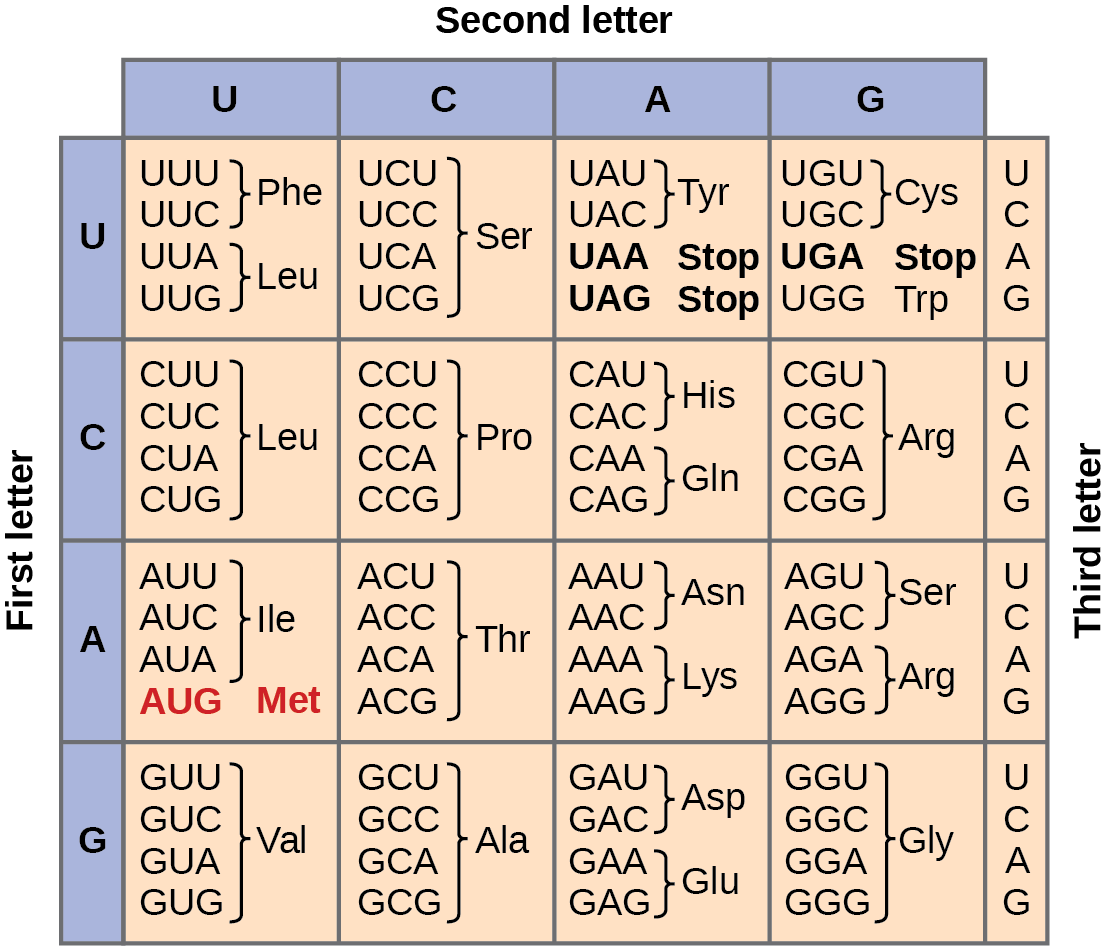
Codon

A sequence of three that specifies an or a stop signal.

Read explanation · OpenStax ↗
Concentration

The amount of a substance in a specified volume or mass of mixture.

Read explanation · OpenStax ↗
Covalent bond · ·

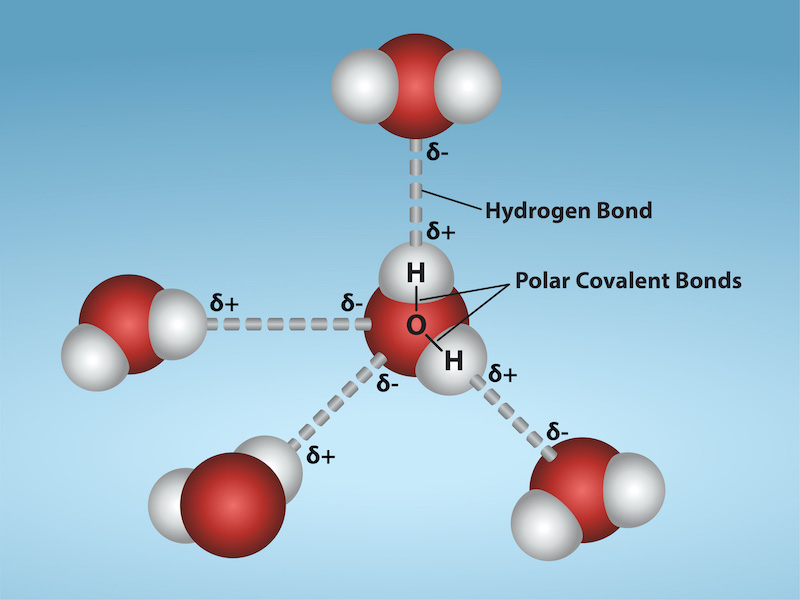
A bond in which share pairs. and are covalent.

Read explanation · OpenStax ↗
Cysteine ·

An with a . Two cysteines can form a .

Read explanation · OpenStax ↗
Deoxyribonucleic acid

The that stores genetic information used to specify and sequences.

Read explanation · OpenStax ↗
Deprotonation

Removal of a from a or group; this changes its by minus one.

Read explanation · OpenStax ↗
Detergent

An substance that can associate with both water and material; detergents can disrupt or interactions.

Read explanation · Thermo Fisher ↗
dimensional analysis

Checking or relating expressions by their underlying units such as length, mass, and time.

Read explanation · OpenStax ↗
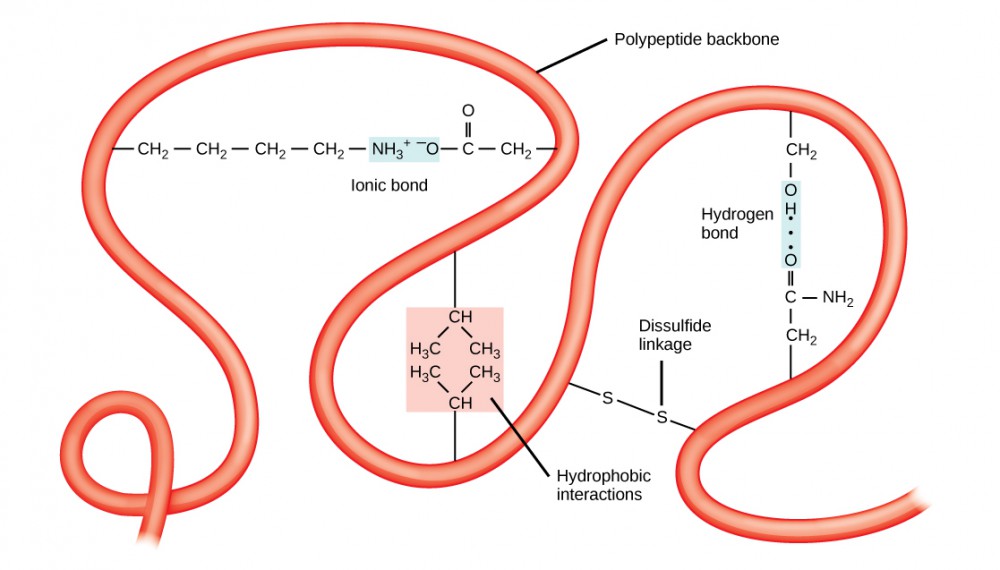
Disulfide bond · · ·

A covalent sulfur–sulfur bond formed by of two , which can stabilize structure.

Read explanation · NCBI Bookshelf ↗
DNA replication

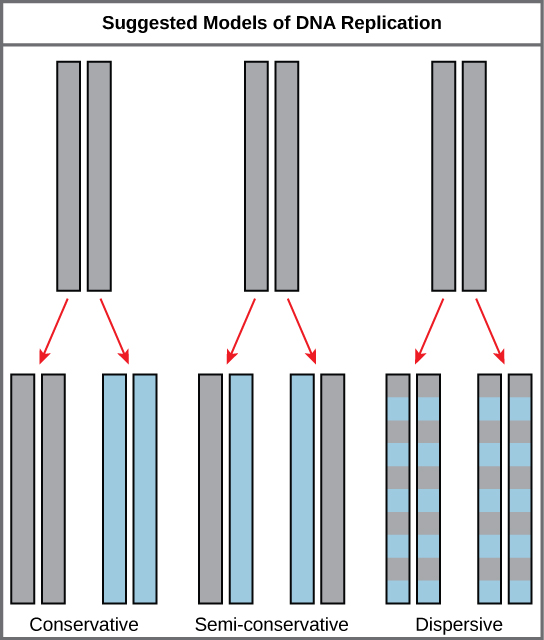
Copying so genetic information can be passed to daughter cells. Each guides a complementary new strand.

Read explanation · OpenStax ↗
Electric charge · · ·

An electrical property that can be positive or negative. Opposite charges attract and like charges repel; net charge is the sum of all charges on a particle.

Read explanation · OpenStax ↗
Electron

A negatively subatomic particle. Electron sharing and transfer determine much of chemical bonding.

Read explanation · OpenStax ↗
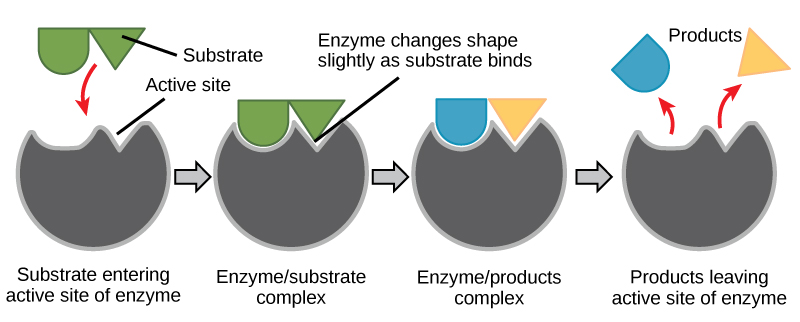
Enzyme

A biological that speeds a without being consumed. Most enzymes are .

Read explanation · OpenStax ↗
Equilibrium

A state where opposing processes occur at equal rates, so macroscopic or other properties remain constant.

Read explanation · OpenStax ↗
Eukaryote ·

An organism whose cells have a -enclosed ; animals, plants, fungi, and protists are eukaryotes.

Read explanation · OpenStax ↗
Functional group

A group of whose chemical behavior gives a characteristic and properties.

Read explanation · OpenStax ↗
Gene

A sequence that contributes to a functional or , together with the information needed to express it.

Read explanation · OpenStax ↗
Gene expression

Production of a functional from a , including and, for -coding , .

Read explanation · NCBI Bookshelf ↗
Hydrogen ion · ·

A positively hydrogen species. H⁺ denotes a , which is hydrated in water; its activity determines .

Read explanation · OpenStax ↗
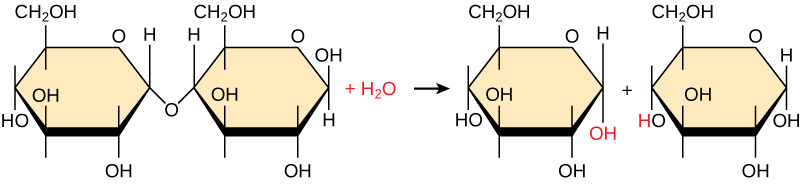
Hydrolysis

Breaking a chemical bond by adding water. hydrolysis separates .

Read explanation · OpenStax ↗
Hydrophilic

Interacting favorably with water, typically because a group is or .

Read explanation · OpenStax ↗
Hydrophobic

Interacting poorly with water. often gather in a ’s interior.

Read explanation · OpenStax ↗
Hydroxide ion ·

The negatively OH⁻. Basic contain a higher hydroxide ion activity than water at the same temperature.

Read explanation · OpenStax ↗
Initial reaction rate · · · ·

The early rate of formation, measured before substantial depletion or accumulation, usually after the brief binding transient.

Read explanation · Biology LibreTexts ↗
Ion · ·

An or with a net because its numbers of and do not balance.

Read explanation · OpenStax ↗
kinematics

Description of motion without specifying its causes.

Read explanation · OpenStax ↗
linkage

A tendency of nearby on the same to be inherited together.

Read explanation · OpenStax ↗
Lipid

A broad class of largely or , including fats, , and steroids.

Read explanation · OpenStax ↗
locus

The specific position of a or other feature.

Read explanation · OpenStax ↗
Logarithm · · ·

The exponent needed to obtain a number from a chosen fixed number. For decimal logarithms, log₁₀(100) = 2 because 10² = 100; uses the negative decimal logarithm of activity.

Read explanation · OpenStax ↗
mechanical power

Rate of energy transfer, measured in watts.

Read explanation · OpenStax ↗
mechanical work

Energy transferred by a force acting through ; the force component parallel to motion contributes.

Read explanation · OpenStax ↗
Membrane · · · ·

A thin boundary or sheet. Cell membranes are bilayers containing ; membranes are synthetic supports that hold or for detection.

Read explanation · OpenStax ↗
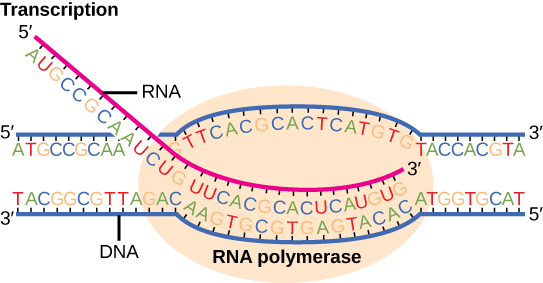
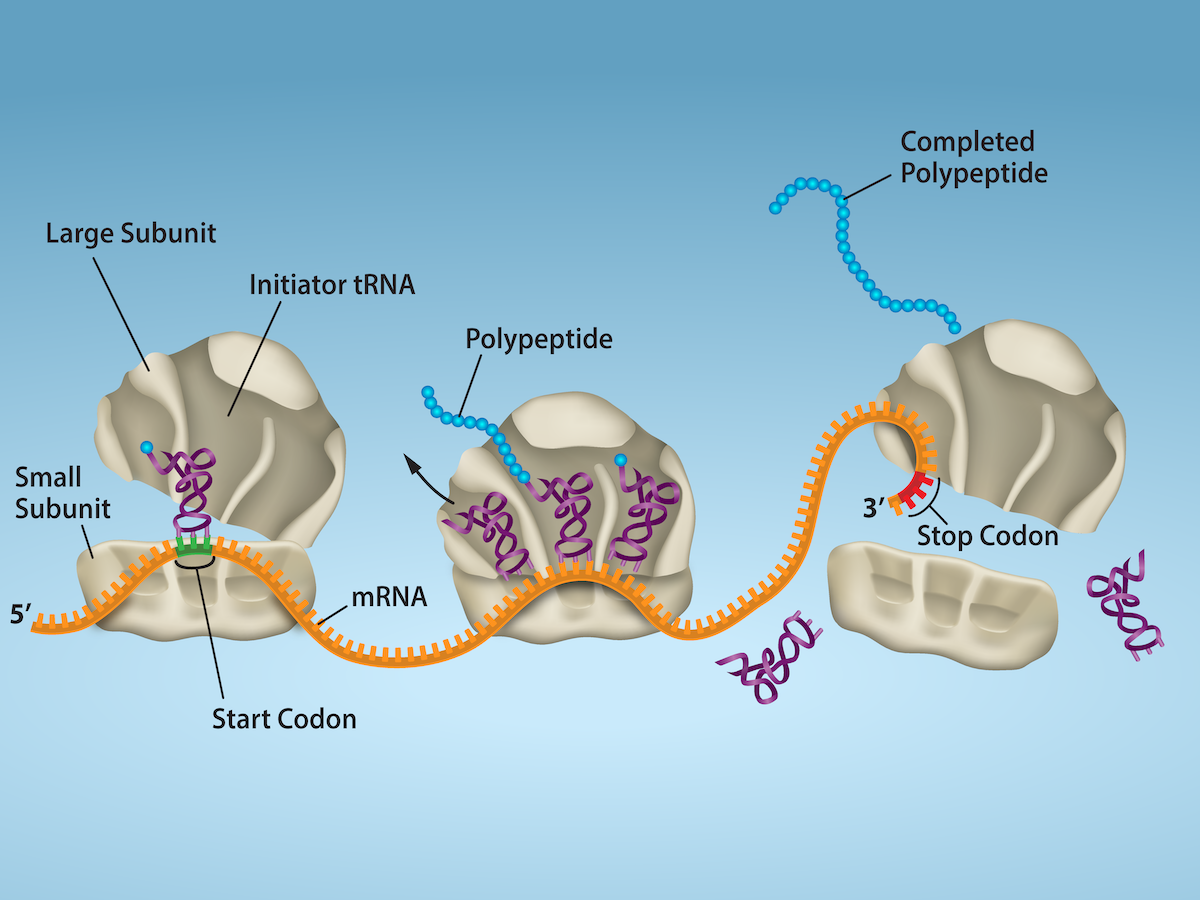
Messenger RNA ·

An that carries coding information used by to synthesize a .

Read explanation · OpenStax ↗
Molecular chaperone · ·

A that assists other in folding or prevents , without specifying their sequence.

Read explanation · NCBI Bookshelf ↗
Molecule

Two or more joined by . A molecule may be electrically or carry a .

Read explanation · OpenStax ↗
Neutral

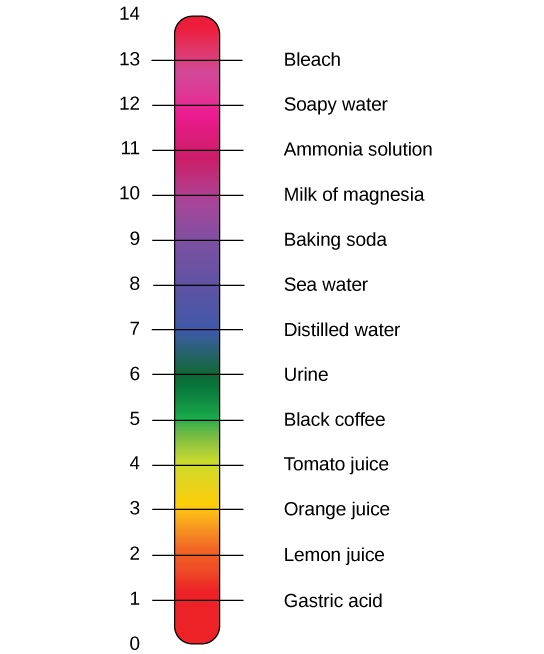
Having no net . For a , neutral instead means equal and activities; its is about 7 at 25 °C.

Read explanation · OpenStax ↗
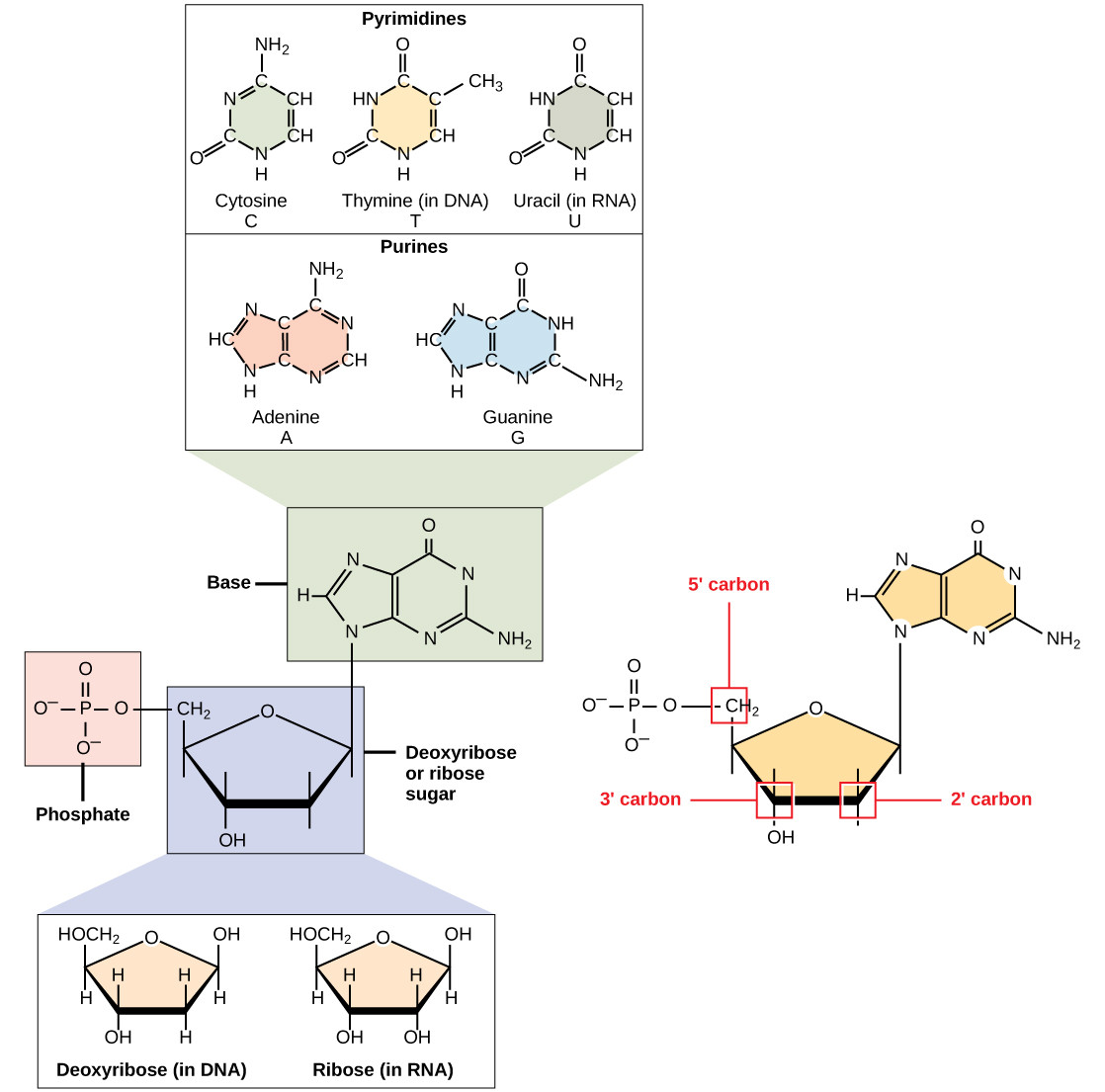
Nitrogenous base · · ·

A nitrogen-containing ring component of ; its pairing interactions help specify sequences.

Read explanation · OpenStax ↗
Nonpolar ·

Lacking a substantial separation of . Nonpolar groups generally interact poorly with water.

Read explanation · OpenStax ↗
Nucleic acid

A of , such as or , used in information storage, expression, and other cellular functions.

Read explanation · OpenStax ↗
Nucleotide

A joined to a sugar and one or more .

Read explanation · OpenStax ↗
Nucleus ·

A -enclosed compartment containing most of a cell’s .

Read explanation · OpenStax ↗
oscillation frequency ·

Number of repeated cycles per unit time, measured in hertz.

Read explanation · OpenStax ↗
oscillation phase ·

Position within an oscillatory cycle relative to a reference.

Read explanation · OpenStax ↗
Oxidation ·

Loss of or an increase in oxidation state. Oxidizing two can form a .

Read explanation · OpenStax ↗
Peptide

A chain of joined by ; the term commonly describes chains shorter than a typical .

Read explanation · OpenStax ↗
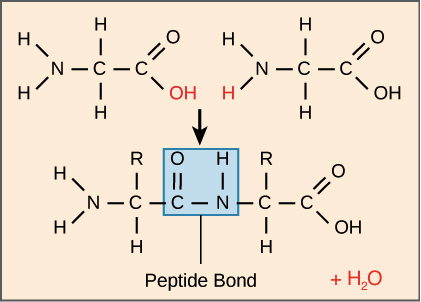
Peptide bond ·

A covalent between the carboxyl carbon of one and the amino nitrogen of the next.

Read explanation · OpenStax ↗
pH

A measure of , defined as the negative of activity. Lower pH means greater ; pH influences .

Read explanation · OpenStax ↗
Phosphate group ·

A phosphorus-containing group bonded to oxygens; phosphate groups occur in , , and modified .

Read explanation · OpenStax ↗
Phospholipid

An with a -containing region and tails; a major component of cellular .

Read explanation · OpenStax ↗
physical displacement ·

Signed or difference between final and initial position.

Read explanation · OpenStax ↗
Polar

Having an uneven distribution of . Polar groups often interact favorably with water.

Read explanation · OpenStax ↗
Polymer

A large made from many linked molecular building blocks.

Read explanation · OpenStax ↗
Polypeptide

A chain of connected by . A functional can contain one or several such chains.

Read explanation · OpenStax ↗
Proline ·

An whose loops back to the nitrogen, restricting rotation and often creating bends.

Read explanation · OpenStax ↗
Protein

One or more folded chains that perform biological roles such as , transport, signaling, or structural support.

Read explanation · OpenStax ↗
Protein aggregation · ·

Association of into larger clusters, often when exposed surfaces of unfolded stick together.

Read explanation · NCBI Bookshelf ↗
Protein backbone ·

The repeating nitrogen–alpha-carbon– chain of a , excluding its variable .

Read explanation · OpenStax ↗
Proton

A positively subatomic particle. In – chemistry, donating a proton means transferring a .

Read explanation · OpenStax ↗
Protonation

Addition of a to an , , or ; this changes its by plus one.

Read explanation · OpenStax ↗
R group · ·

The variable side chain attached to an ’s . It determines identity, , , and chemical behavior.

Read explanation · OpenStax ↗
Reactant

A starting substance transformed during a .

Read explanation · OpenStax ↗
Reaction intermediate · ·

A species formed in one step and consumed in another. It occupies a local energy minimum between .

Read explanation · OpenStax ↗
Reaction product ·

A substance formed by a .

Read explanation · OpenStax ↗
Ribonucleic acid ·

A with roles in , regulation, and ; carries -coding information.

Read explanation · OpenStax ↗
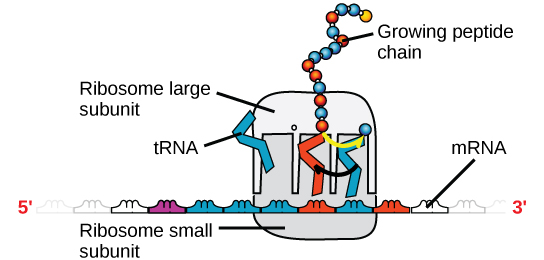
Ribosome ·

A complex of and that translates into a .

Read explanation · OpenStax ↗
scalar

Quantity specified by magnitude without a spatial direction.

Read explanation · OpenStax ↗
Sister chromatid

One of the two copies of a produced by . An intact sister chromatid can supply a template for accurate repair.

Read explanation · Biology LibreTexts / Oregon State University ↗
Solubility ·

The amount of a substance that can dissolve in a under specified conditions. Soluble means able to dissolve; insoluble means only very slightly soluble in that .

Read explanation · OpenStax ↗
Solute

A dissolved component of a .

Read explanation · OpenStax ↗
Solution

A homogeneous mixture in which are dissolved in a .

Read explanation · OpenStax ↗
Solvent

The component of a that dissolves other substances, usually the component present in the greatest amount.

Read explanation · OpenStax ↗
spatial vector ·

Quantity with both magnitude and direction, combined by adding components.

Read explanation · OpenStax ↗
standing wave

Stationary interference pattern with fixed and antinodes.

Read explanation · OpenStax ↗
Substrate

A that an binds and chemically transforms.

Read explanation · OpenStax ↗
Template strand · · ·

A preexisting strand whose sequence guides complementary nucleic- synthesis.

Read explanation · OpenStax ↗
Thiol group · · · ·

A sulfur bonded to hydrogen, –SH. thiols can form through .

Read explanation · OpenStax ↗
Transcription

Synthesis of using a template.

Read explanation · OpenStax ↗
Transition state

A fleeting, high-energy arrangement at a barrier. It is an energy maximum along the path, rather than a stable .

Read explanation · OpenStax ↗
Translation ·

Synthesis of a on a using the sequence of in .

Read explanation · OpenStax ↗
velocity

Rate of change of position, including direction.

Read explanation · OpenStax ↗
wave intensity ·

crossing unit area, measured in W/m².

Read explanation · OpenStax ↗
wave node ·

Point of zero in a .

Read explanation · OpenStax ↗

College Physics 2E 2 — Section Summary

OpenStax · College Physics 2E 2 — Section Summary ↗
Instructional page including learning objectives, examples, figures, source tables and questions. Site navigation and embedded media players are omitted; source media links remain available.

2.1 Displacement

  • is the study of motion without considering its causes. In this chapter, it is limited to motion along a straight line, called one-dimensional motion.
  • is the change in position of an object.
  • In symbols, Δx is defined to be
    Δx=xf−x0,
    where x0 is the initial position and xf is the final position. In this text, the Greek letter Δ (delta) always means “change in” whatever quantity follows it. The SI unit for is the meter (m). has a direction as well as a magnitude.
  • When you start a problem, assign which direction will be positive.
  • Distance is the magnitude of between two positions.
  • Distance traveled is the total length of the path traveled between two positions.

2.2 Vectors, Scalars, and Coordinate Systems

  • A is any quantity that has magnitude and direction.
  • A is any quantity that has magnitude but no direction.
  • and are , whereas distance and speed are scalars.
  • In one-dimensional motion, direction is specified by a plus or minus sign to signify left or right, up or down, and the like.

2.3 Time, Velocity, and Speed

  • Time is measured in terms of change, and its SI unit is the second (s). Elapsed time for an event is
    Δt=tf−t0,
    where tf is the final time and t0 is the initial time. The initial time is often taken to be zero, as if measured with a stopwatch; the elapsed time is then just t.
  • Average v- is defined as divided by the travel time. In symbols, average is
    v - = Δx Δt = x f − x 0 t f − t 0 .
  • The SI unit for is m/s.
  • is a and thus has a direction.
  • Instantaneous v is the at a specific instant or the average for an infinitesimal interval.
  • Instantaneous speed is the magnitude of the instantaneous .
  • Instantaneous speed is a quantity, as it has no direction specified.
  • Average speed is the total distance traveled divided by the elapsed time. (Average speed is not the magnitude of the average .) Speed is a quantity; it has no direction associated with it.

2.4 Acceleration

2.5 Motion Equations for Constant Acceleration in One Dimension

  • To simplify calculations we take to be constant, so that a-=a at all times.
  • We also take initial time to be zero.
  • Initial position and are given a subscript 0; final values have no subscript. Thus,
    Δt = t Δx = x − x 0 Δv = v − v 0
  • The following kinematic equations for motion with constant a are useful:
    x = x 0 + v - t
    v - = v 0 + v 2
    v = v 0 + at
    x = x 0 + v 0 t + 1 2 at 2
    v 2 = v 0 2 + 2a x − x 0
  • In vertical motion, y is substituted for x.

2.6 Problem-Solving Basics for One-Dimensional Kinematics

  • The six basic problem solving steps for physics are:

    Step 1. Examine the situation to determine which physical principles are involved.

    Step 2. Make a list of what is given or can be inferred from the problem as stated (identify the knowns).

    Step 3. Identify exactly what needs to be determined in the problem (identify the unknowns).

    Step 4. Find an equation or set of equations that can help you solve the problem.

    Step 5. Substitute the knowns along with their units into the appropriate equation, and obtain numerical complete with units.

    Step 6. Check the answer to see if it is reasonable: Does it make sense?

2.7 Falling Objects

  • An object in free-fall experiences constant if air resistance is negligible.
  • On Earth, all free-falling objects have an due to gravity g, which averages
    g=9.80 m/s2.
  • Whether the a should be taken as +g or −g is determined by your choice of coordinate system. If you choose the upward direction as positive, a=−g=−9.80 m/s2 is negative. In the opposite case, a=+g=9.80 m/s2 is positive. Since is constant, the kinematic equations above can be applied with the appropriate +g or −g substituted for a.
  • For objects in free-fall, up is normally taken as positive for , , and .

2.8 Graphical Analysis of One-Dimensional Motion

3.3 Vector Addition and Subtraction: Analytical Methods

OpenStax · 3.3 Vector Addition and Subtraction: Analytical Methods ↗
Instructional page including learning objectives, examples, figures, source tables and questions. Site navigation and embedded media players are omitted; source media links remain available.

Learning Objectives

By the end of this section, you will be able to:

  • Understand the rules of addition and subtraction using analytical methods.
  • Apply analytical methods to determine vertical and horizontal component .
  • Apply analytical methods to determine the magnitude and direction of a resultant .

Analytical methods of addition and subtraction employ geometry and simple trigonometry rather than the ruler and protractor of graphical methods. Part of the graphical technique is retained, because are still represented by arrows for easy visualization. However, analytical methods are more concise, accurate, and precise than graphical methods, which are limited by the accuracy with which a drawing can be made. Analytical methods are limited only by the accuracy and precision with which physical quantities are known.

Resolving a into Perpendicular Components

Analytical techniques and right triangles go hand-in-hand in physics because (among other things) motions along perpendicular directions are independent. We very often need to separate a into perpendicular components. For example, given a like A in Figure 3.24, we may wish to find which two perpendicular , Ax and Ay, add to produce it.

In the given figure a dotted vector A sub x is drawn from the origin along the x axis. From the head of the vector A sub x another vector A sub y is drawn in the upward direction. Their resultant vector A is drawn from the tail of the vector A sub x to the head of the vector A sub y at an angle theta from the x axis. On the graph a vector A, inclined at an angle theta with x axis is shown. Therefore vector A is the sum of the vectors A sub x and A sub y.
Figure 3.24 — 3.3 Addition and Subtraction: Analytical Methods

Figure 3.24 The vector A A , with its tail at the origin of an x , y -coordinate system, is shown together with its x - and y -components, A x A x and A y A y . These vectors form a right triangle. The analytical relationships among these vectors are summarized below.

Paul Peter Urone and Roger Hinrichs, College Physics 2E, OpenStax. · CC BY-NC-SA 4.0 · Original image ↗ · Access for free ↗

Ax and Ay are defined to be the components of A along the x- and y-axes. The three A, Ax, and Ay form a right triangle:

Ax + Ay = A.
3.3

Note that this relationship between components and the resultant holds only for quantities (which include both magnitude and direction). The relationship does not apply for the magnitudes alone. For example, if Ax=3 m east, Ay=4 m north, and A=5 m north-east, then it is true that the Ax + Ay = A. However, it is not true that the sum of the magnitudes of the is also equal. That is,

3 m+4 m  ≠  5 m
3.4

Thus,

A x + A y ≠ A
3.5

If the A is known, then its magnitude A (its length) and its angle θ (its direction) are known. To find Ax and Ay, its x- and y-components, we use the following relationships for a right triangle.

A x = A cos θ
3.6

and

Ay=Asinθ.
3.7
]A dotted vector A sub x whose magnitude is equal to A cosine theta is drawn from the origin along the x axis. From the head of the vector A sub x another vector A sub y whose magnitude is equal to A sine theta is drawn in the upward direction. Their resultant vector A is drawn from the tail of the vector A sub x to the head of the vector A-y at an angle theta from the x axis. Therefore vector A is the sum of the vectors A sub x and A sub y.
Figure 3.25 — 3.3 Addition and Subtraction: Analytical Methods

Figure 3.25 The magnitudes of the vector components A x A x and A y A y can be related to the resultant vector A A and the angle θ θ with trigonometric identities. Here we see that A x = A cos θ A x = A cos θ and A y = A sin θ A y = A sin θ .

Paul Peter Urone and Roger Hinrichs, College Physics 2E, OpenStax. · CC BY-NC-SA 4.0 · Original image ↗ · Access for free ↗

Suppose, for example, that A is the representing the total of the person walking in a city considered in Kinematics in Two Dimensions: An Introduction and Vector Addition and Subtraction: Graphical Methods.

In the given figure a vector A of magnitude ten point three blocks is inclined at an angle twenty nine point one degrees to the positive x axis. The horizontal component A sub x of vector A is equal to A cosine theta which is equal to ten point three blocks multiplied to cosine twenty nine point one degrees which is equal to nine blocks east. Also the vertical component A sub y of vector A is equal to A sin theta is equal to ten point three blocks multiplied to sine twenty nine point one degrees,  which is equal to five point zero blocks north.
Figure 3.26 — 3.3 Addition and Subtraction: Analytical Methods

Figure 3.26 We can use the relationships A x = A cos θ A x = A cos θ and A y = A sin θ A y = A sin θ to determine the magnitude of the horizontal and vertical component vectors in this example.

Paul Peter Urone and Roger Hinrichs, College Physics 2E, OpenStax. · CC BY-NC-SA 4.0 · Original image ↗ · Access for free ↗

Then A=10.3 blocks and θ = 29.1º , so that

Ax=Acosθ=(10.3 blocks)(cos29.1º)=9.0 blocks
3.8
Ay=Asinθ=(10.3 blocks)(sin29.1º)=5.0 blocks.
3.9

Calculating a Resultant

If the perpendicular components Ax and Ay of a A are known, then A can also be found analytically. To find the magnitude A and direction θ of a from its perpendicular components Ax and Ay, relative to the x-axis, we use the following relationships:

A= A x 2 + A y 2
3.10
θ = tan − 1 ( A y / A x ) .
3.11
Vector A is shown with its horizontal and vertical components A sub x and A sub y respectively. The magnitude of vector A is equal to the square root of A sub x squared plus A sub y squared. The angle theta of the vector A with the x axis is equal to inverse tangent of A sub y over A sub x
Figure 3.27 — 3.3 Addition and Subtraction: Analytical Methods

Figure 3.27 The magnitude and direction of the resultant vector can be determined once the horizontal and vertical components A x A x and A y A y have been determined.

Paul Peter Urone and Roger Hinrichs, College Physics 2E, OpenStax. · CC BY-NC-SA 4.0 · Original image ↗ · Access for free ↗

Note that the equation A = A x 2 + A y 2 is just the Pythagorean theorem relating the legs of a right triangle to the length of the hypotenuse. For example, if Ax and Ay are 9 and 5 blocks, respectively, then A=92+52=10.3 blocks, again consistent with the example of the person walking in a city. Finally, the direction is θ = tan –1 ( 5/9 ) =29.1º , as before.

Determining and Components with Analytical Methods

Equations Ax=Acosθ and Ay=Asinθ are used to find the perpendicular components of a —that is, to go from A and θ to Ax and Ay. Equations A=Ax2+Ay2 and θ=tan–1(Ay/Ax) are used to find a from its perpendicular components—that is, to go from Ax and Ay to A and θ . Both processes are crucial to analytical methods of addition and subtraction.

Adding Using Analytical Methods

To see how to add using perpendicular components, consider Figure 3.28, in which the A and B are added to produce the resultant R.

Two vectors A and B are shown. The tail of vector B is at the head of vector A and the tail of the vector A is at origin. Both the vectors are in the first quadrant. The resultant R of these two vectors extending from the tail of vector A to the head of vector B is also shown.
Figure 3.28 — 3.3 Addition and Subtraction: Analytical Methods

Figure 3.28 Vectors A A and B B are two legs of a walk, and R R is the resultant or total displacement. You can use analytical methods to determine the magnitude and direction of R R .

Paul Peter Urone and Roger Hinrichs, College Physics 2E, OpenStax. · CC BY-NC-SA 4.0 · Original image ↗ · Access for free ↗

If A and B represent two legs of a walk (two ), then R is the total . The person taking the walk ends up at the tip of R. There are many ways to arrive at the same point. In particular, the person could have walked first in the x-direction and then in the y-direction. Those paths are the x- and y-components of the resultant, Rx and Ry. If we know Rx and Ry, we can find R and θ using the equations A = A x 2 + Ay 2 and θ =tan –1 (Ay /Ax ). When you use the analytical method of addition, you can determine the components or the magnitude and direction of a .

Step 1. Identify the x- and y-axes that will be used in the problem. Then, find the components of each to be added along the chosen perpendicular axes. Use the equations Ax=Acosθ and Ay=Asinθ to find the components. In Figure 3.29, these components are Ax, Ay, Bx, and By. The angles that A and B make with the x-axis are θA and θB, respectively.

Two vectors A and B are shown. The tail of the vector B is at the head of vector A and the tail of the vector A is at origin. Both the vectors are in the first quadrant. The resultant R of these two vectors extending from the tail of vector A to the head of vector B is also shown. The horizontal and vertical components of the vectors A and B are shown with the help of dotted lines. The vectors labeled as A sub x and A sub y are the components of vector A, and B sub x and B sub y as the components of vector B..
Figure 3.29 — 3.3 Addition and Subtraction: Analytical Methods

Figure 3.29 To add vectors A A and B B , first determine the horizontal and vertical components of each vector. These are the dotted vectors A x A x , A y A y , B x B x and B y B y shown in the image.

Paul Peter Urone and Roger Hinrichs, College Physics 2E, OpenStax. · CC BY-NC-SA 4.0 · Original image ↗ · Access for free ↗

Step 2. Find the components of the resultant along each axis by adding the components of the individual along that axis. That is, as shown in Figure 3.30,

R x = A x + B x
3.12

and

R y = A y + B y .
3.13
Two vectors A and B are shown. The tail of vector B is at the head of vector A and the tail of the vector A is at origin. Both the vectors are in the first quadrant. The resultant R of these two vectors extending from the tail of vector A to the head of vector B is also shown. The vectors A and B are resolved into the horizontal and vertical components shown as dotted lines parallel to x axis and y axis respectively. The horizontal components of vector A and vector B are labeled as A sub x and B sub x and the horizontal component of the resultant R is labeled at R sub x and is equal to A sub x plus B sub x. The vertical components of vector A and vector B are labeled as A sub y and B sub y and the vertical components of the resultant R is labeled as R sub y is equal to A sub y plus B sub y.
Figure 3.30 — 3.3 Addition and Subtraction: Analytical Methods

Figure 3.30 The magnitude of the vectors A x A x and B x B x add to give the magnitude R x R x of the resultant vector in the horizontal direction. Similarly, the magnitudes of the vectors A y A y and B y B y add to give the magnitude R y R y of the resultant vector in the vertical direction.

Paul Peter Urone and Roger Hinrichs, College Physics 2E, OpenStax. · CC BY-NC-SA 4.0 · Original image ↗ · Access for free ↗

Components along the same axis, say the x-axis, are along the same line and, thus, can be added to one another like ordinary numbers. The same is true for components along the y-axis. (For example, a 9-block eastward walk could be taken in two legs, the first 3 blocks east and the second 6 blocks east, for a total of 9, because they are along the same direction.) So resolving into components along common axes makes it easier to add them. Now that the components of R are known, its magnitude and direction can be found.

Step 3. To get the magnitude R of the resultant, use the Pythagorean theorem:

R=Rx2+Ry2.
3.14

Step 4. To get the direction of the resultant relative to the x-axis:

θ=tan−1(Ry/Rx).
3.15

The following example illustrates this technique for adding using perpendicular components.

Example 3.3

Adding Using Analytical Methods

Add the A to the B shown in Figure 3.31, using perpendicular components along the x- and y-axes. The x- and y-axes are along the east–west and north–south directions, respectively. A represents the first leg of a walk in which a person walks 53.0 m in a direction 20.0º north of east. B represents the second leg, a of 34.0 m in a direction 63.0º north of east.

Two vectors A and B are shown. The tail of the vector A is at origin. Both the vectors are in the first quadrant. Vector A is of magnitude fifty three units and is inclined at an angle of twenty degrees to the horizontal. From the head of the vector A another vector B of magnitude 34 units is drawn and is inclined at angle sixty three degrees with the horizontal. The resultant of two vectors is drawn from the tail of the vector A to the head of the vector B.
Figure 3.31 — 3.3 Addition and Subtraction: Analytical Methods

Figure 3.31 Vector A A has magnitude 53 . 0 m 53 . 0 m and direction 20 . 0 º 20 . 0 º north of the x -axis. Vector B B has magnitude 34 . 0 m 34 . 0 m and direction 63 . 0 º 63 . 0 º north of the x -axis. You can use analytical methods to determine the magnitude and direction of R R .

Paul Peter Urone and Roger Hinrichs, College Physics 2E, OpenStax. · CC BY-NC-SA 4.0 · Original image ↗ · Access for free ↗

Strategy

The components of A and B along the x- and y-axes represent walking due east and due north to get to the same ending point. Once found, they are combined to produce the resultant.

Following the method outlined above, we first find the components of A and B along the x- and y-axes. Note that A=53.0 m, θA=20.0º, B=34.0 m, and θB=63.0º. We find the x-components by using Ax=Acosθ, which gives

A x = A cos θ A = ( 53. 0 m ) ( cos 20.0º ) = ( 53. 0 m ) ( 0 .940 ) = 49. 8 m
3.16

and

B x = B cos θ B = ( 34 . 0 m ) ( cos 63.0º ) = ( 34 . 0 m ) ( 0 . 454 ) = 15 . 4 m .
3.17

Similarly, the y-components are found using Ay=AsinθA:

A y = A sin θ A = ( 53 . 0 m ) ( sin 20.0º ) = ( 53 . 0 m ) ( 0 . 342 ) = 18 . 1 m
3.18

and

B y = B sin θ B = ( 34 . 0 m ) ( sin 63 . 0 º ) = ( 34 . 0 m ) ( 0 . 891 ) = 30 . 3 m .
3.19

The x- and y-components of the resultant are thus

R x = A x + B x = 49 . 8 m + 15 . 4 m = 65 . 2 m
3.20

and

Ry=Ay+By=18.1 m+30.3 m=48.4 m.
3.21

Now we can find the magnitude of the resultant by using the Pythagorean theorem:

R = R x 2 + R y 2 = ( 65 . 2 ) 2 + ( 48 . 4 ) 2 m
3.22

so that

R = 81.2 m.
3.23

Finally, we find the direction of the resultant:

θ=tan−1(Ry/Rx)=+tan−1(48.4/65.2).
3.24

Thus,

θ=tan−1(0.742)=36.6º.
3.25
The addition of two vectors A and B is shown. Vector A is of magnitude fifty three units and is inclined at an angle of twenty degrees to the horizontal. Vector B is of magnitude thirty four units and is inclined at angle sixty three degrees to the horizontal. The components of vector A are shown as dotted vectors A X is equal to forty nine point eight meter along x axis and A Y is equal to eighteen point one meter along Y axis. The components of vector B are also shown as dotted vectors B X is equal to fifteen point four meter and B Y is equal to thirty point three meter. The horizontal component of the resultant R X is equal to A X plus B X is equal to sixty five point two meter. The vertical component of the resultant R Y is equal to A Y plus B Y is equal to forty eight point four meter. The magnitude of the resultant of two vectors is eighty one point two meters. The direction of the resultant R is in thirty six point six degree from the vector A in anticlockwise direction.
Figure 3.32 — 3.3 Addition and Subtraction: Analytical Methods

Figure 3.32 Using analytical methods, we see that the magnitude of R R is 81 . 2 m 81 . 2 m and its direction is 36 . 6º 36 . 6º north of east.

Paul Peter Urone and Roger Hinrichs, College Physics 2E, OpenStax. · CC BY-NC-SA 4.0 · Original image ↗ · Access for free ↗

Discussion

This example illustrates the addition of using perpendicular components. subtraction using perpendicular components is very similar—it is just the addition of a negative .

Subtraction of is accomplished by the addition of a negative . That is, A−B≡A+(–B). Thus, the method for the subtraction of using perpendicular components is identical to that for addition. The components of –B are the negatives of the components of B. The x- and y-components of the resultant A−B = R are thus

R x = A x + (– B x )
3.26

and

R y = A y + (– B y )
3.27

and the rest of the method outlined above is identical to that for addition. (See Figure 3.33.)

Analyzing using perpendicular components is very useful in many areas of physics, because perpendicular quantities are often independent of one another. The next module, Projectile Motion, is one of many in which using perpendicular components helps make the picture clear and simplifies the physics.

In this figure, the subtraction of two vectors A and B is shown. A red colored vector A is inclined at an angle theta A to the positive of x axis. From the head of vector A a blue vector negative B is drawn. Vector B is in west of south direction. The resultant of the vector A and vector negative B is shown as a black vector R from the tail of vector A to the head of vector negative B. The resultant R is inclined to x axis at an angle theta below the x axis. The components of the vectors are also shown along the coordinate axes as dotted lines of their respective colors.
Figure 3.33 — 3.3 Addition and Subtraction: Analytical Methods

Figure 3.33 The subtraction of the two vectors shown in Figure 3.28 . The components of –B –B are the negatives of the components of B B . The method of subtraction is the same as that for addition.

Paul Peter Urone and Roger Hinrichs, College Physics 2E, OpenStax. · CC BY-NC-SA 4.0 · Original image ↗ · Access for free ↗

PhET Explorations

Addition

Learn how to add . Drag onto a graph, change their length and angle, and sum them together. The magnitude, angle, and components of each can be displayed in several formats.