Conservation of volume sets speed; pressure differences drive flow through resistance.
Flow rate and pressure conversion
Volume flow rate Q = ΔV/Δt = Av. For steady incompressible flow, A₁v₁ = A₂v₂. Along a streamline of ideal steady flow, P + ½ρv² + ρgh is constant. A horizontal Venturi narrowing increases speed and lowers static pressure. A pitot tube brings flow to rest; its stagnation-minus-static pressure is ½ρv². Bernoulli assumes negligible viscous losses and no added pump work between comparison points. Do not use it to claim pressure is recovered perfectly after a real narrow, resistive vessel.
Source: College Physics 2E 12 — Section Summary · 12.4 Viscosity and Laminar Flow; Poiseuille’s Law · 11.8 Cohesion and Adhesion in Liquids: Surface Tension and Capillary Action
Viscosity opposes flow
For laminar Newtonian flow through a rigid cylindrical tube, Q = πr⁴ΔP/(8ηL) and resistance R = 8ηL/(πr⁴). Viscosity η has units Pa·s. Halving radius increases resistance sixteenfold at fixed length and viscosity. Laminar layers slide smoothly; turbulence mixes them and dissipates more energy. Reynolds number Re = ρvD/η compares inertial and viscous effects; higher speed, diameter, or density promotes turbulence. Blood is non-Newtonian and vessels are compliant, so Poiseuille’s relationship is a useful approximation rather than a complete circulation model.
Source: College Physics 2E 12 — Section Summary · 12.4 Viscosity and Laminar Flow; Poiseuille’s Law · 11.8 Cohesion and Adhesion in Liquids: Surface Tension and Capillary Action
Curved interfaces and alveoli
Surface tension γ is force per boundary length, in N/m, arising from intermolecular attraction at an interface. For a spherical liquid–gas interface, ΔP = 2γ/r; a soap bubble with two interfaces has 4γ/r. At equal surface tension, smaller alveoli would require higher inflation pressure. Pulmonary surfactant reduces surface tension and helps stabilize alveoli, particularly at small volumes. Capillary rise reflects surface tension, contact angle, and density: h = 2γ cos θ/(ρgr). Adhesion to a wetting wall pulls liquid upward against gravity.
Source: College Physics 2E 12 — Section Summary · 12.4 Viscosity and Laminar Flow; Poiseuille’s Law · 11.8 Cohesion and Adhesion in Liquids: Surface Tension and Capillary Action
Read circulation as a resistance network
The heart establishes a pressure difference; average flow is approximately ΔP/R. Arteries have relatively thick, elastic walls that accommodate high pulsatile pressure; veins are more compliant reservoirs at lower pressure and may use valves to prevent backflow. Arteriolar radius strongly regulates tissue resistance. Capillary beds have enormous total cross-sectional area, slowing mean velocity for exchange despite each capillary being narrow. Resistances add in series; parallel vascular beds lower total resistance. Source wording about aspirin reducing viscosity should not replace its principal antiplatelet mechanism.
Source: College Physics 2E 12 — Section Summary · 12.4 Viscosity and Laminar Flow; Poiseuille’s Law · 11.8 Cohesion and Adhesion in Liquids: Surface Tension and Capillary Action
Apply it
Try before revealing the answer. Under ideal laminar conditions, a vessel’s radius falls to half while pressure difference and viscosity remain constant. Predict flow. Separately, if an ideal horizontal pipe’s area halves, what happens to speed?
Worked answer
Poiseuille: Qnew/Qold = (1/2)⁴ = 1/16. In the separate continuity scenario, steady volume flow is held constant, so halving area doubles speed. The assumptions differ: holding pressure difference fixed does not hold flow fixed.
Source: College Physics 2E 12 — Section Summary · 12.4 Viscosity and Laminar Flow; Poiseuille’s Law · 11.8 Cohesion and Adhesion in Liquids: Surface Tension and Capillary Action
12.4 Viscosity and Laminar Flow; Poiseuille’s Law — figures and tables
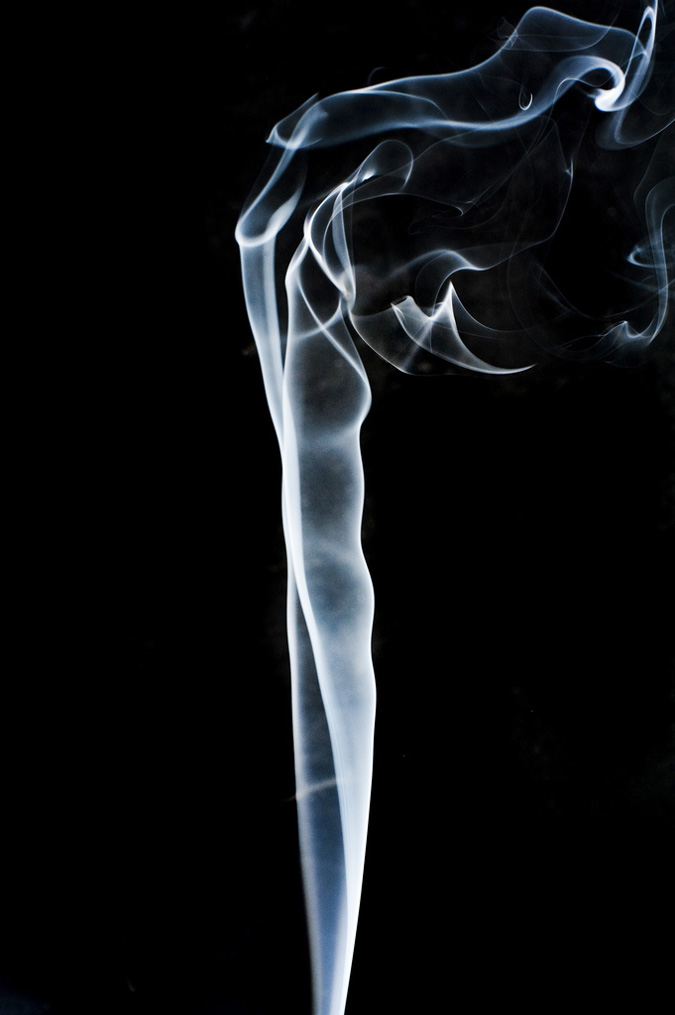
Figure 12.10 Smoke rises smoothly for a while and then begins to form swirls and eddies. The smooth flow is called laminar flow, whereas the swirls and eddies typify turbulent flow. If you watch the smoke (being careful not to breathe on it), you will notice that it rises more rapidly when flowing smoothly than after it becomes turbulent, implying that turbulence poses more resistance to flow. (credit: Creativity103)
Paul Peter Urone and Roger Hinrichs, College Physics 2E, OpenStax. (credit: Creativity103) · CC BY-NC-SA 4.0 · Original image ↗ · Access for free ↗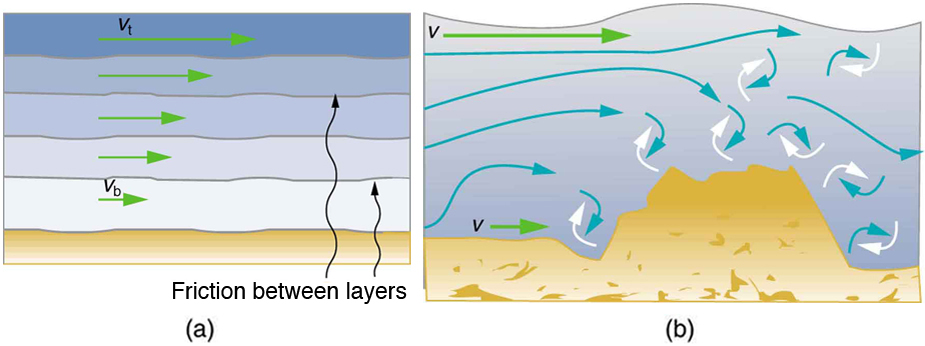
Figure 12.11 (a) Laminar flow occurs in layers without mixing. Notice that viscosity causes drag between layers as well as with the fixed surface. (b) An obstruction in the vessel produces turbulence. Turbulent flow mixes the fluid. There is more interaction, greater heating, and more resistance than in laminar flow.
Paul Peter Urone and Roger Hinrichs, College Physics 2E, OpenStax. · CC BY-NC-SA 4.0 · Original image ↗ · Access for free ↗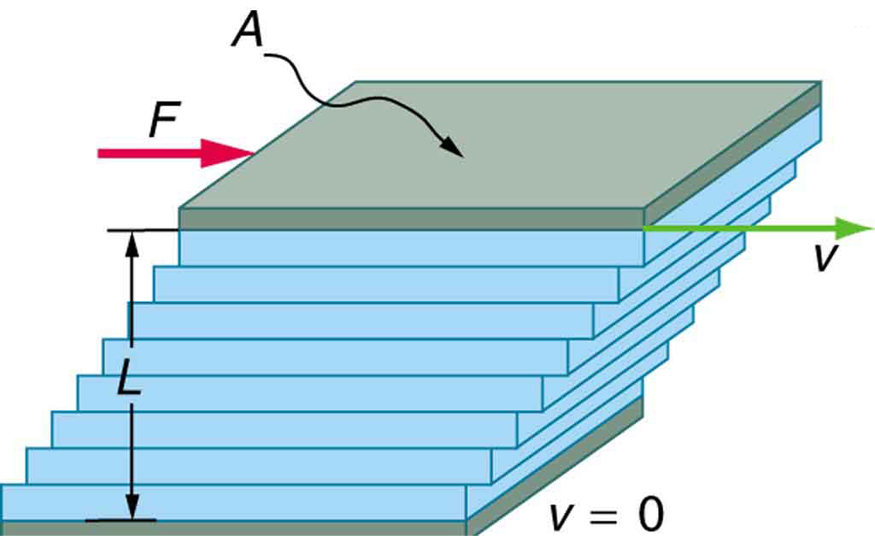
Figure 12.12 The graphic shows laminar flow of fluid between two plates of area A A . The bottom plate is fixed. When the top plate is pushed to the right, it drags the fluid along with it.
Paul Peter Urone and Roger Hinrichs, College Physics 2E, OpenStax. · CC BY-NC-SA 4.0 · Original image ↗ · Access for free ↗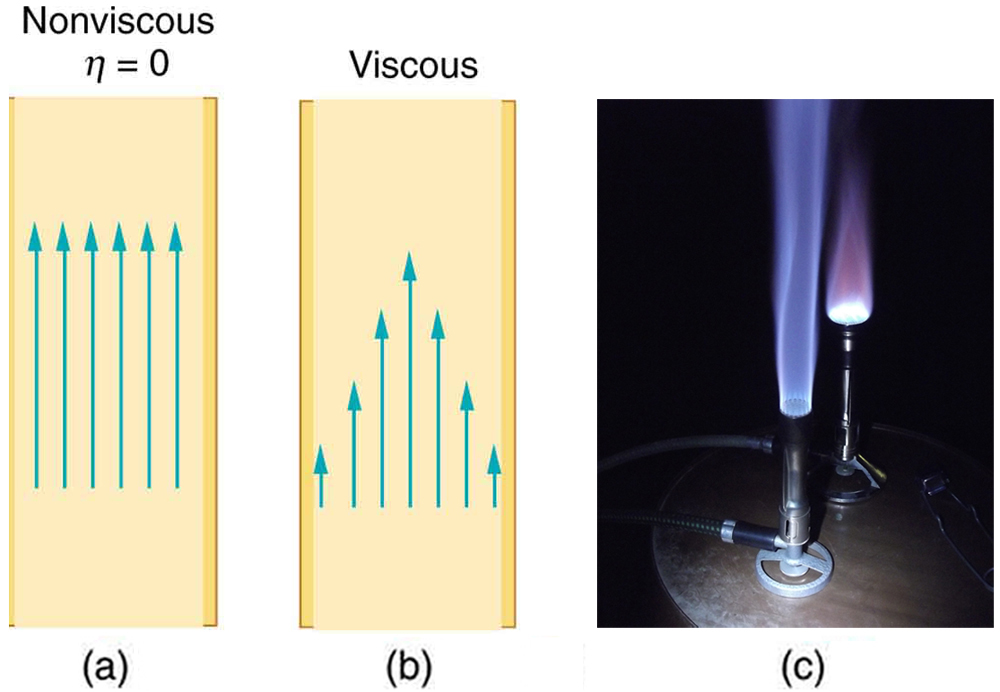
Figure 12.13 (a) If fluid flow in a tube has negligible resistance, the speed is the same all across the tube. (b) When a viscous fluid flows through a tube, its speed at the walls is zero, increasing steadily to its maximum at the center of the tube. (c) The shape of the Bunsen burner flame is due to the velocity profile across the tube. (credit: Jason Woodhead)
Paul Peter Urone and Roger Hinrichs, College Physics 2E, OpenStax. (credit: Jason Woodhead) · CC BY-NC-SA 4.0 · Original image ↗ · Access for free ↗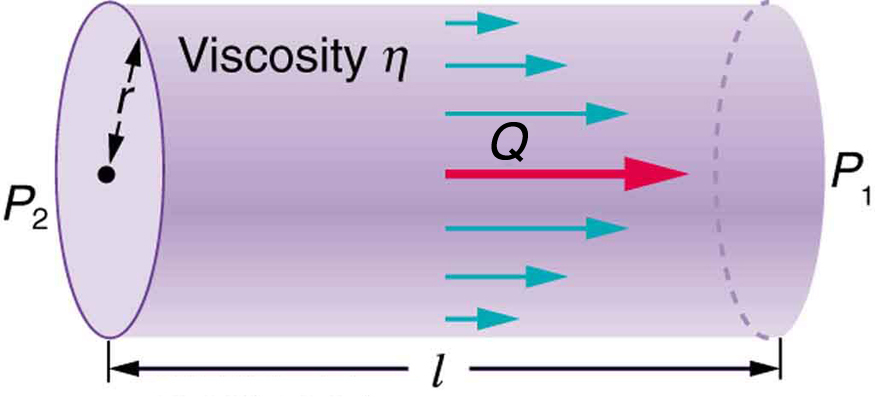
Figure 12.14 Poiseuille’s law applies to laminar flow of an incompressible fluid of viscosity η η through a tube of length l l and radius r r . The direction of flow is from greater to lower pressure. Flow rate Q Q is directly proportional to the pressure difference P 2 − P 1 P 2 − P 1 , and inversely proportional to the length l l of the tube and viscosity η η of the fluid. Flow rate increases with r 4 r 4 , the fourth power of the radius.
Paul Peter Urone and Roger Hinrichs, College Physics 2E, OpenStax. · CC BY-NC-SA 4.0 · Original image ↗ · Access for free ↗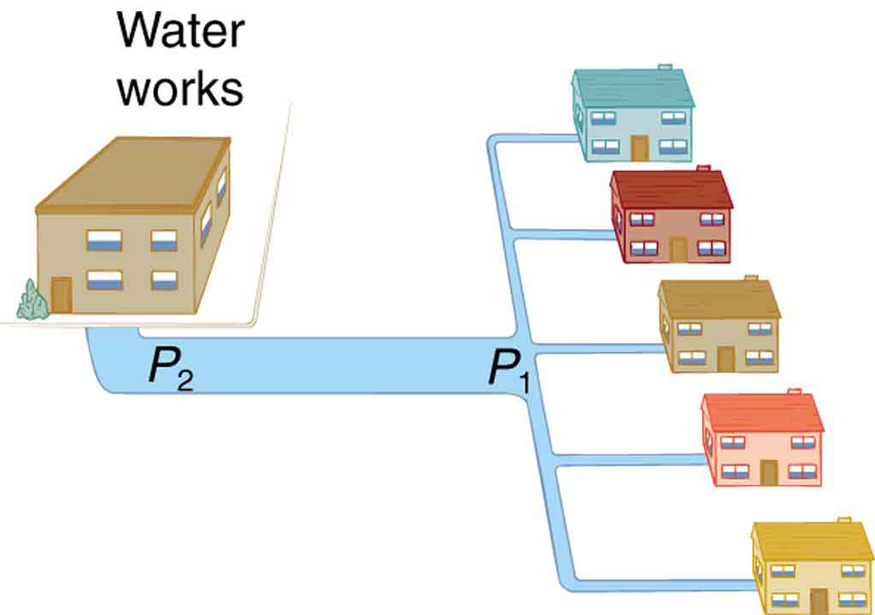
Figure 12.15 During times of heavy use, there is a significant pressure drop in a water main, and P 1 P 1 supplied to users is significantly less than P 2 P 2 created at the water works. If the flow is very small, then the pressure drop is negligible, and P 2 ≈ P 1 P 2 ≈ P 1 .
Paul Peter Urone and Roger Hinrichs, College Physics 2E, OpenStax. · CC BY-NC-SA 4.0 · Original image ↗ · Access for free ↗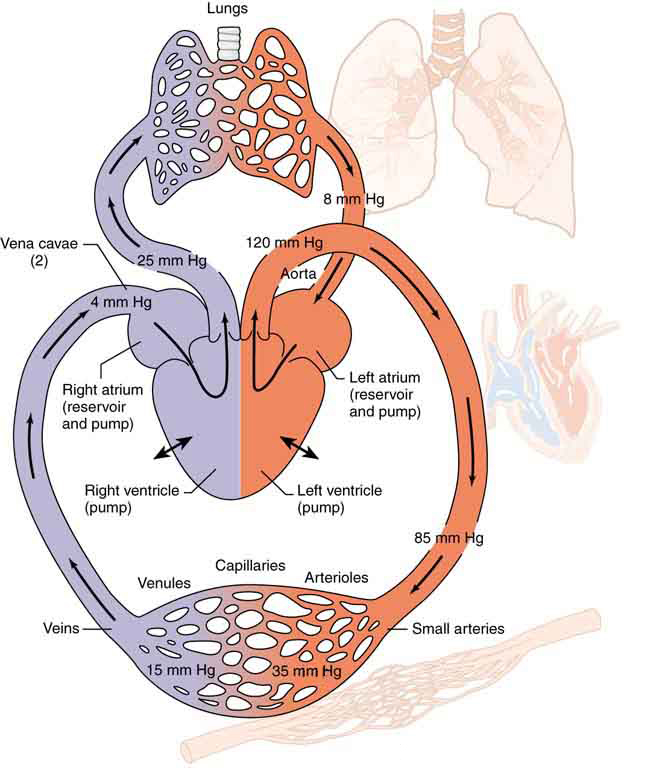
Figure 12.16 Schematic of the circulatory system. Pressure difference is created by the two pumps in the heart and is reduced by resistance in the vessels. Branching of vessels into capillaries allows blood to reach individual cells and exchange substances, such as oxygen and waste products, with them. The system has an impressive ability to regulate flow to individual organs, accomplished largely by varying vessel diameters.
Paul Peter Urone and Roger Hinrichs, College Physics 2E, OpenStax. · CC BY-NC-SA 4.0 · Original image ↗ · Access for free ↗| Fluid | Temperature (ºC) | Viscosity |
|---|---|---|
| Gases | ||
| Air | 0 | 0.0171 |
| 20 | 0.0181 | |
| 40 | 0.0190 | |
| 100 | 0.0218 | |
| Ammonia | 20 | 0.00974 |
| Carbon dioxide | 20 | 0.0147 |
| Helium | 20 | 0.0196 |
| Hydrogen | 0 | 0.0090 |
| Mercury | 20 | 0.0450 |
| Oxygen | 20 | 0.0203 |
| Steam | 100 | 0.0130 |
| Liquids | ||
| Water | 0 | 1.792 |
| 20 | 1.002 | |
| 37 | 0.6947 | |
| 40 | 0.653 | |
| 100 | 0.282 | |
| Whole blood1 | 20 | 3.015 |
| 37 | 2.084 | |
| Blood plasma2 | 20 | 1.810 |
| 37 | 1.257 | |
| Ethyl alcohol | 20 | 1.20 |
| Methanol | 20 | 0.584 |
| Oil (heavy machine) | 20 | 660 |
| Oil (motor, SAE 10) | 30 | 200 |
| Oil (olive) | 20 | 138 |
| Glycerin | 20 | 1500 |
| Honey | 20 | 2000–10000 |
| Maple Syrup | 20 | 2000–3000 |
| Milk | 20 | 3.0 |
| Oil (Corn) | 20 | 65 |
Table 12.1 Coefficients of Viscosity of Various Fluids. Paul Peter Urone and Roger Hinrichs, College Physics 2E, OpenStax.
11.8 Cohesion and Adhesion in Liquids: Surface Tension and Capillary Action — figures and tables
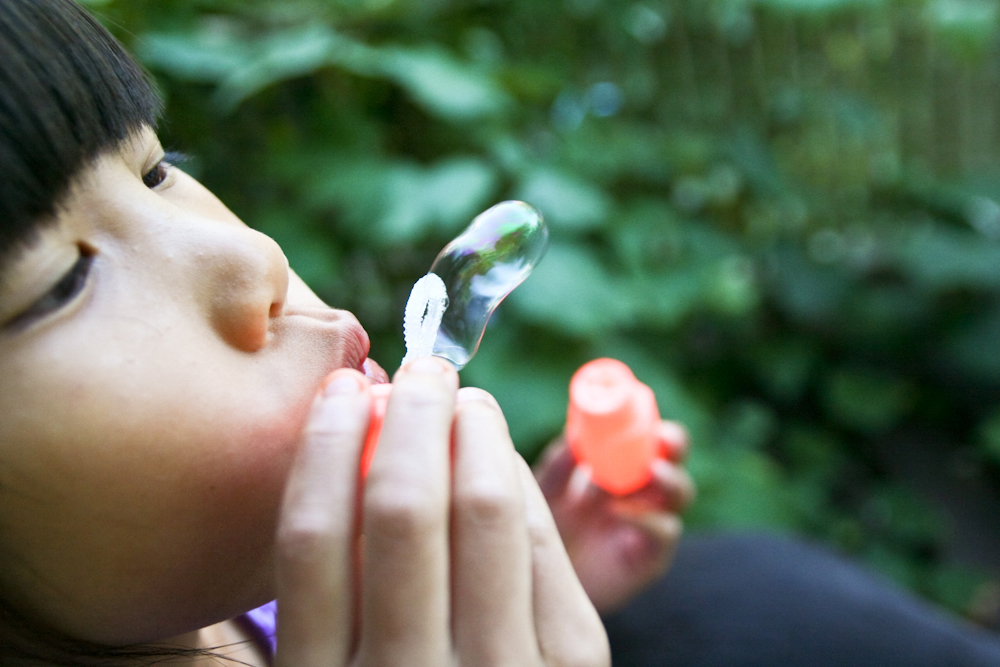
Figure 11.24 The soap bubbles in this photograph are caused by cohesive forces among molecules in liquids. (credit: Steve Ford Elliott)
Paul Peter Urone and Roger Hinrichs, College Physics 2E, OpenStax. (credit: Steve Ford Elliott) · CC BY-NC-SA 4.0 · Original image ↗ · Access for free ↗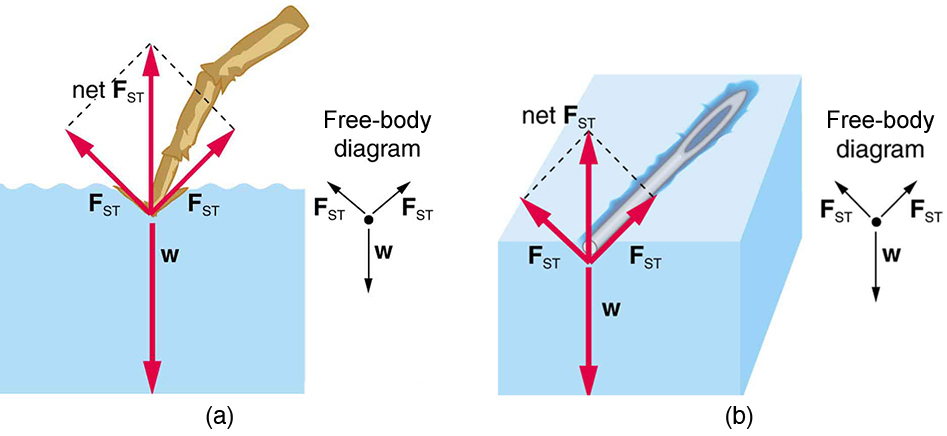
Figure 11.25 Surface tension supporting the weight of an insect and an iron needle, both of which rest on the surface without penetrating it. They are not floating; rather, they are supported by the surface of the liquid. (a) An insect leg dents the water surface. F ST F ST is a restoring force (surface tension) parallel to the surface. (b) An iron needle similarly dents a water surface until the restoring force (surface tension) grows to equal its weight.
Paul Peter Urone and Roger Hinrichs, College Physics 2E, OpenStax. · CC BY-NC-SA 4.0 · Original image ↗ · Access for free ↗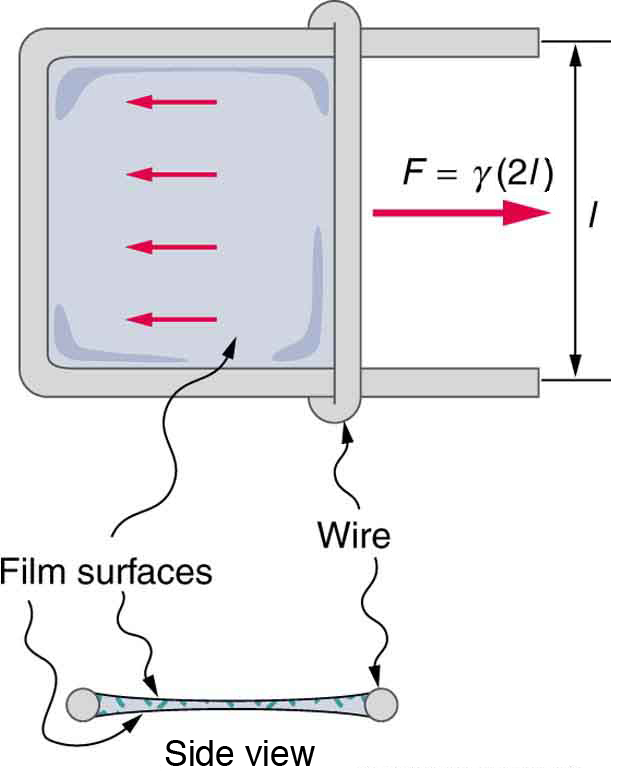
Figure 11.26 Sliding wire device used for measuring surface tension; the device exerts a force to reduce the film’s surface area. The force needed to hold the wire in place is F = γL = γ ( 2 l ) F = γL = γ ( 2 l ) , since there are two liquid surfaces attached to the wire. This force remains nearly constant as the film is stretched, until the film approaches its breaking point.
Paul Peter Urone and Roger Hinrichs, College Physics 2E, OpenStax. · CC BY-NC-SA 4.0 · Original image ↗ · Access for free ↗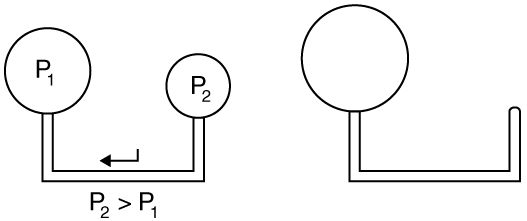
Figure 11.27 With the valve closed, two balloons of different sizes are attached to each end of a tube. Upon opening the valve, the smaller balloon decreases in size with the air moving to fill the larger balloon. The pressure in a spherical balloon is inversely proportional to its radius, so that the smaller balloon has a greater internal pressure than the larger balloon, resulting in this flow.
Paul Peter Urone and Roger Hinrichs, College Physics 2E, OpenStax. · CC BY-NC-SA 4.0 · Original image ↗ · Access for free ↗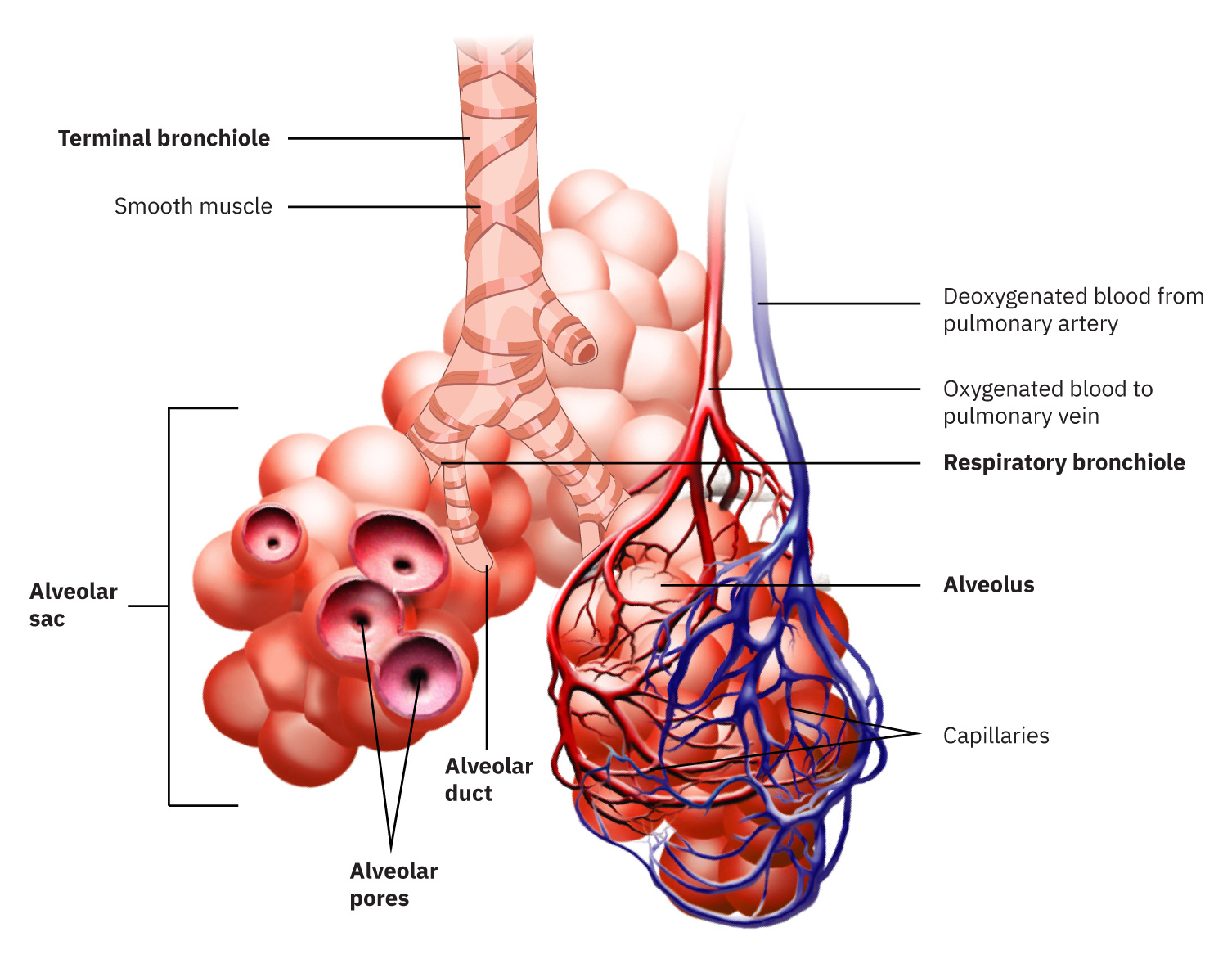
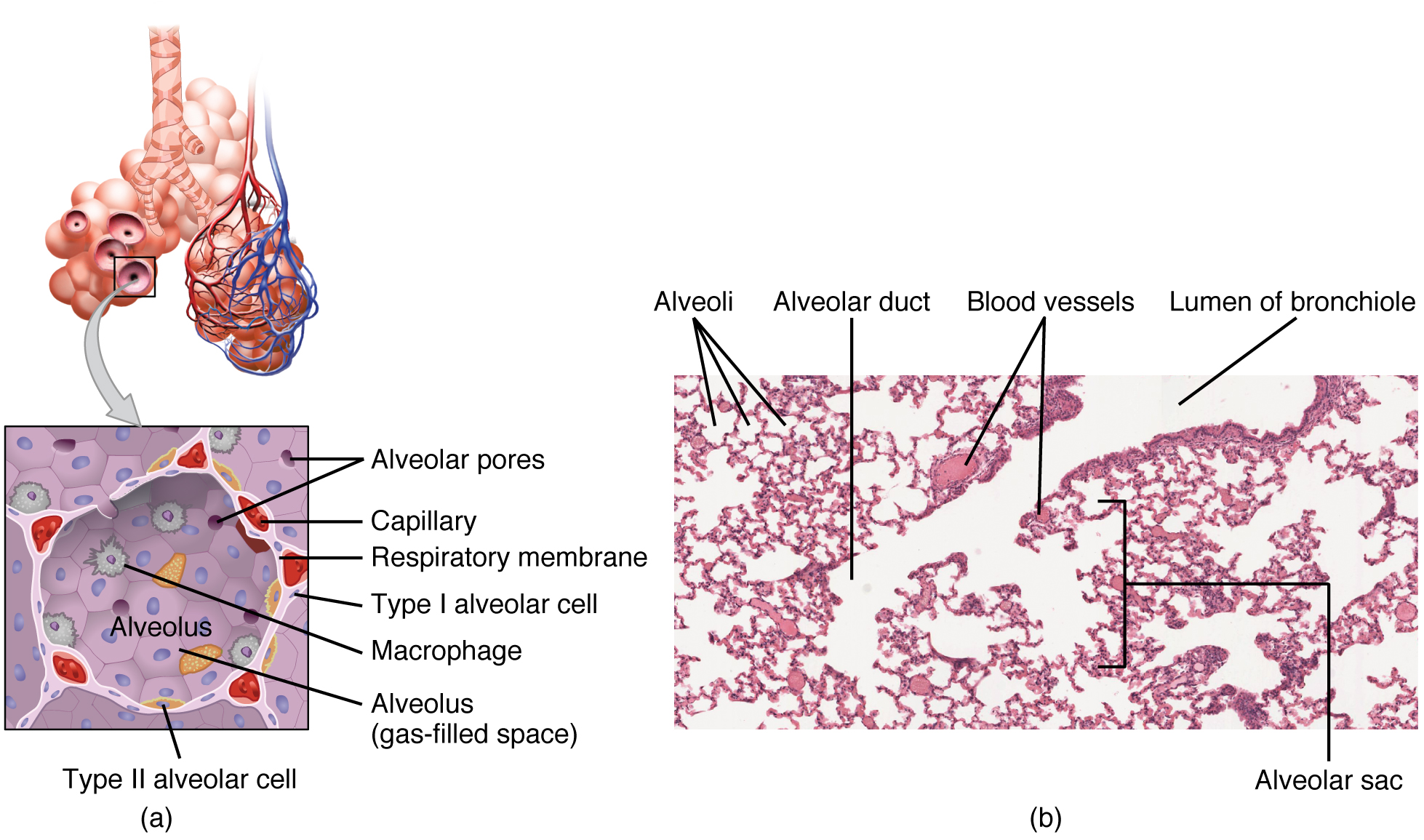
Figure 11.28 Bronchial tubes in the lungs branch into ever-smaller structures, finally ending in alveoli. The alveoli act like tiny bubbles. The surface tension of their mucous lining aids in exhalation and can prevent inhalation if too great.
Paul Peter Urone and Roger Hinrichs, College Physics 2E, OpenStax. · CC BY-NC-SA 4.0 · Original image ↗ · Access for free ↗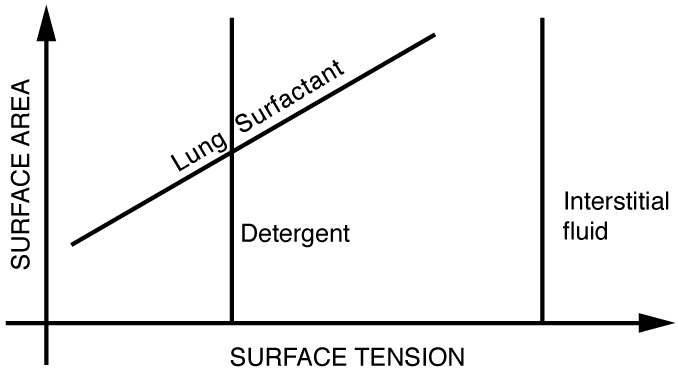
Figure 11.29 Surface tension as a function of surface area. The surface tension for lung surfactant decreases with decreasing area. This ensures that small alveoli don’t collapse and large alveoli are not able to over expand.
Paul Peter Urone and Roger Hinrichs, College Physics 2E, OpenStax. · CC BY-NC-SA 4.0 · Original image ↗ · Access for free ↗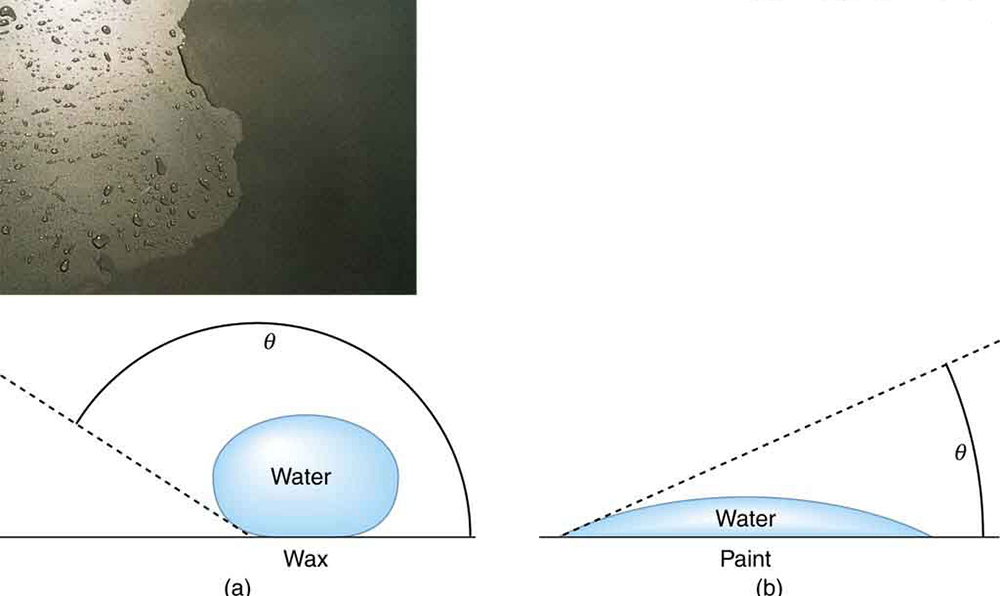
Figure 11.30 In the photograph, water beads on the waxed car paint and flattens on the unwaxed paint. (a) Water forms beads on the waxed surface because the cohesive forces responsible for surface tension are larger than the adhesive forces, which tend to flatten the drop. (b) Water beads on bare paint are flattened considerably because the adhesive forces between water and paint are strong, overcoming surface tension. The contact angle θ θ is directly related to the relative strengths of the cohesive and adhesive forces. The larger θ θ is, the larger the ratio of cohesive to adhesive forces. (credit: P. P. Urone)
Paul Peter Urone and Roger Hinrichs, College Physics 2E, OpenStax. (credit: P. P. Urone) · CC BY-NC-SA 4.0 · Original image ↗ · Access for free ↗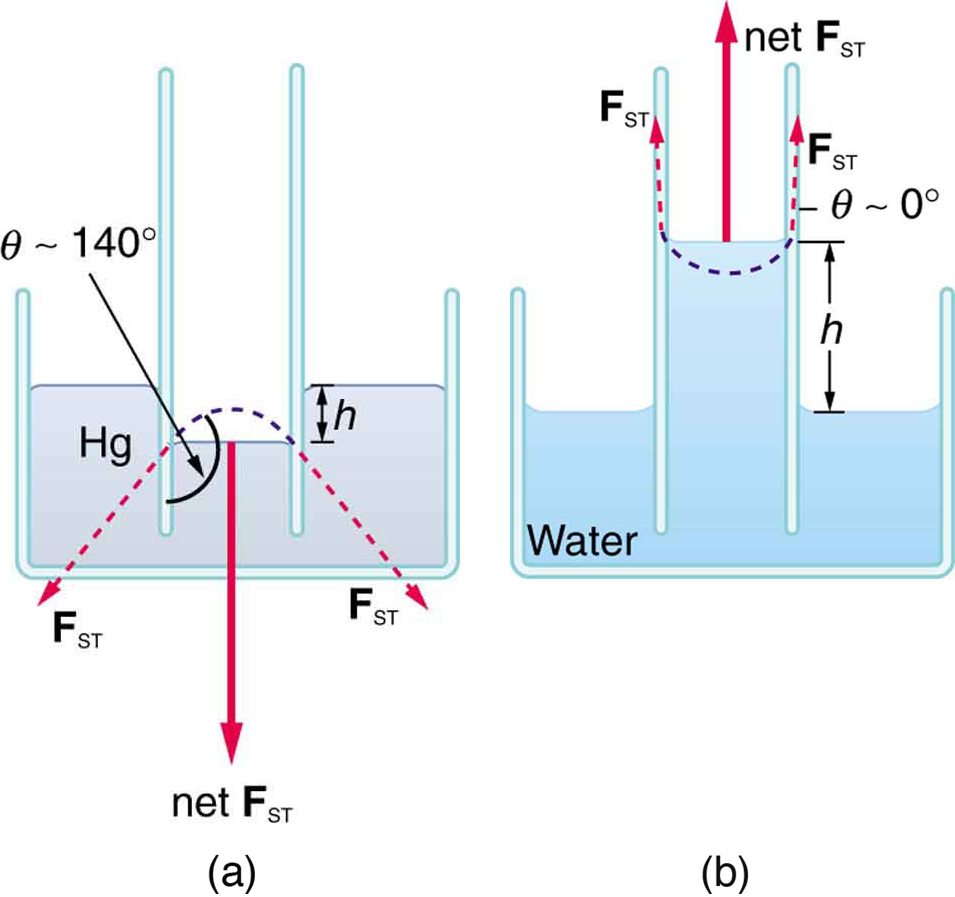
Figure 11.31 (a) Mercury is suppressed in a glass tube because its contact angle is greater than 90º 90º . Surface tension exerts a downward force as it flattens the mercury, suppressing it in the tube. The dashed line shows the shape the mercury surface would have without the flattening effect of surface tension. (b) Water is raised in a glass tube because its contact angle is nearly 0º 0º . Surface tension therefore exerts an upward force when it flattens the surface to reduce its area.
Paul Peter Urone and Roger Hinrichs, College Physics 2E, OpenStax. · CC BY-NC-SA 4.0 · Original image ↗ · Access for free ↗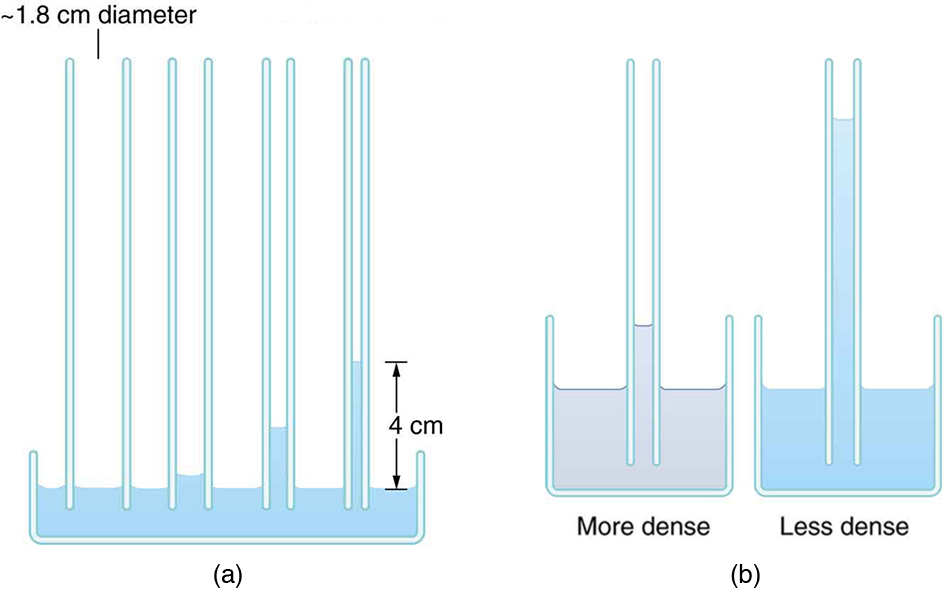
Figure 11.32 (a) Capillary action depends on the radius of a tube. The smaller the tube, the greater the height reached. The height is negligible for large-radius tubes. (b) A denser fluid in the same tube rises to a smaller height, all other factors being the same.
Paul Peter Urone and Roger Hinrichs, College Physics 2E, OpenStax. · CC BY-NC-SA 4.0 · Original image ↗ · Access for free ↗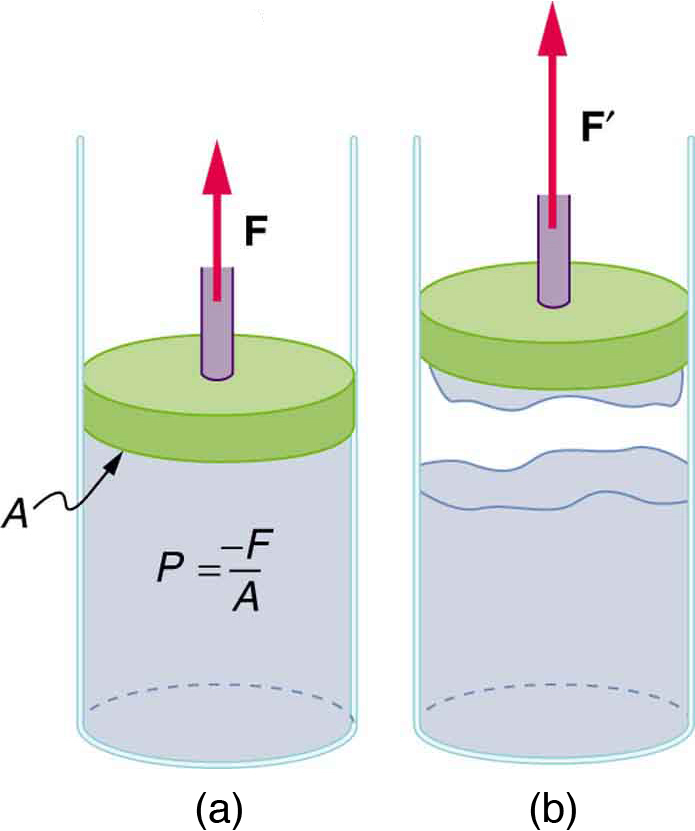
Figure 11.33 (a) When the piston is raised, it stretches the liquid slightly, putting it under tension and creating a negative absolute pressure P = − F / A P = − F / A . (b) The liquid eventually separates, giving an experimental limit to negative pressure in this liquid.
Paul Peter Urone and Roger Hinrichs, College Physics 2E, OpenStax. · CC BY-NC-SA 4.0 · Original image ↗ · Access for free ↗| Liquid | Surface tension γ(N/m) |
|---|---|
| Water at | 0.0756 |
| Water at | 0.0728 |
| Water at | 0.0589 |
| Soapy water (typical) | 0.0370 |
| Ethyl alcohol | 0.0223 |
| Glycerin | 0.0631 |
| Mercury | 0.465 |
| Olive oil | 0.032 |
| Tissue fluids (typical) | 0.050 |
| Blood, whole at | 0.058 |
| Blood plasma at | 0.073 |
| Gold at | 1.000 |
| Oxygen at | 0.0157 |
| Helium at | 0.00012 |
Table 11.3 Surface Tension of Some Liquids 1. Paul Peter Urone and Roger Hinrichs, College Physics 2E, OpenStax.
| Interface | Contact angle Θ |
|---|---|
| Mercury–glass | |
| Water–glass | |
| Water–paraffin | |
| Water–silver | |
| Organic liquids (most)–glass | |
| Ethyl alcohol–glass | |
| Kerosene–glass |
Table 11.4 Contact Angles of Some Substances. Paul Peter Urone and Roger Hinrichs, College Physics 2E, OpenStax.
Source: 11.8 Cohesion and Adhesion in Liquids: Surface Tension and Capillary Action