Observational learning occurs when information from others’ behavior and outcomes changes later behavior without the learner receiving the original consequences directly.
Predict behavior learned through observing models and their outcomes
Observational learning occurs when information from others’ behavior and outcomes changes later behavior without the learner receiving the original consequences directly. Modeling involves attention to the model, retention of what occurred, ability to reproduce the behavior, and motivation to perform it. Vicarious reinforcement can increase enactment after observing a model rewarded; vicarious punishment can suppress enactment. Learning and performance differ: a person may learn an action yet choose not to display it until incentives change. Similarity, prestige, competence, and observed outcomes can affect a model’s influence. Prosocial and harmful behaviors can both be modeled.
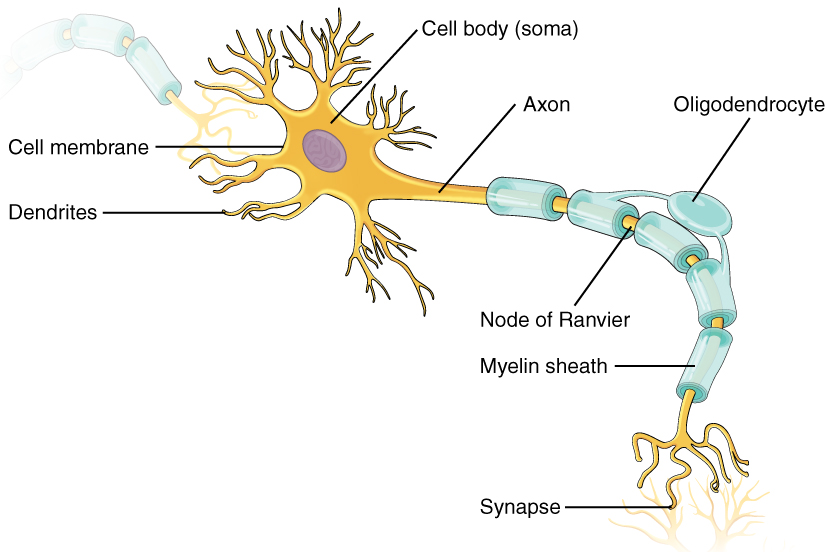
Discuss proposed roles of mirror neurons and vicarious emotional responses
Mirror neurons were identified through activity during both performing and observing certain actions, especially in nonhuman-primate motor systems. Such responses motivate hypotheses about action representation and imitation. They do not by themselves prove a complete neural explanation for empathy, language, or intention reading. Observing another person’s emotion can recruit overlapping affective systems and produce vicarious responses, but shared activation does not mean identical experience or a single dedicated empathy circuit. Human imaging often measures populations indirectly, so evidence should be matched to the level of the claim. Behavioral learning can be demonstrated without establishing a particular neuron-level mechanism.
Worked question. Children observe a model punished for a novel action and initially avoid copying it. When later rewarded for demonstrating remembered actions, they reproduce it. What distinction does this reveal?
They acquired information despite initially suppressing performance. Observed punishment influenced whether they displayed the action, not necessarily whether they learned it. A delayed incentive test separates retention from immediate imitation. The result supports observational learning but does not independently demonstrate mirror-neuron causation.
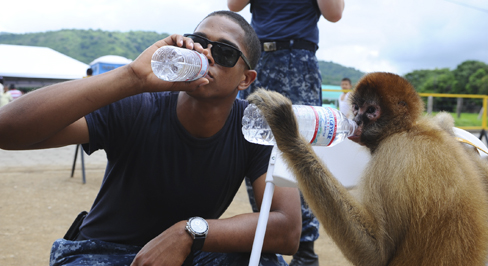
Figure 6.16 This spider monkey learned to drink water from a plastic bottle by seeing the behavior modeled by a human. (credit: U.S. Air Force, Senior Airman Kasey Close)
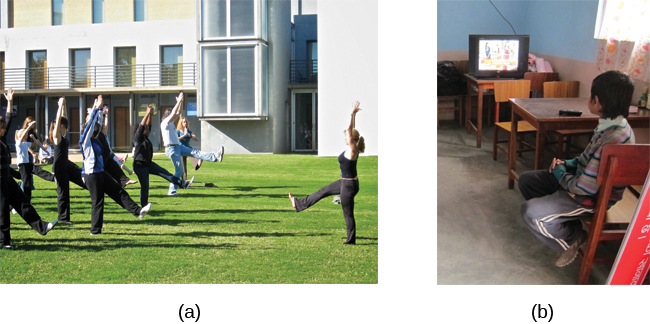
Figure 6.17 (a) Yoga students learn by observation as their yoga instructor demonstrates the correct stance and movement for her students (live model). (b) Models don’t have to be present for learning to occur: through symbolic modeling, this child can learn a behavior by watching someone demonstrate it on television. (credit a: modification of work by Tony Cecala; credit b: modification of work by Andrew Hyde)
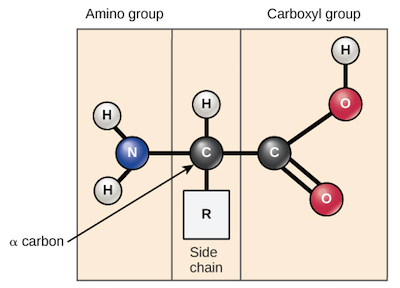
A nitrogen-containing functional group. A free amino acid’s amino group is typically protonated (NH₃⁺) near physiological pH; proline’s ring nitrogen is an exception to this formula.
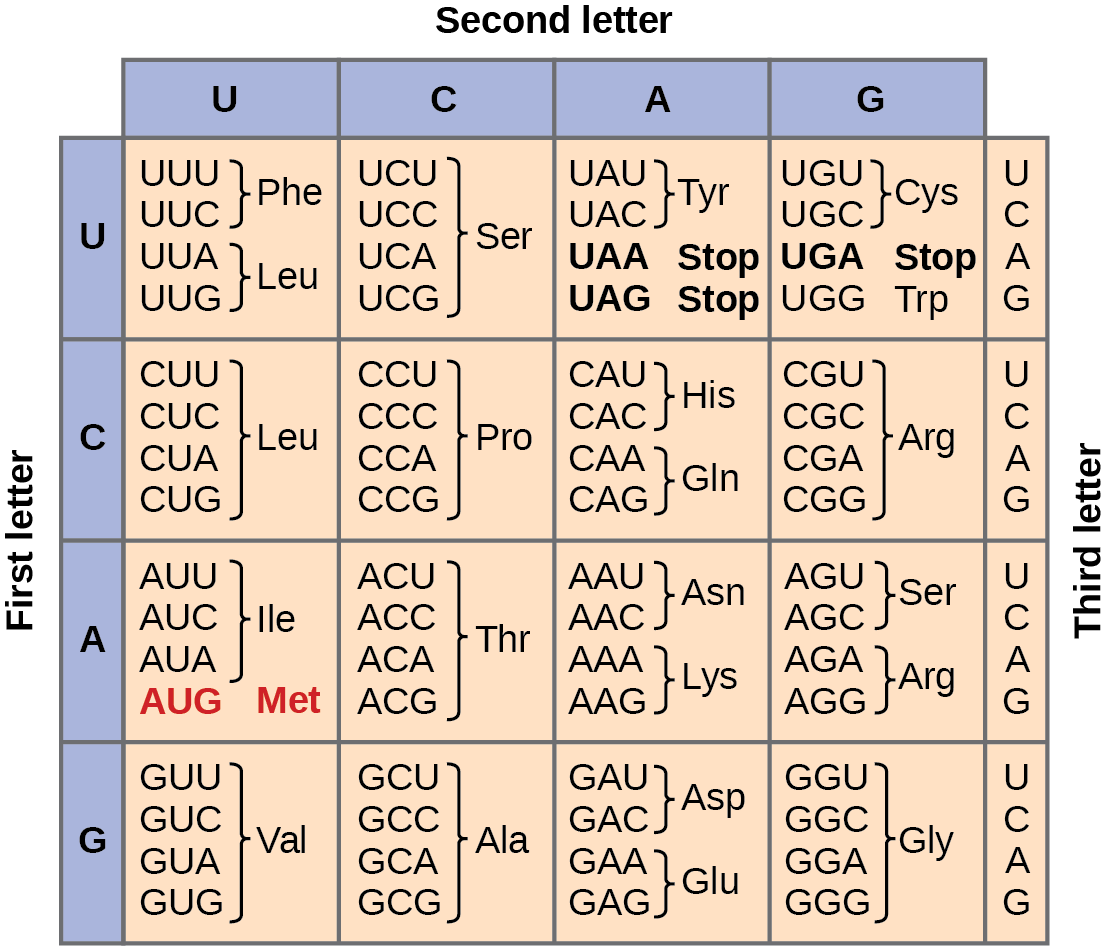
Figure 15.4 This figure shows the genetic code for translating each nucleotide triplet in mRNA into an amino acid or a termination signal in a protein. (credit: modification of work by NIH)
An electrical property that can be positive or negative. Opposite charges attract and like charges repel; net charge is the sum of all charges on a particle.
Figure 15.10 A generalized promoter of a gene transcribed by RNA polymerase II is shown. Transcription factors recognize the promoter. RNA polymerase II then binds and forms the transcription initiation complex.
Figure 12.4 In the P generation, pea plants that are true-breeding for the dominant yellow phenotype are crossed with plants with the recessive green phenotype. This cross produces F 1 heterozygotes with a yellow phenotype. Punnett square analysis can be used to predict the genotypes of the F 2 generation.
The exponent needed to obtain a number from a chosen fixed number. For decimal logarithms, log₁₀(100) = 2 because 10² = 100; pH uses the negative decimal logarithm of hydrogen ion activity.
A thin boundary or sheet. Cell membranes are lipid bilayers containing proteins; blotting membranes are synthetic supports that hold proteins or nucleic acids for detection.
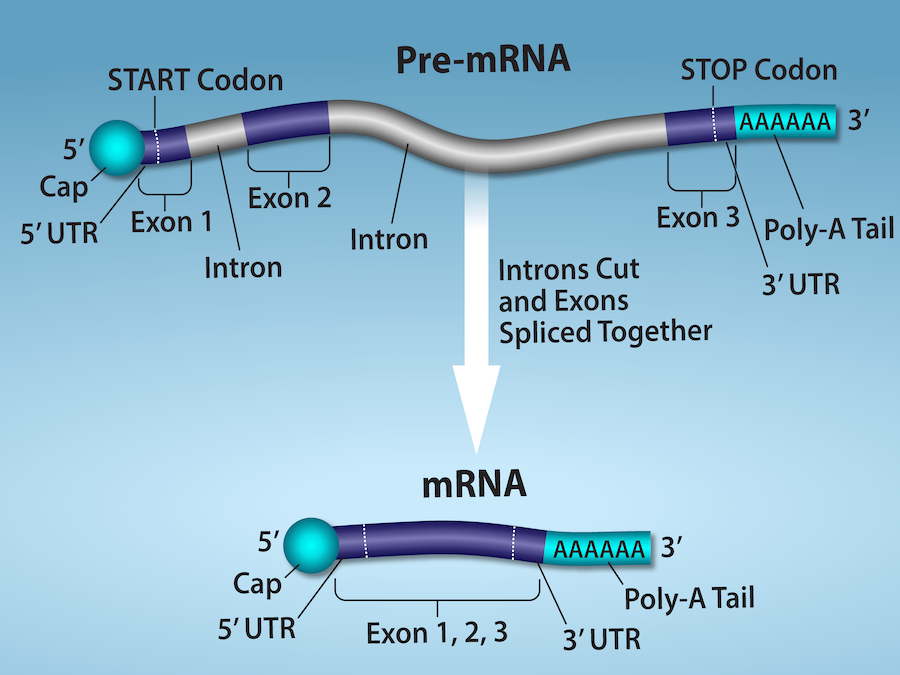
Figure 15.11 Eukaryotic pre-mRNA processing. In addition to 5’ Cap and 3’ Poly-A Tail addition, introns must be precisely removed and exons joined to generate a functional mRNA. Nucleotides upstream (towards the 5’cap) of the translation START codon are part of the 5’ untranslated region (5’ UTR). Nucleotides downstream (towards 3’end) of the STOP codon form the 3’ UTR. Both 5’ and 3’ UTRs are important for regulating translation initiation and mRNA stability. Credit: Rao, A., Ryan, K. Fletcher, S. and Tag, A. Department of Biology, Texas A&M University.
Rao, A., Ryan, K. Fletcher, S. and Tag, A. Department of Biology, Texas A&M University.; Mary Ann Clark, Matthew Douglas, and Jung Choi, Biology 2e, OpenStax. · CC BY-NC-SA 4.0
· Original image ↗ · Access for free ↗
mirror neuron
Neuron showing activity during both an action and observation of a related action.
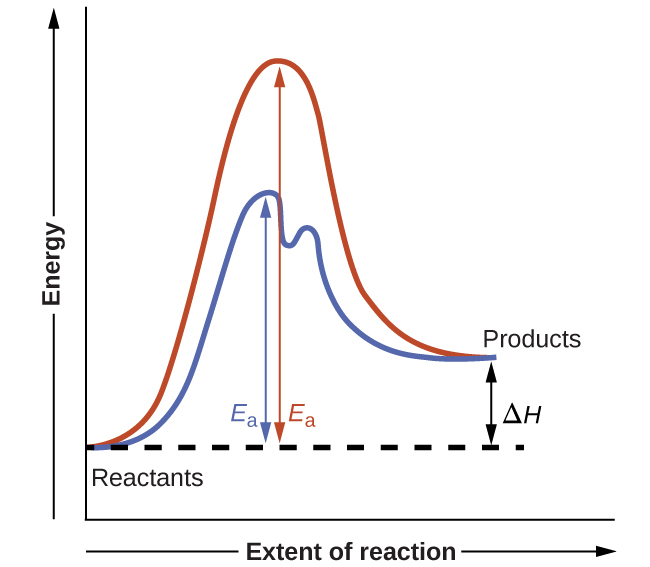
Figure 12.19 Reaction diagrams for an endothermic process in the absence (red curve) and presence (blue curve) of a catalyst. The catalyzed pathway involves a two-step mechanism (note the presence of two transition states) and an intermediate species (represented by the valley between the two transitions states).
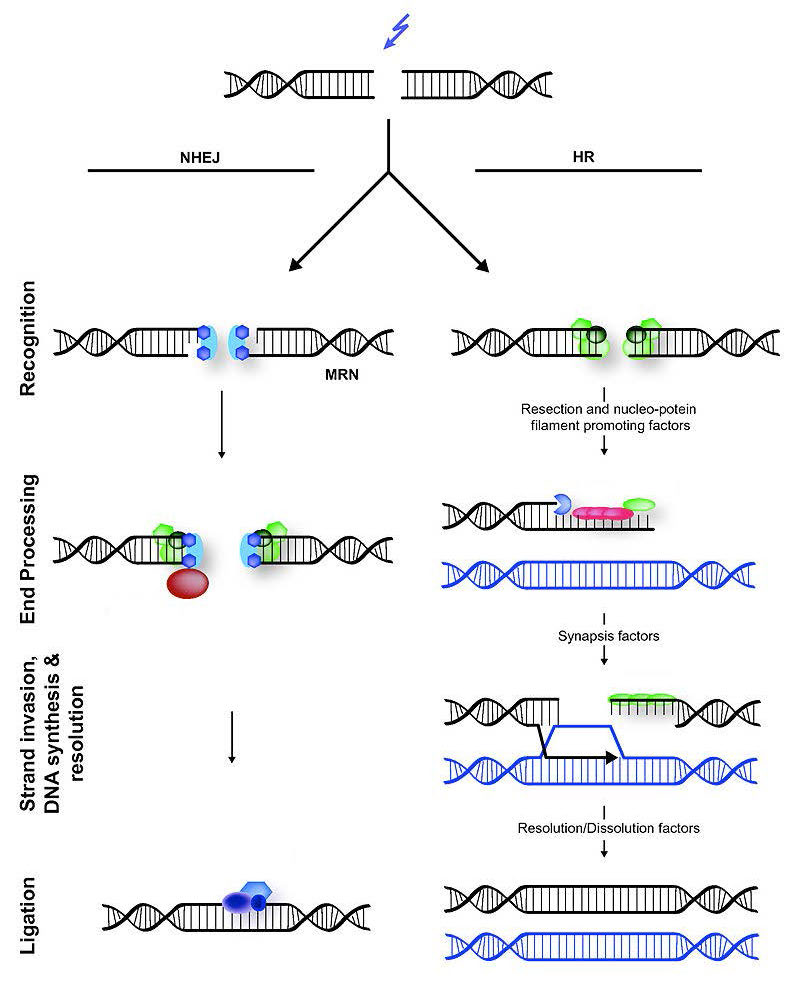
Figure 7.45 - Non-homologous end joining (left) versus homologous recombination (right) - Wikipedia
Wikipedia, as credited by Kevin Ahern, Indira Rajagopal, and Taralyn Tan, Biochemistry Free For All, Oregon State University, via Biology LibreTexts. · Source attribution
· Original image ↗ · Access for free ↗
The amount of a substance that can dissolve in a solvent under specified conditions. Soluble means able to dissolve; insoluble means only very slightly soluble in that solvent.
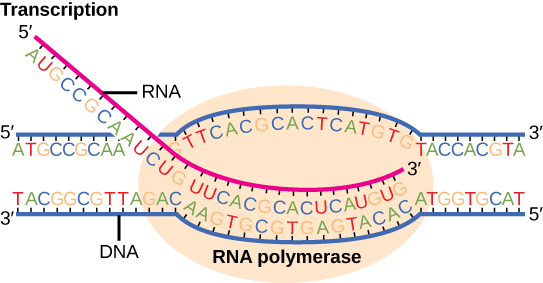
Figure 15.7 Messenger RNA is a copy of protein-coding information in the coding strand of DNA, with the substitution of U in the RNA for T in the coding sequence. However, new RNA nucleotides base pair with the nucleotides of the template strand. RNA is synthesized in its 5'-3' direction, using the enzyme RNA polymerase. As the template is read, the DNA unwinds ahead of the polymerase and then rewinds behind it.
A fleeting, high-energy arrangement at a reaction barrier. It is an energy maximum along the reaction path, rather than a stable reaction intermediate.
Figure 12.19 Reaction diagrams for an endothermic process in the absence (red curve) and presence (blue curve) of a catalyst. The catalyzed pathway involves a two-step mechanism (note the presence of two transition states) and an intermediate species (represented by the valley between the two transitions states).
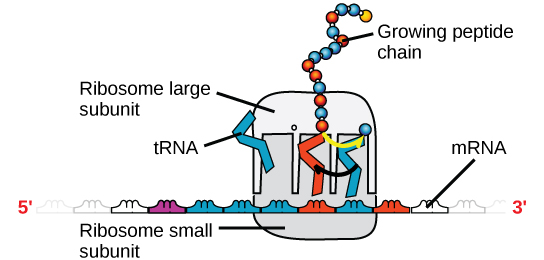
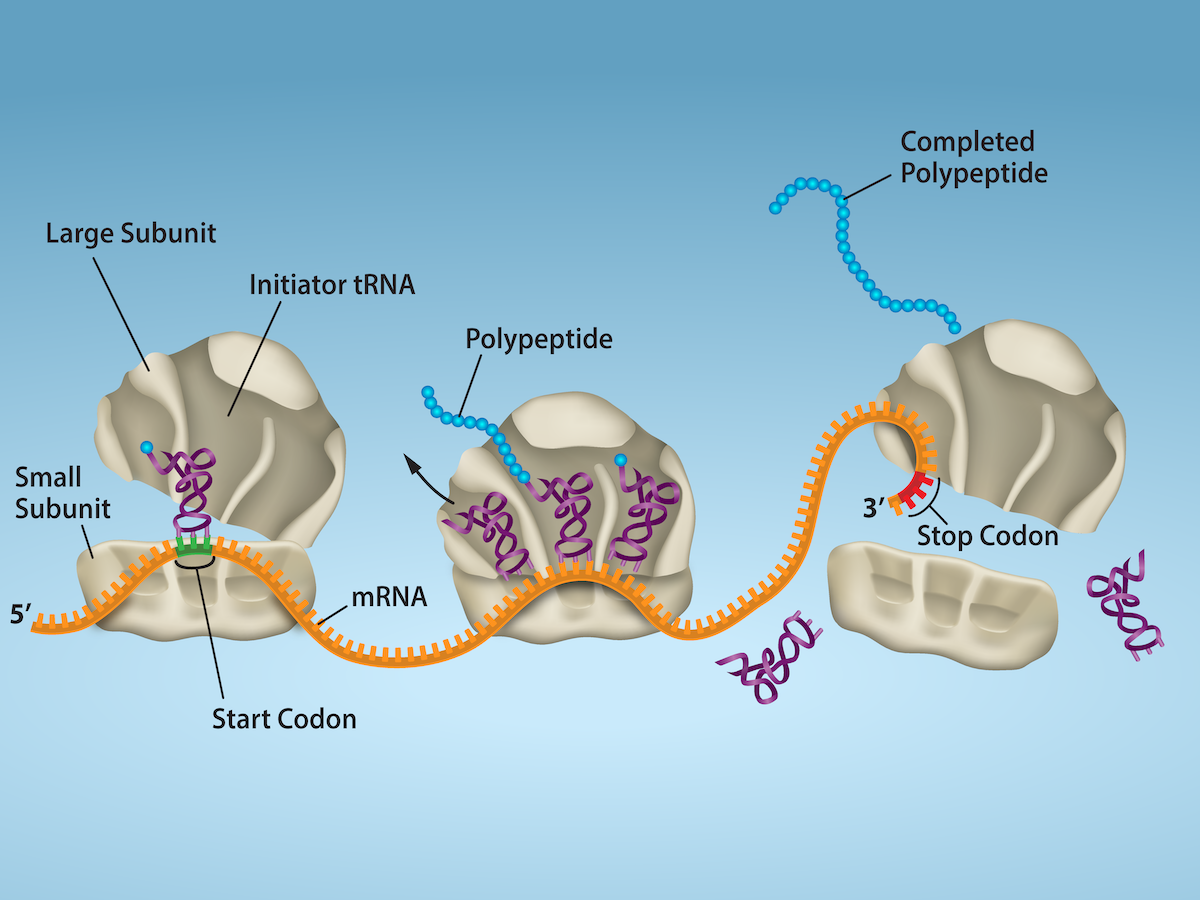
Figure 15.18 Translation begins when an initiator tRNA anticodon recognizes a start codon on mRNA bound to a small ribosomal subunit. The large ribosomal subunit joins the small subunit, and a second tRNA is recruited. As the mRNA moves relative to the ribosome, successive tRNAs move through the ribosome and the polypeptide chain is formed. Entry of a release factor into the A site terminates translation and the components dissociate.
No matching terms. Try a different name or abbreviation.
6.4 Observational Learning (Modeling)
OpenStax · 6.4 Observational Learning (Modeling) ↗ Instructional page including learning objectives, examples, figures, source tables and questions. Site navigation and embedded media players are omitted; source media links remain available.
Previous sections of this chapter focused on classical and operant conditioning, which are forms of associative learning. In observational learning, we learn by watching others and then imitating, or modeling, what they do or say. For instance, have you ever gone to YouTube to find a video showing you how to do something? The individuals performing the imitated behavior are called models. Research suggests that this imitative learning involves a specific type of neuron, called a mirror neuron (Hickock, 2010; Rizzolatti, Fadiga, Fogassi, & Gallese, 2002; Rizzolatti, Fogassi, & Gallese, 2006).
Humans and other animals are capable of observational learning. For example, in a study of social learning in chimpanzees, researchers gave juice boxes with straws to two groups of captive chimpanzees. The first group dipped the straw into the juice box, and then sucked on the small amount of juice at the end of the straw. The second group sucked through the straw directly, getting much more juice. When the first group, the “dippers,” observed the second group, “the suckers,” what do you think happened? All of the “dippers” in the first group switched to sucking through the straws directly. By simply observing the other chimps and modeling their behavior, they learned that this was a more efficient method of getting juice (Yamamoto, Humle, and Tanaka, 2013).
Figure 6.16 This spider monkey learned to drink water from a plastic bottle by seeing the behavior modeled by a human. (credit: U.S. Air Force, Senior Airman Kasey Close)
Rose M. Spielman, William J. Jenkins, and Marilyn D. Lovett, Psychology 2E, OpenStax. (credit: U.S. Air Force, Senior Airman Kasey Close) · CC BY-NC-SA 4.0
· Original image ↗ · Access for free ↗
Imitation is sometimes called the highest form of flattery. But consider Claire’s experience with observational learning. Claire’s nine-year-old son, Jay, was getting into trouble at school and was defiant at home. Claire feared that Jay would end up like her brothers, two of whom were in prison. One day, after yet another bad day at school and another negative note from the teacher, Claire, at her wit’s end, beat her son with a belt to get him to behave. Later that night, as she put her children to bed, Claire witnessed her four-year-old daughter, Anna, take a belt to her teddy bear and whip it. Claire was horrified, realizing that Anna was imitating her mother. It was then that Claire knew she wanted to discipline her children in a different manner.
Like Tolman, whose experiments with rats suggested a cognitive component to learning, psychologist Albert Bandura’s ideas about learning were different from those of strict behaviorists. Bandura and other researchers proposed a brand of behaviorism called social learning theory, which took cognitive processes into account. According to Bandura, pure behaviorism could not explain why learning can take place in the absence of external reinforcement. He felt that internal mental states must also have a role in learning and that observational learning involves much more than imitation. In imitation, a person simply copies what the model does. Observational learning is much more complex. According to Lefrançois (2012) there are several ways that observational learning can occur:
You learn a new response. After watching your coworker get chewed out by your boss for coming in late, you start leaving home 10 minutes earlier so that you won’t be late.
You choose whether or not to imitate the model depending on what you saw happen to the model. Remember Julian and his father? When learning to surf, Julian might watch how his father pops up successfully on his surfboard and then attempt to do the same thing. On the other hand, Julian might learn not to touch a hot stove after watching his father get burned on a stove.
You learn a general rule that you can apply to other situations.
Bandura identified three kinds of models: live, verbal, and symbolic. A live model demonstrates a behavior in person, as when Ben stood up on his surfboard so that Julian could see how he did it. A verbal instructional model does not perform the behavior, but instead explains or describes the behavior, as when a soccer coach tells his young players to kick the ball with the side of the foot, not with the toe. A symbolic model can be fictional characters or real people who demonstrate behaviors in books, movies, television shows, video games, or Internet sources (Figure 6.17).
Figure 6.17 (a) Yoga students learn by observation as their yoga instructor demonstrates the correct stance and movement for her students (live model). (b) Models don’t have to be present for learning to occur: through symbolic modeling, this child can learn a behavior by watching someone demonstrate it on television. (credit a: modification of work by Tony Cecala; credit b: modification of work by Andrew Hyde)
Rose M. Spielman, William J. Jenkins, and Marilyn D. Lovett, Psychology 2E, OpenStax. (credit a: modification of work by Tony Cecala; credit b: modification of work by Andrew Hyde) · CC BY-NC-SA 4.0
· Original image ↗ · Access for free ↗
Link to Learning
Latent learning and modeling are used all the time in the world of marketing and advertising. This Ford commercial starring Derek Jeter played for months across the New York, New Jersey, and Connecticut areas. Jeter was an award-winning baseball player for the New York Yankees. The commercial aired in a part of the country where Jeter is an incredibly well-known athlete. He is wealthy, and considered very loyal and good looking. What message are the advertisers sending by having him featured in the ad? How effective do you think it is?
Of course, we don’t learn a behavior simply by observing a model. Bandura described specific steps in the process of modeling that must be followed if learning is to be successful: attention, retention, reproduction, and motivation. First, you must be focused on what the model is doing—you have to pay attention. Next, you must be able to retain, or remember, what you observed; this is retention. Then, you must be able to perform the behavior that you observed and committed to memory; this is reproduction. Finally, you must have motivation. You need to want to copy the behavior, and whether or not you are motivated depends on what happened to the model. If you saw that the model was reinforced for their behavior, you will be more motivated to copy them. This is known as vicarious reinforcement. On the other hand, if you observed the model being punished, you would be less motivated to copy them. This is called vicarious punishment. For example, imagine that four-year-old Allison watched her older sister Kaitlyn playing in their mother’s makeup, and then saw Kaitlyn get a time out when their mother came in. After their mother left the room, Allison was tempted to play in the make-up, but she did not want to get a time-out from her mother. What do you think she did? Once you actually demonstrate the new behavior, the reinforcement you receive plays a part in whether or not you will repeat the behavior.
Bandura researched modeling behavior, particularly children’s modeling of adults’ aggressive and violent behaviors (Bandura, Ross, & Ross, 1961). He conducted an experiment with a five-foot inflatable doll that he called a Bobo doll. In the experiment, children’s aggressive behavior was influenced by whether the teacher was punished for her behavior. In one scenario, a teacher acted aggressively with the doll, hitting, throwing, and even punching the doll, while a child watched. There were two types of responses by the children to the teacher’s behavior. When the teacher was punished for her bad behavior, the children decreased their tendency to act as she had. When the teacher was praised or ignored (and not punished for her behavior), the children imitated what she did, and even what she said. They punched, kicked, and yelled at the doll.
What are the implications of this study? Bandura concluded that we watch and learn, and that this learning can have both prosocial and antisocial effects. Prosocial (positive) models can be used to encourage socially acceptable behavior. Parents in particular should take note of this finding. If you want your children to read, then read to them. Let them see you reading. Keep books in your home. Talk about your favorite books. If you want your children to be healthy, then let them see you eat right and exercise, and spend time engaging in physical fitness activities together. The same holds true for qualities like kindness, courtesy, and honesty. The main idea is that children observe and learn from their parents, even their parents’ morals, so be consistent and toss out the old adage “Do as I say, not as I do,” because children tend to copy what you do instead of what you say. Besides parents, many public figures, such as Martin Luther King, Jr. and Mahatma Gandhi, are viewed as prosocial models who are able to inspire global social change. Can you think of someone who has been a prosocial model in your life?
The antisocial effects of observational learning are also worth mentioning. As you saw from the example of Claire at the beginning of this section, her daughter viewed Claire’s aggressive behavior and copied it. Research suggests that this may help to explain why victims of abuse often grow up to be abusers themselves (Murrell, Christoff, & Henning, 2007). In fact, about 30% of child abuse victims become abusive parents (U.S. Department of Health & Human Services, 2013). We tend to do what we know. Children who grow up witnessing their parents deal with anger and frustration through violent and aggressive acts often learn to behave in that manner themselves.
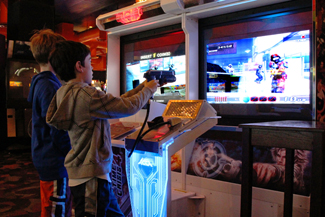
Some studies suggest that violent television shows, movies, and video games may also have antisocial effects (Figure 6.18) although further research needs to be done to understand the correlational and causational aspects of media violence and behavior. Some studies have found a link between viewing violence and aggression seen in children (Anderson & Gentile, 2008; Kirsch, 2010; Miller, Grabell, Thomas, Bermann, & Graham-Bermann, 2012). These findings may not be surprising, given that a child graduating from high school has been exposed to around 200,000 violent acts including murder, robbery, torture, bombings, beatings, and rape through various forms of media (Huston et al., 1992). Not only might viewing media violence affect aggressive behavior by teaching people to act that way in real life situations, but it has also been suggested that repeated exposure to violent acts also desensitizes people to it. Psychologists are working to understand this dynamic.
Does watching violent media or playing violent video games cause aggression? Albert Bandura's early studies suggested television violence increased aggression in children, and more recent studies support these findings. For example, research by Craig Anderson and colleagues (Anderson, Bushman, Donnerstein, Hummer, & Warburton, 2015; Anderson et al., 2010; Bushman et al., 2016) found extensive evidence to suggest a causal link between hours of exposure to violent media and aggressive thoughts and behaviors. However, studies by Christopher Ferguson and others suggests that while there may be a link between violent media exposure and aggression, research to date has not accounted for other risk factors for aggression including mental health and family life (Ferguson, 2011; Gentile, 2016). What do you think?