Distinguish positive and negative reinforcement from punishment and primary from conditioned reinforcers
Operant conditioning changes behavior through its consequences. Reinforcement increases a behavior; punishment decreases it. Positive means adding a consequence and negative means removing one, not good versus bad. Giving praise that increases studying is positive reinforcement; removing an aversive alarm when a seat belt is fastened is negative reinforcement. Adding an unpleasant consequence that reduces behavior is positive punishment; removing a privilege that reduces it is negative punishment. Primary reinforcers have value tied to basic needs, while conditioned reinforcers acquire value through learning. The observed effect on future behavior, rather than the actor’s intention, determines the functional label.
Predict behavior under fixed or variable ratio and interval schedules
Ratio schedules depend on response counts; interval schedules make reinforcement available after time passes, usually delivered for the first eligible response. Fixed schedules use a predictable requirement and variable schedules an unpredictable one around a pattern or average. Fixed-ratio schedules often produce high responding with a post-reinforcement pause; variable-ratio schedules support high persistent responding. Fixed-interval schedules often produce a scallop as responding increases near the expected time; variable-interval schedules support steadier moderate responding. These are characteristic patterns, not universal curves for every organism and task. Partial reinforcement commonly makes behavior more resistant to extinction than continuous reinforcement.
Shaping reinforces successive approximations toward a target response. Chaining links learned responses into a sequence. Operant extinction withholds the reinforcer that previously maintained behavior and can initially produce an extinction burst. Escape learning terminates an ongoing aversive event; avoidance learning prevents or postpones one. Both can be negatively reinforced. A discriminative stimulus signals that a particular response can produce a consequence. A classical conditioned stimulus instead predicts an outcome without requiring that particular instrumental response; responding to either cue is probabilistic, and one cue can acquire both functions. Effective analysis specifies the antecedent, behavior, and consequence, then tests whether changing the consequence changes future response frequency.
Explain cognitive contributions, biological predispositions, and instinctive drift in associative learning
Learning is constrained by cognition and biology. Latent learning can produce knowledge before a reward reveals performance; cognitive maps represent spatial relationships. Organisms learn some associations more readily than others: taste aversion can develop after a long delay and one illness pairing, contrary to a rigid short-delay rule. Instinctive drift occurs when trained behavior shifts toward species-typical patterns that interfere with the task. These findings limit accounts based only on reinforcement frequency. They do not make conditioning irrelevant; rather, expectations, ecological history, stimulus relevance, and available responses influence what is learned and expressed.
Worked question. A worker checks for messages that arrive unpredictably; the first check after a message arrives reveals it. Another earns a bonus after an unpredictable number of completed units. Identify the schedules. Is taking a pain reliever to remove pain punishment?
Message checking approximates a variable-interval schedule; unit-based bonuses approximate a variable-ratio schedule. Taking medication that reduces pain and increases future use is negatively reinforced behavior, because an aversive state is removed. It is not punishment unless the consequence decreases the behavior being analyzed.
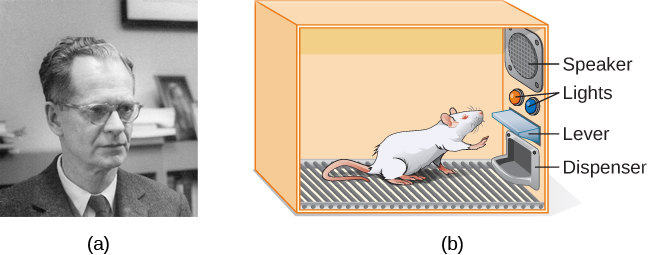
Figure 6.10 (a) B. F. Skinner developed operant conditioning for systematic study of how behaviors are strengthened or weakened according to their consequences. (b) In a Skinner box, a rat presses a lever in an operant conditioning chamber to receive a food reward. (credit a: modification of work by "Silly rabbit"/Wikimedia Commons)
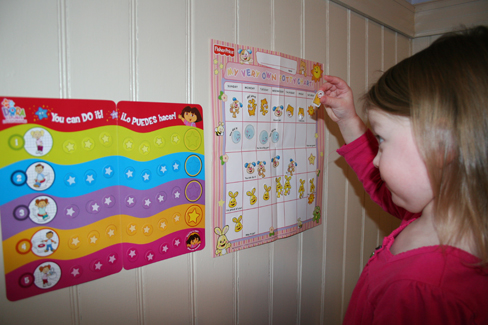
Figure 6.11 Sticker charts are a form of positive reinforcement and a tool for behavior modification. Once this child earns a certain number of stickers for demonstrating a desired behavior, she will be rewarded with a trip to the ice cream parlor. (credit: Abigail Batchelder)
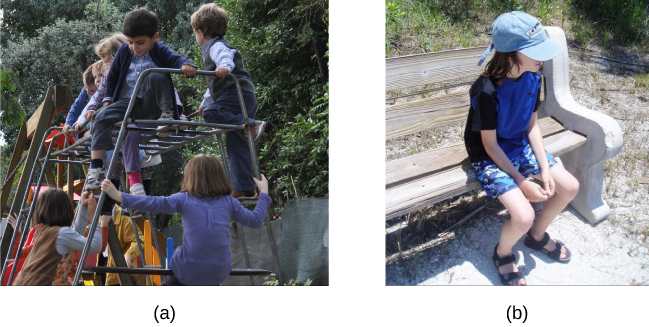
Figure 6.12 Time-out is a popular form of negative punishment used by caregivers. When a child misbehaves, they are removed from a desirable activity in an effort to decrease the unwanted behavior. For example, (a) a child might be playing on the playground with friends and push another child; (b) the child who misbehaved would then be removed from the activity for a short period of time. (credit a: modification of work by Simone Ramella; credit b: modification of work by “Spring Dew”/Flickr)
Rose M. Spielman, William J. Jenkins, and Marilyn D. Lovett, Psychology 2E, OpenStax. (credit a: modification of work by Simone Ramella; credit b: modification of work by “Spring Dew”/Flickr) · CC BY-NC-SA 4.0
· Original image ↗ · Access for free ↗Figure 6.13 — 6.3 Operant Conditioning
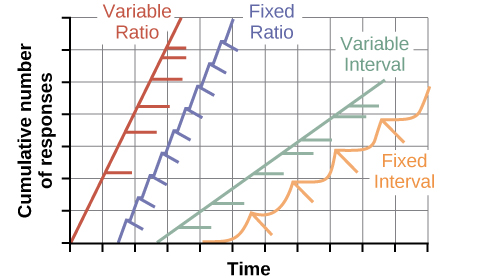
Figure 6.13 The four reinforcement schedules yield different response patterns. The variable ratio schedule is unpredictable and yields high and steady response rates, with little if any pause after reinforcement (e.g., gambler). A fixed ratio schedule is predictable and produces a high response rate, with a short pause after reinforcement (e.g., eyeglass saleswoman). The variable interval schedule is unpredictable and produces a moderate, steady response rate (e.g., restaurant manager). The fixed interval schedule yields a scallop-shaped response pattern, reflecting a significant pause after reinforcement (e.g., surgery patient).
Figure 6.14 Some research suggests that pathological gamblers use gambling to compensate for abnormally low levels of the hormone norepinephrine, which is associated with stress and is secreted in moments of arousal and thrill. (credit: Ted Murphy)
Figure 6.15 Psychologist Edward Tolman found that rats use cognitive maps to navigate through a maze. Have you ever worked your way through various levels on a video game? You learned when to turn left or right, move up or down. In that case you were relying on a cognitive map, just like the rats in a maze. (credit: modification of work by "FutUndBeidl"/Flickr)
Rose M. Spielman, William J. Jenkins, and Marilyn D. Lovett, Psychology 2E, OpenStax. (credit: modification of work by "FutUndBeidl"/Flickr) · CC BY-NC-SA 4.0
· Original image ↗ · Access for free ↗
The target behavior is followed by reinforcement or punishment to either strengthen or weaken it, so that the learner is more likely to exhibit the desired behavior in the future.
Stimulus timing
The stimulus occurs immediately before the response.
The stimulus (either reinforcement or punishment) occurs soon after the response.
Table 6.1. Rose M. Spielman, William J. Jenkins, and Marilyn D. Lovett, Psychology 2E, OpenStax.
Reinforcement
Punishment
Positive
Something is added to increase the likelihood of a behavior.
Something is added to decrease the likelihood of a behavior.
Negative
Something is removed to increase the likelihood of a behavior.
Something is removed to decrease the likelihood of a behavior.
Table 6.2. Rose M. Spielman, William J. Jenkins, and Marilyn D. Lovett, Psychology 2E, OpenStax.
Reinforcement Schedule
Description
Result
Example
Fixed interval
Reinforcement is delivered at predictable time intervals (e.g., after 5, 10, 15, and 20 minutes).
Moderate response rate with significant pauses after reinforcement
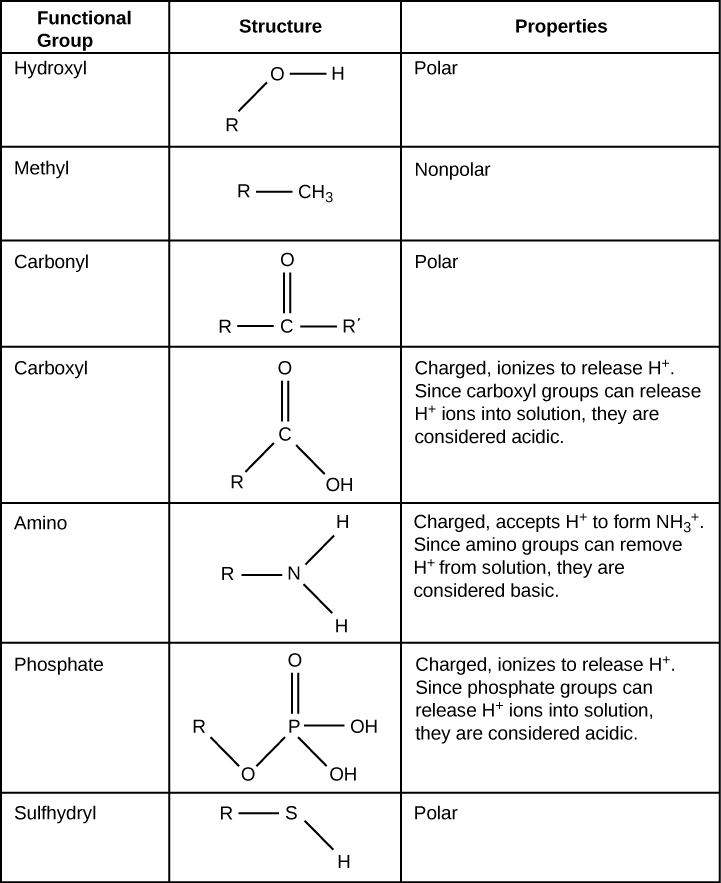
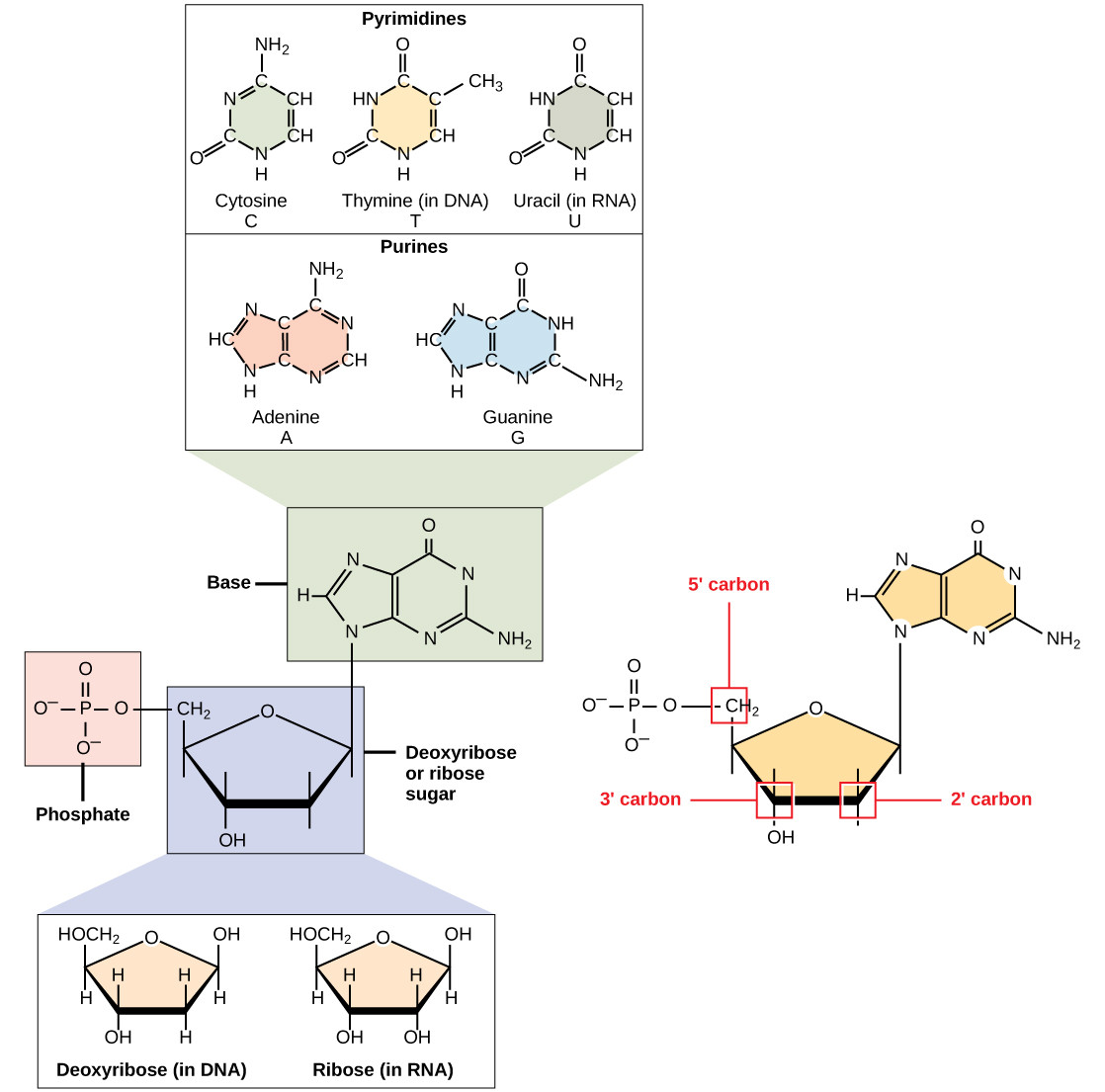
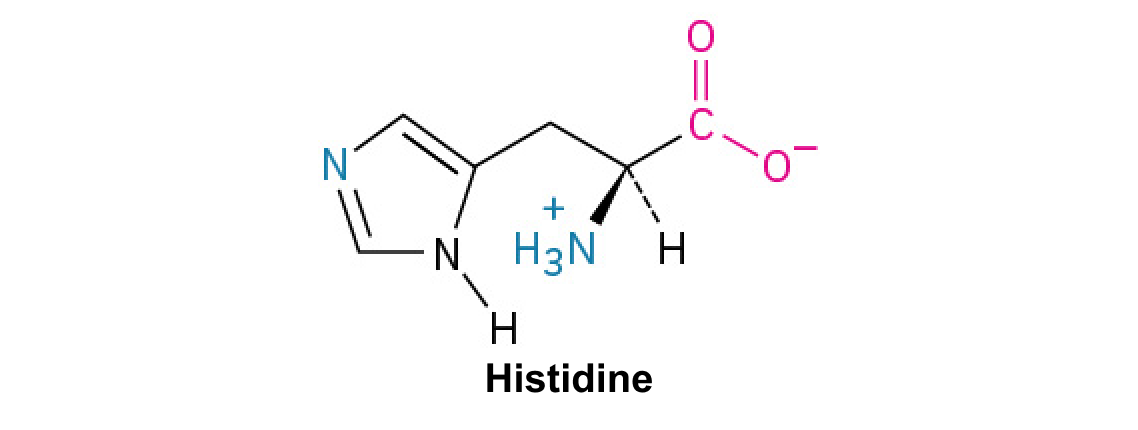
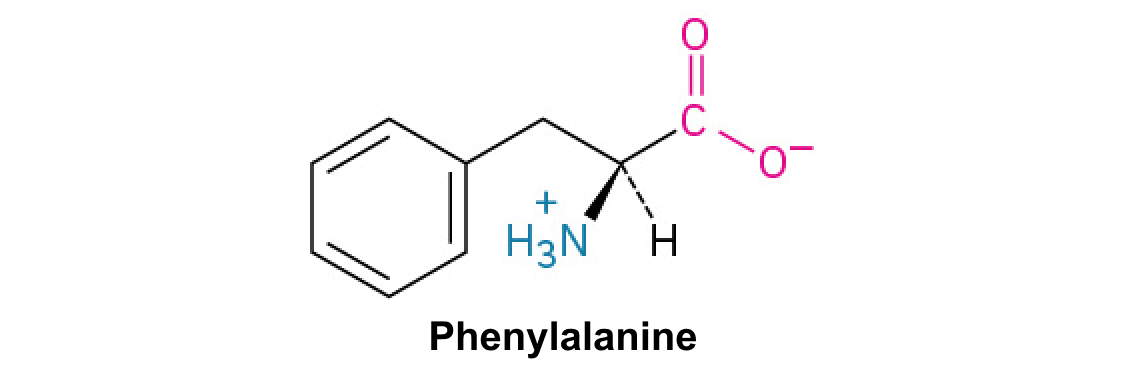
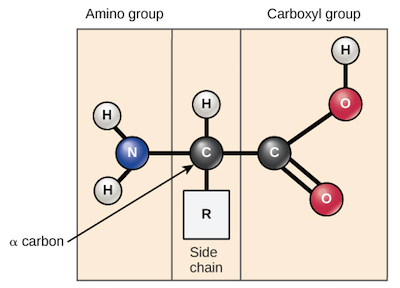
A nitrogen-containing functional group. A free amino acid’s amino group is typically protonated (NH₃⁺) near physiological pH; proline’s ring nitrogen is an exception to this formula.
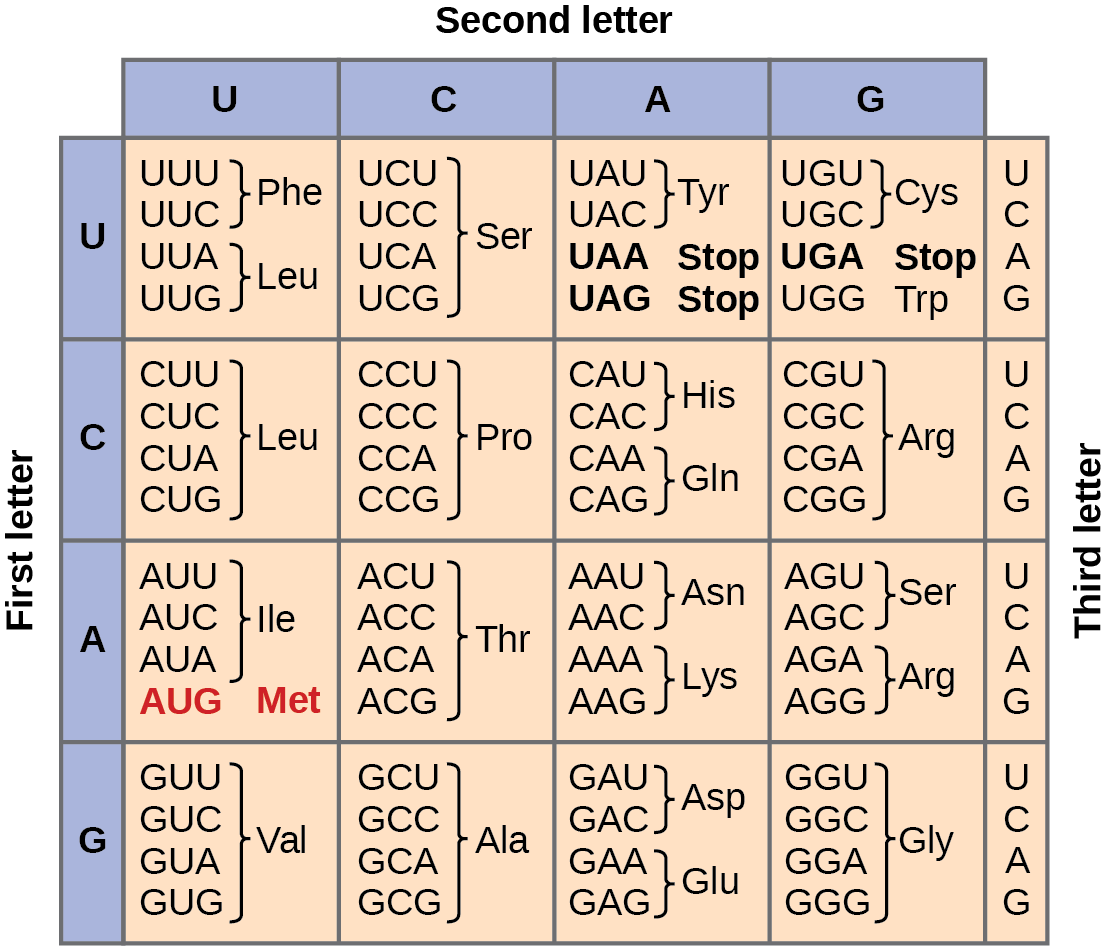
Figure 15.4 This figure shows the genetic code for translating each nucleotide triplet in mRNA into an amino acid or a termination signal in a protein. (credit: modification of work by NIH)
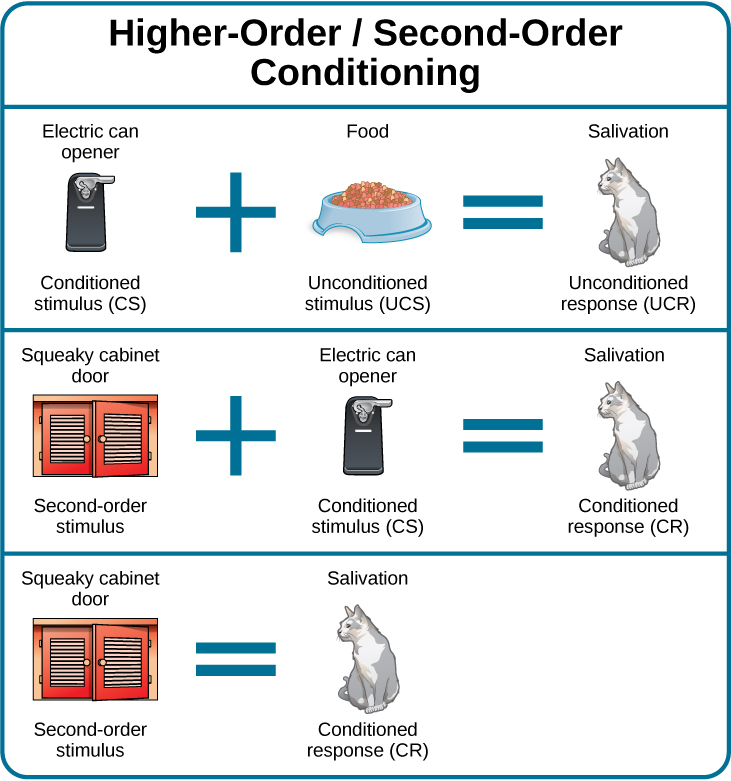
Figure 6.5 In higher-order conditioning, an established conditioned stimulus is paired with a new neutral stimulus (the second-order stimulus), so that eventually the new stimulus also elicits the conditioned response, without the initial conditioned stimulus being presented.
Figure 6.5 In higher-order conditioning, an established conditioned stimulus is paired with a new neutral stimulus (the second-order stimulus), so that eventually the new stimulus also elicits the conditioned response, without the initial conditioned stimulus being presented.
An electrical property that can be positive or negative. Opposite charges attract and like charges repel; net charge is the sum of all charges on a particle.
Figure 4.18 Membrane and secretory proteins are synthesized in the rough endoplasmic reticulum (RER). The RER also sometimes modifies proteins. In this illustration, a (green) integral membrane protein is modified by attachment of a (purple) carbohydrate in the ER. Vesicles with the integral protein bud from the ER and fuse with the Golgi apparatus' cis face. As the protein passes along the Golgi’s cisternae, the addition of more carbohydrates further modifies it. After its synthesis is complete, it exits as an integral membrane protein of the vesicle that buds from the Golgi’s trans face. When the vesicle fuses with the cell membrane, the protein becomes an integral portion of that cell membrane. (credit: modification of work by Magnus Manske)
Figure 4.18 Membrane and secretory proteins are synthesized in the rough endoplasmic reticulum (RER). The RER also sometimes modifies proteins. In this illustration, a (green) integral membrane protein is modified by attachment of a (purple) carbohydrate in the ER. Vesicles with the integral protein bud from the ER and fuse with the Golgi apparatus' cis face. As the protein passes along the Golgi’s cisternae, the addition of more carbohydrates further modifies it. After its synthesis is complete, it exits as an integral membrane protein of the vesicle that buds from the Golgi’s trans face. When the vesicle fuses with the cell membrane, the protein becomes an integral portion of that cell membrane. (credit: modification of work by Magnus Manske)
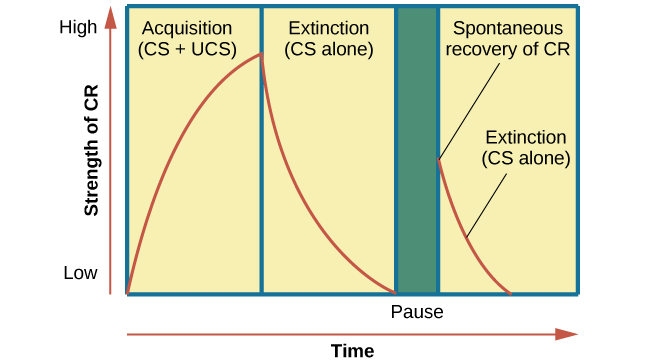
Figure 6.7 This is the curve of acquisition, extinction, and spontaneous recovery. The rising curve shows the conditioned response quickly getting stronger through the repeated pairing of the conditioned stimulus and the unconditioned stimulus (acquisition). Then the curve decreases, which shows how the conditioned response weakens when only the conditioned stimulus is presented (extinction). After a break or pause from conditioning, the conditioned response reappears (spontaneous recovery).
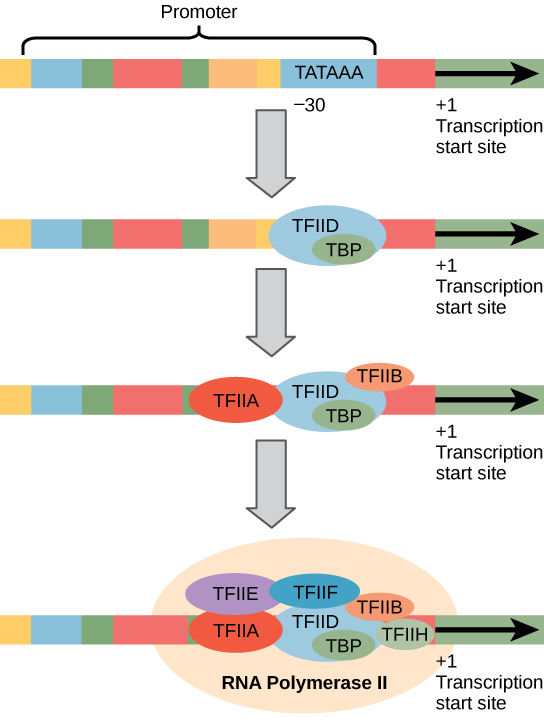
Figure 15.10 A generalized promoter of a gene transcribed by RNA polymerase II is shown. Transcription factors recognize the promoter. RNA polymerase II then binds and forms the transcription initiation complex.
Figure 4.18 Membrane and secretory proteins are synthesized in the rough endoplasmic reticulum (RER). The RER also sometimes modifies proteins. In this illustration, a (green) integral membrane protein is modified by attachment of a (purple) carbohydrate in the ER. Vesicles with the integral protein bud from the ER and fuse with the Golgi apparatus' cis face. As the protein passes along the Golgi’s cisternae, the addition of more carbohydrates further modifies it. After its synthesis is complete, it exits as an integral membrane protein of the vesicle that buds from the Golgi’s trans face. When the vesicle fuses with the cell membrane, the protein becomes an integral portion of that cell membrane. (credit: modification of work by Magnus Manske)
The exponent needed to obtain a number from a chosen fixed number. For decimal logarithms, log₁₀(100) = 2 because 10² = 100; pH uses the negative decimal logarithm of hydrogen ion activity.
A thin boundary or sheet. Cell membranes are lipid bilayers containing proteins; blotting membranes are synthetic supports that hold proteins or nucleic acids for detection.
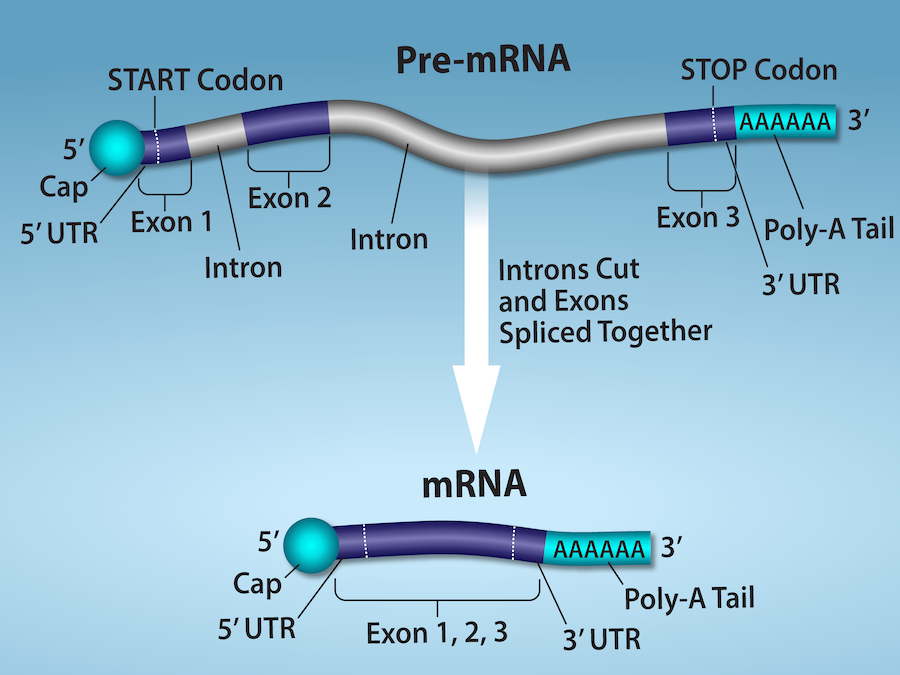
Figure 15.11 Eukaryotic pre-mRNA processing. In addition to 5’ Cap and 3’ Poly-A Tail addition, introns must be precisely removed and exons joined to generate a functional mRNA. Nucleotides upstream (towards the 5’cap) of the translation START codon are part of the 5’ untranslated region (5’ UTR). Nucleotides downstream (towards 3’end) of the STOP codon form the 3’ UTR. Both 5’ and 3’ UTRs are important for regulating translation initiation and mRNA stability. Credit: Rao, A., Ryan, K. Fletcher, S. and Tag, A. Department of Biology, Texas A&M University.
Rao, A., Ryan, K. Fletcher, S. and Tag, A. Department of Biology, Texas A&M University.; Mary Ann Clark, Matthew Douglas, and Jung Choi, Biology 2e, OpenStax. · CC BY-NC-SA 4.0
· Original image ↗ · Access for free ↗
Figure 4.18 Membrane and secretory proteins are synthesized in the rough endoplasmic reticulum (RER). The RER also sometimes modifies proteins. In this illustration, a (green) integral membrane protein is modified by attachment of a (purple) carbohydrate in the ER. Vesicles with the integral protein bud from the ER and fuse with the Golgi apparatus' cis face. As the protein passes along the Golgi’s cisternae, the addition of more carbohydrates further modifies it. After its synthesis is complete, it exits as an integral membrane protein of the vesicle that buds from the Golgi’s trans face. When the vesicle fuses with the cell membrane, the protein becomes an integral portion of that cell membrane. (credit: modification of work by Magnus Manske)
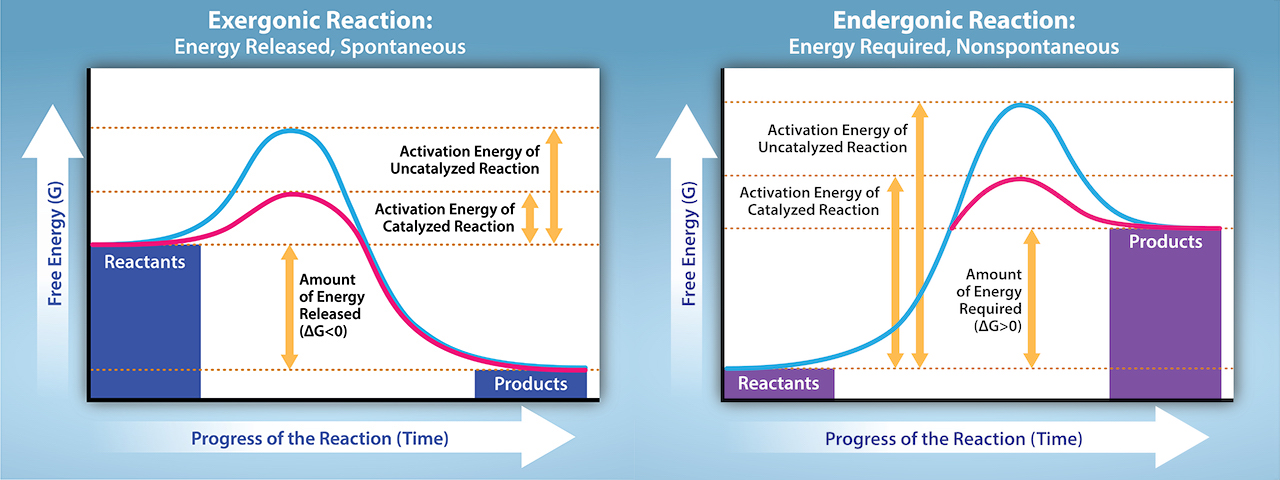
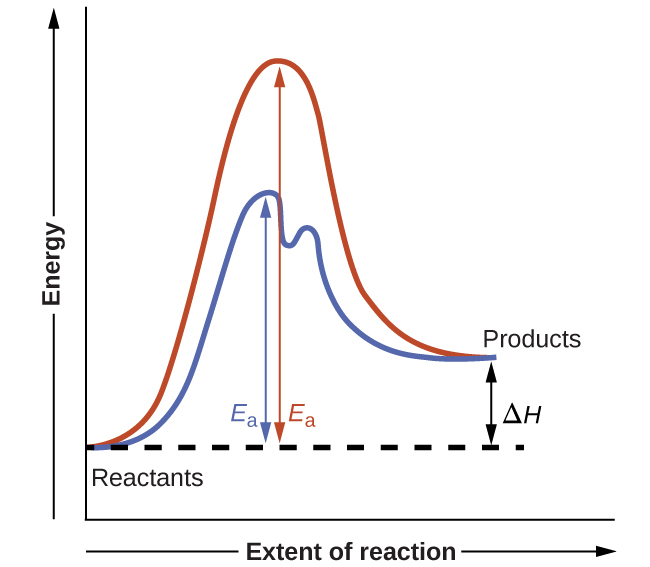
Figure 12.19 Reaction diagrams for an endothermic process in the absence (red curve) and presence (blue curve) of a catalyst. The catalyzed pathway involves a two-step mechanism (note the presence of two transition states) and an intermediate species (represented by the valley between the two transitions states).
Figure 4.18 Membrane and secretory proteins are synthesized in the rough endoplasmic reticulum (RER). The RER also sometimes modifies proteins. In this illustration, a (green) integral membrane protein is modified by attachment of a (purple) carbohydrate in the ER. Vesicles with the integral protein bud from the ER and fuse with the Golgi apparatus' cis face. As the protein passes along the Golgi’s cisternae, the addition of more carbohydrates further modifies it. After its synthesis is complete, it exits as an integral membrane protein of the vesicle that buds from the Golgi’s trans face. When the vesicle fuses with the cell membrane, the protein becomes an integral portion of that cell membrane. (credit: modification of work by Magnus Manske)
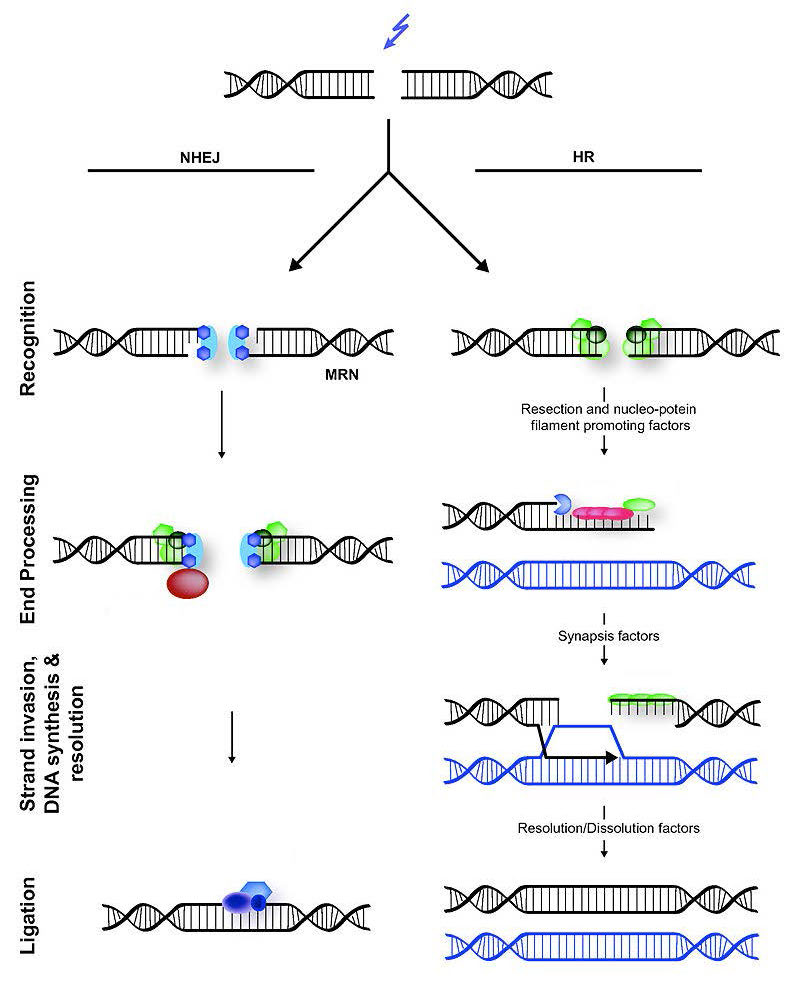
Figure 7.45 - Non-homologous end joining (left) versus homologous recombination (right) - Wikipedia
Wikipedia, as credited by Kevin Ahern, Indira Rajagopal, and Taralyn Tan, Biochemistry Free For All, Oregon State University, via Biology LibreTexts. · Source attribution
· Original image ↗ · Access for free ↗
The amount of a substance that can dissolve in a solvent under specified conditions. Soluble means able to dissolve; insoluble means only very slightly soluble in that solvent.
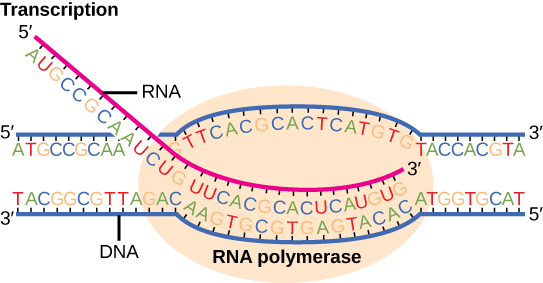
Figure 15.7 Messenger RNA is a copy of protein-coding information in the coding strand of DNA, with the substitution of U in the RNA for T in the coding sequence. However, new RNA nucleotides base pair with the nucleotides of the template strand. RNA is synthesized in its 5'-3' direction, using the enzyme RNA polymerase. As the template is read, the DNA unwinds ahead of the polymerase and then rewinds behind it.
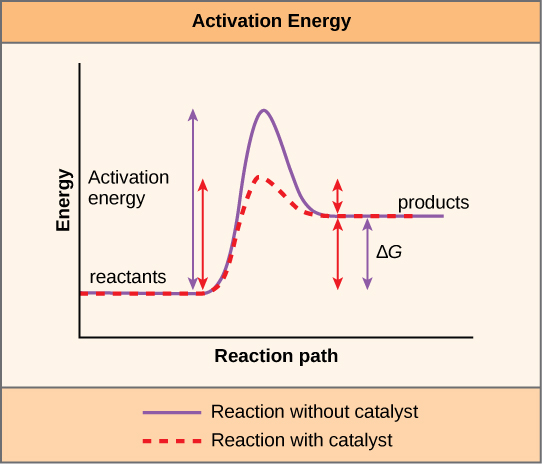
A fleeting, high-energy arrangement at a reaction barrier. It is an energy maximum along the reaction path, rather than a stable reaction intermediate.
Figure 12.19 Reaction diagrams for an endothermic process in the absence (red curve) and presence (blue curve) of a catalyst. The catalyzed pathway involves a two-step mechanism (note the presence of two transition states) and an intermediate species (represented by the valley between the two transitions states).
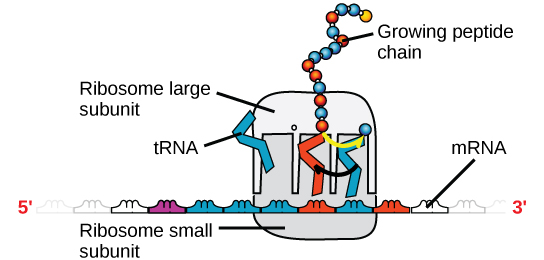
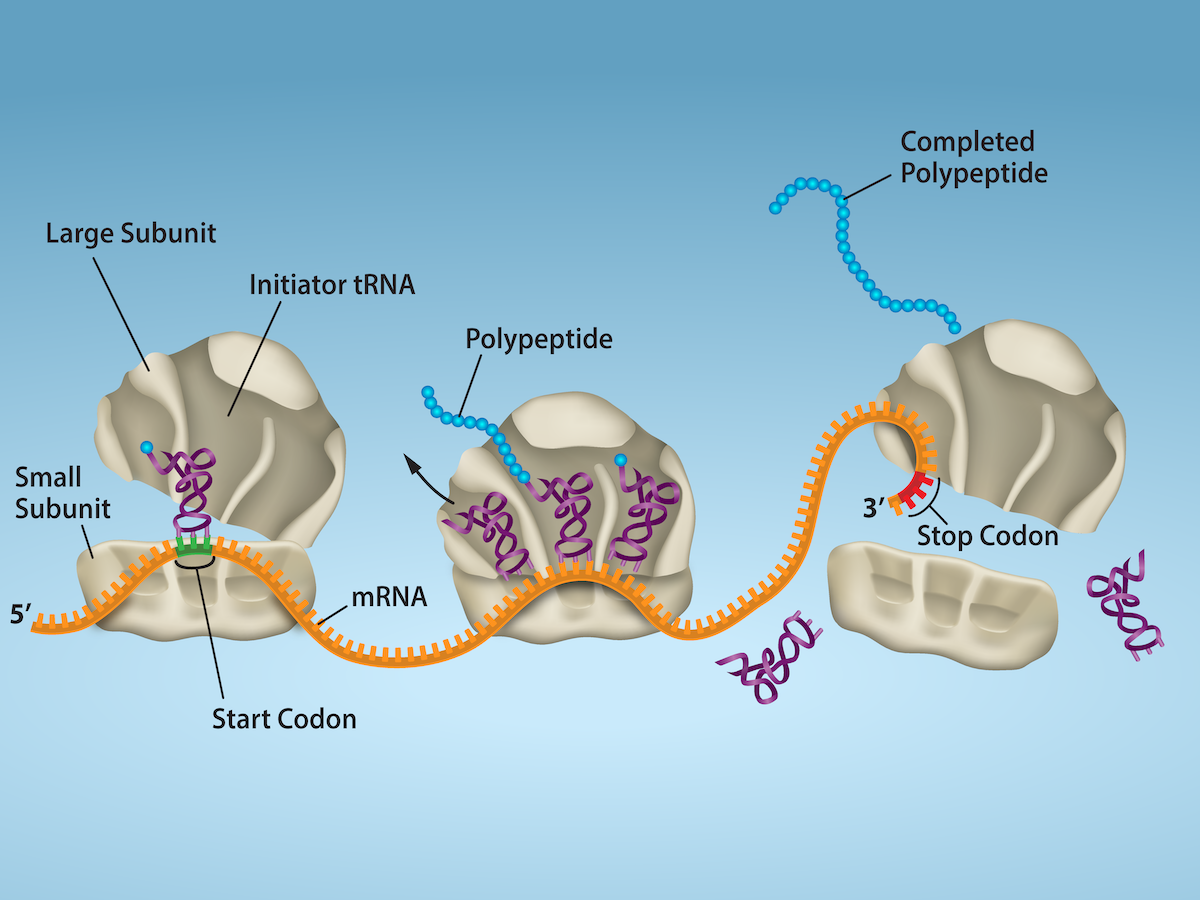
Figure 15.18 Translation begins when an initiator tRNA anticodon recognizes a start codon on mRNA bound to a small ribosomal subunit. The large ribosomal subunit joins the small subunit, and a second tRNA is recruited. As the mRNA moves relative to the ribosome, successive tRNAs move through the ribosome and the polypeptide chain is formed. Entry of a release factor into the A site terminates translation and the components dissociate.
Figure 6.5 In higher-order conditioning, an established conditioned stimulus is paired with a new neutral stimulus (the second-order stimulus), so that eventually the new stimulus also elicits the conditioned response, without the initial conditioned stimulus being presented.
Figure 4.18 Membrane and secretory proteins are synthesized in the rough endoplasmic reticulum (RER). The RER also sometimes modifies proteins. In this illustration, a (green) integral membrane protein is modified by attachment of a (purple) carbohydrate in the ER. Vesicles with the integral protein bud from the ER and fuse with the Golgi apparatus' cis face. As the protein passes along the Golgi’s cisternae, the addition of more carbohydrates further modifies it. After its synthesis is complete, it exits as an integral membrane protein of the vesicle that buds from the Golgi’s trans face. When the vesicle fuses with the cell membrane, the protein becomes an integral portion of that cell membrane. (credit: modification of work by Magnus Manske)
No matching terms. Try a different name or abbreviation.
6.3 Operant Conditioning
OpenStax · 6.3 Operant Conditioning ↗ Instructional page including learning objectives, examples, figures, source tables and questions. Site navigation and embedded media players are omitted; source media links remain available.
Explain the difference between reinforcement and punishment
Distinguish between reinforcement schedules
The previous section of this chapter focused on the type of associative learning known as classical conditioning. Remember that in classical conditioning, something in the environment triggers a reflex automatically, and researchers train the organism to react to a different stimulus. Now we turn to the second type of associative learning, operant conditioning. In operant conditioning, organisms learn to associate a behavior and its consequence (Table 6.1). A pleasant consequence makes that behavior more likely to be repeated in the future. For example, Spirit, a dolphin at the National Aquarium in Baltimore, does a flip in the air when her trainer blows a whistle. The consequence is that she gets a fish.
The target behavior is followed by reinforcement or punishment to either strengthen or weaken it, so that the learner is more likely to exhibit the desired behavior in the future.
Stimulus timing
The stimulus occurs immediately before the response.
The stimulus (either reinforcement or punishment) occurs soon after the response.
Table
6.1
Psychologist B. F. Skinner saw that classical conditioning is limited to existing behaviors that are reflexively elicited, and it doesn’t account for new behaviors such as riding a bike. He proposed a theory about how such behaviors come about. Skinner believed that behavior is motivated by the consequences we receive for the behavior: the reinforcements and punishments. His idea that learning is the result of consequences is based on the law of effect, which was first proposed by psychologist Edward Thorndike. According to the law of effect, behaviors that are followed by consequences that are satisfying to the organism are more likely to be repeated, and behaviors that are followed by unpleasant consequences are less likely to be repeated (Thorndike, 1911). Essentially, if an organism does something that brings about a desired result, the organism is more likely to do it again. If an organism does something that does not bring about a desired result, the organism is less likely to do it again. An example of the law of effect is in employment. One of the reasons (and often the main reason) we show up for work is because we get paid to do so. If we stop getting paid, we will likely stop showing up—even if we love our job.
Working with Thorndike’s law of effect as his foundation, Skinner began conducting scientific experiments on animals (mainly rats and pigeons) to determine how organisms learn through operant conditioning (Skinner, 1938). He placed these animals inside an operant conditioning chamber, which has come to be known as a “Skinner box” (Figure 6.10). A Skinner box contains a lever (for rats) or disk (for pigeons) that the animal can press or peck for a food reward via the dispenser. Speakers and lights can be associated with certain behaviors. A recorder counts the number of responses made by the animal.
Figure 6.10 (a) B. F. Skinner developed operant conditioning for systematic study of how behaviors are strengthened or weakened according to their consequences. (b) In a Skinner box, a rat presses a lever in an operant conditioning chamber to receive a food reward. (credit a: modification of work by "Silly rabbit"/Wikimedia Commons)
Rose M. Spielman, William J. Jenkins, and Marilyn D. Lovett, Psychology 2E, OpenStax. (credit a: modification of work by "Silly rabbit"/Wikimedia Commons) · CC BY-NC-SA 4.0
· Original image ↗ · Access for free ↗
In discussing operant conditioning, we use several everyday words—positive, negative, reinforcement, and punishment—in a specialized manner. In operant conditioning, positive and negative do not mean good and bad. Instead, positive means you are adding something, and negative means you are taking something away. Reinforcement means you are increasing a behavior, and punishment means you are decreasing a behavior. Reinforcement can be positive or negative, and punishment can also be positive or negative. All reinforcers (positive or negative) increase the likelihood of a behavioral response. All punishers (positive or negative) decrease the likelihood of a behavioral response. Now let’s combine these four terms: positive reinforcement, negative reinforcement, positive punishment, and negative punishment (Table 6.2).
Something is added to increase the likelihood of a behavior.
Something is added to decrease the likelihood of a behavior.
Negative
Something is removed to increase the likelihood of a behavior.
Something is removed to decrease the likelihood of a behavior.
Table
6.2
Reinforcement
The most effective way to teach a person or animal a new behavior is with positive reinforcement. In positive reinforcement, a desirable stimulus is added to increase a behavior.
For example, you tell your five-year-old son, Jerome, that if he cleans his room, he will get a toy. Jerome quickly cleans his room because he wants a new art set. Let’s pause for a moment. Some people might say, “Why should I reward my child for doing what is expected?” But in fact we are constantly and consistently rewarded in our lives. Our paychecks are rewards, as are high grades and acceptance into our preferred school. Being praised for doing a good job and for passing a driver’s test is also a reward. Positive reinforcement as a learning tool is extremely effective. It has been found that one of the most effective ways to increase achievement in school districts with below-average reading scores was to pay the children to read. Specifically, second-grade students in Dallas were paid $2 each time they read a book and passed a short quiz about the book. The result was a significant increase in reading comprehension (Fryer, 2010). What do you think about this program? If Skinner were alive today, he would probably think this was a great idea. He was a strong proponent of using operant conditioning principles to influence students’ behavior at school. In fact, in addition to the Skinner box, he also invented what he called a teaching machine that was designed to reward small steps in learning (Skinner, 1961)—an early forerunner of computer-assisted learning. His teaching machine tested students’ knowledge as they worked through various school subjects. If students answered questions correctly, they received immediate positive reinforcement and could continue; if they answered incorrectly, they did not receive any reinforcement. The idea was that students would spend additional time studying the material to increase their chance of being reinforced the next time (Skinner, 1961).
In negative reinforcement, an undesirable stimulus is removed to increase a behavior. For example, car manufacturers use the principles of negative reinforcement in their seatbelt systems, which go “beep, beep, beep” until you fasten your seatbelt. The annoying sound stops when you exhibit the desired behavior, increasing the likelihood that you will buckle up in the future. Negative reinforcement is also used frequently in horse training. Riders apply pressure—by pulling the reins or squeezing their legs—and then remove the pressure when the horse performs the desired behavior, such as turning or speeding up. The pressure is the negative stimulus that the horse wants to remove.
Punishment
Many people confuse negative reinforcement with punishment in operant conditioning, but they are two very different mechanisms. Remember that reinforcement, even when it is negative, always increases a behavior. In contrast, punishment always decreases a behavior. In positive punishment, you add an undesirable stimulus to decrease a behavior. An example of positive punishment is scolding a student to get the student to stop texting in class. In this case, a stimulus (the reprimand) is added in order to decrease the behavior (texting in class). In negative punishment, you remove a pleasant stimulus to decrease behavior. For example, when a child misbehaves, a parent can take away a favorite toy. In this case, a stimulus (the toy) is removed in order to decrease the behavior.
Punishment, especially when it is immediate, is one way to decrease undesirable behavior. For example, imagine your five-year-old son, Brandon, runs out into the street to chase a ball. You have Brandon write 100 times “I will not run into the street" (positive punishment). Chances are he won’t repeat this behavior. While strategies like this are common today, in the past children were often subject to physical punishment, such as spanking. It’s important to be aware of some of the drawbacks in using physical punishment on children. First, punishment may teach fear. Brandon may become fearful of the street, but he also may become fearful of the person who delivered the punishment—you, his parent. Similarly, children who are punished by teachers may come to fear the teacher and try to avoid school (Gershoff et al., 2010). Consequently, most schools in the United States have banned corporal punishment. Second, punishment may cause children to become more aggressive and prone to antisocial behavior and delinquency (Gershoff, 2002). They see their parents resort to spanking when they become angry and frustrated, so, in turn, they may act out this same behavior when they become angry and frustrated. For example, if you spank your child when you are angry with them for their misbehavior, they might start hitting their friends when they won’t share their toys.
While positive punishment can be effective in some cases, Skinner suggested that the use of punishment should be weighed against the possible negative effects. Today’s psychologists and parenting experts favor reinforcement over punishment—they recommend that you catch your child doing something good and reward them for it.
In hisoperant conditioning experiments, Skinner often used an approach called shaping. Instead of rewarding only the target behavior, in shaping, we reward successive approximations of a target behavior. Why is shaping needed? Remember that in order for reinforcement to work, the organism must first display the behavior. Shaping is needed because it is extremely unlikely that an organism will display anything but the simplest of behaviors spontaneously. In shaping, behaviors are broken down into many small, achievable steps. The specific steps used in the process are the following:
Reinforce any response that resembles the desired behavior.
Then reinforce the response that more closely resembles the desired behavior. You will no longer reinforce the previously reinforced response.
Next, begin to reinforce the response that even more closely resembles the desired behavior.
Continue to reinforce closer and closer approximations of the desired behavior.
Finally, only reinforce the desired behavior.
Shaping is often used in teaching a complex behavior or chain of behaviors. Skinner used shaping to teach pigeons not only such relatively simple behaviors as pecking a disk in a Skinner box, but also many unusual and entertaining behaviors, such as turning in circles, walking in figure eights, and even playing ping pong; the technique is commonly used by animal trainers today. An important part of shaping is stimulus discrimination. Recall Pavlov’s dogs—he trained them to respond to the tone of a bell, and not to similar tones or sounds. This discrimination is also important in operant conditioning and in shaping behavior.
It’s easy to see how shaping is effective in teaching behaviors to animals, but how does shaping work with humans? Let’s consider parents whose goal is to have their child learn to clean his room. They use shaping to help him master steps toward the goal. Instead of performing the entire task, they set up these steps and reinforce each step. First, he cleans up one toy. Second, he cleans up five toys. Third, he chooses whether to pick up ten toys or put his books and clothes away. Fourth, he cleans up everything except two toys. Finally, he cleans his entire room.
Primary and Secondary Reinforcers
Rewards such as stickers, praise, money, toys, and more can be used to reinforce learning. Let’s go back to Skinner’s rats again. How did the rats learn to press the lever in the Skinner box? They were rewarded with food each time they pressed the lever. For animals, food would be an obvious reinforcer.
What would be a good reinforcer for humans? For your child cleaning the room, it was the promise of a toy. How about Sydney, the soccer player? If you gave Sydney a piece of candy every time Sydney scored a goal, you would be using a primary reinforcer. Primary reinforcers are reinforcers that have innate reinforcing qualities. These kinds of reinforcers are not learned. Water, food, sleep, shelter, sex, and touch, among others, are primary reinforcers. Pleasure is also a primary reinforcer. Organisms do not lose their drive for these things. For most people, jumping in a cool lake on a very hot day would be reinforcing and the cool lake would be innately reinforcing—the water would cool the person off (a physical need), as well as provide pleasure.
A secondary reinforcer has no inherent value and only has reinforcing qualities when linked with a primary reinforcer. Praise, linked to affection, is one example of a secondary reinforcer, as when you called out “Great shot!” every time Sydney made a goal. Another example, money, is only worth something when you can use it to buy other things—either things that satisfy basic needs (food, water, shelter—all primary reinforcers) or other secondary reinforcers. If you were on a remote island in the middle of the Pacific Ocean and you had stacks of money, the money would not be useful if you could not spend it. What about the stickers on the behavior chart? They are also secondary reinforcers.
Sometimes, instead of stickers on a sticker chart, a token is used. Tokens, which are also secondary reinforcers, can then be traded in for rewards and prizes. Entire behavior management systems, known as token economies, are built around the use of these kinds of token reinforcers. Token economies have been found to be very effective at modifying behavior in a variety of settings such as schools, prisons, and mental hospitals. For example, a study by Adibsereshki and Abkenar (2014) found that use of a token economy increased appropriate social behaviors and reduced inappropriate behaviors in a group of eight grade students. Similar studies show demonstrable gains on behavior and academic achievement for groups ranging from first grade to high school, and representing a wide array of abilities and disabilities. For example, during studies involving younger students, when children in the study exhibited appropriate behavior (not hitting or pinching), they received a “quiet hands” token. When they hit or pinched, they lost a token. The children could then exchange specified amounts of tokens for minutes of playtime.
Everyday Connection
Behavior Modification in Children
Parents and teachers often use behavior modification to change a child’s behavior. Behavior modification uses the principles of operant conditioning to accomplish behavior change so that undesirable behaviors are switched for more socially acceptable ones. Some teachers and parents create a sticker chart, in which several behaviors are listed (Figure 6.11). Sticker charts are a form of token economies, as described in the text. Each time children perform the behavior, they get a sticker, and after a certain number of stickers, they get a prize, or reinforcer. The goal is to increase acceptable behaviors and decrease misbehavior. Remember, it is best to reinforce desired behaviors, rather than to use punishment. In the classroom, the teacher can reinforce a wide range of behaviors, from students raising their hands, to walking quietly in the hall, to turning in their homework. At home, parents might create a behavior chart that rewards children for things such as putting away toys, brushing their teeth, and helping with dinner. In order for behavior modification to be effective, the reinforcement needs to be connected with the behavior; the reinforcement must matter to the child and be done consistently.
Figure 6.11 Sticker charts are a form of positive reinforcement and a tool for behavior modification. Once this child earns a certain number of stickers for demonstrating a desired behavior, she will be rewarded with a trip to the ice cream parlor. (credit: Abigail Batchelder)
Time-out is another popular technique used in behavior modification with children. It operates on the principle of negative punishment. When a child demonstrates an undesirable behavior, they are removed from the desirable activity at hand (Figure 6.12). For example, say that Sophia and her brother Mario are playing with building blocks. Sophia throws some blocks at her brother, so you give her a warning that she will go to time-out if she does it again. A few minutes later, she throws more blocks at Mario. You remove Sophia from the room for a few minutes. When she comes back, she doesn’t throw blocks.
There are several important points that you should know if you plan to implement time-out as a behavior modification technique. First, make sure the child is being removed from a desirable activity and placed in a less desirable location. If the activity is something undesirable for the child, this technique will backfire because it is more enjoyable for the child to be removed from the activity. Second, the length of the time-out is important. The general rule of thumb is one minute for each year of the child’s age. Sophia is five; therefore, she sits in a time-out for five minutes. Setting a timer helps children know how long they have to sit in time-out. Finally, as a caregiver, keep several guidelines in mind over the course of a time-out: remain calm when directing your child to time-out; ignore your child during time-out (because caregiver attention may reinforce misbehavior); and give the child a hug or a kind word when time-out is over.
Figure 6.12 Time-out is a popular form of negative punishment used by caregivers. When a child misbehaves, they are removed from a desirable activity in an effort to decrease the unwanted behavior. For example, (a) a child might be playing on the playground with friends and push another child; (b) the child who misbehaved would then be removed from the activity for a short period of time. (credit a: modification of work by Simone Ramella; credit b: modification of work by “Spring Dew”/Flickr)
Rose M. Spielman, William J. Jenkins, and Marilyn D. Lovett, Psychology 2E, OpenStax. (credit a: modification of work by Simone Ramella; credit b: modification of work by “Spring Dew”/Flickr) · CC BY-NC-SA 4.0
· Original image ↗ · Access for free ↗
Reinforcement Schedules
Remember, the best way to teach a person or animal a behavior is to use positive reinforcement. For example, Skinner used positive reinforcement to teach rats to press a lever in a Skinner box. At first, the rat might randomly hit the lever while exploring the box, and out would come a pellet of food. After eating the pellet, what do you think the hungry rat did next? It hit the lever again, and received another pellet of food. Each time the rat hit the lever, a pellet of food came out. When an organism receives a reinforcer each time it displays a behavior, it is called continuous reinforcement. This reinforcement schedule is the quickest way to teach someone a behavior, and it is especially effective in training a new behavior. Let’s look back at the dog that was learning to sit earlier in the chapter. Now, each time he sits, you give him a treat. Timing is important here: you will be most successful if you present the reinforcer immediately after he sits, so that he can make an association between the target behavior (sitting) and the consequence (getting a treat).
Once a behavior is trained, researchers and trainers often turn to another type of reinforcement schedule—partial reinforcement. In partial reinforcement, also referred to as intermittent reinforcement, the person or animal does not get reinforced every time they perform the desired behavior. There are several different types of partial reinforcement schedules (Table 6.3). These schedules are described as either fixed or variable, and as either interval or ratio. Fixed refers to the number of responses between reinforcements, or the amount of time between reinforcements, which is set and unchanging. Variable refers to the number of responses or amount of time between reinforcements, which varies or changes. Interval means the schedule is based on the time between reinforcements, and ratio means the schedule is based on the number of responses between reinforcements.
Reinforcement Schedules
Reinforcement Schedule
Description
Result
Example
Fixed interval
Reinforcement is delivered at predictable time intervals (e.g., after 5, 10, 15, and 20 minutes).
Moderate response rate with significant pauses after reinforcement
Reinforcement is delivered at unpredictable time intervals (e.g., after 5, 7, 10, and 20 minutes).
Moderate yet steady response rate
Checking social media
Fixed ratio
Reinforcement is delivered after a predictable number of responses (e.g., after 2, 4, 6, and 8 responses).
High response rate with pauses after reinforcement
Piecework—factory worker getting paid for every x number of items manufactured
Variable ratio
Reinforcement is delivered after an unpredictable number of responses (e.g., after 1, 4, 5, and 9 responses).
High and steady response rate
Gambling
Table
6.3
Now let’s combine these four terms. A fixed interval reinforcement schedule is when behavior is rewarded after a set amount of time. For example, June undergoes major surgery in a hospital. During recovery, they are expected to experience pain and will require prescription medications for pain relief. June is given an IV drip with a patient-controlled painkiller. Their doctor sets a limit: one dose per hour. June pushes a button when pain becomes difficult, and they receive a dose of medication. Since the reward (pain relief) only occurs on a fixed interval, there is no point in exhibiting the behavior when it will not be rewarded.
With a variable interval reinforcement schedule, the person or animal gets the reinforcement based on varying amounts of time, which are unpredictable. Say that Manuel is the manager at a fast-food restaurant. Every once in a while someone from the quality control division comes to Manuel’s restaurant. If the restaurant is clean and the service is fast, everyone on that shift earns a $20 bonus. Manuel never knows when the quality control person will show up, so he always tries to keep the restaurant clean and ensures that his employees provide prompt and courteous service. His productivity regarding prompt service and keeping a clean restaurant are steady because he wants his crew to earn the bonus.
With a fixed ratio reinforcement schedule, there are a set number of responses that must occur before the behavior is rewarded. Carla sells glasses at an eyeglass store, and she earns a commission every time she sells a pair of glasses. She always tries to sell people more pairs of glasses, including prescription sunglasses or a backup pair, so she can increase her commission. She does not care if the person really needs the prescription sunglasses, Carla just wants her bonus. The quality of what Carla sells does not matter because her commission is not based on quality; it’s only based on the number of pairs sold. This distinction in the quality of performance can help determine which reinforcement method is most appropriate for a particular situation. Fixed ratios are better suited to optimize the quantity of output, whereas a fixed interval, in which the reward is not quantity based, can lead to a higher quality of output.
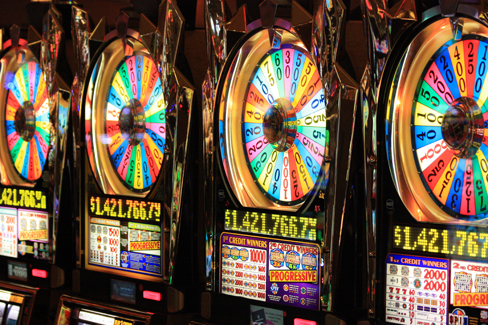
In a variable ratio reinforcement schedule, the number of responses needed for a reward varies. This is the most powerful partial reinforcement schedule. An example of the variable ratio reinforcement schedule is gambling. Imagine that Sarah—generally a smart, thrifty woman—visits Las Vegas for the first time. She is not a gambler, but out of curiosity she puts a quarter into the slot machine, and then another, and another. Nothing happens. Two dollars in quarters later, her curiosity is fading, and she is just about to quit. But then, the machine lights up, bells go off, and Sarah gets 50 quarters back. That’s more like it! Sarah gets back to inserting quarters with renewed interest, and a few minutes later she has used up all her gains and is $10 in the hole. Now might be a sensible time to quit. And yet, she keeps putting money into the slot machine because she never knows when the next reinforcement is coming. She keeps thinking that with the next quarter she could win $50, or $100, or even more. Because the reinforcement schedule in most types of gambling has a variable ratio schedule, people keep trying and hoping that the next time they will win big. This is one of the reasons that gambling is so addictive—and so resistant to extinction.
In operant conditioning, extinction of a reinforced behavior occurs at some point after reinforcement stops, and the speed at which this happens depends on the reinforcement schedule. In a variable ratio schedule, the point of extinction comes very slowly, as described above. But in the other reinforcement schedules, extinction may come quickly. For example, if June presses the button for the pain relief medication before the allotted time the doctor has approved, no medication is administered. They are on a fixed interval reinforcement schedule (dosed hourly), so extinction occurs quickly when reinforcement doesn’t come at the expected time. Among the reinforcement schedules, variable ratio is the most productive and the most resistant to extinction. Fixed interval is the least productive and the easiest to extinguish (Figure 6.13).
Figure 6.13 The four reinforcement schedules yield different response patterns. The variable ratio schedule is unpredictable and yields high and steady response rates, with little if any pause after reinforcement (e.g., gambler). A fixed ratio schedule is predictable and produces a high response rate, with a short pause after reinforcement (e.g., eyeglass saleswoman). The variable interval schedule is unpredictable and produces a moderate, steady response rate (e.g., restaurant manager). The fixed interval schedule yields a scallop-shaped response pattern, reflecting a significant pause after reinforcement (e.g., surgery patient).
Skinner (1953) stated, “If the gambling establishment cannot persuade a patron to turn over money with no return, it may achieve the same effect by returning part of the patron's money on a variable-ratio schedule” (p. 397).
Skinner uses gambling as an example of the power of the variable-ratio reinforcement schedule for maintaining behavior even during long periods without any reinforcement. In fact, Skinner was so confident in his knowledge of gambling addiction that he even claimed he could turn a pigeon into a pathological gambler (“Skinner’s Utopia,” 1971). It is indeed true that variable-ratio schedules keep behavior quite persistent—just imagine the frequency of a child’s tantrums if a parent gives in even once to the behavior. The occasional reward makes it almost impossible to stop the behavior.
Recent research in rats has failed to support Skinner’s idea that training on variable-ratio schedules alone causes pathological gambling (Laskowski et al., 2019). However, other research suggests that gambling does seem to work on the brain in the same way as most addictive drugs, and so there may be some combination of brain chemistry and reinforcement schedule that could lead to problem gambling (Figure 6.14). Specifically, modern research shows the connection between gambling and the activation of the reward centers of the brain that use the neurotransmitter (brain chemical) dopamine (Murch & Clark, 2016). Interestingly, gamblers don’t even have to win to experience the “rush” of dopamine in the brain. “Near misses,” or almost winning but not actually winning, also have been shown to increase activity in the ventral striatum and other brain reward centers that use dopamine (Chase & Clark, 2010). These brain effects are almost identical to those produced by addictive drugs like cocaine and heroin (Murch & Clark, 2016). Based on the neuroscientific evidence showing these similarities, the DSM-5 now considers gambling an addiction, while earlier versions of the DSM classified gambling as an impulse control disorder.
Figure 6.14 Some research suggests that pathological gamblers use gambling to compensate for abnormally low levels of the hormone norepinephrine, which is associated with stress and is secreted in moments of arousal and thrill. (credit: Ted Murphy)
In addition to dopamine, gambling also appears to involve other neurotransmitters, including norepinephrine and serotonin (Potenza, 2013). Norepinephrine is secreted when a person feels stress, arousal, or thrill. It may be that pathological gamblers use gambling to increase their levels of this neurotransmitter. Deficiencies in serotonin might also contribute to compulsive behavior, including a gambling addiction (Potenza, 2013).
It may be that pathological gamblers’ brains are different than those of other people, and perhaps this difference may somehow have led to their gambling addiction, as these studies seem to suggest. However, it is very difficult to ascertain the cause because it is impossible to conduct a true experiment (it would be unethical to try to turn randomly assigned participants into problem gamblers). Therefore, it may be that causation actually moves in the opposite direction—perhaps the act of gambling somehow changes neurotransmitter levels in some gamblers’ brains. It also is possible that some overlooked factor, or confounding variable, played a role in both the gambling addiction and the differences in brain chemistry.
Strict behaviorists like Watson and Skinner focused exclusively on studying behavior rather than cognition (such as thoughts and expectations). In fact, Skinner was such a staunch believer that cognition didn't matter that his ideas were considered radical behaviorism. Skinner considered the mind a "black box"—something completely unknowable—and, therefore, something not to be studied. However, another behaviorist, Edward C. Tolman, had a different opinion. Tolman’s experiments with rats demonstrated that organisms can learn even if they do not receive immediate reinforcement (Tolman & Honzik, 1930; Tolman, Ritchie, & Kalish, 1946). This finding was in conflict with the prevailing idea at the time that reinforcement must be immediate in order for learning to occur, thus suggesting a cognitive aspect to learning.
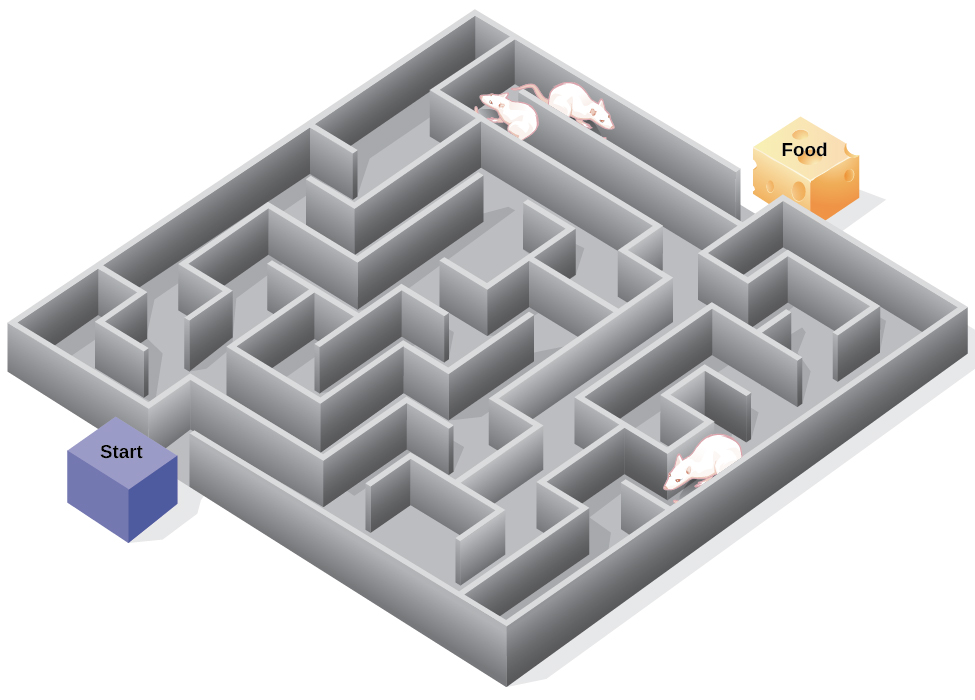
In the experiments, Tolman placed hungry rats in a maze with no reward for finding their way through it. He also studied a comparison group that was rewarded with food at the end of the maze. As the unreinforced rats explored the maze, they developed a cognitive map: a mental picture of the layout of the maze (Figure 6.15). After 10 sessions in the maze without reinforcement, food was placed in a goal box at the end of the maze. As soon as the rats became aware of the food, they were able to find their way through the maze quickly, just as quickly as the comparison group, which had been rewarded with food all along. This is known as latent learning: learning that occurs but is not observable in behavior until there is a reason to demonstrate it.
Figure 6.15 Psychologist Edward Tolman found that rats use cognitive maps to navigate through a maze. Have you ever worked your way through various levels on a video game? You learned when to turn left or right, move up or down. In that case you were relying on a cognitive map, just like the rats in a maze. (credit: modification of work by "FutUndBeidl"/Flickr)
Rose M. Spielman, William J. Jenkins, and Marilyn D. Lovett, Psychology 2E, OpenStax. (credit: modification of work by "FutUndBeidl"/Flickr) · CC BY-NC-SA 4.0
· Original image ↗ · Access for free ↗
Latent learning also occurs in humans. Children may learn by watching the actions of their parents but only demonstrate it at a later date, when the learned material is needed. For example, suppose that Ravi’s dad drives him to school every day. In this way, Ravi learns the route from his house to his school, but he’s never driven there himself, so he has not had a chance to demonstrate that he’s learned the way. One morning Ravi’s dad has to leave early for a meeting, so he can’t drive Ravi to school. Instead, Ravi follows the same route on his bike that his dad would have taken in the car. This demonstrates latent learning. Ravi had learned the route to school, but had no need to demonstrate this knowledge earlier.
Everyday Connection
This Place Is Like a Maze
Have you ever gotten lost in a building and couldn’t find your way back out? While that can be frustrating, you’re not alone. At one time or another we’ve all gotten lost in places like a museum, hospital, or university library. Whenever we go someplace new, we build a mental representation—or cognitive map—of the location, as Tolman’s rats built a cognitive map of their maze. However, some buildings are confusing because they include many areas that look alike or have short lines of sight. Because of this, it’s often difficult to predict what’s around a corner or decide whether to turn left or right to get out of a building. Psychologist Laura Carlson (2010) suggests that what we place in our cognitive map can impact our success in navigating through the environment. She suggests that paying attention to specific features upon entering a building, such as a picture on the wall, a fountain, a statue, or an escalator, adds information to our cognitive map that can be used later to help find our way out of the building.