Magnetic forces redirect moving charges but do no work on a point charge.
Magnetic fields and Lorentz force
Magnetic field B is measured in teslas. Field lines form closed loops; outside a bar magnet they run from north to south. A long straight wire gives B = μ₀I/(2πr), with direction from the right-hand grip rule. The total Lorentz force is F = q(E + v × B). Its magnetic magnitude is |q|vB sin θ. Use the right-hand rule for positive charge, then reverse for negative charge. A current-carrying straight segment experiences F = IL × B.
Source: College Physics 2E 22 — Section Summary · 22.5 Force on a Moving Charge in a Magnetic Field: Examples and Applications
Trajectories reveal field geometry
A charge entering a uniform magnetic field perpendicular to its velocity follows a circle with radius r = mv/(|q|B), because magnetic force supplies centripetal acceleration. Speed and kinetic energy remain constant when the magnetic force acts alone. A velocity component parallel to B remains unchanged, giving a helix. A uniform electric field can change both speed and direction. In crossed perpendicular fields, electric and magnetic forces cancel for a selected speed v = E/B when their force directions oppose; other speeds deflect.
Source: College Physics 2E 22 — Section Summary · 22.5 Force on a Moving Charge in a Magnetic Field: Examples and Applications
Apply it
Try before revealing the answer. A particle’s speed doubles in the same perpendicular magnetic field. What happens to orbit radius, kinetic energy, and cyclotron frequency?
Worked answer
Radius r = mv/(|q|B) doubles. Kinetic energy ½mv² quadruples. Angular frequency |q|B/m is unchanged in the nonrelativistic approximation. Magnetic force increases, but remains perpendicular to velocity and does no work.
Source: College Physics 2E 22 — Section Summary · 22.5 Force on a Moving Charge in a Magnetic Field: Examples and Applications
22.5 Force on a Moving Charge in a Magnetic Field: Examples and Applications — figures and tables
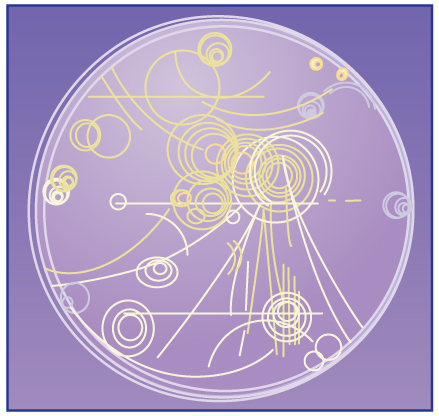
Figure 22.18 Trails of bubbles are produced by high-energy charged particles moving through the superheated liquid hydrogen in this artist’s rendition of a bubble chamber. There is a strong magnetic field perpendicular to the page that causes the curved paths of the particles. The radius of the path can be used to find the mass, charge, and energy of the particle.
Paul Peter Urone and Roger Hinrichs, College Physics 2E, OpenStax. · CC BY-NC-SA 4.0 · Original image ↗ · Access for free ↗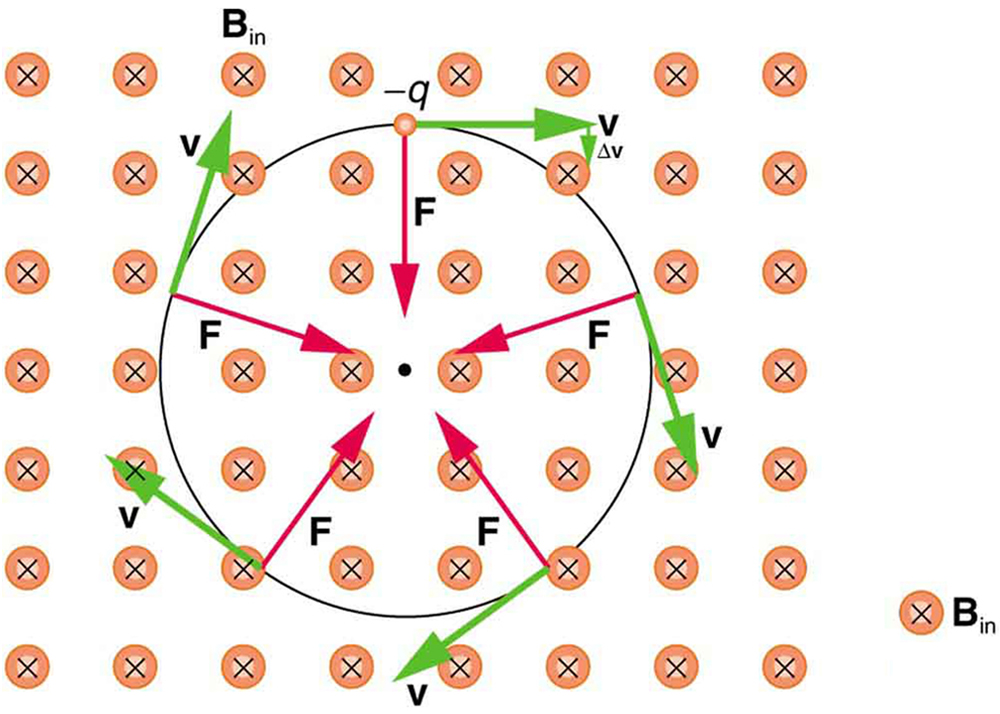
Figure 22.19 A negatively charged particle moves in the plane of the page in a region where the magnetic field is perpendicular into the page (represented by the small circles with x’s—like the tails of arrows). The magnetic force is perpendicular to the velocity, and so velocity changes in direction but not magnitude. Uniform circular motion results.
Paul Peter Urone and Roger Hinrichs, College Physics 2E, OpenStax. · CC BY-NC-SA 4.0 · Original image ↗ · Access for free ↗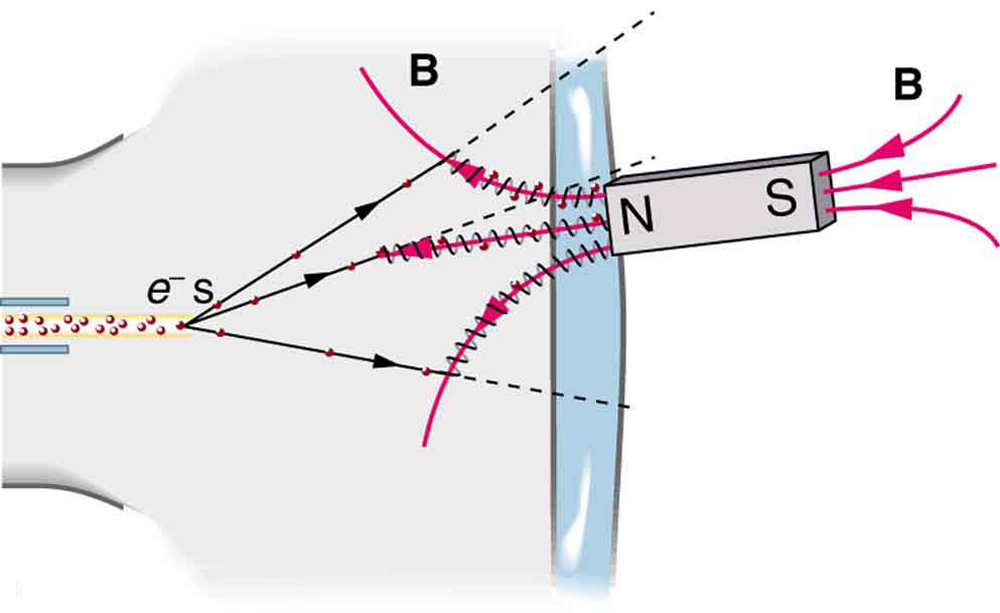
Figure 22.20 Side view showing what happens when a magnet comes in contact with a computer monitor or TV screen. Electrons moving toward the screen spiral about magnetic field lines, maintaining the component of their velocity parallel to the field lines. This distorts the image on the screen.
Paul Peter Urone and Roger Hinrichs, College Physics 2E, OpenStax. · CC BY-NC-SA 4.0 · Original image ↗ · Access for free ↗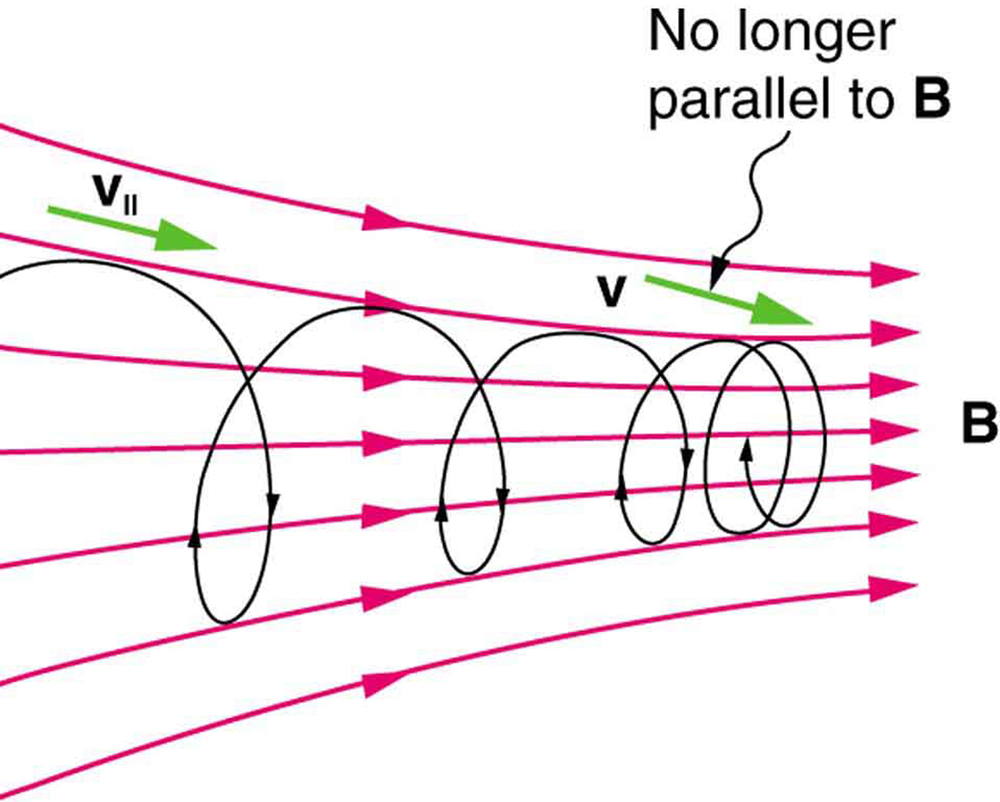
Figure 22.21 When a charged particle moves along a magnetic field line into a region where the field becomes stronger, the particle experiences a force that reduces the component of velocity parallel to the field. This force slows the motion along the field line and here reverses it, forming a “magnetic mirror.”
Paul Peter Urone and Roger Hinrichs, College Physics 2E, OpenStax. · CC BY-NC-SA 4.0 · Original image ↗ · Access for free ↗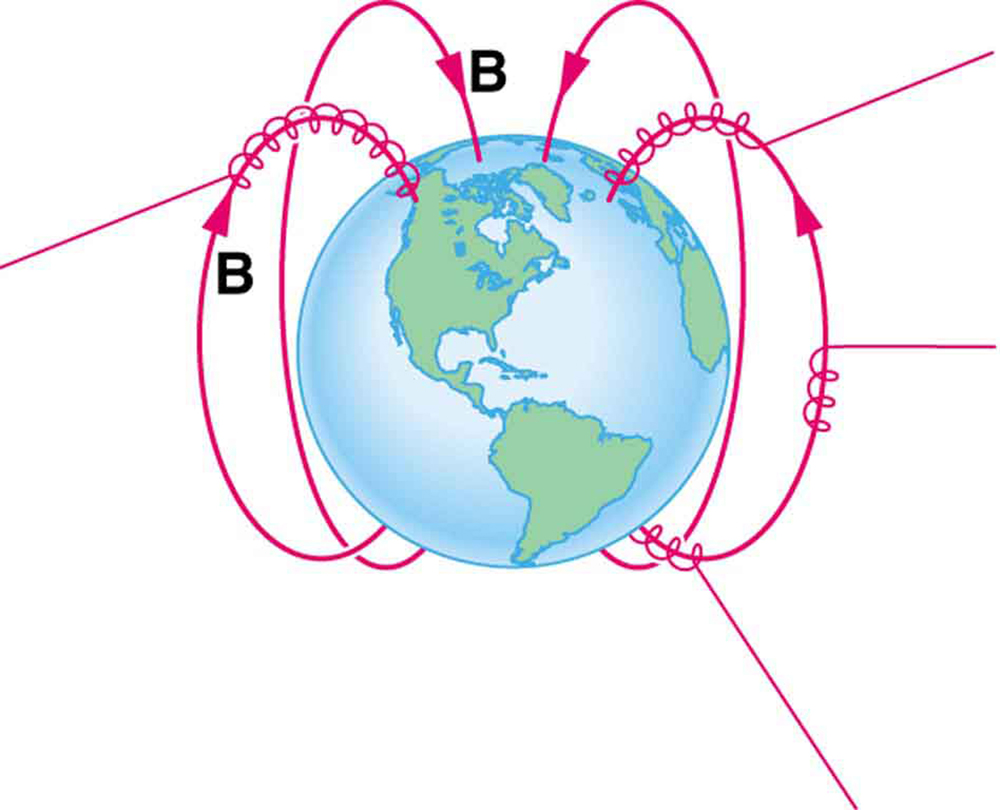
Figure 22.22 Energetic electrons and protons, components of cosmic rays, from the Sun and deep outer space often follow the Earth’s magnetic field lines rather than cross them. (Recall that the Earth’s north magnetic pole is really a south pole in terms of a bar magnet.)
Paul Peter Urone and Roger Hinrichs, College Physics 2E, OpenStax. · CC BY-NC-SA 4.0 · Original image ↗ · Access for free ↗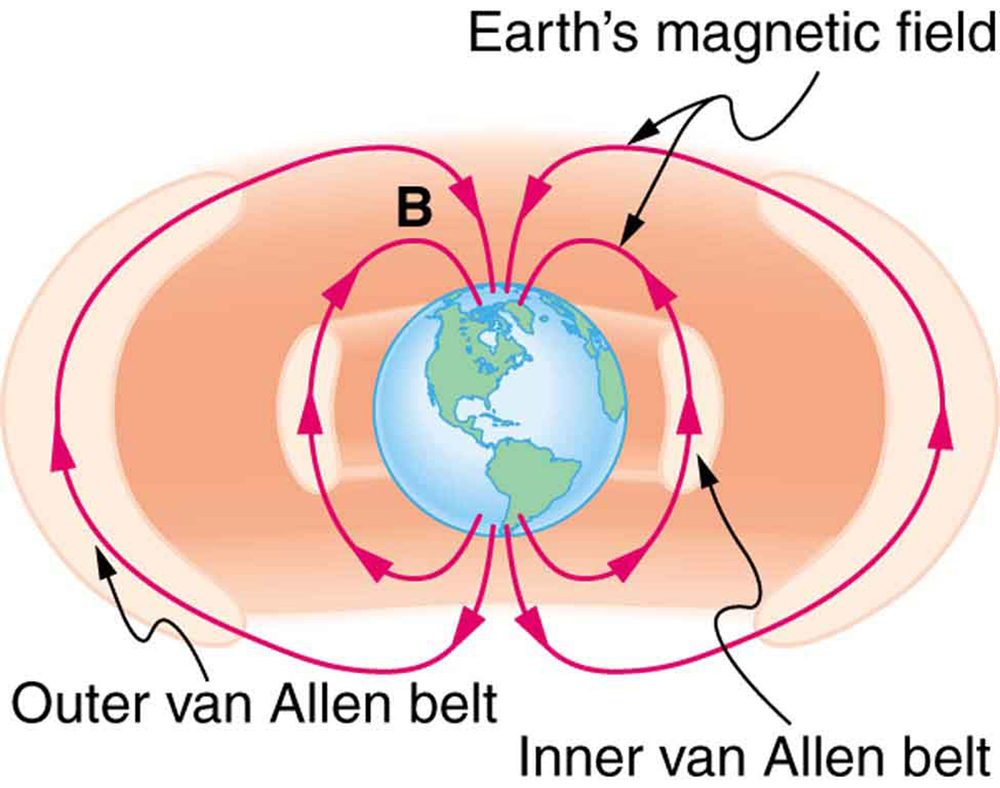
Figure 22.23 The Van Allen radiation belts are two regions in which energetic charged particles are trapped in the Earth’s magnetic field. One belt lies about 300 km above the Earth’s surface, the other about 16,000 km. Charged particles in these belts migrate along magnetic field lines and are partially reflected away from the poles by the stronger fields there. The charged particles that enter the atmosphere are replenished by the Sun and sources in deep outer space.
Paul Peter Urone and Roger Hinrichs, College Physics 2E, OpenStax. · CC BY-NC-SA 4.0 · Original image ↗ · Access for free ↗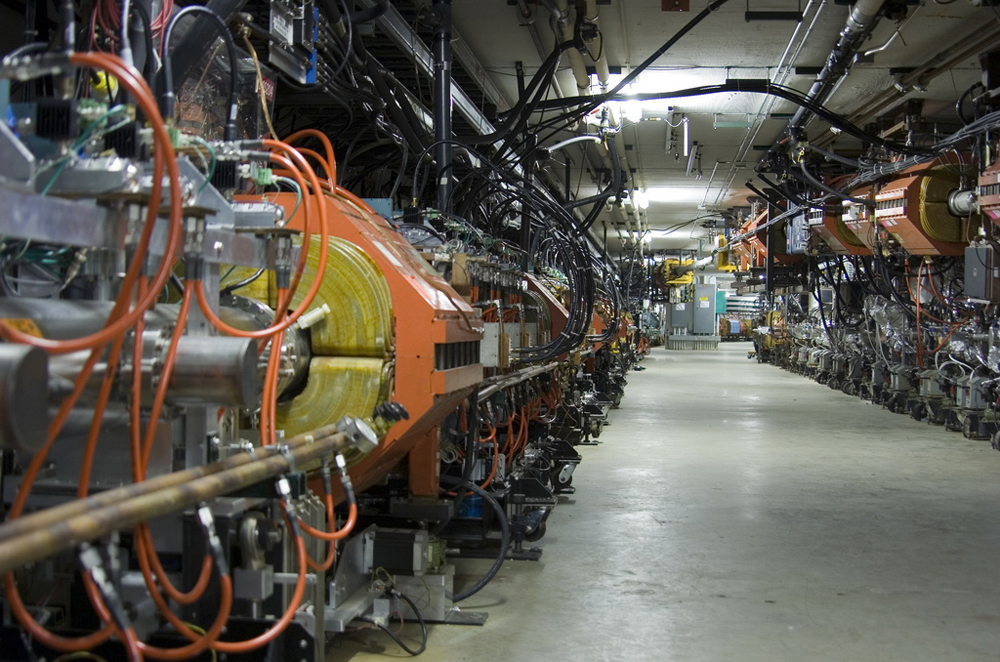
Figure 22.24 The Fermilab facility in Illinois has a large particle accelerator (the most powerful in the world until 2008) that employs magnetic fields (magnets seen here in orange) to contain and direct its beam. This and other accelerators have been in use for several decades and have allowed us to discover some of the laws underlying all matter. (credit: ammcrim, Flickr)
Paul Peter Urone and Roger Hinrichs, College Physics 2E, OpenStax. (credit: ammcrim, Flickr) · CC BY-NC-SA 4.0 · Original image ↗ · Access for free ↗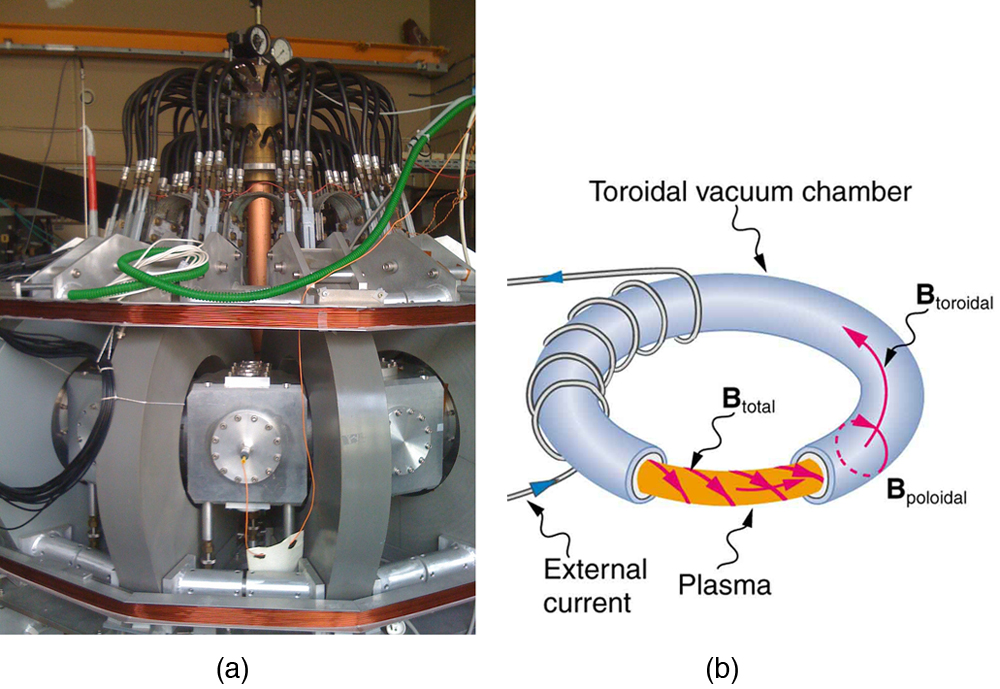
Figure 22.25 Tokamaks such as the one shown in the figure are being studied with the goal of economical production of energy by nuclear fusion. Magnetic fields in the doughnut-shaped device contain and direct the reactive charged particles. (credit: David Mellis, Flickr)
Paul Peter Urone and Roger Hinrichs, College Physics 2E, OpenStax. (credit: David Mellis, Flickr) · CC BY-NC-SA 4.0 · Original image ↗ · Access for free ↗Source: 22.5 Force on a Moving Charge in a Magnetic Field: Examples and Applications