Foundation 5 · 5E · Thermodynamics and kinetics

Rate laws, mechanisms, and energy profiles

Sources ↗

A balanced overall equation gives stoichiometry; the observed requires experiment or a justified mechanism.

Extract order from data

For rate = k[A]ᵐ[B]ⁿ, the exponents define orders and are determined experimentally; they need not equal overall stoichiometric coefficients. Compare experiments where one changes at a time. integrated behavior is [A] = [A]₀ − kt; is ln[A] = ln[A]₀ − kt; second-order for rate = k[A]² is 1/[A] = 1/[A]₀ + kt. is ln2/k and is -independent. Rate-constant units depend on total order, so dimensional consistency helps identify a proposed law.

Source: Chemistry 2E 12 — Summary · 14.3 Kinetic versus Thermodynamic Control of Reactions

Mechanisms must reproduce the observed law

An ’s describes the number of reacting partners in that step, and its follows its microscopic stoichiometry. Summing steps cancels to give the overall . A slow step can control net rate, but a containing an unmeasured intermediate must be rewritten using a justified pre- or relationship. A plausible mechanism must match both the net equation and experimental rate behavior; matching alone may not uniquely prove it. participate and are regenerated, whereas are formed then consumed.

Source: Chemistry 2E 12 — Summary · 14.3 Kinetic versus Thermodynamic Control of Reactions

Read energy profiles

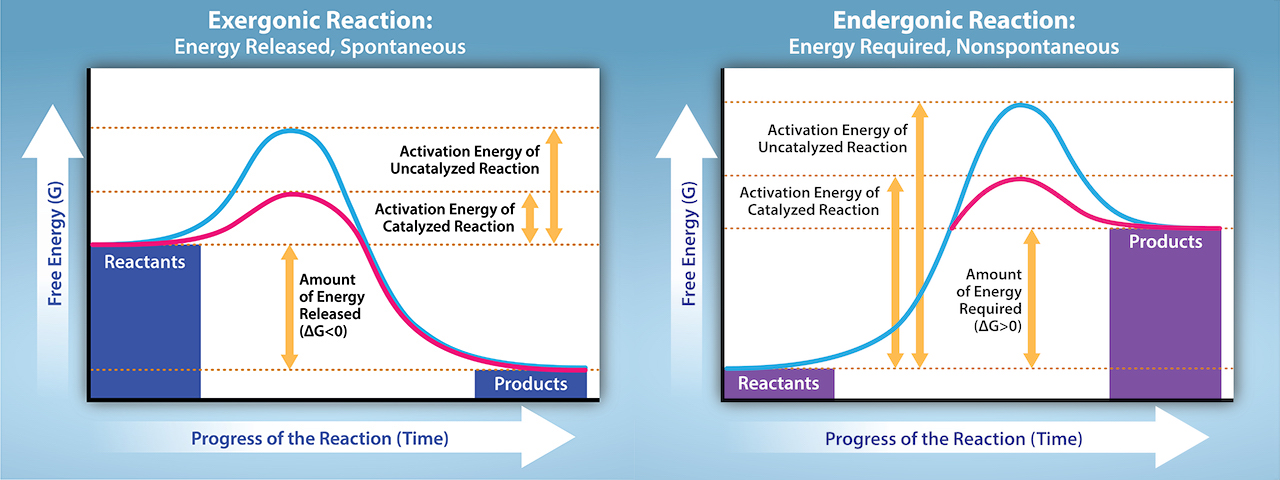
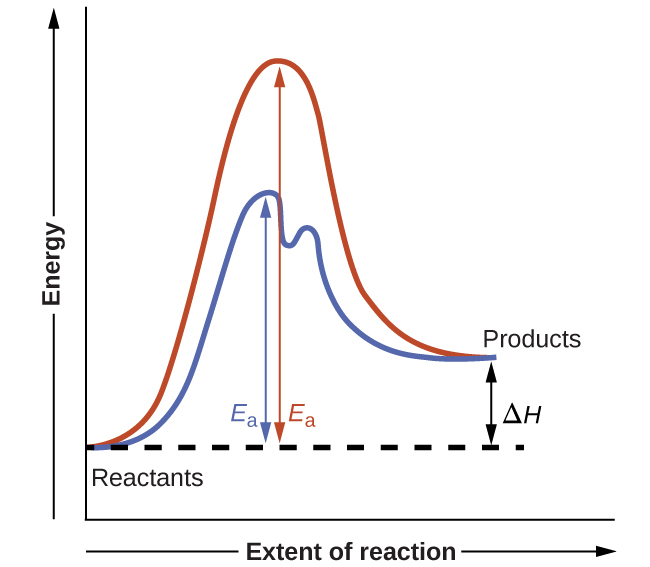
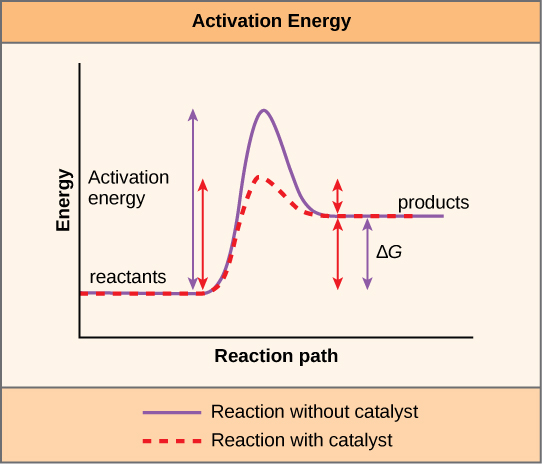
An energy profile plots energy against progress, not time. sit at maxima and are not isolable ; occupy local minima between barriers. Forward is measured from a basin to the relevant barrier, while is the -minus- energy difference on an profile. Multiple steps can have different barriers. The tallest absolute is not automatically the rate-controlling step without considering starting and populations. Stabilizing a relative to its preceding basin speeds that .

Source: Chemistry 2E 12 — Summary · 14.3 Kinetic versus Thermodynamic Control of Reactions

Temperature and

The is k = Ae⁻/(RT); plotting ln k against 1/T gives slope −/R when A and are approximately constant. Higher temperature increases the of collisions able to cross a positive barrier. A offers an alternative mechanism with lower effective activation barriers and accelerates equilibration in both directions. It does not change , K, or the under the same conditions. Surface area, orientation, , and can make real temperature or responses depart from the simplest model.

Source: Chemistry 2E 12 — Summary · 14.3 Kinetic versus Thermodynamic Control of Reactions

versus

When competing form through different barriers, a lower barrier can favor the under conditions that trap early . If are reversible and have time to equilibrate, the more stable can dominate even if it forms more slowly. Temperature and influence which regime is accessible, but high temperature alone does not guarantee or a specific . Compare an energy diagram’s barrier heights for rates and well depths for . Changing a may change selectivity without changing the available to fully interconverting .

Source: Chemistry 2E 12 — Summary · 14.3 Kinetic versus Thermodynamic Control of Reactions

Apply it

Try before revealing the answer. Doubling [A] quadruples the ; doubling [B] has no effect. At [A] = 0.10 M, rate = 2.0 × 10⁻³ M/s. Find the and k.

Worked answer

The is second order in A and zero order in B over the tested conditions: rate = k[A]². k = (2.0 × 10⁻³)/(0.10)² = 0.20 M⁻¹ s⁻¹. These data alone do not establish that the overall contains two A in one .

Source: Chemistry 2E 12 — Summary · 14.3 Kinetic versus Thermodynamic Control of Reactions

14.3 versus of — figures and tables

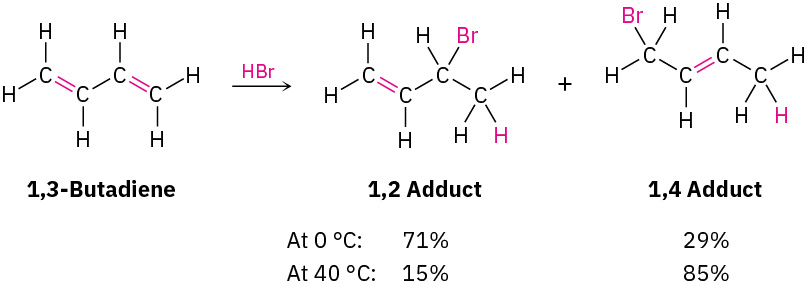
In a reaction, 1,3-butadiene reacts with hydrogen bromide to yield 1,2 adduct and 1,4 adduct. At 0 and 40 degrees Celsius, the ratio of the two adducts is different.
14.3 versus of — illustration 1 John McMurry, Organic Chemistry, OpenStax. · CC BY-NC-SA 4.0 · Original image ↗ · Access for free ↗
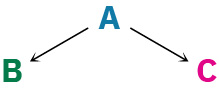
The figure shows reactant A forms product B and product C.
14.3 versus of — illustration 2 John McMurry, Organic Chemistry, OpenStax. · CC BY-NC-SA 4.0 · Original image ↗ · Access for free ↗
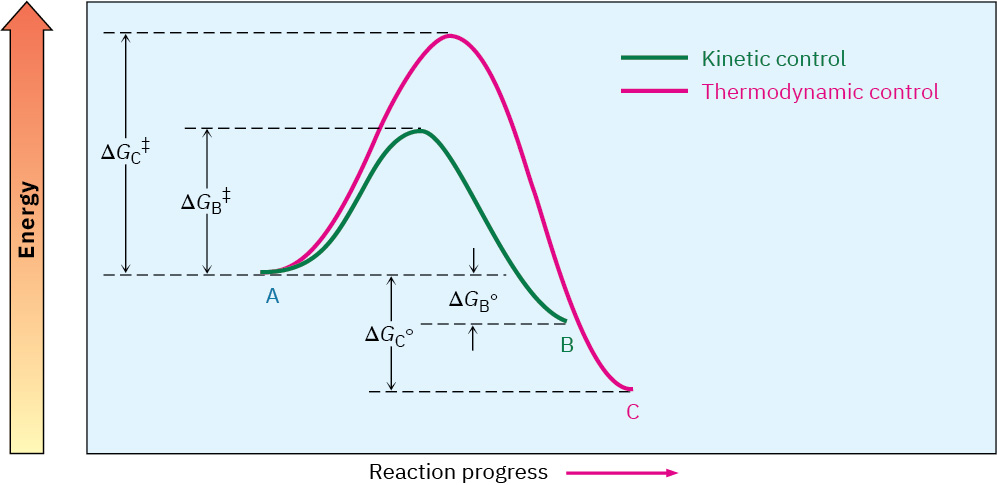
The energy diagram shows the thermodynamic control curve forming a higher peak than the kinetic control curve. The x and y axes denotes reaction progress and energy, respectively.
Figure 14.6 — 14.3 versus of

Figure 14.6 An energy diagram for two competing reactions in which the less stable product B forms faster than the more stable product C .

John McMurry, Organic Chemistry, OpenStax. · CC BY-NC-SA 4.0 · Original image ↗ · Access for free ↗


Reactant A forms products B and C in faster and slower reactions, respectively. The text next to the reaction generating product B reads Kinetic control (Lower temperature; irreversible).
14.3 versus of — illustration 4 John McMurry, Organic Chemistry, OpenStax. · CC BY-NC-SA 4.0 · Original image ↗ · Access for free ↗
Reactant A yields two products, B and C in reversible reactions. The text next to the reaction generating product B readsThermodynamic control (Higher temperature; reversible).
14.3 versus of — illustration 5 John McMurry, Organic Chemistry, OpenStax. · CC BY-NC-SA 4.0 · Original image ↗ · Access for free ↗
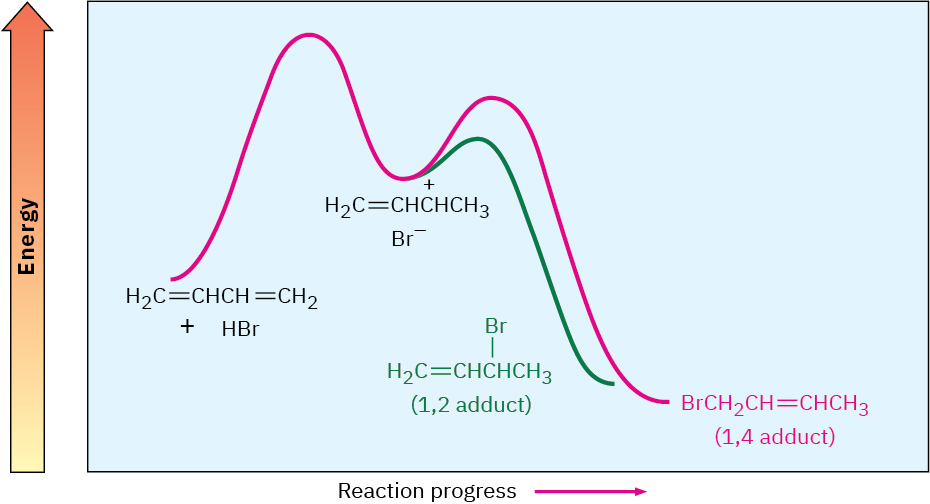
Energy diagram shows curve for 1,4-adduct formation has two maxima, the first being higher. The curve for 1,2 adduct initiates from trough of first curve and ends higher in energy than the first curve.
Figure 14.7 — 14.3 versus of

Figure 14.7 Energy diagram for the electrophilic addition of HBr to 1,3-butadiene. The 1,2 adduct is the kinetic product because it forms faster, but the 1,4 adduct is the thermodynamic product because it is more stable.

John McMurry, Organic Chemistry, OpenStax. · CC BY-NC-SA 4.0 · Original image ↗ · Access for free ↗

Source: 14.3 Kinetic versus Thermodynamic Control of Reactions
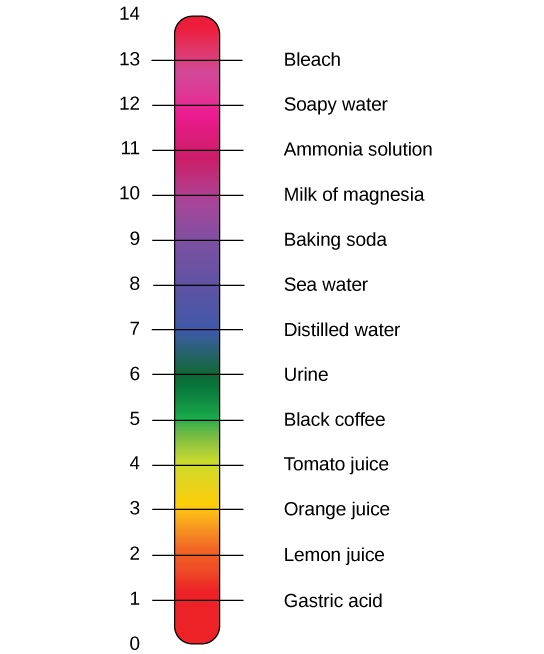
132 terms, alphabetically ordered

Acid · ·

In the Brønsted–Lowry model, a substance that can donate a . Acidic have a higher activity than water.

Read explanation · OpenStax ↗
Activation energy ·

The energy barrier that must overcome to reach a and undergo .

Read explanation · OpenStax ↗
Active catalytic-site concentration ·

The total of active sites used to calculate from . It equals active when each has one site.

Read explanation · Biology LibreTexts ↗
Active site

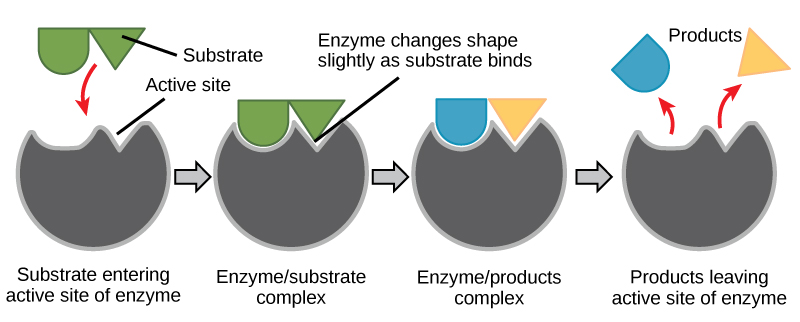
The region of an that binds its and carries out .

Read explanation · OpenStax ↗
Adenosine triphosphate

An energy-carrying ; its powers many cellular processes, including cycles.

Read explanation · OpenStax ↗
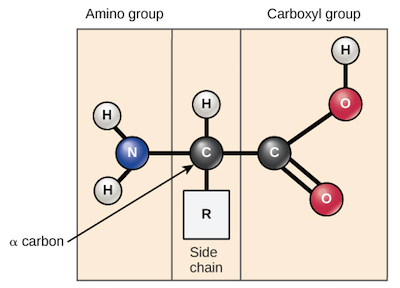
Alpha carbon · ·

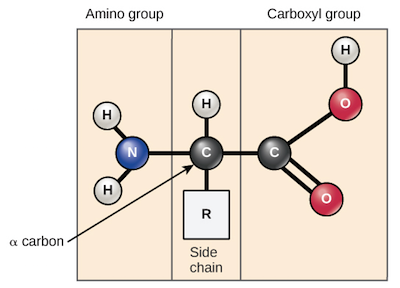
The central carbon next to the carboxyl carbon. In a standard it binds an , hydrogen, and .

Read explanation · OpenStax ↗
Amide · · ·

A group containing a carbon bonded to nitrogen. are amide linkages.

Read explanation · OpenStax ↗
Amino acid

A building block containing amino and and a characteristic .

Read explanation · OpenStax ↗
Amino acid residue · ·

The part of an incorporated into a chain. Residue can also describe another building block within a larger .

Read explanation · OpenStax ↗
Amino group · · ·

A nitrogen-containing . A free ’s amino group is typically (NH₃⁺) near physiological ; ’s ring nitrogen is an exception to this formula.

Read explanation · OpenStax ↗
Amphipathic

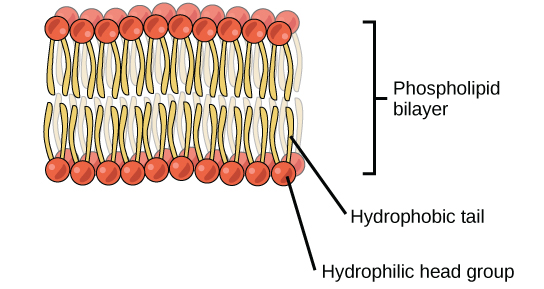
Having both a region and a region, as in a or .

Read explanation · OpenStax ↗
Aqueous solution ·

A in which water is the .

Read explanation · OpenStax ↗
Arrhenius equation

Temperature dependence k = Ae⁻/(RT) for a rate constant under its model assumptions.

Read explanation · OpenStax ↗
Atom

The smallest unit of an element that retains its chemical identity; it has a surrounded by .

Read explanation · OpenStax ↗
Biomolecule

A made by or involved in living systems, including , , , and .

Read explanation · OpenStax ↗
Blotting ·

Transfer of separated or to a so a specific target can be detected.

Read explanation · Thermo Fisher ↗
Brønsted–Lowry base · · · · · · · · · · ·

In the Brønsted–Lowry model, a substance that can accept a . Basic solutions have lower activity than water.

Read explanation · OpenStax ↗
Carbohydrate

A class of including sugars and their , used for energy storage, structure, and recognition.

Read explanation · OpenStax ↗
Carbonyl group · ·

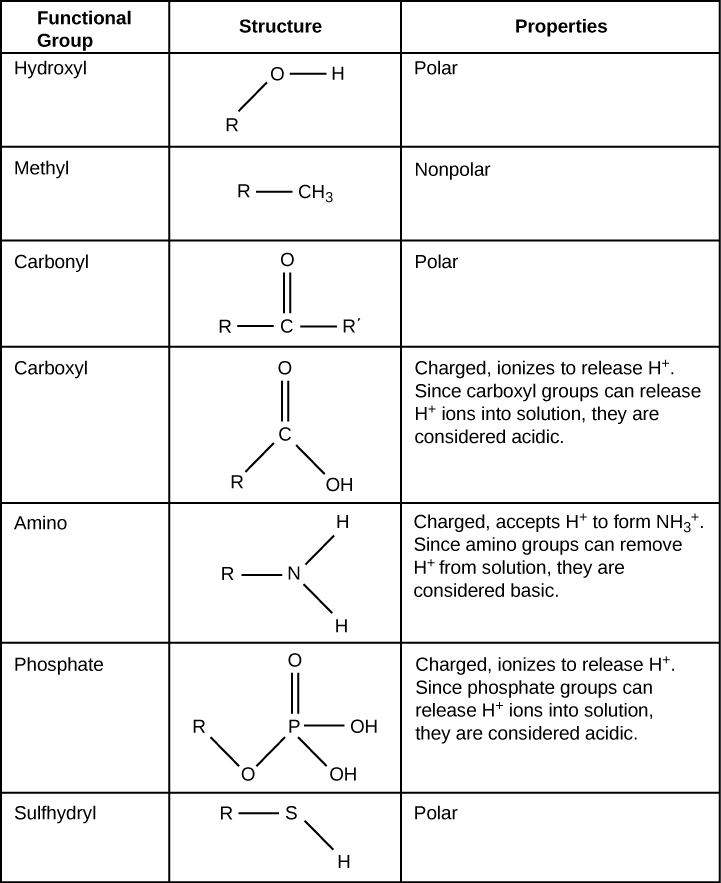
A carbon double-bonded to oxygen, C=O; present in and many other .

Read explanation · OpenStax ↗
Carboxyl group · ·

An , COOH. In free it is usually to COO⁻ near physiological .

Read explanation · OpenStax ↗
Catalyst · ·

A substance that speeds a by providing a pathway with lower and is regenerated rather than consumed overall.

Read explanation · OpenStax ↗
Chemical compound ·

A substance containing of two or more different chemically combined in a definite composition.

Read explanation · OpenStax ↗
Chemical element

A substance defined by having the same number of , such as carbon or oxygen.

Read explanation · OpenStax ↗
Chemical reaction ·

A process that rearranges and chemical bonds, converting into .

Read explanation · OpenStax ↗
Chromatographic peak · ·

A rise and fall in detector signal as one or more components pass through the detector; a peak does not guarantee a single pure .

Read explanation · Agilent ↗
Chromosome ·

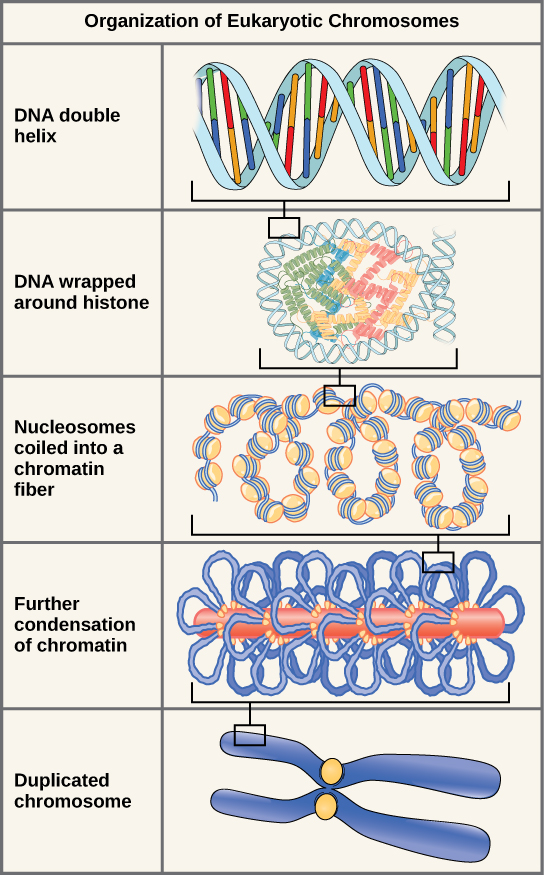
An organized with associated that carries . A replicated chromosome has two .

Read explanation · OpenStax ↗
Codon

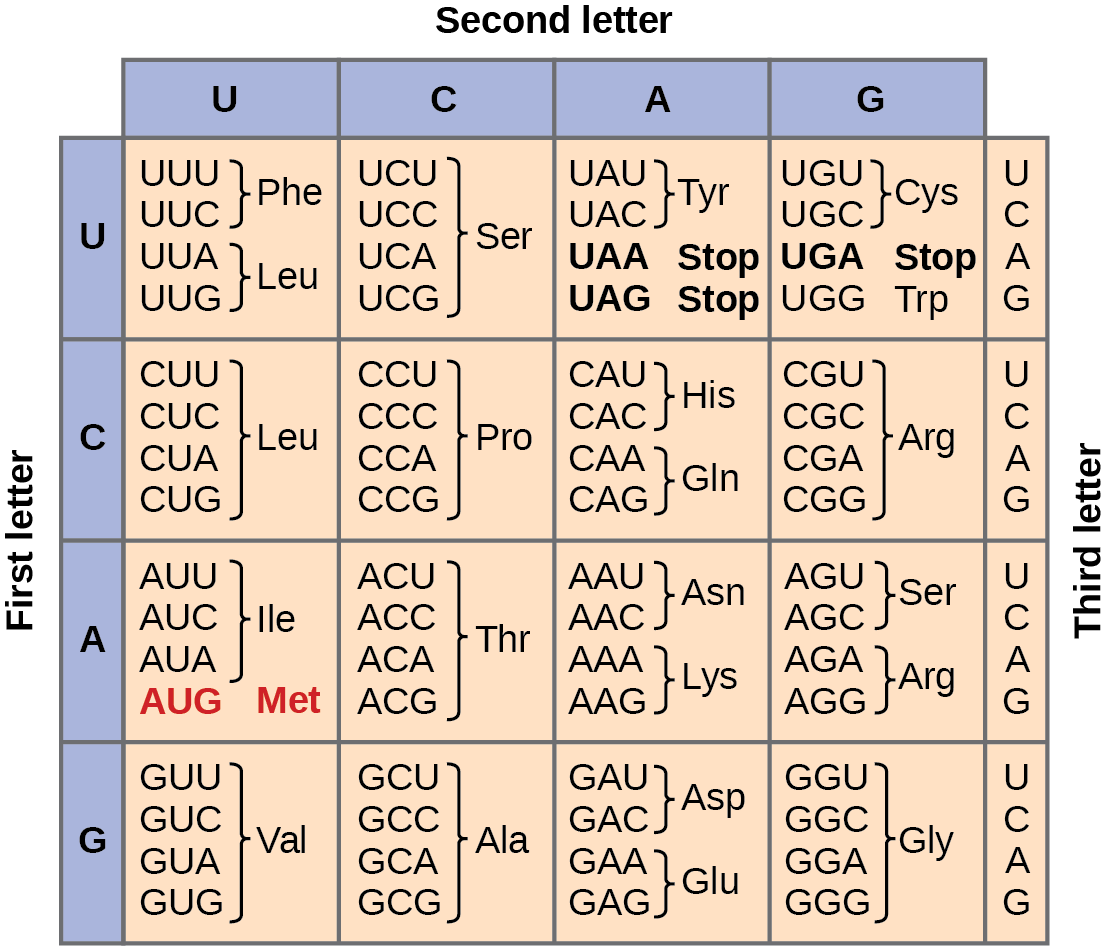
A sequence of three that specifies an or a stop signal.

Read explanation · OpenStax ↗
Concentration

The amount of a substance in a specified volume or mass of mixture.

Read explanation · OpenStax ↗
Cooperativity · ·

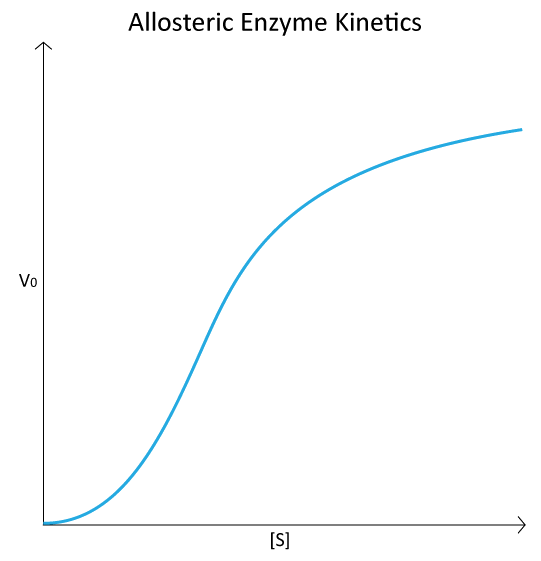
An interaction in which binding at one site changes binding at other sites. Positive cooperativity can produce a response.

Read explanation · Biology LibreTexts ↗
Covalent bond · ·

A bond in which share pairs. and are covalent.

Read explanation · OpenStax ↗
Cysteine ·

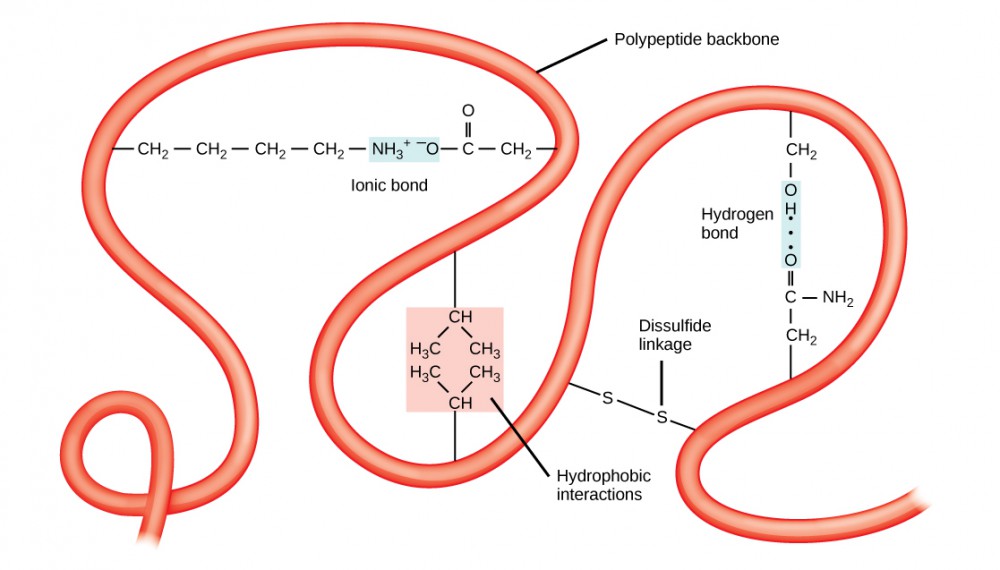
An with a . Two cysteines can form a .

Read explanation · OpenStax ↗
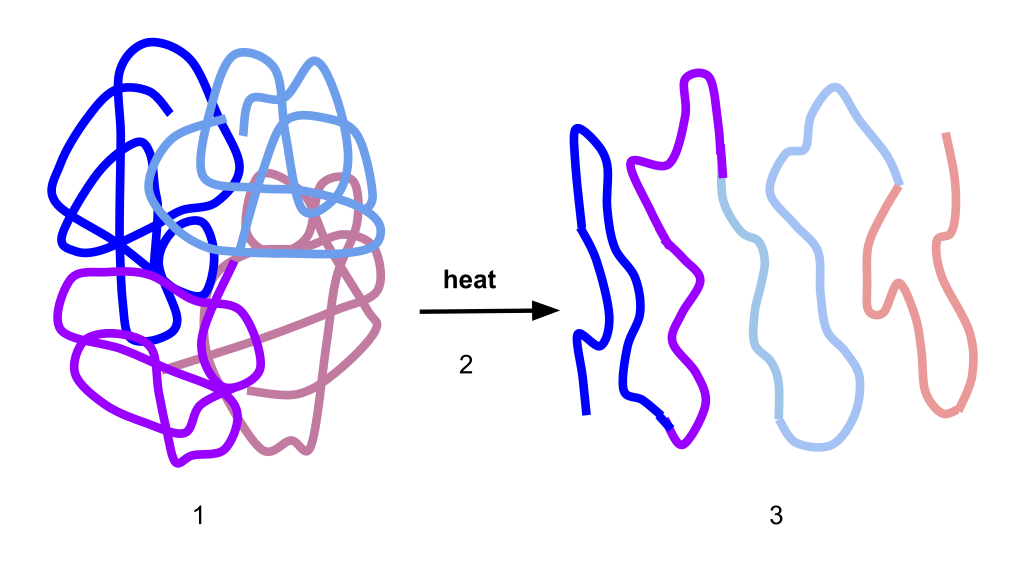
Denaturation · ·

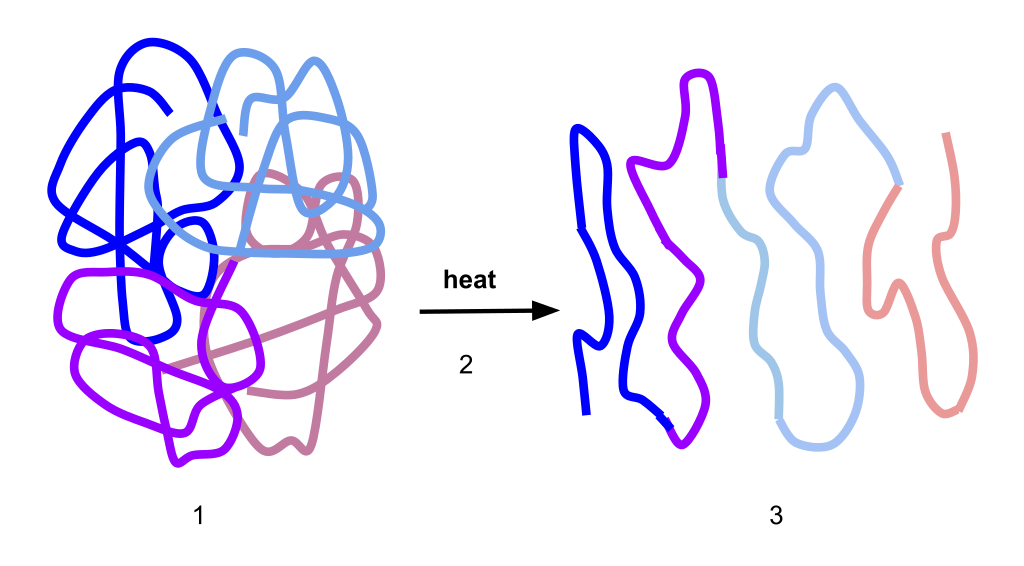
Loss of a ’s , often with . This usually preserves the chain’s .

Read explanation · NCBI Bookshelf ↗
Deoxyribonucleic acid

The that stores genetic information used to specify and sequences.

Read explanation · OpenStax ↗
Deprotonation

Removal of a from a or group; this changes its by minus one.

Read explanation · OpenStax ↗
Detergent

An substance that can associate with both water and material; detergents can disrupt or interactions.

Read explanation · Thermo Fisher ↗
Diffusion

Net spreading of particles down a due to random molecular motion.

Read explanation · OpenStax ↗
Disulfide bond · · ·

A covalent sulfur–sulfur bond formed by of two , which can stabilize structure.

Read explanation · NCBI Bookshelf ↗
DNA replication

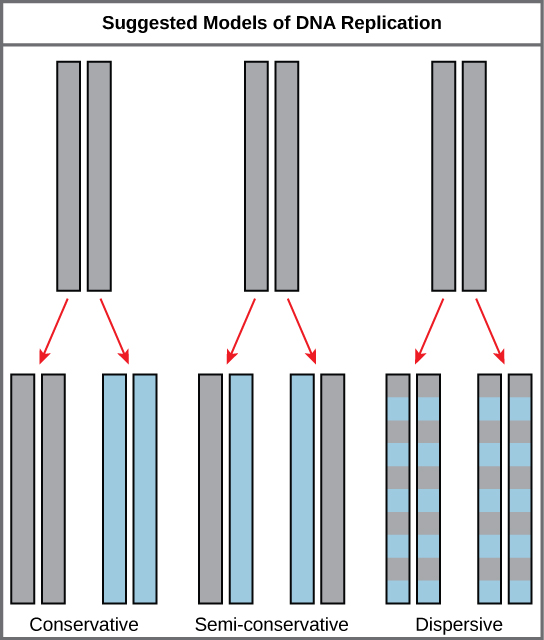
Copying so genetic information can be passed to daughter cells. Each guides a complementary new strand.

Read explanation · OpenStax ↗
Electric charge · · ·

An electrical property that can be positive or negative. Opposite charges attract and like charges repel; net charge is the sum of all charges on a particle.

Read explanation · OpenStax ↗
Electron

A negatively subatomic particle. Electron sharing and transfer determine much of chemical bonding.

Read explanation · OpenStax ↗
elementary step

Single microscopic event within a mechanism.

Read explanation · OpenStax ↗
Enthalpy

A quantity whose change equals heat exchanged at constant pressure when only pressure–volume occurs.

Read explanation · OpenStax ↗
Entropy

A measure related to the number of accessible microscopic arrangements and the dispersal of energy.

Read explanation · OpenStax ↗
Enzyme

A biological that speeds a without being consumed. Most enzymes are .

Read explanation · OpenStax ↗
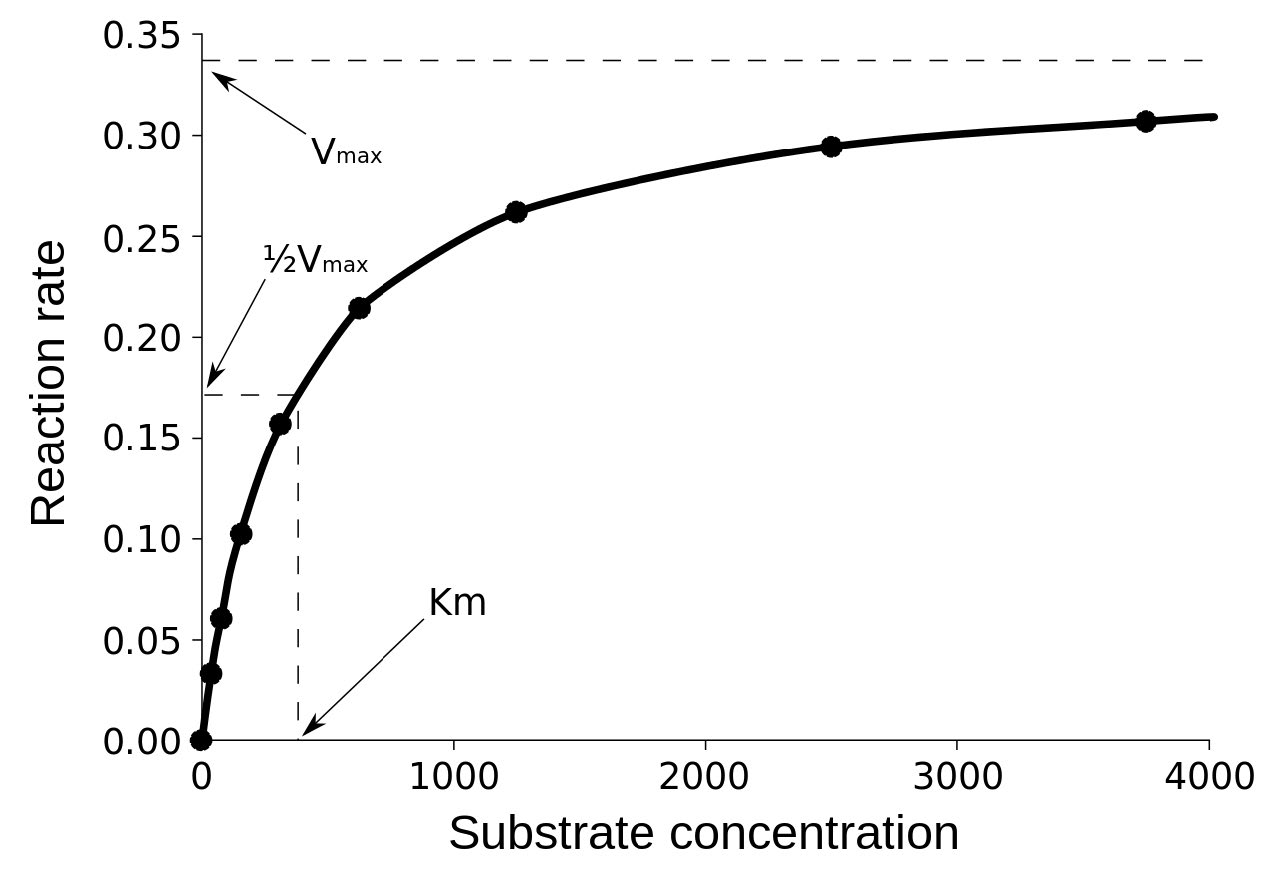
Enzyme saturation · ·

The high- limit in which sites spend almost all their time processing and the rate approaches .

Read explanation · Biology LibreTexts ↗
Equilibrium

A state where opposing processes occur at equal rates, so macroscopic or other properties remain constant.

Read explanation · OpenStax ↗
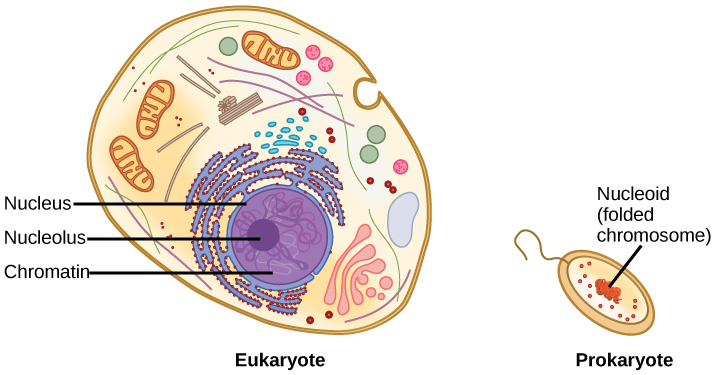
Eukaryote ·

An organism whose cells have a -enclosed ; animals, plants, fungi, and protists are eukaryotes.

Read explanation · OpenStax ↗
First-order kinetics

A rate dependence proportional to the first of a . At low , a is approximately first-order in .

Read explanation · Biology LibreTexts ↗
Fraction · ·

A portion of a sample collected during a separation, such as the fluid leaving a column during a time interval.

Read explanation · Waters ↗
Functional group

A group of whose chemical behavior gives a characteristic and properties.

Read explanation · OpenStax ↗
Gene

A sequence that contributes to a functional or , together with the information needed to express it.

Read explanation · OpenStax ↗
Gene expression

Production of a functional from a , including and, for -coding , .

Read explanation · NCBI Bookshelf ↗
Gradient

A change in a quantity, such as , , or density, across a distance or over time.

Read explanation · Thermo Fisher ↗
Half-life

The time required for half of a population or amount to remain during decay; a constant half-life is characteristic of decay.

Read explanation · OpenStax ↗
Hydrogen ion · ·

A positively hydrogen species. H⁺ denotes a , which is hydrated in water; its activity determines .

Read explanation · OpenStax ↗
Hydrolysis

Breaking a chemical bond by adding water. hydrolysis separates .

Read explanation · OpenStax ↗
Hydrophilic

Interacting favorably with water, typically because a group is or .

Read explanation · OpenStax ↗
Hydrophobic

Interacting poorly with water. often gather in a ’s interior.

Read explanation · OpenStax ↗
Hydroxide ion ·

The negatively OH⁻. Basic contain a higher hydroxide ion activity than water at the same temperature.

Read explanation · OpenStax ↗
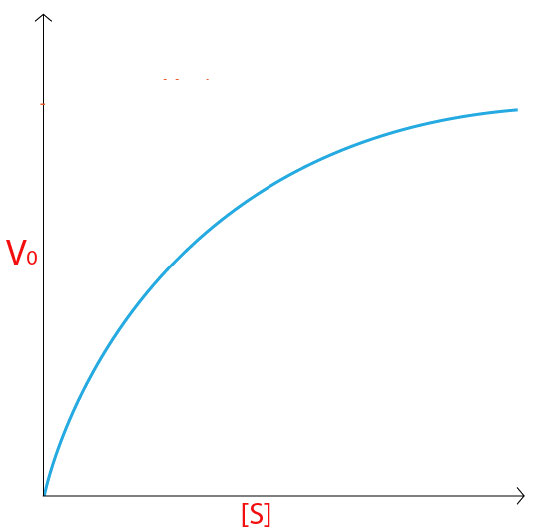
Hyperbolic curve ·

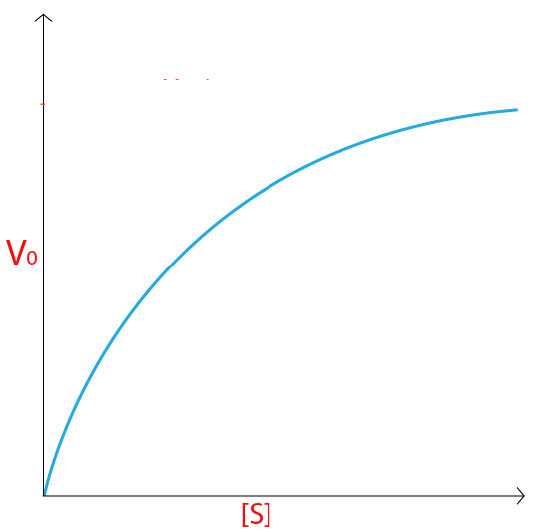
A curve that approaches an asymptote. The standard rate curve is a rectangular hyperbola approaching .

Read explanation · Biology LibreTexts ↗
Initial reaction rate · · · ·

The early rate of formation, measured before substantial depletion or accumulation, usually after the brief binding transient.

Read explanation · Biology LibreTexts ↗
Ion · ·

An or with a net because its numbers of and do not balance.

Read explanation · OpenStax ↗
kinetic control

distribution determined mainly by relative formation rates under limited equilibration.

Read explanation · OpenStax ↗
Kinetics

The study of and the factors and mechanisms that control them. A favorable may still proceed slowly.

Read explanation · OpenStax ↗
linkage

A tendency of nearby on the same to be inherited together.

Read explanation · OpenStax ↗
Lipid

A broad class of largely or , including fats, , and steroids.

Read explanation · OpenStax ↗
locus

The specific position of a or other feature.

Read explanation · OpenStax ↗
Logarithm · · ·

The exponent needed to obtain a number from a chosen fixed number. For decimal logarithms, log₁₀(100) = 2 because 10² = 100; uses the negative decimal logarithm of activity.

Read explanation · OpenStax ↗
Loss of function

or elimination of a ’s normal activity.

Read explanation · NCBI Bookshelf / Sinauer Associates ↗
Maximum reaction rate · ·

The limiting as becomes saturating. For a fixed under given conditions, Vmax = times .

Read explanation · Biology LibreTexts ↗
mechanical power

Rate of energy transfer, measured in watts.

Read explanation · OpenStax ↗
mechanical work

Energy transferred by a force acting through displacement; the force component parallel to motion contributes.

Read explanation · OpenStax ↗
Membrane · · · ·

A thin boundary or sheet. Cell membranes are bilayers containing ; membranes are synthetic supports that hold or for detection.

Read explanation · OpenStax ↗
Messenger RNA ·

An that carries coding information used by to synthesize a .

Read explanation · OpenStax ↗
Michaelis–Menten kinetics · ·

A model with = [S]/(Km + ). Its curve is ; may require a different model.

Read explanation · Biology LibreTexts ↗
Molecular chaperone · ·

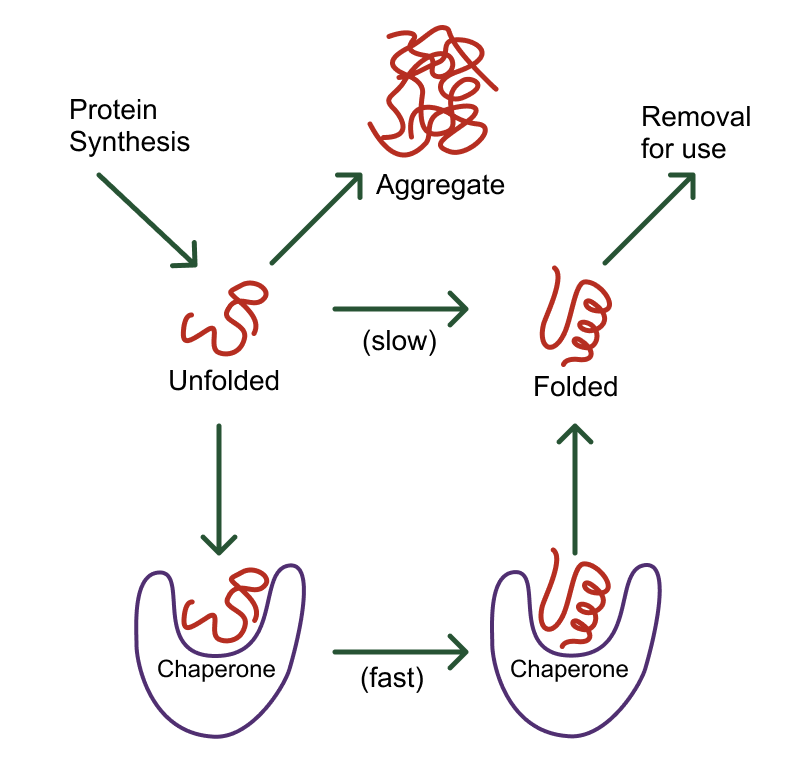
A that assists other in folding or prevents , without specifying their sequence.

Read explanation · NCBI Bookshelf ↗
molecularity

Number of reacting entities participating in an .

Read explanation · OpenStax ↗
Molecule

Two or more joined by . A molecule may be electrically or carry a .

Read explanation · OpenStax ↗
Native structure · · ·

A ’s functional folded arrangement under its normal conditions.

Read explanation · NCBI Bookshelf ↗
Neutral

Having no net . For a , neutral instead means equal and activities; its is about 7 at 25 °C.

Read explanation · OpenStax ↗
Nitrogenous base · · ·

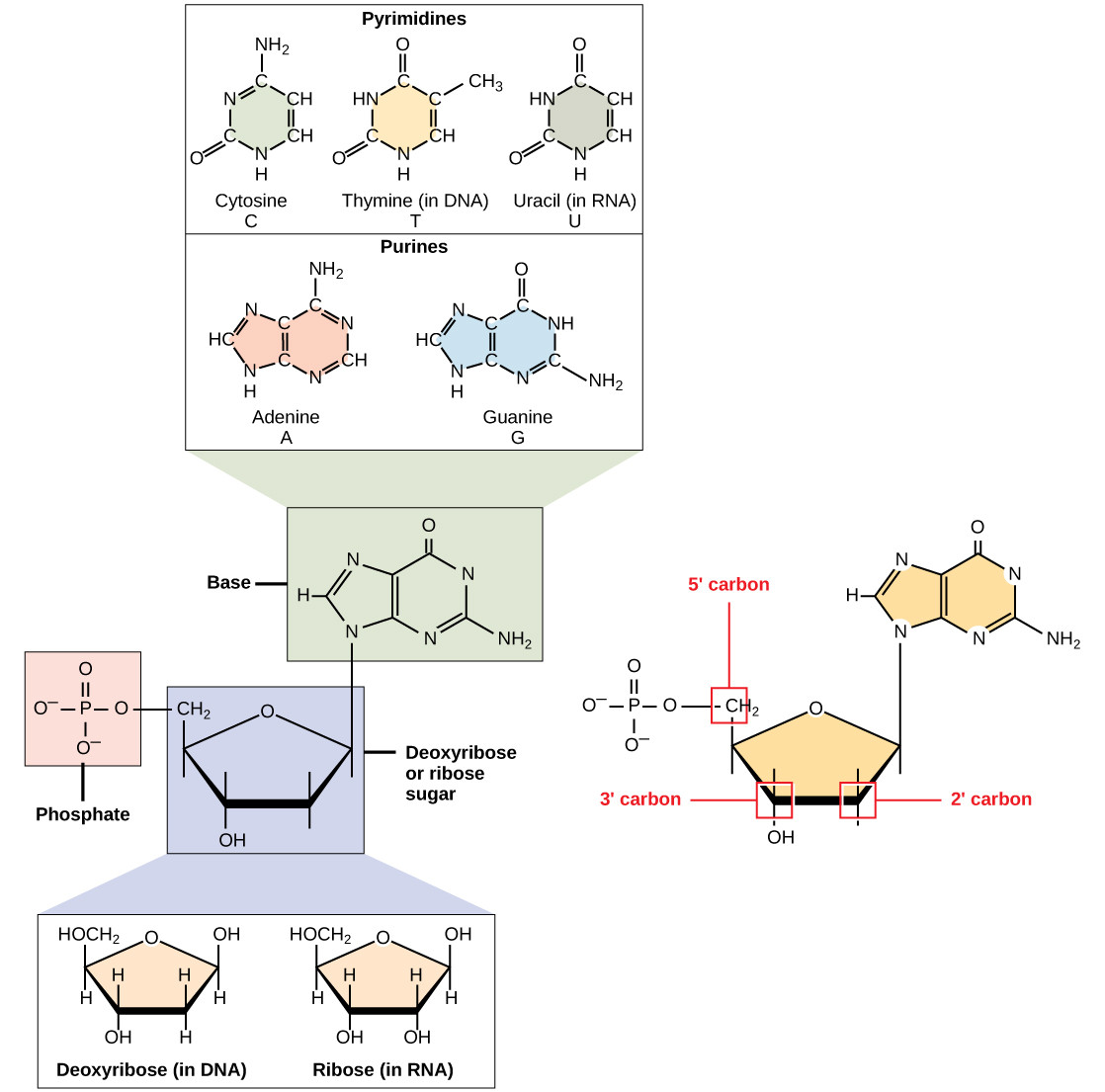
A nitrogen-containing ring component of ; its pairing interactions help specify sequences.

Read explanation · OpenStax ↗
Nonpolar ·

Lacking a substantial separation of . Nonpolar groups generally interact poorly with water.

Read explanation · OpenStax ↗
Nucleic acid

A of , such as or , used in information storage, expression, and other cellular functions.

Read explanation · OpenStax ↗
Nucleotide

A joined to a sugar and one or more .

Read explanation · OpenStax ↗
Nucleus ·

A -enclosed compartment containing most of a cell’s .

Read explanation · OpenStax ↗
Oxidation ·

Loss of or an increase in oxidation state. Oxidizing two can form a .

Read explanation · OpenStax ↗
Peptide

A chain of joined by ; the term commonly describes chains shorter than a typical .

Read explanation · OpenStax ↗
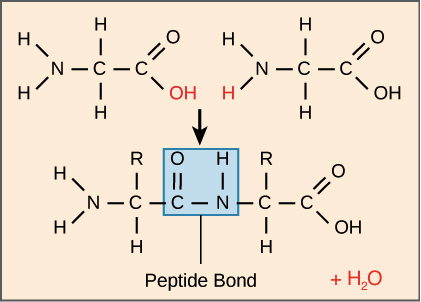
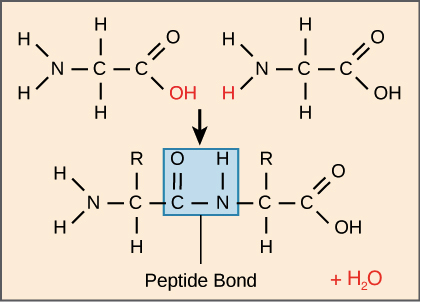
Peptide bond ·

A covalent between the carboxyl carbon of one and the amino nitrogen of the next.

Read explanation · OpenStax ↗
pH

A measure of , defined as the negative of activity. Lower pH means greater ; pH influences .

Read explanation · OpenStax ↗
Phosphate group ·

A phosphorus-containing group bonded to oxygens; phosphate groups occur in , , and modified .

Read explanation · OpenStax ↗
Phospholipid

An with a -containing region and tails; a major component of cellular .

Read explanation · OpenStax ↗
Polar

Having an uneven distribution of . Polar groups often interact favorably with water.

Read explanation · OpenStax ↗
Polymer

A large made from many linked molecular building blocks.

Read explanation · OpenStax ↗
Polypeptide

A chain of connected by . A functional can contain one or several such chains.

Read explanation · OpenStax ↗
Proline ·

An whose loops back to the nitrogen, restricting rotation and often creating bends.

Read explanation · OpenStax ↗
Protein

One or more folded chains that perform biological roles such as , transport, signaling, or structural support.

Read explanation · OpenStax ↗
Protein aggregation · ·

Association of into larger clusters, often when exposed surfaces of unfolded stick together.

Read explanation · NCBI Bookshelf ↗
Protein backbone ·

The repeating nitrogen–alpha-carbon– chain of a , excluding its variable .

Read explanation · OpenStax ↗
Proton

A positively subatomic particle. In – chemistry, donating a proton means transferring a .

Read explanation · OpenStax ↗
Protonation

Addition of a to an , , or ; this changes its by plus one.

Read explanation · OpenStax ↗
R group · ·

The variable side chain attached to an ’s . It determines identity, , , and chemical behavior.

Read explanation · OpenStax ↗
rate law

Experimentally supported relationship between and or activities.

Read explanation · OpenStax ↗
Rate-determining step ·

A step that strongly limits the overall rate of a ; in simple sequential mechanisms, it is the slowest step.

Read explanation · OpenStax ↗
Reactant

A starting substance transformed during a .

Read explanation · OpenStax ↗
Reaction intermediate · ·

A species formed in one step and consumed in another. It occupies a local energy minimum between .

Read explanation · OpenStax ↗
Reaction mechanism · ·

The sequence of elementary steps by which become , including any .

Read explanation · OpenStax ↗
reaction order

Exponent of a term in a , or sum of such exponents for overall order.

Read explanation · OpenStax ↗
Reaction product ·

A substance formed by a .

Read explanation · OpenStax ↗
Reaction rate · ·

How quickly are consumed or form, usually expressed as a change per unit time.

Read explanation · OpenStax ↗
reaction time

Elapsed time between a stimulus or cue and a measured response.

Read explanation · OpenStax ↗
Reduction

Gain of or a decrease in state. Reducing a restores two .

Read explanation · OpenStax ↗
Ribonucleic acid ·

A with roles in , regulation, and ; carries -coding information.

Read explanation · OpenStax ↗
Ribosome ·

A complex of and that translates into a .

Read explanation · OpenStax ↗
Sigmoidal curve ·

An S-shaped curve. A sigmoidal rate-versus- curve can indicate rather than simple behavior.

Read explanation · Biology LibreTexts ↗
Sister chromatid

One of the two copies of a produced by . An intact sister chromatid can supply a template for accurate repair.

Read explanation · Biology LibreTexts / Oregon State University ↗
Solubility ·

The amount of a substance that can dissolve in a under specified conditions. Soluble means able to dissolve; insoluble means only very slightly soluble in that .

Read explanation · OpenStax ↗
Solute

A dissolved component of a .

Read explanation · OpenStax ↗
Solution

A homogeneous mixture in which are dissolved in a .

Read explanation · OpenStax ↗
Solvent

The component of a that dissolves other substances, usually the component present in the greatest amount.

Read explanation · OpenStax ↗
standard Gibbs energy change

Gibbs energy change for a under specified standard-state conditions.

Read explanation · OpenStax ↗
Steady state ·

A condition in which an intermediate remains approximately constant because formation and breakdown rates balance. can still accumulate; this is not .

Read explanation · Biology LibreTexts ↗
Substrate

A that an binds and chemically transforms.

Read explanation · OpenStax ↗
Substrate concentration

The amount of per volume. Square brackets denote ; [S] is varied to measure an curve.

Read explanation · Biology LibreTexts ↗
Template strand · · ·

A preexisting strand whose sequence guides complementary nucleic- synthesis.

Read explanation · OpenStax ↗
thermodynamic control

distribution determined mainly by relative stability when can interconvert.

Read explanation · OpenStax ↗
Thermodynamics ·

The study of energy, , and . It helps determine whether a process is favorable, while concerns how fast it occurs.

Read explanation · OpenStax ↗
Thiol group · · · ·

A sulfur bonded to hydrogen, –SH. thiols can form through .

Read explanation · OpenStax ↗
Transcription

Synthesis of using a template.

Read explanation · OpenStax ↗
Transition state

A fleeting, high-energy arrangement at a barrier. It is an energy maximum along the path, rather than a stable .

Read explanation · OpenStax ↗
Translation ·

Synthesis of a on a using the sequence of in .

Read explanation · OpenStax ↗
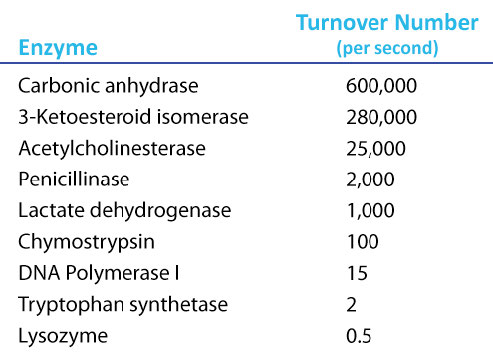
Turnover number · · ·

The maximum number of cycles per per unit time, calculated as /. Units are inverse time, commonly s⁻¹.

Read explanation · IUBMB ↗
Zero-order kinetics

A rate that is approximately independent of a specified . At , are approximately zero-order in .

Read explanation · Biology LibreTexts ↗

Chemistry 2E 12 — Summary

OpenStax · Chemistry 2E 12 — Summary ↗
Instructional page including learning objectives, examples, figures, source tables and questions. Site navigation and embedded media players are omitted; source media links remain available.

12.1 Chemical Reaction Rates

The rate of a can be expressed either in terms of the decrease in the amount of a or the increase in the amount of a per unit time. Relations between different rate expressions for a given are derived directly from the stoichiometric coefficients of the equation representing the .

12.2 Factors Affecting Reaction Rates

The rate of a is affected by several parameters. involving two phases proceed more rapidly when there is greater surface area contact. If temperature or is increased, the rate of a given generally increases as well. A can increase the rate of a by providing an alternative pathway with a lower .

12.3 Rate Laws

Rate laws (differential rate laws) provide a mathematical description of how changes in the of a substance affect the rate of a . Rate laws are determined experimentally and cannot be predicted by stoichiometry. The order of describes how much a change in the of each substance affects the overall rate, and the overall order of a is the sum of the orders for each substance present in the . orders are typically first order, second order, or zero order, but fractional and even negative orders are possible.

12.4 Integrated Rate Laws

Integrated rate laws are mathematically derived from differential rate laws, and they describe the time dependence of and .

The of a is the time required to decrease the amount of a given by one-half. A ’s varies with rate constant and, for some orders, . The of a decreases as the initial of the in the decreases. The of a is independent of , and the of a second-order decreases as the increases.

12.5 Collision Theory

Chemical typically require collisions between species. These collisions must be of proper orientation and sufficient energy in order to result in formation. Collision theory provides a simple but effective explanation for the effect of many experimental parameters on . The describes the relation between a ’s rate constant, , temperature, and dependence on collision orientation.

12.6 Reaction Mechanisms

The sequence of individual steps, or elementary , by which are converted into during the course of a is called the . The of an elementary is the number of entities involved, typically one (unimolecular), two (bimolecular), or, less commonly, three (termolecular). The overall rate of a is determined by the rate of the slowest in its mechanism, called the . Unimolecular elementary have rate laws, while bimolecular elementary have second-order rate laws. By comparing the rate laws derived from a to that determined experimentally, the mechanism may be deemed either incorrect or plausible.

12.7 Catalysis

affect the rate of a by altering its mechanism to provide a lower . can be homogenous (in the same phase as the ) or heterogeneous (a different phase than the ).

14.3 Kinetic versus Thermodynamic Control of Reactions
OpenStax · 14.3 Kinetic versus Thermodynamic Control of Reactions ↗
Instructional page including learning objectives, examples, figures, source tables and questions. Site navigation and embedded media players are omitted; source media links remain available.

14.3 • versus of

Electrophilic addition to a conjugated diene at or below room temperature normally leads to a mixture of in which the 1,2 adduct predominates over the 1,4 adduct. When the same is carried out at higher temperatures, however, the ratio often changes and the 1,4 adduct predominates. For example, addition of HBr to 1,3-butadiene at 0 °C yields a 71 : 29 mixture of 1,2 and 1,4 adducts, but the same carried out at 40 °C yields a 15 : 85 mixture. Furthermore, when the mixture formed at 0 °C is heated to 40 °C in the presence of HBr, the ratio of adducts slowly changes from 71 : 29 to 15 : 85. Why?

In a reaction, 1,3-butadiene reacts with hydrogen bromide to yield 1,2 adduct and 1,4 adduct. At 0 and 40 degrees Celsius, the ratio of the two adducts is different.
14.3 versus of — illustration 1 John McMurry, Organic Chemistry, OpenStax. · CC BY-NC-SA 4.0 · Original image ↗ · Access for free ↗

To understand the effect of temperature on distribution, let’s briefly review what we said in Section 6.7 about rates and equilibria. Imagine a that can give either or both of two , B and C.

The figure shows reactant A forms product B and product C.
14.3 versus of — illustration 2 John McMurry, Organic Chemistry, OpenStax. · CC BY-NC-SA 4.0 · Original image ↗ · Access for free ↗

Let’s assume that B forms faster than C (in other words, ΔG‡B<ΔG‡C) but that C is more stable than B (in other words, ΔG∘C >ΔG∘B). An energy diagram for the two processes might look like that shown in Figure 14.6.

The energy diagram shows the thermodynamic control curve forming a higher peak than the kinetic control curve. The x and y axes denotes reaction progress and energy, respectively.
Figure 14.6 — 14.3 versus of

Figure 14.6 An energy diagram for two competing reactions in which the less stable product B forms faster than the more stable product C .
John McMurry, Organic Chemistry, OpenStax. · CC BY-NC-SA 4.0 · Original image ↗ · Access for free ↗

Let’s first carry out the at a lower temperature so that both processes are irreversible and no is reached. Because B forms faster than C, B is the major . It doesn’t matter that C is more stable than B, because the two are not in . The of an irreversible depends only on relative rates, not on stability. Such are said to be under .

Reactant A forms products B and C in faster and slower reactions, respectively. The text next to the reaction generating product B reads Kinetic control (Lower temperature; irreversible).
14.3 versus of — illustration 4 John McMurry, Organic Chemistry, OpenStax. · CC BY-NC-SA 4.0 · Original image ↗ · Access for free ↗

Now let’s carry out the same at some higher temperature so that both processes are readily reversible and an is reached. Because C is more stable than B, C is the major obtained. It doesn’t matter that C forms more slowly than B, because the two are in . The of a readily reversible depends only on stability, not on relative rates. Such are said to be under control, or .

Reactant A yields two products, B and C in reversible reactions. The text next to the reaction generating product B readsThermodynamic control (Higher temperature; reversible).
14.3 versus of — illustration 5 John McMurry, Organic Chemistry, OpenStax. · CC BY-NC-SA 4.0 · Original image ↗ · Access for free ↗

We can now explain the effect of temperature on the electrophilic addition of conjugated dienes. At low temperature (0 °C), HBr adds to 1,3-butadiene under to give a 71 : 29 mixture of , with the more rapidly formed 1,2 adduct predominating. Because these low-temperature conditions don’t allow the to reach , the that forms faster predominates. At higher temperature (40 °C), however, the occurs under to give a 15 : 85 mixture of , with the more stable 1,4 adduct predominating. The higher temperature allows the addition process to become reversible, so an mixture of results. Figure 14.7 shows this situation in an energy diagram.
Energy diagram shows curve for 1,4-adduct formation has two maxima, the first being higher. The curve for 1,2 adduct initiates from trough of first curve and ends higher in energy than the first curve.
Figure 14.7 — 14.3 versus of

Figure 14.7 Energy diagram for the electrophilic addition of HBr to 1,3-butadiene. The 1,2 adduct is the kinetic product because it forms faster, but the 1,4 adduct is the thermodynamic product because it is more stable.

John McMurry, Organic Chemistry, OpenStax. · CC BY-NC-SA 4.0 · Original image ↗ · Access for free ↗

The electrophilic addition of HBr to 1,3-butadiene is a good example of how a change in experimental conditions can change the of a . The concept of versus is a useful one that we can sometimes take advantage of in the laboratory.
Problem 14-5
The 1,2 adduct and the 1,4 adduct formed by of HBr with 1,3-butadiene are in at 40 °C. Propose a mechanism by which the interconversion of takes place.
Problem 14-6
Why do you suppose 1,4 adducts of 1,3-butadiene are generally more stable than 1,2 adducts?