Heat and work describe energy transfer; internal energy is a property of the system’s state.
Systems and sign conventions
An open system exchanges matter and energy, a closed system exchanges energy but not matter, and an isolated system exchanges neither. Temperature equality defines thermal equilibrium; the zeroth law makes temperature comparison consistent. Internal energy U, enthalpy H, entropy S, and Gibbs energy G are state functions whose changes depend only on endpoints. Heat q and work w depend on the process. Using the chemistry sign convention, ΔU = q + w: heat entering and work done on the system are positive. Always check whether a physics passage instead defines work done by the system as positive.
For expansion against constant external pressure, w = −PexternalΔV in the chemistry convention. Expansion does work on the surroundings and gives negative w; compression gives positive w. In a quasistatic process, work by the gas is the area under the P–V curve; a loop’s signed enclosed area gives net cycle work. An isochoric process has no pressure–volume work because ΔV = 0. Free expansion into vacuum also has zero external-pressure work despite volume change. Reversible and irreversible paths can give different work between the same endpoints.
The second law requires ΔSuniverse ≥ 0 for a spontaneous process, with equality for a reversible idealization. A system’s entropy may decrease if its surroundings increase by more. Entropy relates to accessible microstates, not simply visible disorder. Melting, vaporization, mixing, and gas expansion usually increase accessible configurations. For reversible heat transfer, dS = δqrev/T. Heat flowing from hot to cold increases total entropy because the colder reservoir gains more entropy per joule than the hotter one loses. An isolated system cannot spontaneously lower its total entropy.
For a temperature change without a phase transition, q = mcΔT, where c is specific heat in J g⁻¹ K⁻¹ or compatible units. Heat capacity C = mc applies to the whole object. In an insulated calorimeter, qreaction + qsolution + qcalorimeter = 0; neglecting the container’s heat capacity must be an explicit approximation. Constant-pressure heat corresponds to ΔH when only pressure–volume work occurs; constant-volume heat corresponds to ΔU. A phase transition instead requires latent heat and may absorb energy without raising temperature.
Conduction transfers energy through microscopic interactions without bulk material flow; for a uniform slab its steady rate is kAΔT/L. Convection transports energy by bulk fluid motion, whether buoyancy-driven or forced. Radiation transfers electromagnetic energy and needs no medium; net thermal emission is approximately εσA(T⁴ − Tsurroundings⁴) for an idealized surface. Thermal expansion changes lengths by ΔL = αL₀ΔT for small changes; isotropic volume expansion is approximately three times the linear coefficient. Expansion and transfer coefficients depend on material and temperature.
Try before revealing the answer. A gas absorbs 500 J of heat while expanding by 2.0 L against 100 kPa. Find work on the gas and its internal-energy change.
Worked answer
Convert volume: 2.0 L = 0.0020 m³. Work on the gas is w = −100,000 × 0.0020 = −200 J. ΔU = q + w = 500 − 200 = +300 J. The gas gained internal energy while also transferring work to its surroundings.
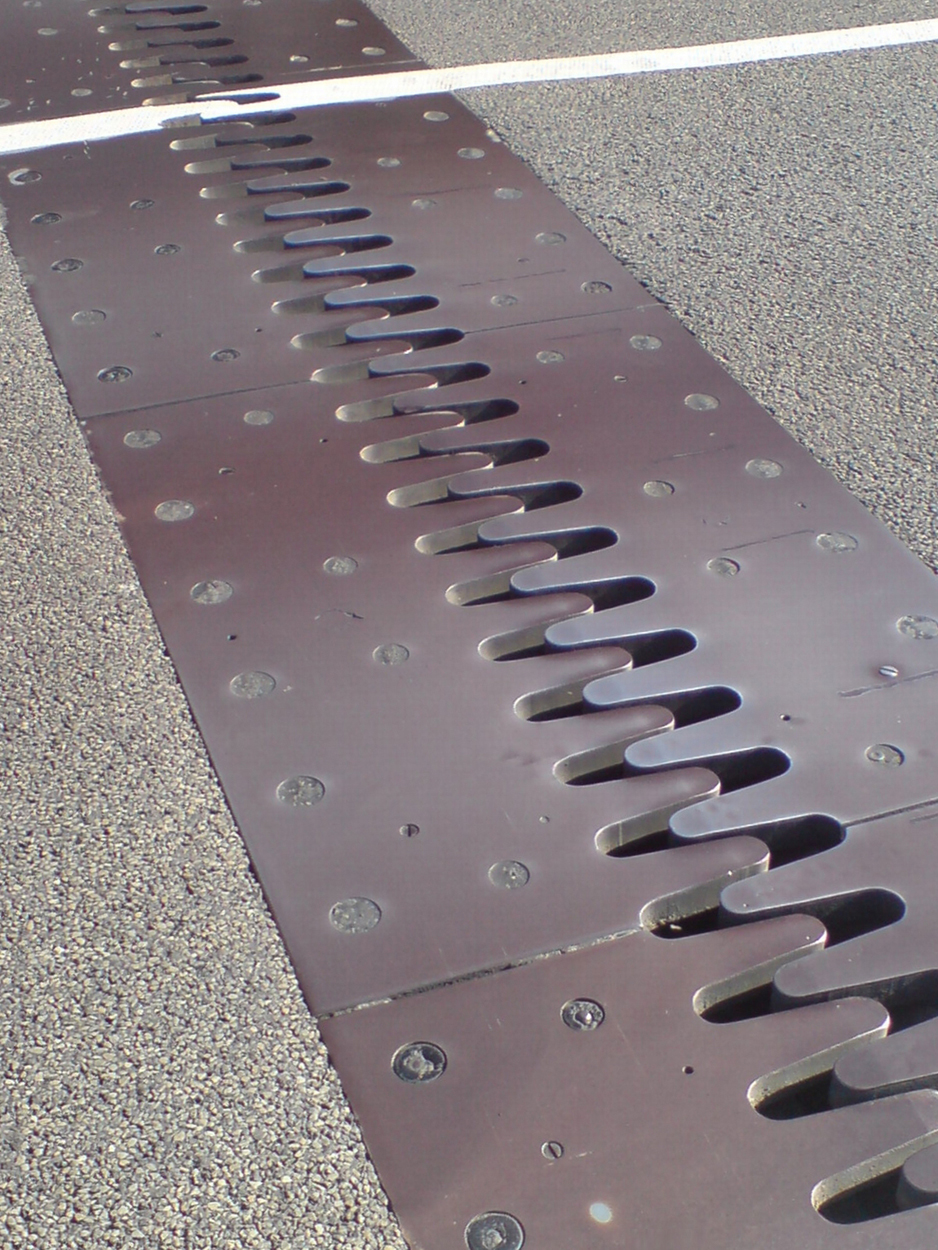
Figure 13.11 Thermal expansion joints like these in the Auckland Harbour Bridge in New Zealand allow bridges to change length without buckling. (credit: Ingolfson, Wikimedia Commons)
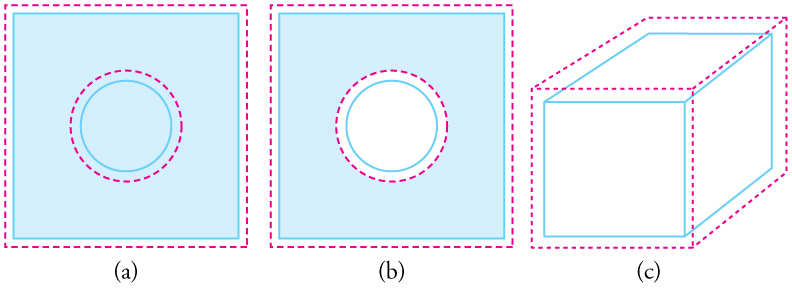
Figure 13.12 In general, objects expand in all directions as temperature increases. In these drawings, the original boundaries of the objects are shown with solid lines, and the expanded boundaries with dashed lines. (a) Area increases because both length and width increase. The area of a circular plug also increases. (b) If the plug is removed, the hole it leaves becomes larger with increasing temperature, just as if the expanding plug were still in place. (c) Volume also increases, because all three dimensions increase.
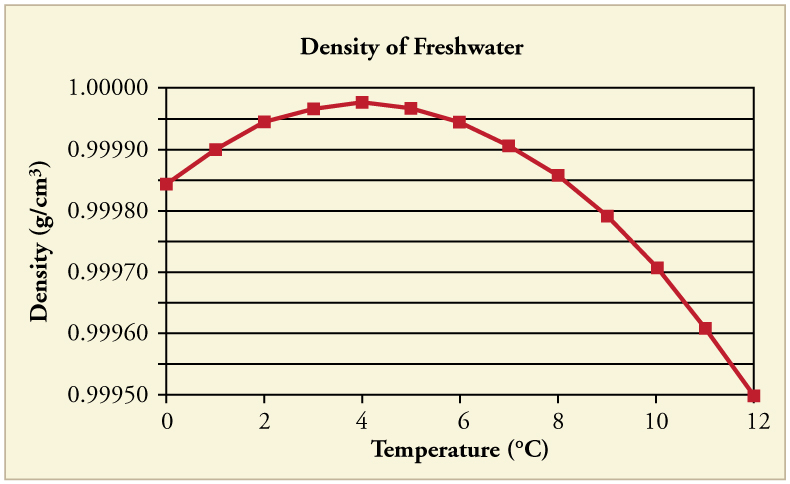
Figure 13.13 The density of water as a function of temperature. Note that the thermal expansion is actually very small. The maximum density at + 4 º C + 4 º C is only 0.0075% greater than the density at 2 º C 2 º C , and 0.012% greater than that at 0 º C 0 º C .
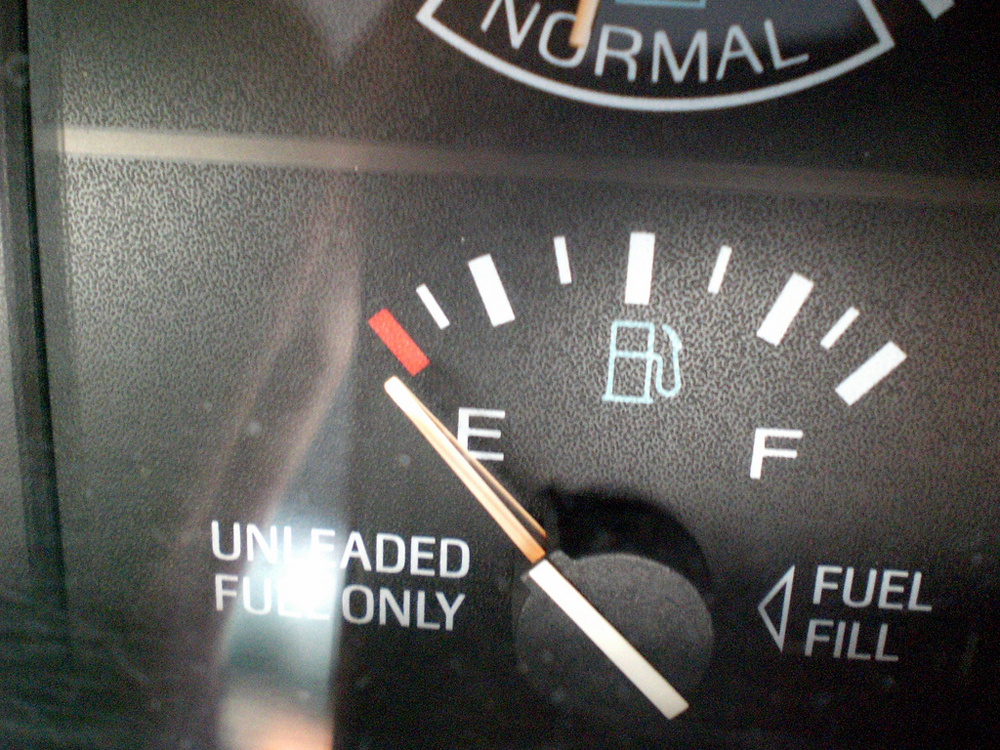
Figure 13.14 Because the gas expands more than the gas tank with increasing temperature, you can’t drive as many miles on “empty” in the summer as you can in the winter. (credit: Hector Alejandro, Flickr)
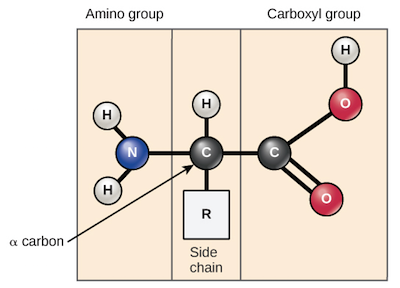
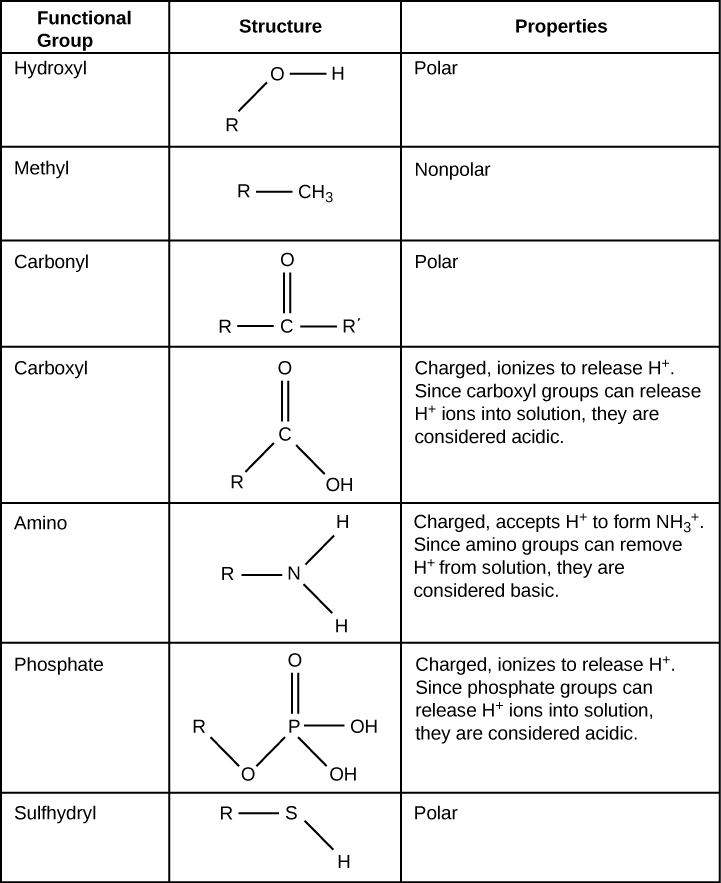
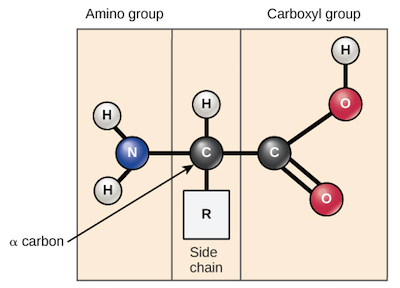
A nitrogen-containing functional group. A free amino acid’s amino group is typically protonated (NH₃⁺) near physiological pH; proline’s ring nitrogen is an exception to this formula.
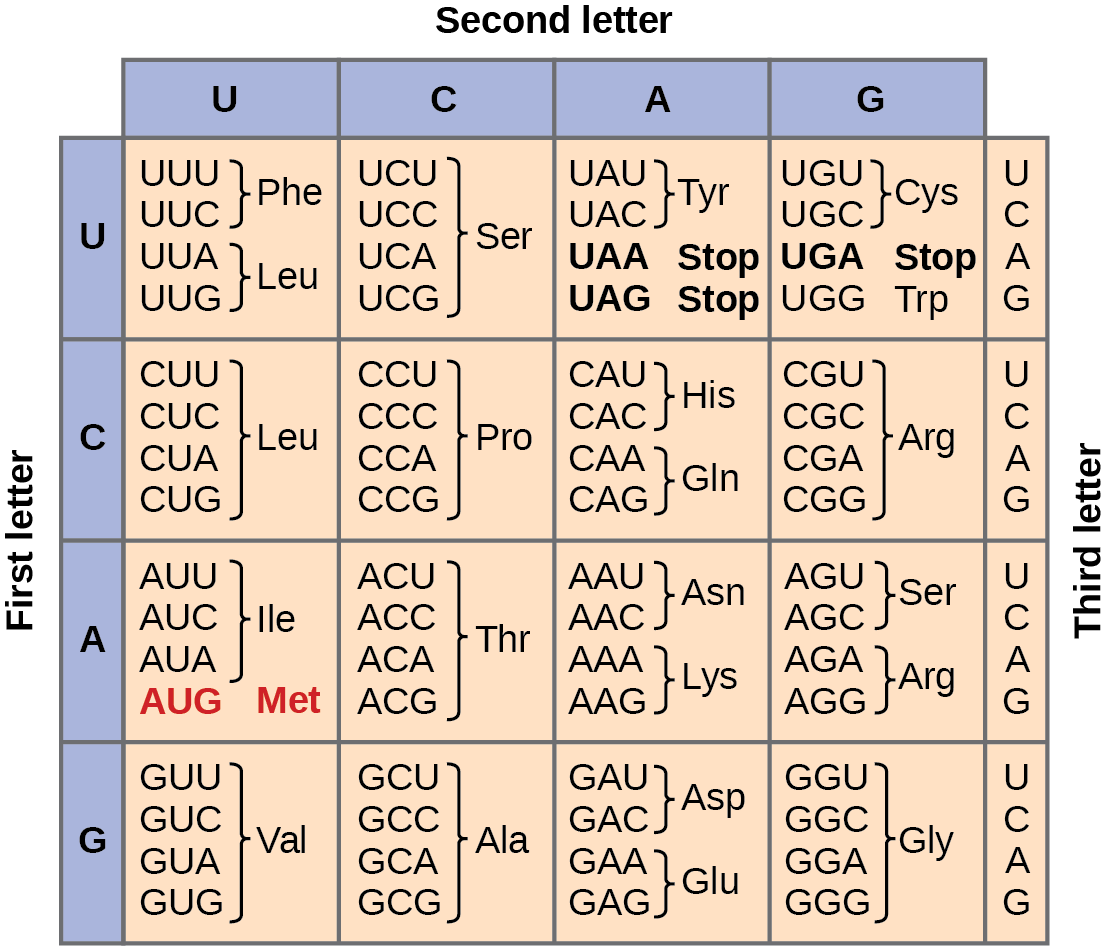
Figure 15.4 This figure shows the genetic code for translating each nucleotide triplet in mRNA into an amino acid or a termination signal in a protein. (credit: modification of work by NIH)
An electrical property that can be positive or negative. Opposite charges attract and like charges repel; net charge is the sum of all charges on a particle.
The difference in enthalpy between products and reactants. At constant pressure with only pressure–volume work, it equals the heat transferred to the system.
A ratio of product to reactant activities at equilibrium, each raised to its stoichiometric coefficient. At a fixed temperature, a catalyst does not change this ratio.
The exponent needed to obtain a number from a chosen fixed number. For decimal logarithms, log₁₀(100) = 2 because 10² = 100; pH uses the negative decimal logarithm of hydrogen ion activity.
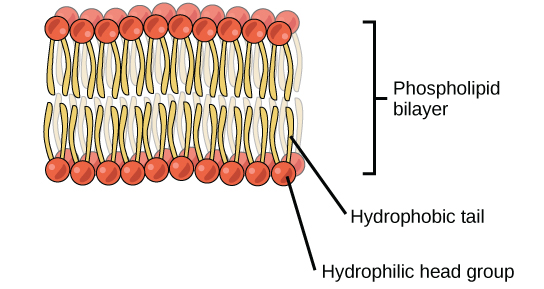
A thin boundary or sheet. Cell membranes are lipid bilayers containing proteins; blotting membranes are synthetic supports that hold proteins or nucleic acids for detection.
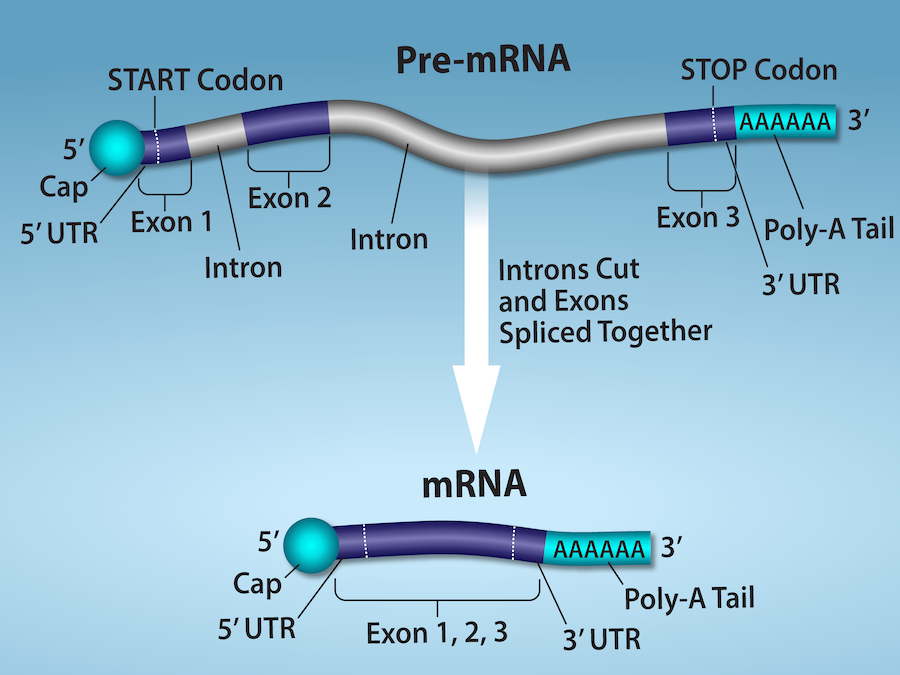
Figure 15.11 Eukaryotic pre-mRNA processing. In addition to 5’ Cap and 3’ Poly-A Tail addition, introns must be precisely removed and exons joined to generate a functional mRNA. Nucleotides upstream (towards the 5’cap) of the translation START codon are part of the 5’ untranslated region (5’ UTR). Nucleotides downstream (towards 3’end) of the STOP codon form the 3’ UTR. Both 5’ and 3’ UTRs are important for regulating translation initiation and mRNA stability. Credit: Rao, A., Ryan, K. Fletcher, S. and Tag, A. Department of Biology, Texas A&M University.
Rao, A., Ryan, K. Fletcher, S. and Tag, A. Department of Biology, Texas A&M University.; Mary Ann Clark, Matthew Douglas, and Jung Choi, Biology 2e, OpenStax. · CC BY-NC-SA 4.0
· Original image ↗ · Access for free ↗
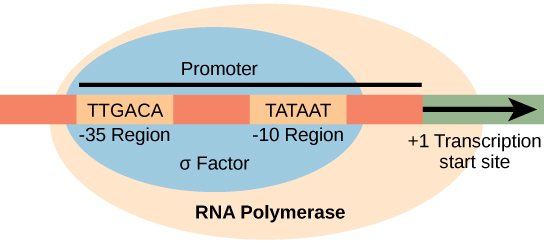
Figure 15.8 The σ subunit of prokaryotic RNA polymerase recognizes consensus sequences found in the promoter region upstream of the transcription start site. The σ subunit dissociates from the polymerase after transcription has been initiated.
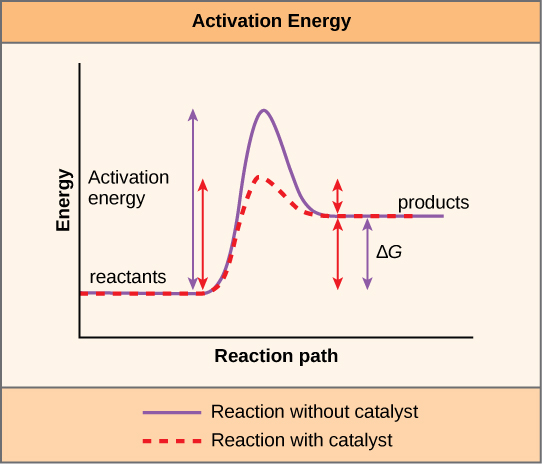
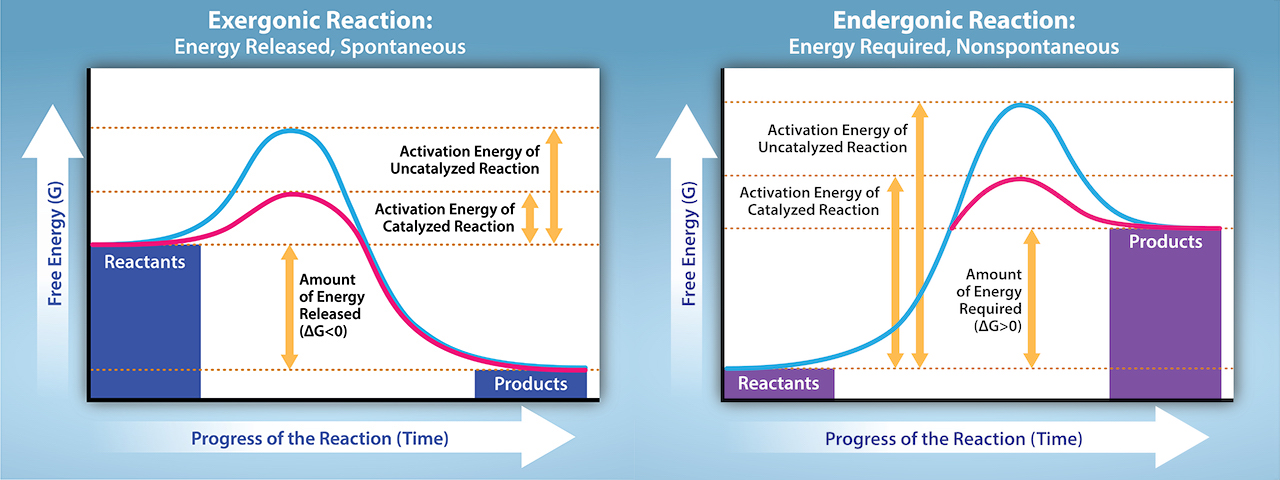
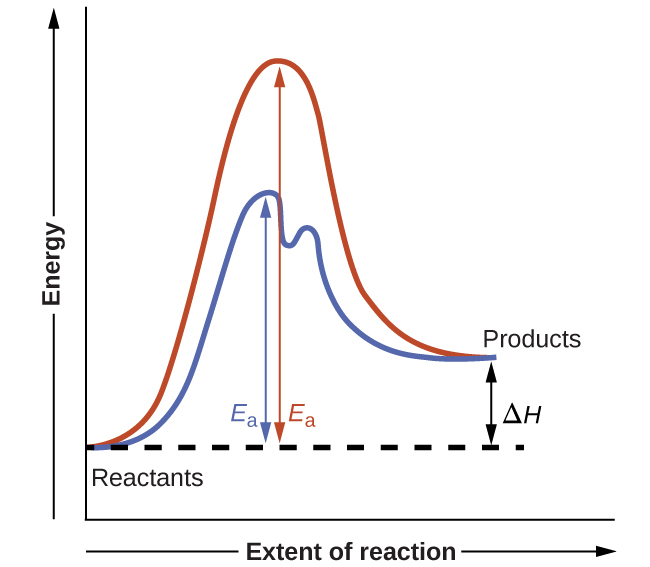
Figure 12.19 Reaction diagrams for an endothermic process in the absence (red curve) and presence (blue curve) of a catalyst. The catalyzed pathway involves a two-step mechanism (note the presence of two transition states) and an intermediate species (represented by the valley between the two transitions states).
Figure 15.8 The σ subunit of prokaryotic RNA polymerase recognizes consensus sequences found in the promoter region upstream of the transcription start site. The σ subunit dissociates from the polymerase after transcription has been initiated.
Figure 7.45 - Non-homologous end joining (left) versus homologous recombination (right) - Wikipedia
Wikipedia, as credited by Kevin Ahern, Indira Rajagopal, and Taralyn Tan, Biochemistry Free For All, Oregon State University, via Biology LibreTexts. · Source attribution
· Original image ↗ · Access for free ↗
The amount of a substance that can dissolve in a solvent under specified conditions. Soluble means able to dissolve; insoluble means only very slightly soluble in that solvent.
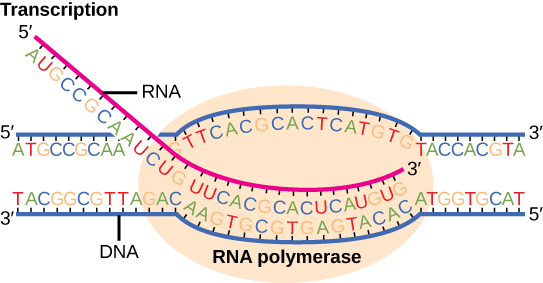
Figure 15.7 Messenger RNA is a copy of protein-coding information in the coding strand of DNA, with the substitution of U in the RNA for T in the coding sequence. However, new RNA nucleotides base pair with the nucleotides of the template strand. RNA is synthesized in its 5'-3' direction, using the enzyme RNA polymerase. As the template is read, the DNA unwinds ahead of the polymerase and then rewinds behind it.
A fleeting, high-energy arrangement at a reaction barrier. It is an energy maximum along the reaction path, rather than a stable reaction intermediate.
Figure 12.19 Reaction diagrams for an endothermic process in the absence (red curve) and presence (blue curve) of a catalyst. The catalyzed pathway involves a two-step mechanism (note the presence of two transition states) and an intermediate species (represented by the valley between the two transitions states).
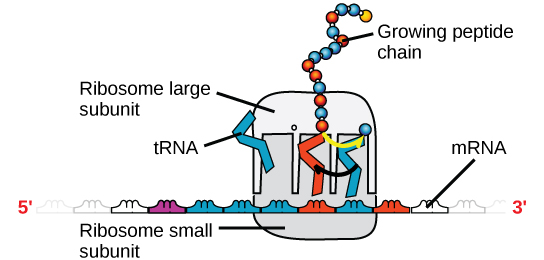
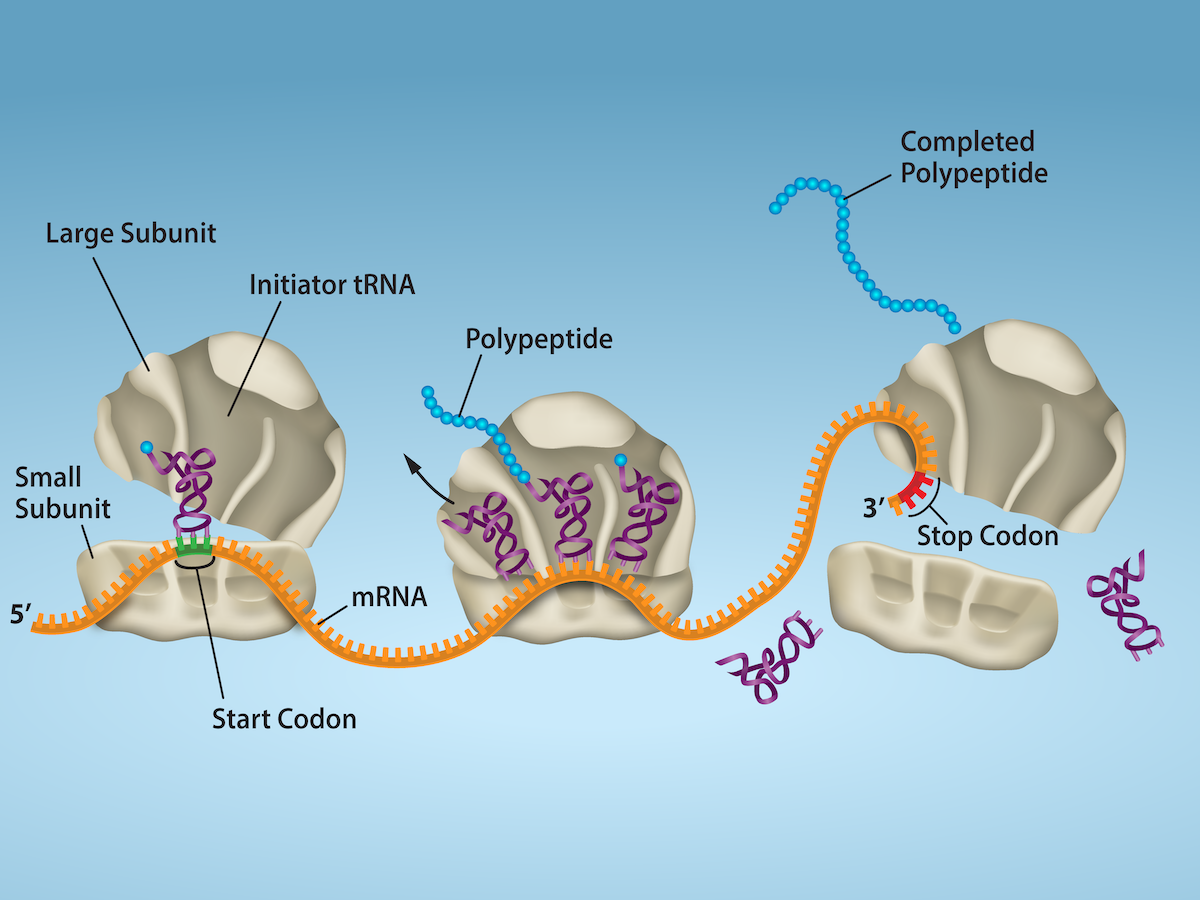
Figure 15.18 Translation begins when an initiator tRNA anticodon recognizes a start codon on mRNA bound to a small ribosomal subunit. The large ribosomal subunit joins the small subunit, and a second tRNA is recruited. As the mRNA moves relative to the ribosome, successive tRNAs move through the ribosome and the polypeptide chain is formed. Entry of a release factor into the A site terminates translation and the components dissociate.
No matching terms. Try a different name or abbreviation.
College Physics 2E 15 — Section Summary
OpenStax · College Physics 2E 15 — Section Summary ↗ Instructional page including learning objectives, examples, figures, source tables and questions. Site navigation and embedded media players are omitted; source media links remain available.
The first law of thermodynamics is given as , where is the change in internal energy of a system, is the net heat transfer (the sum of all heat transfer into and out of the system), and is the net work done (the sum of all work done on or by the system).
Both and are energy in transit; only represents an independent quantity capable of being stored.
The internal energy of a system depends only on the state of the system and not how it reached that state.
Metabolism of living organisms, and photosynthesis of plants, are specialized types of heat transfer, doing work, and internal energy of systems.
One of the important implications of the first law of thermodynamics is that machines can be harnessed to do work that humans previously did by hand or by external energy supplies such as running water or the heat of the Sun. A machine that uses heat transfer to do work is known as a heat engine.
There are several simple processes, used by heat engines, that flow from the first law of thermodynamics. Among them are the isobaric, isochoric, isothermal and adiabatic processes.
These processes differ from one another based on how they affect pressure, volume, temperature, and heat transfer.
If the work done is performed on the outside environment, work () will be a positive value. If the work done is done to the heat engine system, work () will be a negative value.
Some thermodynamic processes, including isothermal and adiabatic processes, are reversible in theory; that is, both the thermodynamic system and the environment can be returned to their initial states. However, because of loss of energy owing to the second law of thermodynamics, complete reversibility does not work in practice.
The two expressions of the second law of thermodynamics are: (i) Heat transfer occurs spontaneously from higher- to lower-temperature bodies but never spontaneously in the reverse direction; and (ii) It is impossible in any system for heat transfer from a reservoir to completely convert to work in a cyclical process in which the system returns to its initial state.
Irreversible processes depend on path and do not return to their original state. Cyclical processes are processes that return to their original state at the end of every cycle.
In a cyclical process, such as a heat engine, the net work done by the system equals the net heat transfer into the system, or
, where is the heat transfer from the hot object (hot reservoir), and is the heat transfer into the cold object (cold reservoir).
Efficiency can be expressed as
,
the ratio of work output divided by the amount of energy input.
The four-stroke gasoline engine is often explained in terms of the Otto cycle, which is a repeating sequence of processes that convert heat into work.
The Carnot cycle is a theoretical cycle that is the most efficient cyclical process possible. Any engine using the Carnot cycle, which uses only reversible processes (adiabatic and isothermal), is known as a Carnot engine.
Any engine that uses the Carnot cycle enjoys the maximum theoretical efficiency.
While Carnot engines are ideal engines, in reality, no engine achieves Carnot’s theoretical maximum efficiency, since dissipative processes, such as friction, play a role. Carnot cycles without heat loss may be possible at absolute zero, but this has never been seen in nature.
An artifact of the second law of thermodynamics is the ability to heat an interior space using a heat pump. Heat pumps compress cold ambient air and, in so doing, heat it to room temperature without violation of conservation principles.
To calculate the heat pump’s coefficient of performance, use the equation .
A refrigerator is a heat pump; it takes warm ambient air and expands it to chill it.
The ultimate fate of the universe is likely to be thermodynamicequilibrium, where the universal temperature is constant and no energy is available to do work.
Entropy is also associated with the tendency toward disorder in a closed system.
Disorder is far more likely than order, which can be seen statistically.
The entropy of a system in a given state (a macrostate) can be written as
where
is Boltzmann’s constant, and is the natural logarithm of the number of microstates corresponding to the given macrostate.
College Physics 2E 14 — Section Summary
OpenStax · College Physics 2E 14 — Section Summary ↗ Instructional page including learning objectives, examples, figures, source tables and questions. Site navigation and embedded media players are omitted; source media links remain available.
The transfer of heat that leads to a change in the temperature of a body with mass is , where is the specific heat of the material. This relationship can also be considered as the definition of specific heat.
Most substances can exist either in solid, liquid, and gas forms, which are referred to as “phases.”
Phase changes occur at fixed temperatures for a given substance at a given pressure, and these temperatures are called boiling and freezing (or melting) points.
During phase changes, heat absorbed or released is given by:
Heat conduction is the transfer of heat between two objects in direct contact with each other.
The rate of heat transfer (energy per unit time) is proportional to the temperature difference and the contact area and inversely proportional to the distance between the objects:
Convection is heat transfer by the macroscopic movement of mass. Convection can be natural or forced and generally transfers thermal energy faster than conduction. Table 14.4 gives wind-chill factors, indicating that moving air has the same chilling effect of much colder stationary air. Convection that occurs along with a phase change can transfer energy from cold regions to warm ones.
Radiation is the rate of heat transfer through the emission or absorption of electromagnetic waves.
The rate of heat transfer depends on the surface area and the fourth power of the absolute temperature:
where is the Stefan-Boltzmann constant and is the emissivity of the body. For a black body, whereas a shiny white or perfect reflector has , with real objects having values of between 1 and 0. The net rate of heat transfer by radiation is
where is the temperature of an object surrounded by an environment with uniform temperature and is the emissivity of the object.
13.2 Thermal Expansion of Solids and Liquids
OpenStax · 13.2 Thermal Expansion of Solids and Liquids ↗ Instructional page including learning objectives, examples, figures, source tables and questions. Site navigation and embedded media players are omitted; source media links remain available.
Figure 13.11 Thermal expansion joints like these in the Auckland Harbour Bridge in New Zealand allow bridges to change length without buckling. (credit: Ingolfson, Wikimedia Commons)
The expansion of alcohol in a thermometer is one of many commonly encountered examples of thermal expansion, the change in size or volume of a given mass with temperature. Hot air rises because air expands when its temperature increases, which causes the hot air’s density to be smaller than the density of surrounding air. As a result, the buoyant (upward) force on a given mass of air increases when the air is heated, resulting in a net upward force on that air mass. The same happens in all liquids and gases, driving natural heat transfer upwards in homes, oceans, and weather systems. Solids also undergo thermal expansion. Railroad tracks and bridges, for example, have expansion joints to allow them to freely expand and contract with temperature changes.
What are the basic properties of thermal expansion? First, thermal expansion is clearly related to temperature change. The greater the temperature change, the more a bimetallic strip will bend. Second, it depends on the material. In a thermometer, for example, the expansion of alcohol is much greater than the expansion of the glass containing it.
What is the underlying cause of thermal expansion? As is discussed in Kinetic Theory: Atomic and Molecular Explanation of Pressure and Temperature, an increase in temperature implies an increase in the kinetic energy of the individual atoms. In a solid, unlike in a gas, the atoms or molecules are closely packed together, but their kinetic energy (in the form of small, rapid vibrations) pushes neighboring atoms or molecules apart from each other. This neighbor-to-neighbor pushing results in a slightly greater distance, on average, between neighbors, and adds up to a larger size for the whole body. For most substances under ordinary conditions, there is no preferred direction, and an increase in temperature will increase the solid’s size by a certain fraction in each dimension.
The change in length is proportional to length . The dependence of thermal expansion on temperature, substance, and length is summarized in the equation
13.7
where is the change in length , is the change in temperature, and is the coefficient of linear expansion, which varies slightly with temperature.
Table 13.2 lists representative values of the coefficient of linear expansion, which may have units of or 1/K. Because the size of a kelvin and a degree Celsius are the same, both and can be expressed in units of kelvins or degrees Celsius. The equation is accurate for small changes in temperature and can be used for large changes in temperature if an average value of is used.
The main span of San Francisco’s Golden Gate Bridge is 1275 m long at its coldest. The bridge is exposed to temperatures ranging from to . What is its change in length between these temperatures? Assume that the bridge is made entirely of steel.
Strategy
Use the equation for linear thermal expansion to calculate the change in length , . Use the coefficient of linear expansion, , for steel from Table 13.2, and note that the change in temperature, , is .
Plug all of the known values into the equation to solve for .
13.8
Discussion
Although not large compared with the length of the bridge, this change in length is observable. It is generally spread over many expansion joints so that the expansion at each joint is small.
Objects expand in all dimensions, as illustrated in Figure 13.12. That is, their areas and volumes, as well as their lengths, increase with temperature. Holes also get larger with temperature. If you cut a hole in a metal plate, the remaining material will expand exactly as it would if the plug was still in place. The plug would get bigger, and so the hole must get bigger too. (Think of the ring of neighboring atoms or molecules on the wall of the hole as pushing each other farther apart as temperature increases. Obviously, the ring of neighbors must get slightly larger, so the hole gets slightly larger).
Figure 13.12 In general, objects expand in all directions as temperature increases. In these drawings, the original boundaries of the objects are shown with solid lines, and the expanded boundaries with dashed lines. (a) Area increases because both length and width increase. The area of a circular plug also increases. (b) If the plug is removed, the hole it leaves becomes larger with increasing temperature, just as if the expanding plug were still in place. (c) Volume also increases, because all three dimensions increase.
The change in volume is very nearly . This equation is usually written as
13.10
where is the coefficient of volume expansion and . Note that the values of in Table 13.2 are almost exactly equal to .
In general, objects will expand with increasing temperature. Water is the most important exception to this rule. Water expands with increasing temperature (its density decreases) when it is at temperatures greater than . However, it expands with decreasing temperature when it is between and to . Water is densest at . (See Figure 13.13.) Perhaps the most striking effect of this phenomenon is the freezing of water in a pond. When water near the surface cools down to it is denser than the remaining water and thus will sink to the bottom. This “turnover” results in a layer of warmer water near the surface, which is then cooled. Eventually the pond has a uniform temperature of . If the temperature in the surface layer drops below , the water is less dense than the water below, and thus stays near the top. As a result, the pond surface can completely freeze over. The ice on top of liquid water provides an insulating layer from winter’s harsh exterior air temperatures. Fish and other aquatic life can survive in water beneath ice, due to this unusual characteristic of water. It also produces circulation of water in the pond that is necessary for a healthy ecosystem of the body of water.
Figure 13.13 The density of water as a function of temperature. Note that the thermal expansion is actually very small. The maximum density at + 4 º C + 4 º C is only 0.0075% greater than the density at 2 º C 2 º C , and 0.012% greater than that at 0 º C 0 º C .
Making Connections: Real-World Connections—Filling the Tank
Differences in the thermal expansion of materials can lead to interesting effects at the gas station. One example is the dripping of gasoline from a freshly filled tank on a hot day. Gasoline starts out at the temperature of the ground under the gas station, which is cooler than the air temperature above. The gasoline cools the steel tank when it is filled. Both gasoline and steel tank expand as they warm to air temperature, but gasoline expands much more than steel, and so it may overflow.
This difference in expansion can also cause problems when interpreting the gasoline gauge. The actual amount (mass) of gasoline left in the tank when the gauge hits “empty” is a lot less in the summer than in the winter. The gasoline has the same volume as it does in the winter when the “add fuel” light goes on, but because the gasoline has expanded, there is less mass. If you are used to getting another 40 miles on “empty” in the winter, beware—you may only get 38 miles in the summer.
Figure 13.14 Because the gas expands more than the gas tank with increasing temperature, you can’t drive as many miles on “empty” in the summer as you can in the winter. (credit: Hector Alejandro, Flickr)
Suppose your 60.0-L (15.9-gal) steel gasoline tank is full of gas, so both the tank and the gasoline have a temperature of . How much gasoline has spilled by the time they warm to ?
Strategy
The tank and gasoline increase in volume, but the gasoline increases more, so the amount spilled is the difference in their volume changes. (The gasoline tank can be treated as solid steel.) We can use the equation for volume expansion to calculate the change in volume of the gasoline and of the tank.
1. Use the equation for volume expansion to calculate the increase in volume of the steel tank:
13.11
2. The increase in volume of the gasoline is given by this equation:
13.12
3. Find the difference in volume to determine the amount spilled as
13.13
Alternatively, we can combine these three equations into a single equation. (Note that the original volumes are equal.)
13.14
Discussion
This amount is significant, particularly for a 60.0-L tank. The effect is so striking because the gasoline and steel expand quickly. The rate of change in thermal properties is discussed in Heat and Heat Transfer Methods.
If you try to cap the tank tightly to prevent overflow, you will find that it leaks anyway, either around the cap or by bursting the tank. Tightly constricting the expanding gas is equivalent to compressing it, and both liquids and solids resist being compressed with extremely large forces. To avoid rupturing rigid containers, these containers have air gaps, which allow them to expand and contract without stressing them.
Thermal Stress
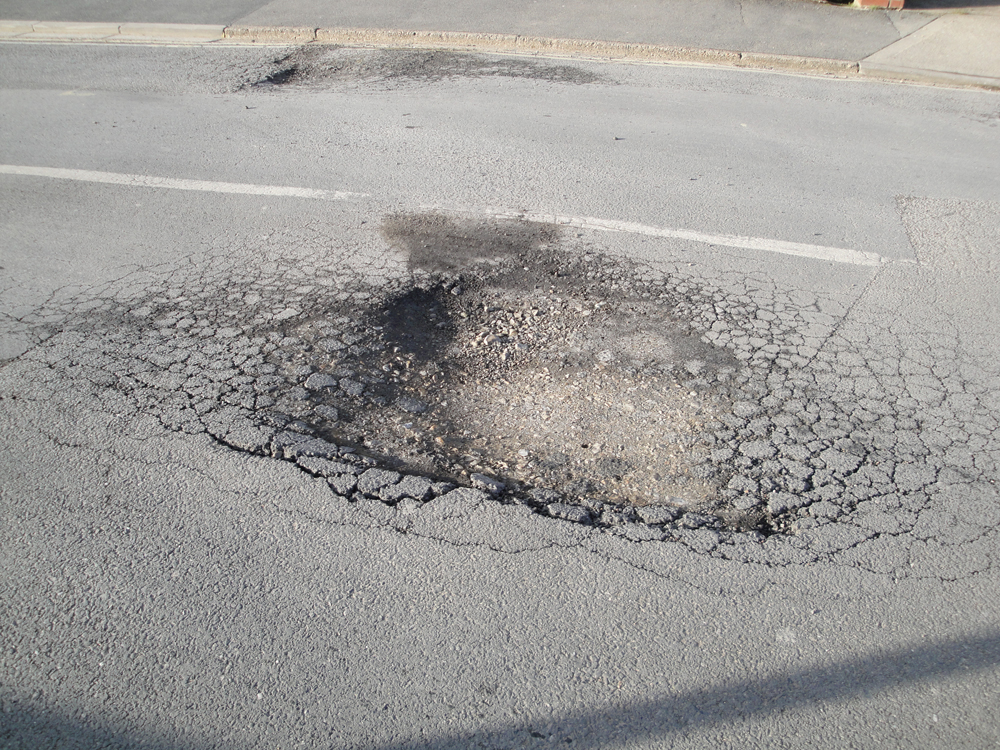
Thermal stress is created by thermal expansion or contraction (see Elasticity: Stress and Strain for a discussion of stress and strain). Thermal stress can be destructive, such as when expanding gasoline ruptures a tank. It can also be useful: for example, when two parts are joined together by heating one in manufacturing, then slipping it over the other and allowing the combination to cool. Thermal stress can explain many phenomena, such as the weathering of rocks and pavement by the expansion of ice when it freezes.
Example
13.5
Calculating Thermal Stress: Gas Pressure
What pressure would be created in the gasoline tank considered in Example 13.4, if the gasoline increases in temperature from to without being allowed to expand? Assume that the bulk modulus for gasoline is . (For more on bulk modulus, see Elasticity: Stress and Strain.)
Strategy
To solve this problem, we must use the following equation, which relates a change in volume to pressure:
13.15
where is pressure, is the original volume, and is the bulk modulus of the material involved. We will use the amount spilled in Example 13.4 as the change in volume, . To estimate the pressure when the gas is heated at a constant volume, we can calculate the change in volume that would occur if the gas were allowed to expand at a fixed pressure, and then calculate the additional pressure needed to reduce the volume to its original level.
1. Rearrange the equation for calculating pressure:
13.16
2. Insert the known values. The bulk modulus for gasoline is . In the previous example, the change in volume is the amount that would spill. Here, is the original volume of the gasoline. Substituting these values into the equation, we obtain
13.17
Discussion
This pressure is about , much more than a gasoline tank can handle.
Forces and pressures created by thermal stress are typically as great as that in the example above. Railroad tracks and roadways can buckle on hot days if they lack sufficient expansion joints. (See Figure 13.15.) Power lines sag more in the summer than in the winter, and will snap in cold weather if there is insufficient slack. Cracks open and close in plaster walls as a house warms and cools. Glass cooking pans will crack if cooled rapidly or unevenly, because of differential contraction and the stresses it creates. (Pyrex® is less susceptible because of its small coefficient of thermal expansion.) Nuclear reactor pressure vessels are threatened by overly rapid cooling, and although none have failed, several have been cooled faster than considered desirable. Biological cells are ruptured when foods are frozen, detracting from their taste. Repeated thawing and freezing accentuate the damage. Even the oceans can be affected. A significant portion of the rise in sea level that is resulting from global warming is due to the thermal expansion of sea water.
Metal is regularly used in the human body for hip and knee implants. Most implants need to be replaced over time because, among other things, metal does not bond with bone. Researchers are trying to find better metal coatings that would allow metal-to-bone bonding. One challenge is to find a coating that has an expansion coefficient similar to that of metal. If the expansion coefficients are too different, the thermal stresses during the manufacturing process lead to cracks at the coating-metal interface.
Another example of thermal stress is found in the mouth. Dental fillings can expand differently from tooth enamel, causing pain when eating ice cream or having a hot drink. Cracks might occur in the filling. Metal fillings (gold, silver, etc.) are being replaced by composite fillings (porcelain), which have smaller coefficients of expansion closer to those of teeth.
Check Your Understanding
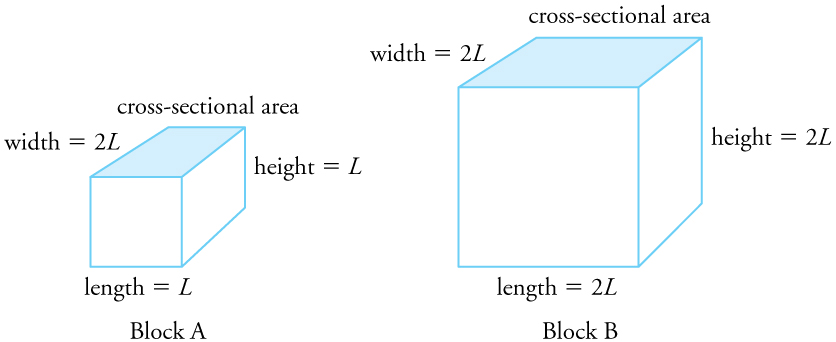
Two blocks, A and B, are made of the same material. Block A has dimensions and Block B has dimensions . If the temperature changes, what is (a) the change in ratio of the volumes (VB/VA) of the two blocks, (b) the change in the ratio of the cross-sectional areas , and (c) the change in the ratio of the heights (hB/hA) of the two blocks?
(a) The change in volume is proportional to the original volume. Block A has a volume of . Block B has a volume of which is 4 times that of Block A. Thus the change in volume of Block B should be 4 times the change in volume of Block A.
(b) The change in area is proportional to the area. The cross-sectional area of Block A is while that of Block B is Because cross-sectional area of Block B is twice that of Block A, the change in the cross-sectional area of Block B is twice that of Block A.
(c) The change in height is proportional to the original height. Because the original height of Block B is twice that of A, the change in the height of Block B is twice that of Block A.