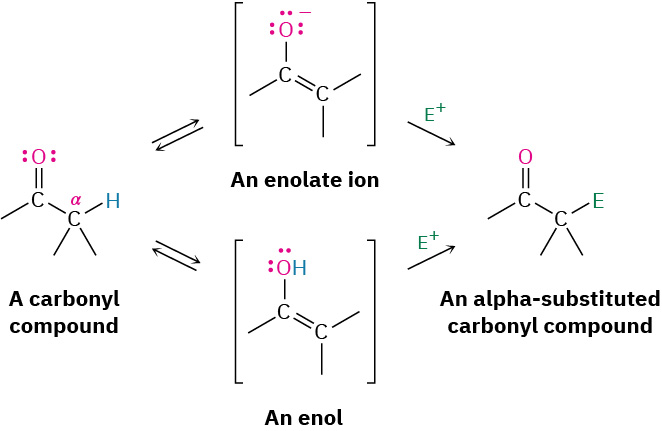
An enolate is a resonance-stabilized nucleophile; distinguish its reactive α-carbon from the electrophilic carbonyl partner.
Why α-hydrogens are acidic
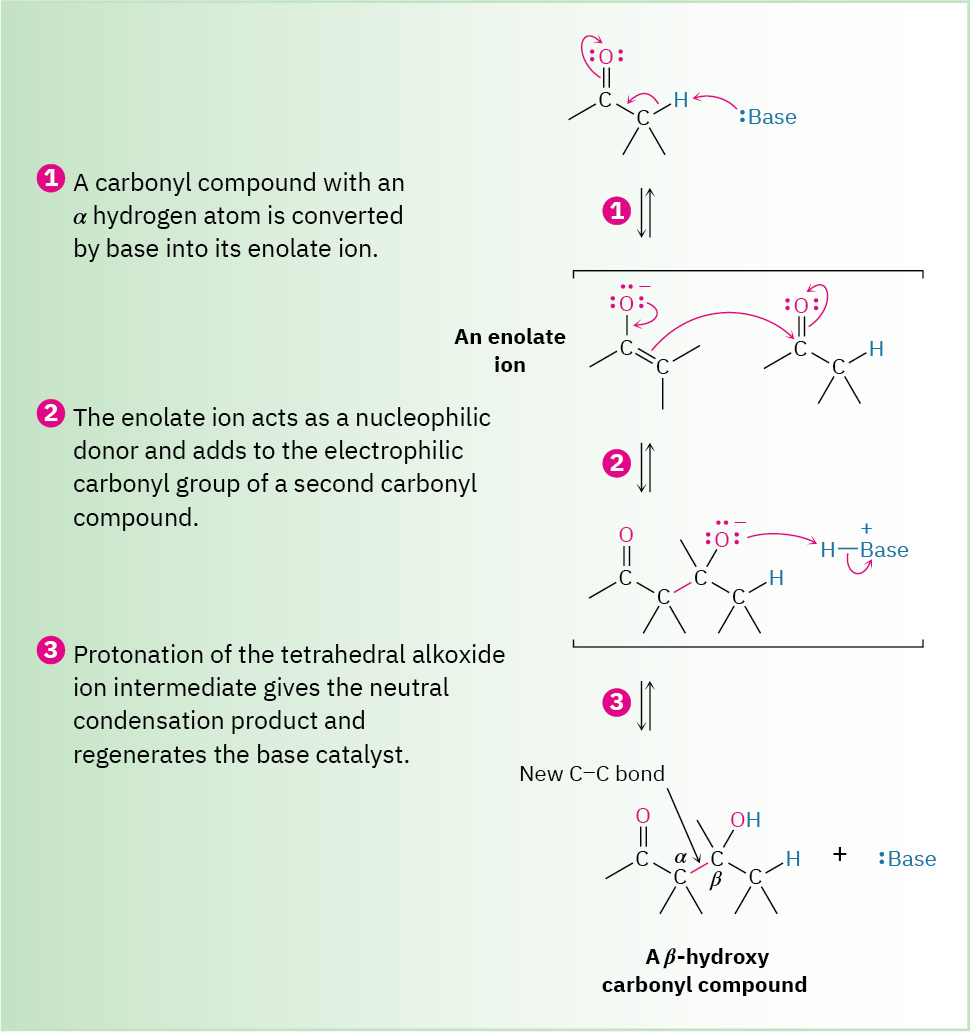
Removing a hydrogen next to a carbonyl yields an enolate whose negative charge is delocalized between oxygen and the α-carbon. This stabilization makes such hydrogens more acidic than ordinary alkane hydrogens; two adjacent electron-withdrawing carbonyl groups stabilize the anion further. Keto–enol tautomerism moves both a proton and a double bond, so tautomers are constitutional isomers rather than resonance drawings. A planar enol or enolate can be reprotonated from either face, causing racemization at an initially chiral α-carbon when both faces are accessible.
Source: Organic Chemistry 22 — Summary · 23.1 Carbonyl Condensations: The Aldol Reaction
Aldol and product selection
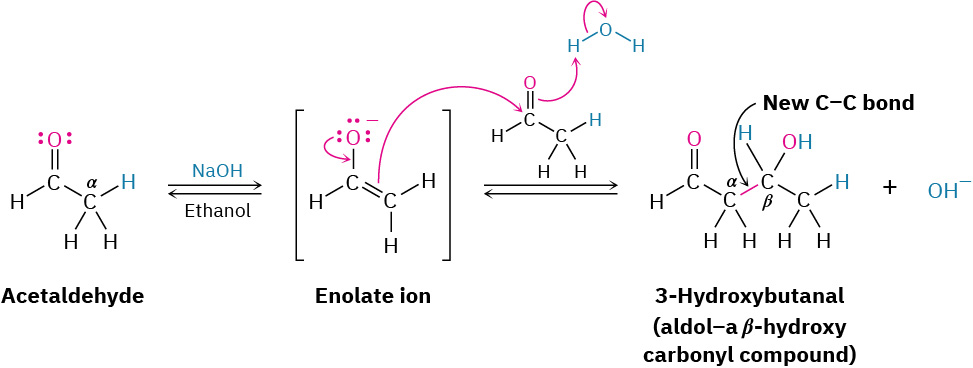
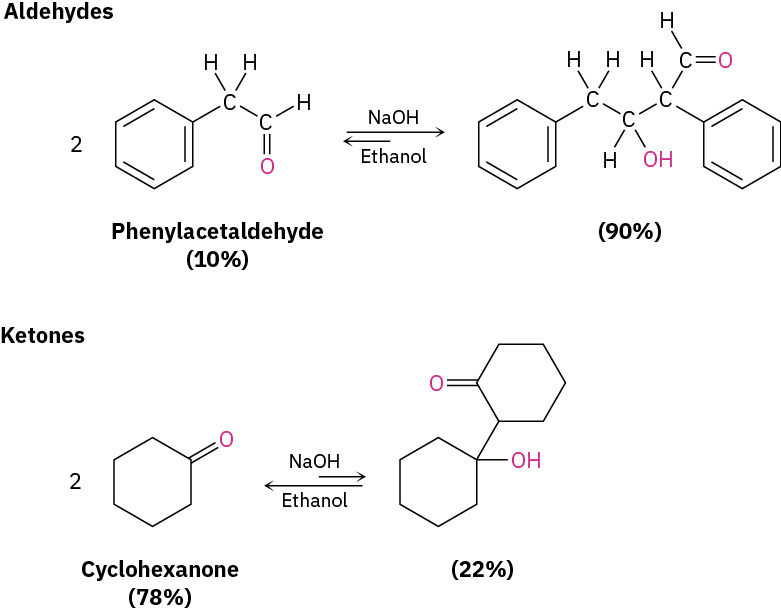
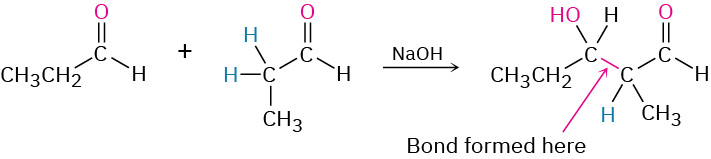
An enolate attacks another aldehyde or ketone, forming a new carbon–carbon bond and, after protonation, a β-hydroxy carbonyl: the aldol addition product. Dehydration yields an α,β-unsaturated carbonyl in an aldol condensation. Retro-aldol cleavage breaks the corresponding carbon–carbon bond, regenerating carbonyl partners. A bulky strong base at low temperature can favor the less hindered kinetic enolate; reversible equilibration can favor the more substituted thermodynamic enolate. Temperature, base, solvent, and reversibility matter, so neither label is an unconditional rule. Crossed aldol reactions can form mixtures unless donor and acceptor roles are controlled.
Source: Organic Chemistry 22 — Summary · 23.1 Carbonyl Condensations: The Aldol Reaction
Apply it
Try before revealing the answer. Two ethanal molecules undergo aldol addition. What is the four-carbon product, and what results after dehydration?
Worked answer
The ethanal enolate attacks the carbonyl carbon of another ethanal, giving CH₃CH(OH)CH₂CHO, 3-hydroxybutanal. Dehydration removes the β-OH and an α-H to give CH₃CH=CHCHO, but-2-enal. The carbonyl of the nucleophilic donor remains in the product.
Source: Organic Chemistry 22 — Summary · 23.1 Carbonyl Condensations: The Aldol Reaction
Organic Chemistry 22 — Summary — figures and tables
Source: Organic Chemistry 22 — Summary
23.1 Carbonyl Condensations: The Aldol Reaction — figures and tables