Pyruvate oxidation links glycolysis to mitochondrial metabolism; each acetyl-CoA turn reduces carriers while regenerating oxaloacetate.
Make acetyl-CoA by oxidative decarboxylation
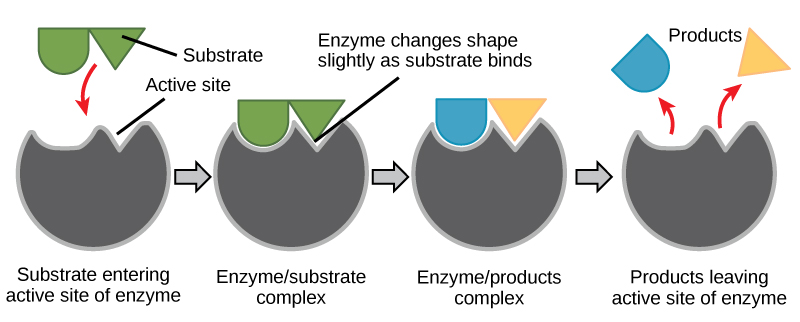
The mitochondrial pyruvate dehydrogenase complex converts pyruvate + CoA + NAD+ into acetyl-CoA + CO2 + NADH. The reaction is effectively irreversible and uses thiamine pyrophosphate, lipoamide, CoA, FAD, and NAD+. Pyruvate dehydrogenase kinase inhibits the complex by phosphorylation; phosphatase activates it. High NADH and acetyl-CoA oppose additional oxidation, whereas demand signals promote flux.
Fatty-acid β-oxidation and breakdown of ketogenic amino acids also supply acetyl-CoA. Acetyl-CoA can enter the citric acid cycle, support ketone synthesis in liver mitochondria, or provide carbon for lipid synthesis after export in another form. Its fate depends on oxaloacetate availability, compartment, and hormonal state.
Source: 7.3 Oxidation of Pyruvate and the Citric Acid Cycle · 7.7 Regulation of Cellular Respiration
Follow intermediates and count outputs
Citrate synthase condenses two-carbon acetyl-CoA with four-carbon oxaloacetate to make citrate. Aconitase rearranges citrate to isocitrate. Isocitrate dehydrogenase generates α-ketoglutarate, CO2, and NADH; α-ketoglutarate dehydrogenase makes succinyl-CoA, another CO2, and NADH. Succinyl-CoA synthetase produces succinate and GTP or ATP by substrate-level phosphorylation.
Succinate dehydrogenase forms fumarate and transfers electrons through FAD to the respiratory chain; fumarase produces malate; malate dehydrogenase regenerates oxaloacetate and NADH. Per acetyl-CoA: 3 NADH, 1 FADH2 equivalent, 1 GTP/ATP, and 2 CO2. The entering acetyl carbons are not generally the carbons lost in the first turn. All enzymes are in the matrix except inner-membrane succinate dehydrogenase.
Source: 7.3 Oxidation of Pyruvate and the Citric Acid Cycle · 7.7 Regulation of Cellular Respiration
Match oxidation to energy demand and intermediates
High ATP and NADH indicate abundant energy and inhibit key oxidative fluxes; ADP and, in active muscle, Ca2+ stimulate control points such as isocitrate dehydrogenase. Product inhibition and substrate supply also regulate citrate synthase and α-ketoglutarate dehydrogenase. Oxygen is not a direct cycle substrate, but oxidative cycling depends on respiratory reoxidation of NADH and reduced flavin.
Intermediates support biosynthesis, making the cycle amphibolic. Removing oxaloacetate or α-ketoglutarate requires anaplerotic replenishment; pyruvate carboxylase makes oxaloacetate using ATP and biotin. Low oxaloacetate can limit acetyl-CoA oxidation even when fuel is abundant, contributing to ketogenesis during fasting.
Source: 7.3 Oxidation of Pyruvate and the Citric Acid Cycle · 7.7 Regulation of Cellular Respiration
Practice: apply the mechanism
Question. How many NADH, FADH2 equivalents, substrate-level ATP equivalents, and CO2 arise when two pyruvates undergo pyruvate dehydrogenase plus two complete cycle turns? Exclude glycolysis.
Show reasoning
Pyruvate dehydrogenase gives 2 NADH and 2 CO2. Two cycle turns give 6 NADH, 2 FADH2 equivalents, 2 GTP/ATP, and 4 CO2. Total: 8 NADH, 2 FADH2 equivalents, 2 ATP equivalents, and 6 CO2. Using 2.5 ATP per NADH and 1.5 per FADH2 equivalent gives about 25 ATP equivalents from these stages, before glycolysis and its cytosolic reducing equivalents are included.
Source: 7.3 Oxidation of Pyruvate and the Citric Acid Cycle · 7.7 Regulation of Cellular Respiration
7.3 Oxidation of Pyruvate and the Citric Acid Cycle — figures and tables
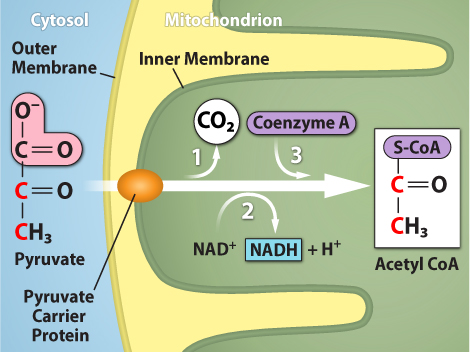
Figure 7.10 Upon entering the mitochondrial matrix, a multienzyme complex converts pyruvate into acetyl CoA. In the process, carbon dioxide is released, and one molecule of NADH is formed. Credit: Rao, A., Ryan, K. and Tag, A. Department of Biology, Texas A&M University.
Mary Ann Clark, Matthew Douglas, and Jung Choi, Biology 2E, OpenStax. · CC BY-NC-SA 4.0 · Original image ↗ · Access for free ↗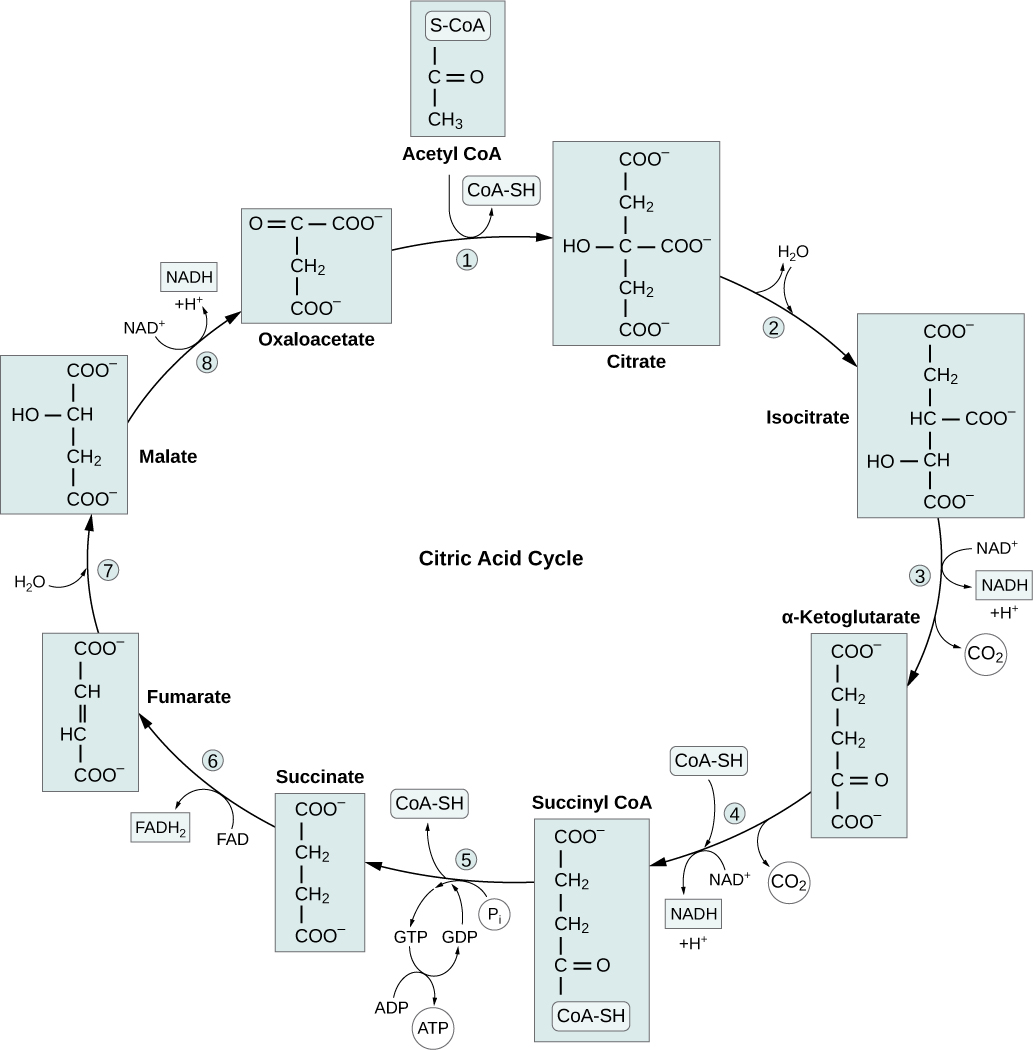
Figure 7.11 In the citric acid cycle, the acetyl group from acetyl CoA is attached to a four-carbon oxaloacetate molecule to form a six-carbon citrate molecule. Through a series of steps, citrate is oxidized, releasing two carbon dioxide molecules for each acetyl group fed into the cycle. In the process, three NAD + molecules are reduced to NADH, one FAD molecule is reduced to FADH 2 , and one ATP or GTP (depending on the cell type) is produced (by substrate-level phosphorylation). Because the final product of the citric acid cycle is also the first reactant, the cycle runs continuously in the presence of sufficient reactants. Credit: Rao, A., Ryan, K., Tag, A., and Fletcher, S. Department of Biology, Texas A&M University.
Mary Ann Clark, Matthew Douglas, and Jung Choi, Biology 2E, OpenStax. · CC BY-NC-SA 4.0 · Original image ↗ · Access for free ↗7.7 Regulation of Cellular Respiration — figures and tables
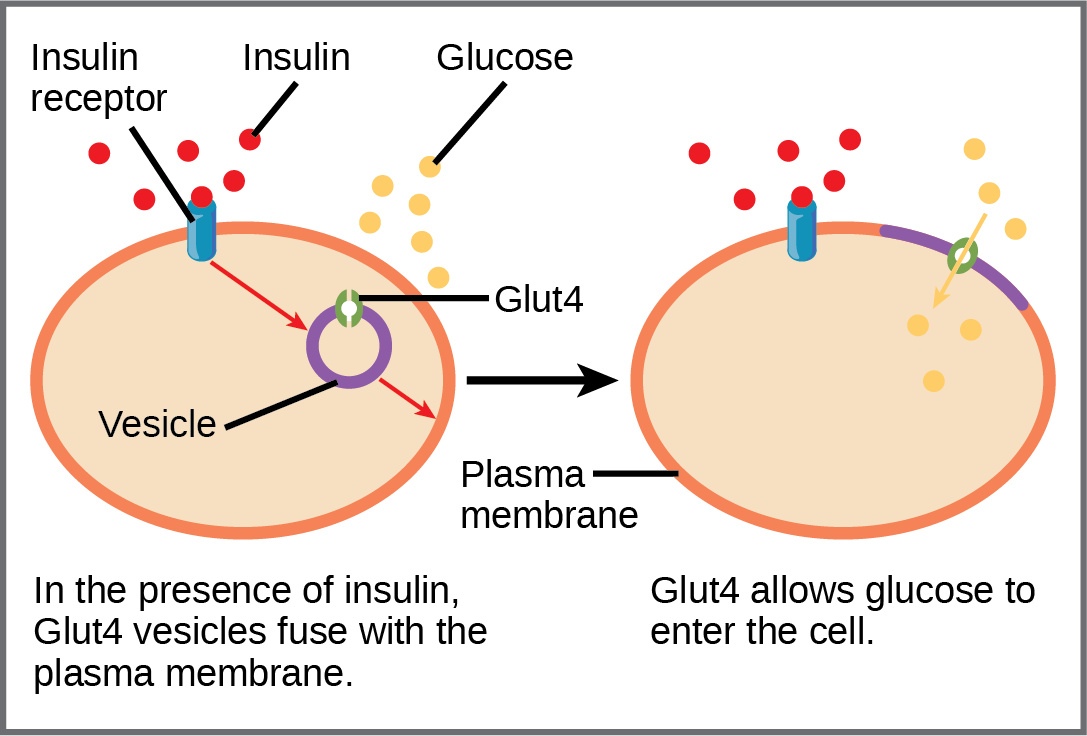
Figure 7.20 GLUT4 is a glucose transporter that is stored in vesicles. A cascade of events that occurs upon insulin binding to a receptor in the plasma membrane causes GLUT4-containing vesicles to fuse with the plasma membrane so that glucose may be transported into the cell.
Mary Ann Clark, Matthew Douglas, and Jung Choi, Biology 2E, OpenStax. · CC BY-NC-SA 4.0 · Original image ↗ · Access for free ↗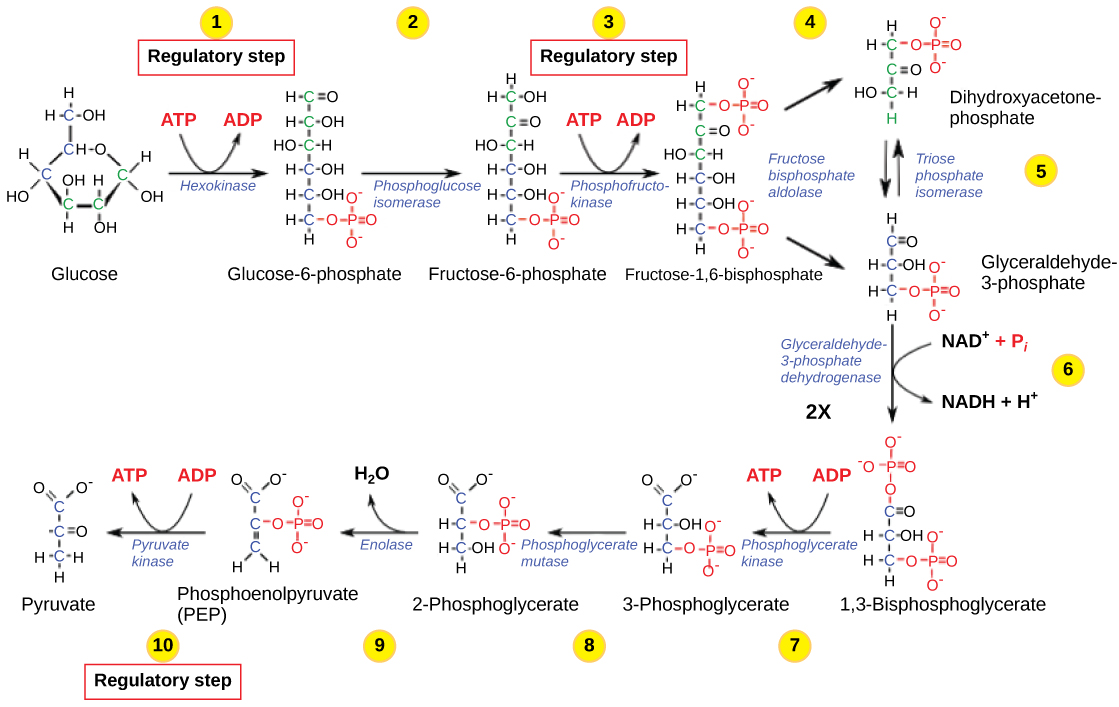
Figure 7.21 The glycolysis pathway is primarily regulated at the three key enzymatic steps (1, 3, and 10) as indicated. Note that the first two steps that are regulated occur early in the pathway and involve hydrolysis of ATP.
Mary Ann Clark, Matthew Douglas, and Jung Choi, Biology 2E, OpenStax. · CC BY-NC-SA 4.0 · Original image ↗ · Access for free ↗| Pathway | Enzyme affected | Elevated levels of effector | Effect on pathway activity |
|---|---|---|---|
| glycolysis | hexokinase | glucose-6-phosphate | decrease |
| phosphofructokinase | low-energy charge (ATP, AMP), fructose-6-phosphate via fructose-2,6-bisphosphate | increase | |
| high-energy charge (ATP, AMP), citrate, acidic pH | decrease | ||
| pyruvate kinase | fructose-1,6-bisphosphate | increase | |
| high-energy charge (ATP, AMP), alanine | decrease | ||
| pyruvate to acetyl CoA conversion | pyruvate dehydrogenase | ADP, pyruvate | increase |
| acetyl CoA, ATP, NADH | decrease | ||
| citric acid cycle | isocitrate dehydrogenase | ADP | increase |
| ATP, NADH | decrease | ||
| α-ketoglutarate dehydrogenase | calcium ions, ADP | increase | |
| ATP, NADH, succinyl CoA | decrease | ||
| electron transport chain | ADP | increase | |
| ATP | decrease |
Table 7.1. Mary Ann Clark, Matthew Douglas, and Jung Choi, Biology 2E, OpenStax.