Foundation 1 · 1D · Bioenergetics and metabolism

Biological energy and redox

Sources ↗

determine actual , coupling adds energies, and transfer links fuel to production.

Actual conditions determine

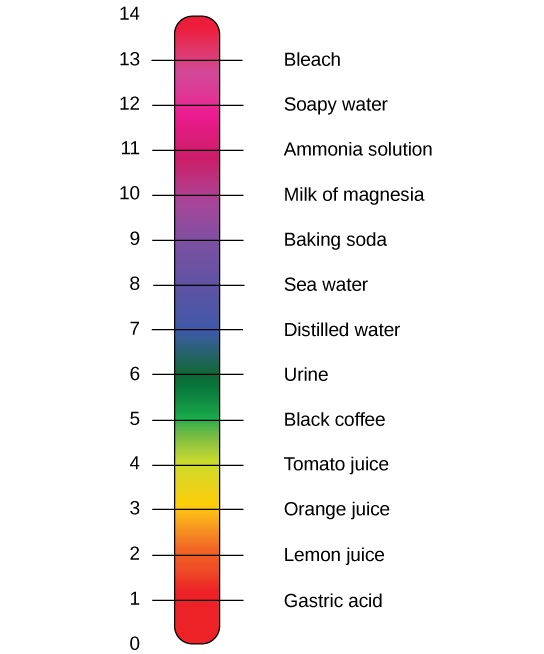
At constant temperature and pressure, =−TΔS. Negative favors the forward , positive favors the reverse, and =0 denotes . For a mixture, =+RT ln ; at =−RT ln K. The biochemical standard ′ uses a specified buffered , usually 7. Keep that convention consistent with the .

Increasing raises and opposes the forward direction; removing can make a with positive standard proceed. Favorability says nothing about speed: a large activation barrier can prevent a favorable process from occurring rapidly, and change rates without changing .

Source: 6.2 Potential, Kinetic, Free, and Activation Energy · 6.4 ATP: Adenosine Triphosphate · 7.4 Oxidative Phosphorylation

Heat flow is not the same as spontaneity

An exothermic releases heat and has <0; an one absorbs heat and has >0. and instead describe the sign of . An can be favorable when its positive contribution TΔS exceeds . Conversely, an exothermic with a sufficiently negative change can become unfavorable at high temperature. Biological systems maintain local organization by exchanging matter and energy with their surroundings; the second law concerns total , not the of one isolated component of a cell.

Source: 6.2 Potential, Kinetic, Free, and Activation Energy · 6.4 ATP: Adenosine Triphosphate · 7.4 Oxidative Phosphorylation

couples through shared

to ADP and inorganic is favorable because the are better stabilized by , hydration, and reduced repulsion. Breaking a bond alone costs energy; the net releases . Cellular depends on , ADP, and and is often more negative than the standard value.

Coupling requires a mechanistic connection, such as transfer of ’s terminal phosphoryl group to form an activated intermediate. Adding the adds their values. Simply placing an unfavorable beside in does not guarantee coupling. → plus consumes two phosphoanhydride-bond equivalents.

Source: 6.2 Potential, Kinetic, Free, and Activation Energy · 6.4 ATP: Adenosine Triphosphate · 7.4 Oxidative Phosphorylation

Follow and roles

loses ; gains them. + + 2e− → represents of a nicotinamide ; obeys the same chemistry but its extra enables recognition. generally transfers fuel-derived toward production, while often supplies reductive synthesis and antioxidant systems.

Flavin and are commonly -bound and can participate in one- or two- transfers; + 2H+ + 2e− → is the net two- . Balance and in half-, equalize numbers, then add. For transfer from donor to acceptor, ′=−nFΔE°′; a positive acceptor-minus-donor -potential difference favors transfer.

Source: 6.2 Potential, Kinetic, Free, and Activation Energy · 6.4 ATP: Adenosine Triphosphate · 7.4 Oxidative Phosphorylation

Practice: apply the mechanism

Question. A has =+18 /mol and its coupled has =−50 /mol under the same cellular conditions. What is the combined ? If accumulates, what happens to the ’s ?

Show reasoning

The coupled free energies add to −32 /mol, favoring the combined forward process when the couples the . Increasing raises and therefore raises through RT ln . It does not change the standard or imply that a faster can reset .

Source: 6.2 Potential, Kinetic, Free, and Activation Energy · 6.4 ATP: Adenosine Triphosphate · 7.4 Oxidative Phosphorylation

6.2 Potential, , Free, and — figures and tables

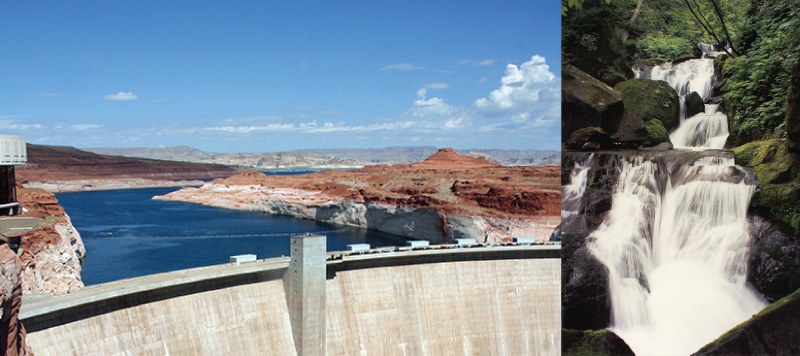
The photo on the left shows a river that is blocked by a giant cement wall, called a dam. The photo on the right shows a waterfall.
Figure 6.6 — 6.2 Potential, , Free, and

Figure 6.6 Water behind a dam has potential energy. Moving water, such as in a waterfall or a rapidly flowing river, has kinetic energy. (credit “dam”: modification of work by "Pascal"/Flickr; credit “waterfall”: modification of work by Frank Gualtieri)

Mary Ann Clark, Matthew Douglas, and Jung Choi, Biology 2E, OpenStax. (credit “dam”: modification of work by "Pascal"/Flickr; credit “waterfall”: modification of work by Frank Gualtieri) · CC BY-NC-SA 4.0 · Original image ↗ · Access for free ↗
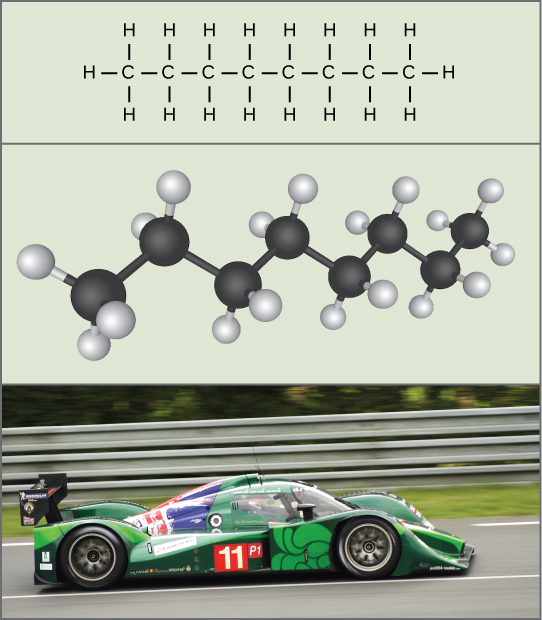
The molecular formula of octane (top), which is a chain of eight carbons and eighteen hydrogens, fuels a racecar speeding along a track (bottom).
Figure 6.7 — 6.2 Potential, , Free, and

Figure 6.7 The molecules in gasoline contain chemical energy within the chemical bonds. This energy transforms into kinetic energy that allows a car to race on a racetrack. (credit “car”: modification of work by Russell Trow)

Mary Ann Clark, Matthew Douglas, and Jung Choi, Biology 2E, OpenStax. (credit “car”: modification of work by Russell Trow) · CC BY-NC-SA 4.0 · Original image ↗ · Access for free ↗
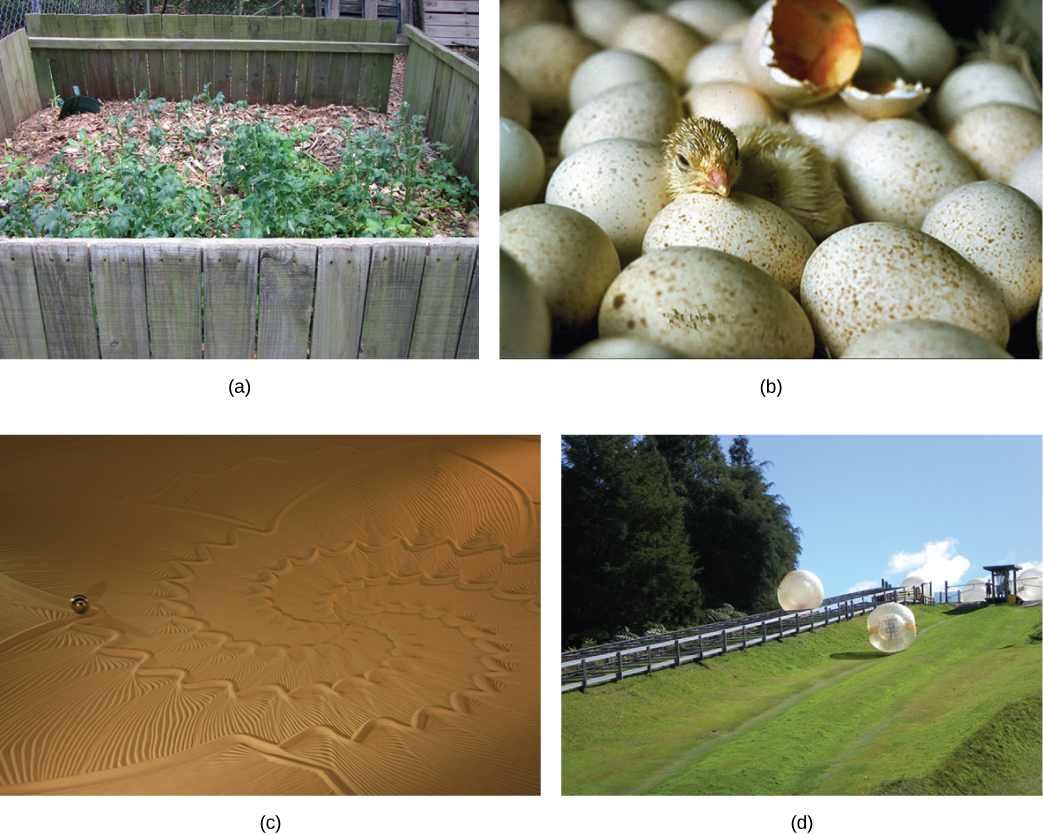
There are four photos show.  The first photo shows a pile of wood chips and dirt, with small plants growing from this.  The second photo shows a small baby bird breaking out of its egg as it hatches.  The third photo shows a large patch of desert where someone has drawn patterns in the sand.  The fourth photo shows a grassy hill outside where people climb into giant inflatable balls and roll down the hillside.
Figure 6.8 — 6.2 Potential, , Free, and

Figure 6.8 This figure shows some examples of endergonic processes (ones that require energy) and exergonic processes (ones that release energy). These include (a) a compost pile decomposing, (b) a chick developing from a fertilized egg, (c) sand art destruction, and (d) a ball rolling down a hill. (credit a: modification of work by Natalie Maynor; credit b: modification of work by USDA; credit c: modification of work by “Athlex”/Flickr; credit d: modification of work by Harry Malsch)

Mary Ann Clark, Matthew Douglas, and Jung Choi, Biology 2E, OpenStax. (credit a: modification of work by Natalie Maynor; credit b: modification of work by USDA; credit c: modification of work by “Athlex”/Flickr; credit d: modification of work by Harry Malsch) · CC BY-NC-SA 4.0 · Original image ↗ · Access for free ↗
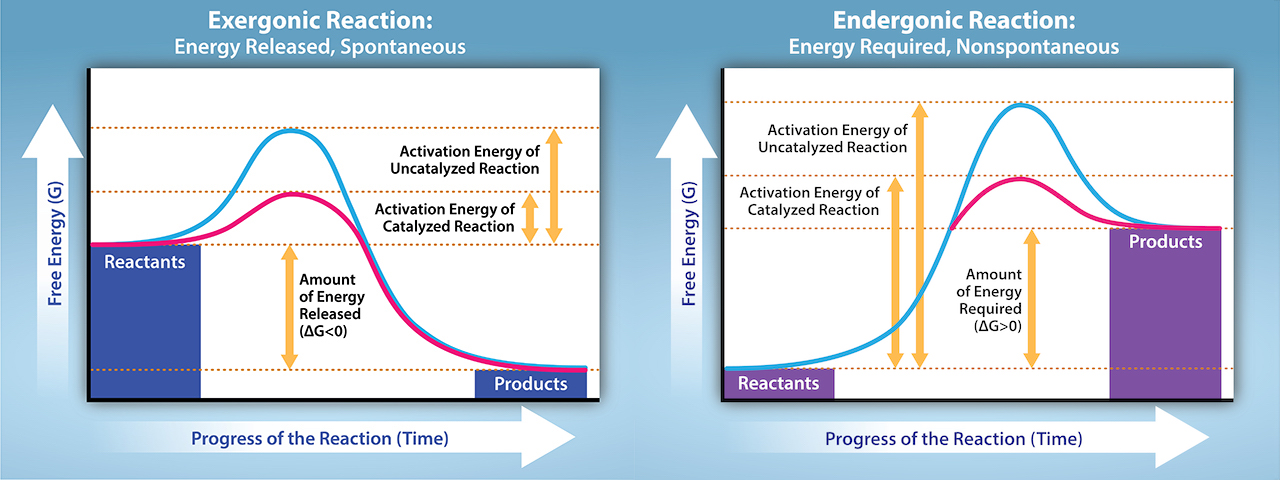
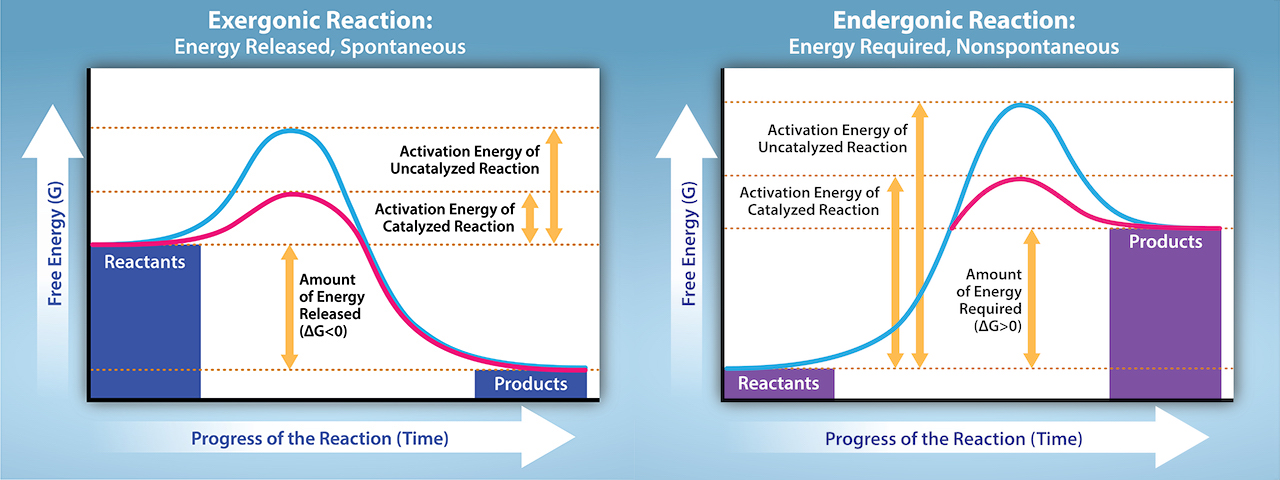
The two plots show the change in Gibbs free energy as reactants are converted to products. Gibbs free energy decreases with time for an exergonic reaction (left), and the reaction is spontaneous. Gibbs free energy increases with time for an endergonic reaction (right), and the reaction is not spontaneous.
Figure 6.9 — 6.2 Potential, , Free, and

Figure 6.9 Exergonic and endergonic reactions result in changes in Gibbs free energy (G). Exergonic reactions have a net release of energy and are spontaneous reactions. Endergonic reactions require an input of energy to proceed and are nonspontaneous reactions. Both Exergonic and endergonic reactions require initial activation energy for the reaction to occur.Credit: Tag, A., Rao, A., Fletcher, S. and Ryan, A. Department of Biology, Texas A&M University.

Mary Ann Clark, Matthew Douglas, and Jung Choi, Biology 2E, OpenStax. · CC BY-NC-SA 4.0 · Original image ↗ · Access for free ↗
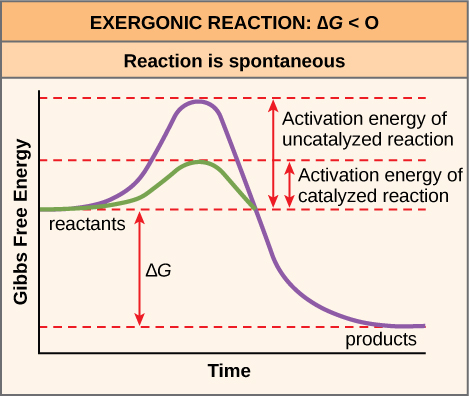
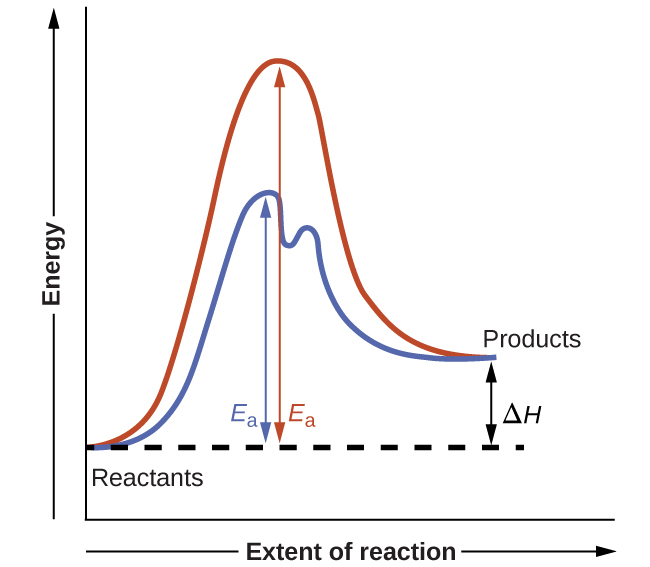
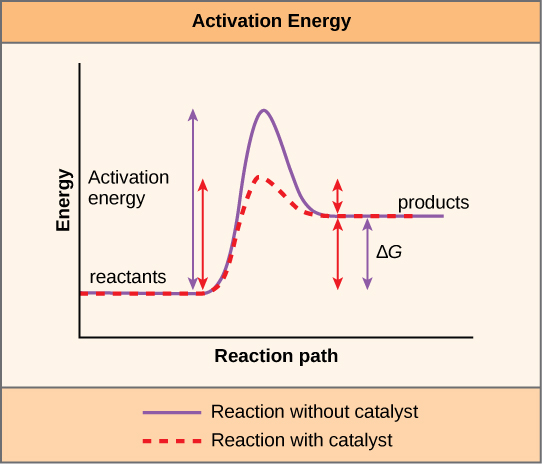
This plot shows the activation energy for an exergonic reaction. As the reaction proceeds, energy initially increases to overcome the activation energy. In a catalyzed reaction, the activation energy is much lower. The energy then decreases such that the Gibbs free energy of the products is less than that of the reactants. The activation energy is the peak of the energy plot minus the energy of the reactants. The Gibbs free energy (delta G) is the energy of the products minus the energy of the reactants.
Figure 6.10 — 6.2 Potential, , Free, and

Figure 6.10 Activation energy is the energy required for a reaction to proceed, and it is lower if the reaction is catalyzed. This diagram's horizontal axis describes the sequence of events in time.

Mary Ann Clark, Matthew Douglas, and Jung Choi, Biology 2E, OpenStax. · CC BY-NC-SA 4.0 · Original image ↗ · Access for free ↗
Source: 6.2 Potential, Kinetic, Free, and Activation Energy

6.4 : — figures and tables

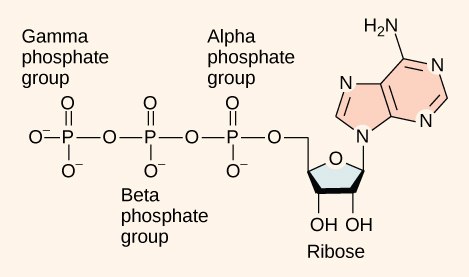
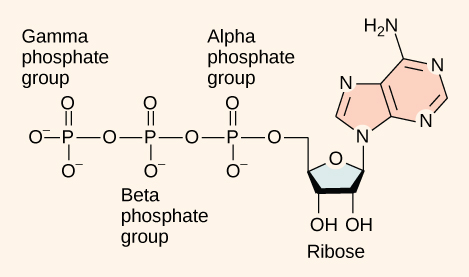
The molecular structure of adenosine triphosphate is shown. Three phosphate groups, called alpha, beta, and gamma, are attached to a ribose sugar. Adenine is also attached to the ribose.
Figure 6.13 — 6.4 :

Figure 6.13 ATP is the cell's primary energy currency. It has an adenosine backbone with three phosphate groups attached.

Mary Ann Clark, Matthew Douglas, and Jung Choi, Biology 2E, OpenStax. · CC BY-NC-SA 4.0 · Original image ↗ · Access for free ↗
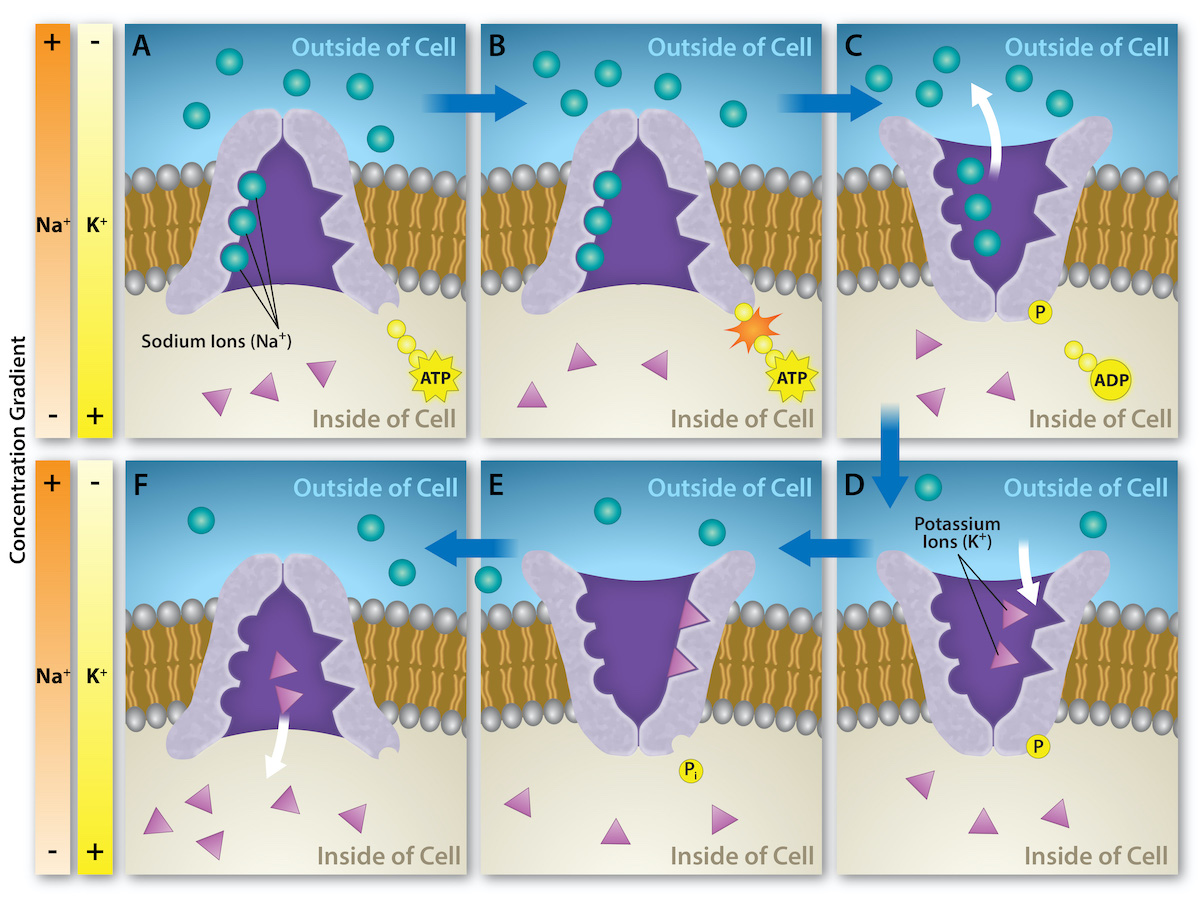
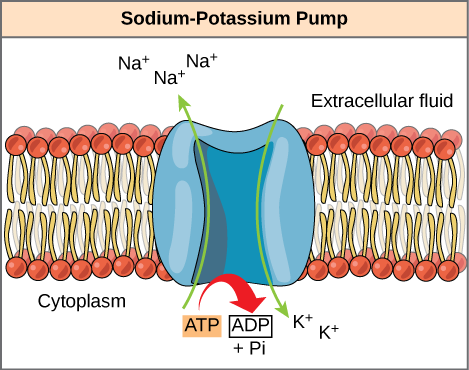
This illustration shows the sodium-potassium pump embedded in the cell membrane. A T P hydrolysis catalyzes a conformational change in the pump that allows sodium ions to move from the cytoplasmic side to the extracellular side of the membrane, and potassium ions to move from the extracellular side to the cytoplasmic side of the membrane as well.
Figure 6.14 — 6.4 :

Figure 6.14 The sodium-potassium pump is an example of energy coupling. The energy derived from exergonic ATP hydrolysis pumps sodium and potassium ions across the cell membrane.

Mary Ann Clark, Matthew Douglas, and Jung Choi, Biology 2E, OpenStax. · CC BY-NC-SA 4.0 · Original image ↗ · Access for free ↗
Source: 6.4 ATP: Adenosine Triphosphate

7.4 — figures and tables

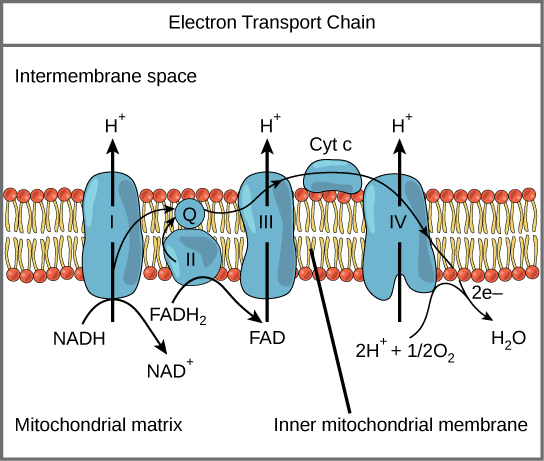
This illustration shows the electron transport chain embedded in the inner mitochondrial membrane. The electron transport chain consists of four electron complexes. Complex I oxidizes N A D H to N A D superscript plus sign baseline; and simultaneously pumps a proton across the membrane to the intermembrane space. The two electrons released from N A D H are shuttled to coenzyme Q, then to complex I I I, to cytochrome c, to complex I V, then to molecular oxygen. In the process, two more protons are pumped across the membrane to the intermembrane space, and molecular oxygen is reduced to form water. Complex I I removes two electrons from F A D H subscript 2 baseline, thereby forming F A D. The electrons are shuttled to coenzyme Q, then to complex I I I, cytochrome c, complex I V, and molecular oxygen as in the case of N A D H oxidation.
Figure 7.12 — 7.4

Figure 7.12 The electron transport chain is a series of electron transporters embedded in the inner mitochondrial membrane that shuttles electrons from NADH and FADH 2 to molecular oxygen. In the process, protons are pumped from the mitochondrial matrix to the intermembrane space, and oxygen is reduced to form water.

Mary Ann Clark, Matthew Douglas, and Jung Choi, Biology 2E, OpenStax. · CC BY-NC-SA 4.0 · Original image ↗ · Access for free ↗
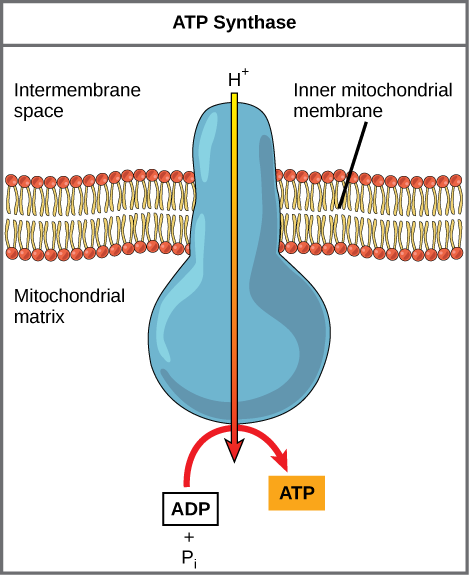
This illustration shows an A T P synthase enzyme embedded in the inner mitochondrial membrane. A T P synthase allows protons to move from an area of high concentration in the intermembrane space to an area of low concentration in the mitochondrial matrix. The energy derived from this exergonic process is used to synthesize A T P from A D P and inorganic phosphate.
Figure 7.13 — 7.4

Figure 7.13 ATP synthase is a complex, molecular machine that uses a proton (H + ) gradient to form ATP from ADP and inorganic phosphate (Pi). (Credit: modification of work by Klaus Hoffmeier)

Mary Ann Clark, Matthew Douglas, and Jung Choi, Biology 2E, OpenStax. · CC BY-NC-SA 4.0 · Original image ↗ · Access for free ↗
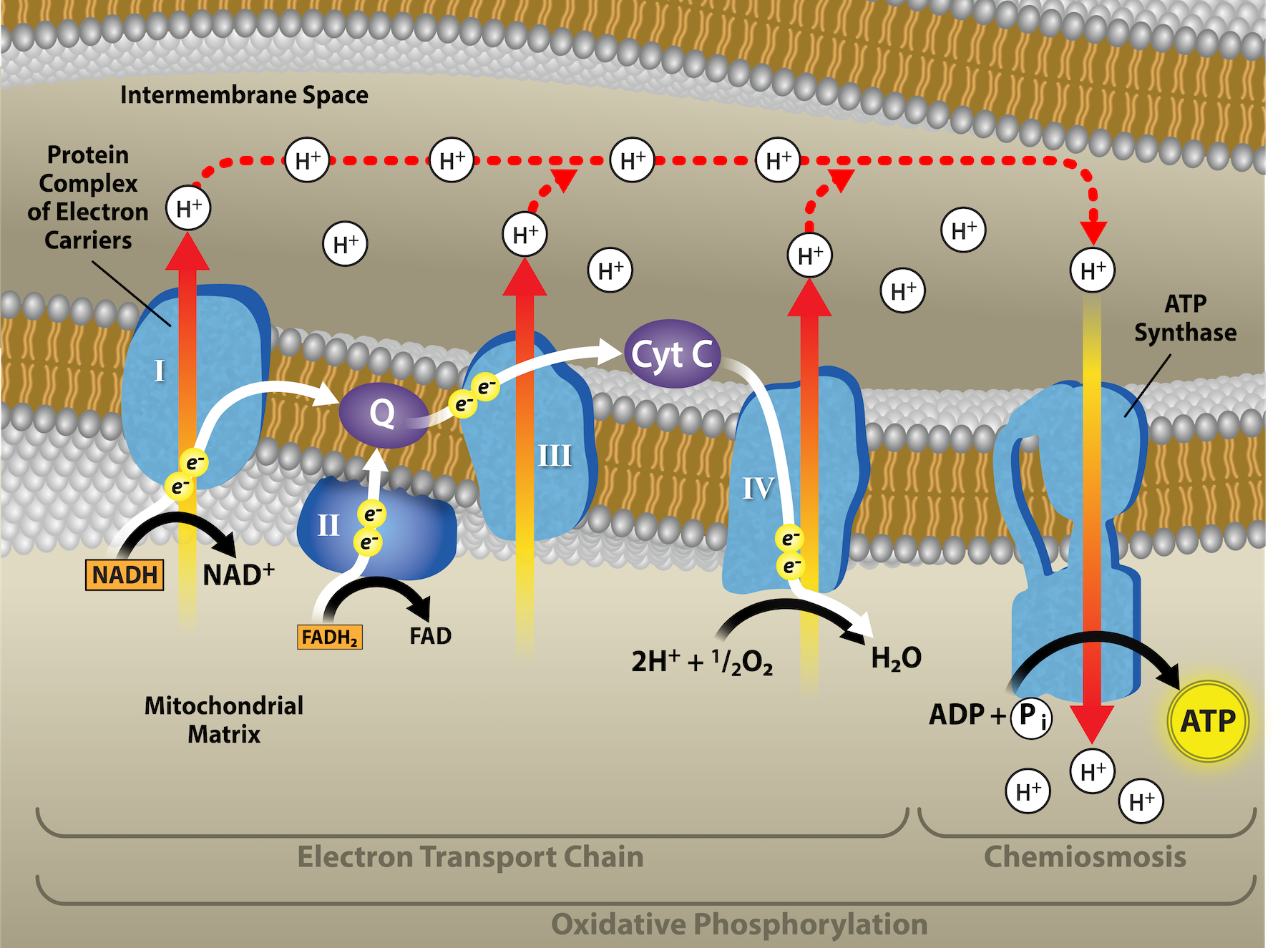
This illustration shows the electron transport chain, the A T P synthase enzyme embedded in the inner mitochondrial membrane, and chemiosmosis occurring in the mitochondrial matrix.  The electron transport chain oxidizes substrates and, in the process, pumps protons into the intermembrane space. A T P synthase allows protons to leak back into the matrix and synthesizes A T P in chemiosmosis.
Figure 7.14 — 7.4

Figure 7.14 In oxidative phosphorylation, the pH gradient formed by the electron transport chain is used by ATP synthase to form ATP. Credit: Rao, A., Ryan, K., Fletcher, S. and Tag, A. Department of Biology, Texas A&M University.

Mary Ann Clark, Matthew Douglas, and Jung Choi, Biology 2E, OpenStax. · CC BY-NC-SA 4.0 · Original image ↗ · Access for free ↗

Source: 7.4 Oxidative Phosphorylation
250 terms, alphabetically ordered

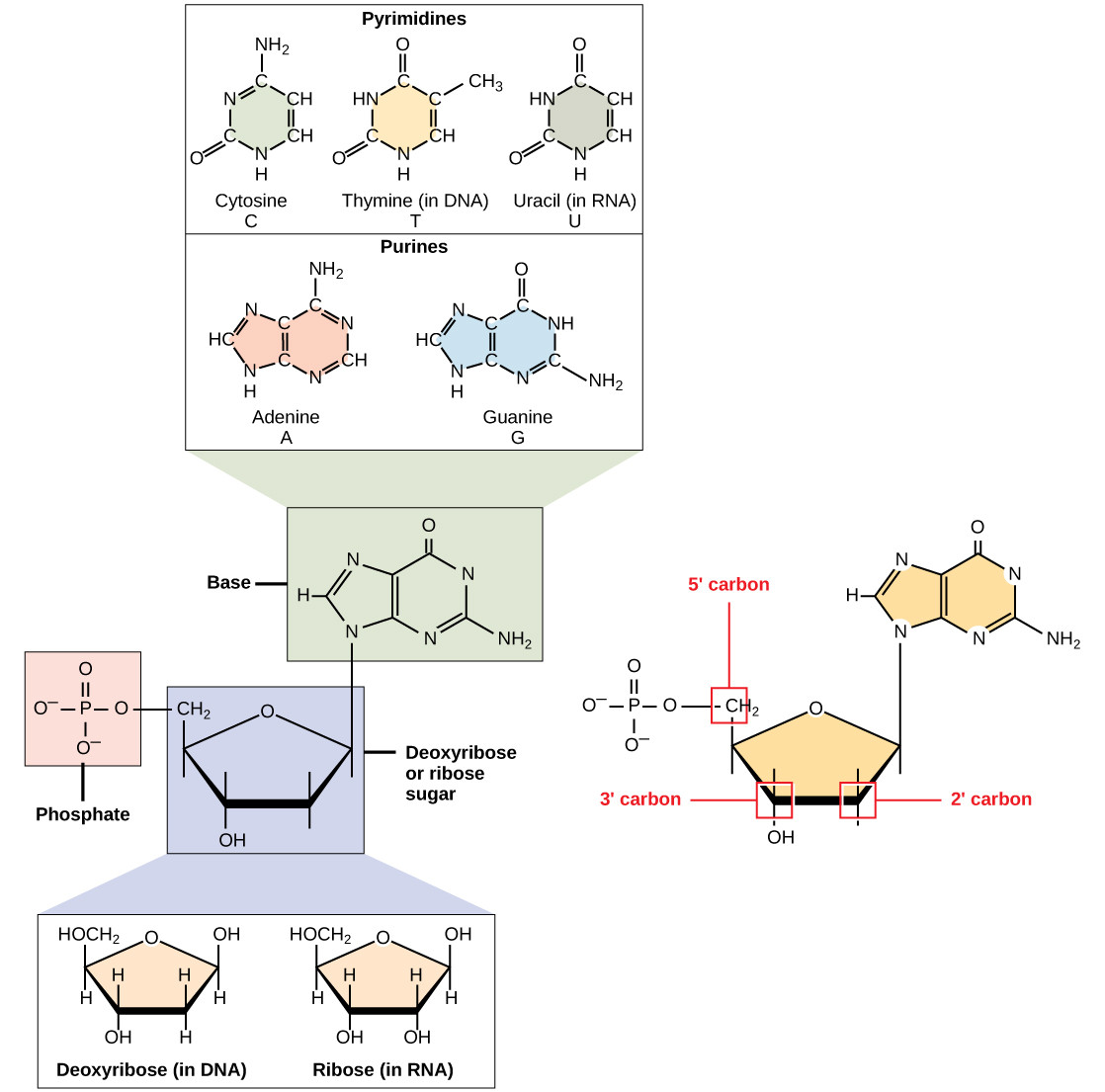
5′ end · ·

The end of a nucleic- strand associated with the sugar’s 5′ position. Sequences are conventionally written from 5′ to 3′.

Read explanation · OpenStax ↗
absolute temperature

temperature measured from absolute zero; gas-law ratios require this scale.

Read explanation · OpenStax ↗
acceleration

Rate of change of , measured in m/s².

Read explanation · OpenStax ↗
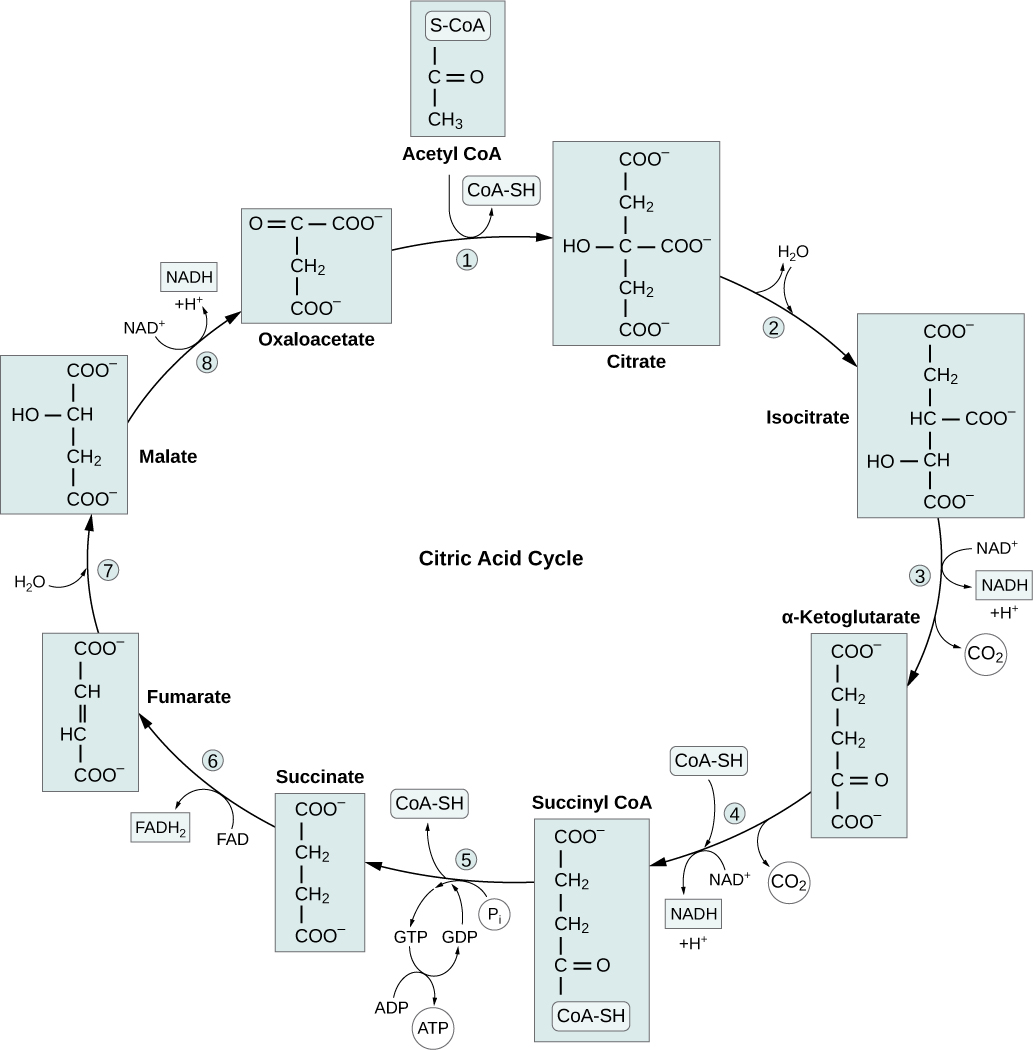
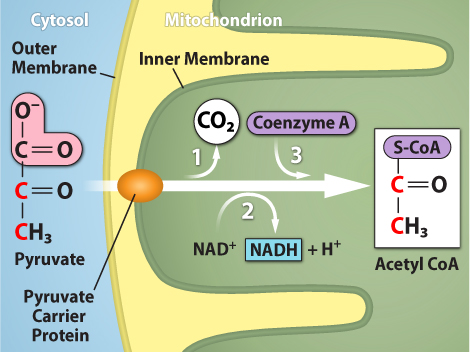
acetyl-CoA

A two-carbon acetyl group linked to by a thioester; a central fuel and intermediate.

Read explanation · OpenStax ↗
Acid · ·

In the Brønsted–Lowry model, a substance that can donate a . Acidic have a higher activity than water.

Read explanation · OpenStax ↗
Activation energy ·

The energy barrier that must overcome to reach a and undergo .

Read explanation · OpenStax ↗
Adenine

A that pairs with in and in .

Read explanation · OpenStax ↗
Adenosine monophosphate

A containing , , and one ; -dependent releases AMP.

Read explanation · OpenStax ↗
Adenosine triphosphate

An energy-carrying ; its powers many cellular processes, including cycles.

Read explanation · OpenStax ↗
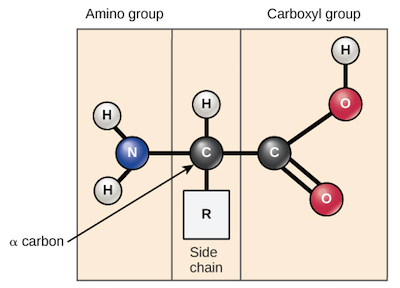
Alpha carbon · ·

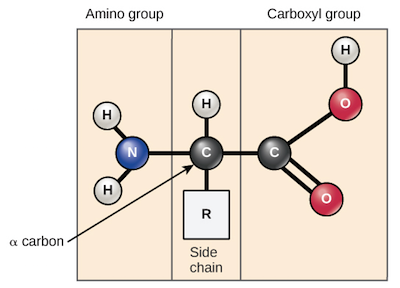
The central carbon next to the carboxyl carbon. In a standard it binds an , hydrogen, and .

Read explanation · OpenStax ↗
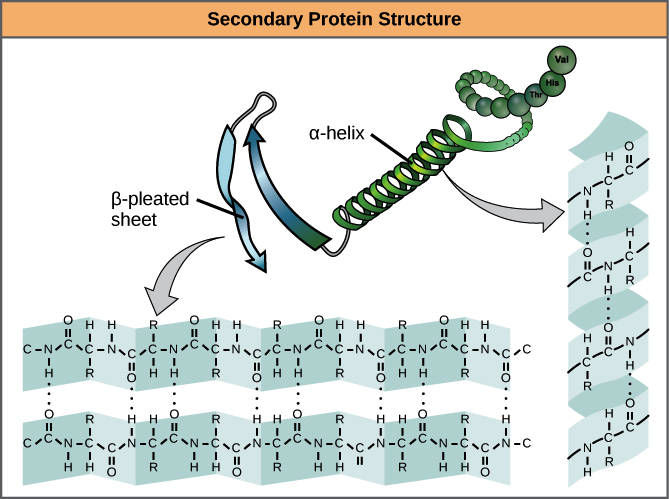
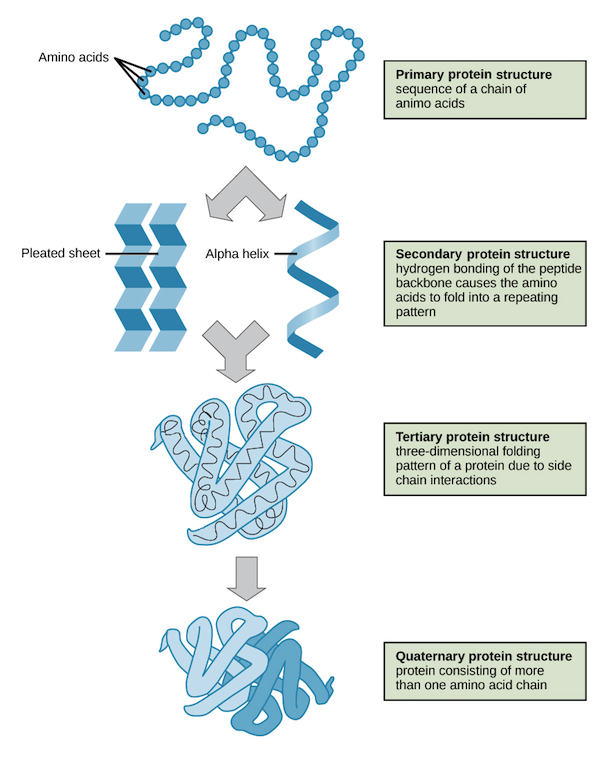
Alpha helix · · · · · ·

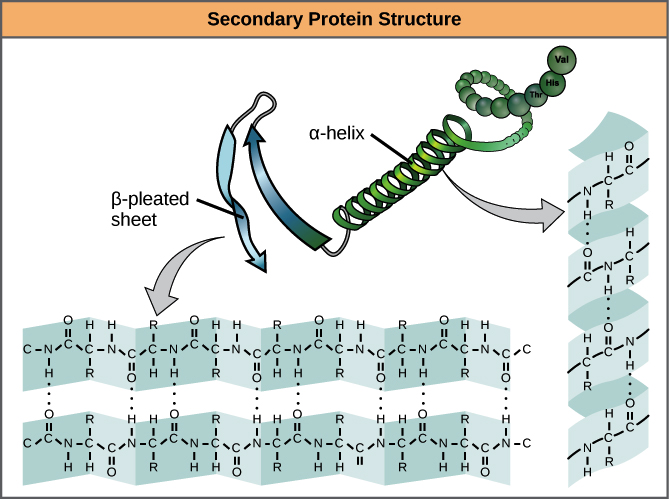
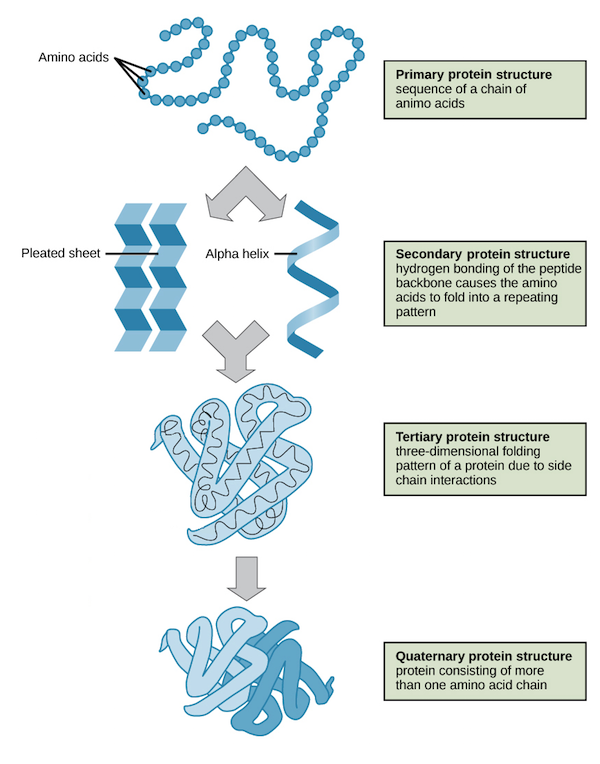
A helical stabilized by between a oxygen and an hydrogen four later.

Read explanation · OpenStax ↗
Amide · · ·

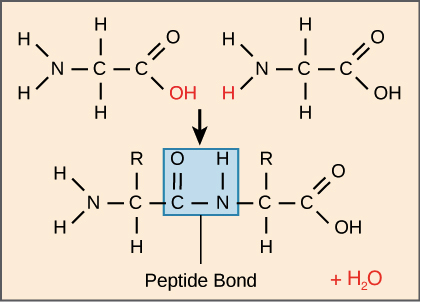
A group containing a carbon bonded to nitrogen. are amide linkages.

Read explanation · OpenStax ↗
Amino acid

A building block containing amino and and a characteristic .

Read explanation · OpenStax ↗
Amino acid residue · ·

The part of an incorporated into a chain. Residue can also describe another building block within a larger .

Read explanation · OpenStax ↗
Amino group · · ·

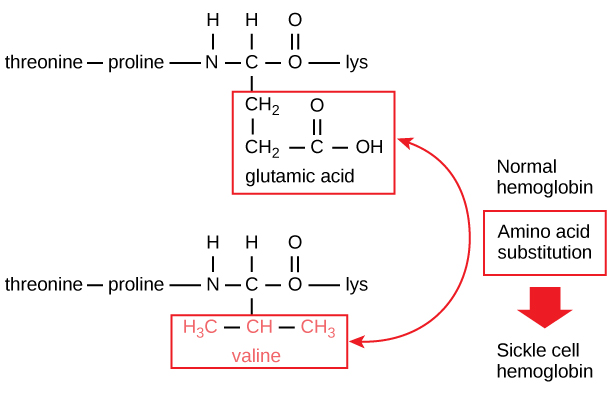
A nitrogen-containing . A free ’s amino group is typically (NH₃⁺) near physiological ; ’s ring nitrogen is an exception to this formula.

Read explanation · OpenStax ↗
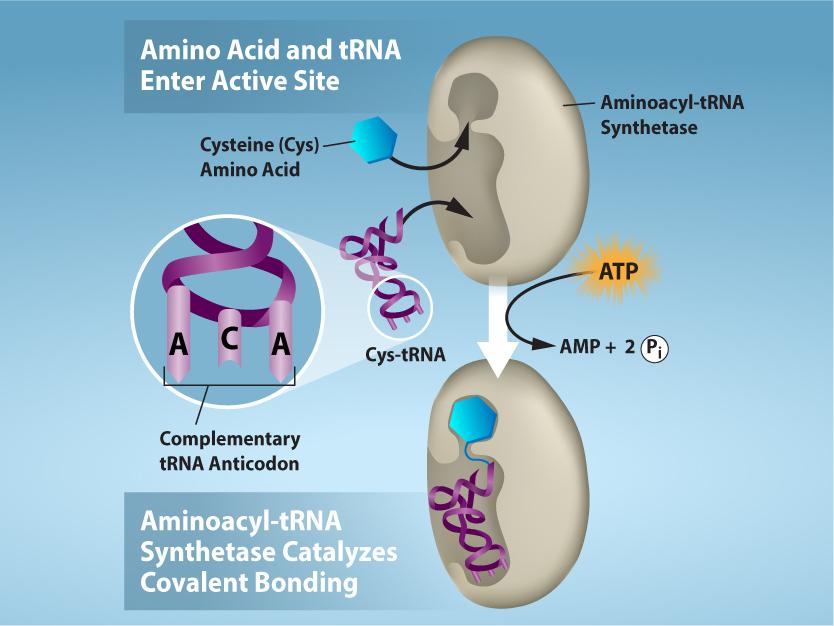
Aminoacyl-tRNA synthetase · · · · ·

An that uses to attach the appropriate to a ; many also edit charging errors.

Read explanation · OpenStax ↗
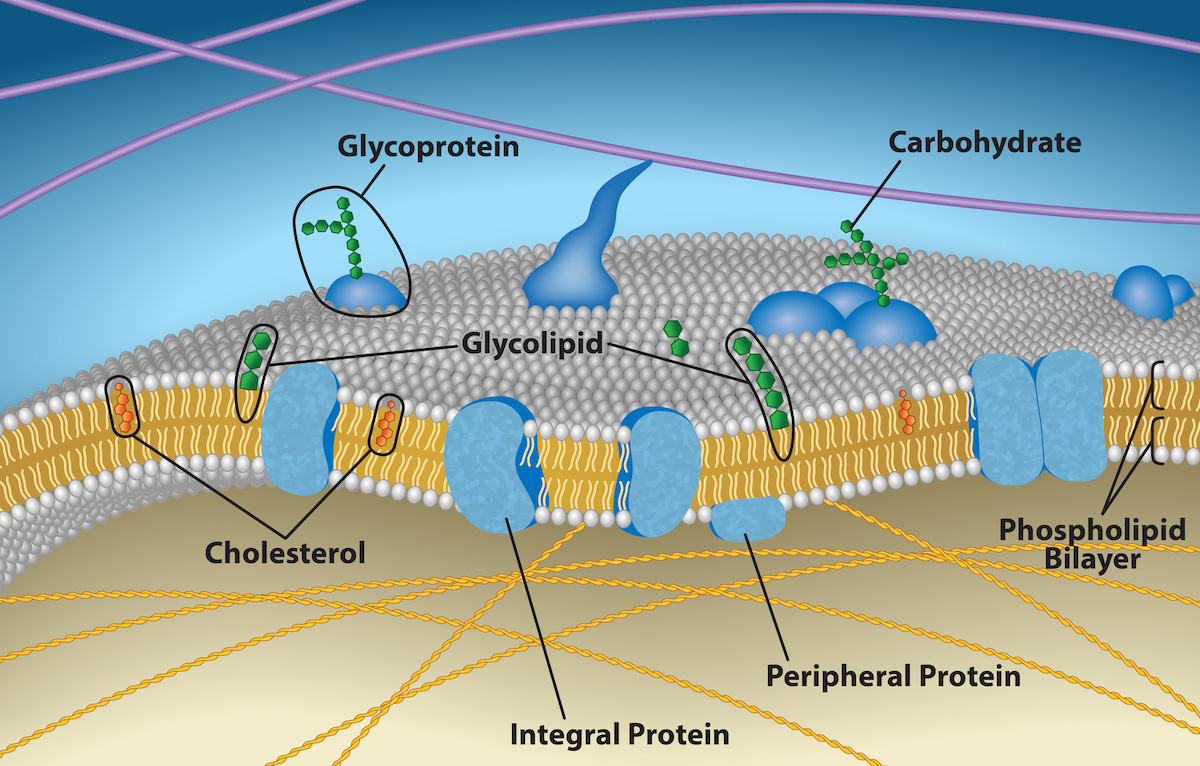
Amphipathic

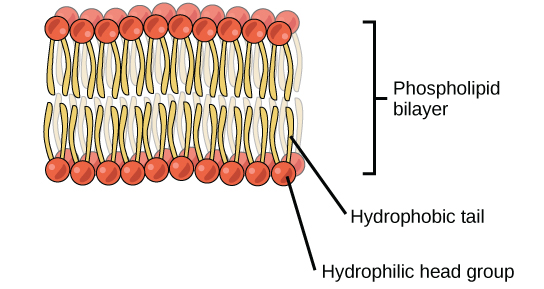
Having both a region and a region, as in a or .

Read explanation · OpenStax ↗
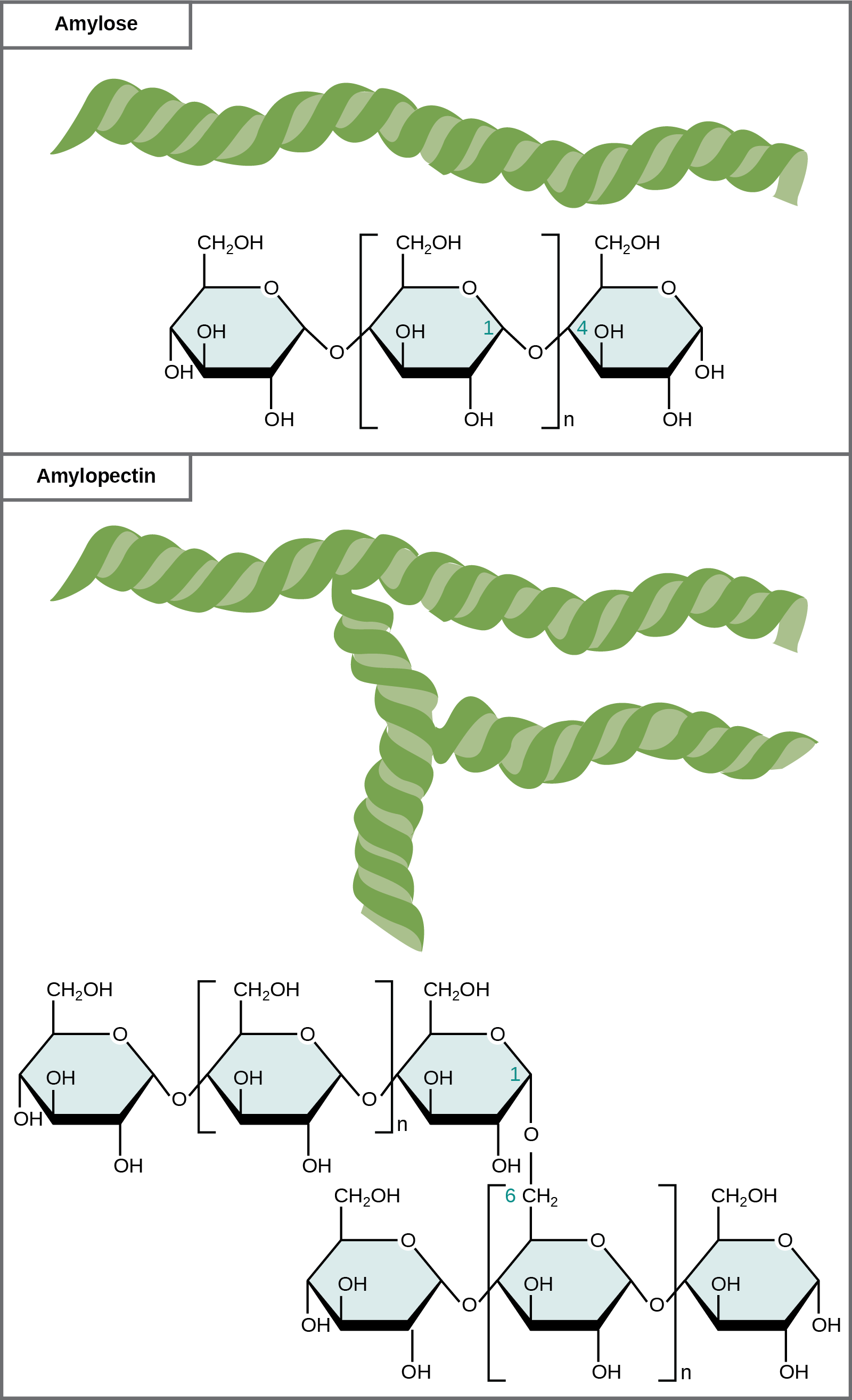
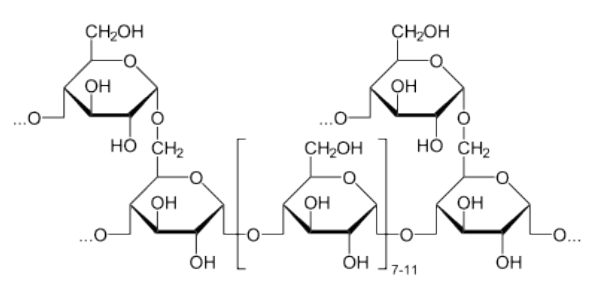
Amylose

The largely unbranched component of , made mainly of linked by alpha-1,4 .

Read explanation · OpenStax ↗
Analytical standard ·

A material with a known identity or amount used to compare or calibrate measurements.

Read explanation · Agilent ↗
anomeric carbon

The former carbon of a sugar, which becomes the or hemiketal center upon cyclization.

Read explanation · OpenStax ↗
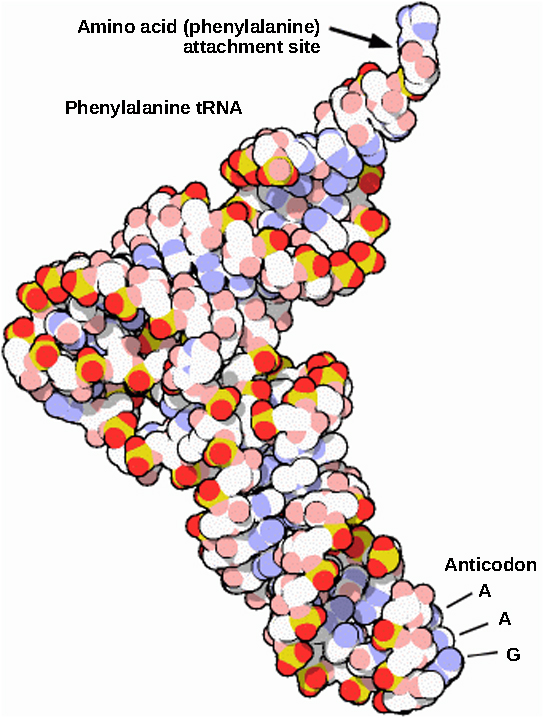
Anticodon

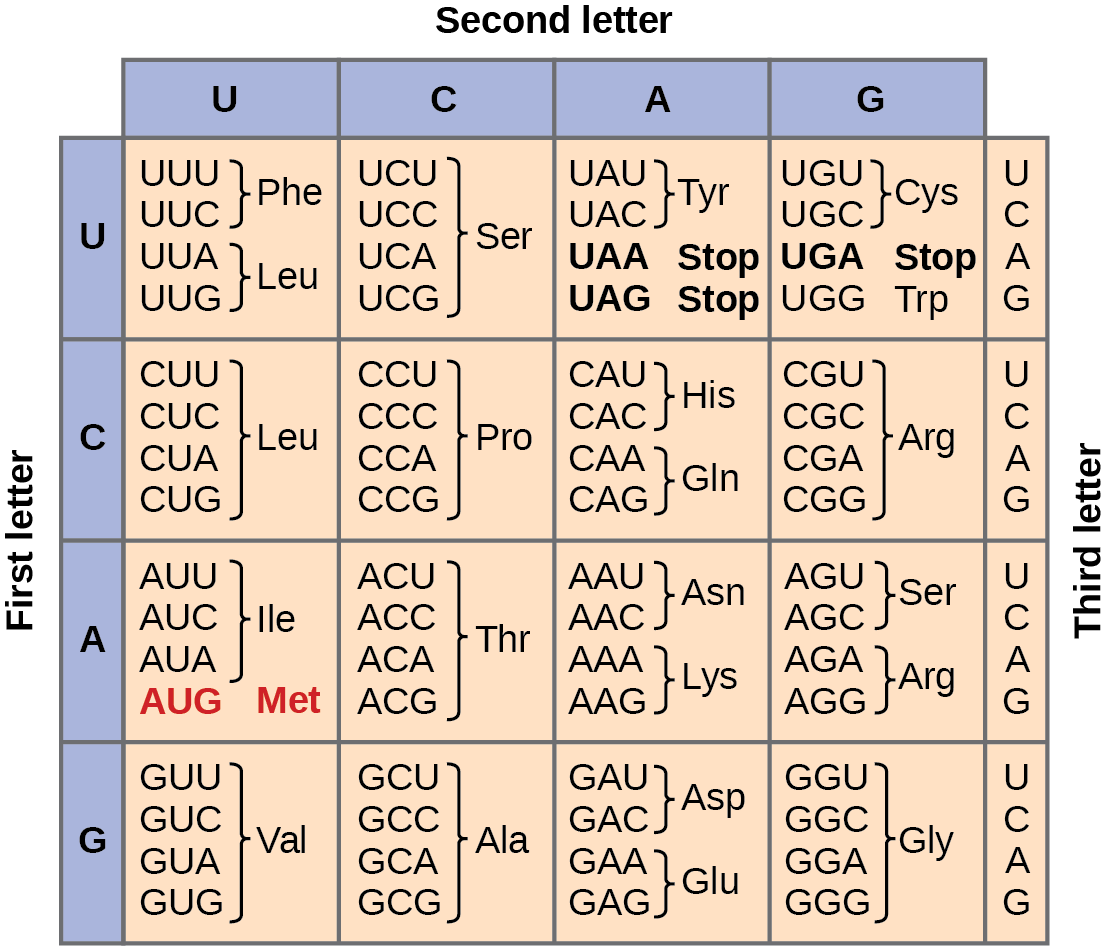
A triplet that pairs to an . The anticodon for 5′-AUG-3′ is aligned 3′-UAC-5′, or written 5′-CAU-3′.

Read explanation · NCBI Bookshelf / Garland Science ↗
Antiparallel

Running in opposite directions, as with two strands or neighboring strands in some .

Read explanation · OpenStax ↗
Apoptosis

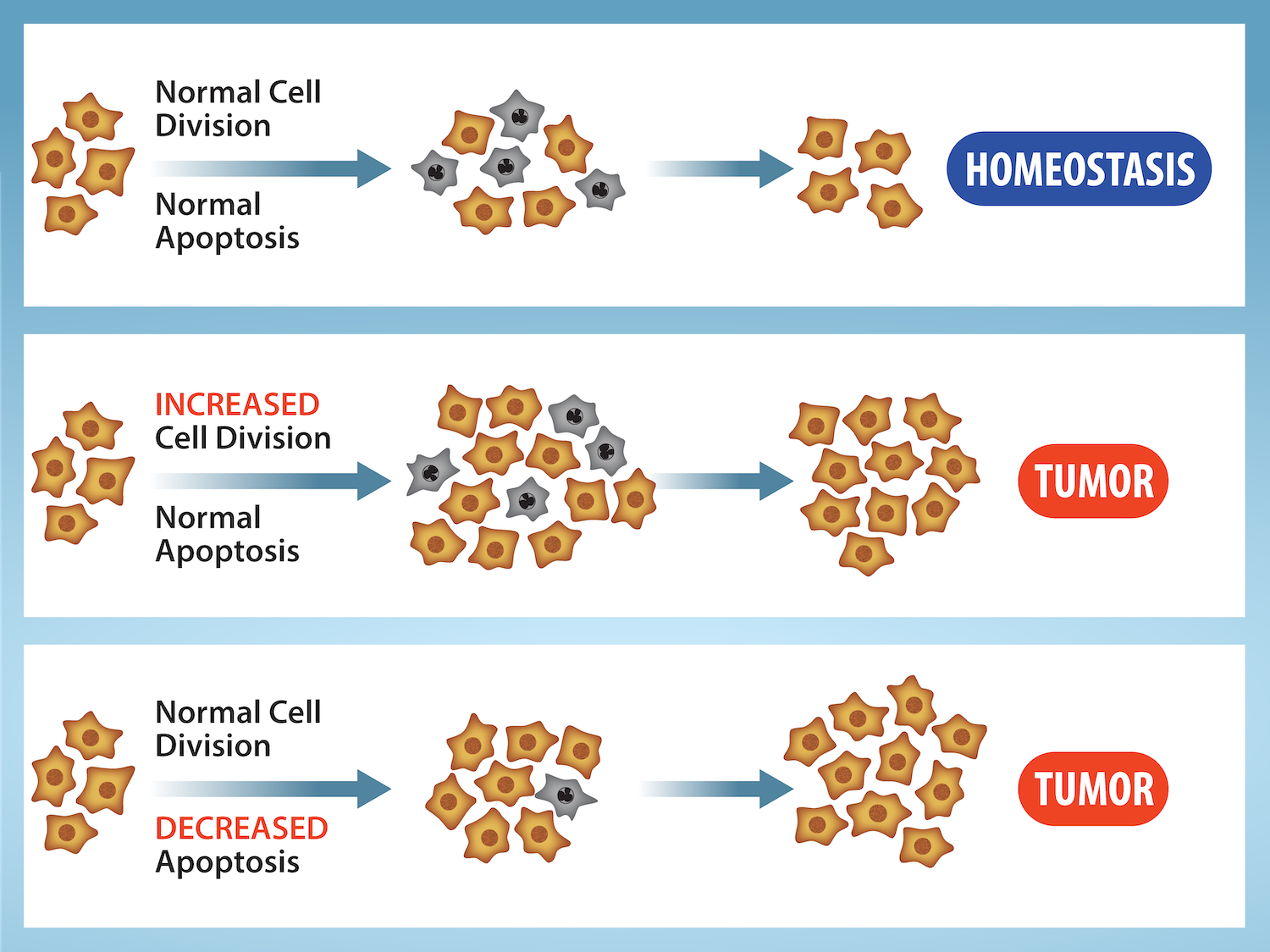
A regulated process of cell death that removes cells in development, tissue maintenance, and responses to damage.

Read explanation · OpenStax ↗
Aqueous solution ·

A in which water is the .

Read explanation · OpenStax ↗
Archaea ·

A of distinct from , with characteristic chemistry and -expression machinery.

Read explanation · OpenStax ↗
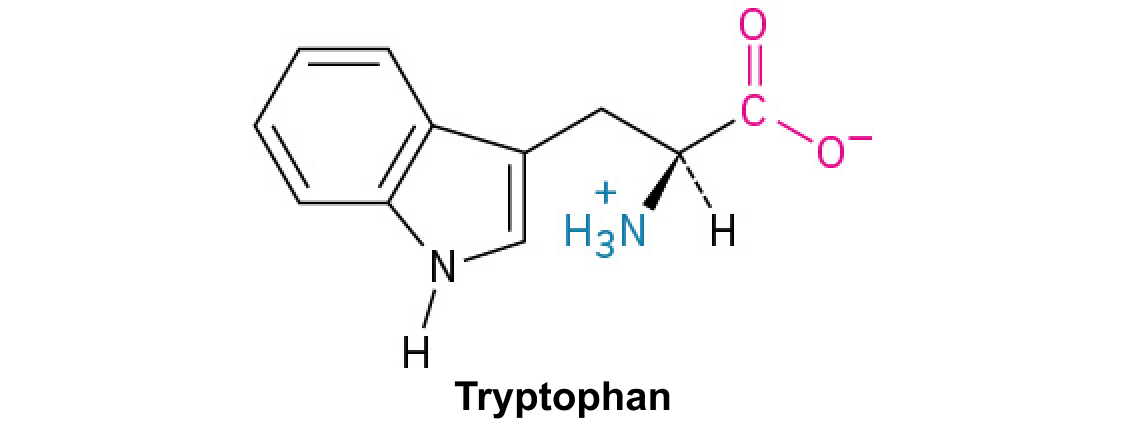
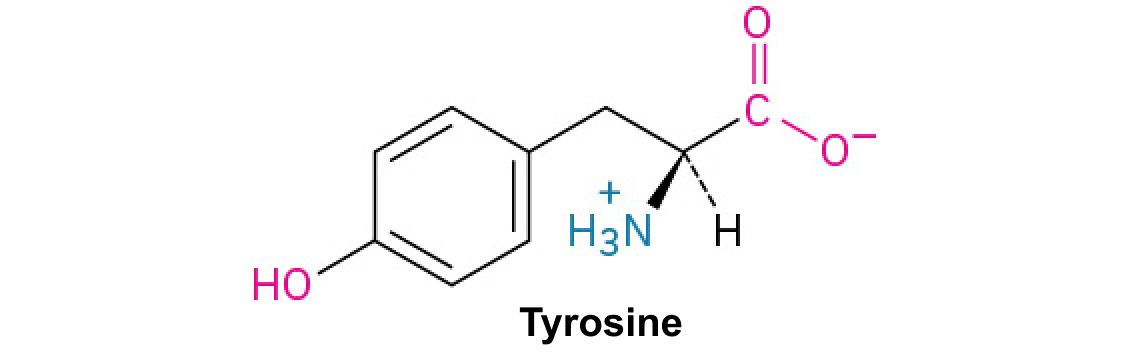
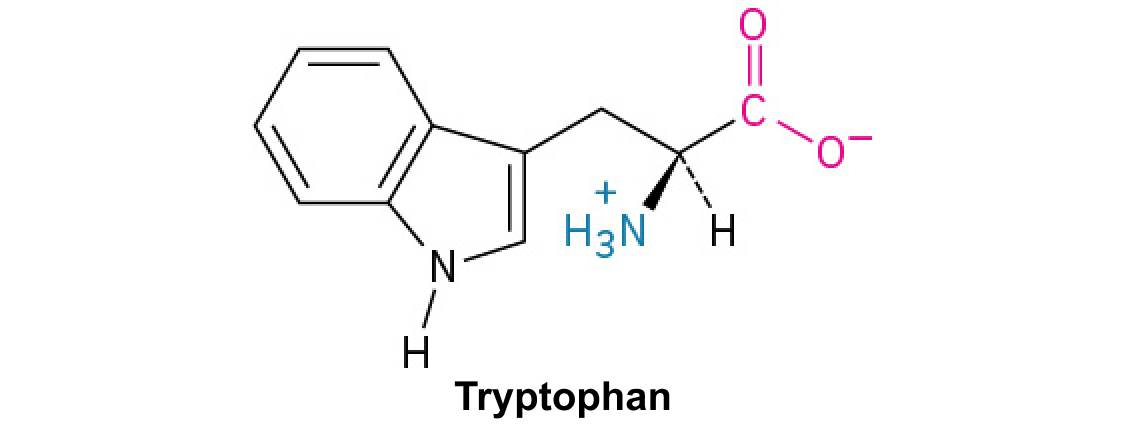
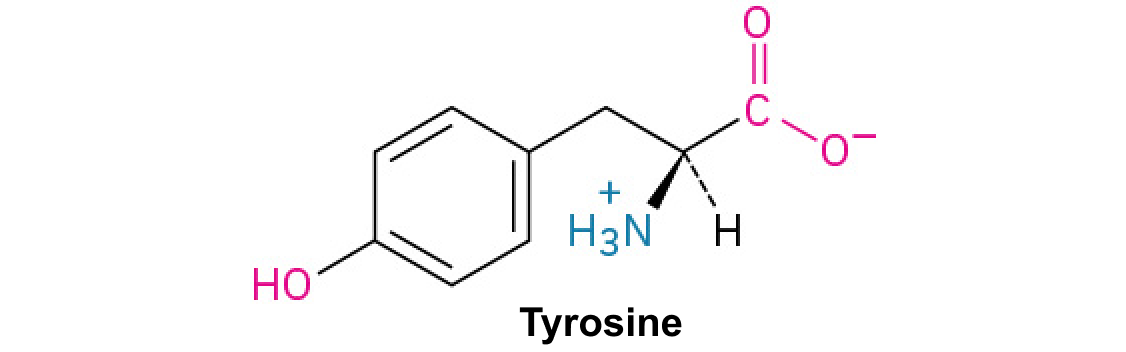
Aromatic

Containing a cyclic, with . , , and have aromatic .

Read explanation · OpenStax ↗
Atom

The smallest unit of an element that retains its chemical identity; it has a surrounded by .

Read explanation · OpenStax ↗
ATP synthase

A rotary that commonly uses to synthesize from ADP and .

Read explanation · OpenStax ↗
attachment

Enduring emotional bond and expectations about another’s availability and responsiveness.

Read explanation · OpenStax ↗
Bacteria ·

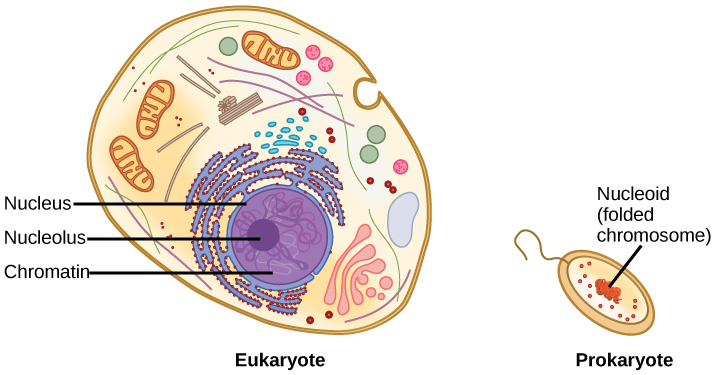
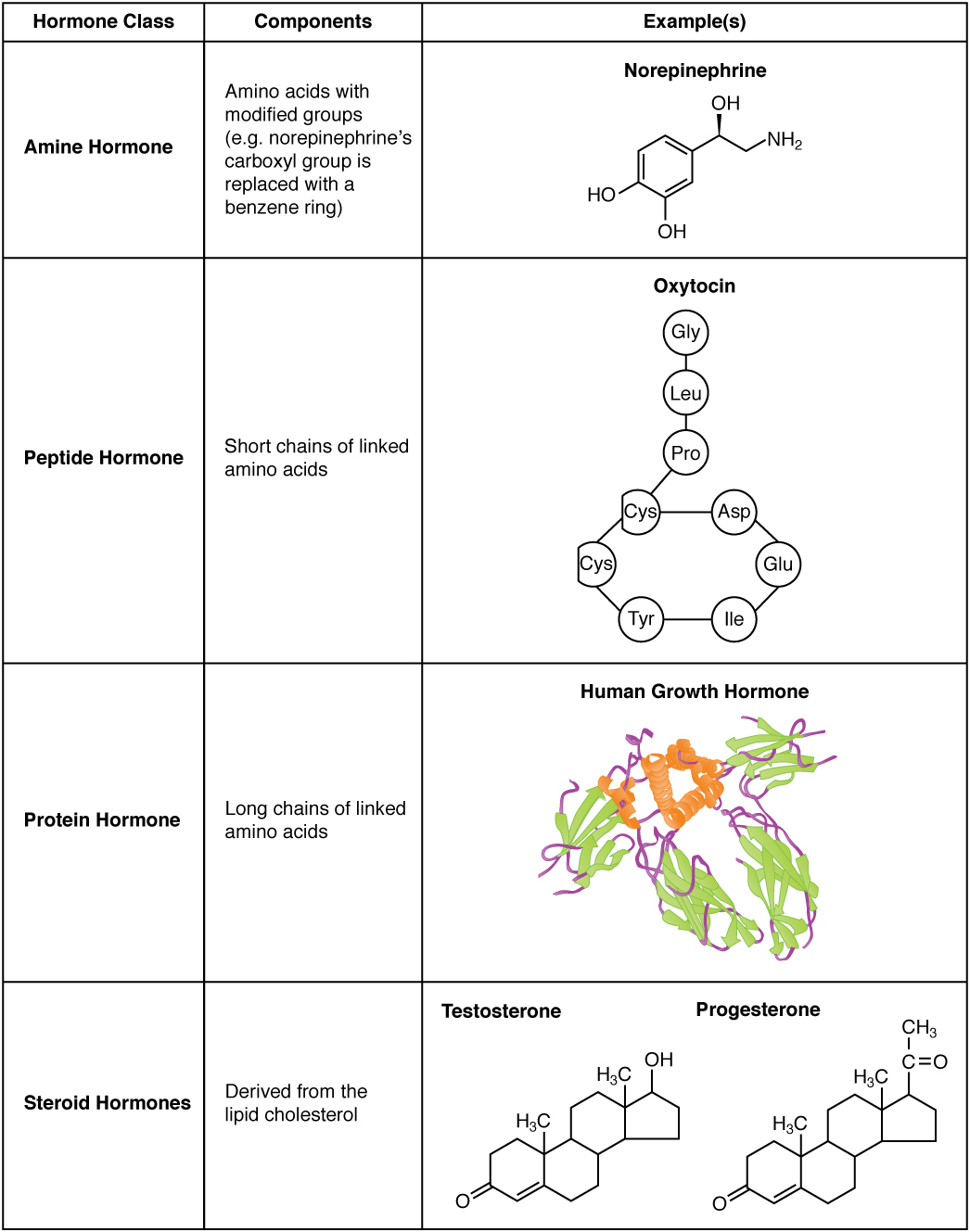
A of single-celled . Bacterial cells lack a -bound and are distinct from .

Read explanation · OpenStax ↗
Benzene ring

A six-carbon ring with .

Read explanation · OpenStax ↗
Benzyl group

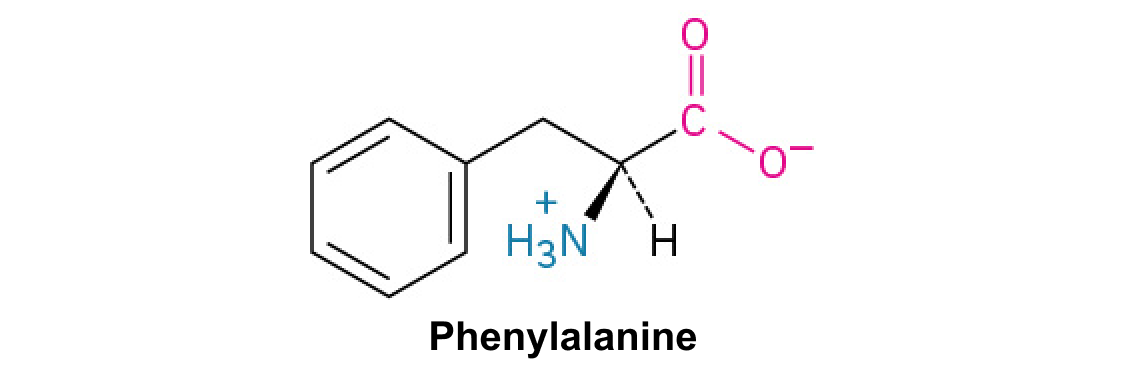
A attached through a –CH₂– group; part of ’s .

Read explanation · OpenStax ↗
Beta sheet · · · · · ·

A made of aligned segments connected by ; strands may be parallel or .

Read explanation · OpenStax ↗
Biomolecule

A made by or involved in living systems, including , , , and .

Read explanation · OpenStax ↗
Biosynthesis

Formation of biological through cellular , such as synthesis of .

Read explanation · OpenStax ↗
Blotting ·

Transfer of separated or to a so a specific target can be detected.

Read explanation · Thermo Fisher ↗
Branch point ·

An site, usually containing , whose 2′-OH participates in forming the during spliceosomal .

Read explanation · NCBI Bookshelf / Garland Science ↗
Brønsted–Lowry base · · · · · · · · · · ·

In the Brønsted–Lowry model, a substance that can accept a . Basic solutions have lower activity than water.

Read explanation · OpenStax ↗
Buffer ·

A that resists changes when small amounts of or are added, commonly through a weak and its .

Read explanation · OpenStax ↗
Calibration

Establishing the relation between a measured signal and known values or .

Read explanation · Agilent ↗
Carbohydrate

A class of including sugars and their , used for energy storage, structure, and recognition.

Read explanation · OpenStax ↗
Carbonyl group · ·

A carbon double-bonded to oxygen, C=O; present in and many other .

Read explanation · OpenStax ↗
Carboxyl group · ·

An , COOH. In free it is usually to COO⁻ near physiological .

Read explanation · OpenStax ↗
Catalyst · ·

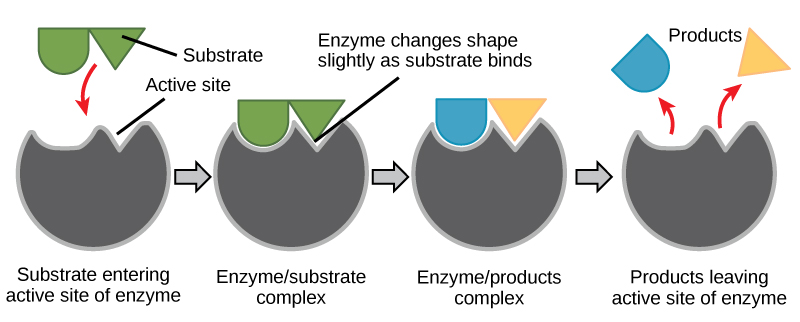
A substance that speeds a by providing a pathway with lower and is regenerated rather than consumed overall.

Read explanation · OpenStax ↗
Cellulose

A structural in plant cell walls, with beta-1,4 linkages; also used as a support.

Read explanation · OpenStax ↗
Centrifugation ·

Spinning a sample to accelerate separation of particles according to their behavior.

Read explanation · Beckman Coulter ↗
Chemical compound ·

A substance containing of two or more different chemically combined in a definite composition.

Read explanation · OpenStax ↗
Chemical element

A substance defined by having the same number of , such as carbon or oxygen.

Read explanation · OpenStax ↗
Chemical reaction ·

A process that rearranges and chemical bonds, converting into .

Read explanation · OpenStax ↗
chemiosmosis

Coupling of an ’s downhill movement across a to cellular work such as synthesis.

Read explanation · OpenStax ↗
cholesterol

An animal that modulates packing and serves as a precursor for and bile .

Read explanation · OpenStax ↗
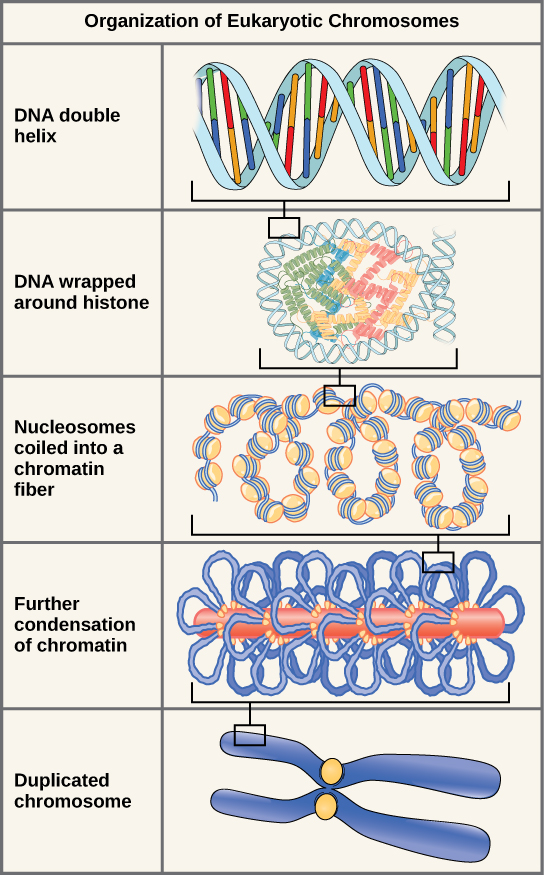
Chromatin

The complex of and associated , including , in .

Read explanation · OpenStax ↗
Chromatography

Separation of mixture components by their different interactions with a and a moving .

Read explanation · Waters ↗
Chromosome ·

An organized with associated that carries . A replicated chromosome has two .

Read explanation · OpenStax ↗
citric acid cycle ·

A cyclic pathway oxidizing acetyl units to CO2 while reducing carriers and regenerating .

Read explanation · OpenStax ↗
CoA

Coenzyme A, a -containing of activated acyl groups.

Read explanation · OpenStax ↗
Codon

A sequence of three that specifies an or a stop signal.

Read explanation · OpenStax ↗
Coenzyme

An organic that helps an catalyze a , often by carrying or chemical groups.

Read explanation · OpenStax ↗
coenzyme Q

A - respiratory transferring to complex III.

Read explanation · OpenStax ↗
Cofactor

A nonprotein component needed for an to work, such as a metal or an organic .

Read explanation · OpenStax ↗
Concentration

The amount of a substance in a specified volume or mass of mixture.

Read explanation · OpenStax ↗
Conformation ·

A spatial arrangement accessible by rotations and other motions that do not require breaking .

Read explanation · NCBI Bookshelf ↗
conjugate base

Species formed when an loses one .

Read explanation · OpenStax ↗
Conjugated system ·

Adjacent orbitals that allow to be distributed across several , often through alternating single and multiple bonds.

Read explanation · OpenStax ↗
Covalent bond · ·

A bond in which share pairs. and are covalent.

Read explanation · OpenStax ↗
cyanide

An of oxidase, respiratory complex IV.

Read explanation · OpenStax ↗
Cysteine ·

An with a . Two cysteines can form a .

Read explanation · OpenStax ↗
cytochrome

A heme-containing involved in transfer.

Read explanation · OpenStax ↗
cytochrome c

A small mobile heme carrying from respiratory complex III to IV and participating in when released into .

Read explanation · OpenStax ↗
Cytoplasm

Cell contents inside the plasma and outside the , where one is present.

Read explanation · OpenStax ↗
Cytosine

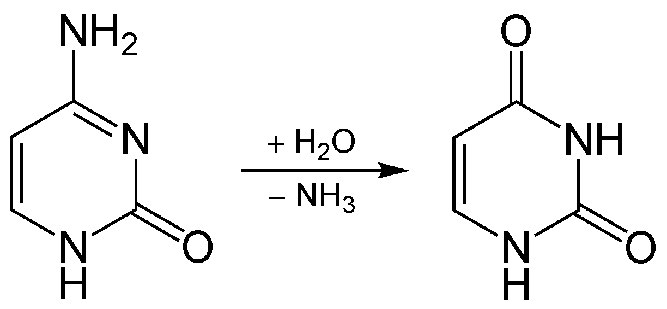
A in and that pairs with . can convert it to .

Read explanation · OpenStax ↗
Cytosol

The aqueous part of the outside -enclosed .

Read explanation · OpenStax ↗
Deamination

Removal of an . Deamination of produces and can change genetic information if unrepaired.

Read explanation · Biology LibreTexts / Oregon State University ↗
Density gradient

A fluid whose density varies with position, used to improve separation during .

Read explanation · Beckman Coulter ↗
Deoxyribonucleic acid

The that stores genetic information used to specify and sequences.

Read explanation · OpenStax ↗
Deprotonation

Removal of a from a or group; this changes its by minus one.

Read explanation · OpenStax ↗
Detergent

An substance that can associate with both water and material; detergents can disrupt or interactions.

Read explanation · Thermo Fisher ↗
Diffusion

Net spreading of particles down a due to random molecular motion.

Read explanation · OpenStax ↗
Dissociation · ·

Separation of a chemical species or molecular complex into smaller components; dissociation releases a .

Read explanation · OpenStax ↗
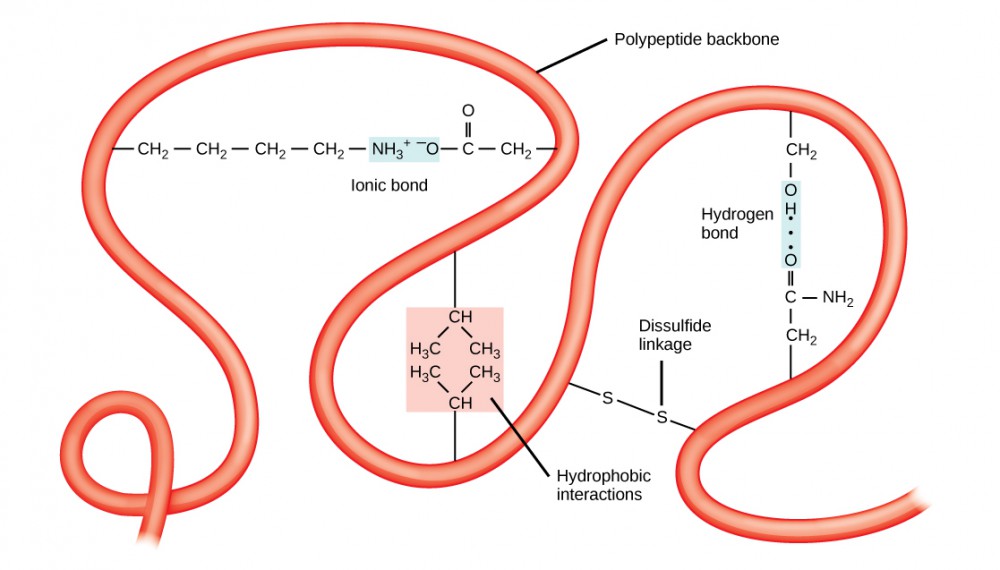
Disulfide bond · · ·

A covalent sulfur–sulfur bond formed by of two , which can stabilize structure.

Read explanation · NCBI Bookshelf ↗
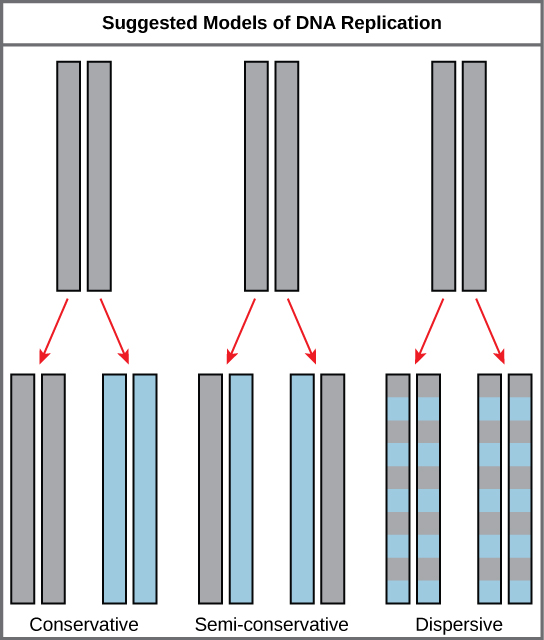
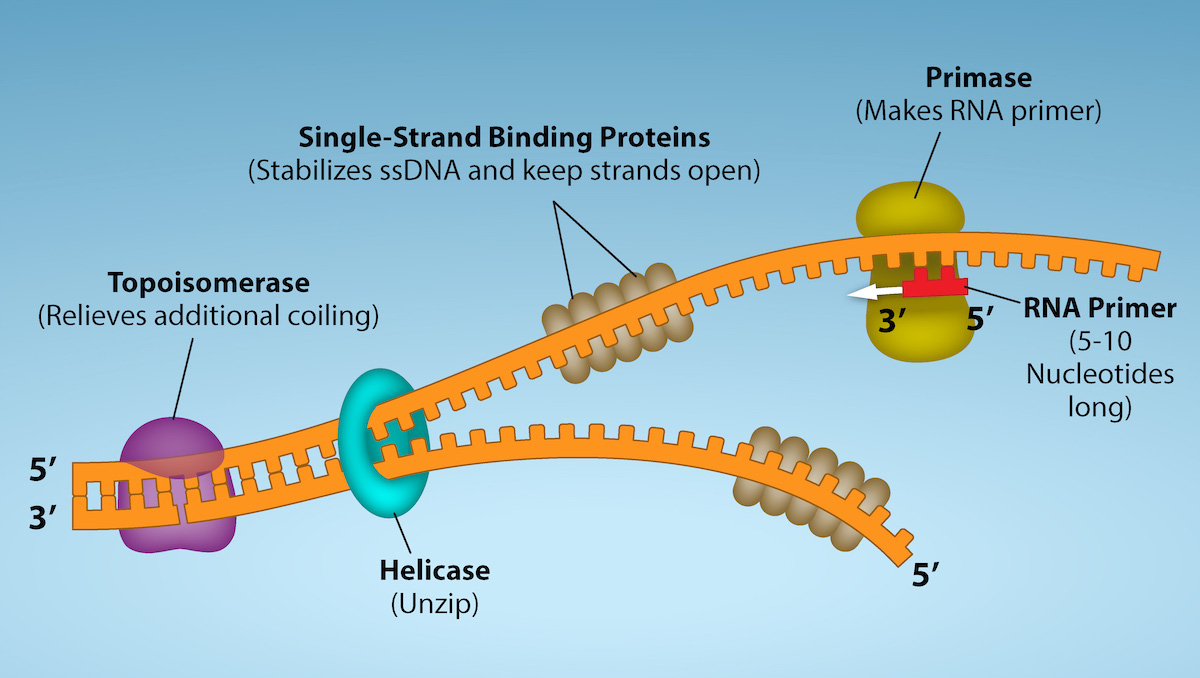
DNA replication

Copying so genetic information can be passed to daughter cells. Each guides a complementary new strand.

Read explanation · OpenStax ↗
Downstream

Later along a directed sequence or process; in , toward positions following a reference site in the direction of synthesis.

Read explanation · OpenStax ↗
Electric charge · · ·

An electrical property that can be positive or negative. Opposite charges attract and like charges repel; net charge is the sum of all charges on a particle.

Read explanation · OpenStax ↗
electrochemical gradient

The combined and electrical driving forces acting on an across space or a .

Read explanation · OpenStax ↗
Electron

A negatively subatomic particle. Electron sharing and transfer determine much of chemical bonding.

Read explanation · OpenStax ↗
Electron delocalization ·

Distribution of across several rather than confinement to one or bond.

Read explanation · OpenStax ↗
Electronegativity ·

An ’s tendency to attract shared in a chemical bond. Unequal attraction can make a bond .

Read explanation · OpenStax ↗
Electrostatic interaction · ·

Attraction between opposite electrical or repulsion between like .

Read explanation · OpenStax ↗
Endergonic

Having a positive under the stated conditions. Progress requires an energy input or coupling to a favorable process.

Read explanation · OpenStax ↗
Endothermic

Having a positive . The process absorbs heat at constant pressure when only pressure–volume work occurs.

Read explanation · OpenStax ↗
endpoint

Observed indicator or instrument change used to stop a .

Read explanation · OpenStax ↗
Enthalpy

A quantity whose change equals heat exchanged at constant pressure when only pressure–volume work occurs.

Read explanation · OpenStax ↗
Enthalpy change · ·

The difference in between and . At constant pressure with only pressure–volume work, it equals the heat transferred to the system.

Read explanation · OpenStax ↗
Entropy

A measure related to the number of accessible microscopic arrangements and the dispersal of energy.

Read explanation · OpenStax ↗
Enzyme

A biological that speeds a without being consumed. Most enzymes are .

Read explanation · OpenStax ↗
Enzyme inhibitor · ·

A substance that reduces activity. The binding mechanism and rate data determine whether inhibition is competitive, uncompetitive, mixed, or another type.

Read explanation · Biology LibreTexts ↗
Equilibrium

A state where opposing processes occur at equal rates, so macroscopic or other properties remain constant.

Read explanation · OpenStax ↗
Eukaryote ·

An organism whose cells have a -enclosed ; animals, plants, fungi, and protists are eukaryotes.

Read explanation · OpenStax ↗
Exergonic

Having a negative under the stated conditions. Such a is favorable but may require to proceed quickly.

Read explanation · OpenStax ↗
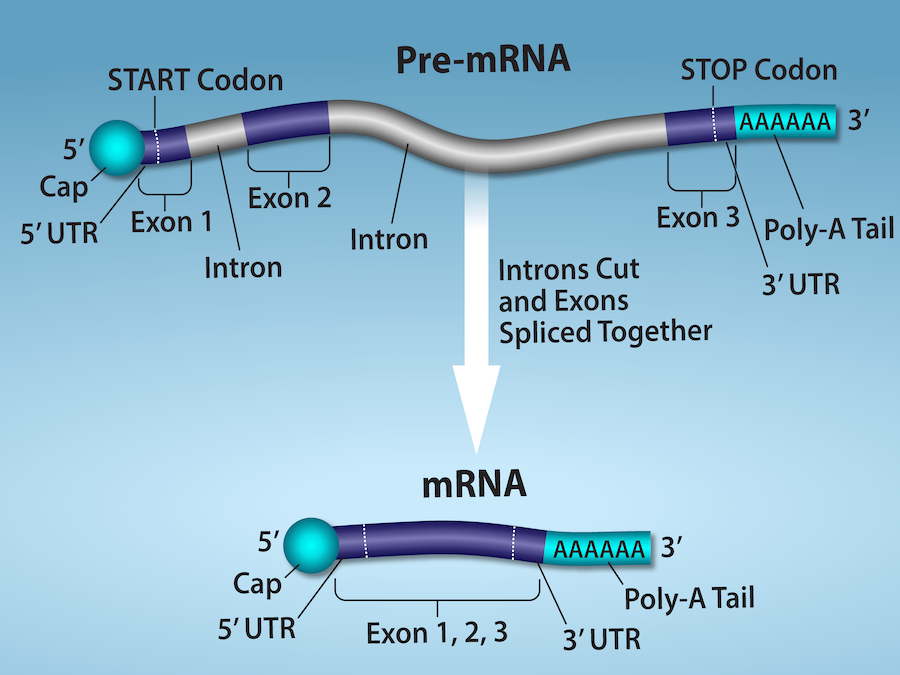
Exon

A segment retained in a mature spliced . In an exon may contain coding sequence, untranslated sequence, or both.

Read explanation · OpenStax ↗
FACT complex ·

A -associated complex that helps machinery traverse and supports reorganization.

Read explanation · OpenStax ↗
FAD

Flavin dinucleotide, often an -bound capable of one- or two- chemistry.

Read explanation · OpenStax ↗
FADH2

The two--reduced form of ; its respiratory equivalents generally enter of complex I.

Read explanation · OpenStax ↗
Fatty acid

A attached to a chain; fatty acids are components of many .

Read explanation · OpenStax ↗
FMN

Flavin mononucleotide, a redox used in respiratory complex I.

Read explanation · OpenStax ↗
Functional group

A group of whose chemical behavior gives a characteristic and properties.

Read explanation · OpenStax ↗
Gene

A sequence that contributes to a functional or , together with the information needed to express it.

Read explanation · OpenStax ↗
Gene expression

Production of a functional from a , including and, for -coding , .

Read explanation · NCBI Bookshelf ↗
Genome

The complete genetic material of an organism or cell.

Read explanation · OpenStax ↗
Gibbs free energy · ·

A quantity used to predict whether a process is favorable at constant temperature and pressure. A negative change favors the forward process.

Read explanation · OpenStax ↗
Gibbs free energy change · ·

The change in during a process. At constant temperature and pressure, a negative value favors the forward under the stated conditions; it does not specify speed.

Read explanation · OpenStax ↗
gluconeogenesis

Synthesis of from noncarbohydrate precursors, using bypass for irreversible glycolytic steps.

Read explanation · Biology LibreTexts / Oregon State University ↗
Glucose

A six-carbon sugar that is a major cellular energy source and a building block of , , and .

Read explanation · OpenStax ↗
Glycerol

A three-carbon alcohol with three ; used in sample to increase density and in some .

Read explanation · OpenStax ↗
glycogen

A highly branched used for storage in animals.

Read explanation · Biology LibreTexts / Oregon State University ↗
glycolysis

A pathway converting to with net production of and .

Read explanation · Biology LibreTexts / Oregon State University ↗
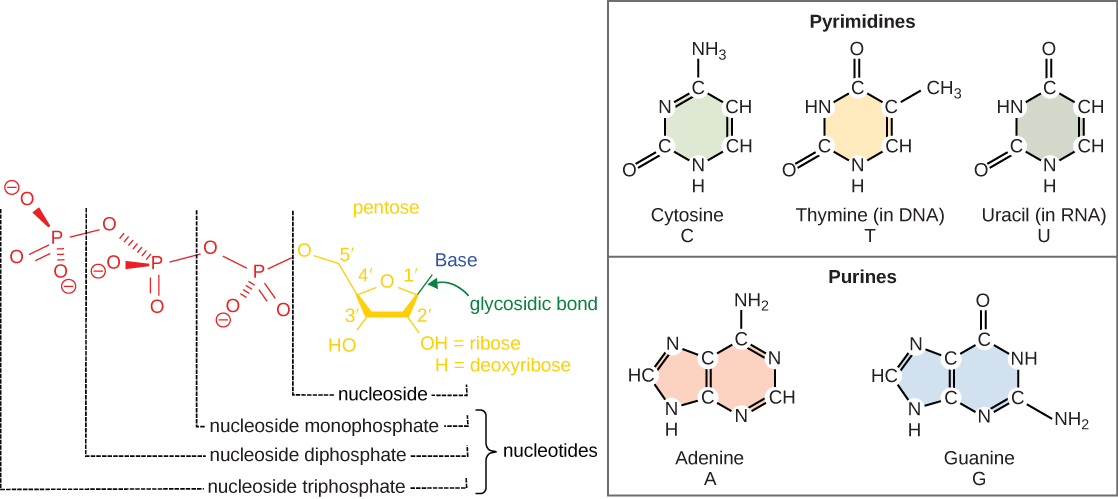
Glycosidic bond

A involving a sugar’s . In a , an N-glycosidic bond links the sugar to the .

Read explanation · Biology LibreTexts / Oregon State University ↗
Gradient

A change in a quantity, such as , , or density, across a distance or over time.

Read explanation · Thermo Fisher ↗
Guanine

A that pairs with through three .

Read explanation · OpenStax ↗
harmonic

Mode whose frequency is an integer multiple of a fundamental frequency.

Read explanation · OpenStax ↗
hemiacetal

Carbon bonded to both and alkoxy groups, usually formed by alcohol addition to a .

Read explanation · OpenStax ↗
Hemoglobin

The oxygen-carrying in , composed of four with heme groups.

Read explanation · OpenStax ↗
Histone

A -associated rich in . Core histones form the around which nucleosomal wraps.

Read explanation · OpenStax ↗
Hormone

A chemical messenger released by cells that changes the activity of target cells with matching .

Read explanation · OpenStax ↗
hydride

Formally H⁻; hydride-transfer reagents or deliver a hydrogen with an pair.

Read explanation · OpenStax ↗
Hydrocarbon · ·

A made only of carbon and hydrogen. Hydrocarbon regions are generally .

Read explanation · OpenStax ↗
Hydrogen bond ·

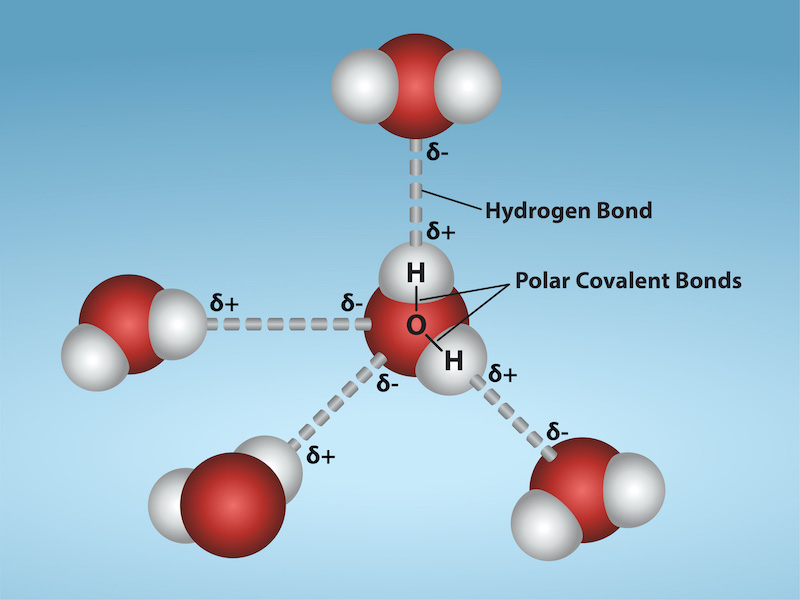
An attraction between a hydrogen bonded to an and another . hydrogen bonds stabilize .

Read explanation · OpenStax ↗
Hydrogen ion · ·

A positively hydrogen species. H⁺ denotes a , which is hydrated in water; its activity determines .

Read explanation · OpenStax ↗
Hydrolysis

Breaking a chemical bond by adding water. hydrolysis separates .

Read explanation · OpenStax ↗
Hydrophilic

Interacting favorably with water, typically because a group is or .

Read explanation · OpenStax ↗
Hydrophobic

Interacting poorly with water. often gather in a ’s interior.

Read explanation · OpenStax ↗
Hydroxide ion ·

The negatively OH⁻. Basic contain a higher hydroxide ion activity than water at the same temperature.

Read explanation · OpenStax ↗
Hydroxyl group ·

An oxygen bonded to hydrogen, –OH. Hydroxyl groups can and often increase .

Read explanation · OpenStax ↗
Indole

A fused six-membered and five-membered ring system containing nitrogen; found in .

Read explanation · OpenStax ↗
Integral membrane protein

A embedded in a , often with one or more -spanning regions.

Read explanation · OpenStax ↗
Intron ·

A segment removed from a precursor during . Intronic signals or regulatory sequences can affect .

Read explanation · OpenStax ↗
Ion · ·

An or with a net because its numbers of and do not balance.

Read explanation · OpenStax ↗
Kilojoule ·

A unit of energy equal to 1,000 joules. Energy changes are often reported per , in kJ/mol.

Read explanation · NIST ↗
Kinetic energy

Energy associated with motion; higher temperature generally increases average molecular kinetic energy.

Read explanation · OpenStax ↗
Kinetics

The study of and the factors and mechanisms that control them. A favorable may still proceed slowly.

Read explanation · OpenStax ↗
Lariat ·

The branched, loop-shaped intermediate formed when an ’s joins the .

Read explanation · NCBI Bookshelf / Garland Science ↗
linkage

A tendency of nearby on the same to be inherited together.

Read explanation · OpenStax ↗
Lipid

A broad class of largely or , including fats, , and steroids.

Read explanation · OpenStax ↗
locus

The specific position of a or other feature.

Read explanation · OpenStax ↗
Logarithm · · ·

The exponent needed to obtain a number from a chosen fixed number. For decimal logarithms, log₁₀(100) = 2 because 10² = 100; uses the negative decimal logarithm of activity.

Read explanation · OpenStax ↗
Lysosome

An -enclosed compartment that uses hydrolytic to digest and recycle cellular material.

Read explanation · OpenStax ↗
Macromolecule

A large , such as a , , or polysaccharide.

Read explanation · OpenStax ↗
Matrix

A supporting material, such as a gel or the solid support in a column. Its properties influence movement and binding of sample .

Read explanation · Thermo Fisher ↗
Membrane · · · ·

A thin boundary or sheet. Cell membranes are bilayers containing ; membranes are synthetic supports that hold or for detection.

Read explanation · OpenStax ↗
Messenger RNA ·

An that carries coding information used by to synthesize a .

Read explanation · OpenStax ↗
Metabolism

The chemical that build , break them down, and transform energy in a living system.

Read explanation · OpenStax ↗
Methyl group ·

A –CH₃ group, consisting of one carbon bonded to three hydrogens.

Read explanation · OpenStax ↗
Mitochondrion ·

A with its own , central to aerobic production and several other processes.

Read explanation · OpenStax ↗
Mobile phase

The moving fluid that carries a sample through a system.

Read explanation · Waters ↗
mole

Amount containing exactly 6.02214076 × 10²³ specified entities.

Read explanation · OpenStax ↗
Molecular chaperone · ·

A that assists other in folding or prevents , without specifying their sequence.

Read explanation · NCBI Bookshelf ↗
Molecule

Two or more joined by . A molecule may be electrically or carry a .

Read explanation · OpenStax ↗
NAD+

nicotinamide dinucleotide, a that accepts a equivalent to become .

Read explanation · OpenStax ↗
NADH

Reduced nicotinamide dinucleotide, commonly carrying fuel-derived toward respiratory .

Read explanation · OpenStax ↗
NADP+

The -containing nicotinamide reduced to ; distinguish it from .

Read explanation · OpenStax ↗
NADPH

A reduced commonly used in reductive and antioxidant defense.

Read explanation · OpenStax ↗
Neutral

Having no net . For a , neutral instead means equal and activities; its is about 7 at 25 °C.

Read explanation · OpenStax ↗
Nitrogenous base · · ·

A nitrogen-containing ring component of ; its pairing interactions help specify sequences.

Read explanation · OpenStax ↗
Nonessential amino acid ·

An the body can normally synthesize. Some become conditionally essential during growth or illness.

Read explanation · OpenStax ↗
Nonpolar ·

Lacking a substantial separation of . Nonpolar groups generally interact poorly with water.

Read explanation · OpenStax ↗
Nucleic acid

A of , such as or , used in information storage, expression, and other cellular functions.

Read explanation · OpenStax ↗
Nucleoside

A joined to a sugar, without a .

Read explanation · OpenStax ↗
Nucleosome

The basic unit of : wrapped around a .

Read explanation · OpenStax ↗
Nucleotide

A joined to a sugar and one or more .

Read explanation · OpenStax ↗
Nucleus ·

A -enclosed compartment containing most of a cell’s .

Read explanation · OpenStax ↗
Octamer

A complex made of eight . A core contains eight .

Read explanation · OpenStax ↗
Organelle ·

A specialized structure within a cell that carries out particular functions, such as a or .

Read explanation · OpenStax ↗
oxaloacetate

A four-carbon citric-cycle intermediate that condenses with and participates in .

Read explanation · OpenStax ↗
Oxidation ·

Loss of or an increase in oxidation state. Oxidizing two can form a .

Read explanation · OpenStax ↗
oxidative phosphorylation

synthesis driven by a generated through respiratory transfer.

Read explanation · OpenStax ↗
oxidoreductase

An catalyzing an – .

Read explanation · OpenStax ↗
Peptide

A chain of joined by ; the term commonly describes chains shorter than a typical .

Read explanation · OpenStax ↗
Peptide bond ·

A covalent between the carboxyl carbon of one and the amino nitrogen of the next.

Read explanation · OpenStax ↗
pH

A measure of , defined as the negative of activity. Lower pH means greater ; pH influences .

Read explanation · OpenStax ↗
Phenylalanine ·

A with an .

Read explanation · OpenStax ↗
Phosphate group ·

A phosphorus-containing group bonded to oxygens; phosphate groups occur in , , and modified .

Read explanation · OpenStax ↗
Phospholipid

An with a -containing region and tails; a major component of cellular .

Read explanation · OpenStax ↗
Phosphorylation

Addition of a , often to , , or in ; can regulate activity.

Read explanation · Thermo Fisher ↗
Polar

Having an uneven distribution of . Polar groups often interact favorably with water.

Read explanation · OpenStax ↗
Polymer

A large made from many linked molecular building blocks.

Read explanation · OpenStax ↗
Polypeptide

A chain of connected by . A functional can contain one or several such chains.

Read explanation · OpenStax ↗
Porous material · · · ·

A material containing small spaces that can admit of suitable size.

Read explanation · Cytiva ↗
Potential energy

Stored energy associated with position or molecular arrangement.

Read explanation · OpenStax ↗
Prokaryote ·

An organism whose cells lack a -bound ; and are prokaryotes.

Read explanation · OpenStax ↗
Proline ·

An whose loops back to the nitrogen, restricting rotation and often creating bends.

Read explanation · OpenStax ↗
prosthetic group

Nonprotein component tightly associated with a and required for its function.

Read explanation · OpenStax ↗
Protein

One or more folded chains that perform biological roles such as , transport, signaling, or structural support.

Read explanation · OpenStax ↗
Protein aggregation · ·

Association of into larger clusters, often when exposed surfaces of unfolded stick together.

Read explanation · NCBI Bookshelf ↗
Protein backbone ·

The repeating nitrogen–alpha-carbon– chain of a , excluding its variable .

Read explanation · OpenStax ↗
Protein domain · ·

A region of a that forms a recognizable structural or functional unit.

Read explanation · OpenStax ↗
Proton

A positively subatomic particle. In – chemistry, donating a proton means transferring a .

Read explanation · OpenStax ↗
proton-motive force

The combined chemical and electrical driving force for movement across a .

Read explanation · OpenStax ↗
Protonation

Addition of a to an , , or ; this changes its by plus one.

Read explanation · OpenStax ↗
Purine · ·

A with two fused rings. and are purines.

Read explanation · OpenStax ↗
Pyrimidine · ·

A with one six-membered ring. , , and are pyrimidines.

Read explanation · OpenStax ↗
Pyrophosphate ·

Two linked together; released when a is incorporated into or . Its helps drive polymerization.

Read explanation · OpenStax ↗
pyruvate

A three-carbon α-keto produced by and serving as a in .

Read explanation · Biology LibreTexts / Oregon State University ↗
Quantification · ·

Estimating the amount or of a substance from measured signals and suitable or .

Read explanation · Waters ↗
R group · ·

The variable side chain attached to an ’s . It determines identity, , , and chemical behavior.

Read explanation · OpenStax ↗
Reactant

A starting substance transformed during a .

Read explanation · OpenStax ↗
Reaction intermediate · ·

A species formed in one step and consumed in another. It occupies a local energy minimum between .

Read explanation · OpenStax ↗
Reaction product ·

A substance formed by a .

Read explanation · OpenStax ↗
reaction quotient

-to- activity ratio with stoichiometric exponents at the current composition.

Read explanation · OpenStax ↗
Reaction rate · ·

How quickly are consumed or form, usually expressed as a change per unit time.

Read explanation · OpenStax ↗
Receptor

A that recognizes a particular signal and helps produce a cellular response.

Read explanation · OpenStax ↗
Red blood cell · ·

A blood cell that transports oxygen using ; mature human red blood cells lack a .

Read explanation · OpenStax ↗
Reduction

Gain of or a decrease in state. Reducing a restores two .

Read explanation · OpenStax ↗
resonance

Large driven response near a system’s natural frequency.

Read explanation · OpenStax ↗
Ribonucleic acid ·

A with roles in , regulation, and ; carries -coding information.

Read explanation · OpenStax ↗
Ribose

The five-carbon sugar in , with a at the 2′ carbon.

Read explanation · OpenStax ↗
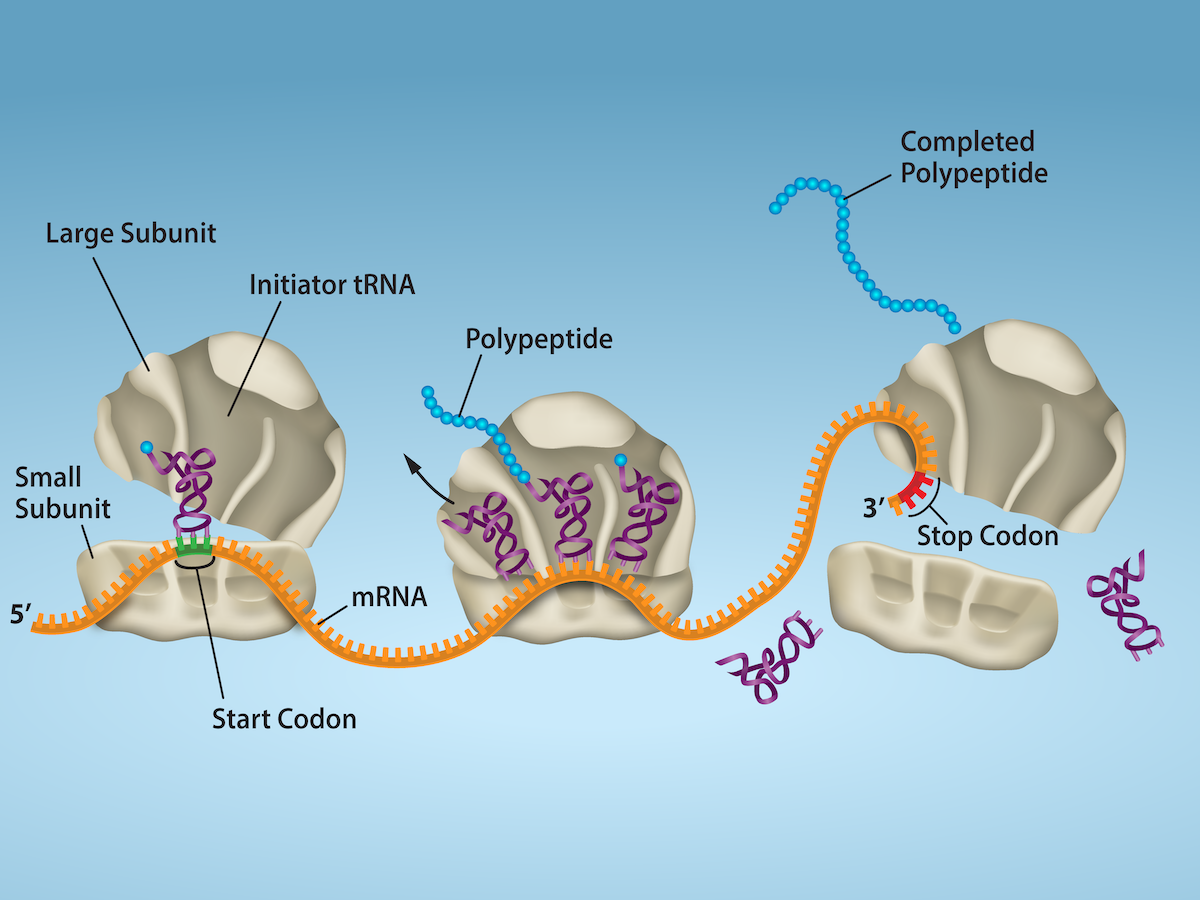
Ribosome ·

A complex of and that translates into a .

Read explanation · OpenStax ↗
RNA splicing · ·

Removal of and joining of in a precursor .

Read explanation · NCBI Bookshelf / Garland Science ↗
Secondary structure

Local folding, such as and , stabilized mainly by .

Read explanation · OpenStax ↗
Sedimentation ·

Movement of particles through a fluid under gravity or centrifugal .

Read explanation · Beckman Coulter ↗
Serine ·

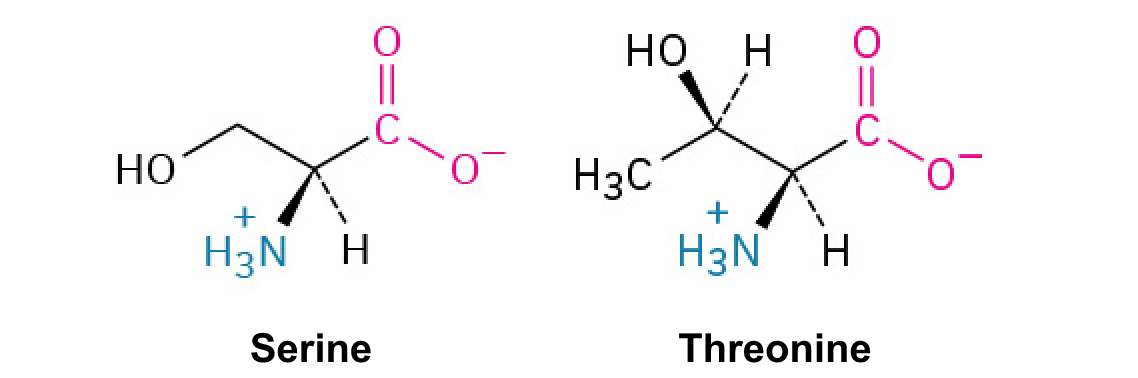
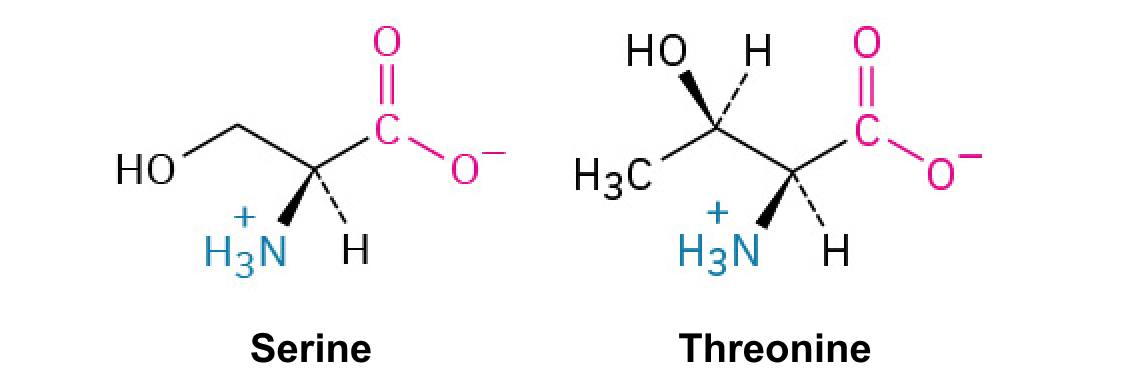
A , uncharged with a -containing .

Read explanation · OpenStax ↗
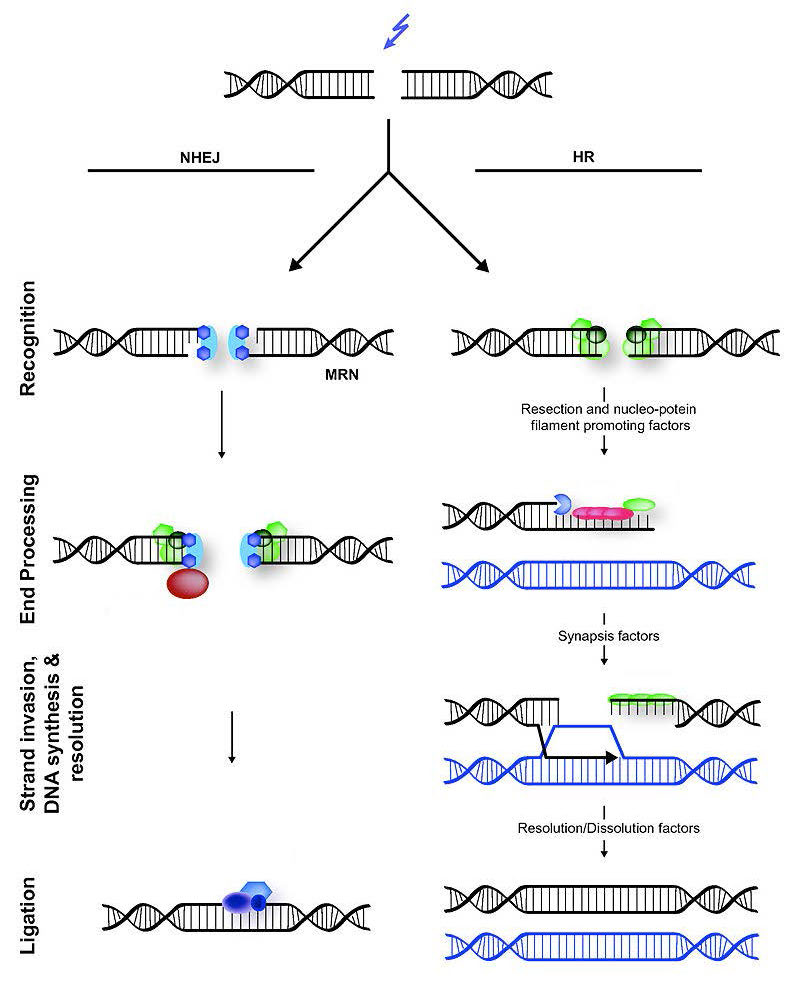
Sister chromatid

One of the two copies of a produced by . An intact sister chromatid can supply a template for accurate repair.

Read explanation · Biology LibreTexts / Oregon State University ↗
sodium–potassium ATPase ·

The -driven pump exporting three Na+ and importing two K+ per cycle.

Read explanation · OpenStax ↗
Solubility ·

The amount of a substance that can dissolve in a under specified conditions. Soluble means able to dissolve; insoluble means only very slightly soluble in that .

Read explanation · OpenStax ↗
Solute

A dissolved component of a .

Read explanation · OpenStax ↗
Solution

A homogeneous mixture in which are dissolved in a .

Read explanation · OpenStax ↗
Solvent

The component of a that dissolves other substances, usually the component present in the greatest amount.

Read explanation · OpenStax ↗
standard Gibbs energy change

Gibbs energy change for a under specified standard-state conditions.

Read explanation · OpenStax ↗
Starch

A plant storage made of chains; its two main forms are and amylopectin.

Read explanation · OpenStax ↗
Stationary phase

The material that remains fixed in a system.

Read explanation · Waters ↗
steroid hormone

A -derived with fused-ring structure, commonly acting through intracellular .

Read explanation · OpenStax ↗
sterol

A containing fused rings and a ; is a major animal example.

Read explanation · OpenStax ↗
Substrate

A that an binds and chemically transforms.

Read explanation · OpenStax ↗
Subunit ·

An individual chain within a containing multiple chains.

Read explanation · OpenStax ↗
Template strand · · ·

A preexisting strand whose sequence guides complementary nucleic- synthesis.

Read explanation · OpenStax ↗
Thermodynamics ·

The study of energy, , and . It helps determine whether a process is favorable, while concerns how fast it occurs.

Read explanation · OpenStax ↗
Thiol group · · · ·

A sulfur bonded to hydrogen, –SH. thiols can form through .

Read explanation · OpenStax ↗
Threonine ·

A , uncharged with a and a on its .

Read explanation · OpenStax ↗
Thymine

A normally used in ; it pairs with through two .

Read explanation · OpenStax ↗
Titration

Gradually adding a of known to another to measure its amount or – behavior.

Read explanation · OpenStax ↗
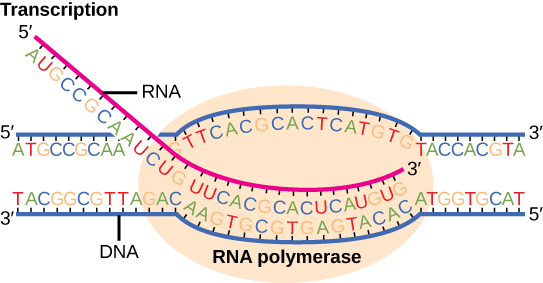
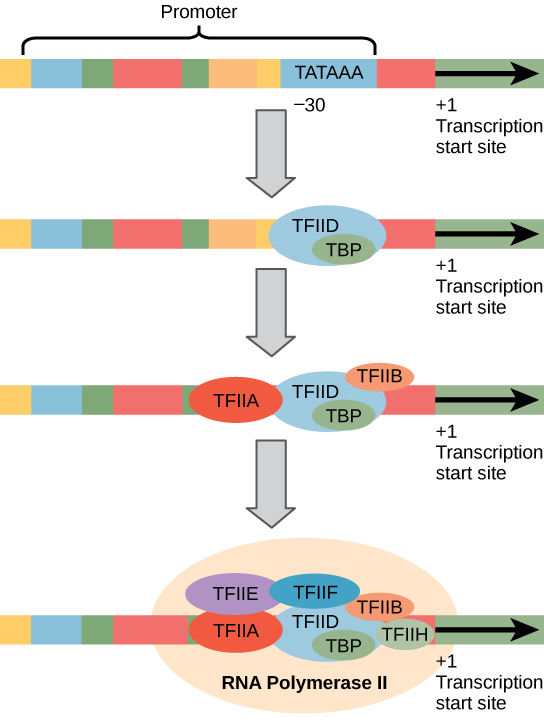
Transcription

Synthesis of using a template.

Read explanation · OpenStax ↗
Transfer RNA ·

An adaptor that carries an and pairs its with a on .

Read explanation · OpenStax ↗
Transition state

A fleeting, high-energy arrangement at a barrier. It is an energy maximum along the path, rather than a stable .

Read explanation · OpenStax ↗
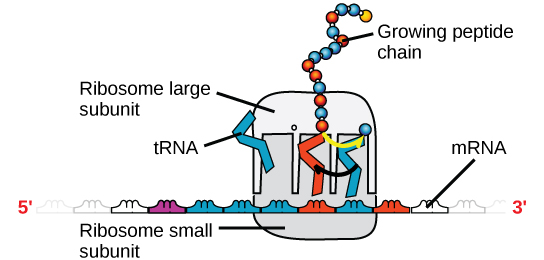
Translation ·

Synthesis of a on a using the sequence of in .

Read explanation · OpenStax ↗
triacylglycerol · ·

A esterified to three ; a major energy-storage .

Read explanation · Biology LibreTexts / Oregon State University ↗
tRNA charging

of an to a by an . is converted to and .

Read explanation · OpenStax ↗
Tryptophan ·

An with a bulky ; commonly grouped as .

Read explanation · OpenStax ↗
Tyrosine ·

An with a phenolic . Usually uncharged near physiological .

Read explanation · OpenStax ↗
uncoupler ·

An agent that dissipates respiratory , reducing coupling between transport and synthesis.

Read explanation · OpenStax ↗
Uracil

A normally used in in place of . Uracil produced by in is a repair target.

Read explanation · OpenStax ↗
velocity

Rate of change of position, including direction.

Read explanation · OpenStax ↗

6.2 Potential, Kinetic, Free, and Activation Energy

OpenStax · 6.2 Potential, Kinetic, Free, and Activation Energy ↗
Instructional page including learning objectives, examples, figures, source tables and questions. Site navigation and embedded media players are omitted; source media links remain available.

Learning Objectives

By the end of this section, you will be able to do the following:

We define energy as the ability to do work. As you’ve learned, energy exists in different forms. For example, electrical energy, light energy, and heat energy are all different energy types. While these are all familiar energy types that one can see or feel, there is another energy type that is much less tangible. Scientists associate this energy with something as simple as an object above the ground. In order to appreciate the way energy flows into and out of biological systems, it is important to understand more about the different energy types that exist in the physical world.

Energy Types

When an object is in motion, there is energy. For example, an airplane in flight produces considerable energy. This is because moving objects are capable of enacting a change, or doing work. Think of a wrecking ball. Even a slow-moving wrecking ball can do considerable damage to other objects. However, a wrecking ball that is not in motion is incapable of performing work. Energy with objects in motion is . A speeding bullet, a walking person, rapid movement in the air (which produces heat), and electromagnetic radiation like light all have .

What if we lift that same motionless wrecking ball two stories above a car with a crane? If the suspended wrecking ball is unmoving, can we associate energy with it? The answer is yes. The suspended wrecking ball has associated energy that is fundamentally different from the of objects in motion. This energy form results from the potential for the wrecking ball to do work. If we release the ball it would do work. Because this energy type refers to the potential to do work, we call it . Objects transfer their energy between and potential in the following way: As the wrecking ball hangs motionless, it has 0 and 100 percent . Once it releases, its begins to increase because it builds speed due to gravity. Simultaneously, as it nears the ground, it loses . Somewhere mid-fall it has 50 percent and 50 percent . Just before it hits the ground, the ball has nearly lost its and has near-maximal . Other examples of include water's energy held behind a dam (Figure 6.6), or a person about to skydive from an airplane.

The photo on the left shows a river that is blocked by a giant cement wall, called a dam. The photo on the right shows a waterfall.
Figure 6.6 — 6.2 Potential, , Free, and

Figure 6.6 Water behind a dam has potential energy. Moving water, such as in a waterfall or a rapidly flowing river, has kinetic energy. (credit “dam”: modification of work by "Pascal"/Flickr; credit “waterfall”: modification of work by Frank Gualtieri)

Mary Ann Clark, Matthew Douglas, and Jung Choi, Biology 2E, OpenStax. (credit “dam”: modification of work by "Pascal"/Flickr; credit “waterfall”: modification of work by Frank Gualtieri) · CC BY-NC-SA 4.0 · Original image ↗ · Access for free ↗

We associate not only with the matter's location (such as a child sitting on a tree branch), but also with the matter's structure. A spring on the ground has if it is compressed; so does a tautly pulled rubber band. The very existence of living cells relies heavily on structural . On a chemical level, the bonds that hold the ' together have . Remember that anabolic cellular pathways require energy to synthesize complex from simpler ones, and catabolic pathways release energy when complex break down. That certain chemical bonds' breakdown can release energy implies that those bonds have . In , there is stored within the bonds of all the food we eat, which we eventually harness for use. This is because these bonds can release energy when broken. Scientists call the type that exists within chemical bonds that releases when those bonds break chemical energy (Figure 6.7). Chemical energy is responsible for providing living cells with energy from food. Breaking the molecular bonds within fuel brings about the energy's release.

The molecular formula of octane (top), which is a chain of eight carbons and eighteen hydrogens, fuels a racecar speeding along a track (bottom).
Figure 6.7 — 6.2 Potential, , Free, and

Figure 6.7 The molecules in gasoline contain chemical energy within the chemical bonds. This energy transforms into kinetic energy that allows a car to race on a racetrack. (credit “car”: modification of work by Russell Trow)

Mary Ann Clark, Matthew Douglas, and Jung Choi, Biology 2E, OpenStax. (credit “car”: modification of work by Russell Trow) · CC BY-NC-SA 4.0 · Original image ↗ · Access for free ↗

Link to Learning

Visit this site and select “A simple pendulum” on the menu (under “ Motion”) to see the shifting (K) and (U) of a pendulum in motion.

After learning that chemical release energy when energy-storing bonds break, an important next question is how do we and express the chemical with the associated energy? How can we compare the energy that releases from one to that of another ? We use a measurement of to quantitate these energy transfers. Scientists call this (abbreviated with the letter G) after Josiah Willard Gibbs, the scientist who developed the measurement. According to the second law of , all energy transfers involve losing some energy in an unusable form such as heat, resulting in . specifically refers to the energy that takes place with a that is available after we account for . In other words, is usable energy, or energy that is available to do work.

Every involves a change in , called (). We can calculate the change in for any system that undergoes such a change, such as a . To calculate , subtract the amount of energy lost to (denoted as ∆S) from the system's total energy change. The total energy in the system is and we denote it as . The formula for calculating is as follows, where the symbol T refers to in (degrees Celsius + 273):

ΔG=ΔH−TΔS

We express a 's standard change as an amount of energy per of the (either in or kilocalories, /mol or kcal/mol; 1 = 0.239 kcal) under standard , temperature, and pressure conditions. We generally calculate standard , temperature, and pressure conditions at 7.0 in biological systems, 25 degrees Celsius, and 100 kilopascals (1 atm pressure), respectively. Note that cellular conditions vary considerably from these standard conditions, and so standard calculated values for biological will be different inside the cell.

and

If energy releases during a , then the resulting value from the above equation will be a negative number. In other words, that release energy have a < 0. A negative also means that the 's have less than the , because they gave off some during the . Scientists call that have a negative and consequently release . Think: exergonic means energy is exiting the system. We also refer to these as spontaneous , because they can occur without adding energy into the system. Understanding which chemical are spontaneous and release is extremely useful for biologists, because these can be harnessed to perform work inside the cell. We must draw an important distinction between the term spontaneous and the idea of a that occurs immediately. Contrary to the everyday use of the term, a spontaneous is not one that suddenly or quickly occurs. Rusting iron is an example of a spontaneous that occurs slowly, little by little, over time.

If a requires an energy input rather than releasing energy, then the for that will be a positive value. In this case, the have more than the . Thus, we can think of the ' as energy-storing . We call these chemical , and they are non-spontaneous. An will not take place on its own without adding .

Let’s revisit the example of the synthesis and breakdown of the food , . Remember that building complex , such as sugars, from simpler ones is an anabolic process and requires energy. Therefore, the chemical involved in anabolic processes are . Alternatively the catabolic process of breaking sugar down into simpler releases energy in a series of . Like the rust example above, the sugar breakdown involves spontaneous , but these do not occur instantaneously. Figure 6.8 shows some other examples of and . Later sections will provide more information about what else is required to make even spontaneous happen more efficiently.

Visual Connection

There are four photos show.  The first photo shows a pile of wood chips and dirt, with small plants growing from this.  The second photo shows a small baby bird breaking out of its egg as it hatches.  The third photo shows a large patch of desert where someone has drawn patterns in the sand.  The fourth photo shows a grassy hill outside where people climb into giant inflatable balls and roll down the hillside.
Figure 6.8 — 6.2 Potential, , Free, and

Figure 6.8 This figure shows some examples of endergonic processes (ones that require energy) and exergonic processes (ones that release energy). These include (a) a compost pile decomposing, (b) a chick developing from a fertilized egg, (c) sand art destruction, and (d) a ball rolling down a hill. (credit a: modification of work by Natalie Maynor; credit b: modification of work by USDA; credit c: modification of work by “Athlex”/Flickr; credit d: modification of work by Harry Malsch)

Mary Ann Clark, Matthew Douglas, and Jung Choi, Biology 2E, OpenStax. (credit a: modification of work by Natalie Maynor; credit b: modification of work by USDA; credit c: modification of work by “Athlex”/Flickr; credit d: modification of work by Harry Malsch) · CC BY-NC-SA 4.0 · Original image ↗ · Access for free ↗

Look at each of the processes, and decide if it is or . In each case, does increase or decrease, and does increase or decrease?

An important concept in studying and energy is that of chemical . Most chemical are reversible. They can proceed in both directions, releasing energy into their environment in one direction, and absorbing it from the environment in the other direction (Figure 6.9). The same is true for the chemical involved in cell , such as the breaking down and building up of into and from individual , respectively. within a closed system will undergo chemical in both directions until they reach a state of , which is one of the lowest possible and a state of maximal . To push the and away from a state of requires energy. Either or must be added, removed, or changed. If a cell were a closed system, its chemical would reach , and it would die because there would be insufficient left to perform the necessary work to maintain life. In a living cell, chemical are constantly moving towards , but never reach it. This is because a living cell is an open system. Materials pass in and out, the cell recycles the of certain chemical into other , and there is never chemical . In this way, living organisms are in a constant energy-requiring, uphill battle against and . This constant energy supply ultimately comes from sunlight, which produces nutrients in the photosynthesis process.

The two plots show the change in Gibbs free energy as reactants are converted to products. Gibbs free energy decreases with time for an exergonic reaction (left), and the reaction is spontaneous. Gibbs free energy increases with time for an endergonic reaction (right), and the reaction is not spontaneous.
Figure 6.9 — 6.2 Potential, , Free, and

Figure 6.9 Exergonic and endergonic reactions result in changes in Gibbs free energy (G). Exergonic reactions have a net release of energy and are spontaneous reactions. Endergonic reactions require an input of energy to proceed and are nonspontaneous reactions. Both Exergonic and endergonic reactions require initial activation energy for the reaction to occur.Credit: Tag, A., Rao, A., Fletcher, S. and Ryan, A. Department of Biology, Texas A&M University.

Mary Ann Clark, Matthew Douglas, and Jung Choi, Biology 2E, OpenStax. · CC BY-NC-SA 4.0 · Original image ↗ · Access for free ↗

There is another important concept that we must consider regarding and . Even require a small amount of energy input before they can proceed with their energy-releasing steps. These have a net release of energy, but still require some initial energy. Scientists call this small amount of energy input necessary for all chemical to occur the (or of activation) abbreviated as EA (Figure 6.10).

Why would an energy-releasing, negative actually require some energy to proceed? The reason lies in the steps that take place during a . During chemical , certain chemical bonds break and new ones form. For example, when a breaks down, bonds between the 's carbon break. Since these are energy-storing bonds, they release energy when broken. However, to get them into a state that allows the bonds to break, the must be somewhat contorted. A small energy input is required to achieve this contorted state. This contorted state is the , and it is a high-energy, unstable state. For this reason, do not last long in their , but very quickly proceed to the 's next steps. diagrams illustrate the energy profiles for a given . Whether the is or determines whether the in the diagram will exist at a lower or higher energy state than both the and the . However, regardless of this measure, the of the exists at a higher energy state than the , and thus, EA is always positive.

Link to Learning

Watch an animation of the move from to at this site.

From where does the that chemical require come? The 's required source to push forward is typically heat energy from the surroundings. Heat energy (the total bond energy of or in a ) speeds up the 's motion, increasing the frequency and force with which they collide. It also moves and bonds within the slightly, helping them reach their . For this reason, heating a system will cause chemical within that system to react more frequently. Increasing the pressure on a system has the same effect. Once have absorbed enough heat energy from their surroundings to reach the , the will proceed.

The of a particular determines the rate at which it will proceed. The higher the , the slower the . The example of iron rusting illustrates an inherently slow . This occurs slowly over time because of its high EA. Additionally, burning many fuels, which is strongly , will take place at a negligible rate unless sufficient heat from a spark overcomes their . However, once they begin to burn, the chemical release enough heat to continue the burning process, supplying the for surrounding fuel . Like these outside of cells, the for most cellular is too high for heat energy to overcome at efficient rates. In other words, in order for important cellular to occur at appreciable rates (number of per unit time), their activation energies must be lowered (Figure 6.10). Scientist refer to this as . This is a very good thing as far as living cells are concerned. Important , such as , , and , store considerable energy, and their breakdown is . If cellular temperatures alone provided enough heat energy for these to overcome their activation barriers, the cell's essential components would disintegrate.

Visual Connection

This plot shows the activation energy for an exergonic reaction. As the reaction proceeds, energy initially increases to overcome the activation energy. In a catalyzed reaction, the activation energy is much lower. The energy then decreases such that the Gibbs free energy of the products is less than that of the reactants. The activation energy is the peak of the energy plot minus the energy of the reactants. The Gibbs free energy (delta G) is the energy of the products minus the energy of the reactants.
Figure 6.10 — 6.2 Potential, , Free, and

Figure 6.10 Activation energy is the energy required for a reaction to proceed, and it is lower if the reaction is catalyzed. This diagram's horizontal axis describes the sequence of events in time.

Mary Ann Clark, Matthew Douglas, and Jung Choi, Biology 2E, OpenStax. · CC BY-NC-SA 4.0 · Original image ↗ · Access for free ↗

If no were required to break down sucrose (table sugar), would you be able to store it in a sugar bowl?

6.4 ATP: Adenosine Triphosphate

OpenStax · 6.4 ATP: Adenosine Triphosphate ↗
Instructional page including learning objectives, examples, figures, source tables and questions. Site navigation and embedded media players are omitted; source media links remain available.

Learning Objectives

By the end of this section, you will be able to do the following:

  • Explain 's role as the cellular energy currency
  • Describe how energy releases through

Even , energy-releasing require a small amount of in order to proceed. However, consider , which require much more energy input, because their have more than their . Within the cell, from where does energy to power such come? The answer lies with an energy-supplying scientists call , or . This is a small, relatively simple (Figure 6.13), but within some of its bonds, it contains the potential for a quick burst of energy that can be harnessed to perform cellular work. Think of this as the cells' primary energy currency in much the same way that money is the currency that people exchange for things they need. powers the majority of energy-requiring cellular .

The molecular structure of adenosine triphosphate is shown. Three phosphate groups, called alpha, beta, and gamma, are attached to a ribose sugar. Adenine is also attached to the ribose.
Figure 6.13 — 6.4 :

Figure 6.13 ATP is the cell's primary energy currency. It has an adenosine backbone with three phosphate groups attached.

Mary Ann Clark, Matthew Douglas, and Jung Choi, Biology 2E, OpenStax. · CC BY-NC-SA 4.0 · Original image ↗ · Access for free ↗

As its name suggests, is comprised of adenosine bound to three (Figure 6.13). Adenosine is a consisting of the and a five-carbon sugar, . The three , in order of closest to furthest from the sugar, are alpha, beta, and gamma. Together, these chemical groups constitute an energy powerhouse. However, not all bonds within this exist in a particularly high-energy state. Both bonds that link the phosphates are equally high-energy bonds (phosphoanhydride bonds) that, when broken, during chemical can release sufficient energy to power a variety of cellular and processes. These high-energy bonds are the bonds between the second and third (or beta and gamma) and between the first and second . These bonds are “high-energy” because the of —adenosine diphosphate (ADP) and one inorganic (Pi)—have considerably lower than the : and a water . In other words, hydrolyzes into ADP in the following :

ATP+ H 2 O→ADP+ P i +free energy

Like most chemical , to ADP is reversible. The reverse regenerates from ADP + Pi. Cells rely on regeneration just as people rely on regenerating spent money through some sort of income. Since releases energy, regeneration must require an input of . This equation expresses formation:

ADP+ P i +free energy→ATP+ H 2 O

Two prominent questions remain with regard to using as an energy source. Exactly how much releases with , and how does that do cellular work? The calculated for the of one into ADP and Pi is −7.3 kcal/ (−30.5 /mol). Since this calculation is true under standard conditions, one would expect a different value exists under cellular conditions. In , the for one 's in a living cell is almost double the value at standard conditions: –14 kcal/mol (−57 /mol).

is a highly unstable . Unless quickly used to perform work, spontaneously into ADP + Pi, and the released during this process is lost as heat. The second question we posed above discusses how energy release performs work inside the cell. This depends on a strategy scientists call energy coupling. Cells couple the ' allowing them to proceed. One example of energy coupling using involves a transmembrane pump that is extremely important for cellular function. This (Na+/K+ pump) drives sodium out of the cell and potassium into the cell (Figure 6.14). A large percentage of a cell’s powers this pump, because cellular processes bring a considerable amount of sodium into the cell and potassium out of it. The pump works constantly to stabilize cellular of sodium and potassium. In order for the pump to turn one cycle (exporting three Na+ and importing two K+ ), one must hydrolyze. When hydrolyzes, its gamma does not simply float away, but it actually transfers onto the pump . Scientists call this process of a binding to a . As with most cases, a from transfers onto another . In a state, the Na+/K+ pump has more and is triggered to undergo a change. This change allows it to release Na+ to the cell's outside. It then binds extracellular K+, which, through another change, causes the to detach from the pump. This release triggers the K+ to release to the cell's inside. Essentially, the energy released from the couples with the energy required to power the pump and transport Na+ and K+ . Once again, the releases energy used for of another , creating an unstable intermediate that powers the change. In this way, performs cellular work using this basic form of energy coupling through .

Visual Connection

This illustration shows the sodium-potassium pump embedded in the cell membrane. A T P hydrolysis catalyzes a conformational change in the pump that allows sodium ions to move from the cytoplasmic side to the extracellular side of the membrane, and potassium ions to move from the extracellular side to the cytoplasmic side of the membrane as well.
Figure 6.14 — 6.4 :

Figure 6.14 The sodium-potassium pump is an example of energy coupling. The energy derived from exergonic ATP hydrolysis pumps sodium and potassium ions across the cell membrane.

Mary Ann Clark, Matthew Douglas, and Jung Choi, Biology 2E, OpenStax. · CC BY-NC-SA 4.0 · Original image ↗ · Access for free ↗

One 's releases 7.3 kcal/mol of energy ( = −7.3 kcal/mol of energy). If it takes 2.1 kcal/mol of energy to move one Na+ across the ( = +2.1 kcal/mol of energy), how many sodium could one 's move?

Often during cellular , such as nutrient synthesis and breakdown, certain must alter slightly in their to become for the next step in the series. One example is during the very first steps of cellular respiration, when a sugar breaks down in the process of . In the first step, is required to phosphorylate , creating a high-energy but unstable intermediate. This powers a change that allows the to convert to the sugar fructose. Fructose is a necessary intermediate for to move forward. Here, ' couples with the of converting into a intermediate in the pathway. Once again, the energy released by breaking a bond within was used for phosphorylyzing another , creating an unstable intermediate and powering an important change.

Link to Learning

See an animation of the -producing process at this site.

7.4 Oxidative Phosphorylation
OpenStax · 7.4 Oxidative Phosphorylation ↗
Instructional page including learning objectives, examples, figures, source tables and questions. Site navigation and embedded media players are omitted; source media links remain available.
Learning Objectives

By the end of this section, you will be able to do the following:

  • Describe how move through the transport chain and explain what happens to their energy levels during this process
  • Explain how a (H+) is established and maintained by the transport chain

You have just read about two pathways in catabolism— and the —that generate . Most of the generated during the aerobic catabolism of , however, is not generated directly from these pathways. Instead, it is derived from a process that begins by moving through a series of carriers that undergo redox . This process causes to accumulate within the intermembranous space. Therefore, a forms in which diffuse out of the intermembranous space into the by passing through . The current of powers the action of , which phosphorylates ADP, producing .
Transport Chain

The transport chain (Figure 7.12) is the last component of aerobic respiration and is the only part of that uses atmospheric oxygen. Oxygen continuously diffuses into plant tissues (typically through stomata), as well as into fungi and ; however, in animals, oxygen enters the body through a variety of respiratory systems. transport is a series of redox that resembles a relay race or bucket brigade in that are passed rapidly from one component to the next, to the of the chain where the reduce molecular oxygen and, along with associated , produces water. There are four complexes composed of , labeled I through IV in Figure 7.12, and the of these four complexes, together with associated mobile, accessory carriers, is called the transport chain. The transport chain is present with multiple copies in the inner of and within the plasma of .
This illustration shows the electron transport chain embedded in the inner mitochondrial membrane. The electron transport chain consists of four electron complexes. Complex I oxidizes N A D H to N A D superscript plus sign baseline; and simultaneously pumps a proton across the membrane to the intermembrane space. The two electrons released from N A D H are shuttled to coenzyme Q, then to complex I I I, to cytochrome c, to complex I V, then to molecular oxygen. In the process, two more protons are pumped across the membrane to the intermembrane space, and molecular oxygen is reduced to form water. Complex I I removes two electrons from F A D H subscript 2 baseline, thereby forming F A D. The electrons are shuttled to coenzyme Q, then to complex I I I, cytochrome c, complex I V, and molecular oxygen as in the case of N A D H oxidation.
Figure 7.12 — 7.4

Figure 7.12 The electron transport chain is a series of electron transporters embedded in the inner mitochondrial membrane that shuttles electrons from NADH and FADH 2 to molecular oxygen. In the process, protons are pumped from the mitochondrial matrix to the intermembrane space, and oxygen is reduced to form water.

Mary Ann Clark, Matthew Douglas, and Jung Choi, Biology 2E, OpenStax. · CC BY-NC-SA 4.0 · Original image ↗ · Access for free ↗

Complex I

First, two are carried to the first complex via . This complex, labeled I, is composed of () and an iron-sulfur (Fe-S)-containing . , which is derived from vitamin B2 (also called riboflavin), is one of several prosthetic groups or in the transport chain. A is a nonprotein required for the activity of a . Prosthetic groups are organic or inorganic, nonpeptide bound to a that facilitate its function. Prosthetic groups include , which are the prosthetic groups of . The in complex I is dehydrogenase and is composed of 44 separate chains. Complex I can pump four across the from the into the intermembrane space, and it is in this way that the is established and maintained between the two compartments separated by the inner .

and Complex II

Complex II directly receives FADH2—which does not pass through complex I. The connecting the first and second complexes to the third is B. The is and freely moves through the core of the . Once it is reduced (QH2), delivers its to the next complex in the transport chain. receives the derived from from complex I, and the derived from FADH2 from complex II. This and FADH2 form a small complex that delivers directly to the transport chain, bypassing the first complex. Since these bypass and thus do not energize the pump in the first complex, fewer are made from the FADH2 . The number of ultimately obtained is directly proportional to the number of pumped across the inner .

Complex III

The third complex is composed of b—another Fe-S , a Rieske center (2Fe-2S center), and . This complex is also called . have a of heme. The heme is similar to the heme in , but it carries , not oxygen. As a result, the iron at its core is reduced and as it passes the , fluctuating between different states: Fe++ (reduced) and Fe+++ (). The heme in the have slightly different characteristics due to the effects of the different binding to them, giving slightly different characteristics to each complex. Complex III pumps through the and passes its to for transport to the fourth complex of and . ( receives from ; however, whereas carries pairs of , can accept only one at a time.)

Complex IV

The fourth complex is composed of c, a, and a3. This complex contains two heme groups (one in each of the two , a, and a3) and three copper (a pair of CuA and one CuB in a3). The hold an oxygen very tightly between the iron and copper until the oxygen is completely reduced by the gain of two . The reduced oxygen then picks up two from the surrounding medium to make water (H2O). The removal of the from the system contributes to the that forms the foundation for the process of .

In , the from the series of redox just described is used to pump () across the . The uneven distribution of H+ across the establishes both and electrical (thus, an ), owing to the ’ positive and their on one side of the .

If the were continuously open to simple by the , the would tend to diffuse back across into the , driven by the producing their . Recall that many cannot diffuse through the regions of without the aid of channels. Similarly, in the space can only pass through the inner by an called (Figure 7.13). This complex acts as a tiny generator, turned by the force of the diffusing through it, down their . The turning of parts of this molecular machine facilitates the addition of a to ADP, forming , using the of the .

Visual Connection

This illustration shows an A T P synthase enzyme embedded in the inner mitochondrial membrane. A T P synthase allows protons to move from an area of high concentration in the intermembrane space to an area of low concentration in the mitochondrial matrix. The energy derived from this exergonic process is used to synthesize A T P from A D P and inorganic phosphate.
Figure 7.13 — 7.4

Figure 7.13 ATP synthase is a complex, molecular machine that uses a proton (H + ) gradient to form ATP from ADP and inorganic phosphate (Pi). (Credit: modification of work by Klaus Hoffmeier)

Mary Ann Clark, Matthew Douglas, and Jung Choi, Biology 2E, OpenStax. · CC BY-NC-SA 4.0 · Original image ↗ · Access for free ↗

Dinitrophenol (DNP) is an “” that makes the inner “leaky” to . It was used until 1938 as a weight-loss drug. What effect would you expect DNP to have on the change in across the inner ? Why do you think this might be an effective weight-loss drug?

(Figure 7.14) is used to generate 90 percent of the made during aerobic catabolism; it is also the method used in the light of photosynthesis to harness the energy of sunlight in the process of photophosphorylation. Recall that the production of using the process of in is called . The overall result of these is the production of from the energy of the removed from hydrogen . These were originally part of a . At the end of the pathway, the are used to reduce an oxygen to oxygen . The extra on the oxygen attract () from the surrounding medium, and water is formed. Thus, oxygen is the final acceptor in the transport chain.

Visual Connection

This illustration shows the electron transport chain, the A T P synthase enzyme embedded in the inner mitochondrial membrane, and chemiosmosis occurring in the mitochondrial matrix.  The electron transport chain oxidizes substrates and, in the process, pumps protons into the intermembrane space. A T P synthase allows protons to leak back into the matrix and synthesizes A T P in chemiosmosis.
Figure 7.14 — 7.4

Figure 7.14 In oxidative phosphorylation, the pH gradient formed by the electron transport chain is used by ATP synthase to form ATP. Credit: Rao, A., Ryan, K., Fletcher, S. and Tag, A. Department of Biology, Texas A&M University.

Mary Ann Clark, Matthew Douglas, and Jung Choi, Biology 2E, OpenStax. · CC BY-NC-SA 4.0 · Original image ↗ · Access for free ↗

inhibits oxidase, a component of the transport chain. If poisoning occurs, would you expect the of the intermembrane space to increase or decrease? What effect would have on synthesis?

Yield

The number of generated from the catabolism of varies. For example, the number of that the transport chain complexes can pump through the varies between species. Another source of variance stems from the shuttle of across the of the . (The generated from cannot easily enter .) Thus, are picked up on the inside of by either NAD+ or +. As you have learned earlier, these + can transport fewer ; consequently, fewer are generated when + acts as a . NAD+ is used as the transporter in the liver and + acts in the brain.

Another factor that affects the yield of generated from is the that intermediate in these pathways are also used for other purposes. catabolism connects with the pathways that build or break down all other biochemical in cells, and the result is somewhat messier than the ideal situations described thus far. For example, sugars other than are fed into the glycolytic pathway for energy extraction. In addition, the five-carbon sugars that form are made from in . Certain can be made from of both and the . , such as and , are also made from in these pathways, and both and are broken down for energy through these pathways. Overall, in living systems, these pathways of catabolism extract about 34 percent of the energy contained in , with the remainder being released as heat.