Foundation 1 · 1D · Bioenergetics and metabolism

, , and

Sources ↗

extracts in the ; restores , while spends energy to bypass irreversible steps.

Ten glycolytic and their balance

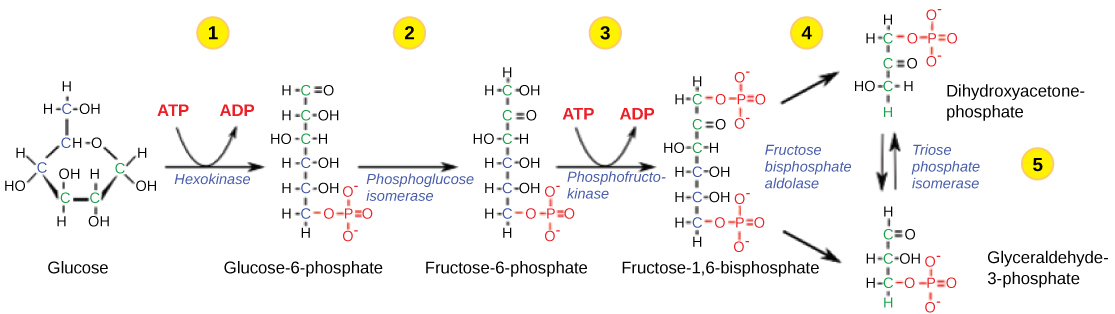
In the , uses to make -6-, phosphoglucose makes fructose-6-, and uses to make fructose-1,6-bisphosphate. splits it into glyceraldehyde-3- and dihydroxyacetone ; converts the latter to a second glyceraldehyde-3-.

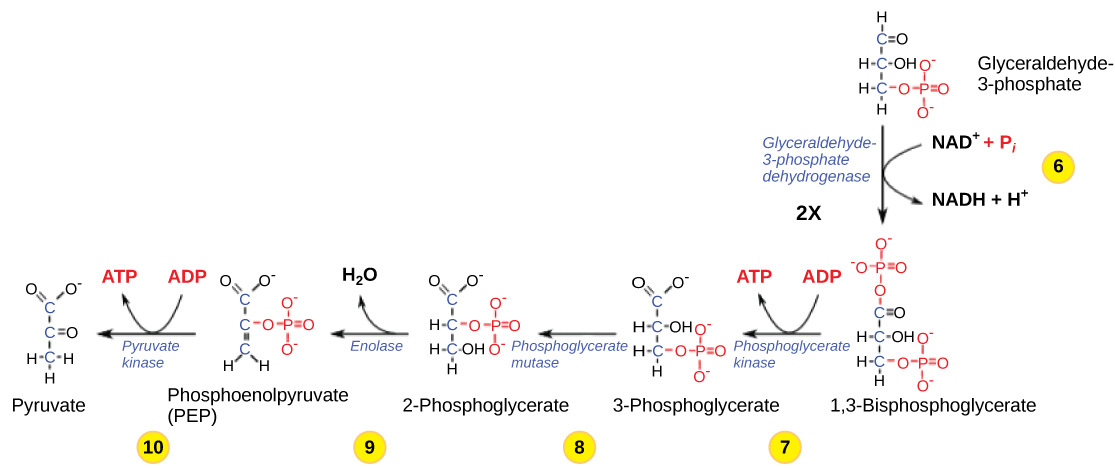
Each triose then passes through , producing and 1,3-bisphosphoglycerate; , producing and 3-phosphoglycerate; to 2-phosphoglycerate; to ; and , producing and . Per , investment is 2 and payoff is 4 : net 2 , 2 , and 2 . /, , and are strongly forward-favored control steps.

Source: 7.2 Glycolysis · 7.5 Metabolism without Oxygen · 24.2 Carbohydrate Metabolism · 6.1: Metabolism - Sugars · 7.1: Carbohydrate Storage and Breakdown

Regenerate without extra respiratory

reduces to while oxidizing to . This regenerates the needed by , allowing to continue when respiratory reoxidation is unavailable or insufficient. itself adds no beyond ’s net two per free . Mature lack and rely on this route even when oxygen is present.

can travel to the liver for in the . Yeast instead decarboxylate to acetaldehyde and reduce it to ethanol, regenerating and releasing CO2. Anaerobic respiration differs from because it uses an -transport chain with a terminal acceptor other than oxygen.

Source: 7.2 Glycolysis · 7.5 Metabolism without Oxygen · 24.2 Carbohydrate Metabolism · 6.1: Metabolism - Sugars · 7.1: Carbohydrate Storage and Breakdown

Stored feed the pathway

Dietary is hydrolyzed by amylases and brush-border to absorbable sugars; entering a cell generally consumes at . instead releases -1- from α(1→4) chains, and converts it to -6-. Debranching releases some free at α(1→6) branch points.

A -derived glucosyl entering as -6- bypasses the investment at and can yield net 3 when converted to , rather than 2 from free . Liver can dephosphorylate -6- for ; muscle primarily uses its own locally.

Source: 7.2 Glycolysis · 7.5 Metabolism without Oxygen · 24.2 Carbohydrate Metabolism · 6.1: Metabolism - Sugars · 7.1: Carbohydrate Storage and Breakdown

Build with three bypasses

occurs mainly in liver and, increasingly during prolonged fasting, kidney. , , and contribute; even-chain fatty- cannot give net in humans. uses and to form ; uses to form . and hydrolyze the other irreversible glycolytic . requires conversion or transport of related metabolites to cross the inner .

Two pyruvates to one cost 4 , 2 , and 2 . and promote and oppose ; lowers hepatic and favors production, while favors use. activates . Reciprocal regulation limits futile cycling.

Source: 7.2 Glycolysis · 7.5 Metabolism without Oxygen · 24.2 Carbohydrate Metabolism · 6.1: Metabolism - Sugars · 7.1: Carbohydrate Storage and Breakdown

Practice: apply the mechanism

Question. One is converted to two lactates in muscle, and the liver converts those lactates back to . Count muscle gain, liver high-energy cost, and whole-cycle net cost.

Show reasoning

Muscle gains 2 . The liver spends 4 plus 2 , six equivalents. supplies the required for the gluconeogenic step. The complete costs the body 4 equivalents while moving the energy demand to a tissue able to support synthesis.

Source: 7.2 Glycolysis · 7.5 Metabolism without Oxygen · 24.2 Carbohydrate Metabolism · 6.1: Metabolism - Sugars · 7.1: Carbohydrate Storage and Breakdown

Reading the original source

Clarification of legacy source wording

The preserved Anatomy and Physiology chapter uses older 36- respiratory accounting, includes an inconsistent sentence that calls ’s net zero, and describes the brain as using only . These notes use net 2 from and approximately 30–32 from complete with modern yields. During prolonged fasting the brain also uses ; it retains a requirement. Original wording is retained for comparison.

Source: 24.2 Carbohydrate Metabolism

7.2 — figures and tables

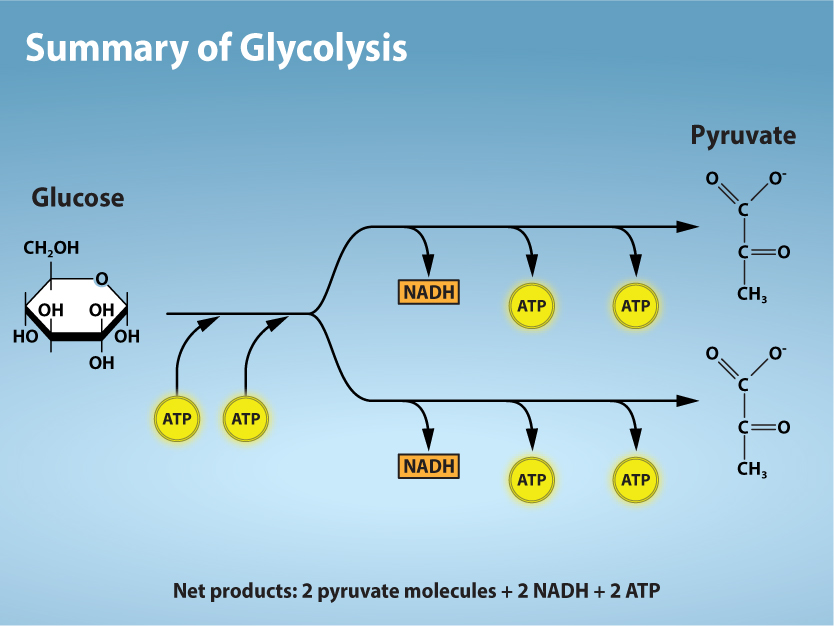
The illustration shows a simplified process of glucose moving through the stages of glycolysis. First two A T P are added, then the glucose is split into two branches, with N A D H and two A T P being released.  The net products are 2 pyruvate molecules and 2 N A D H and 2 A T P molecules.
Figure 7.7 — 7.2

Figure 7.7 Glycolysis begins with an energy investment phase which requires 2 ATP to phosphorylate the starting glucose molecule. The 6-carbon intermediate is then split into 2, 3-carbon sugar molecules. In the energy recovery phase, each 3-carbon sugar is then oxidized to pyruvate with the energy transferred to form NADH and 2 ATP. Credit: Rao, A. and Ryan, K. Department of Biology, Texas A&M University

Mary Ann Clark, Matthew Douglas, and Jung Choi, Biology 2E, OpenStax. · CC BY-NC-SA 4.0 · Original image ↗ · Access for free ↗
This illustration shows the steps in the first half of glycolysis. In step one, the enzyme hexokinase uses one A T P molecule in the phosphorylation of glucose. In step two, glucose dash 6 dash phosphate is rearranged to form fructose dash 6 dash phosphate by phosphoglucose isomerase. In step three, phosphofructokinase uses a second A T P molecule in the phosphorylation of the substrate, forming fructose dash 1, 6 dash bisphosphate. In step four, the enzyme fructose bisphosphate aldolase splits the substrate into two, forming glyceraldeyde dash 3 dash phosphate and dihydroxyacetone-phosphate. In step five, triose phosphate isomerase converts the dihydroxyacetone-phosphate into glyceraldehyde dash 3 dash phosphate.
Figure 7.8 — 7.2

Figure 7.8 The first half of glycolysis uses two ATP molecules in the phosphorylation of glucose, which is then split into two three-carbon molecules.

Mary Ann Clark, Matthew Douglas, and Jung Choi, Biology 2E, OpenStax. · CC BY-NC-SA 4.0 · Original image ↗ · Access for free ↗
This illustration shows the steps in the second half of glycolysis. In step six, the enzyme glyceraldehyde dash 3 dash phosphate dehydrogenase produces one N A D H molecule and forms 1, 3 dash bisphosphoglycerate. In step seven, the enzyme phosphoglycerate kinase removes a phosphate group from the substrate, forming one A T P molecule and 3 dash phosphoglycerate. In step eight, the enzyme phosphoglycerate mutase rearranges the substrate to form 2 dash phosphoglycerate. In step nine, the enzyme enolase rearranges the substrate to form phosphoenolpyruvate. In step ten, a phosphate group is removed from the substrate, forming one A T P molecule and pyruvate.
Figure 7.9 — 7.2

Figure 7.9 The second half of glycolysis involves phosphorylation without ATP investment (step 6) and produces two NADH and four ATP molecules per glucose.

Mary Ann Clark, Matthew Douglas, and Jung Choi, Biology 2E, OpenStax. · CC BY-NC-SA 4.0 · Original image ↗ · Access for free ↗

Source: 7.2 Glycolysis

7.5 without Oxygen — figures and tables

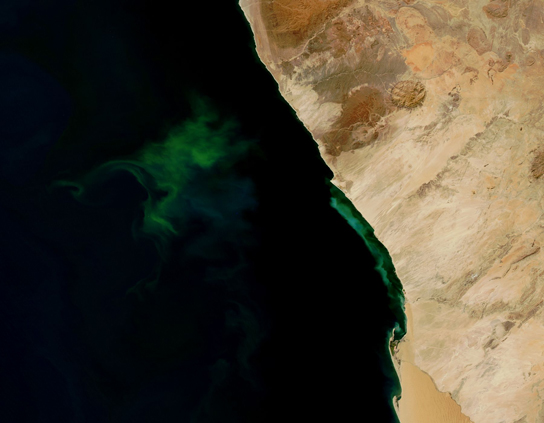
This photo shows a bloom of green bacteria in water.
Figure 7.15 — 7.5 without Oxygen

Figure 7.15 The green color seen in these coastal waters is from an eruption of hydrogen sulfide–producing bacteria. These anaerobic, sulfate-reducing bacteria release hydrogen sulfide gas as they decompose algae in the water. (credit: modification of work by NASA/Jeff Schmaltz, MODIS Land Rapid Response Team at NASA GSFC, Visible Earth Catalog of NASA images)

Mary Ann Clark, Matthew Douglas, and Jung Choi, Biology 2E, OpenStax. (credit: modification of work by NASA/Jeff Schmaltz, MODIS Land Rapid Response Team at NASA GSFC, Visible Earth Catalog of NASA images) · CC BY-NC-SA 4.0 · Original image ↗ · Access for free ↗
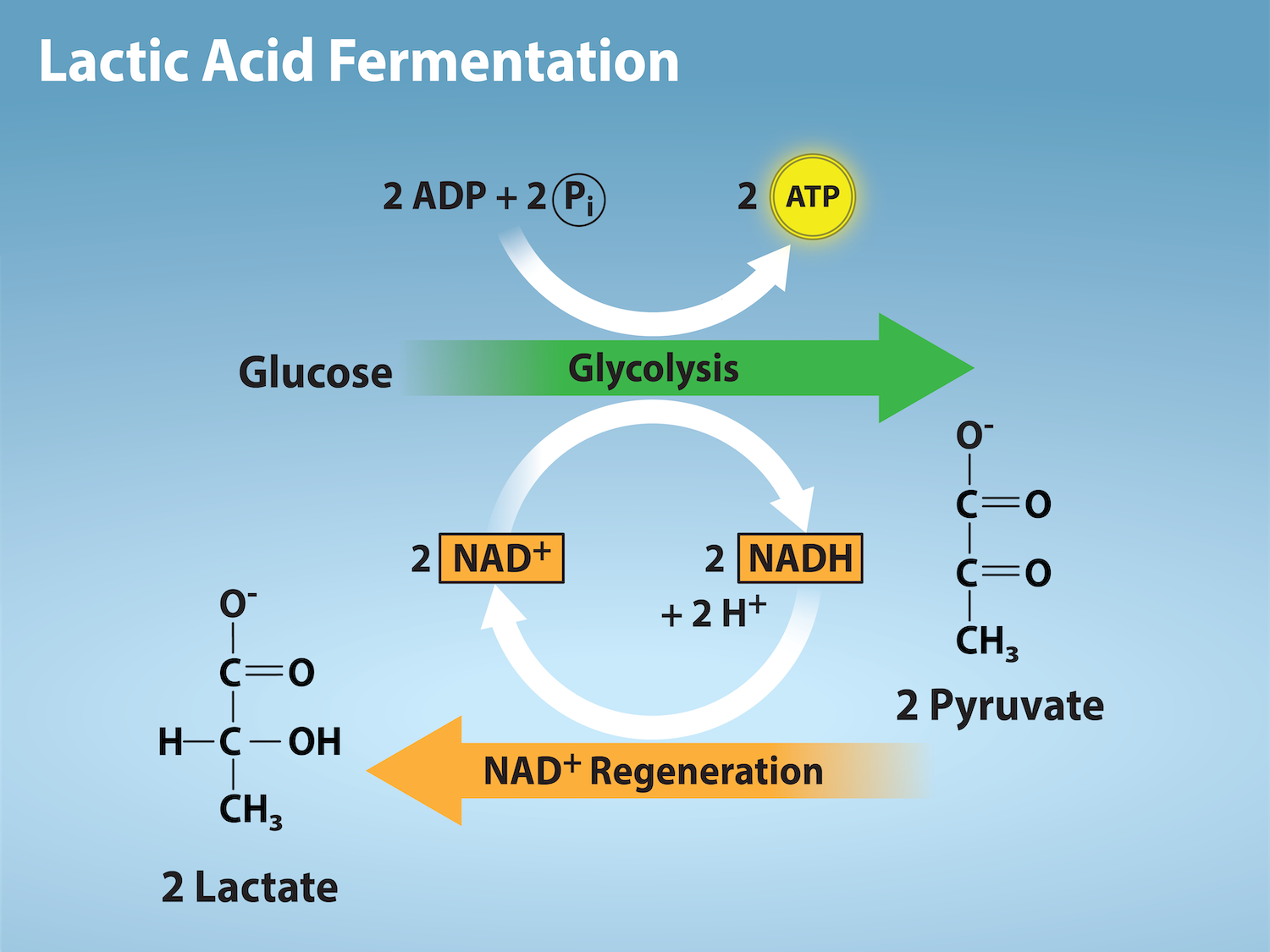
This illustration shows that during glycolysis, glucose is broken down into two pyruvate molecules and, in the process, two N A D H are formed from N A D superscript plus sign baseline. During lactic acid fermentation, the two pyruvate molecules are converted into lactate, and N A D H is recycled back into N A D superscript plus sign baseline.
Figure 7.16 — 7.5 without Oxygen

Figure 7.16 During glycolysis, glucose is oxidized to pyruvate while NAD+ is reduced to NADH. Two molecules of ATP are also produced by substrate level phosphorylation. In the absence of oxygen in some cell types, fermentation allows the reduction of pyruvate to lactate and the reoxidation of NADH to NAD+. The regeneration of NAD+ allows glycolysis to continue to make ATP by substrate level phosphorylation. Credit: Rao, A., Ryan, K., Tag, A., and Fletcher, S. Department of Biology, Texas A&M University.

Mary Ann Clark, Matthew Douglas, and Jung Choi, Biology 2E, OpenStax. · CC BY-NC-SA 4.0 · Original image ↗ · Access for free ↗
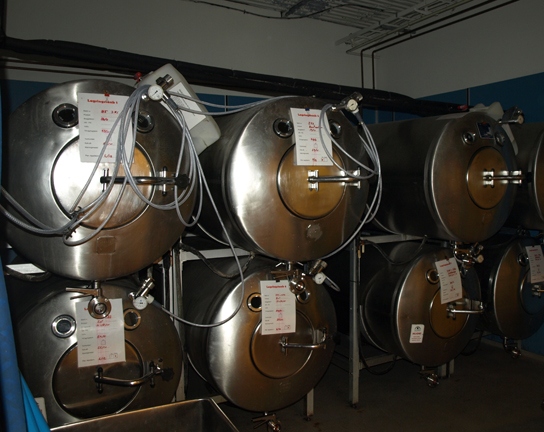
This photo shows large cylindrical fermentation tanks stacked one on top of the other.
Figure 7.17 — 7.5 without Oxygen

Figure 7.17 Fermentation of grape juice into wine produces CO 2 as a byproduct. Fermentation tanks have valves so that the pressure inside the tanks created by the carbon dioxide produced can be released.

Mary Ann Clark, Matthew Douglas, and Jung Choi, Biology 2E, OpenStax. · CC BY-NC-SA 4.0 · Original image ↗ · Access for free ↗

Source: 7.5 Metabolism without Oxygen

24.2 — figures and tables

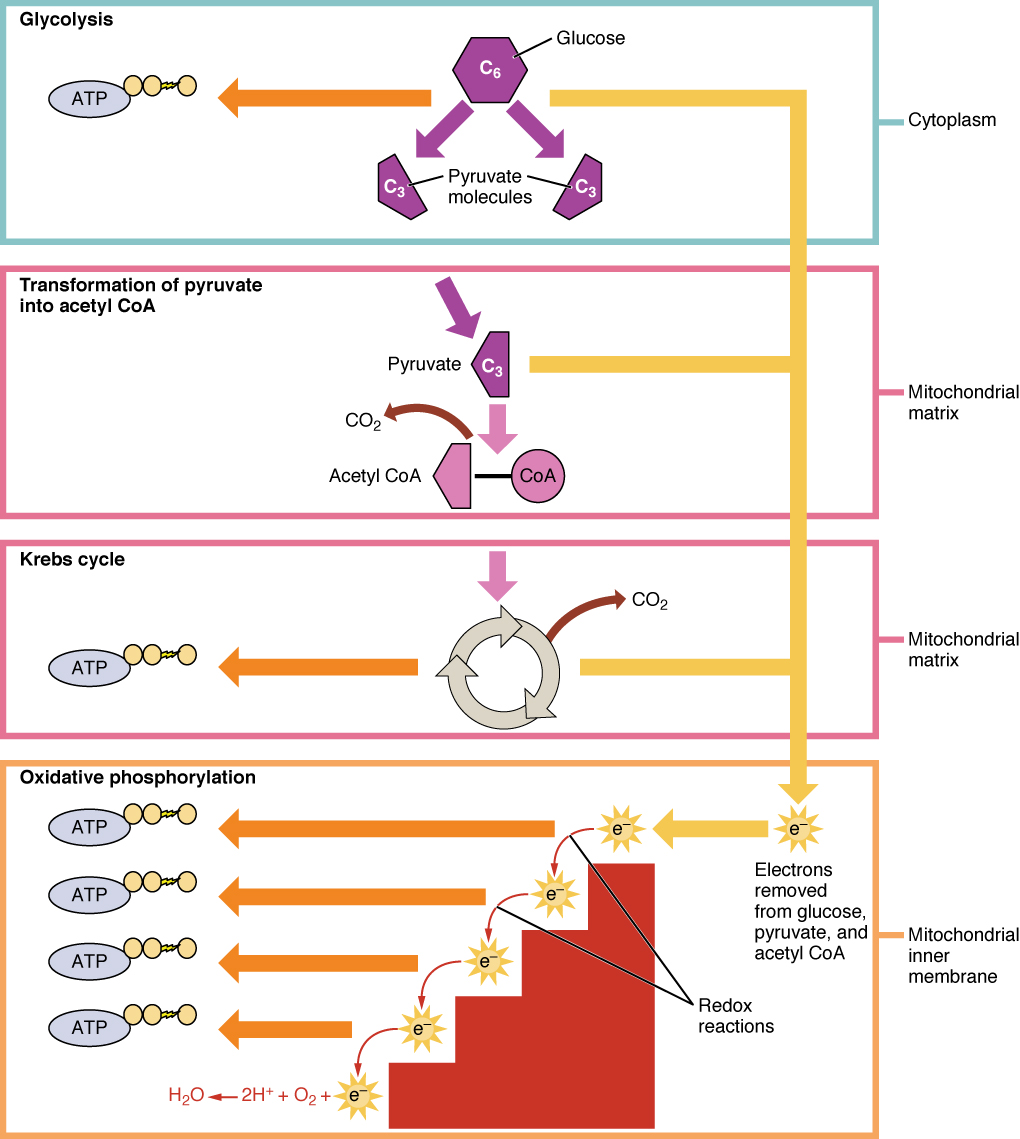
This figure shows the different pathways of cellular respiration. The pathways shown are glycolysis, the pyruvic acid cycle, the Krebs cycle, and oxidative phosphorylation.
Figure 24.4 — 24.2

Figure 24.4 Cellular Respiration Cellular respiration oxidizes glucose molecules through glycolysis, the Krebs cycle, and oxidative phosphorylation to produce ATP.

J. Gordon Betts and colleagues, Anatomy And Physiology 2E, OpenStax. · CC BY-NC-SA 4.0 · Original image ↗ · Access for free ↗
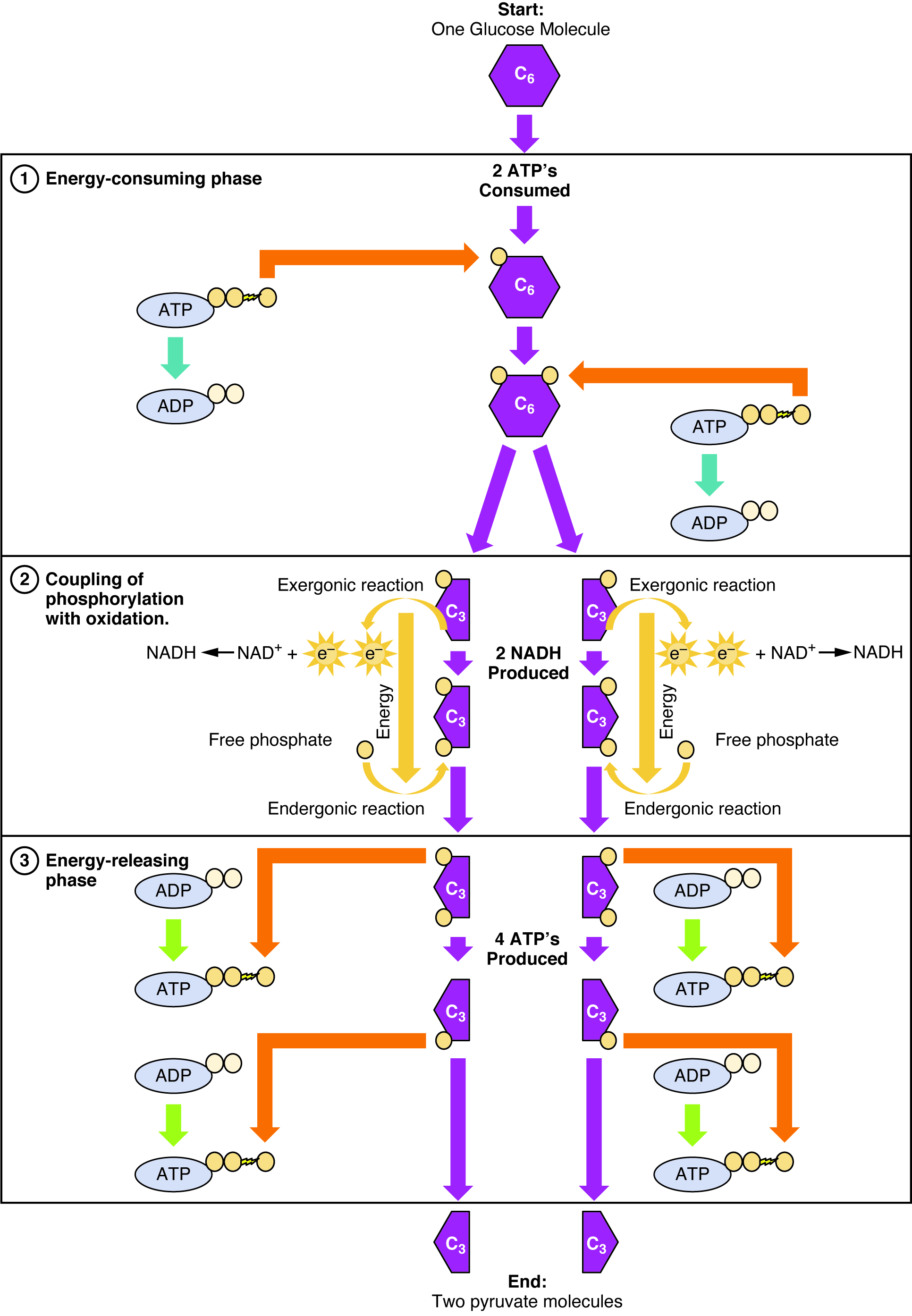
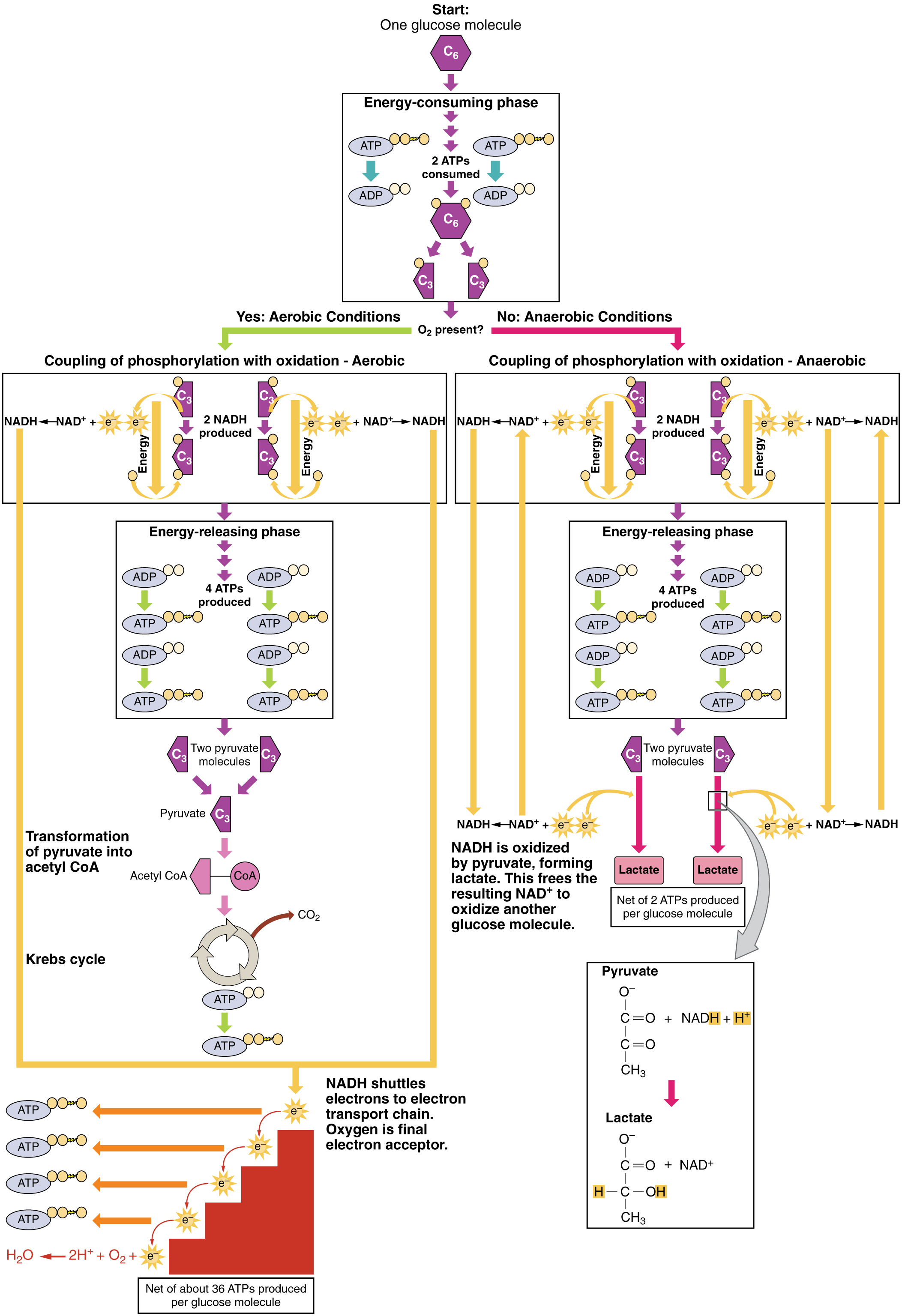
This flowchart shows the different steps in glycolysis in detail. The top panel shows the energy-consuming phase, the middle panel shows the coupling of phosphorylation with oxidation, and the bottom panel shows the energy-releasing phase.
Figure 24.5 — 24.2

Figure 24.5 Glycolysis Overview During the energy-consuming phase of glycolysis, two ATPs are consumed, transferring two phosphates to the glucose molecule. The glucose molecule then splits into two three-carbon compounds, each containing a phosphate. During the second phase, an additional phosphate is added to each of the three-carbon compounds. The energy for this endergonic reaction is provided by the removal (oxidation) of two electrons from each three-carbon compound. During the energy-releasing phase, the phosphates are removed from both three-carbon compounds and used to produce four ATP molecules.

J. Gordon Betts and colleagues, Anatomy And Physiology 2E, OpenStax. · CC BY-NC-SA 4.0 · Original image ↗ · Access for free ↗
This flowchart shows the processes of fermentation and aerobic respiration. The top image shows the energy consuming phase of glycolysis. This branches into aerobic respiration on the left and fermentation on the right.
Figure 24.6 — 24.2

Figure 24.6 Aerobic versus Fermentation The process of fermentation converts glucose into two lactate molecules in the absence of oxygen or within erythrocytes that lack mitochondria. During fermentation, glucose is oxidized into two pyruvate molecules.

J. Gordon Betts and colleagues, Anatomy And Physiology 2E, OpenStax. · CC BY-NC-SA 4.0 · Original image ↗ · Access for free ↗
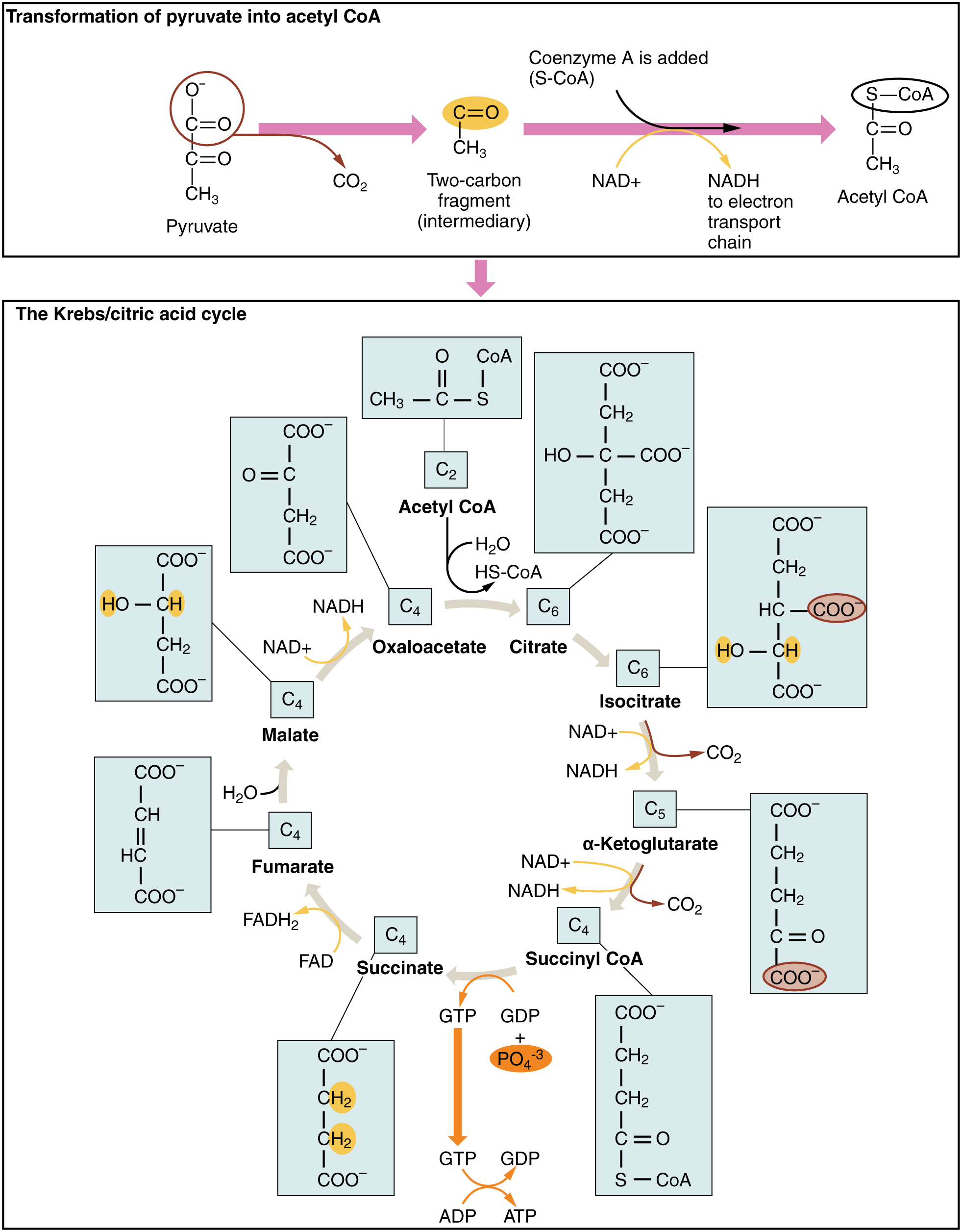
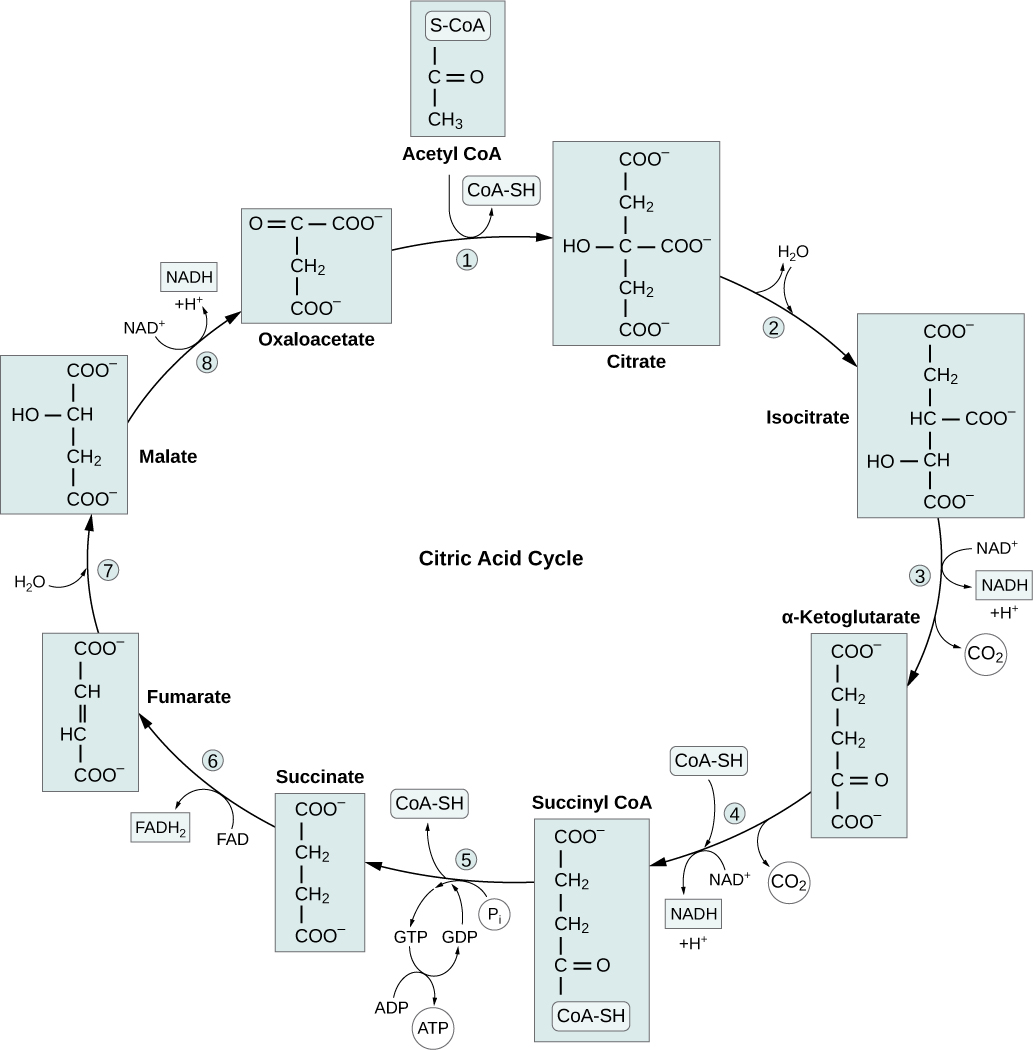
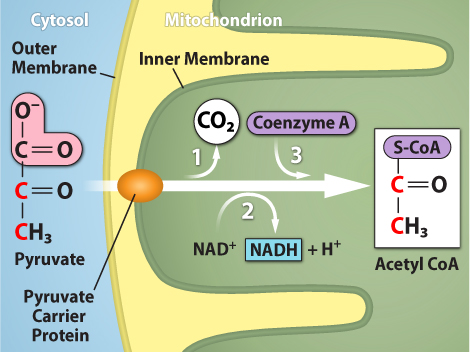
The top panel of this figure shows the transformation of pyruvate to acetyl-CoA, and the bottom panel shows the steps in Krebs cycle.
Figure 24.7 — 24.2

Figure 24.7 Krebs Cycle During the Krebs cycle, each pyruvate that is generated by glycolysis is converted into a two-carbon acetyl CoA molecule. The acetyl CoA is systematically processed through the cycle and produces high-energy NADH, FADH 2 , and ATP molecules.

J. Gordon Betts and colleagues, Anatomy And Physiology 2E, OpenStax. · CC BY-NC-SA 4.0 · Original image ↗ · Access for free ↗
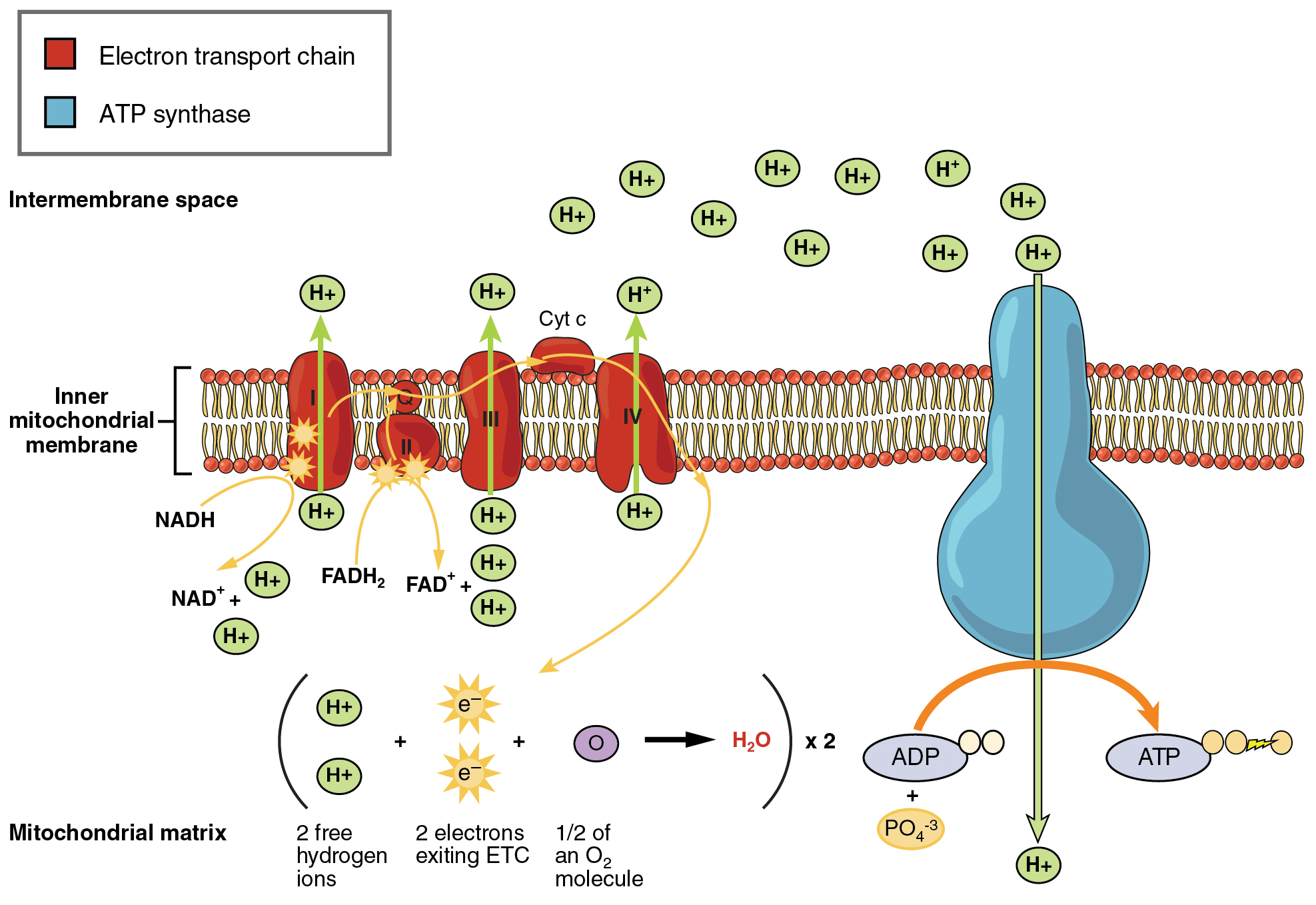
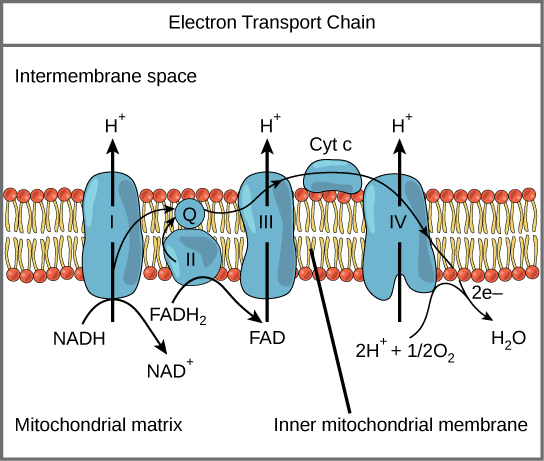
This image shows the mitochondrial membrane with proton pumps and ATP synthase embedded in the membrane. Arrows show the direction of flow of proteins and electrons across the membrane.
Figure 24.8 — 24.2

Figure 24.8 Electron Transport Chain The electron transport chain is a series of electron carriers and ion pumps that are used to pump H + ions out of the inner mitochondrial matrix.

J. Gordon Betts and colleagues, Anatomy And Physiology 2E, OpenStax. · CC BY-NC-SA 4.0 · Original image ↗ · Access for free ↗
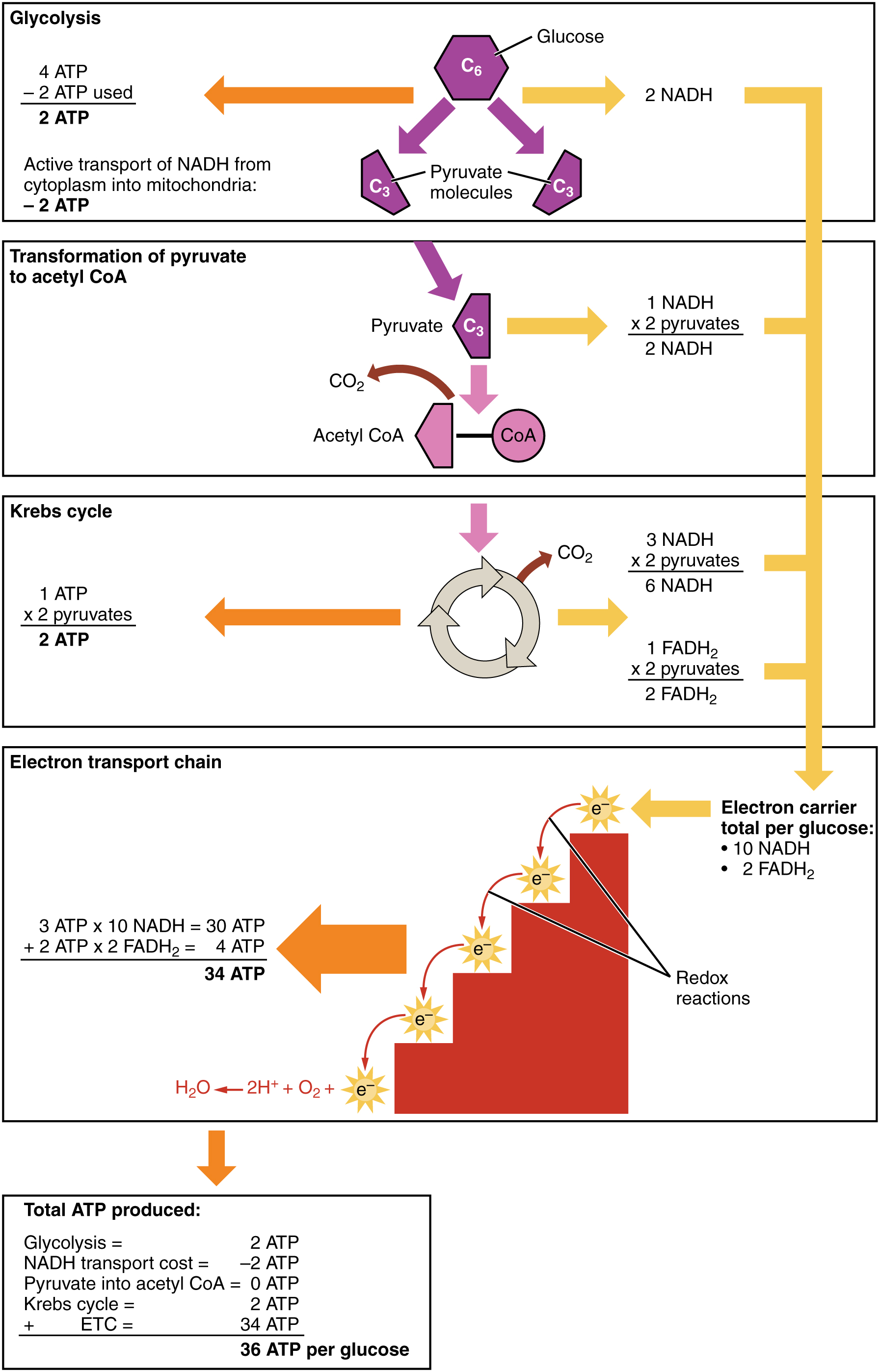
This figure shows the different steps in which carbohydrates are metabolized and lists the number of ATP molecules produced in each step. The different steps shown are glycolysis, transformation of pyruvate to acetyl-CoA, the Krebs cycle, and the electron transport chain.
Figure 24.9 — 24.2

Figure 24.9 Carbohydrate Metabolism Carbohydrate metabolism involves glycolysis, the Krebs cycle, and the electron transport chain.

J. Gordon Betts and colleagues, Anatomy And Physiology 2E, OpenStax. · CC BY-NC-SA 4.0 · Original image ↗ · Access for free ↗
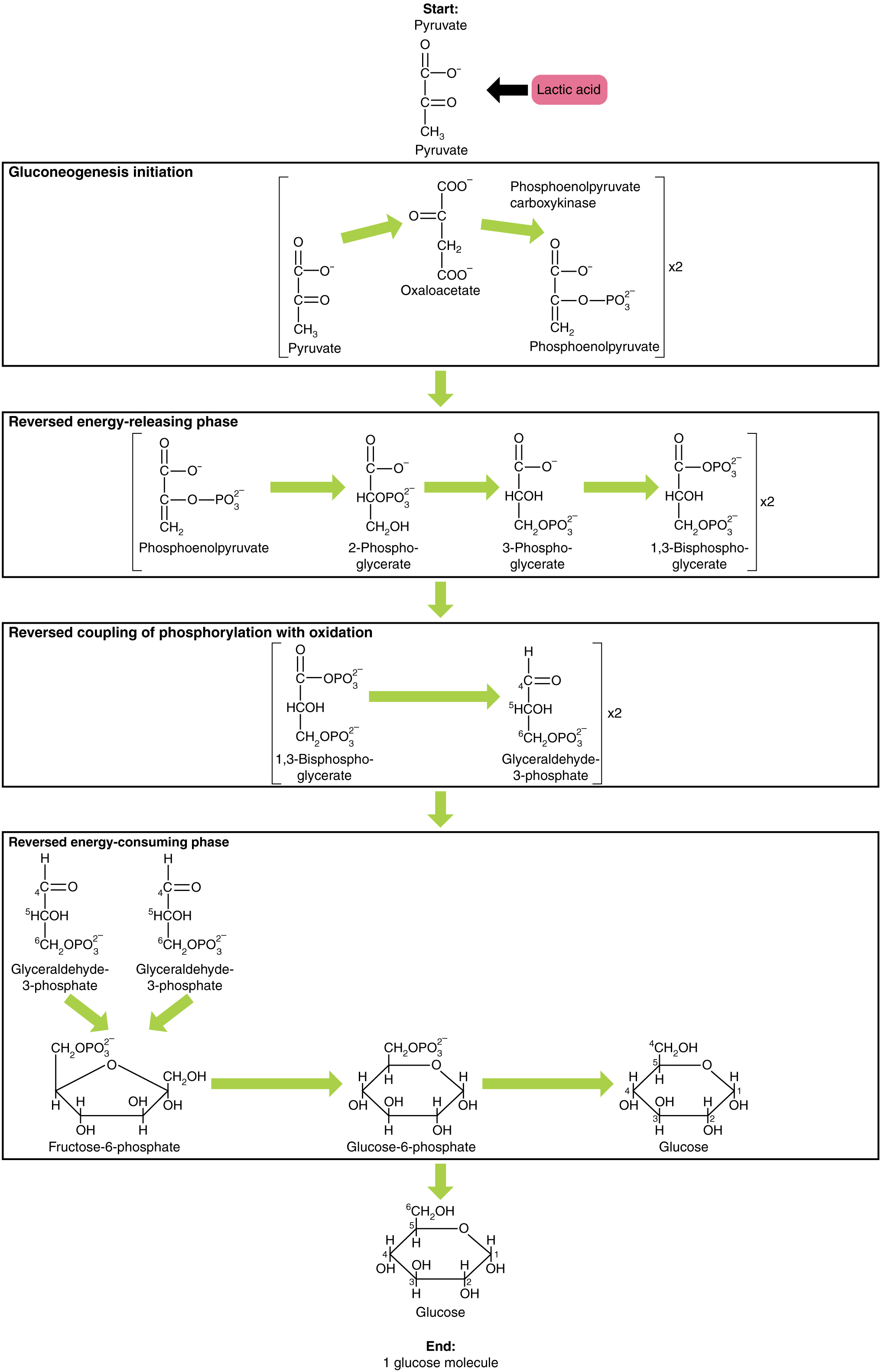
This figure shows the different steps in  gluconeogenesis, where pyruvate is converted to glucose.
Figure 24.10 — 24.2

Figure 24.10 Gluconeogenesis Gluconeogenesis is the synthesis of glucose from pyruvate, lactate, glycerol, alanine, or glutamate.

J. Gordon Betts and colleagues, Anatomy And Physiology 2E, OpenStax. · CC BY-NC-SA 4.0 · Original image ↗ · Access for free ↗

Source: 24.2 Carbohydrate Metabolism

7.1: Storage and Breakdown — figures and tables

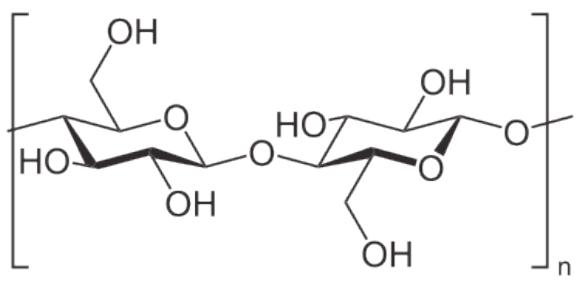
Figure 7.1.1: The Repeating Structure of Cellulose
Figure 7.1.1: The Repeating Structure of

Figure 7.1.1: The Repeating Structure of Cellulose

Kevin Ahern and Indira Rajagopal, Biochemistry Free & Easy, Oregon State University, via Biology LibreTexts. · CC BY-NC-SA 4.0 · Original image ↗ · Access for free ↗
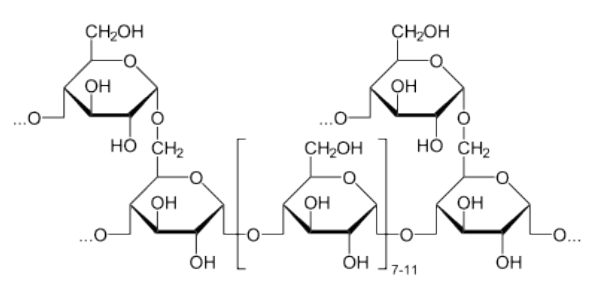
Figure 7.1.2: The Repeating Unit of Glycogen
Figure 7.1.2: The Repeating Unit of

Figure 7.1.2: The Repeating Unit of Glycogen

Kevin Ahern and Indira Rajagopal, Biochemistry Free & Easy, Oregon State University, via Biology LibreTexts. · CC BY-NC-SA 4.0 · Original image ↗ · Access for free ↗
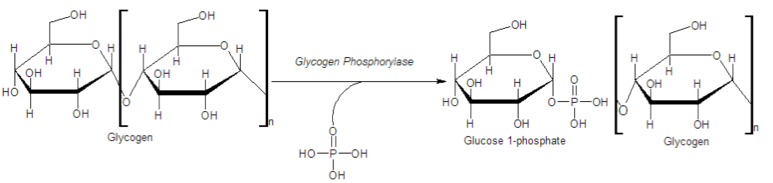
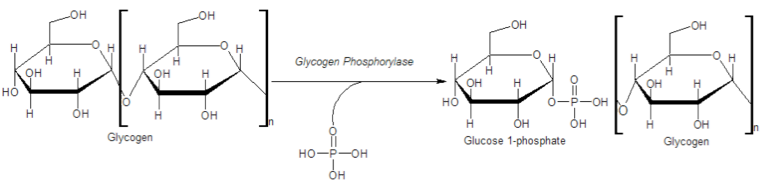
Figure 7.1.3: Phosphorolysis of Glycogen
Figure 7.1.3: Phosphorolysis of

Figure 7.1.3: Phosphorolysis of Glycogen

Kevin Ahern and Indira Rajagopal, Biochemistry Free & Easy, Oregon State University, via Biology LibreTexts. · CC BY-NC-SA 4.0 · Original image ↗ · Access for free ↗
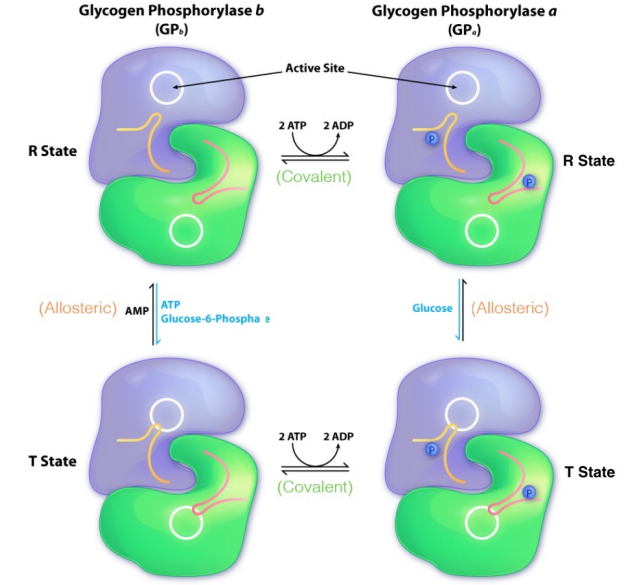
Figure 7.1.4: Regulation of Glycogen Phosphorylase
Figure 7.1.4: Regulation of

Figure 7.1.4: Regulation of Glycogen Phosphorylase

Kevin Ahern and Indira Rajagopal, Biochemistry Free & Easy, Oregon State University, via Biology LibreTexts. · CC BY-NC-SA 4.0 · Original image ↗ · Access for free ↗
Figure 7.1.5: Glycogen Synthase
Figure 7.1.5:

Figure 7.1.5: Glycogen Synthase

Kevin Ahern and Indira Rajagopal, Biochemistry Free & Easy, Oregon State University, via Biology LibreTexts. · CC BY-NC-SA 4.0 · Original image ↗ · Access for free ↗
Figure 7.1.6: The 3D structure of Insulin
Figure 7.1.6: The 3D structure of

Figure 7.1.6: The 3D structure of Insulin

Kevin Ahern and Indira Rajagopal, Biochemistry Free & Easy, Oregon State University, via Biology LibreTexts. · CC BY-NC-SA 4.0 · Original image ↗ · Access for free ↗

Source: 7.1: Carbohydrate Storage and Breakdown

413 terms, alphabetically ordered

2,3-BPG ·

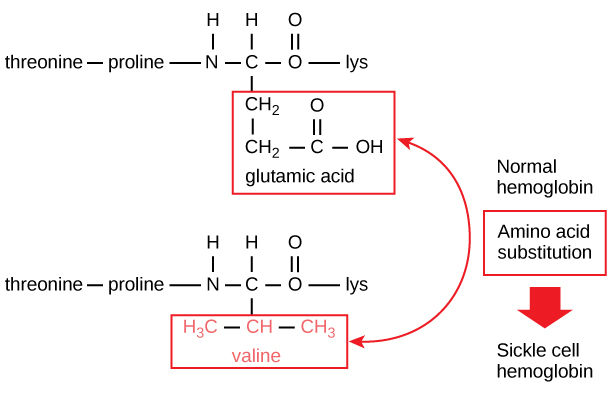
2,3-Bisphosphoglycerate, an metabolite that stabilizes deoxygenated and favors oxygen unloading.

Read explanation · OpenStax ↗
3′ end · ·

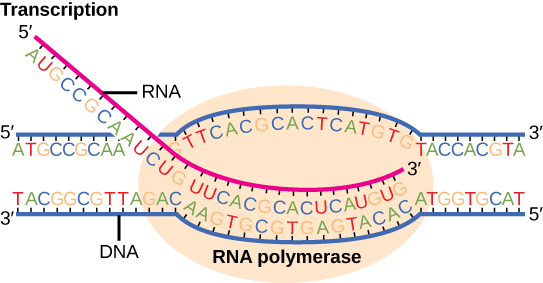
The end of a nucleic- strand associated with the sugar’s 3′ position. extends a strand at a free .

Read explanation · OpenStax ↗
3′ hydroxyl group · · ·

The at the sugar’s 3′ carbon that attacks the incoming ’s during strand extension.

Read explanation · OpenStax ↗
5′ end · ·

The end of a nucleic- strand associated with the sugar’s 5′ position. Sequences are conventionally written from 5′ to 3′.

Read explanation · OpenStax ↗
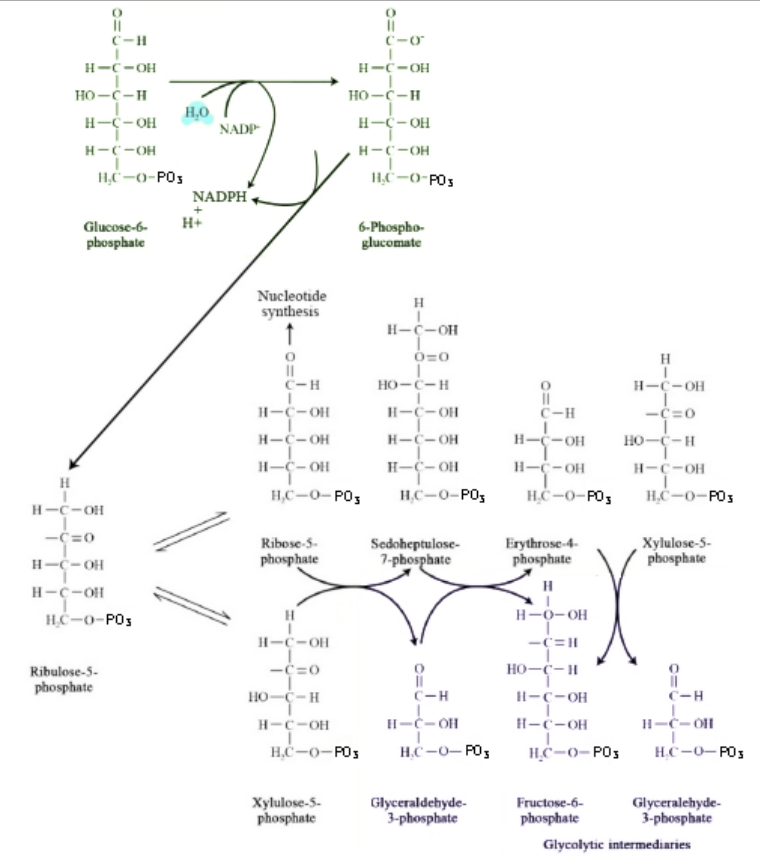
6-phosphogluconate dehydrogenase

The producing ribulose-5-, CO2, and in the oxidative .

Read explanation · Biology LibreTexts / Oregon State University ↗
A site · ·

The site that accepts most incoming during elongation and at termination.

Read explanation · OpenStax ↗
acceleration

Rate of change of , measured in m/s².

Read explanation · OpenStax ↗
acetyl-CoA

A two-carbon acetyl group linked to by a thioester; a central fuel and intermediate.

Read explanation · OpenStax ↗
Achiral

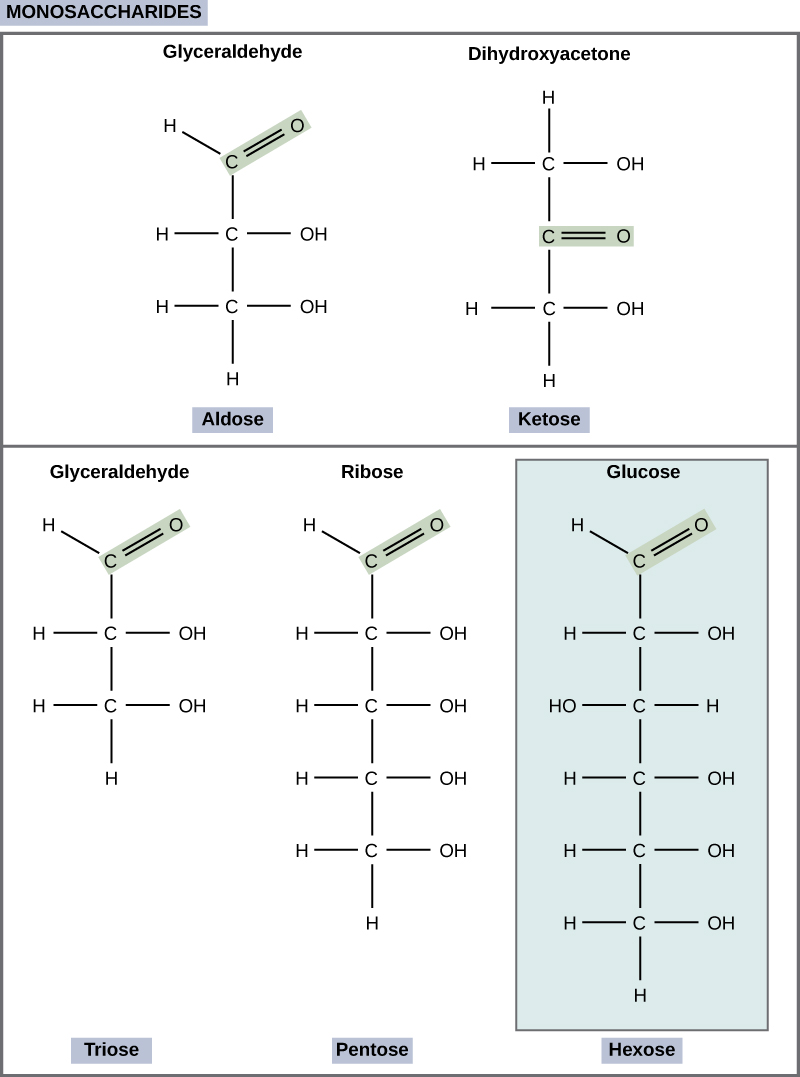
Superimposable on its mirror image. is achiral because its has two hydrogen substituents.

Read explanation · OpenStax ↗
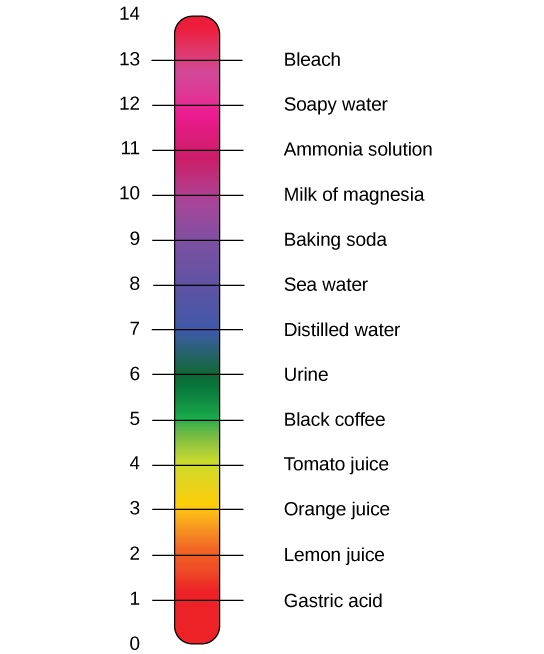
Acid · ·

In the Brønsted–Lowry model, a substance that can donate a . Acidic have a higher activity than water.

Read explanation · OpenStax ↗
acid dissociation constant

for an ’s -donation .

Read explanation · OpenStax ↗
Acid dissociation pKa · ·

The negative of an . At equal to pKa, an group is half .

Read explanation · OpenStax ↗
aconitase

The citric-cycle rearranging to isocitrate.

Read explanation · OpenStax ↗
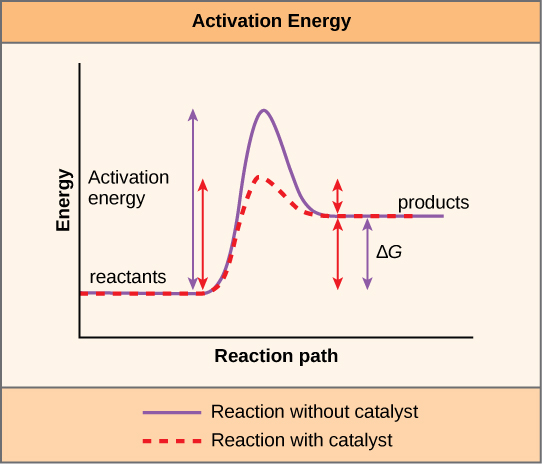
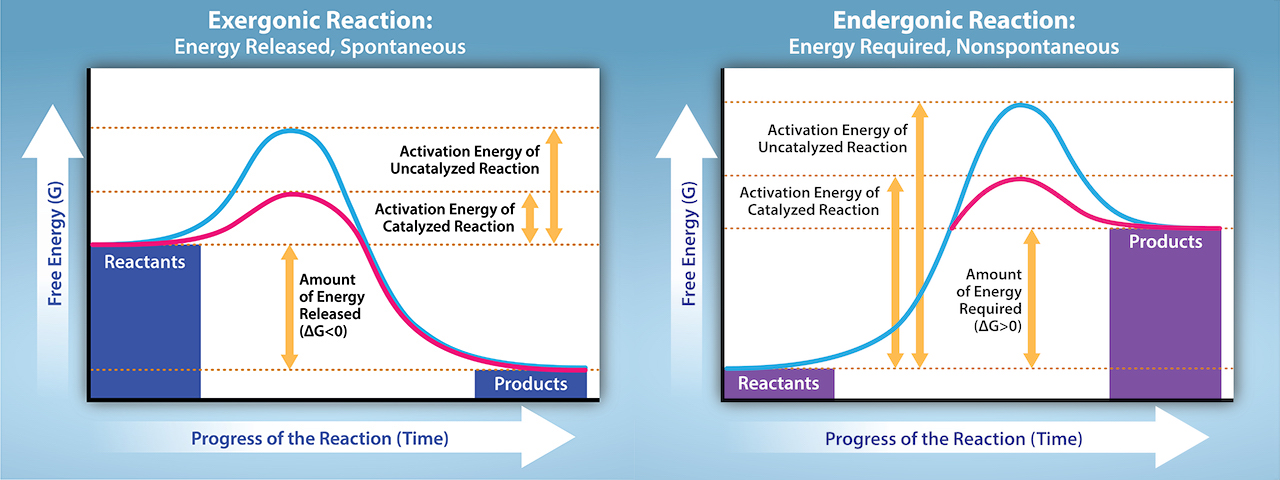
Activation energy ·

The energy barrier that must overcome to reach a and undergo .

Read explanation · OpenStax ↗
Active catalytic-site concentration ·

The total of active sites used to calculate from . It equals active when each has one site.

Read explanation · Biology LibreTexts ↗
Active site

The region of an that binds its and carries out .

Read explanation · OpenStax ↗
Adenine

A that pairs with in and in .

Read explanation · OpenStax ↗
Adenosine monophosphate

A containing , , and one ; -dependent releases AMP.

Read explanation · OpenStax ↗
Adenosine triphosphate

An energy-carrying ; its powers many cellular processes, including cycles.

Read explanation · OpenStax ↗
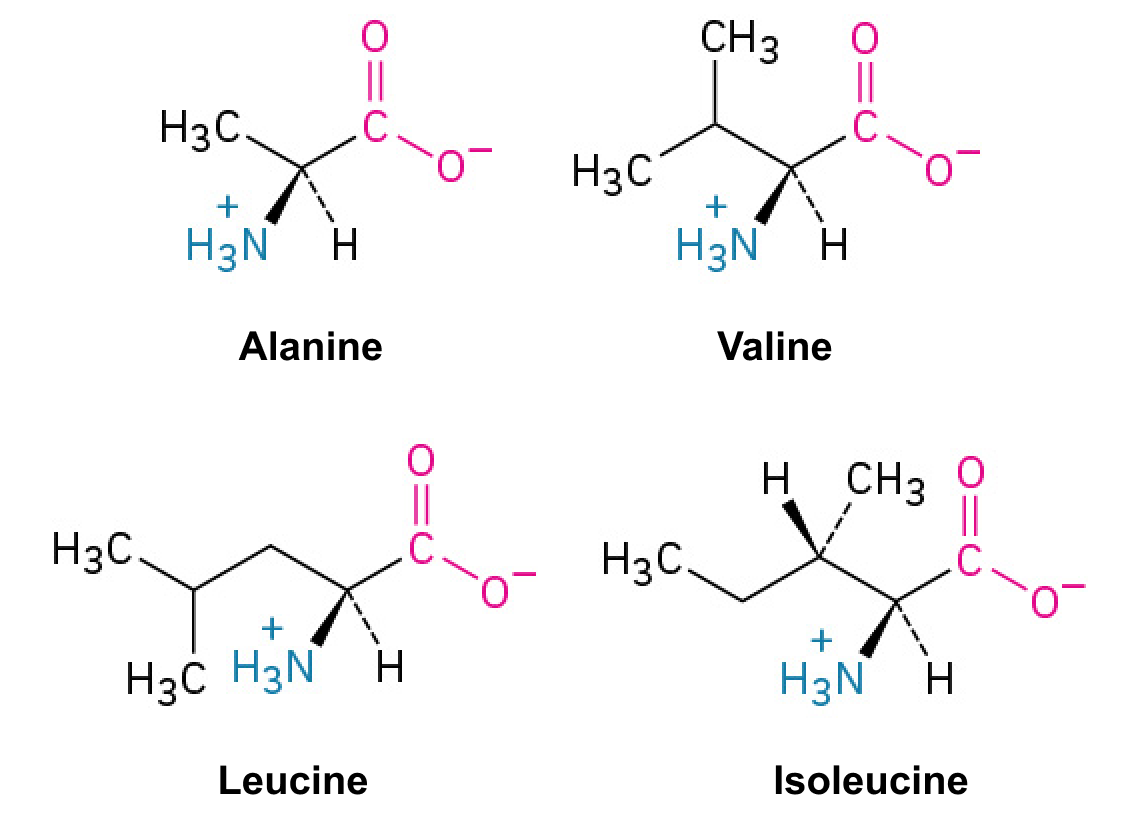
Alanine ·

A with a .

Read explanation · OpenStax ↗
aldolase

The glycolytic that cleaves fructose-1,6-bisphosphate into two three-carbon phosphates.

Read explanation · Biology LibreTexts / Oregon State University ↗
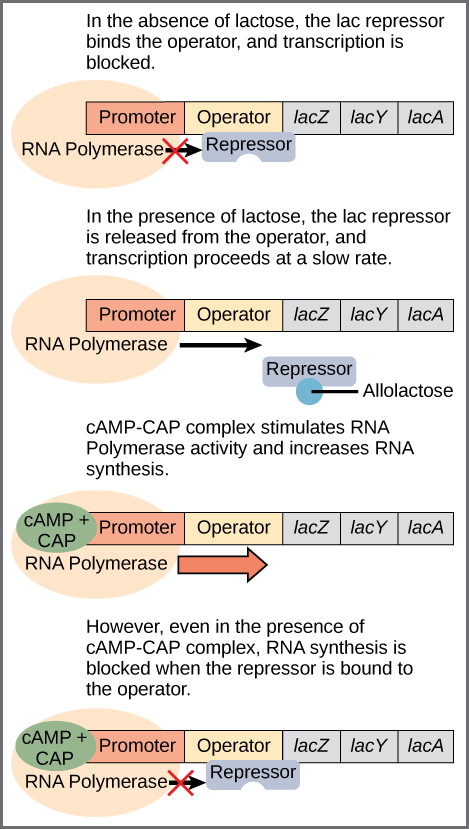
Allolactose

A isomer produced by that binds and relieves lac repression.

Read explanation · OpenStax ↗
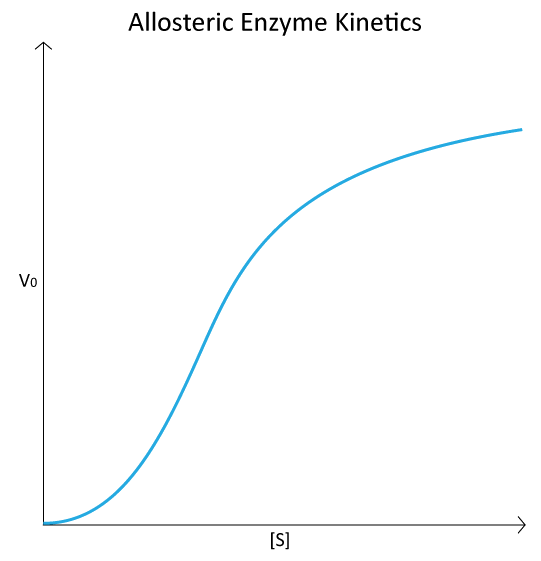
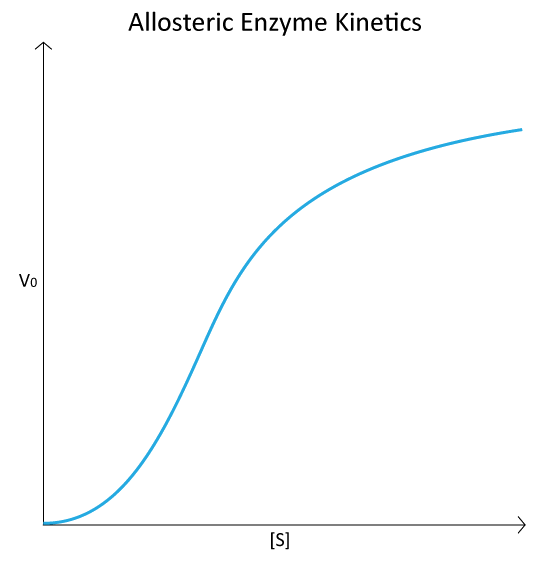
Allosteric regulation · · ·

A change in activity caused by communication between . An can activate or inhibit; allostery does not imply a particular inhibition pattern.

Read explanation · Biology LibreTexts ↗
Allosteric site ·

A whose occupancy changes activity at another site through or dynamic coupling.

Read explanation · Biology LibreTexts ↗
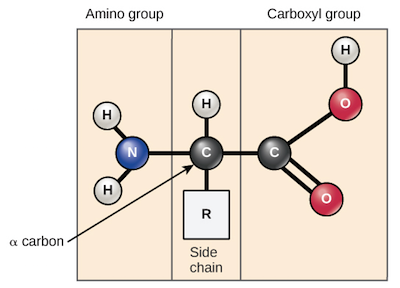
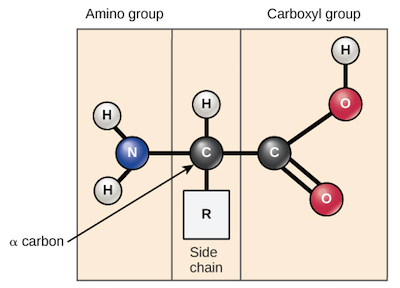
Alpha carbon · ·

The central carbon next to the carboxyl carbon. In a standard it binds an , hydrogen, and .

Read explanation · OpenStax ↗
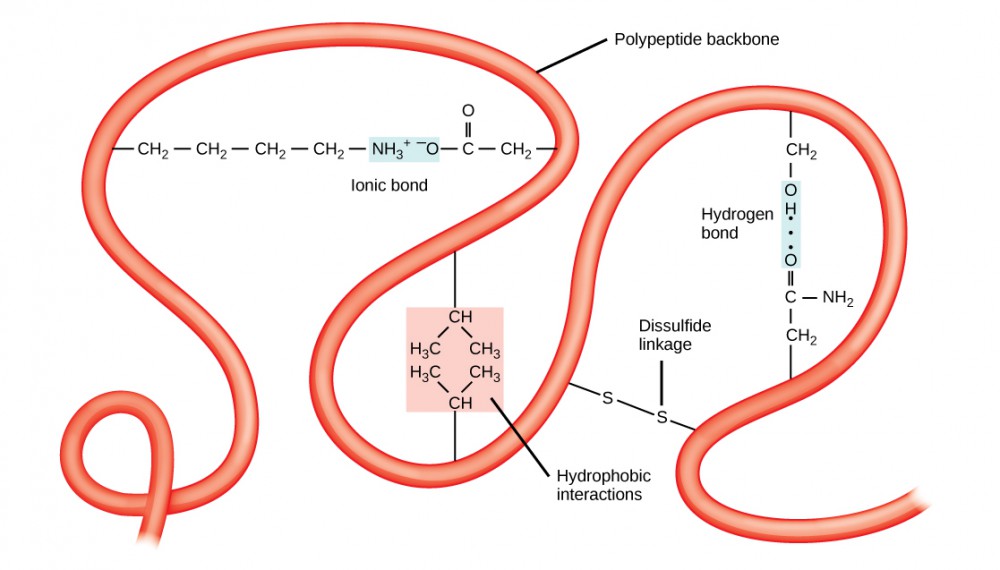
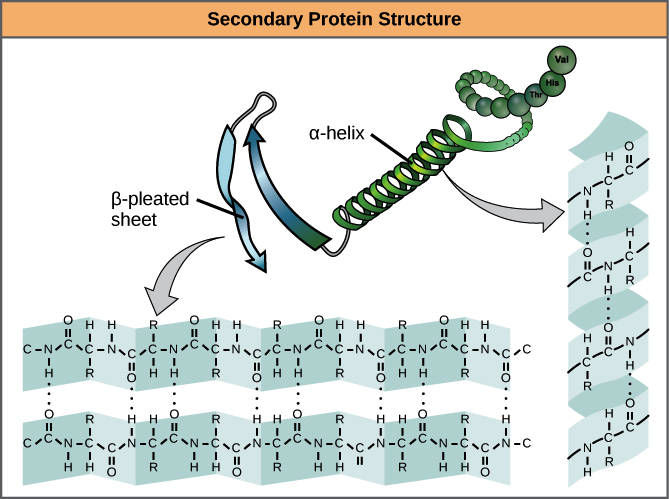
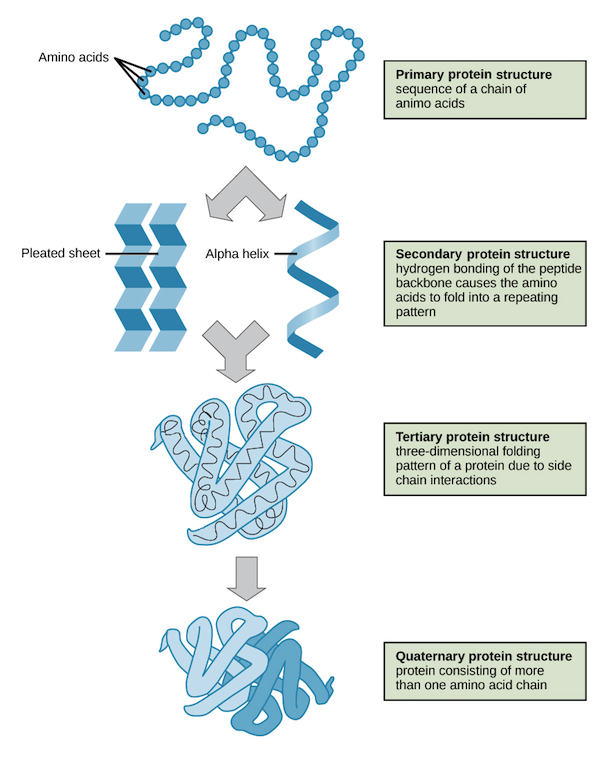
Alpha helix · · · · · ·

A helical stabilized by between a oxygen and an hydrogen four later.

Read explanation · OpenStax ↗
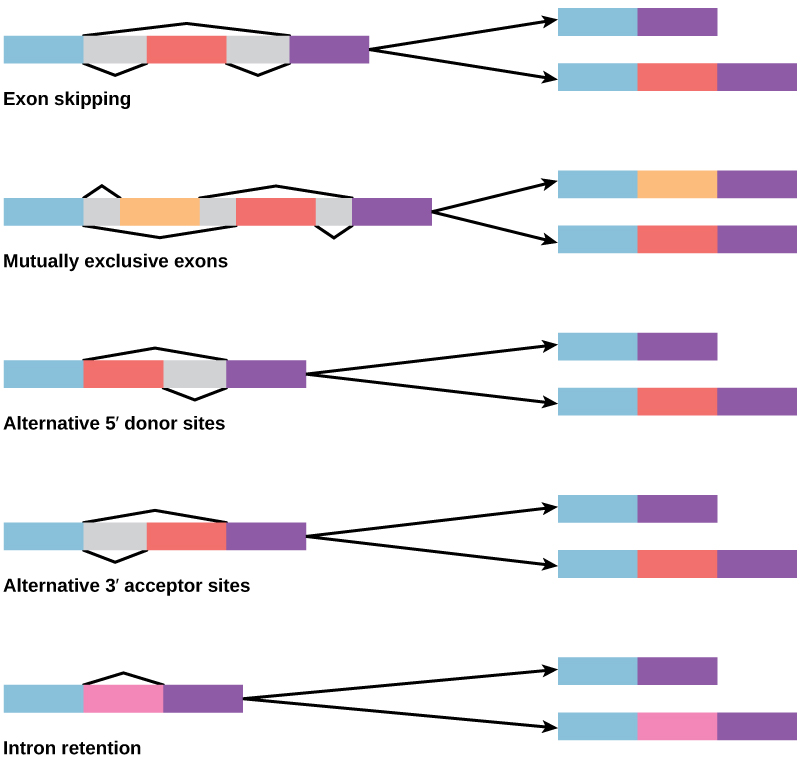
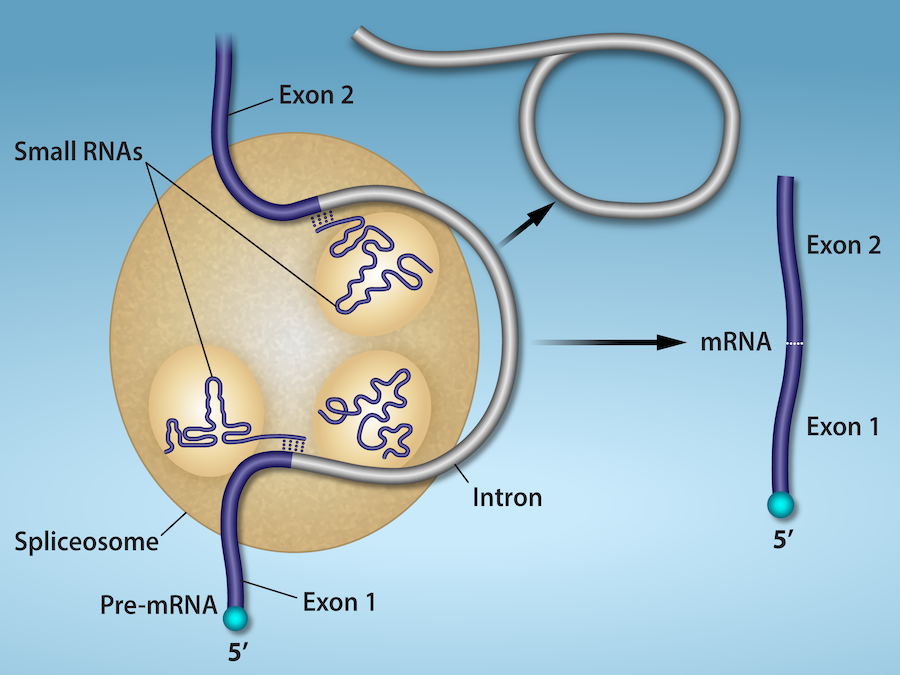
Alternative splicing ·

Regulated or context-dependent use of different or combinations to generate different mature from one precursor.

Read explanation · OpenStax ↗
Amide · · ·

A group containing a carbon bonded to nitrogen. are amide linkages.

Read explanation · OpenStax ↗
Amine ·

An organic derivative of ammonia containing a nitrogen with a lone pair; many amines can accept a .

Read explanation · OpenStax ↗
Amino acid

A building block containing amino and and a characteristic .

Read explanation · OpenStax ↗
Amino acid residue · ·

The part of an incorporated into a chain. Residue can also describe another building block within a larger .

Read explanation · OpenStax ↗
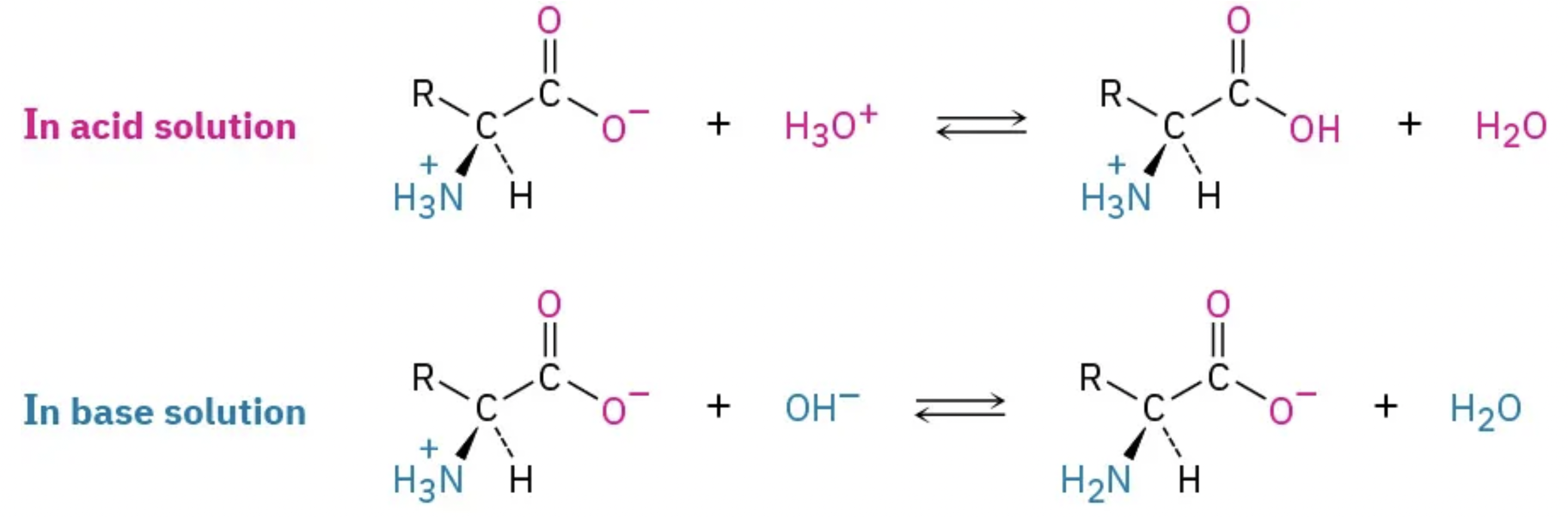
Amino group · · ·

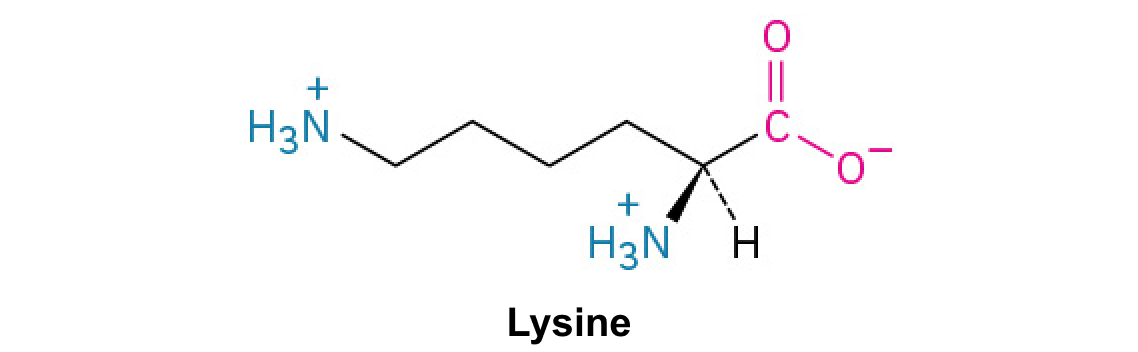
A nitrogen-containing . A free ’s amino group is typically (NH₃⁺) near physiological ; ’s ring nitrogen is an exception to this formula.

Read explanation · OpenStax ↗
Aminoacyl-tRNA · ·

A covalently linked to an at its , ready to deliver that during .

Read explanation · OpenStax ↗
Aminoacyl-tRNA synthetase · · · · ·

An that uses to attach the appropriate to a ; many also edit charging errors.

Read explanation · OpenStax ↗
aminotransferase ·

An transferring an between an and a keto .

Read explanation · OpenStax ↗
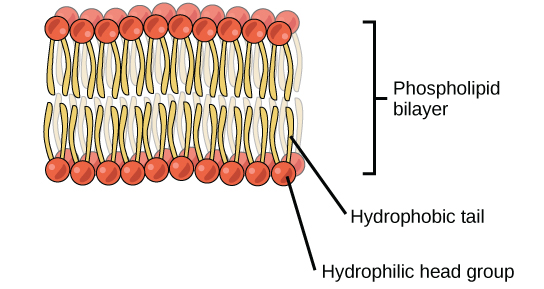
Amphipathic

Having both a region and a region, as in a or .

Read explanation · OpenStax ↗
Amylase

An that hydrolyzes certain in to produce smaller .

Read explanation · OpenStax ↗
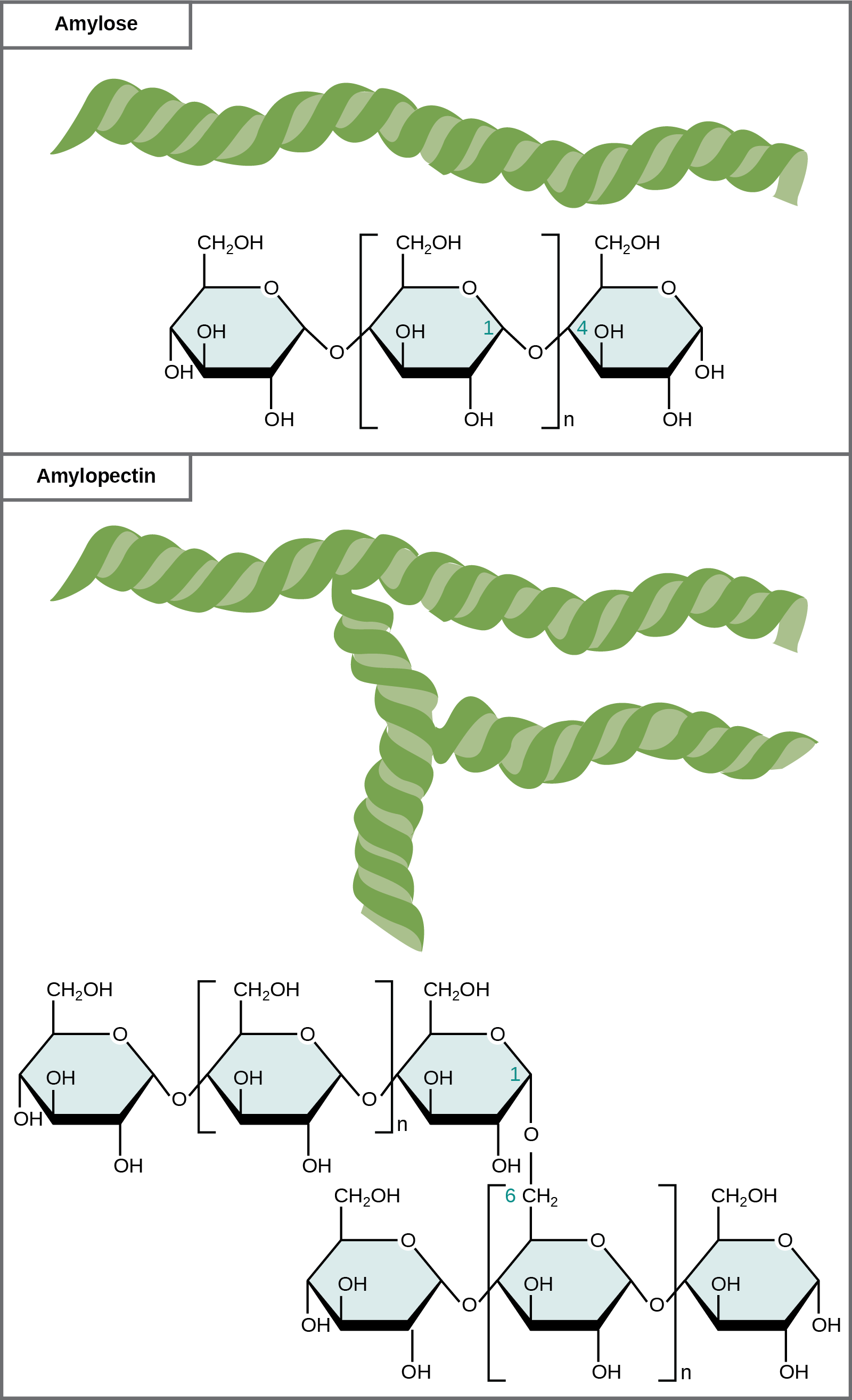
Amylose

The largely unbranched component of , made mainly of linked by alpha-1,4 .

Read explanation · OpenStax ↗
anemia

Reduced blood oxygen-carrying capacity associated with low or red-cell mass for the relevant reference context.

Read explanation · OpenStax ↗
Anion ·

An with a negative net .

Read explanation · OpenStax ↗
anomeric carbon

The former carbon of a sugar, which becomes the or hemiketal center upon cyclization.

Read explanation · OpenStax ↗
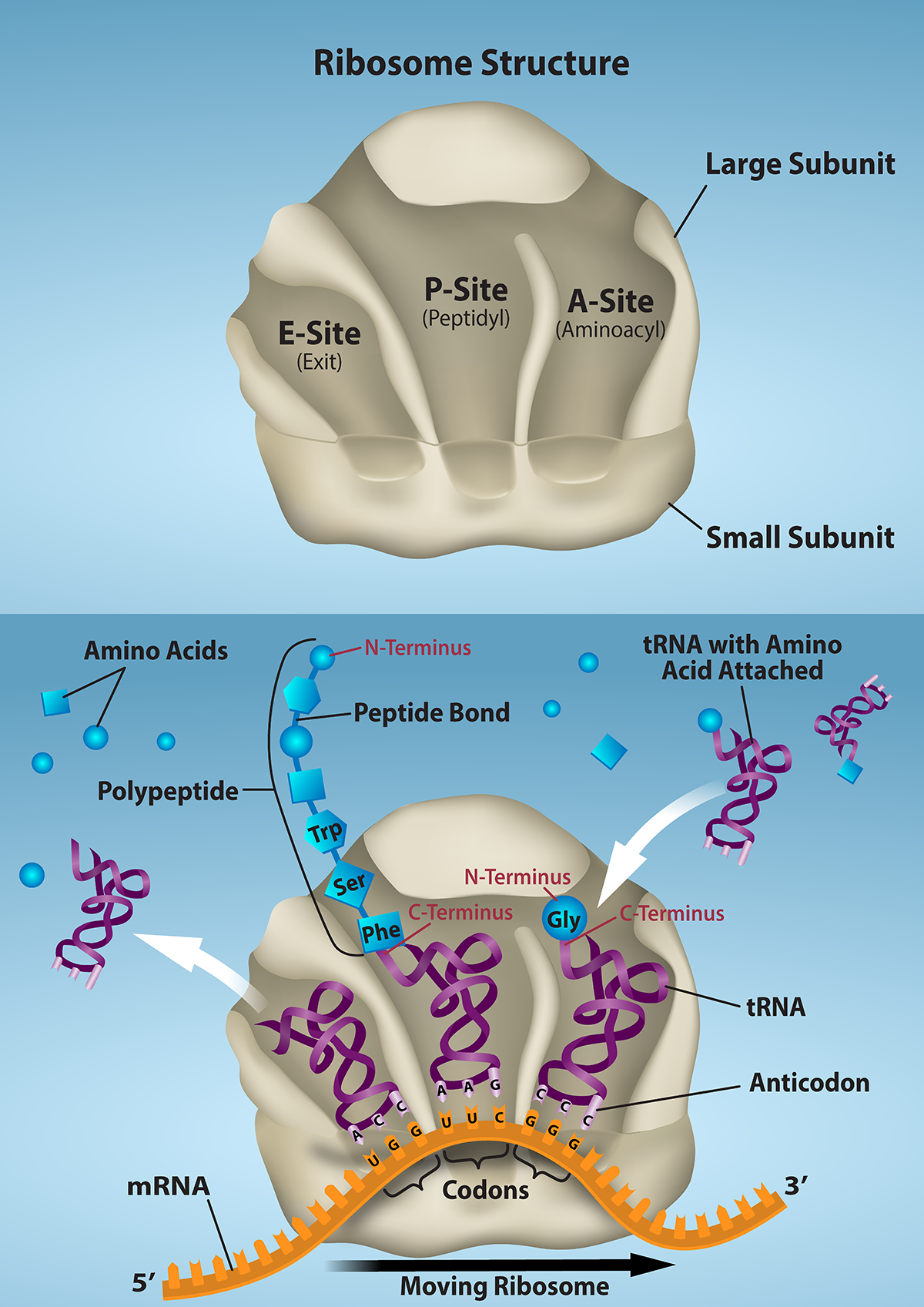
Anticodon

A triplet that pairs to an . The anticodon for 5′-AUG-3′ is aligned 3′-UAC-5′, or written 5′-CAU-3′.

Read explanation · NCBI Bookshelf / Garland Science ↗
Antiparallel

Running in opposite directions, as with two strands or neighboring strands in some .

Read explanation · OpenStax ↗
Apoptosis

A regulated process of cell death that removes cells in development, tissue maintenance, and responses to damage.

Read explanation · OpenStax ↗
Aqueous solution ·

A in which water is the .

Read explanation · OpenStax ↗
Archaea ·

A of distinct from , with characteristic chemistry and -expression machinery.

Read explanation · OpenStax ↗
Aromatic

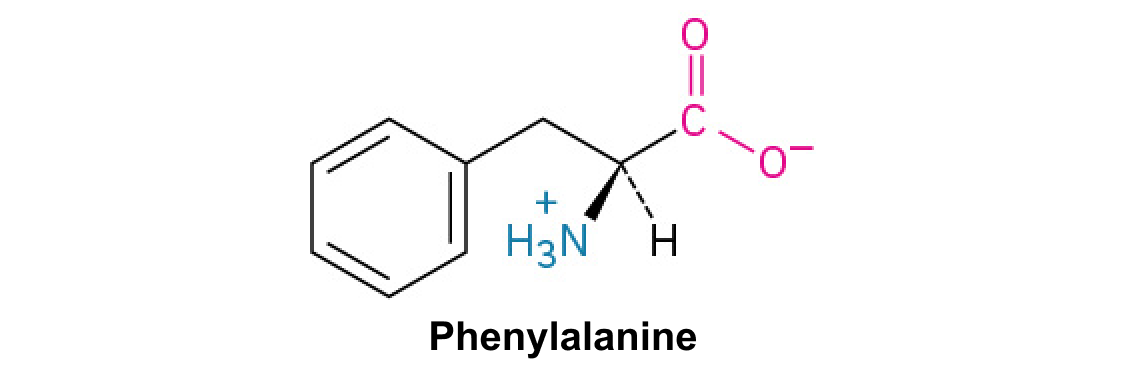
Containing a cyclic, with . , , and have aromatic .

Read explanation · OpenStax ↗
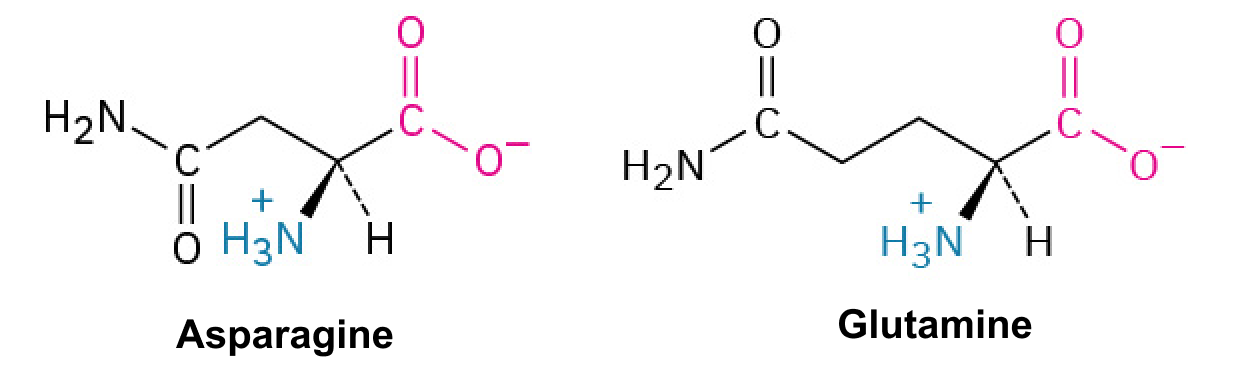
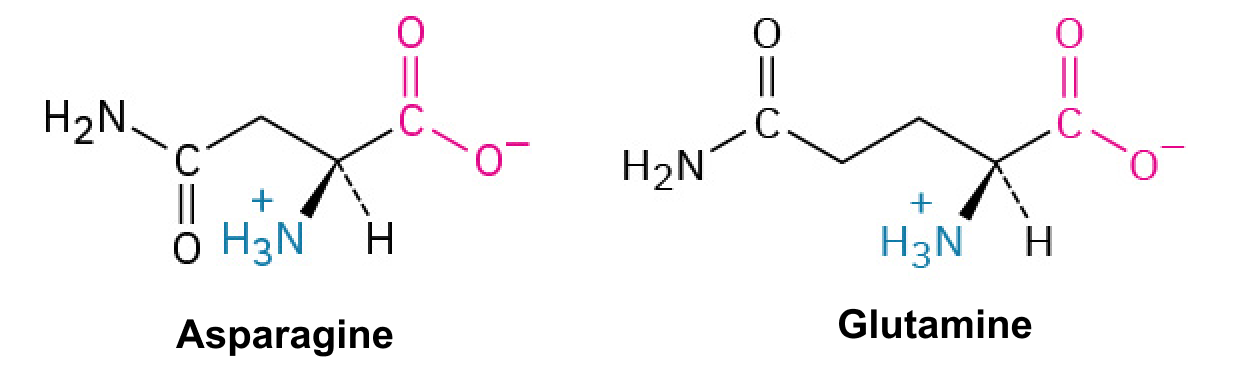
Asparagine ·

A , uncharged with an .

Read explanation · OpenStax ↗
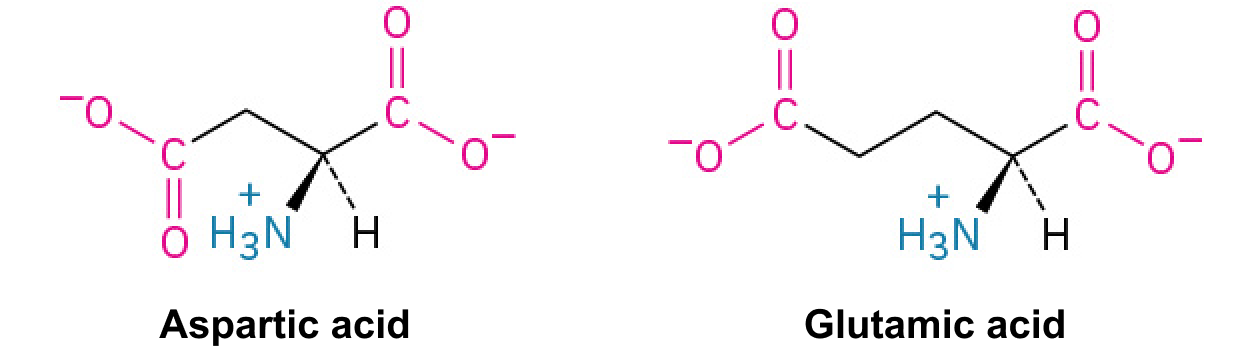
Aspartate · ·

An whose is usually negatively near physiological .

Read explanation · OpenStax ↗
Atom

The smallest unit of an element that retains its chemical identity; it has a surrounded by .

Read explanation · OpenStax ↗
ATP synthase

A rotary that commonly uses to synthesize from ADP and .

Read explanation · OpenStax ↗
attachment

Enduring emotional bond and expectations about another’s availability and responsiveness.

Read explanation · OpenStax ↗
Bacteria ·

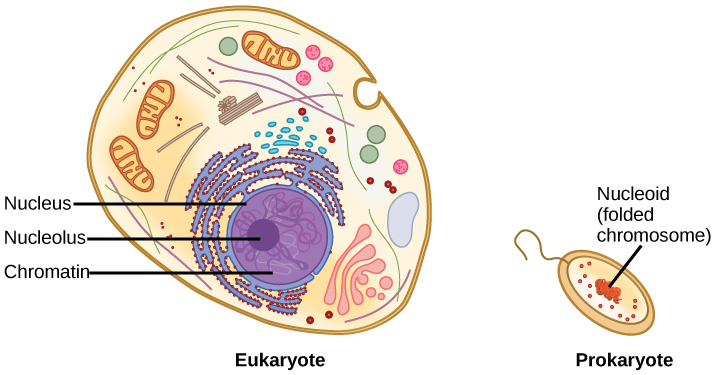
A of single-celled . Bacterial cells lack a -bound and are distinct from .

Read explanation · OpenStax ↗
Benzene ring

A six-carbon ring with .

Read explanation · OpenStax ↗
Benzyl group

A attached through a –CH₂– group; part of ’s .

Read explanation · OpenStax ↗
Beta sheet · · · · · ·

A made of aligned segments connected by ; strands may be parallel or .

Read explanation · OpenStax ↗
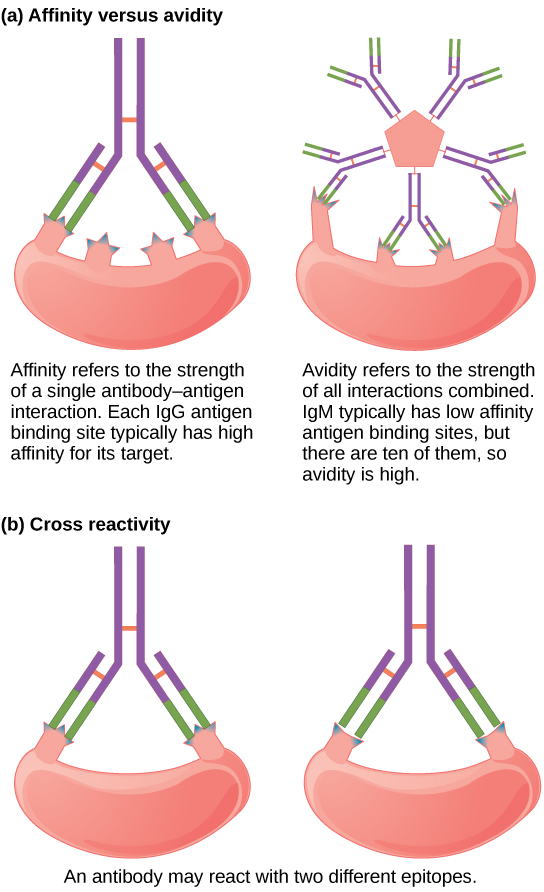
Binding affinity ·

The strength of a binding interaction between . For simple binding, a smaller means higher affinity.

Read explanation · OpenStax ↗
Binding site

A region of a where another interacts selectively.

Read explanation · OpenStax ↗
Biomolecule

A made by or involved in living systems, including , , , and .

Read explanation · OpenStax ↗
Biosynthesis

Formation of biological through cellular , such as synthesis of .

Read explanation · OpenStax ↗
biotin

A vitamin-derived carrying activated carbon dioxide in carboxylation .

Read explanation · Biology LibreTexts / Oregon State University ↗
Blotting ·

Transfer of separated or to a so a specific target can be detected.

Read explanation · Thermo Fisher ↗
Branch point ·

An site, usually containing , whose 2′-OH participates in forming the during spliceosomal .

Read explanation · NCBI Bookshelf / Garland Science ↗
Brønsted–Lowry base · · · · · · · · · · ·

In the Brønsted–Lowry model, a substance that can accept a . Basic solutions have lower activity than water.

Read explanation · OpenStax ↗
Buffer ·

A that resists changes when small amounts of or are added, commonly through a weak and its .

Read explanation · OpenStax ↗
Cancer

A group of diseases involving abnormal cells that can proliferate without normal restraints and invade tissues.

Read explanation · OpenStax ↗
Carbohydrate

A class of including sugars and their , used for energy storage, structure, and recognition.

Read explanation · OpenStax ↗
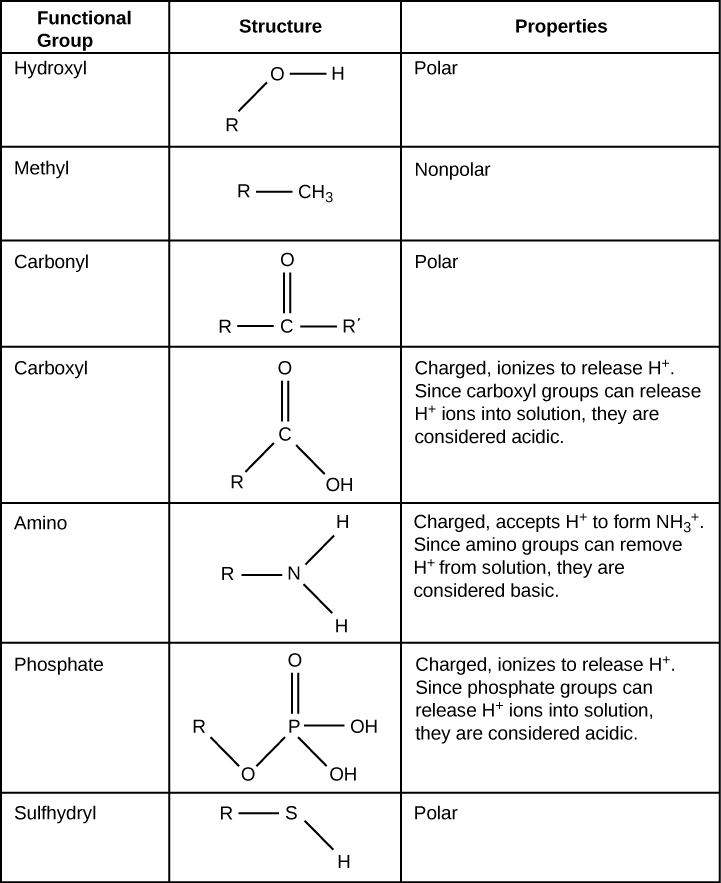
Carbonyl group · ·

A carbon double-bonded to oxygen, C=O; present in and many other .

Read explanation · OpenStax ↗
Carboxyl group · ·

An , COOH. In free it is usually to COO⁻ near physiological .

Read explanation · OpenStax ↗
Catalyst · ·

A substance that speeds a by providing a pathway with lower and is regenerated rather than consumed overall.

Read explanation · OpenStax ↗
Catalytic efficiency · ·

The ratio kcat/Km, describing performance at low . Units are ⁻¹ time⁻¹, commonly M⁻¹ s⁻¹.

Read explanation · IUBMB ↗
Cation ·

An with a positive net .

Read explanation · OpenStax ↗
Cellulose

A structural in plant cell walls, with beta-1,4 linkages; also used as a support.

Read explanation · OpenStax ↗
Centrifugation ·

Spinning a sample to accelerate separation of particles according to their behavior.

Read explanation · Beckman Coulter ↗
Chemical compound ·

A substance containing of two or more different chemically combined in a definite composition.

Read explanation · OpenStax ↗
Chemical element

A substance defined by having the same number of , such as carbon or oxygen.

Read explanation · OpenStax ↗
Chemical reaction ·

A process that rearranges and chemical bonds, converting into .

Read explanation · OpenStax ↗
Chloroplast

A photosynthetic in plants and algae with its own and -synthesis machinery.

Read explanation · OpenStax ↗
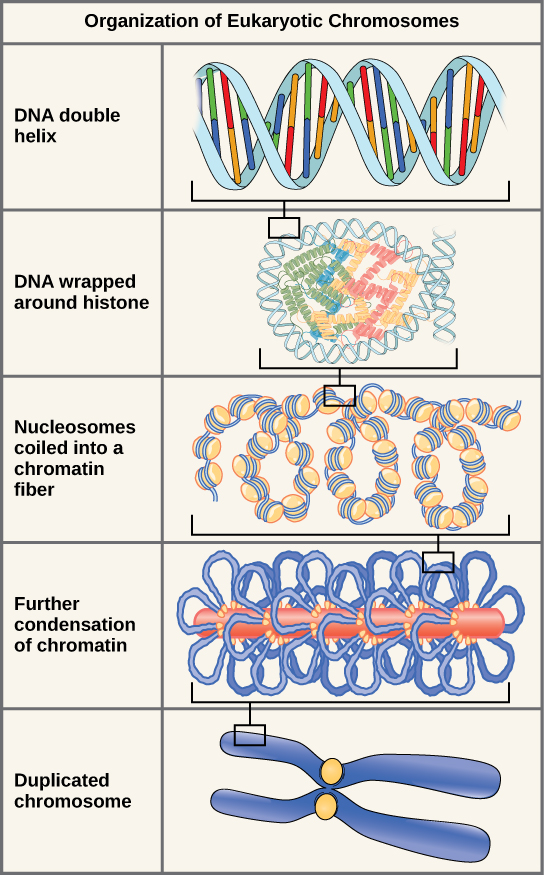
Chromatin

The complex of and associated , including , in .

Read explanation · OpenStax ↗
Chromatography

Separation of mixture components by their different interactions with a and a moving .

Read explanation · Waters ↗
Chromatography resin ·

The solid or beads in a column, often carrying chemical groups that determine separation behavior.

Read explanation · Cytiva ↗
Chromosome ·

An organized with associated that carries . A replicated chromosome has two .

Read explanation · OpenStax ↗
citrate

The six-carbon of with , also carrying acetyl units for synthesis.

Read explanation · OpenStax ↗
citric acid cycle ·

A cyclic pathway oxidizing acetyl units to CO2 while reducing carriers and regenerating .

Read explanation · OpenStax ↗
CoA

Coenzyme A, a -containing of activated acyl groups.

Read explanation · OpenStax ↗
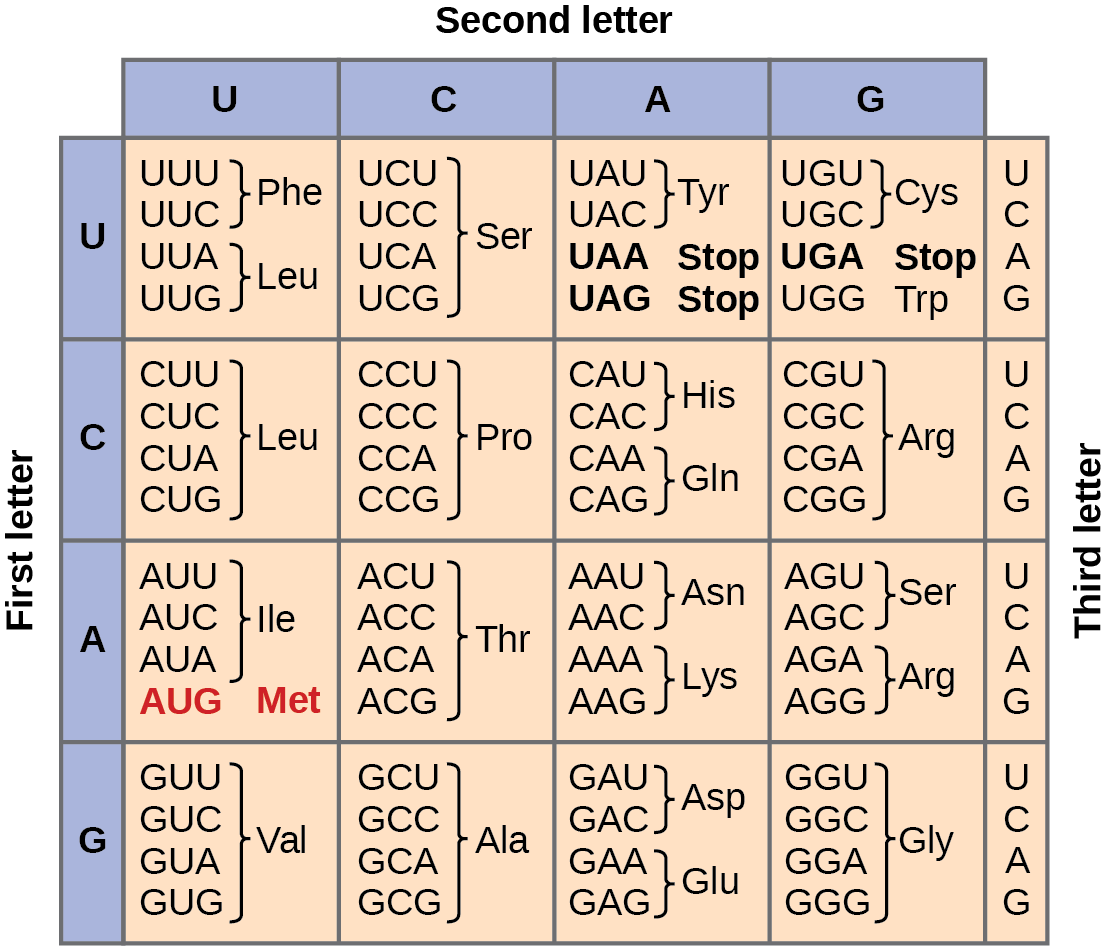
Codon

A sequence of three that specifies an or a stop signal.

Read explanation · OpenStax ↗
Coenzyme

An organic that helps an catalyze a , often by carrying or chemical groups.

Read explanation · OpenStax ↗
coenzyme Q

A - respiratory transferring to complex III.

Read explanation · OpenStax ↗
Cofactor

A nonprotein component needed for an to work, such as a metal or an organic .

Read explanation · OpenStax ↗
Concentration

The amount of a substance in a specified volume or mass of mixture.

Read explanation · OpenStax ↗
Conformation ·

A spatial arrangement accessible by rotations and other motions that do not require breaking .

Read explanation · NCBI Bookshelf ↗
conjugate base

Species formed when an loses one .

Read explanation · OpenStax ↗
Conjugated system ·

Adjacent orbitals that allow to be distributed across several , often through alternating single and multiple bonds.

Read explanation · OpenStax ↗
Cooperativity · ·

An interaction in which binding at one site changes binding at other sites. Positive cooperativity can produce a response.

Read explanation · Biology LibreTexts ↗
Cori cycle

Transfer of from peripheral to liver , followed by return of .

Read explanation · Biology LibreTexts / Oregon State University ↗
cortisol

An adrenal-cortex glucocorticoid regulating , stress responses, and immune activity.

Read explanation · OpenStax ↗
Covalent bond · ·

A bond in which share pairs. and are covalent.

Read explanation · OpenStax ↗
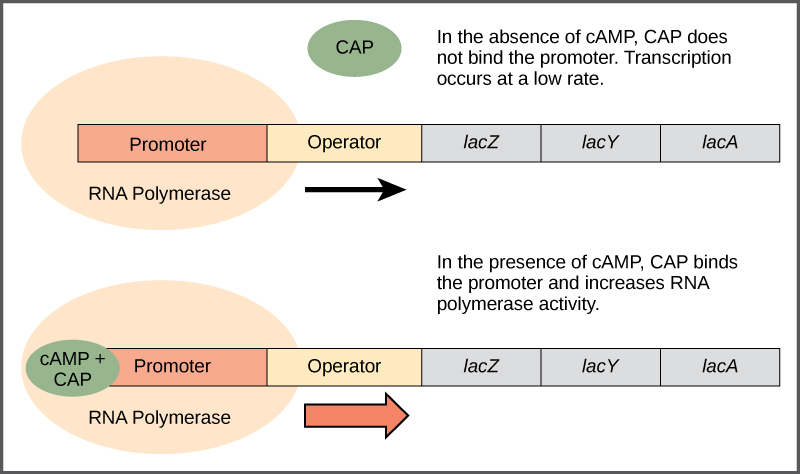
Cyclic AMP ·

A signal. In the simplified E. coli lac model, low raises cAMP, which activates CAP.

Read explanation · OpenStax ↗
cyclic nucleotide

whose forms a cyclic within its sugar, such as .

Read explanation · OpenStax ↗
Cysteine ·

An with a . Two cysteines can form a .

Read explanation · OpenStax ↗
cytochrome c

A small mobile heme carrying from respiratory complex III to IV and participating in when released into .

Read explanation · OpenStax ↗
Cytoplasm

Cell contents inside the plasma and outside the , where one is present.

Read explanation · OpenStax ↗
Cytosine

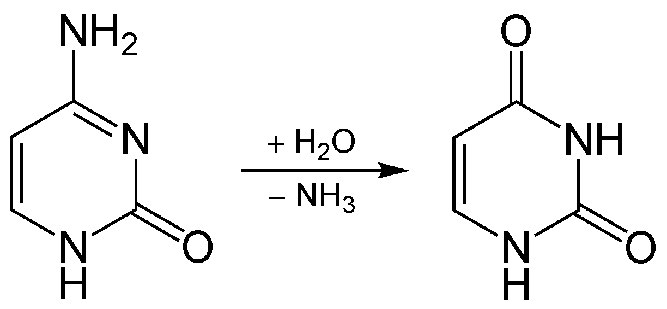
A in and that pairs with . can convert it to .

Read explanation · OpenStax ↗
Cytosol

The aqueous part of the outside -enclosed .

Read explanation · OpenStax ↗
Deamination

Removal of an . Deamination of produces and can change genetic information if unrepaired.

Read explanation · Biology LibreTexts / Oregon State University ↗
debranching enzyme

A -degrading with transfer and α(1→6)- activities.

Read explanation · Biology LibreTexts / Oregon State University ↗
decarboxylation

Loss of a carboxyl-derived carbon as carbon dioxide.

Read explanation · OpenStax ↗
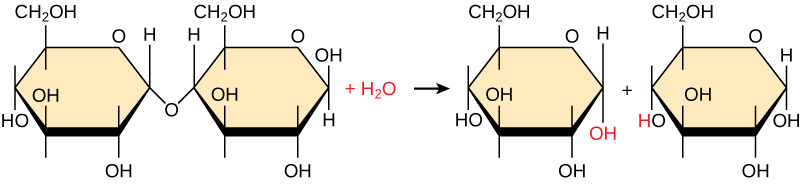
Dehydration synthesis

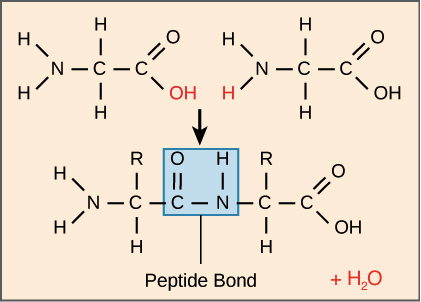
Joining with net removal of water; the overall used to depict formation.

Read explanation · OpenStax ↗
Density gradient

A fluid whose density varies with position, used to improve separation during .

Read explanation · Beckman Coulter ↗
Deoxyribonucleic acid

The that stores genetic information used to specify and sequences.

Read explanation · OpenStax ↗
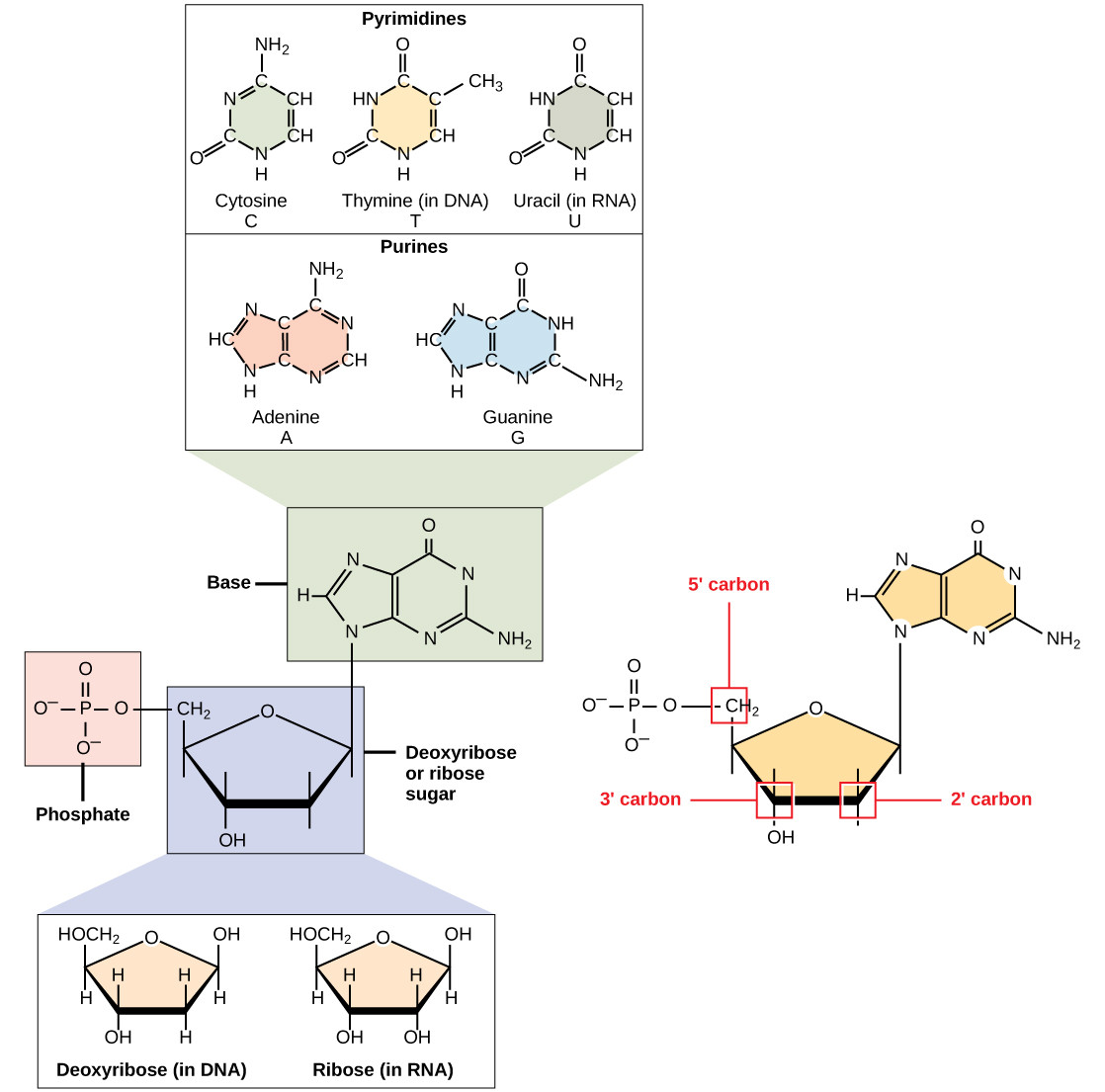
Deoxyribose

The five-carbon sugar in ; its 2′ carbon bears H instead of the found in .

Read explanation · OpenStax ↗
Deprotonation

Removal of a from a or group; this changes its by minus one.

Read explanation · OpenStax ↗
Detergent

An substance that can associate with both water and material; detergents can disrupt or interactions.

Read explanation · Thermo Fisher ↗
Diffusion

Net spreading of particles down a due to random molecular motion.

Read explanation · OpenStax ↗
Dissociation · ·

Separation of a chemical species or molecular complex into smaller components; dissociation releases a .

Read explanation · OpenStax ↗
Dissociation constant · ·

An for complex . For E + S ⇌ , Kd = [E]/[]; a smaller value indicates tighter binding under the stated conditions.

Read explanation · IUBMB ↗
Disulfide bond · · ·

A covalent sulfur–sulfur bond formed by of two , which can stabilize structure.

Read explanation · NCBI Bookshelf ↗
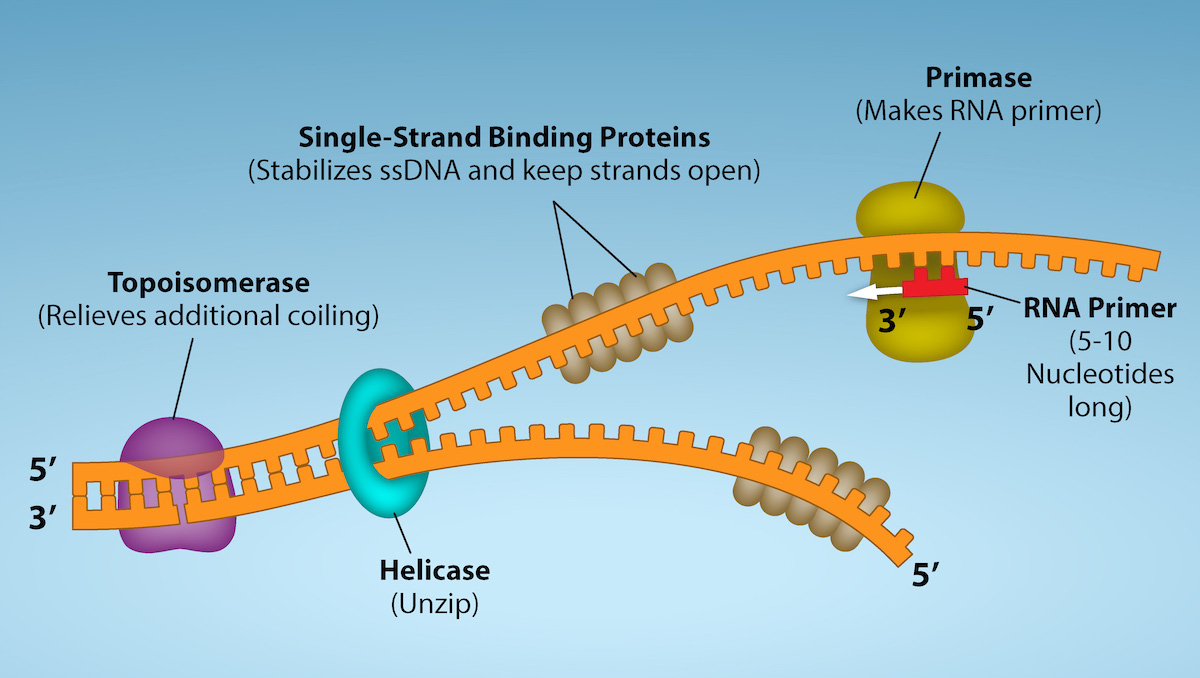
DNA polymerase ·

An that synthesizes 5′ to 3′ using a template and a with a free .

Read explanation · OpenStax ↗
DNA replication

Copying so genetic information can be passed to daughter cells. Each guides a complementary new strand.

Read explanation · OpenStax ↗
Effector

A that changes a ’s activity or binding behavior, often by stabilizing a particular .

Read explanation · Biology LibreTexts ↗
Electric charge · · ·

An electrical property that can be positive or negative. Opposite charges attract and like charges repel; net charge is the sum of all charges on a particle.

Read explanation · OpenStax ↗
Electric field

A quantity describing the electrical force per unit positive . An applied field drives through a gel during .

Read explanation · Thermo Fisher ↗
electrochemical gradient

The combined and electrical driving forces acting on an across space or a .

Read explanation · OpenStax ↗
Electron

A negatively subatomic particle. Electron sharing and transfer determine much of chemical bonding.

Read explanation · OpenStax ↗
Electron delocalization ·

Distribution of across several rather than confinement to one or bond.

Read explanation · OpenStax ↗
Electronegativity ·

An ’s tendency to attract shared in a chemical bond. Unequal attraction can make a bond .

Read explanation · OpenStax ↗
Electrophoresis

Movement of in an , used to separate through a support such as a gel.

Read explanation · Thermo Fisher ↗
Electrostatic interaction · ·

Attraction between opposite electrical or repulsion between like .

Read explanation · OpenStax ↗
Endocrine signaling ·

Communication in which enter the circulation and act on distant target cells.

Read explanation · OpenStax ↗
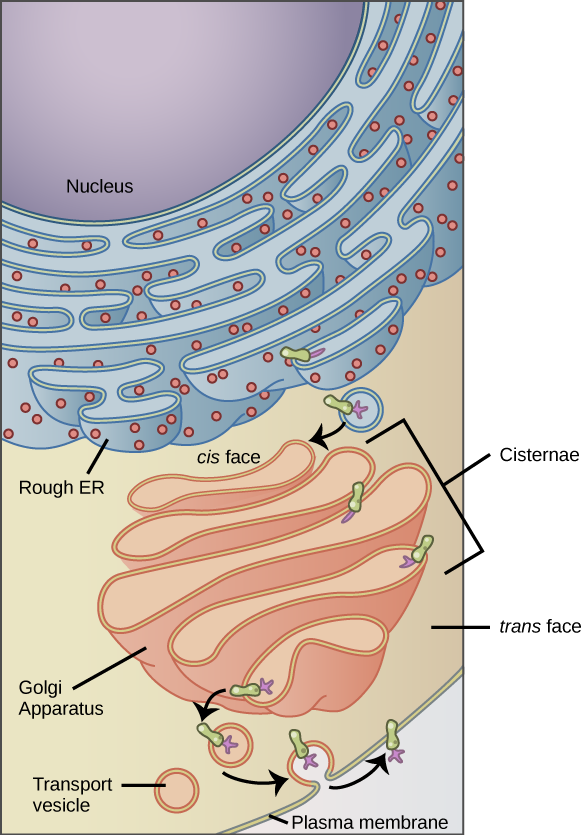
Endoplasmic reticulum

An interconnected network continuous with the ; it includes regions involved in processing and synthesis.

Read explanation · OpenStax ↗
enolase

The glycolytic dehydrating 2-phosphoglycerate to .

Read explanation · Biology LibreTexts / Oregon State University ↗
Entropy

A measure related to the number of accessible microscopic arrangements and the dispersal of energy.

Read explanation · OpenStax ↗
Enzyme

A biological that speeds a without being consumed. Most enzymes are .

Read explanation · OpenStax ↗
Enzyme inhibitor · ·

A substance that reduces activity. The binding mechanism and rate data determine whether inhibition is competitive, uncompetitive, mixed, or another type.

Read explanation · Biology LibreTexts ↗
Enzyme saturation · ·

The high- limit in which sites spend almost all their time processing and the rate approaches .

Read explanation · Biology LibreTexts ↗
Enzyme–inhibitor complex

The complex formed when an binds free . In the simple competitive model it cannot bind or produce .

Read explanation · Biology LibreTexts ↗
Enzyme–substrate complex · · ·

The bound association of an and its during a cycle. Often abbreviated ES in schemes.

Read explanation · OpenStax ↗
epithelium ·

A polarized sheet of closely connected cells that covers surfaces, lines cavities, or forms glands.

Read explanation · OpenStax ↗
Equilibrium

A state where opposing processes occur at equal rates, so macroscopic or other properties remain constant.

Read explanation · OpenStax ↗
Equilibrium constant

A ratio of to activities at , each raised to its stoichiometric coefficient. At a fixed temperature, a does not change this ratio.

Read explanation · OpenStax ↗
Eukaryote ·

An organism whose cells have a -enclosed ; animals, plants, fungi, and protists are eukaryotes.

Read explanation · OpenStax ↗
Exon

A segment retained in a mature spliced . In an exon may contain coding sequence, untranslated sequence, or both.

Read explanation · OpenStax ↗
Experimental control ·

A comparison sample or condition used to distinguish the effect being tested from other influences.

Read explanation · Thermo Fisher ↗
F1

The first filial generation, produced by crossing the parental generation.

Read explanation · OpenStax ↗
F2

The second filial generation, typically produced by crossing or selfing individuals.

Read explanation · OpenStax ↗
facilitated diffusion

Passive movement down an through a selective channel or .

Read explanation · OpenStax ↗
FACT complex ·

A -associated complex that helps machinery traverse and supports reorganization.

Read explanation · OpenStax ↗
FAD

Flavin dinucleotide, often an -bound capable of one- or two- chemistry.

Read explanation · OpenStax ↗
Fatty acid

A attached to a chain; fatty acids are components of many .

Read explanation · OpenStax ↗
fermentation

Regeneration of carriers by reducing organic without respiratory transport.

Read explanation · Biology LibreTexts / Oregon State University ↗
First-order kinetics

A rate dependence proportional to the first power of a . At low , a is approximately first-order in .

Read explanation · Biology LibreTexts ↗
Free-enzyme inhibition factor

The dimensionless factor α = 1 + / in the simple reversible-inhibition equation. It describes binding to free .

Read explanation · Biology LibreTexts ↗
fructose-1,6-bisphosphatase

A gluconeogenic hydrolyzing fructose-1,6-bisphosphate to fructose-6-.

Read explanation · Biology LibreTexts / Oregon State University ↗
fructose-2,6-bisphosphate

A regulatory metabolite that activates and inhibits .

Read explanation · Biology LibreTexts / Oregon State University ↗
fumarase

The citric-cycle hydrating fumarate to malate.

Read explanation · OpenStax ↗
Functional group

A group of whose chemical behavior gives a characteristic and properties.

Read explanation · OpenStax ↗
futile cycle

Simultaneous opposing pathway activity that consumes energy without corresponding net conversion of .

Read explanation · Biology LibreTexts / Oregon State University ↗
Galactose

A six-carbon monosaccharide released along with when is hydrolyzed.

Read explanation · OpenStax ↗
Gene

A sequence that contributes to a functional or , together with the information needed to express it.

Read explanation · OpenStax ↗
Gene expression

Production of a functional from a , including and, for -coding , .

Read explanation · NCBI Bookshelf ↗
Genome

The complete genetic material of an organism or cell.

Read explanation · OpenStax ↗
Gibbs free energy · ·

A quantity used to predict whether a process is favorable at constant temperature and pressure. A negative change favors the forward process.

Read explanation · OpenStax ↗
Gibbs free energy change · ·

The change in during a process. At constant temperature and pressure, a negative value favors the forward under the stated conditions; it does not specify speed.

Read explanation · OpenStax ↗
Glucagon

A pancreatic that helps raise , especially by promoting release from the liver.

Read explanation · OpenStax ↗
glucogenic

Describing a whose carbon can contribute to net synthesis in humans.

Read explanation · OpenStax ↗
glucokinase

A -phosphorylating with important liver and pancreatic sensing functions.

Read explanation · Biology LibreTexts / Oregon State University ↗
gluconeogenesis

Synthesis of from noncarbohydrate precursors, using bypass for irreversible glycolytic steps.

Read explanation · Biology LibreTexts / Oregon State University ↗
Glucose

A six-carbon sugar that is a major cellular energy source and a building block of , , and .

Read explanation · OpenStax ↗
glucose-6-phosphatase

An allowing release of free from -6-, important in liver and kidney output.

Read explanation · Biology LibreTexts / Oregon State University ↗
Glutamate · ·

An whose is usually negatively near physiological .

Read explanation · OpenStax ↗
Glutamine ·

A , uncharged with an one carbon longer than ’s.

Read explanation · OpenStax ↗
glutathione

A small –– whose reduced form supports cellular redox protection.

Read explanation · Biology LibreTexts / Oregon State University ↗
glyceraldehyde-3-phosphate dehydrogenase

The glycolytic that oxidizes glyceraldehyde-3- while producing and 1,3-bisphosphoglycerate.

Read explanation · Biology LibreTexts / Oregon State University ↗
Glycerol

A three-carbon alcohol with three ; used in sample to increase density and in some .

Read explanation · OpenStax ↗
Glycine ·

The smallest ; its is hydrogen. It is and allows substantial flexibility.

Read explanation · OpenStax ↗
glycogen

A highly branched used for storage in animals.

Read explanation · Biology LibreTexts / Oregon State University ↗
glycogen phosphorylase

The releasing -1- from by phosphorolysis.

Read explanation · Biology LibreTexts / Oregon State University ↗
glycogen synthase

The extending chains with α(1→4)-linked from .

Read explanation · Biology LibreTexts / Oregon State University ↗
glycogenin

A self-glucosylating that provides a for synthesis.

Read explanation · Biology LibreTexts / Oregon State University ↗
glycolysis

A pathway converting to with net production of and .

Read explanation · Biology LibreTexts / Oregon State University ↗
Glycosidic bond

A involving a sugar’s . In a , an N-glycosidic bond links the sugar to the .

Read explanation · Biology LibreTexts / Oregon State University ↗
Gradient

A change in a quantity, such as , , or density, across a distance or over time.

Read explanation · Thermo Fisher ↗
Guanine

A that pairs with through three .

Read explanation · OpenStax ↗
Guanosine diphosphate

A with two phosphates, produced when is hydrolyzed by many signaling and factors.

Read explanation · The International Journal of Biochemistry & Cell Biology / PubMed ↗
Guanosine triphosphate

A -containing whose supports factor-driven steps in and other cellular processes.

Read explanation · OpenStax ↗
Half-life

The time required for half of a population or amount to remain during decay; a constant half-life is characteristic of decay.

Read explanation · OpenStax ↗
hemiacetal

Carbon bonded to both and alkoxy groups, usually formed by alcohol addition to a .

Read explanation · OpenStax ↗
Hemoglobin

The oxygen-carrying in , composed of four with heme groups.

Read explanation · OpenStax ↗
heterotroph

An organism obtaining carbon from organic .

Read explanation · OpenStax ↗
hexokinase

An that uses to phosphorylate and certain other hexoses.

Read explanation · Biology LibreTexts / Oregon State University ↗
Histone

A -associated rich in . Core histones form the around which nucleosomal wraps.

Read explanation · OpenStax ↗
Hormone

A chemical messenger released by cells that changes the activity of target cells with matching .

Read explanation · OpenStax ↗
hydride

Formally H⁻; hydride-transfer reagents or deliver a hydrogen with an pair.

Read explanation · OpenStax ↗
Hydrocarbon · ·

A made only of carbon and hydrogen. Hydrocarbon regions are generally .

Read explanation · OpenStax ↗
Hydrogen bond ·

An attraction between a hydrogen bonded to an and another . hydrogen bonds stabilize .

Read explanation · OpenStax ↗
Hydrogen ion · ·

A positively hydrogen species. H⁺ denotes a , which is hydrated in water; its activity determines .

Read explanation · OpenStax ↗
Hydrolysis

Breaking a chemical bond by adding water. hydrolysis separates .

Read explanation · OpenStax ↗
Hydrophilic

Interacting favorably with water, typically because a group is or .

Read explanation · OpenStax ↗
Hydrophobic

Interacting poorly with water. often gather in a ’s interior.

Read explanation · OpenStax ↗
Hydroxide ion ·

The negatively OH⁻. Basic contain a higher hydroxide ion activity than water at the same temperature.

Read explanation · OpenStax ↗
Hydroxyl group ·

An oxygen bonded to hydrogen, –OH. Hydroxyl groups can and often increase .

Read explanation · OpenStax ↗
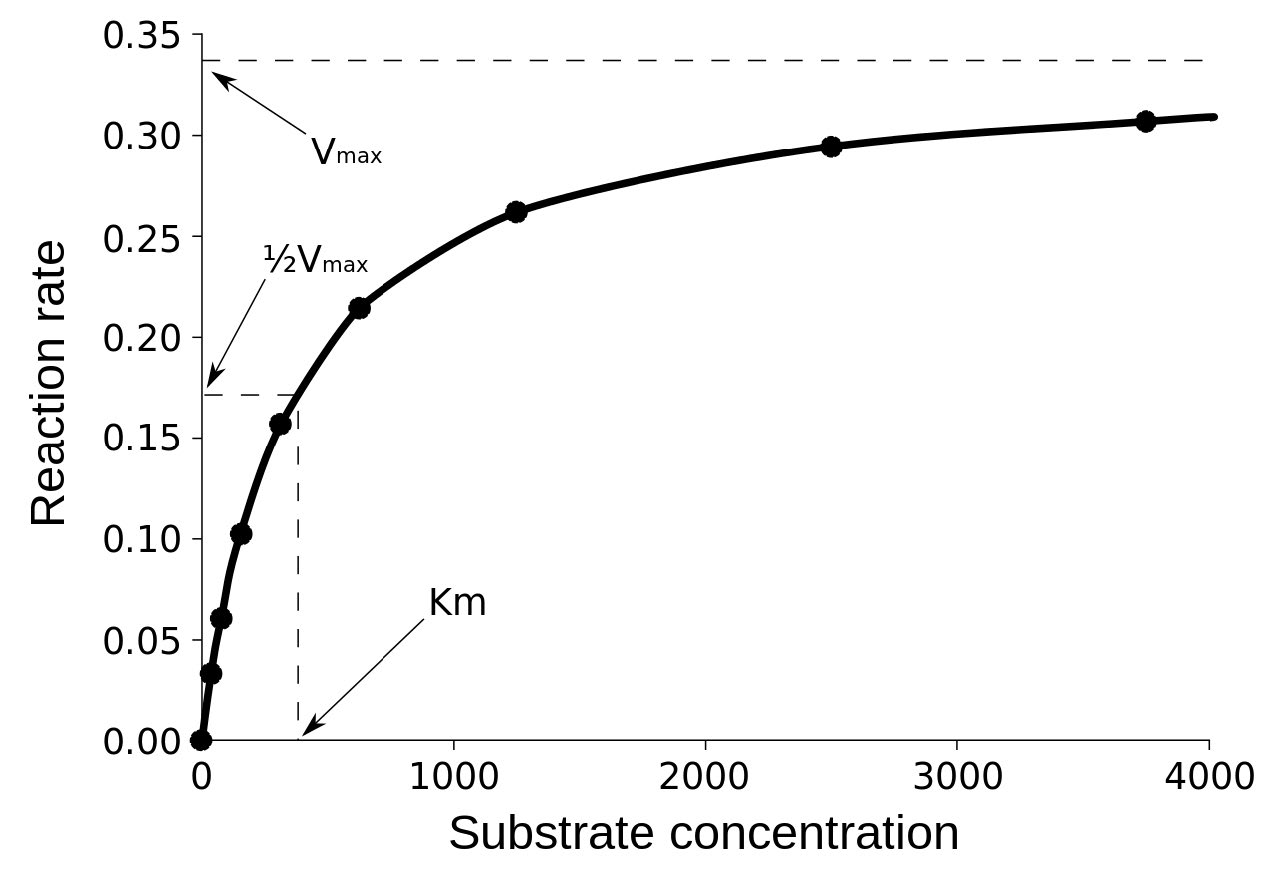
Hyperbolic curve ·

A curve that approaches an asymptote. The standard rate curve is a rectangular hyperbola approaching .

Read explanation · Biology LibreTexts ↗
hypoventilation

insufficient relative to CO2 production, tending to raise arterial CO2.

Read explanation · OpenStax ↗
Hypoxia

A state of reduced oxygen availability that can alter cellular stress signaling.

Read explanation · OpenStax ↗
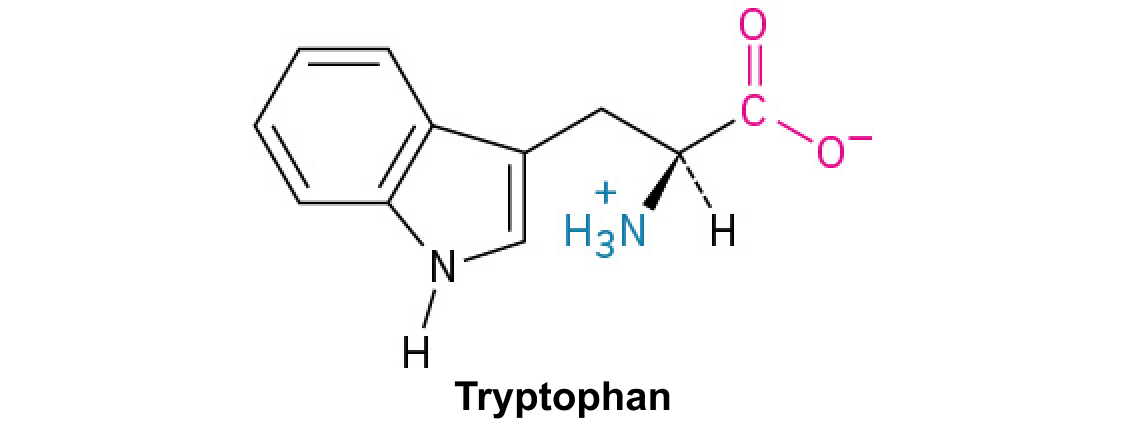
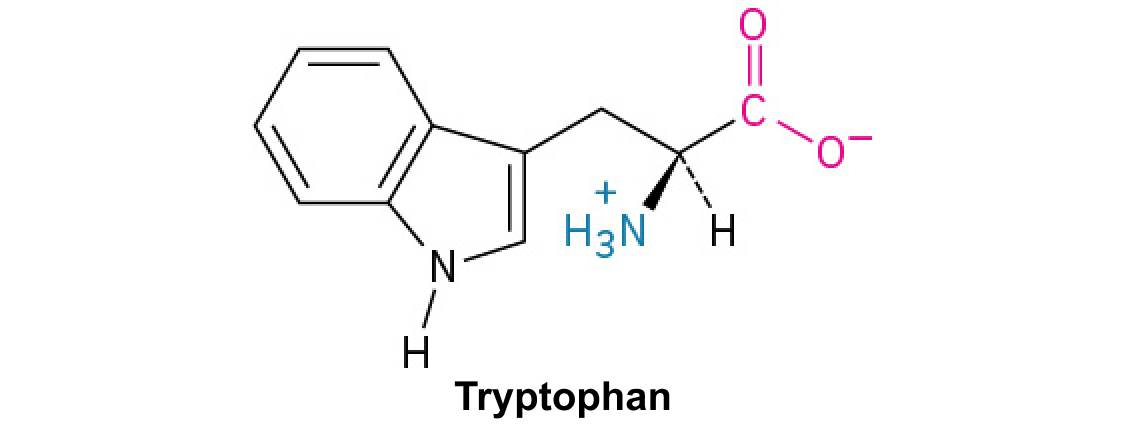
Indole

A fused six-membered and five-membered ring system containing nitrogen; found in .

Read explanation · OpenStax ↗
Inducer

A signal that increases expression of a regulated ; does so by disabling the .

Read explanation · OpenStax ↗
Inhibitor concentration

The of free in an inhibition model. It is held fixed while is varied in a standard inhibition experiment.

Read explanation · Biology LibreTexts ↗
Inhibitor dissociation constant ·

For the simple inhibition scheme, Ki describes binding to free : Ki = [E]/[]. Smaller values indicate tighter binding.

Read explanation · Biology LibreTexts ↗
Initial reaction rate · · · ·

The early rate of formation, measured before substantial depletion or accumulation, usually after the brief binding transient.

Read explanation · Biology LibreTexts ↗
Insulin

A from that lowers by promoting uptake and storage and reducing production.

Read explanation · OpenStax ↗
Intron ·

A segment removed from a precursor during . Intronic signals or regulatory sequences can affect .

Read explanation · OpenStax ↗
Ion · ·

An or with a net because its numbers of and do not balance.

Read explanation · OpenStax ↗
isocitrate dehydrogenase

An oxidatively decarboxylating isocitrate to .

Read explanation · OpenStax ↗
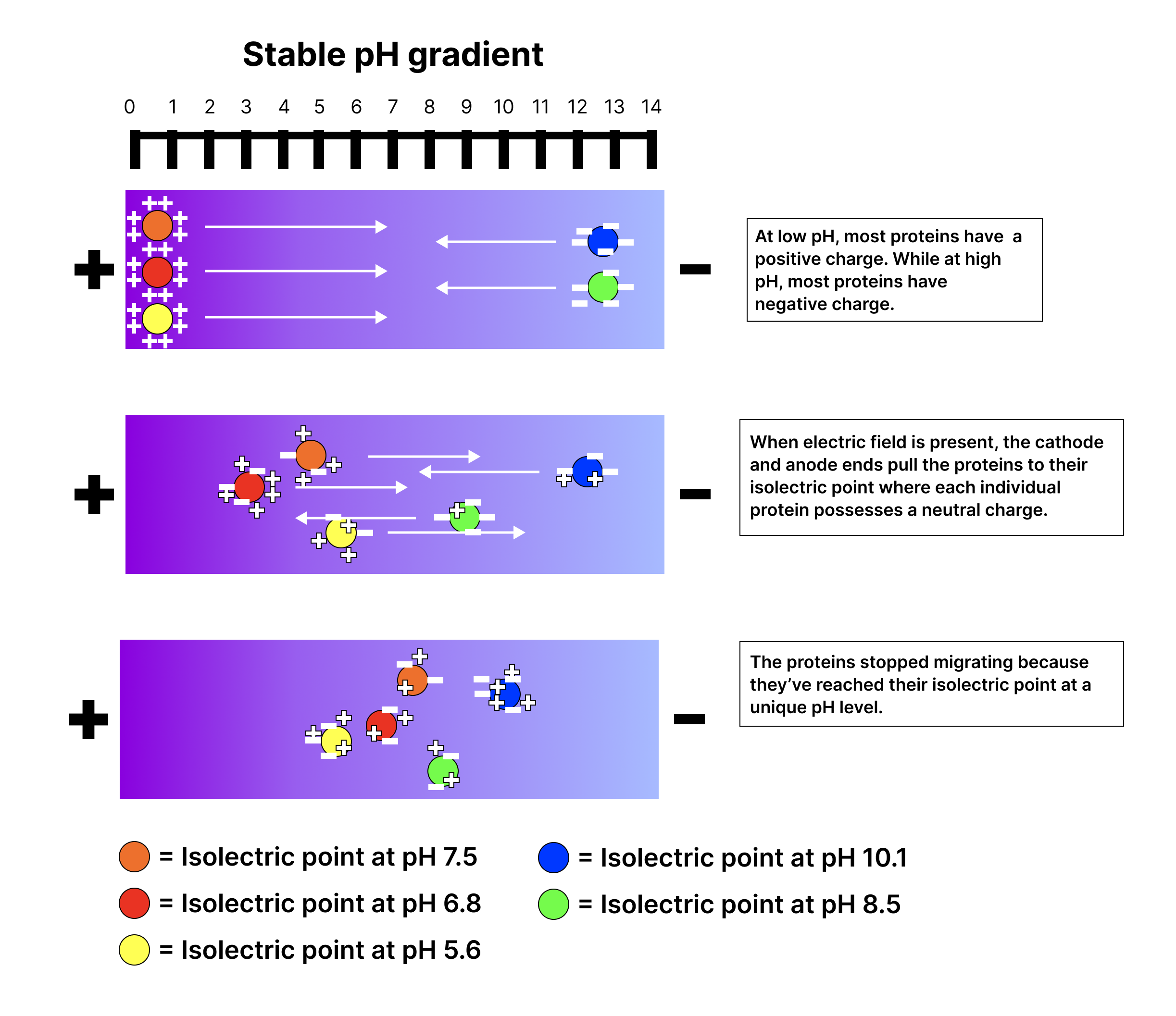
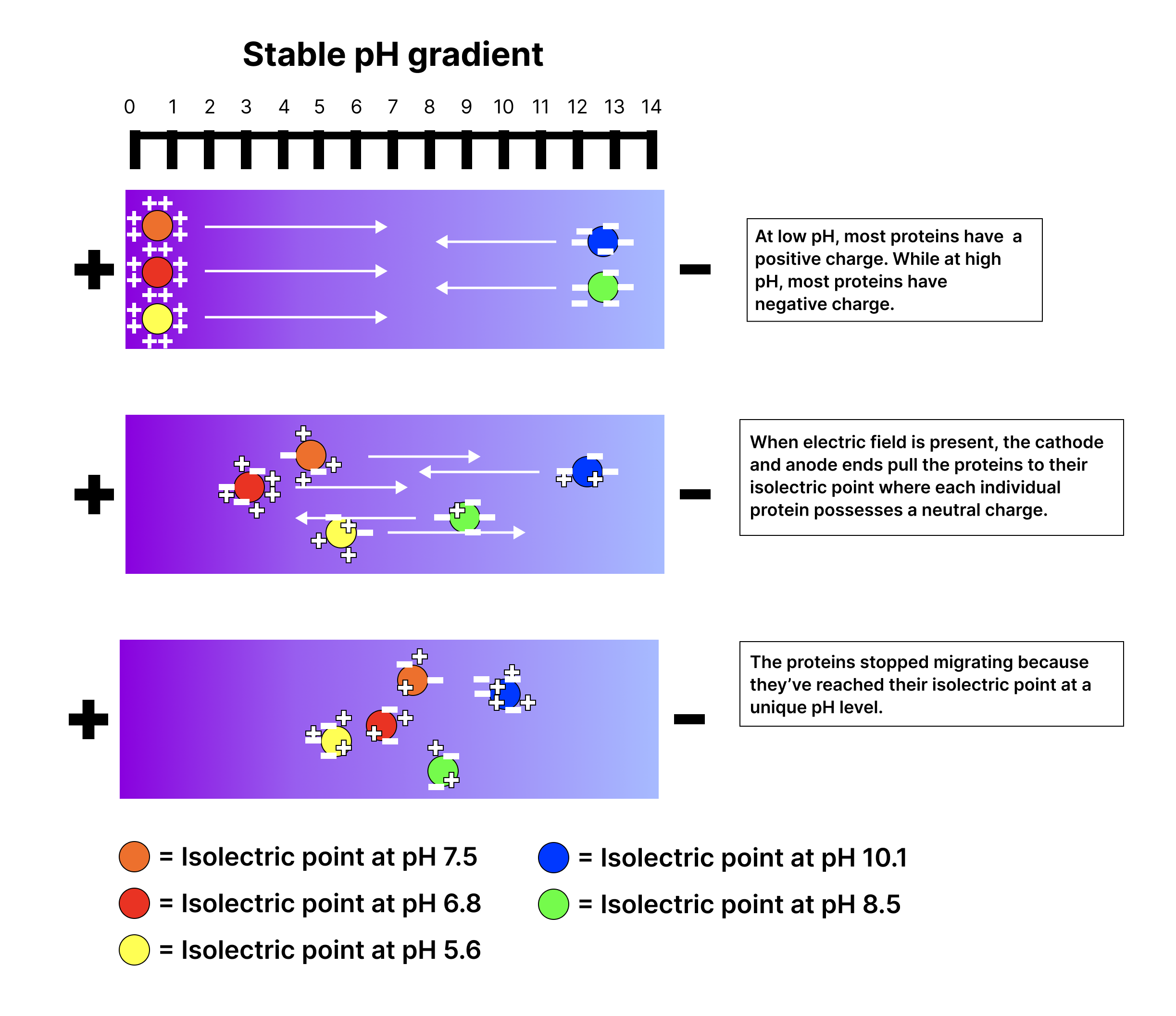
Isoelectric focusing

Separation of in a by their . A stops migrating where it has no net .

Read explanation · Thermo Fisher ↗
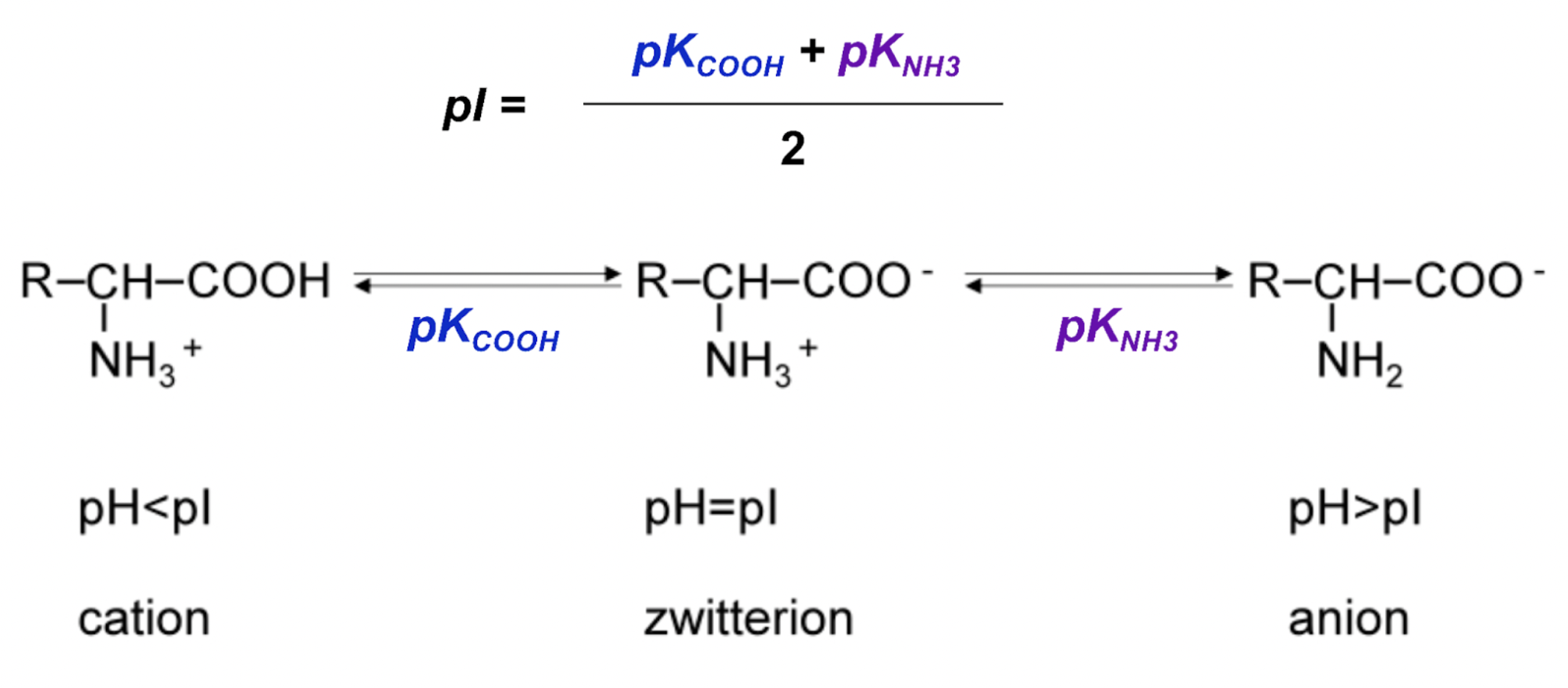
Isoelectric point ·

The at which a has zero net . In , a accumulates where local equals its pI.

Read explanation · OpenStax ↗
Isoform

One of several related or forms produced from a , for example through .

Read explanation · OpenStax ↗
Isoleucine ·

A with a branched .

Read explanation · OpenStax ↗
isomerase

An rearranging a into an isomer.

Read explanation · OpenStax ↗
ketone bodies

Acetoacetate, β-hydroxybutyrate, and acetone, produced mainly by liver during increased fatty- .

Read explanation · Biology LibreTexts / Oregon State University ↗
ketose

A monosaccharide with a ketone in its open-chain form.

Read explanation · OpenStax ↗
Kilojoule ·

A unit of energy equal to 1,000 joules. Energy changes are often reported per , in kJ/mol.

Read explanation · NIST ↗
Kinase ·

An that transfers a , often from , to a target .

Read explanation · Thermo Fisher ↗
Kinetics

The study of and the factors and mechanisms that control them. A favorable may still proceed slowly.

Read explanation · OpenStax ↗
Lac operon

The E. coli containing , , and , controlled by repression and CAP– activation.

Read explanation · OpenStax ↗
Lac repressor

The encoded by lacI; it binds lac and represses until an reduces its binding.

Read explanation · OpenStax ↗
lacA

The encoding a galactoside .

Read explanation · OpenStax ↗
lactate

The predominant form of lactic at physiological , produced from by .

Read explanation · Biology LibreTexts / Oregon State University ↗
lactate dehydrogenase

The interconverting and while interconverting and .

Read explanation · Biology LibreTexts / Oregon State University ↗
lactone

Cyclic ester.

Read explanation · OpenStax ↗
Lactose

A disaccharide containing and ; its use by E. coli is supported by .

Read explanation · OpenStax ↗
Lactose permease

The transport that couples uptake to movement.

Read explanation · OpenStax ↗
lacY

The encoding , which transports into the cell.

Read explanation · OpenStax ↗
lacZ

The encoding , often used as an experimental .

Read explanation · OpenStax ↗
Lariat ·

The branched, loop-shaped intermediate formed when an ’s joins the .

Read explanation · NCBI Bookshelf / Garland Science ↗
Leucine ·

A , with a branched .

Read explanation · OpenStax ↗
Ligand

A or that binds to a particular site on another , such as a or metal .

Read explanation · Cytiva ↗
linkage

A tendency of nearby on the same to be inherited together.

Read explanation · OpenStax ↗
Lipid

A broad class of largely or , including fats, , and steroids.

Read explanation · OpenStax ↗
lipoamide

A covalently attached acyl- and -transfer used in oxidative complexes.

Read explanation · OpenStax ↗
lipolysis

of stored to release and .

Read explanation · Biology LibreTexts / Oregon State University ↗
locus

The specific position of a or other feature.

Read explanation · OpenStax ↗
Logarithm · · ·

The exponent needed to obtain a number from a chosen fixed number. For decimal logarithms, log₁₀(100) = 2 because 10² = 100; uses the negative decimal logarithm of activity.

Read explanation · OpenStax ↗
lyase

An catalyzing nonhydrolytic, nonoxidative bond cleavage or the reverse addition .

Read explanation · OpenStax ↗
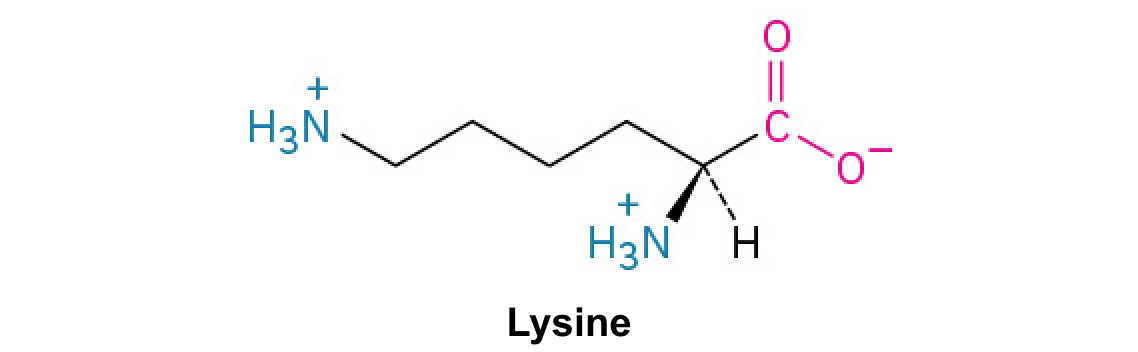
Lysine ·

A with a terminal , usually positively near physiological .

Read explanation · OpenStax ↗
Lysosome

An -enclosed compartment that uses hydrolytic to digest and recycle cellular material.

Read explanation · OpenStax ↗
Matrix

A supporting material, such as a gel or the solid support in a column. Its properties influence movement and binding of sample .

Read explanation · Thermo Fisher ↗
Maximum reaction rate · ·

The limiting as becomes saturating. For a fixed under given conditions, Vmax = times .

Read explanation · Biology LibreTexts ↗
Membrane · · · ·

A thin boundary or sheet. Cell membranes are bilayers containing ; membranes are synthetic supports that hold or for detection.

Read explanation · OpenStax ↗
Messenger RNA ·

An that carries coding information used by to synthesize a .

Read explanation · OpenStax ↗
Metabolic pathway

A sequence of linked chemical , usually each catalyzed by an .

Read explanation · OpenStax ↗
Metabolism

The chemical that build , break them down, and transform energy in a living system.

Read explanation · OpenStax ↗
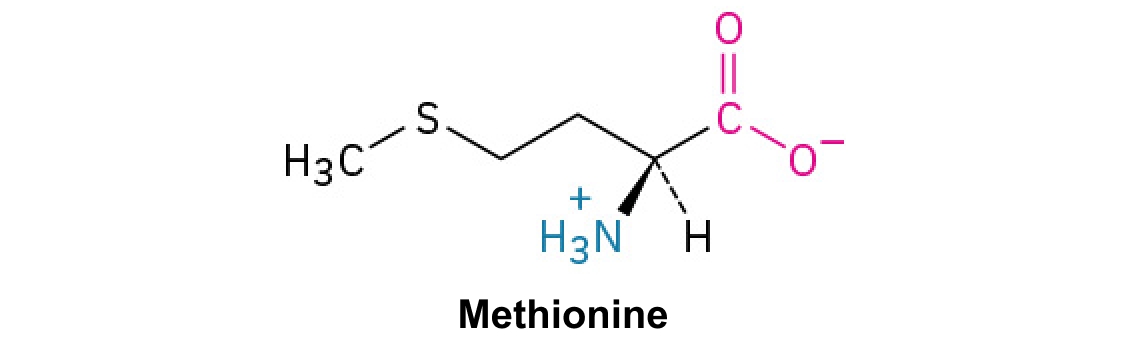
Methionine ·

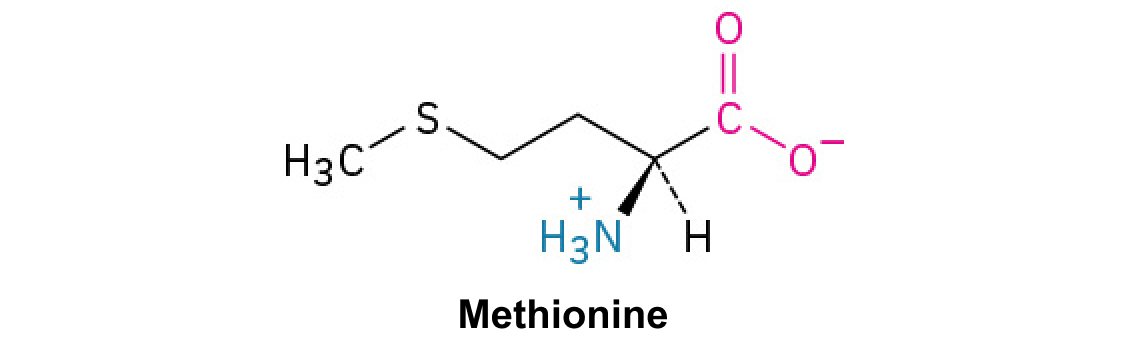
A with sulfur in a . Unlike , it does not form .

Read explanation · OpenStax ↗
Methyl group ·

A –CH₃ group, consisting of one carbon bonded to three hydrogens.

Read explanation · OpenStax ↗
Michaelis constant · ·

The at half for a . It has units and is not generally an .

Read explanation · IUBMB ↗
Michaelis–Menten kinetics · ·

A model with = [S]/( + ). Its curve is ; may require a different model.

Read explanation · Biology LibreTexts ↗
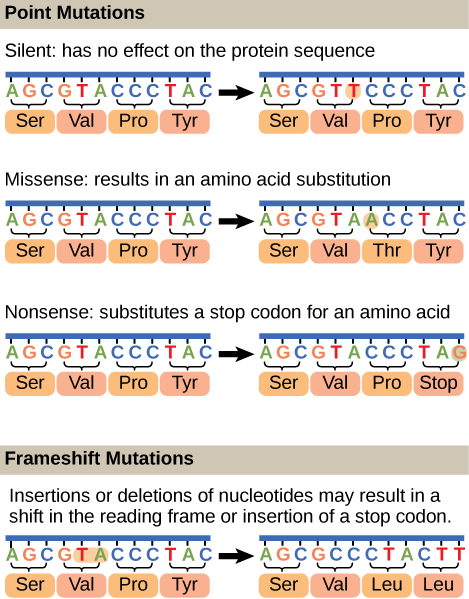
Missense mutation ·

A coding-sequence that changes the specified ; its effect depends on the and context.

Read explanation · OpenStax ↗
Mitochondrion ·

A with its own , central to aerobic production and several other processes.

Read explanation · OpenStax ↗
Mobile phase

The moving fluid that carries a sample through a system.

Read explanation · Waters ↗
mole

Amount containing exactly 6.02214076 × 10²³ specified entities.

Read explanation · OpenStax ↗
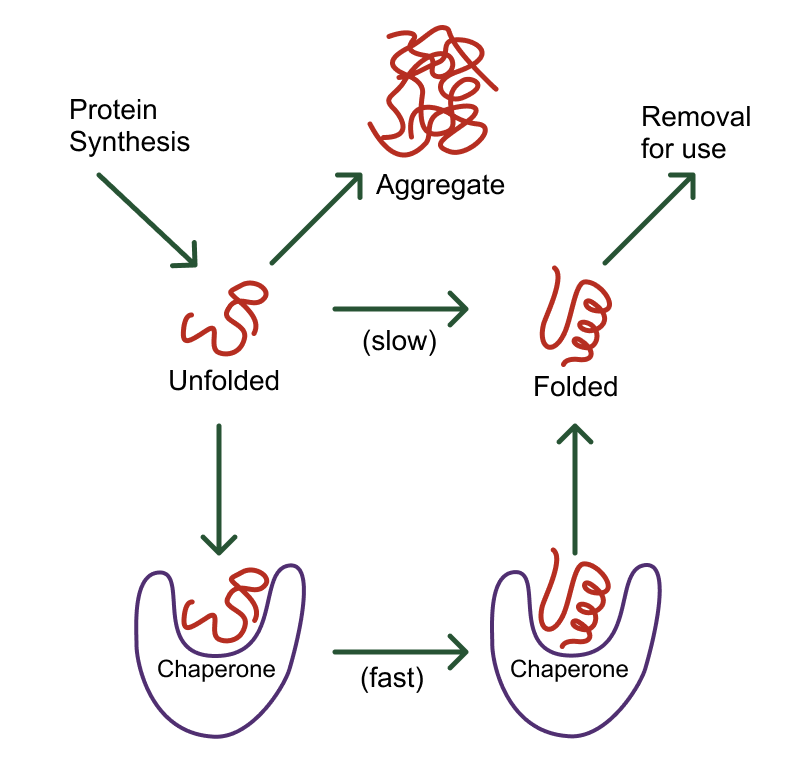
Molecular chaperone · ·

A that assists other in folding or prevents , without specifying their sequence.

Read explanation · NCBI Bookshelf ↗
Molecule

Two or more joined by . A molecule may be electrically or carry a .

Read explanation · OpenStax ↗
Mutation

A change in a sequence; some mutations alter a ’s sequence.

Read explanation · OpenStax ↗
NAD+

nicotinamide dinucleotide, a that accepts a equivalent to become .

Read explanation · OpenStax ↗
NADH

Reduced nicotinamide dinucleotide, commonly carrying fuel-derived toward respiratory .

Read explanation · OpenStax ↗
NADP+

The -containing nicotinamide reduced to ; distinguish it from .

Read explanation · OpenStax ↗
NADPH

A reduced commonly used in reductive and antioxidant defense.

Read explanation · OpenStax ↗
Native structure · · ·

A ’s functional folded arrangement under its normal conditions.

Read explanation · NCBI Bookshelf ↗
Neutral

Having no net . For a , neutral instead means equal and activities; its is about 7 at 25 °C.

Read explanation · OpenStax ↗
Nitrogenous base · · ·

A nitrogen-containing ring component of ; its pairing interactions help specify sequences.

Read explanation · OpenStax ↗
Noncovalent interaction · · ·

An interaction that does not create a shared- , such as attraction or .

Read explanation · OpenStax ↗
Nonpolar ·

Lacking a substantial separation of . Nonpolar groups generally interact poorly with water.

Read explanation · OpenStax ↗
Nonsense mutation ·

A that converts an amino- into a premature , potentially truncating the or destabilizing its .

Read explanation · OpenStax ↗
Nuclear envelope

The double enclosing the and continuous with the .

Read explanation · OpenStax ↗
Nucleic acid

A of , such as or , used in information storage, expression, and other cellular functions.

Read explanation · OpenStax ↗
Nucleosome

The basic unit of : wrapped around a .

Read explanation · OpenStax ↗
Nucleotide

A joined to a sugar and one or more .

Read explanation · OpenStax ↗
Nucleus ·

A -enclosed compartment containing most of a cell’s .

Read explanation · OpenStax ↗
obligate anaerobe

An organism that grows without oxygen and is harmed by oxygen under its normal growth conditions.

Read explanation · OpenStax ↗
Octamer

A complex made of eight . A core contains eight .

Read explanation · OpenStax ↗
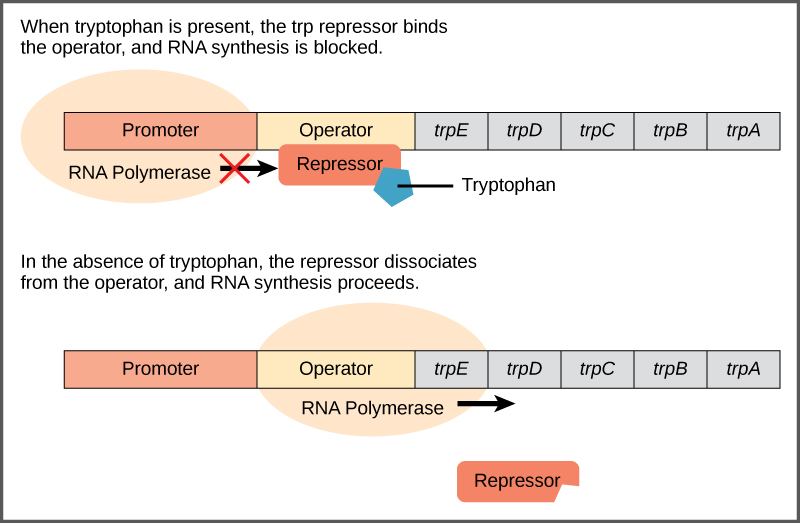
Operator · ·

A regulatory sequence bound by a , often overlapping or near a .

Read explanation · OpenStax ↗
Operon

A group of from a shared into one , with regulatory that coordinates their expression.

Read explanation · OpenStax ↗
Organelle ·

A specialized structure within a cell that carries out particular functions, such as a or .

Read explanation · OpenStax ↗
overexpression

Production of a above its usual level in the relevant context.

Read explanation · OpenStax ↗
oxaloacetate

A four-carbon citric-cycle intermediate that condenses with and participates in .

Read explanation · OpenStax ↗
Oxidation ·

Loss of or an increase in oxidation state. Oxidizing two can form a .

Read explanation · OpenStax ↗
oxidative phosphorylation

synthesis driven by a generated through respiratory transfer.

Read explanation · OpenStax ↗
oxidoreductase

An catalyzing an – .

Read explanation · OpenStax ↗
Pancreatic beta cell ·

An cell in a pancreatic islet that secretes .

Read explanation · OpenStax ↗
Pentose

A sugar with five carbon , such as or .

Read explanation · OpenStax ↗
pentose phosphate pathway

A pathway providing and sugars through oxidative and reversible carbon-rearrangement .

Read explanation · Biology LibreTexts / Oregon State University ↗
PEP carboxykinase ·

The gluconeogenic converting to using .

Read explanation · Biology LibreTexts / Oregon State University ↗
Peptide

A chain of joined by ; the term commonly describes chains shorter than a typical .

Read explanation · OpenStax ↗
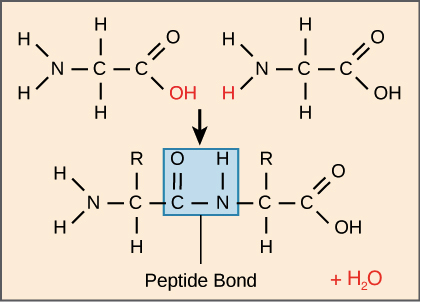
Peptide bond ·

A covalent between the carboxyl carbon of one and the amino nitrogen of the next.

Read explanation · OpenStax ↗
Peptide hormone

An amino--based chemical messenger released by ; and are examples.

Read explanation · OpenStax ↗
peptidoglycan

A wall of sugar chains cross-linked by short .

Read explanation · OpenStax ↗
peripheral nervous system

Nerves and ganglia outside the brain and spinal cord.

Read explanation · OpenStax ↗
PFK-1

Phosphofructokinase-1, the glycolytic converting fructose-6- to fructose-1,6-bisphosphate using .

Read explanation · Biology LibreTexts / Oregon State University ↗
pH

A measure of , defined as the negative of activity. Lower pH means greater ; pH influences .

Read explanation · OpenStax ↗
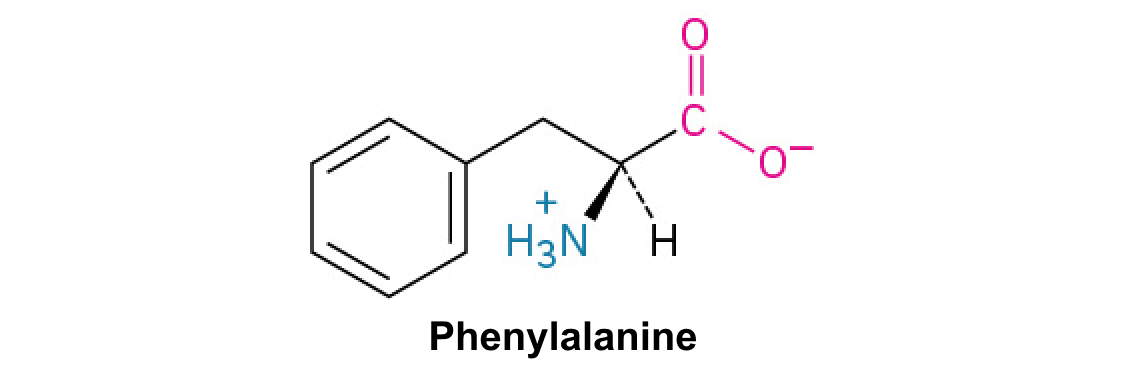
Phenylalanine ·

A with an .

Read explanation · OpenStax ↗
phosphatase

An removing a by .

Read explanation · OpenStax ↗
Phosphate group ·

A phosphorus-containing group bonded to oxygens; phosphate groups occur in , , and modified .

Read explanation · OpenStax ↗
phosphoenolpyruvate

A high phosphoryl-transfer-potential glycolytic intermediate converted to by .

Read explanation · Biology LibreTexts / Oregon State University ↗
phosphoglucomutase

An interconverting -1- and -6-.

Read explanation · Biology LibreTexts / Oregon State University ↗
phosphoglycerate kinase

A glycolytic transferring from 1,3-bisphosphoglycerate to ADP, producing .

Read explanation · Biology LibreTexts / Oregon State University ↗
phosphoglycerate mutase

The glycolytic interconverting 3-phosphoglycerate and 2-phosphoglycerate.

Read explanation · Biology LibreTexts / Oregon State University ↗
Phospholipid

An with a -containing region and tails; a major component of cellular .

Read explanation · OpenStax ↗
phosphorylase kinase

An that activates by .

Read explanation · Biology LibreTexts / Oregon State University ↗
Phosphorylation

Addition of a , often to , , or in ; can regulate activity.

Read explanation · Thermo Fisher ↗
Polar

Having an uneven distribution of . Polar groups often interact favorably with water.

Read explanation · OpenStax ↗
Polyacrylamide

A used to form a gel for separating by .

Read explanation · Thermo Fisher ↗
Polyacrylamide gel electrophoresis ·

Electrophoretic separation using a . Native PAGE preserves much of a ’s .

Read explanation · Thermo Fisher ↗
Polymer

A large made from many linked molecular building blocks.

Read explanation · OpenStax ↗
Polypeptide

A chain of connected by . A functional can contain one or several such chains.

Read explanation · OpenStax ↗
Porous material · · · ·

A material containing small spaces that can admit of suitable size.

Read explanation · Cytiva ↗
Potential energy

Stored energy associated with position or molecular arrangement.

Read explanation · OpenStax ↗
Primer · ·

A short nucleic- strand paired with a template that provides a free for polymerase extension.

Read explanation · OpenStax ↗
Prokaryote ·

An organism whose cells lack a -bound ; and are prokaryotes.

Read explanation · OpenStax ↗
Proline ·

An whose loops back to the nitrogen, restricting rotation and often creating bends.

Read explanation · OpenStax ↗
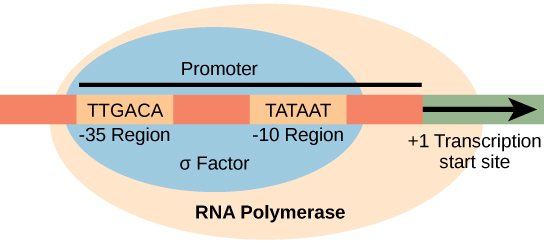
Promoter

A region that recruits machinery and helps specify where and in which direction begins.

Read explanation · OpenStax ↗
Proteasome

A cellular -degrading complex that breaks down many marked by particular chains.

Read explanation · NCBI Bookshelf ↗
Protein

One or more folded chains that perform biological roles such as , transport, signaling, or structural support.

Read explanation · OpenStax ↗
Protein aggregation · ·

Association of into larger clusters, often when exposed surfaces of unfolded stick together.

Read explanation · NCBI Bookshelf ↗
Protein backbone ·

The repeating nitrogen–alpha-carbon– chain of a , excluding its variable .

Read explanation · OpenStax ↗
Protein complex ·

An assembly of interacting chains that function together.

Read explanation · OpenStax ↗
Protein domain · ·

A region of a that forms a recognizable structural or functional unit.

Read explanation · OpenStax ↗
Proton

A positively subatomic particle. In – chemistry, donating a proton means transferring a .

Read explanation · OpenStax ↗
proton-motive force

The combined chemical and electrical driving force for movement across a .

Read explanation · OpenStax ↗
Protonation

Addition of a to an , , or ; this changes its by plus one.

Read explanation · OpenStax ↗
Purine · ·

A with two fused rings. and are purines.

Read explanation · OpenStax ↗
Pyrimidine · ·

A with one six-membered ring. , , and are pyrimidines.

Read explanation · OpenStax ↗
Pyrophosphate ·

Two linked together; released when a is incorporated into or . Its helps drive polymerization.

Read explanation · OpenStax ↗
pyruvate

A three-carbon α-keto produced by and serving as a in .

Read explanation · Biology LibreTexts / Oregon State University ↗
pyruvate carboxylase

A -dependent using to convert to .

Read explanation · Biology LibreTexts / Oregon State University ↗
pyruvate dehydrogenase

The complex converting to , CO2, and .

Read explanation · OpenStax ↗
pyruvate kinase

The glycolytic transferring from to ADP to form and .

Read explanation · Biology LibreTexts / Oregon State University ↗
R group · ·

The variable side chain attached to an ’s . It determines identity, , , and chemical behavior.

Read explanation · OpenStax ↗
R state ·

In a simple model, the relaxed , commonly associated with higher or activity.

Read explanation · Biology LibreTexts ↗
Reactant

A starting substance transformed during a .

Read explanation · OpenStax ↗
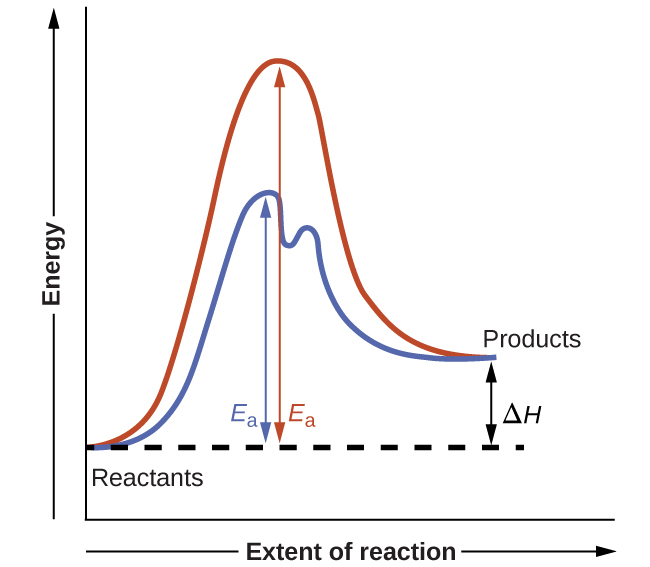
Reaction intermediate · ·

A species formed in one step and consumed in another. It occupies a local energy minimum between .

Read explanation · OpenStax ↗
Reaction mechanism · ·

The sequence of elementary steps by which become , including any .

Read explanation · OpenStax ↗
Reaction product ·

A substance formed by a .

Read explanation · OpenStax ↗
Reaction rate · ·

How quickly are consumed or form, usually expressed as a change per unit time.

Read explanation · OpenStax ↗
Reactive oxygen species

Reactive oxygen-containing or radicals that can damage and other cellular components.

Read explanation · Biology LibreTexts / Oregon State University ↗
Receptor

A that recognizes a particular signal and helps produce a cellular response.

Read explanation · OpenStax ↗
Red blood cell · ·

A blood cell that transports oxygen using ; mature human red blood cells lack a .

Read explanation · OpenStax ↗
Reduction

Gain of or a decrease in state. Reducing a restores two .

Read explanation · OpenStax ↗
Release factor ·

A that recognizes a stop signal and promotes of the – to release the .

Read explanation · OpenStax ↗
Reporter gene · ·

A with a readily measured used to study regulation; reporter output can depend on synthesis, decay, , and behavior.

Read explanation · NCBI Bookshelf / Sinauer Associates ↗
resonance

Large driven response near a system’s natural frequency.

Read explanation · OpenStax ↗
Ribonucleic acid ·

A with roles in , regulation, and ; carries -coding information.

Read explanation · OpenStax ↗
Ribose

The five-carbon sugar in , with a at the 2′ carbon.

Read explanation · OpenStax ↗
Ribosome ·

A complex of and that translates into a .

Read explanation · OpenStax ↗
RNA splicing · ·

Removal of and joining of in a precursor .

Read explanation · NCBI Bookshelf / Garland Science ↗
RNA stability

Persistence of an before degradation; greater stability generally means a longer lifetime or under specified conditions.

Read explanation · OpenStax ↗
Salt

An electrically made from and . Dissolved salts can screen or compete with – interactions.

Read explanation · Cytiva ↗
secondary active transport

Uphill movement of one substance coupled to downhill movement of another across a .

Read explanation · OpenStax ↗
Secondary structure

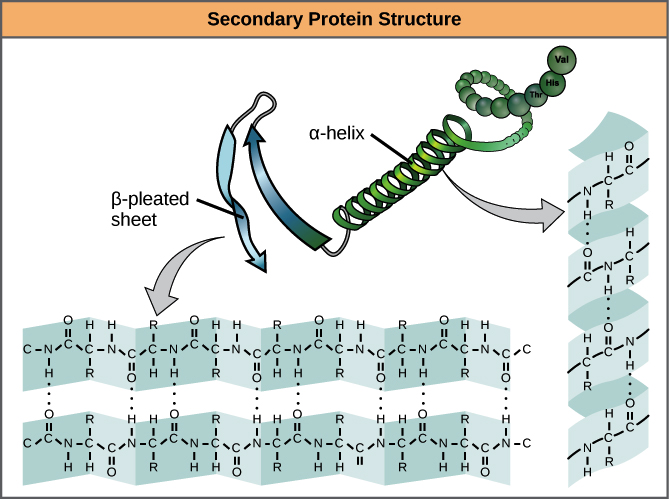
Local folding, such as and , stabilized mainly by .

Read explanation · OpenStax ↗
Sedimentation ·

Movement of particles through a fluid under gravity or centrifugal .

Read explanation · Beckman Coulter ↗
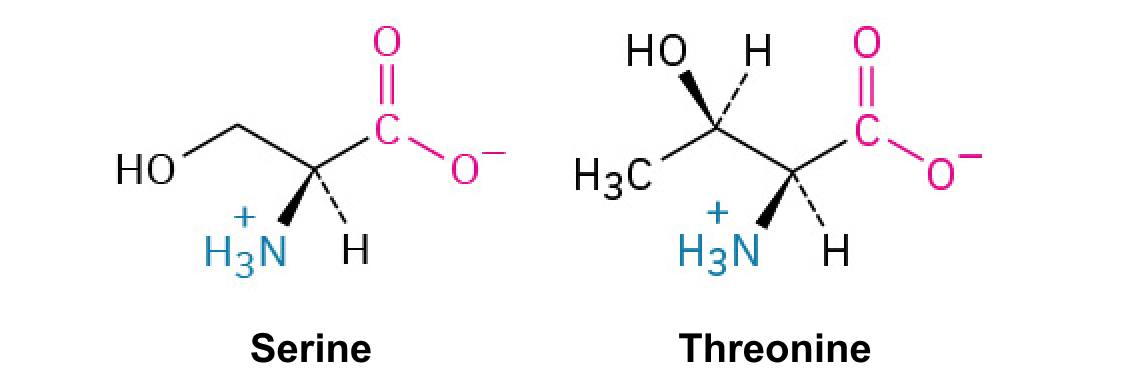
Serine ·

A , uncharged with a -containing .

Read explanation · OpenStax ↗
Sigmoidal curve ·

An S-shaped curve. A sigmoidal rate-versus- curve can indicate rather than simple behavior.

Read explanation · Biology LibreTexts ↗
Sister chromatid

One of the two copies of a produced by . An intact sister chromatid can supply a template for accurate repair.

Read explanation · Biology LibreTexts / Oregon State University ↗
Solubility ·

The amount of a substance that can dissolve in a under specified conditions. Soluble means able to dissolve; insoluble means only very slightly soluble in that .

Read explanation · OpenStax ↗
Solute

A dissolved component of a .

Read explanation · OpenStax ↗
Solution

A homogeneous mixture in which are dissolved in a .

Read explanation · OpenStax ↗
Solvent

The component of a that dissolves other substances, usually the component present in the greatest amount.

Read explanation · OpenStax ↗
Splice site · · ·

A sequence at an – boundary recognized during ; changing it can alter use or removal.

Read explanation · OpenStax ↗
standard Gibbs energy change

Gibbs energy change for a under specified standard-state conditions.

Read explanation · OpenStax ↗
Starch

A plant storage made of chains; its two main forms are and amylopectin.

Read explanation · OpenStax ↗
Stationary phase

The material that remains fixed in a system.

Read explanation · Waters ↗
Stop codon · · ·

An that recruits a to end : UAA, UAG, or UGA in the standard code.

Read explanation · OpenStax ↗
Substitution · ·

Replacement of one by another. In a coding region it can be , , or .

Read explanation · OpenStax ↗
Substrate

A that an binds and chemically transforms.

Read explanation · OpenStax ↗
Substrate concentration

The amount of per volume. Square brackets denote ; [S] is varied to measure an curve.

Read explanation · Biology LibreTexts ↗
substrate-level phosphorylation

or formation by direct transfer from a intermediate, without a respiratory .

Read explanation · OpenStax ↗
Subunit ·

An individual chain within a containing multiple chains.

Read explanation · OpenStax ↗
succinate dehydrogenase

The inner- oxidizing succinate to fumarate; it is also respiratory complex II.

Read explanation · OpenStax ↗
Synonymous mutation · · · · ·

A coding-sequence that leaves the specified unchanged. It can still affect , , or .

Read explanation · OpenStax ↗
T state ·

In a simple model, the tense , commonly associated with lower or activity.

Read explanation · Biology LibreTexts ↗
Template strand · · ·

A preexisting strand whose sequence guides complementary nucleic- synthesis.

Read explanation · OpenStax ↗
Thermodynamics ·

The study of energy, , and . It helps determine whether a process is favorable, while concerns how fast it occurs.

Read explanation · OpenStax ↗
thiamine pyrophosphate

A vitamin B1-derived used in and oxidative .

Read explanation · Biology LibreTexts / Oregon State University ↗
Thioether

A sulfur bonded to two carbon groups, as in ’s . It has no hydrogen.

Read explanation · OpenStax ↗
Thiol group · · · ·

A sulfur bonded to hydrogen, –SH. thiols can form through .

Read explanation · OpenStax ↗
Threonine ·

A , uncharged with a and a on its .

Read explanation · OpenStax ↗
Thymine

A normally used in ; it pairs with through two .

Read explanation · OpenStax ↗
tolerance

Reduced effect of a given drug dose after repeated exposure.

Read explanation · OpenStax ↗
Transacetylase

An transferring an acetyl group; the acetylates certain galactosides.

Read explanation · OpenStax ↗
transaldolase

An transferring three-carbon units between sugar phosphates in the .

Read explanation · Biology LibreTexts / Oregon State University ↗
Transcription

Synthesis of using a template.

Read explanation · OpenStax ↗
Transcription factor

A that helps recruit or regulate machinery, often by binding or other .

Read explanation · OpenStax ↗
Transcriptional repressor · ·

A regulatory that reduces , for example by obstructing polymerase access or recruiting other repressing factors.

Read explanation · OpenStax ↗
Transfer RNA ·

An adaptor that carries an and pairs its with a on .

Read explanation · OpenStax ↗
transferase

An transferring a from one to another.

Read explanation · OpenStax ↗
Transition state

A fleeting, high-energy arrangement at a barrier. It is an energy maximum along the path, rather than a stable .

Read explanation · OpenStax ↗
transketolase

A thiamine-dependent transferring two-carbon units between sugar phosphates.

Read explanation · Biology LibreTexts / Oregon State University ↗
Translation ·

Synthesis of a on a using the sequence of in .

Read explanation · OpenStax ↗
transport maximum

The maximum rate of -mediated transport when the relevant transport capacity is saturated.

Read explanation · OpenStax ↗
triacylglycerol · ·

A esterified to three ; a major energy-storage .

Read explanation · Biology LibreTexts / Oregon State University ↗
triose-phosphate isomerase

The interconverting dihydroxyacetone and glyceraldehyde-3-.

Read explanation · Biology LibreTexts / Oregon State University ↗
tRNA charging

of an to a by an . is converted to and .

Read explanation · OpenStax ↗
Tryptophan ·

An with a bulky ; commonly grouped as .

Read explanation · OpenStax ↗
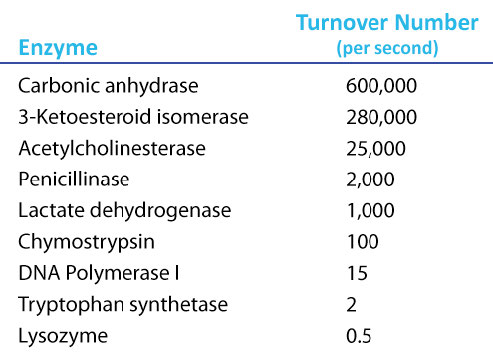
Turnover number · · ·

The maximum number of cycles per per unit time, calculated as /. Units are inverse time, commonly s⁻¹.

Read explanation · IUBMB ↗
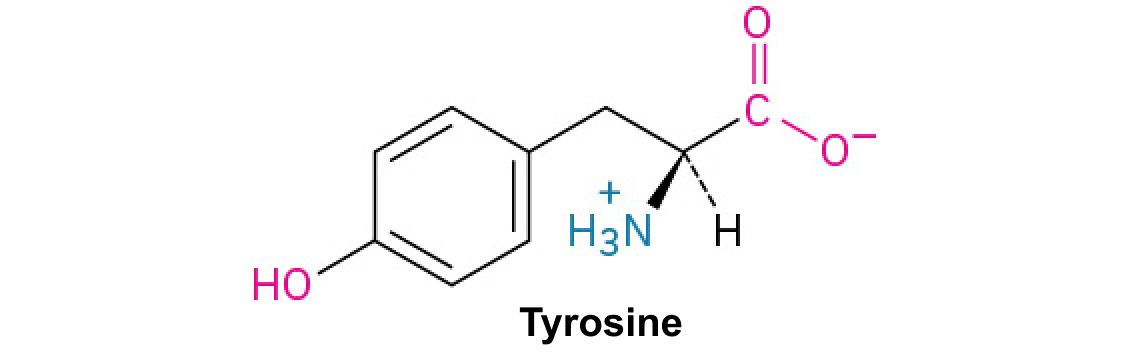
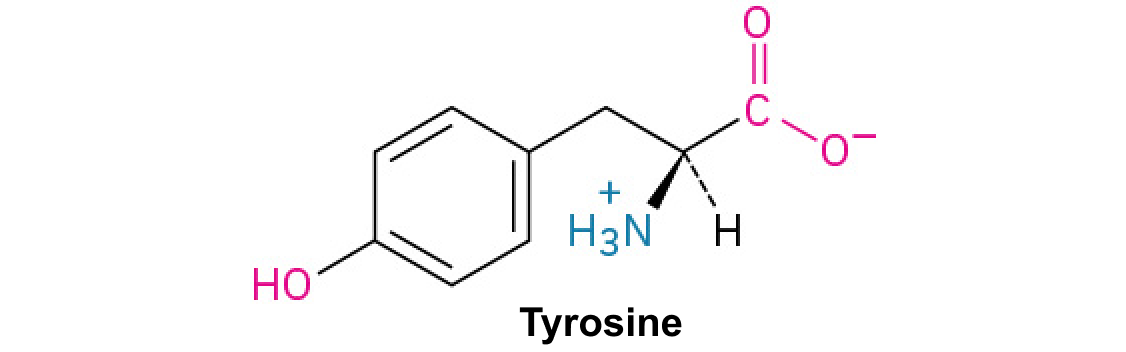
Tyrosine ·

An with a phenolic . Usually uncharged near physiological .

Read explanation · OpenStax ↗
Ubiquitin

A small attached to other to regulate their degradation, localization, or interactions.

Read explanation · Thermo Fisher ↗
UDP-glucose

An activated donor used by and other .

Read explanation · Biology LibreTexts / Oregon State University ↗
Uracil

A normally used in in place of . Uracil produced by in is a repair target.

Read explanation · OpenStax ↗
Urea

A small nitrogen-containing that, at sufficiently high , can destabilize folds.

Read explanation · NCBI Bookshelf ↗
UTP

Uridine triphosphate, a used to activate and in synthesis.

Read explanation · Biology LibreTexts / Oregon State University ↗
Valine ·

A , with a branched .

Read explanation · OpenStax ↗
velocity

Rate of change of position, including direction.

Read explanation · OpenStax ↗
ventilation

Movement of air into and out of the respiratory system or a specified lung region.

Read explanation · OpenStax ↗
α-ketoglutarate

A five-carbon citric-cycle intermediate that also accepts to form .

Read explanation · OpenStax ↗
β-Galactosidase ·

The -encoded that hydrolyzes and can also convert to .

Read explanation · OpenStax ↗

7.2 Glycolysis

OpenStax · 7.2 Glycolysis ↗
Instructional page including learning objectives, examples, figures, source tables and questions. Site navigation and embedded media players are omitted; source media links remain available.

Learning Objectives

By the end of this section, you will be able to do the following:

As you have read, nearly all of the energy used by living cells comes to them in the bonds of the sugar . is the first step in the breakdown of to extract energy for cellular . In , nearly all living organisms carry out as part of their . The process does not use oxygen directly and therefore is termed anaerobic. takes place in the of both and cells. enters heterotrophic cells in two ways. One method is through in which the transport takes place against the . The other mechanism uses a group of integral called GLUT , also known as transporter . These transporters assist in the of .

begins with the six-carbon ring-shaped structure of a single and ends with two of a three-carbon keto called . consists of two distinct phases. The first part of the pathway traps the in the cell and uses energy to modify it so that the six-carbon sugar can be split evenly into the two three-carbon . The second part of extracts energy from the and stores it in the form of and —remember: this is the reduced form of NAD.

The illustration shows a simplified process of glucose moving through the stages of glycolysis. First two A T P are added, then the glucose is split into two branches, with N A D H and two A T P being released.  The net products are 2 pyruvate molecules and 2 N A D H and 2 A T P molecules.
Figure 7.7 — 7.2

Figure 7.7 Glycolysis begins with an energy investment phase which requires 2 ATP to phosphorylate the starting glucose molecule. The 6-carbon intermediate is then split into 2, 3-carbon sugar molecules. In the energy recovery phase, each 3-carbon sugar is then oxidized to pyruvate with the energy transferred to form NADH and 2 ATP. Credit: Rao, A. and Ryan, K. Department of Biology, Texas A&M University

Mary Ann Clark, Matthew Douglas, and Jung Choi, Biology 2E, OpenStax. · CC BY-NC-SA 4.0 · Original image ↗ · Access for free ↗

First Half of (Energy-Requiring Steps)

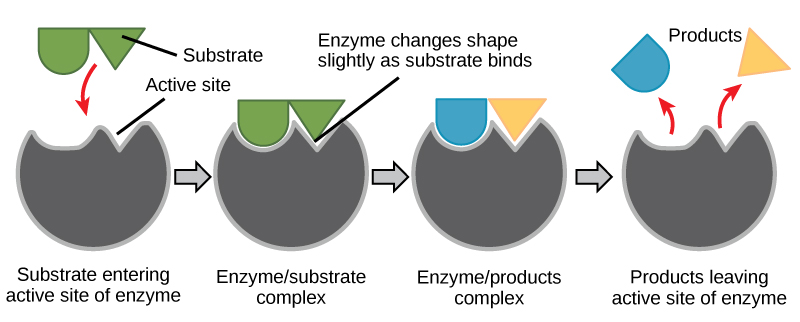
Step 1. The first step in (Figure 7.8) is catalyzed by , an with broad specificity that catalyzes the of six-carbon sugars. phosphorylates using as the source of the , producing -6-, a more reactive form of . This prevents the from continuing to interact with the GLUT , and it can no longer leave the cell because the negatively will not allow it to cross the interior of the plasma .

Step 2. In the second step of , an converts -6- into one of its isomers, fructose-6- (this isomer has a attached at the location of the sixth carbon of the ring). An is an that catalyzes the conversion of a into one of its isomers. (This change from phosphoglucose to phosphofructose allows the eventual split of the sugar into two three-carbon .)

Step 3. The third step is the of fructose-6-, catalyzed by the phosphofructokinase. A second donates a high-energy to fructose-6-, producing fructose-1,6-underlinebiend underlinesphosphate. In this pathway, phosphofructokinase is a rate-limiting . It is active when the of ADP is high; it is less active when ADP levels are low and the of is high. Thus, if there is “sufficient” in the system, the pathway slows down. This is a type of end inhibition, since is the end of catabolism.

Step 4. The newly added high-energy phosphates further destabilize fructose-1,6-bisphosphate. The fourth step in employs an , , to cleave fructose-1,6-bisphosphate into two three-carbon isomers: dihydroxyacetone and glyceraldehyde-3-.

Step 5. In the fifth step, an transforms the dihydroxyacetone- into its isomer, glyceraldehyde-3-. Thus, the pathway will continue with two of a glyceraldehyde-3-. At this point in the pathway, there is a net investment of energy from two in the breakdown of one .

This illustration shows the steps in the first half of glycolysis. In step one, the enzyme hexokinase uses one A T P molecule in the phosphorylation of glucose. In step two, glucose dash 6 dash phosphate is rearranged to form fructose dash 6 dash phosphate by phosphoglucose isomerase. In step three, phosphofructokinase uses a second A T P molecule in the phosphorylation of the substrate, forming fructose dash 1, 6 dash bisphosphate. In step four, the enzyme fructose bisphosphate aldolase splits the substrate into two, forming glyceraldeyde dash 3 dash phosphate and dihydroxyacetone-phosphate. In step five, triose phosphate isomerase converts the dihydroxyacetone-phosphate into glyceraldehyde dash 3 dash phosphate.
Figure 7.8 — 7.2

Figure 7.8 The first half of glycolysis uses two ATP molecules in the phosphorylation of glucose, which is then split into two three-carbon molecules.

Mary Ann Clark, Matthew Douglas, and Jung Choi, Biology 2E, OpenStax. · CC BY-NC-SA 4.0 · Original image ↗ · Access for free ↗

Second Half of (Energy-Releasing Steps)

So far, has cost the cell two and produced two small, three-carbon sugar . Both of these will proceed through the second half of the pathway, and sufficient energy will be extracted to pay back the two used as an initial investment and produce a profit for the cell of two additional and two even higher-energy .

Step 6. The sixth step in (Figure 7.9) oxidizes the sugar (glyceraldehyde-3-), extracting high-energy , which are picked up by the NAD+, producing . The sugar is then by the addition of a second , producing 1,3-bisphosphoglycerate. Note that the second does not require another .

This illustration shows the steps in the second half of glycolysis. In step six, the enzyme glyceraldehyde dash 3 dash phosphate dehydrogenase produces one N A D H molecule and forms 1, 3 dash bisphosphoglycerate. In step seven, the enzyme phosphoglycerate kinase removes a phosphate group from the substrate, forming one A T P molecule and 3 dash phosphoglycerate. In step eight, the enzyme phosphoglycerate mutase rearranges the substrate to form 2 dash phosphoglycerate. In step nine, the enzyme enolase rearranges the substrate to form phosphoenolpyruvate. In step ten, a phosphate group is removed from the substrate, forming one A T P molecule and pyruvate.
Figure 7.9 — 7.2

Figure 7.9 The second half of glycolysis involves phosphorylation without ATP investment (step 6) and produces two NADH and four ATP molecules per glucose.

Mary Ann Clark, Matthew Douglas, and Jung Choi, Biology 2E, OpenStax. · CC BY-NC-SA 4.0 · Original image ↗ · Access for free ↗

Here again is a potential limiting factor for this pathway. The continuation of the depends upon the availability of the form of the , NAD+. Thus, must be continuously back into NAD+ in order to keep this step going. If NAD+ is not available, the second half of slows down or stops. If oxygen is available in the system, the will be readily, though indirectly, and the high-energy from the hydrogen released in this process will be used to produce . In an environment without oxygen, an alternate pathway () can provide the of to NAD+.

Step 7. In the seventh step, catalyzed by (an named for the reverse ), 1,3-bisphosphoglycerate donates a high-energy to ADP, forming one of . (This is an example of .) A on the 1,3-bisphosphoglycerate is to a , and 3-phosphoglycerate is formed.

Step 8. In the eighth step, the remaining in 3-phosphoglycerate moves from the third carbon to the second carbon, producing 2-phosphoglycerate (an isomer of 3-phosphoglycerate). The catalyzing this step is a mutase ().

Step 9. catalyzes the ninth step. This causes 2-phosphoglycerate to lose water from its structure; this is a dehydration , resulting in the formation of a double bond that increases the in the remaining bond and produces ().

Step 10. The last step in is catalyzed by the (the in this case is named for the reverse of ’s conversion into ) and results in the production of a second by and the pyruvic (or its form, ). Many in enzymatic pathways are named for the reverse , since the can catalyze both forward and reverse (these may have been described initially by the reverse that takes place in vitro, under nonphysiological conditions).
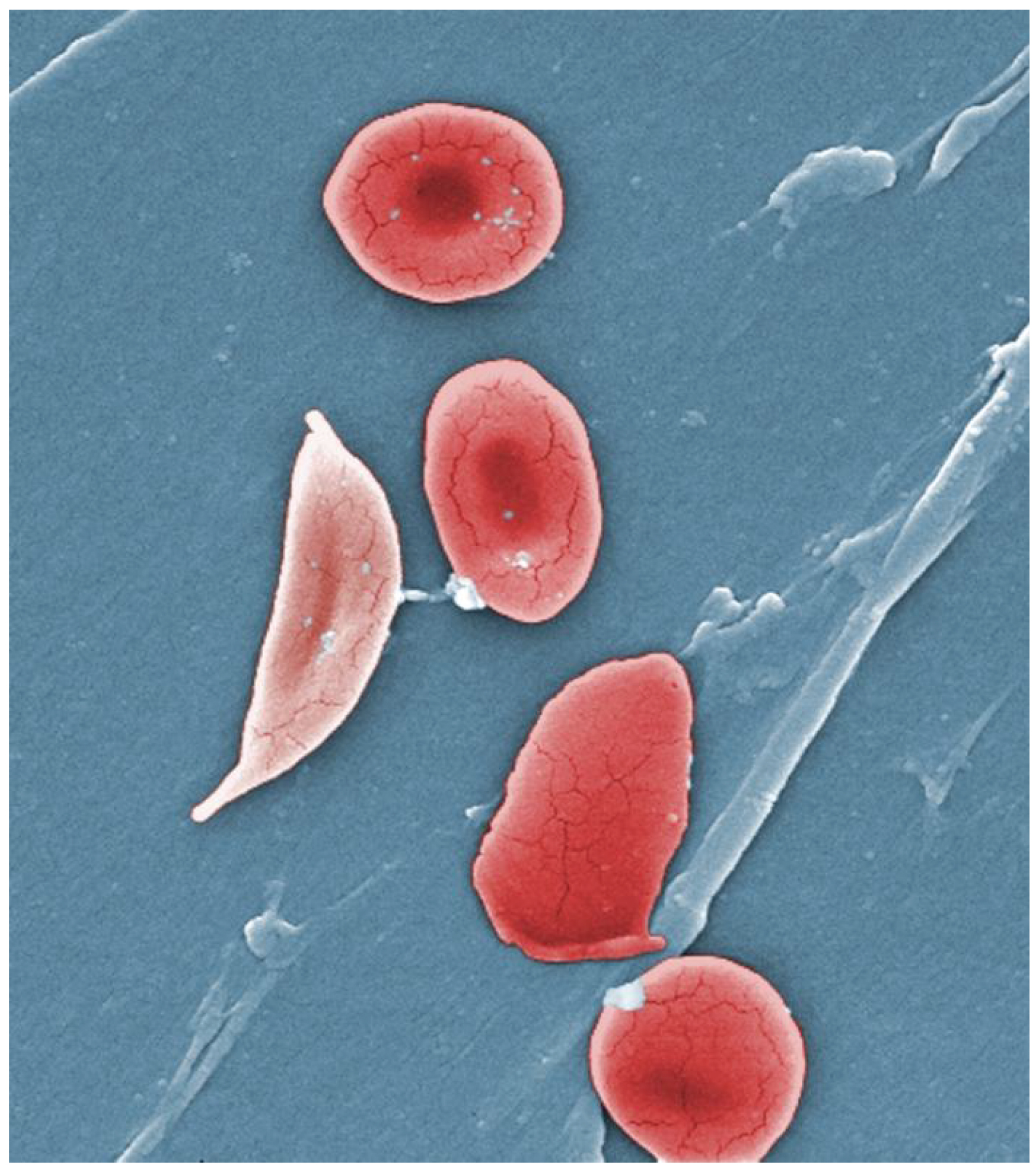
Link to Learning

Gain a better understanding of the breakdown of by by visiting this site to see the process in action.

Outcomes of

begins with and produces two , four new , and two of . (Note: two are used in the first half of the pathway to prepare the six-carbon ring for cleavage, so the cell has a net gain of two and two for its use). If the cell cannot catabolize the further, it will harvest only two from one of . Mature mammalian do not have and thus are not capable of aerobic respiration—the process in which organisms convert energy in the presence of oxygen—and is their sole source of . If is interrupted, these cells lose their ability to maintain their sodium-potassium pumps, and eventually, they die.
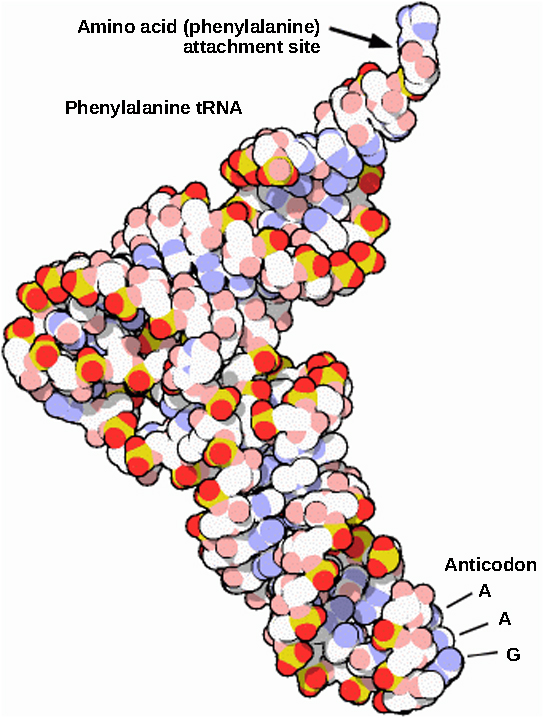
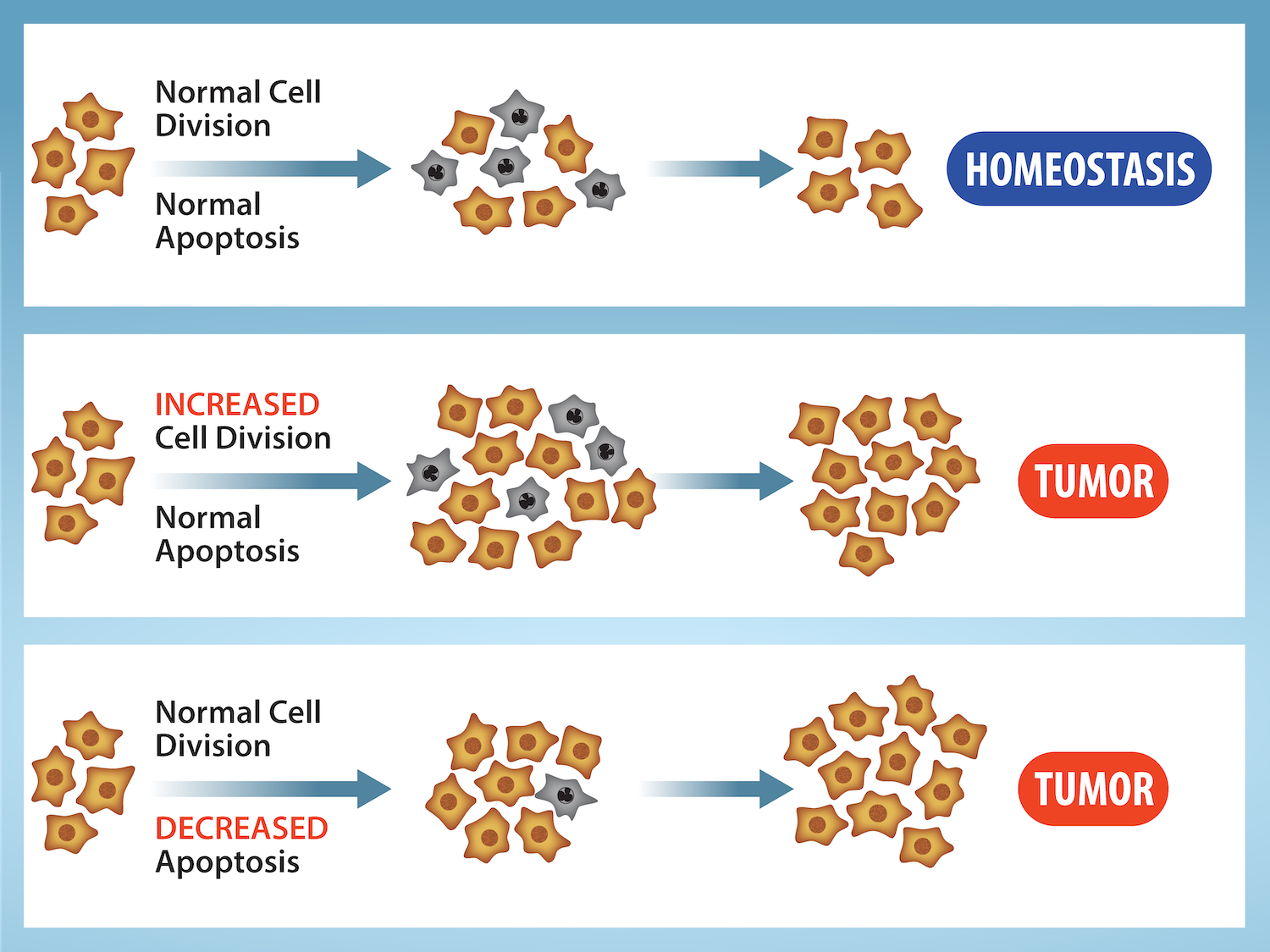
The last step in will not occur if , the that catalyzes the formation of , is not available in sufficient quantities. In this situation, the entire pathway will proceed, but only two will be made in the second half. Thus, is a rate-limiting for .

7.5 Metabolism without Oxygen

OpenStax · 7.5 Metabolism without Oxygen ↗
Instructional page including learning objectives, examples, figures, source tables and questions. Site navigation and embedded media players are omitted; source media links remain available.

Learning Objectives

By the end of this section, you will be able to do the following:

  • Discuss the fundamental difference between anaerobic cellular respiration and
  • Describe the type of that readily occurs in animal cells and the conditions that initiate that

In aerobic respiration, the final acceptor is an oxygen , O2. If aerobic respiration occurs, then will be produced using the energy of high-energy carried by or FADH2 to the transport chain. If aerobic respiration does not occur, must be reoxidized to NAD+ for reuse as an for the glycolytic pathway to continue. How is this done? Some living systems use an organic as the final acceptor. Processes that use an organic to regenerate NAD+ from are collectively referred to as . In contrast, in some living systems, the transport chain (ETC) uses an inorganic as a final acceptor, which is called anaerobic cellular respiration. Both processes allow organisms to convert energy for their use in the absence of oxygen. Both methods are anaerobic, in which organisms convert energy for their use in the absence of oxygen.

Link to Learning

Visit this site to see in action.

Anaerobic Cellular Respiration

Certain , including some species in the and , use anaerobic respiration. For example, a group of archaeans called methanogens reduces carbon dioxide to methane to . These microorganisms are found in soil and in the digestive tracts of ruminants, such as cows and sheep. Similarly, sulfate-reducing , most of which are anaerobic (Figure 7.15), reduce sulfate to hydrogen sulfide to regenerate NAD+ from .

This photo shows a bloom of green bacteria in water.
Figure 7.15 — 7.5 without Oxygen

Figure 7.15 The green color seen in these coastal waters is from an eruption of hydrogen sulfide–producing bacteria. These anaerobic, sulfate-reducing bacteria release hydrogen sulfide gas as they decompose algae in the water. (credit: modification of work by NASA/Jeff Schmaltz, MODIS Land Rapid Response Team at NASA GSFC, Visible Earth Catalog of NASA images)

Mary Ann Clark, Matthew Douglas, and Jung Choi, Biology 2E, OpenStax. (credit: modification of work by NASA/Jeff Schmaltz, MODIS Land Rapid Response Team at NASA GSFC, Visible Earth Catalog of NASA images) · CC BY-NC-SA 4.0 · Original image ↗ · Access for free ↗

Lactic

The method used by animals and certain , such as those in yogurt, is lactic (Figure 7.16). This type of is used routinely in mammalian , which do not have , and in skeletal muscle that has an insufficient oxygen supply to allow aerobic respiration to continue (that is, in muscles used to the point of fatigue). In muscles, lactic accumulation must be removed by the blood circulation, and when the lactic loses a hydrogen, the resulting is brought to the liver for further . The chemical of lactic are the following:

Pyruvic acid + NADH ↔ lactic acid + NAD +

The used in this is (LDH). The can proceed in either direction, but the from left to right is inhibited by conditions. Such lactic accumulation was once believed to cause muscle stiffness, fatigue, and soreness, although more recent research disputes this hypothesis. Once the lactic has been removed from the muscle and circulated to the liver, it can be reconverted into pyruvic and further catabolized for energy.

Visual Connection

This illustration shows that during glycolysis, glucose is broken down into two pyruvate molecules and, in the process, two N A D H are formed from N A D superscript plus sign baseline. During lactic acid fermentation, the two pyruvate molecules are converted into lactate, and N A D H is recycled back into N A D superscript plus sign baseline.
Figure 7.16 — 7.5 without Oxygen

Figure 7.16 During glycolysis, glucose is oxidized to pyruvate while NAD+ is reduced to NADH. Two molecules of ATP are also produced by substrate level phosphorylation. In the absence of oxygen in some cell types, fermentation allows the reduction of pyruvate to lactate and the reoxidation of NADH to NAD+. The regeneration of NAD+ allows glycolysis to continue to make ATP by substrate level phosphorylation. Credit: Rao, A., Ryan, K., Tag, A., and Fletcher, S. Department of Biology, Texas A&M University.

Mary Ann Clark, Matthew Douglas, and Jung Choi, Biology 2E, OpenStax. · CC BY-NC-SA 4.0 · Original image ↗ · Access for free ↗

Tremetol, a poison found in the white snakeroot plant, prevents the of . When cows eat this plant, tremetol is concentrated in the milk they produce. Humans who consume the milk can become seriously ill. Symptoms of this disease, which include vomiting, abdominal pain, and tremors, become worse after exercise. Why do you think this is the case?

Alcohol

Another familiar process is alcohol (Figure 7.17), which produces ethanol. The first of alcohol is the following (CO2 does not participate in the second ):

pyruvic acid + H + → CO 2 + acetaldehyde + NADH + H + → ethanol + NAD +

The first is catalyzed by decarboxylase, a , with a of (, derived from vitamin B1 and also called thiamine). A is removed from pyruvic , releasing carbon dioxide as a gas. The loss of carbon dioxide reduces the size of the by one carbon, producing acetaldehyde. The second is catalyzed by alcohol dehydrogenase to to NAD+ and reduce acetaldehyde to ethanol. The of pyruvic by yeast produces the ethanol found in alcoholic beverages. Ethanol of yeast is variable, ranging from about 5 percent to 21 percent, depending on the yeast strain and environmental conditions.

This photo shows large cylindrical fermentation tanks stacked one on top of the other.
Figure 7.17 — 7.5 without Oxygen

Figure 7.17 Fermentation of grape juice into wine produces CO 2 as a byproduct. Fermentation tanks have valves so that the pressure inside the tanks created by the carbon dioxide produced can be released.

Mary Ann Clark, Matthew Douglas, and Jung Choi, Biology 2E, OpenStax. · CC BY-NC-SA 4.0 · Original image ↗ · Access for free ↗

Other Types of

Other methods take place in . We should note that many are facultatively anaerobic. This means that they can switch between aerobic respiration and , depending on the availability of free oxygen. Certain , such as Clostridia, are . live and grow in the absence of molecular oxygen. Oxygen is a poison to these microorganisms and kills them on exposure. We should also note that most forms of produce gas (an exception is lactic which, in most cases, does not result in gas production). The production of particular types of gas is used as an indicator of the of specific , which plays a role in the laboratory identification of the . Various methods of are used by assorted organisms to ensure an adequate supply of NAD+ for the sixth step in . Without these pathways, this step would not occur, and could not be harvested from the breakdown of .

24.2 Carbohydrate Metabolism

OpenStax · 24.2 Carbohydrate Metabolism ↗
Instructional page including learning objectives, examples, figures, source tables and questions. Site navigation and embedded media players are omitted; source media links remain available.

Learning Objectives

By the end of this section, you will be able to:

are organic composed of carbon, hydrogen, and oxygen . The family of includes both simple and complex sugars. and fructose are examples of simple sugars, and , , and are all examples of complex sugars. The complex sugars are also called polysaccharides and are made of multiple monosaccharide . Polysaccharides serve as energy storage (e.g., and ) and as structural components (e.g., chitin in insects and in plants).
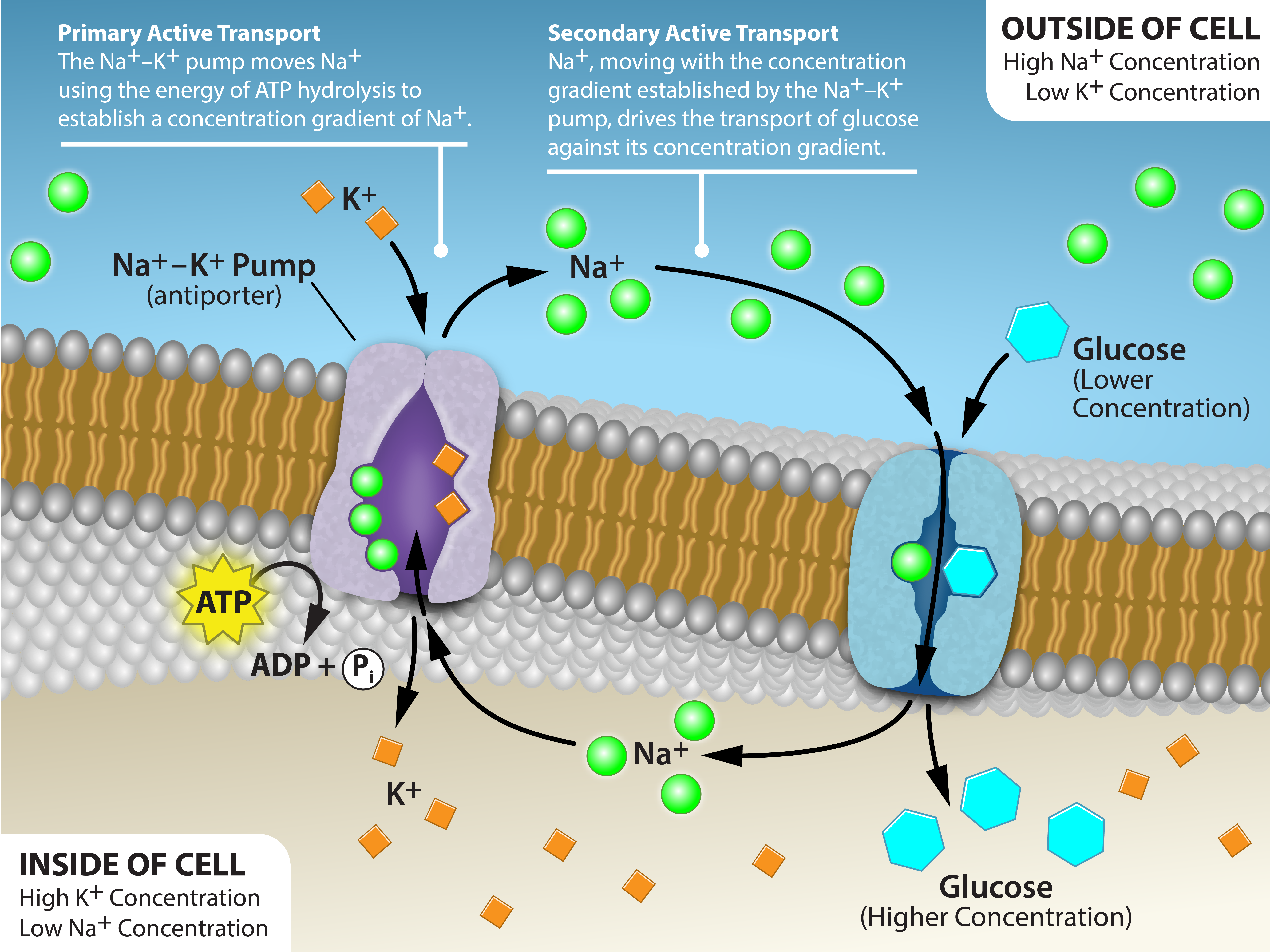
During digestion, are broken down into simple, sugars that can be transported across the intestinal wall into the circulatory system to be transported throughout the body. digestion begins in the mouth with the action of on starches and ends with monosaccharides being absorbed across the of the small intestine. Once the absorbed monosaccharides are transported to the tissues, the process of cellular respiration begins (Figure 24.4). This section will focus first on , a process where the monosaccharide is , releasing the energy stored in its bonds to produce .
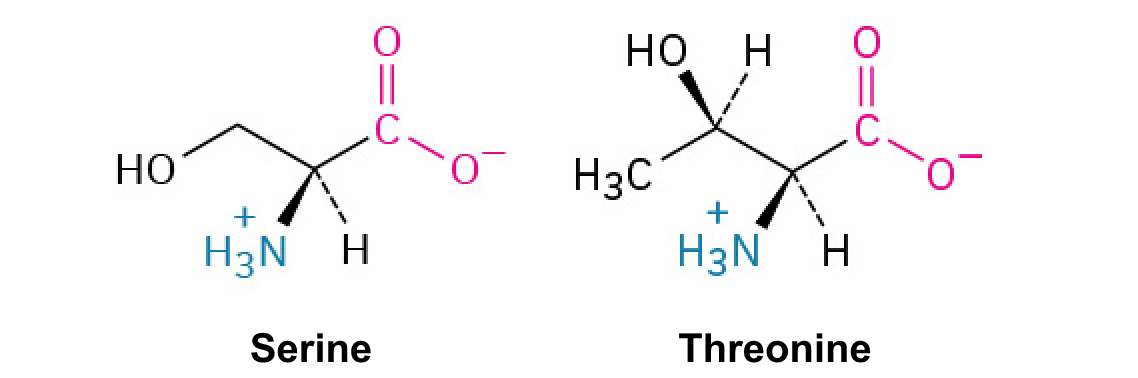
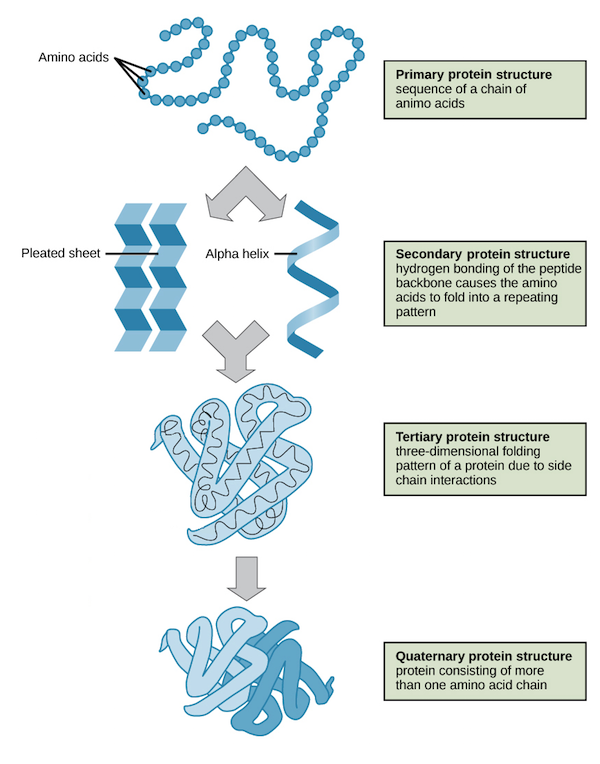
This figure shows the different pathways of cellular respiration. The pathways shown are glycolysis, the pyruvic acid cycle, the Krebs cycle, and oxidative phosphorylation.
Figure 24.4 — 24.2

Figure 24.4 Cellular Respiration Cellular respiration oxidizes glucose molecules through glycolysis, the Krebs cycle, and oxidative phosphorylation to produce ATP.

J. Gordon Betts and colleagues, Anatomy And Physiology 2E, OpenStax. · CC BY-NC-SA 4.0 · Original image ↗ · Access for free ↗

is the body’s most readily available source of energy. After digestive processes break polysaccharides down into monosaccharides, including , the monosaccharides are transported across the wall of the small intestine and into the circulatory system, which transports them to the liver. In the liver, hepatocytes either pass the on through the circulatory system or store excess as . Cells in the body take up the circulating in response to and, through a series of called , transfer some of the energy in to ADP to form (Figure 24.5). The last step in produces the .

begins with the of by to form -6-. This step uses one , which is the donor of the . Under the action of phosphofructokinase, -6- is converted into fructose-6-. At this point, a second donates its , forming fructose-1,6-bisphosphate. This six-carbon sugar is split to form two three-carbon , glyceraldehyde-3- and dihydroxyacetone , which are both converted into glyceraldehyde-3-. The glyceraldehyde-3- is further with groups donated by dihydrogen present in the cell to form the three-carbon 1,3-bisphosphoglycerate. The energy of this comes from the of (removal of from) glyceraldehyde-3-. In a series of leading to , the two are then transferred to two ADPs to form two ATPs. Thus, uses two ATPs but generates four ATPs, yielding a net gain of two ATPs and two of . In the presence of oxygen, continues on to the (also called the or tricarboxylic cycle (TCA), where additional energy is extracted and passed on.

This flowchart shows the different steps in glycolysis in detail. The top panel shows the energy-consuming phase, the middle panel shows the coupling of phosphorylation with oxidation, and the bottom panel shows the energy-releasing phase.
Figure 24.5 — 24.2

Figure 24.5 Glycolysis Overview During the energy-consuming phase of glycolysis, two ATPs are consumed, transferring two phosphates to the glucose molecule. The glucose molecule then splits into two three-carbon compounds, each containing a phosphate. During the second phase, an additional phosphate is added to each of the three-carbon compounds. The energy for this endergonic reaction is provided by the removal (oxidation) of two electrons from each three-carbon compound. During the energy-releasing phase, the phosphates are removed from both three-carbon compounds and used to produce four ATP molecules.

J. Gordon Betts and colleagues, Anatomy And Physiology 2E, OpenStax. · CC BY-NC-SA 4.0 · Original image ↗ · Access for free ↗

Interactive Link

Watch this video to learn about .

can be divided into two phases: energy consuming (also called chemical priming) and energy yielding. The first phase is the energy-consuming phase, so it requires two to start the for each of . However, the end of the produces four ATPs, resulting in a net gain of two energy .

can be expressed as the following equation:

Glucose + 2ATP + 2NAD +  + 4ADP + 2P i  →  2 Pyruvate + 4ATP + 2NADH + 2H +

This equation states that , in combination with (the energy source), NAD+ (a that serves as an acceptor), and inorganic , breaks down into two , generating four —for a net yield of two —and two energy-containing . The that is produced in this process will be used later to produce in the . Importantly, by the end of this process, one generates two , two high-energy , and two -carrying .

The following discussions of include the responsible for the . When enters a cell, the (or , in the liver) rapidly adds a to convert it into -6-. A is a type of that adds a to a (in this case, , but it can be true of other also). This conversion step requires one and essentially traps the in the cell, preventing it from passing back through the plasma , thus allowing to proceed. It also functions to maintain a with higher levels in the blood than in the tissues. By establishing this , the in the blood will be able to flow from an area of high (the blood) into an area of low (the tissues) to be either used or stored. is found in nearly every tissue in the body. , on the other hand, is expressed in tissues that are active when levels are high, such as the liver. has a higher for than and therefore is able to convert at a faster rate than . This is important when levels of are very low in the body, as it allows to travel preferentially to those tissues that require it more.

In the next step of the first phase of , the -6- converts -6- into fructose-6-. Like , fructose is also a six carbon-containing sugar. The then adds one more to convert fructose-6- into fructose-1-6-bisphosphate, another six-carbon sugar, using another . then breaks down this fructose-1-6-bisphosphate into two three-carbon , glyceraldehyde-3- and dihydroxyacetone . The triosephosphate then converts dihydroxyacetone into a second glyceraldehyde-3- . Therefore, by the end of this chemical-priming or energy-consuming phase, one is broken down into two glyceraldehyde-3- .

The second phase of , the energy-yielding phase, creates the energy that is the of . converts each three-carbon glyceraldehyde-3- produced during the energy-consuming phase into 1,3-bisphosphoglycerate. This releases an that is then picked up by NAD+ to create an . is a high-energy , like , but unlike , it is not used as energy currency by the cell. Because there are two glyceraldehyde-3- , two are synthesized during this step. Each 1,3-bisphosphoglycerate is subsequently dephosphorylated (i.e., a is removed) by into 3-phosphoglycerate. Each released in this can convert one of ADP into one high-energy , resulting in a gain of two .

The then converts the 3-phosphoglycerate into 2-phosphoglycerate. The then acts upon the 2-phosphoglycerate to convert them into . The last step of involves the dephosphorylation of the two by to create two and two .

In summary, one breaks down into two , and creates two net and two by . Therefore, generates energy for the cell and creates that can be processed further through the aerobic (also called the or tricarboxylic cycle); converted into lactic or alcohol (in yeast) by ; or used later for the synthesis of through .

Anaerobic Respiration

When oxygen is limited or absent, enters an anaerobic pathway called . In these , can be converted into lactic . This pathway serves to keep the low so continues, and it oxidizes into the NAD+ needed by . In this , lactic replaces oxygen as the final acceptor. occurs in most cells of the body when oxygen is limited or are absent or nonfunctional. For example, because () lack , they must produce their from . This is an effective pathway of production for short periods of time, ranging from seconds to a few minutes. The lactic produced diffuses into the plasma and is carried to the liver, where it is converted back into or via the . Similarly, when a person exercises, muscles use faster than oxygen can be delivered to them. They depend on and lactic production for rapid production.

Aerobic Respiration

In the presence of oxygen, can enter the where additional energy is extracted as are transferred from the to the NAD+, , and , with carbon dioxide being a “waste ” (Figure 24.6). The and FADH2 pass on to the transport chain, which uses the transferred energy to produce . As the terminal step in the transport chain, oxygen is the terminal acceptor and creates water inside the .

This flowchart shows the processes of fermentation and aerobic respiration. The top image shows the energy consuming phase of glycolysis. This branches into aerobic respiration on the left and fermentation on the right.
Figure 24.6 — 24.2

Figure 24.6 Aerobic versus Fermentation The process of fermentation converts glucose into two lactate molecules in the absence of oxygen or within erythrocytes that lack mitochondria. During fermentation, glucose is oxidized into two pyruvate molecules.

J. Gordon Betts and colleagues, Anatomy And Physiology 2E, OpenStax. · CC BY-NC-SA 4.0 · Original image ↗ · Access for free ↗

//Tricarboxylic Cycle

The generated during are transported across the into the inner , where they are metabolized by in a pathway called the (Figure 24.7). The is also commonly called the or the tricarboxylic (TCA) cycle. During the , high-energy , including , , and FADH2, are created. and FADH2 then pass through the transport chain in the to generate more .

The top panel of this figure shows the transformation of pyruvate to acetyl-CoA, and the bottom panel shows the steps in Krebs cycle.
Figure 24.7 — 24.2

Figure 24.7 Krebs Cycle During the Krebs cycle, each pyruvate that is generated by glycolysis is converted into a two-carbon acetyl CoA molecule. The acetyl CoA is systematically processed through the cycle and produces high-energy NADH, FADH 2 , and ATP molecules.

J. Gordon Betts and colleagues, Anatomy And Physiology 2E, OpenStax. · CC BY-NC-SA 4.0 · Original image ↗ · Access for free ↗

Interactive Link

Watch this animation to observe the .

The three-carbon generated during moves from the into the , where it is converted by the into a two-carbon acetyl (acetyl ) . This is an oxidative . It converts the three-carbon into a two-carbon acetyl , releasing carbon dioxide and transferring two that combine with NAD+ to form . Acetyl enters the by combining with a four-carbon , , to form the six-carbon , or citric , at the same time releasing the .

The six-carbon is systematically converted to a five-carbon and then a four-carbon , ending with , the beginning of the cycle. Along the way, each will produce one , one FADH2, and three . The FADH2 and will enter the system located in the inner . In addition, the supplies the starting materials to process and break down and fats.

To start the , synthase combines acetyl and to form a six-carbon ; is subsequently released and can combine with another to begin the cycle again. The converts into isocitrate. In two successive steps of oxidative , two of CO2 and two are produced when converts isocitrate into the five-carbon , which is then catalyzed and converted into the four-carbon succinyl by dehydrogenase. The succinyl dehydrogenase then converts succinyl into succinate and forms the high-energy , which transfers its energy to ADP to produce . then converts succinate into fumarate, forming a of FADH2. then converts fumarate into malate, which malate dehydrogenase then converts back into while reducing NAD+ to . is then ready to combine with the next acetyl to start the again (see Figure 24.7). For each turn of the cycle, three , one (through ), and one FADH2 are created. Each carbon of is converted into CO2, which is released as a byproduct of oxidative (aerobic) respiration.

and the Transport Chain

The transport chain (ETC) uses the and FADH2 produced by the to generate . from and FADH2 are transferred through embedded in the inner by a series of enzymatic . The transport chain consists of a series of four complexes (Complex I – Complex IV) and two ( and ), which act as carriers and pumps used to transfer H+ into the space between the inner and outer (Figure 24.8). The ETC couples the transfer of between a donor (like ) and an acceptor (like O2) with the transfer of (H+ ) across the inner , enabling the process of . In the presence of oxygen, energy is passed, stepwise, through the carriers to collect gradually the energy needed to attach a to ADP and produce . The role of molecular oxygen, O2, is as the terminal acceptor for the ETC. This means that once the have passed through the entire ETC, they must be passed to another, separate . These , O2, and H+ from the combine to form new water . This is the basis for your need to breathe in oxygen. Without oxygen, flow through the ETC ceases.

This image shows the mitochondrial membrane with proton pumps and ATP synthase embedded in the membrane. Arrows show the direction of flow of proteins and electrons across the membrane.
Figure 24.8 — 24.2

Figure 24.8 Electron Transport Chain The electron transport chain is a series of electron carriers and ion pumps that are used to pump H + ions out of the inner mitochondrial matrix.

J. Gordon Betts and colleagues, Anatomy And Physiology 2E, OpenStax. · CC BY-NC-SA 4.0 · Original image ↗ · Access for free ↗

Interactive Link

Watch this video to learn about the transport chain.

The released from and FADH2 are passed along the chain by each of the carriers, which are reduced when they receive the and when passing it on to the next . Each of these releases a small amount of energy, which is used to pump H+ across the inner . The accumulation of these in the space between the creates a with respect to the .

Also embedded in the inner is an amazing complex called . Effectively, it is a turbine that is powered by the flow of H+ across the inner down a and into the . As the H+ traverse the complex, the shaft of the complex rotates. This rotation enables other portions of to encourage ADP and Pi to create . In accounting for the total number of produced per through aerobic respiration, it is important to remember the following points:

Therefore, for every that enters aerobic respiration, a net total of 36 ATPs are produced (Figure 24.9).

This figure shows the different steps in which carbohydrates are metabolized and lists the number of ATP molecules produced in each step. The different steps shown are glycolysis, transformation of pyruvate to acetyl-CoA, the Krebs cycle, and the electron transport chain.
Figure 24.9 — 24.2

Figure 24.9 Carbohydrate Metabolism Carbohydrate metabolism involves glycolysis, the Krebs cycle, and the electron transport chain.

J. Gordon Betts and colleagues, Anatomy And Physiology 2E, OpenStax. · CC BY-NC-SA 4.0 · Original image ↗ · Access for free ↗

is the synthesis of new from , , , or the or . This process takes place primarily in the liver during periods of low , that is, under conditions of fasting, starvation, and low diets. So, the question can be raised as to why the body would create something it has just spent a fair amount of effort to break down? Certain key organs, including the brain, can use only as an energy source; therefore, it is essential that the body maintain a minimum . When the falls below that certain point, new is synthesized by the liver to raise the blood to normal.

is not simply the reverse of . There are some important differences (Figure 24.10). is a common starting material for . First, the is converted into . then serves as a for the (), which transforms into (). From this step, is nearly the reverse of . is converted back into 2-phosphoglycerate, which is converted into 3-phosphoglycerate. Then, 3-phosphoglycerate is converted into 1,3 bisphosphoglycerate and then into glyceraldehyde-3-. Two of glyceraldehyde-3- then combine to form fructose-1-6-bisphosphate, which is converted into fructose 6- and then into -6-. Finally, a series of generates itself. In (as compared to ), the is replaced by , and the is replaced by . This helps the cell to regulate and independently of each other.

As will be discussed as part of , fats can be broken down into , which can be to form dihydroxyacetone or DHAP. DHAP can either enter the glycolytic pathway or be used by the liver as a for .

This figure shows the different steps in  gluconeogenesis, where pyruvate is converted to glucose.
Figure 24.10 — 24.2

Figure 24.10 Gluconeogenesis Gluconeogenesis is the synthesis of glucose from pyruvate, lactate, glycerol, alanine, or glutamate.

J. Gordon Betts and colleagues, Anatomy And Physiology 2E, OpenStax. · CC BY-NC-SA 4.0 · Original image ↗ · Access for free ↗

Aging and the...

Body’s Rate

The human body’s rate decreases nearly 2 percent per decade after age 30. Changes in body composition, including reduced lean muscle mass, are mostly responsible for this decrease. The most dramatic loss of muscle mass, and consequential decline in rate, occurs between 50 and 70 years of age. Loss of muscle mass is the equivalent of reduced strength, which tends to inhibit seniors from engaging in sufficient physical activity. This results in a positive-feedback system where the reduced physical activity leads to even more muscle loss, further reducing .

There are several things that can be done to help prevent general declines in and to fight back against the cyclic nature of these declines. These include eating breakfast, eating small meals frequently, consuming plenty of lean , drinking water to remain hydrated, exercising (including strength training), and getting enough sleep. These measures can help keep energy levels from dropping and curb the urge for increased calorie consumption from excessive snacking. While these strategies are not guaranteed to maintain , they do help prevent muscle loss and may increase energy levels. Some experts also suggest avoiding sugar, which can lead to excess fat storage. Spicy foods and green tea might also be beneficial. Because stress activates release, and slows , avoiding stress, or at least practicing relaxation techniques, can also help.

6.1: Metabolism - Sugars

Biology LibreTexts / Oregon State University · 6.1: Metabolism - Sugars ↗
Complete instructional article, including all source figures and tables. Navigation, author portrait, license footer, and embedded players are omitted. The published HTML contains figure references but no embedded instructional image files; all available source text is retained. Source TeX notation is displayed as native MathML; wording, figure assets, table structure, and the source expressions are preserved.

, whether synthesized by photosynthetic organisms, stored in cells as , or ingested by , must be broken down to obtain energy for the cell’s activities as well as to synthesize other required by the cell. and , of , are the main energy storage forms of in plants and animals, respectively. To use these sources of energy, cells must first break down the to yield . The is then taken up by cells through transporters in . The of , as well as other six carbon sugars (hexoses) begins with the catabolic pathway called . In this pathway, sugars are and broken down into . The corresponding anabolic pathway by which is synthesized is termed . Neither nor is a major oxidative/reductive process, with one step in each one involving loss/gain of , but the of , , can be completely to carbon dioxide (Figure 6.2). Indeed, without production of from in , a major energy source for the cell would not be available.

is the most abundant hexose in nature and is traditionally used to illustrate the of , but fructose (in the form of fructose-6- ) is also readily metabolized, while can easily be converted into for catabolism in the pathway as well. The end of are two of , two of and two of (Figure 6.3), which, in turn, can be further in the .

Entry points for

and fructose are the sugar ‘funnels’ serving as entry points to the glycolytic pathway. Other sugars must be converted to either of these forms to be metabolized in . Some pathways, including the Calvin

Figure 6.2 - fates of Image by Aleia Kim Your cells may have a mounting crisis Should they not go through glyco-lye-sis No energy releases Until it’s fractured into pieces

Figure 6.3 - and its Regulators Image by Ben Carson Cycle and the Pentose Phosphate Pathway () contain in common with , so in that sense, almost any cellular sugar can be metabolized here.

Other pathways

of and that are common to other pathways include -6- (, ), Fructose-6- (Calvin Cycle, ), Glyceraldehyde-3- (Calvin Cycle, ), dihydroxyacetone (, , Calvin Cycle), 3- phosphoglycerate (Calvin Cycle, ), (C4 plant , Calvin Cycle), and (, genesis, ). It is worth noting that from the breakdown of fat can readily be metabolized to dihydroxyacetone (DHAP) and thus enter the pathway. It is the only part of a fat that is used in these pathways.

1

gets a from to make -6- (G6P) in a catalyzed by the , a .

+ ⇄ G6P + ADP +

is one of three regulated in and is inhibited by one of the of its action - G6P. has flexibility in its binding and is able to phosphorylate a variety of hexoses, including fructose, mannose, and .

Why phosphorylate ?

of serves two important purposes. First, the addition of a to effectively traps it in the cell, as G6P cannot diffuse across the bilayer. Second, the decreases the of free , favoring additional import of the . G6P is a for the and can also be converted to -1- (G1P) for use in synthesis and (Figure 6.5).

It is worth noting that the liver has an like called , which Figure 6.4 - #1 - of - catalyzed by has a much higher (lower ) for . This is important, because the liver is of synthesis () where cellular of can be relatively high. With a lower phosphorylating , is not converted to G6P unless get high, so the liver is able to release the it makes into the bloodstream for the rest of the body to use.

2

Next, G6P is converted to fructose-6- (F6P), in a catalyzed by the

GX6P⇄ FX6P

The has a low ’ , so it is readily favorable in either direction with Figure 6.6 - Mechanism of conversion of G6P to F6P in #2 Figure 6.5 - The centrality of -6- in Image by Aleia Kim only slight changes in of .

3

FX6P+ATP⇄ FX1, 6 BP+ADP+HX+

The second input of energy occurs when F6P gets another from in a catalyzed by the ( - another ) to make fructose-1,6- bisphosphate (,6BP). is a very important regulating , with several activators and (see HERE).

Like the the energy from is needed to make the energetically favorable. is the most important regulatory in the pathway and this is the ratelimiting step. It is also one of three essentially irreversible in .

A variant found in plants and some uses rather than as the energy source and due to the lower energy input from of the , that is reversible.

4

FX1, 6 BP⇄ D−GLYALX3P+DHAP

With the pump thus primed, the pathway proceeds to split the ,6BP into two 3-carbon . This catalyzed by the known as is energetically a “hump” to overcome in the direction (°’ = +24 /mol Figure 6.7 - #3 - Conversion of F6P to ,6BP by PFK Wikipedia Figure 6.8 - #4 - Breakdown of ,6BP into GLYAL3P (left) and DHAP (right) by °K) so to get over the energy hump, cells must increase the the (,6BP) and decrease the of the , which are D-glyceraldehyde- 3- (D-GLYAL3P) and dihydroxyacetone (DHAP).

A novel scheme facilitates decreasing of the (see below). Aldolases cut the ring by two different mechanisms and these are grouped as Class I (in animals and plants) and Class II (in fungi and ).

5

DHAP⇄ D−GLYALX3P

In the next step, DHAP is converted to DGLYAL3P in a catalyzed by the triosephosphate . At this point, the six carbon has been broken down to two units of three carbons each - D-GLYAL3P. From this point forward each of contains two of each . #5 is fairly readily reversible in cells.

The is of note because it is one example of a “perfect .” in this category have very high ratios of that approach a theoretical maximum limited only by the of into the of the . The apparent reason for the evolving in this way is that the mechanism of the produces an unstable, toxic intermediate (Figure 6.9). With the proceeding as rapidly as it does, there is less chance of the intermediate escaping and causing damage in the cell.

6

D−GLYALX3P+NADX++Pi D-1,3 BPG+NADH+HX+

Figure 6.9 - #5 - Triose with unstable, toxic intermediate ( glyoxal) Image by Ben Carson

In this , D-GLYAL3P is in the only step of catalyzed by the glyceraldehyde-3- dehydrogenase, an . The aldehyde in this is , then linked to a to make an ester - D-1,3-bisphospho-glycerate (D- 1,3BPG). from the are donated to , creating .

is a critical constituent in this and is the reason that cells need a option at the end of the pathway (see below).

Note here that energy was not required to put the onto the D-GLYAL3P. The reason for this is because the energy provided by the is sufficient for adding the .

7

D-1,3 BPG+ADP⇄ 3 PG+ATP

The two phosphates in the tiny 1,3BPG repel each other and give the high . This energy is utilized by the (another ) to phosphorylate ADP and make , as well as the , 3-phosphoglycerate (3-PG). This is an example of a . Such mechanisms for making require an intermediate with a high enough energy to phosphorylate ADP to make . Figure 6.10 - #6 - of GLYAL3P, catalyzed by Figure 6.11 - #7 - by 1,3-BPG

Though there are a few level phosphorylations in cells (including another one at the end of ), the vast major of is made by in the (in animals). In addition to , plants also make by photophosphorylation in their . Since there are two 1,3 BPGs produced for every , the two ATPs produced in this replenish the two ATPs used to start the cycle and the net count at this point of the pathway is zero.

8

3-PG⇄ 2-PG

Conversion of the 3-PG intermediate to 2-PG (2- phosphoglycerate) occurs by an important mechanism. An intermediate in this readily reversible (catalyzed by - a mutase ) is . This intermediate, which is stable, is released with low frequency by the instead of being con- Figure 6.13 - Two routes to formation of Figure 6.14 - 2,3- Bisphosphoglycerate () Figure 6.12 - #8 - Conversion of 3-PG to 2-PG verted to 2-PG. 2,3BPG is important because it binds to and stimulates release of oxygen. The can also be made from 1,3-BPG as a of a catalyzed by bisphophglycerate mutase (Figure 6.13). Cells which are metabolizing rapidly release more and, as a result, get more oxygen, supporting their needs. Notably, cells which are metabolizing rapidly are using oxygen more rapidly and are more likely to be deficient in it.

9

2-PG⇄ PEP+HX2O

2-PG is converted by (a ) to () by removal of water, creating a very high energy intermediate. The is readily reversible, but with , the cell has one of its highest energy and that is important for the next .

10

PEP+ADP+HX+⇄ PYR+ATP

Conversion of to by is the second level of , creating . This is what some refer to as the “Big Bang” of because there is almost enough energy in to stimulate production of a second (’ = 31.6 / mol), but it is not used. Consequently, this energy is lost as heat. If you wonder why you get hot when you exercise, the heat produced in the breakdown of is a prime contributor and the is a major source. Figure 6.16 - #10 - The big bang - phosphorylates ADP with a lot of energy to spare Wikipedia Figure 6.15 - #9 - -catalyzed removal of water Wikipedia

is the third and last of that is regulated (see below). The primary reason this is the case is to be able to prevent this from occurring when cells are making while going through (see more HERE).

Catabolism of other sugars

Though is a pathway focused on the of and fructose, the that other sugars can be readily metabolized into means that can be used for extracting energy from them as well. is a good example. It is commonly produced in the produced in the body as a result of of , catalyzed by the known as lactase (Figure 6.17). Deficiency of lactase is the cause of intolerance.

begins preparation for entry into by being converted to -1- (catalyzed by galactokinase - Figure 6.18). -1- swaps with -1- from to make UDP- (Figure 6.19). An epimerase converts UDPgalactose back to and the cycle is complete. Each turn of the cycle thus takes in one -1- and releases one -1-.

Deficiency of conversion results in accumulation of (from breakdown of ). Excess is converted to galactitol, a sugar alcohol. Galactitol in the human eye lens causes it to absorb water and this may be a factor in formation of cataracts.Figure 6.17 - Breakdown of to and by lactase Image by Pehr Jacobson Figure 6.18 - Galactokinase Image by Penelope Irving Free fructose can also enter by two mechanisms. First, it can be to fructose-6- by . A more interesting alternate entry point is that shown in Figure 6.20. of fructose by fructokinase produces fructose-1- and cleavage of that by fructose-1- yields DHAP and glyceraldehyde.

of glyceraldehyde by triose yields GLYAL3P. This alternative entry means for fructose may have important implications because DHAP and GLYAL3P are introduced into the pathway while bypassing regulation. Some have proposed this may be important when considering of high fructose corn syrup, since it forces production of , a precursor of , which is itself a precursor of when levels are high.

Mannose

Mannose can also be metabolized in . In this case, it enters via fructose by the following two-step process - 1) phosphoryla- Figure 6.19 - Conversion of -1- into -6- Image by Aleia Kim tion by to make mannose-6- followed by its conversion to fructose-6-, catalyzed by phosphomannoisomerase (Figure 6.21).

is an important for the synthesis of fats, glycerophospholipids, and other . Most commonly it is made into -3- (Figure 6.22) and the / pathways are important both for producing the and for metabolizing it. The relevant intermediate in these pathways both for producing and for using -3- is DHAP. The -3- dehydrogenase reversibly converts -3- into DHAP (Figure 6.22).

This , which is an , transfers to to produce . In the reverse , production of -3- from DHAP, of course, requires from for the . Both and are sources DHAP, meaning when the cell needs - 3- that it can use sugars (, fructose, mannose, or ) as sources in . For , sources include , and Figure 6.20 - Entry of fructose into , bypassing Image by Penelope Irving Figure 6.21 - Entry of other sugars into Image by Penelope Irving (both can easily be made into ), , (which can be made into by transamination), and others. All of the of the (and glyoxylate cycle) can be converted ultimately to , which is a intermediate, as well.

It is worth noting that animals are unable to use as materials for in net amounts, but they can, in , use in both and . It is the only part of the fat that can be so used.

As noted, produced in can be to , which is itself in the to carbon dioxide. That is not the only fate of , though (Figure 6.23).

is a “starting” point for , being converted to in the in the first step. in animals can also be reduced to by adding from (Figure 6.24). This produces and is critical for generating the latter to keep the of ( #6) going under conditions when there is no oxygen.

This is because oxygen is necessary for the transport system (ETS) to operate and it performs the important function of converting back to . When the ETS is running, donates to Complex I and is to in the process, generating the intermediate needed for oxidizing GLYAL-3P. In the absence of oxygen, however, cannot be converted to Figure 6.22 - in Image by Penelope Irving by the ETS, so an alternative means of making is necessary for keeping running under low oxygen conditions ().

and yeast generate under oxygen deprived conditions by doing in a different way (Figure 6.25). They use -requiring that regenerate while producing ethanol from instead of making . Thus, of is essential to keep operating when oxygen is limiting. It is also for these reasons that brewing of beer (using yeast) involves depletion of oxygen and muscles low in oxygen produce lactic (animals).

is a precursor of which can be easily synthesized by transfer of a nitrogen from an donor, such as . can also be converted into by carboxylation in the process of (see below).

The involved in include (makes ), (makes ), transaminases (make ), (makes ox- Figure 6.23 - . When oxygen is absent, is converted to (animals) or ethanol ( and yeast). When oxygen is present, is converted to . Not shown - transamination to or carboxylation to form . aloacetate), and decarboxylase (a part of that makes acetaldehyde in and yeast).

action and regulation of the complex is discussed in the section on the (HERE).

The anabolic counterpart to is (Figure 6.26), which occurs mostly in the cells of the liver and kidney and virtually no other cells in the body. In seven of the eleven of (starting from ), the same are used as in , but the directions are reversed. Notably, the values of these in the cell are typically near zero, meaning their direction can be readily controlled by changing and by small amounts.

The three regulated of all catalyze whose cellular values are not close to zero, making manipulation of direction for their reac- Figure 6.24 - Formation of in animal produces for G3PDH Image by Ben Carson Figure 6.25 - Formation of ethanol in microbial produces for G3PDH Image by Ben Carson tions non-trivial. Consequently, cells employ “work-around” catalyzed by four different to favor , when appropriate.

Bypassing

Two of the ( and - ) catalyze that bypass . ,6BPase bypasses and G6Pase bypasses . Notably, and G6Pase are found in the and , respectively, whereas the other two are found in the along with all of the of .

An important used by is (Figure 6.27). is commonly used by carboxylases to carry CO2 to incorporate into the .

Also known as vitamin H, is a water B vitamin (B7) needed for many processes, including synthesis, , and . Deficiency of the vitamin is rare, since it is readily produced by gut and . Only the differing in are shown Image by Aleia Kim teria. There are many claims of advantages of taking supplements, but there is no strong indication of benefits in most cases. Deficiencies are associated with inborn genetic errors, alcoholism, burn patients, and people who have had a gastrectomy. Some pregnant and lactating women may have reduced levels due to increased catabolism.

Reciprocal regulation

All of the of and nine of the eleven of are all in the , necessitating a coordinated means of controlling them. Cells generally need to minimize the extent to which paired anabolic and catabolic pathways are occurring simultaneously, lest they produce a , resulting in wasted energy with no tangible except heat. The mechanisms of controlling these pathways have opposite effects on catabolic and anabolic processes. This method of control is called reciprocal regulation (see above).

Reciprocal regulation is a coordinated means of simultaneously controlling that do opposite things. In reciprocal regulation, a single () or a single covalent modification (/dephosphorylation,

of &

Reciprocal Regulation

- Activates , Inhibits ,6BPase

,6BP - Activates , Inhibits ,6BPase

- Activates , Inhibits ,6BPase

Only

- Inhibits and

- Inhibits

Only

ADP - Inhibits and

- Activates

Figure 6.27 - carrying carbon dioxide (red) Wikipedia for example) has opposite effects on the different pathways.

Reciprocal effects For example, in , the known as phosphofructokinase () is activated by and a known as ,6BP (Figure 6.28). The corresponding from catalyzing a reversal of the is known as ,6BPase. ,6BPase is inhibited by both and ,6BP.

Reciprocal covalent effects

In , the and catalyze important for the breakdown of . The catalyzes the synthesis of glyco- Directional Inverts with reciprocity If is flowing synthesis awaits But when the latter is a-going Sugar breakdown then abates Figure 6.28 - Regulation of (orange path) and (black path) Image by Aleia Kim gen. Each of these is, at least partly, regulated by and removal of .

of and has the effect of making them more active, whereas of makes it less active. Conversely, dephosphorylation has the reverse effects on these - and become less active and becomes more active.

Simple and efficient

The advantage of reciprocal regulation schemes is that they are very efficient. It doesn’t take separate or separate treatments to control two pathways simultaneously. Further, its simplicity ensures that when one pathway is turned on, the other is turned off.

This is especially important with catabolic/ anabolic regulation, because having both pathways going on simultaneously in a cell is not very productive, leading only to production of heat in a . A simple is shown on Figure 6.29. If unregulated, the cyclic pathway in the figure (shown in black) will make in creating from and will use to make from .

It will also use to make from . Thus, each turn of the cycle will make one , use one and use one for a net loss of energy. The process will start with and end with , so there is no net production of . (see HERE for one physiological use of a ).

Specific

Besides reciprocal regulation, other mechanisms help control . First, is controlled largely at the level of synthesis. of (stimulated by , glucocorticoid , and and inhibited by ) produces symptoms of diabetes.

is sequestered in the (one means of regulation) Figure 6.29 - A simple - follow the black lines Image by Aleia Kim Interactive Learning Module HERE and is sensitive to , which is an activator. increase as the activity decreases. -6- is present in low in many tissues, but is found most abundantly and importantly in the major gluconeogenic organs – the liver and kidney cortex.

Specific

Control of and is unusual for , in that regulation occurs at multiple points. For , this involves three :

1. ( ⇄ G6P)

2. (F6P ⇄ ,6BP)

3. ( ⇄ ).

Regulation of is the simplest of these. The is unusual in being inhibited by its , -6-. This ensures when is slowing down is also slowing down to reduce feeding the pathway.

It might also seem odd that , the last in the pathway, is regulated (Figure 6.30), but the reason is simple. catalyzes the most energetically rich of . The is favored so strongly in the forward direction that cells must do a ‘two-step’ around it in the reverse direction when making in the pathway. In other words, it takes two , two , and two triphosphates ( and ) to go from one back to one in . When cells are needing to make - igure 6.30 - Regulation of For cells a cycling’s cost Is energy in reams Four ATPs each time is lost From breaking/making schemes So use for heat To make it warm inside your feet Else it’s of no utility To practice such futility cose, they can’t be sidetracked by having the they have made in be converted directly back to by . Consequently, must be inhibited during or a will occur and no will be made.

Another interesting control mechanism called feedforward activation involves . is activated by the intermediate, ,6BP. This is a of the and a for the .

pulled

As noted above, the is energetically unfavorable (high positive °’), thus allowing ,6BP to accumulate. When this happens, some of the excess ,6BP binds to , which activates and jump- Figure 6.31 - Regulation of Synthesis and Breakdown of ,6BP Image by Penelope Irving starts the conversion of to . The resulting drop in levels has the effect of “pulling” on the preceding . As a consequence, the of GLYAL3P and DHAP fall, helping to pull the forward.

regulation

has a complex regulation scheme. First, it is reciprocally regulated (relative to ,6BPase) by three . ,6BP activates and inhibits ,6BPase. is also activated by , whereas ,6BPase is inhibited. On the other hand, inhibits , but activates ,6BPase.

is also inhibited by and is exquisitely sensitive to , easily losing activity when the drops only slightly. PFK- 1’s inhibition by is noteworthy and odd at first glance because is also a whose increasing should favor the instead of inhibit it. The root of this conundrum is that has two - one at an that binds relatively inefficiently and one that the that binds with high . Thus, only when is high is binding at the favored and only then can turn off the .

,6BP regulation

Regulation of by ,6BP is simple at the level, but more complicated at the level of synthesis of ,6BP. Despite having a name sounding like a / intermediate (,6BP), ,6BP is not an intermediate in either pathway. Instead, it is made from fructose-6- and by the known as phosphofructokinase-2 (PFK- 2 - Figure 6.31).

With respect to energy, the liver and muscles act complementarily. The liver is the major or- Figure 6.32 - The Image by Aleia Kim gan in the body for the synthesis of . Muscles are major users of to make . Actively exercising muscles use oxygen faster than the blood can deliver it. As a consequence, the muscles go anaerobic and produce . This is of no use to muscle cells, so they dump it into the blood. travels in the blood to the liver, which takes it up and reoxidizes it back to , catalyzed by the (Figure 6.32).

in the liver is then converted to by . The thus made by the liver is dumped into the bloodstream where it is taken up by muscles and used for energy, completing the important intercellular pathway known as the .

cycle

The cycle (also known as the Cahill Cycle), has been described as the equivalent of the (Figure 6.33). The , of course, exports lac- Figure 6.33 - Overlap between the and the cycle tate from muscles (when oxygen is limiting) to the liver via the bloodstream. The liver, in turn, converts to , which it ships back to the muscles via the bloodstream. The is an essential source of energy for muscles during periods of exercise when oxygen is used faster than it can be delivered.

In the - cycle, cells are generating toxic and must export them. This is accomplished by transaminating (the of ) to produce the .

The - process requires the , which is found in muscles, liver, and intestines. is exported in the process to the blood and picked up by the liver, which deaminates it to release the for synthesis of and excretion. The left over after the transamination is a for . produced in the liver is then exported to the blood for use by cells, thus completing the cycle.

Polysaccharide

Sugars are metabolized rapidly in the body and that is one of the primary reasons they are used. Managing levels of in the body is very important - too much leads to complications related to diabetes and too little gives rise to hypoglycemia (low blood sugar). Sugars in the body are maintained by three processes - 1) diet; 2) synthesis (); and 3) storage. The storage forms of sugars are, of course, the polysaccharides and their is our next topic of discussion.

and amylopectin

The energy needs of a plant are much less dynamic than those of animals. Muscular contraction, nervous systems, and information processing in the brain require large amounts of quick energy. Because of this, the polysaccharides stored in plants are somewhat less complicated than those of animals. Plants store for energy in the form of (Figure 6.34 and see HERE) and amylopectin and for structural integrity in the form of (see HERE). These structures differ in that contains units solely joined by β-1,4 bonds, whereas has only α-1,4 bonds and amylopectin has α-1,4 and α-1,6 bonds. Figure 6.34 , a of in plants

Animals store primarily in liver and muscle in the form of a related to amylopectin known as . The structural differences between and amylopectin are solely due to the frequency of the α-1,6 branches of glucoses. In they occur about every 10 instead of every 30-50, as in amylopectin (Figure 6.35).

provides an additional source of besides that produced via . Because contains so many glucoses, it acts like a battery backup for the body, providing a quick source of when needed and providing a place to store excess when in the blood rise.

The branching of is an important feature of the metabolically as well. Since is broken down from the "ends" of the , more branches translate to more ends, and more that can be released at once.

Just as in , the cell has a separate mechanism for synthesis that is distinct from breakdown. As noted previously, this allows the cell to separately control the , avoiding futile cycles, and enabling a process to occur efficiently (synthesis of ) that would not occur if Figure 6.35 - Structure - α-1,4 links with α-1,6 branches every 7-10 it were simply the reversal of breakdown.

breakdown

Breakdown of involves 1) release of -1- (G1P), 2) rearranging the remaining (as necessary) to permit continued breakdown, and 3) conversion of G1P to G6P for further . G6P can be 1) used in , 2) converted to by , or 3) in the .

(sometimes simply called phosphorylase) catalyzes breakdown of into -1- (G1P - Figure 6.36). The that produces G1P from is a phosphorolysis, not a . The distinction is that use water to cleave bigger into smaller ones, but phosphorolysis use instead for the same purpose. Note that the is just that - it does NOT come from . Since is not used to put on G1P, the saves the cell energy.

will only act on nonreducing ends of a chain that are at least 5 glucoses away from a . A second , (GDE) (also called ), is therefore needed to convert α (1-6) branches to α (1-4) branches. GDE acts on branches that have reached their limit of phosphorylysis with . Figure 6.36 - Breaking of α-1,4 bonds of by Image by Aleia Kim Interactive Learning Module HERE

GDE acts to transfer a trisaccharide from an α-1,6 branch onto an adjacent α-1,4 branch, leaving a single at the 1,6 branch. Note that the also catalyzes the of the remaining at the 1,6 (Figure 6.37). Thus, the breakdown from are G1P and (mostly G1P). can, of course, be converted to -6- (G6P) as the first step in by either or .

G1P can be converted to G6P by action of an called . This is readily reversible, allowing G6P and G1P to be interconverted as the of one or the other increases. This is important, because is needed to form G1P for synthesis.

Regulation of

Regulation of is complex, occurring both and via - controlled events that result in or dephosphorylation. In order to avoid a of synthesis and breakdown simultaneously, cells have evolved an elaborate set of that ensure only one pathway is primarily active at a time.

Regulation of is managed by the and . is regulated by both factors (, G6P, , and ) and by covalent modification ( / dephosphorylation). Its regulation is consistent with the energy needs of the cell. High energy (, G6P, ) al- Figure 6.37 - activity of losterically inhibit , while the low energy activates it.

GPa/GPb

exists in two different covalent forms – one form with (called GPa here) and one form lacking (GPb here). GPb is converted to GPa by by an known as . GPa and GPb can each exist in an 'R' state and a 'T' state (Figure 6.38). For both GPa and GPb, the is the more active form of the . GPa's negative () is usually not abundant in cells, so GPa does not flip into the often. There is no positive of GPa. When is absent, GPa automatically flips into the R (more active) state (Figure 6.39). It is for this reason that people tend to think of GPa as being the more active covalent form of the .

GPb can convert from the GPb to the GPb by binding . Unless a cell is low in energy, is low. Thus GPb is not converted Figure 6.38 - regulation - covalent (horizontal) and (vertical) Image by Aleia Kim to the very often. This is why people think of the GPb form as less active than GPa. On the other hand, and/or G6P are usually present at high enough in cells that GPb is readily flipped into the (Figure 6.40).

GPa/GPb covalent regulation

The relative amounts of GPa and GPb largely govern the overall process of breakdown, since GPa tends to be active more often than GPb. It is i

itself has two covalent forms – (active) and dephosphorylated (inactive). It is by the A ( - ). Another way to activate the is with calcium (Figure 6.41). Phosphory- Figure 6.39 - of GPa Image by Aleia Kim Figure 6.40 - of GPb Image by Aleia Kim lase is dephosphorylated by phosphoprotein , the same that removes from GPa.

and cAMPcAMP

is activated by , which is, in turn, produced by adenylate cyclase after activation by a G- (See HERE for overview). G- are activated ultimately by binding of to specific called 7- , also known as Gprotein coupled . These are discussed in greater detail HERE. Common for 7- include epinephrine (binds β- adrenergic ) and (binds ). Epinephrine exerts its greatest effects on muscle and works preferentially on the liver. Thus, epinephrine and can activate breakdown by stimulating synthesis of followed by the cascade of events described above.

Turning off breakdown

Turning off signals is as important, if not more so, than turning them on. is a precious resource. If its breakdown is not controlled, a lot of energy used in its synthesis is wasted. The steps in the breakdown regulatory pathway can be reversed at every level. First, the (epinephrine or ) can leave the , turning off the stimulus. Second, the G- have an inherent GTPase activity. , of course, is what activates Gproteins, so a GTPase activity converts the it is carrying to and the G- becomes inactive. Thus, G- turn off Figure 6.41 - Activation of Image by Aleia Kim their own activity. Interfering with their ability to convert to can have dire consequences, including in some cases.

Third, cells have phosphodiesterase (inhibited by caffeine) for breaking down . is needed to activate , so breaking it down stops from activating . Fourth, the known as phosphoprotein (also called PP1) plays a major role. It can remove phosphates from (inactivating it) and form GPa, converting it to the less likely to be active GPb. Regulation of phosphoprotein activity occurs at several levels. Two of these are shown in Figures 6.42 & 6.43.

In Figure 6.42, phosphoprotein is shown being inactivated by of an (called -1 - see below). This happens as a result of cascading actions from binding of epinephrine (or ) to a cell’s β-adrenergic . Reversal of these actions occurs when binds to the cell’s , resulting in activation of phosphoprotein .

-1

The -1 can block activity of phosphpoprotein only if it (-1) is . When -1 gets dephosphorylated, it no longer functions as an , so phosphoprotein be- Figure 6.42 - Inactivation of phosphoprotein by A via of -1 () and the GM binding Image by Pehr Jacobson Interactive Learning Module HERE comes active. Now, here is the clincher - -1 gets by (thus, when epinephrine or binds to a cell) and gets dephosphorylated when binds to a cell.

Another regulatory mechanism

Another way to regulate phosphoprotein in the liver involves GPa directly (Figure 6.43). In liver cells, phosphoprotein is bound to a called GL. GL can also bind to GPa. As shown in the figure, if the three are complexed together (top of figure), then PP1 (phosphoprotein ) is inactive. When is present (such as when the liver has made too much ), then the free binds to the GPa and causes GPa to be released from the GL.

This has the effect of activating phosphoprotein , which begins dephosphorylating . As shown in the figure, two such are GPa (making GPb) and b, making a. These dephosphorylations have opposite effects on the two , making GPb, which is less active and a, which is much more active.

synthesis

The anabolic pathway opposing breakdown is that of synthesis. Just Figure 6.43 - Regulation of phosphoprotein (PP-1) activity by GPa Image by Penelope Irving as cells reciprocally regulate and to prevent a between these pathways, so too do cells use reciprocal schemes to regulate breakdown and synthesis.

Synthesis of starts with G1P, which is converted to an 'activated' intermediate, UDPglucose. This activated intermediate is what 'adds' the to the growing chain in a catalyzed by the known as (Figure 6.44). Once the is added to , the may need to have branches inserted in it by the known as branching (Figure 6.45).

Steps

Let us first consider the steps in synthesis. 1) synthesis from involves to form G6P, and isomerization to form G1P (using phospho- igure 6.45 - Branch formation in by branching Image by Penelope Irving Figure 6.44 - activity of Image by Penelope Irving glucomutase, common to breakdown). G1P is reacted with to form in a catalyzed by pyrophosphorylase. catalyzes synthesis of by joining carbon #1 of the UDP-derived onto the carbon #4 of the non-reducing end of a chain, to form the familiar α(1,4) links. Another of the is UDP.

“” requirements

It is also worth noting, in passing, that will only add units from onto a preexisting chain that has at least four . of the first few units to form the minimal "" needed for recognition is catalyzed by a called , which attaches to the first and catalyzes of the first eight glucoses by α(1,4) bonds. 3) The characteristic α(1,6) branches of are the of the known as branching . Branching breaks α(1,4) chains and carries the broken chain to the carbon #6 and forms an α(1,6) (Figure 6.45).

Regulation of synthesis

The regulation of is reciprocal to that of breakdown. It also has a cascading covalent modification system similar to the breakdown system described above. In , part of the system is identical to breakdown. Epinephrine or signaling stimulates adenylate cyclase to make , which activates . Figure 6.46 - Reciprocal regulation by the cascade - breakdown activated / synthesis inhibited Image by Penelope Irving

Effect of

In synthesis, A phosphorylates the active form of (GSa), and converts it into the usually inactive b form (called GSb).

Note the conventions for and . For both , the more active forms are called the 'a' forms (GPa and GSa) and the less active forms are called the 'b' forms (GPb and GSb). The major difference, however, is that GPa has a , but GSa does not and GPb has no , but GSb does.

Thus and dephosphorylation have opposite effects on the of (Figure 6.46). This is the hallmark of reciprocal regulation. It is of note that the less active form, GSb, can be activated by G6P. Recall that G6P had the exactly opposite effect on GPb.

, (and ) can all be dephosphorylated by the same - phosphoprotein - and it is activated when binds to its in the .

Big picture

In the big picture, binding of epinephrine or to appropriate cell stimulates a cascade which simultaneously activates breakdown of by and inhibits synthesis of by . Epinephrine, is also known as adrenalin, and the properties that adrenalin gives arise from a large temporary increase of , which powers muscles.

On the other hand, stimulates dephosphorylation by activating phosphoprotein . Dephosphorylation reduces action of (less breakdown) and activates (starts synthesis). Our bodies make when levels rise. Since high levels are harmful, stimulates cells to take up . In the liver and in muscle cells, the uptaken is made into . Figure 6.47 - Cotton - the purest natural form of Wikipedia Interactive Learning Module HERE

synthesis

is synthesized as a result of by synthase. Like synthesis it requires an activated intermediate to add and there are two possible ones - - and UDPglucose, depending on which synthase is involved. In plants, provides support to cell walls.

The catalyzed is shown next where Cellulosen = a of [(1→4)-β-Dglucosyl] n units long.

The - is the same except with of - for UDP-Figure 6.48 - The - - 1 = G6P dehydrogenase / 2 = 6-Phosphogluconolactonase / 3 = 6-PG dehydrogenase / 4a = 5- / 4b = Ribulose 5- 3-epimerase / 5,7 = / 6 = + Cellulosen UDP + Cellulosen+1 . for the is obtained by of sucrose synthase. The is named for the reverse .

The ( - also called the hexose monophosphate shunt) is an oxidative pathway involving sugars that is sometimes described as a parallel pathway to . It is, in , a pathway with multiple inputs and outputs (Figure 6.48). is also a major source of for and can provide -5- for synthesis.

Though when drawn out, the pathway’s “starting point” is often shown as -6- (G6P), in there are multiple entry points including other , such as fructose-6- (F6P) and glyceraldehyde-3- (GLYAL-3-P), as well as less common sugar with 4,5, and 7 carbons.

The multiple entry points and multiple outputs gives the cell tremendous flexibility to meet its needs by allowing it to use a variety of materials to make any of these .

#1

Beginning with G6P, proceeds through its oxidative phase as follows:

The catalyzing the is G6P dehydrogenase. It is the rate limiting step of the pathway and the is inhibited both by and . is important for anabolic pathways, such as synthesis and also for maintaining in a reduced state. The latter is important in protection against damage from .

Deficiency of the G6P dehydrogenase is not rare, leading to acute hemolytic , due to reduced , and a reduced ability of the cell to disarm with . Reduced activity of the appears to have a protective effect against malarial infection, likely due to the increased fragility of the , which is then unable to sustain an infection by the parasite. #2 is a and it is catalyzed by

#2 is a and it is catalyzed by 6-phosphogluconolactonase. The reac- Sucrose + UDP + Fructose G6P + 6-Phosphoglucono-δ- + tion converts the circular 6-phosphoglucono- δ- into the linear 6- phosphogluconate (6-PG) in preparation for in the next step.

#3 is the only in the and the last oxidative step. It is catalyzed by .

disabling the made from this negatively impact . At this point, the oxidative phase of is complete and the remaining involve molecular rearrangements. Ru5P has two possible fates and these are each described below.

Isomerization

4a: The catalyzing this reversible is Ru5P (top of next column). It is important because this is the way cells make R-5-P for synthesis. The R-5-P can also be used in other shown elsewhere.

Epimerization

4b (catalyzed by Ru-5-P epimerase) is another source of a sugars and provides an important for subsequent .

The other don’t really have an order to them and whether they occur or not depends on cellular needs. The first , , is flexible in terms of its / combinations and is used not only in , but also in the Calvin cycle of plants. It catalyzes the next two

In the first (above), two sugars of 5 carbons each are converted into one sugar of 3 carbons and one of 7 carbons. In the second (next ), a five carbon sugar and aRu-5-P Xylulose-5- (Xu-5-P) Xu-5-P + R-5-P GLYAL-3-P + Sedoheptulose-7- (S-7-P) 6-PG + Ribulose-5- (Ru-5-P) + + CO2 6-Phosphoglucono-δ- + H2O 6-phosphogluconate (6-PG) + Ru-5-P -5- (R-5-P) four carbon sugar are rearranged into sugar phosphates with 3 and 6 carbons.

In the reversible of the , one can see how can easily be rearranged and made into other sugars. Thus, GLYAL-3-P and F6P can be readily made into -5- for synthesis.

Involvement of F6P in the pathway permits cells to continue making (by making R-5-P) or (by making E- 4-P) even if the oxidative of are inhibited.

The last is catalyzed by the known as .

co-factor

uses () to catalyze . ’s thiaFigure 6.49 - of the Xu-5-P + Erythrose-4- (E-4-P) GLYAL-3-P + F6P GLYAL-3-P + S-7-P E-4-P + F6P zole ring’s nitrogen and sulfur on either side of a carbon, allow it to donate a and act as an , thus forming a carbanion, which gets stabilized by the adjacent tetravalent nitrogen (Figures 6.50 & 6.51)).

The stabilized carbanion plays important roles in the of , such as that use as a . Commonly, the carbanion acts as a nucleophile that attacks the carbon of the . Such is the case with . Attack by the carbanion breaks the bond on the and covalently links it to the carbon of , thus allowing it to “carry” the to the other for . In this way, two carbons are moved from Xu- 5-P to E-4-P to make F6P (from E-4-P) and GLYAL-3-P (from Xu-5-P). Similarly, S-7-P and GLYAL-3-P are made from R-5-P and Xu-5-P, respectively.

Thiamines

Thiamines are a class of involved in of important respiration-related The by Kevin Ahern I need erythrose And don’t know what to do My cells are full of G-6-P And NADP too But I just hit upon a plan As simple as can be I’ll run through the path That’s known as In just two oxidations There’s ribulose-5P Which morphs to other Each one attached to P The next step it is simple Deserving of some praise The carbons mix and match Thanks to Glyceraldehyde’s a Sedoheptulose is too Each with a trailing But we are not quite through Now three plus seven is the same As adding six and four By swapping carbons back and forth There’s erythrose-P and more At last I’ve got the thing I need From carbons trading places I’m happy that my cells are full Of some transaldolases Figure 6.50 - in the , , the , and the Calvin cycle. Thiamine was the first water- vitamin (B1) to be discovered via association with the disease known as Beriberi. () is an found in all living systems derived from thiamine by action of the thiamine diphosphokinase. facilitates of several biochemical essential for tissue respiration.

Deficiency of the vitamin is rare today, though people suffering from Crohn’s disease, anorexia, alcoholism or undergoing kidney dialysis may develop deficiencies. is required for the oxidative of to form and similar . , an important in the , also uses it as a . Besides these , is also required for oxidative of α-keto like and branched-chain α-keto arising from of , , and . Figure 6.51 - Mechanism of action of () - 1) Carbanion formation; 2) Nucleophilic attack; 3) Covalent of ; 4) Transfer to second group; 5) Release of and regeneration of

acts in the complex to assist in of and “carrying” the activated acetaldehyde to its (and subsequent ) to . Central to ’s function is the thiazolium ring, which stabilizes carbanion (through ) by acting as an sink (Figure 6.51). Such action facilitates breaking of carbon-carbon bonds such as occurs during of to produce the activated acetaldehyde.

Thiamine deficiency

Thiamine is integral to respiration and is needed in every cell. Acute deficiency of thiamine leads to numerous problems - the best known condition is beriberi, whose symptoms include weight loss, weakness, swelling, neurological issues, and irregular heart rhythms. Figure 6.52 - The Calvin cycle - The resynthesis phase has multiple steps and is described below. Image by Aleia Kim

Causes of deficiency include poor nutrition, significant intake of foods containing the known as thiaminase, foods with that counter thiamine action (tea, coffee), and chronic diseases, including diabetes, gastrointestinal diseases, persistent vomiting. People with severe alcoholism often are deficient in thiamine.

Calvin cycle

The Calvin cycle (Figure 6.52) is a occurring exclusively in photosynthetic organisms. Commonly referred to as the “Dark Cycle” or the Light-Independent Cycle, the Calvin cycle does not actually occur in the dark. The cell/ simply is not directly using light energy to drive it.

Assimilation

It is in the Calvin cycle of photosynthesis that carbon dioxide is taken from the atmosphere and ultimately built into (or other sugars). of the Calvin cycle take place in regions of the known as the stroma, the fluid areas outside of the thylakoid . The cycle can be broken into three phases

1) assimilation of CO2

2)

3) regeneration of the starting material, ribulose 1,5 bisphosphate (Ru1,5BP).

Though of carbon dioxide to ultimately requires from twelve of (and 18 ATPs), it is confusing because one occurs 12 times (1,3 BPG to GLYAL-3P) to input the overall necessary to make one .

Carbon dioxide

Another reason students find the pathway confusing is because the carbon dioxide are absorbed one at a time into six different of Ru1,5BP. At no point are the six carbons ever together in the same to make a single .

Instead, six of Ru1,5BP (30 carbons) gain six more carbons via carbon dioxide and then split into 12 of 3- phosphoglycerate (36 carbons). The gain of six carbons allows two three carbon to be produced in excess for each turn of the cycle. These two are then converted into using the of . The other ten of 3-PG are used to regenerate the six of Ru1,5BP. Figure 6.53 - Rubisco, the most abundant on Earth

Cyclic pathway

Like the , the Calvin cycle doesn’t really have a starting or ending point, but can we think of the first as the fixation of carbon dioxide to Ru1,5BP. This is catalyzed by the known as ribulose-1,5 bisphosphate carboxylase (RUBISCO - Figure 6.53). The resulting six carbon intermediate is unstable and is rapidly converted to two of 3- phosphoglycerate.

As noted, if one starts with 6 of Ru1,5BP and makes 12 of 3-PG, the extra 6 carbons that are a part of the cycle can be shunted off as two three-carbon of glyceraldehyde-3- (GLYAL3P) to , leaving behind 10 to be reconverted into 6 moleFigure 6.54 - Resynthesis phase of the Calvin cycle - All paths lead to regenerating Ru1,5BP, which is the aim of the resynthesis phase. / shown in blue. numbers explained in text. cules of Ru1,5BP. This occurs in what is called the resynthesis phase.

Resynthesis phase

The resynthesis phase (Figure 6.54) requires multiple steps, but only utilizes two unique to plants - sedoheptulose-1,7 bisphosphatase and phosphoribulokinase. RUBISCO is the third (and only other) of the pathway that is unique to plants.

All of the other of the pathway are common to plants and animals and include some found in the and . shown as numbers in Figure 6.54 are as follows ( unique to plants in green):

1 -

2 - G3PDH

3 - Triosephosphate

4 -

5 - Fructose 1,6 bisphosphatase

6 -

7 - Phosphopentose Epimerase

8 - Phosphoribulokinase

9 - Sedoheptulose 1,7 bisphosphatase

10 - Phosphopentose

The resynthesis phase begins with conversion of the 3-PG into GLYAL3P (there are actually 10 GLYAL3P involved in resynthesis, as noted above, but we are omitting numbers to try to help students to see the bigger picture. Suffice it to say that there are sufficient quantities of all of the to complete the described). Some GLYAL3P is converted to DHAP by triose . Some DHAPs are converted (via ) to F6P (one is lost for each F6P).

Two carbons from F6P are given to GLYAL3P to create E-4P and Xu-5P (reversal of ). E- 4P combines with DHAP to form sedoheptulose-1,7 bisphosphate (S1,7BP). The at position #1 is Figure 6.55 - Use of CO2 (Calvin cycle) vs. O2 (photorespiration) by RUBISCO. Image by Pehr Jacobson cleaved by sedoheptulose-1,7 bisphosphatase to yield S-7-P. (another ) catalyzes transfer to two carbons from S-7-P to GLYAL3P to yield Xu-5P and R5P.

Phosphopentose catalyzes conversion of R5P to Ru5P and phosphopentose epimerase similarly converts Xu-5P to Ru5P. Finally, phosphoribulokinase transfers a to Ru5P (from ) to yield Ru1,5BP.

Photorespiration

In the Calvin cycle of photosynthesis, the ribulose-1,5-bisphosphate carboxylase (RUBISCO) catalyzes the addition of carbon dioxide to ribulose-1,5- bisphosphate (Ru1,5BP) to create two of 3-phosphoglycerate. Molecular oxygen (O2), however, competes with CO2 for this , so about 25% of the time, the that gets added is not CO2, but rather O2 (Figure 6.55). When this happens, the following occurs

This is the first step in the process known as photorespiration. The process of photorespiration is inefficient relative to the carboxylation of Ru1,5BP. Phosphoglycolate is converted to glyoxylate in the glyoxysome and then transamination of that yields . Two glycines can combine in a complicated coupled set of in the shown next. Figure 6.56 - Maize - a C4 plant Ru1,5BP + O2 Phosphoglycolate + 3-phosphoglycerate + 2H+ 2 + + H2O + CO2 + NH3 + +

and of yields , which can be then be converted back to 3-phosphoglycerate. The end point of oxygenation of Ru1,5BP is the same as the carboxylation of Ru1,5BP , but there are significant energy costs associated with it, making the process less efficient.

C4 plants

The Calvin cycle is the means by which plants assimilate carbon dioxide from the atmosphere, ultimately into . Plants use two general strategies for doing so. The first is employed by plants called C3 plants (most plants) and it simply involves the pathway described above. They are called C3 plants because the first stable intermediate after absorbing carbon dioxide contains three carbons - 3-phosphoglycerate. Another class of plants, called C4 plants (Figure 6.56) employ a novel strategy for concentrating the Figure 6.57 - Assimilation of CO2 by C4 plants Image by Aleia Kim CO2 prior to assimilation. C4 plants are generally found in hot, dry environments where conditions would otherwise favor the wasteful photorespiration of RUBISCO and loss of water.

Capture by

In C4 plants, carbon dioxide is captured in special mesophyll cells first by () to make (contains four carbons and gives the C4 plants their name - Figure 6.57). The is converted to malate and transported into bundle sheath cells where the carbon dioxide is released and captured by Ru1,5BP, as in C3 plants. The Calvin cycle proceeds from there. The advantage of the C4 plant scheme is that it allows of carbon dioxide while minimizing loss of water and photorespiration.

synthesis

cell walls contain a layer of protection known as the layer. Assembly of the layer begins in the .

Steps in the process follow

1. Donation of an from to fructose-6- and isomerization to make glucosamine-6- .

2. Donation of an acetyl group from to make N-acetylglucosamine-6-

3. Isomerization of N-acetylglucosamine-6- makes N-acetylglucosamine-1- Figure 6.58 - layer in a outer cell wall Wikipedia

4. combines with N-acetylglucosamine-1- to make UDP-N-acetyl-glucosamine-1-

5. Addition of and from yields UDP-Nacetylmuramic

6. A pentapeptide or tetrapeptide chain is attached to the UDP-Nacetylmuramic . The sequence varies a bit between species, but commonly is L- - D- - L- - DAla - D-

7. Dolichol replaces UMP on the UDP-N-acetylmuramic -pentapeptide.

8. UDP-N-acetyl-glucosamine donates a to the Nacetylmuramic part of the Dolichol-PP-N-acetylmuramic acidpentapeptide

9. A pentapeptide chain of glycines (pentaglycine) is linked to of the pentapeptide chain to create a Dolichol-PP-Nacetylmuramic -N-acetylglucosaminedecapeptide. The pentaglycine serves as cross links in the overall structure.

10. Dolichol-PP is removed to yield Nacetylmuramic -N-acetylglucosaminedecapeptide Figure 6.60 - activity of DDtranspeptidase Wikipedia Figure 6.59 - Penicillin

11. This last group is added to the growing network by joining the pentaglycine of one chain to the tetrapeptide/ pentapeptide of another.

The catalyzing the addition of the N-acetylmuramic -N-acetylglucosaminedecapeptide to the network in the last step is DD-transpeptidase. This is the cellular targeted by penicillin and its derivatives. One reason penicillin is so effective is because synthesis of a cell wall for a single requires millions of cycles of above. Even slowing down the process can have a major effect on growth. On the flip side, resistance to penicillin and derivatives arises as a result of in one - the transpeptidase.

Metabolons

At this point, it is appropriate to bring up the concept of metabolons. Metabolons are cellular complexes containing multiple of a that appear to be arranged so that the of one enzymatic is passed directly as to the that catalyzes the next in the . The structural complexes are temporary and are held together by forces.

Metabolons appear to offer advantages of reducing the amount of water needed to hydrate . Activity of in the complex is increased. Most of the basic are thought to use metabolons. They include , the , , synthesis, steroid synthesis, synthesis, synthesis, the cycle, and the process of transport.

occurs when the body or a region of it has an insufficient oxygen supply. Varia- Figure 6.61 - inducible factor tions in arterial oxygen in normal physiology may lead to , for example, during training or strenuous physical exercise. Generalized may appear in healthy people when at high altitudes. cells, which may be undergoing faster respiration than surrounding tissues may also tend to be hypoxic. is an important consideration for sugar due to the ability of cells to change their sugar () when these conditions exist.

The body’s response to is to produce -Inducible Factors (HIFs), which are that induce expression of to help cells adapt to the hypoxic conditions. Many of the activated by HIFs are of and GLUTs ( transport ). The combination of these allows cells to 1) import more and 2) metabolize it more rapidly when it arrives. This is to be expected because anaerobic sugar is only about 1/15th as efficient as aerobic . Consequently, it requires much more sugar to keep the cells alive. A recently discovered called cytoglobin is believed to help assist in by facilitating transfer of oxygen from arteries to the brain.

Covalent modification

HIFs are regulated partly by an interesting covalent modification. When oxygen is high, the prolyl hydroxylase will hydroxylate in HIFs. This stimulates the degradation system () to degrade them. When oxygen is low, the hydroxylation occurs to a much lower extent (or does not occur at all), reducing/stopping degradation of HIFs and allowing them to activate . In this way, the of HIFs is kept high under low oxygen (to activate HIF ) and low under high oxygen (to stop synthesis of HIF ).

7.1: Carbohydrate Storage and Breakdown

Biology LibreTexts / Oregon State University · 7.1: Carbohydrate Storage and Breakdown ↗
Complete instructional article, including all source figures and tables. Navigation, author portrait, license footer, and embedded players are omitted.

are important cellular energy sources. They provide energy quickly through and passing of to pathways, such as the , (indirectly), and the pentose phosphate pathway. It is important, therefore, to understand how these important are made.

Plants are notable in storing for energy in the form of and amylopectin (see and for structural integrity in the form of . These structures differ in that contains glucoses solely joined by beta-1,4 bonds, whereas has only alpha1,4 bonds and amylopectin has alpha 1,4 and alpha 1,6 bonds.Animals store primary in liver and muscle in the form of a related to amylopectin known as . The structural differences between and amylopectin are solely due to the frequency of the alpha 1,6 branches of glucoses. In they occur about every 10 instead of every 30-50, as in amylopectin.

Figure 7.1.1: The Repeating Structure of Cellulose
Figure 7.1.1: The Repeating Structure of

Figure 7.1.1: The Repeating Structure of Cellulose

Kevin Ahern and Indira Rajagopal, Biochemistry Free & Easy, Oregon State University, via Biology LibreTexts. · CC BY-NC-SA 4.0 · Original image ↗ · Access for free ↗

provides an additional source of besides that produced via gluconeogenesis. Because contains so many glucoses, it acts like a battery backup for the body, providing a quick source of when needed and providing a place to store excess when in the blood rise. The branching of is an important feature of the metabolically as well. Since is broken down from the "ends" of the , more branches translate to more ends, and more that can be released at once. Breakdown of involves

  1. release of -1- (G1P),
  2. rearranging the remaining (as necessary) to permit continued breakdown, and
  3. conversion of G1P to G6P for further . G6P can be 1) broken down in , 2) converted to by , and 3) in the .

Just as in , the cell has a separate mechanism for synthesis that is distinct from breakdown. As noted previously, this allows the cell to separately control the , avoiding futile cycles, and enabling a process to occur efficiently (synthesis of ) that would not occur if it were simply the reversal of breakdown.

Figure 7.1.2: The Repeating Unit of Glycogen
Figure 7.1.2: The Repeating Unit of

Figure 7.1.2: The Repeating Unit of Glycogen

Kevin Ahern and Indira Rajagopal, Biochemistry Free & Easy, Oregon State University, via Biology LibreTexts. · CC BY-NC-SA 4.0 · Original image ↗ · Access for free ↗

Synthesis of starts with G1P, which is converted to an 'activated' intermediate, . This activated intermediate is what 'adds' the to the growing chain in a catalyzed by the known as . Once the is added to , the may need to have branches inserted in it by the known as branching .

Breakdown

(sometimes simply called phosphorylase) catalyzes breakdown of into -1- (G1P). The , (see above right) that produces G1P from is a phosphorolysis, not a . The distinction is that use water to cleave bigger into smaller ones, but phosphorolysis use instead for the same purpose. Note that the is just that - it does NOT come from . Since is not used to put on G1P, the saves the cell energy.

Figure 7.1.3: Phosphorolysis of Glycogen
Figure 7.1.3: Phosphorolysis of

Figure 7.1.3: Phosphorolysis of Glycogen

Kevin Ahern and Indira Rajagopal, Biochemistry Free & Easy, Oregon State University, via Biology LibreTexts. · CC BY-NC-SA 4.0 · Original image ↗ · Access for free ↗

will only act on non-reducing ends of a chain that are at least 5 glucoses away from a . A second , (GDE), is therefore needed to convert alpha(1-6) branches to alpha(1-4) branches. GDE acts on branches that have reached their limit of with . GDE acts to transfer a trisaccharide from a 1,6 branch onto an adjacent 1,4 branch, leaving a single at the 1,6 branch. Note that the also catalyzes the of the remaining at the 1,6 . Thus, the breakdown from are G1P and (mostly G1P, however). can, of course, be converted to -6- (G6P) as the first step in by either or . G1P can be converted to G6P by action of an called . This is readily reversible, allowing G6P and G1P to be interconverted as the of one or the other increases. This is important, because is needed to form G1P for .

Regulation of

Regulation of is complex, occurring both and via - controlled events that result in or dephosphorylation. In order to avoid a of synthesis and breakdown simultaneously, cells have evolved an elaborate set of that ensure only one pathway is primarily active at a time.

Figure 7.1.4: Regulation of Glycogen Phosphorylase
Figure 7.1.4: Regulation of

Figure 7.1.4: Regulation of Glycogen Phosphorylase

Kevin Ahern and Indira Rajagopal, Biochemistry Free & Easy, Oregon State University, via Biology LibreTexts. · CC BY-NC-SA 4.0 · Original image ↗ · Access for free ↗

Regulation of is managed by the and . is regulated by both factors (, G6P, , and ) and by covalent modification (/dephosphorylation). Its regulation is consistent with the energy needs of the cell. High energy (, G6P, ) inhibit GP, while low energy (, others) activate it.

GPa/GPb

exists in two different covalent forms – one form with (called GPa here) and one form lacking (GPb here). GPb is converted to GPa by by an known as . GPa and GPb can each exist in an 'R' state and a 'T' state. For both GPa and GPb, the is the more active form of the . GPa's negative () is usually not abundant in cells, so GPa does not .ip into the often. There is no positive of GPa, so when is absent, GPa automatically flips into the R (more active) state.

GPb can convert from the to the GPb by binding . Unless a cell is low in energy, is low. Thus GPb is not converted to the very often. On the other hand, and/or G6P are usually present at high enough in cells that GPb is readily flipped into the .

GPa/GPb Covalent Conversion

Because the relative amounts of GPa and GPb largely govern the overall process of breakdown, it is important to understand the on the that interconvert GPa and GPb. This is accomplished by the , which transfers phosphates from 2 ATPs to GPb to form GPa. has two covalent forms – (active) and dephosphorylated (inactive). It is by the A (). Another way to activate the is with calcium. is dephosphorylated by the same , phosphoprotein , that removes from GPa.

is activated by , which is, in turn produced by adenylate cyclase after activation by a G-. G- are activated ultimately by binding of to specific 7- , also known as G- coupled . These are discussed in greater detail in Chapter 8. Common for these include epinephrine (binds beta-adrenergic ) and (binds ). Epinephrine exerts it greatest effects on muscle and works preferentially on the liver.

Turning Off Breakdown

Turning OFF signals is as important, if not more so, than turning them ON. The steps in the breakdown regulatory pathway can be reversed at several levels. First, the can leave the . Second, the G- have an inherent GTPase activity that serves to turn them off over time. Third, cells have phosphodiesterase (inhibited by caffeine) for breaking down . Fourth, an known as phosphoprotein can remove phosphates from (inactivating it) AND from GPa, converting it to the much less active GPb.

Synthesis

The anabolic pathway contrasting with breakdown is that of synthesis. Just as cells reciprocally regulate and to prevent a , so too do cells use reciprocal schemes to regulate breakdown and synthesis. Let us first consider the steps in synthesis. 1) synthesis from involves to form G6P, and isomerization to form G1P (using common to breakdown). G1P is reacted with to form in a catalyzed by pyrophosphorylase. catalyzes synthesis of by joining carbon #1 of the UDPG-derived onto the carbon #4 of the non-reducing end of a chain. to form the familiar alpha(1,4) links. Another of the is UDP.

It is also worth noting in passing that will only add units from UDPG onto a preexisting chain that has at least four . of the first few units to form the minimal "" needed for recognition is catalyzed by a called , which attaches to the first and catalyzes of the first eight glucoses by alpha(1,4) bonds. 3) The characteristic alpha(1,6) branches of are the of an known as Branching . Branching breaks alpha(1,4) chains and carries the broken chain to the carbon #6 and forms an alpha(1,6) .

Regulation of Synthesis

The regulation of is reciprocal to that of breakdown. It also has a cascading covalent modification system similar to the breakdown system described above. In , part of the system is identical to breakdown. Epinephrine or signaling can stimulate adenylate cyclase to make , which activates , which activates .

In breakdown, phosphorylates GPb to the more active form, GPa. In synthesis, A phosphorylates the active form of (GSa), and converts it into the usually inactive b form (called GSb). Note the conventions for and . For both , the more active forms are called the 'a' forms (GPa and GSa) and the less active forms are called the 'b' forms (GPb and GSb). The major difference, however, is that GPa has a , but GSa does not and GPb has no , but GSb does. Thus and dephosphorylation have opposite effects on the of . This is the hallmark of reciprocal regulation. It is of note that the less active form, GSb, can be activated by G6P. Recall that G6P had the exactly opposite effect on GPb.

Figure 7.1.5: Glycogen Synthase
Figure 7.1.5:

Figure 7.1.5: Glycogen Synthase

Kevin Ahern and Indira Rajagopal, Biochemistry Free & Easy, Oregon State University, via Biology LibreTexts. · CC BY-NC-SA 4.0 · Original image ↗ · Access for free ↗

, (and ) can be dephosphorylated by several called . One of these is called and it is activated when binds to a in the . It causes PP to be activated, stimulating dephosphorylation, and thus activating synthesis and inhibiting breakdown. Again, there is reciprocal regulation of synthesis and degradation.

Figure 7.1.6: The 3D structure of Insulin
Figure 7.1.6: The 3D structure of

Figure 7.1.6: The 3D structure of Insulin

Kevin Ahern and Indira Rajagopal, Biochemistry Free & Easy, Oregon State University, via Biology LibreTexts. · CC BY-NC-SA 4.0 · Original image ↗ · Access for free ↗

Maintaining Levels

After a meal, levels rise and is released. It simultaneously stimulates uptake of by cells and incorporation of it into by activation of and inactivation of . When levels fall, GPa gets activated (stimulating breakdown to raise ) and GSb is formed (stopping synthesis).