Amino acid sequence → side-chain interactions → protein shape → protein function.
What proteins do
A protein contains one or more polypeptide chains. Each chain is a sequence of amino acids; its sequence helps determine the protein’s shape and function.
| Role | Examples | Functions |
|---|---|---|
| Digestive enzyme | Amylase, lipase, pepsin | Break down nutrients in food into small pieces that can be readily absorbed |
| Transport | Hemoglobin | Carry substances throughout the body in blood or lymph |
| Structure | Actin, tubulin, keratin | Build different structures, like the cytoskeleton |
| Hormone signaling | Insulin, glucagon | Coordinate the activity of different body systems |
| Defense | Antibodies | Protect the body from foreign pathogens |
| Contraction | Myosin | Carry out muscle contraction |
| Storage | Legume storage proteins, egg white (albumin) | Provide food for the early development of the embryo or the seedling |
Table modified from OpenStax College, Biology.
Shape is part of the job. Globular proteins are compact; fibrous proteins are elongated. Heat, altered pH, or chemicals can disrupt folding: denaturation often reduces function without breaking peptide bonds.
One backbone, different side chains
The alpha carbon of an amino acid connects to an amino group, a carboxyl group, a hydrogen, and an R group. The R group gives each amino acid its chemical identity.
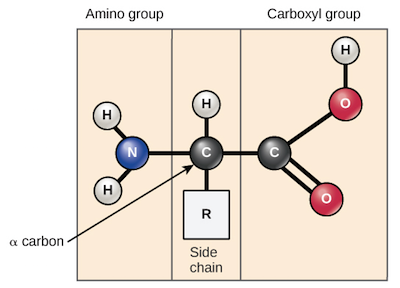
Read the charges, not just the drawing. Near physiological pH, the amino group is usually NH₃⁺ and the carboxyl group COO⁻. The neutral groups in this diagram are a simplified drawing. With an uncharged R group, the amino acid is a zwitterion: it carries opposite charges but has no net charge.
Let the R group tell the story
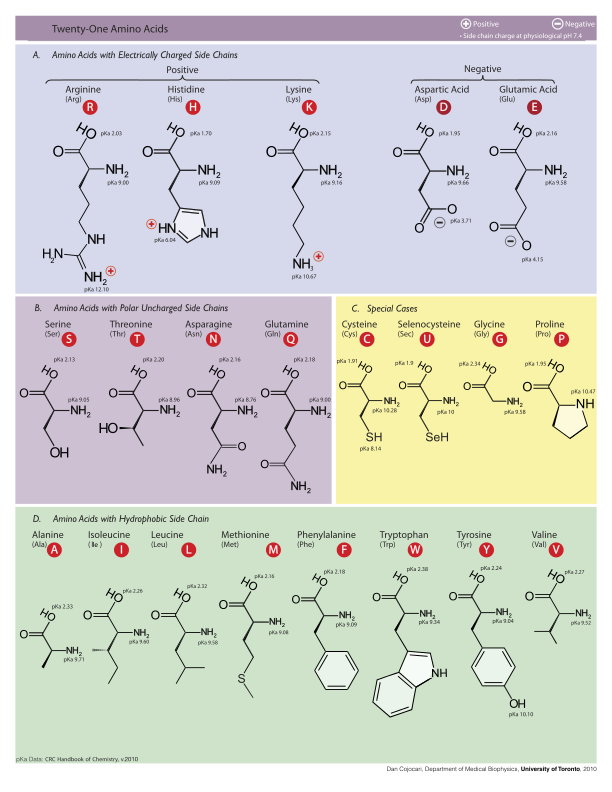
Proteins commonly use 20 amino acids. Their side chains determine polarity, charge, and interactions with water.
- Nonpolar: hydrophobic side chains, such as valine and leucine, tend to cluster away from water.
- Polar, uncharged: serine and glutamine interact favorably with water.
- Acidic: aspartate and glutamate are usually negatively charged at physiological pH.
- Basic: lysine and arginine are usually positively charged. Histidine is classified as basic but is mostly uncharged at physiological pH.
Amino acid code key 20 amino acids
- Ala · AAlanine
- Arg · RArginine
- Asn · NAsparagine
- Asp · DAspartate
- Cys · CCysteine
- Glu · EGlutamate
- Gln · QGlutamine
- Gly · GGlycine
- His · HHistidine
- Ile · IIsoleucine
- Leu · LLeucine
- Lys · KLysine
- Met · MMethionine
- Phe · FPhenylalanine
- Pro · PProline
- Ser · SSerine
- Thr · TThreonine
- Trp · WTryptophan
- Tyr · YTyrosine
- Val · VValine
Three exceptions worth remembering. Glycine has only hydrogen as its side chain, making it small and flexible. Proline’s side chain loops back to its nitrogen, restricting motion and often introducing bends. Two cysteine side chains can form a covalent disulfide bond.
Beyond the usual 20
Bacterial protein synthesis often starts with fMet. Pyrrolysine occurs in some archaea and bacteria; selenocysteine occurs in organisms including humans. These are exceptions to the standard set of 20.
Link the pieces, keep the direction
A peptide bond joins the carboxyl carbon of one amino acid to the amino nitrogen of another. The overall joining reaction is represented as dehydration synthesis: water is removed as the bond forms. Hydrolysis uses water to break the bond.
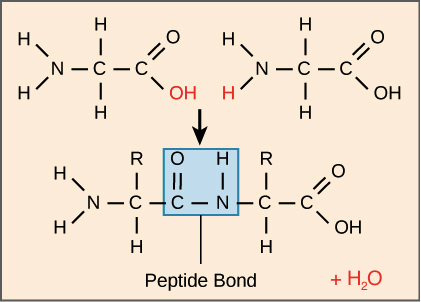
Keep track of the two ends. The N-terminus has the free amino group; the C-terminus has the free carboxyl group. Sequences are written N-terminus → C-terminus, and new residues are added at the C-terminus during synthesis.