Stronger attraction to the stationary phase means slower movement; stronger preference for the mobile phase means faster movement.
Two phases separate a mixture
Chromatography separates components because they interact differently with a stationary phase and a mobile phase. Adsorption to the stationary phase slows movement; solubility in the moving phase favors travel. Thin layer chromatography (TLC) separates spots on a plate; column chromatography separates bands that leave the column at different times.

| Term | Definition |
|---|---|
| Mobile phase or carrier | solvent moving through the column |
| Stationary phase or adsorbent | substance that stays fixed inside the column |
| Eluent | fluid entering the column |
| Eluate | fluid exiting the column (that is collected in flasks) |
| Elution | the process of washing out a compound through a column using a suitable solvent |
| Analyte | mixture whose individual components have to be separated and analyzed |

Follow the bands
Load the sample, pass eluent through the stationary phase, and collect successive fractions of eluate. Components that spend less time retained emerge first. Retention time measures how long a component takes to reach the detector or column outlet.

Original comparison of methods
| Technique | Stationary phase | Mobile phase | Basis of separation | Notes |
|---|---|---|---|---|
| *Paper chromatography | solid (cellulose) | liquid | polarity of molecules | compound spotted directly on a cellulose paper |
| *Thin layer chromatography (TLC) | solid (silica or alumina) | liquid | polarity of molecules | glass is coated with thin layer of silica on which is spotted the compound |
| *Liquid column chromatography | solid (silica or alumina) | liquid | polarity of molecules | glass column is packed with slurry of silica |
| Size exclusion chromatography | solid (microporous beads of silica) | liquid | size of molecules | small molecules get trapped in the pores of the stationary phase, while large molecules flow through the gaps between the beads and have very small retention times. So larger molecules come out first. In this type of chromatography there isn’t any interaction, physical or chemical, between the analyte and the stationary phase. |
| Ion-exchange chromatography | solid (cationic or anionic resin) | liquid | ionic charge of the molecules | molecules possessing the opposite charge as the resin will bind tightly to the resin, and molecules having the same charge as the resin will flow through the column and elute out first. |
| Affinity chromatography | solid (agarose or porous glass beads on to which are immobilized molecules like enzymes and antibodies) | liquid | binding affinity of the analyte molecule to the molecule immobilized on the stationary phase | if the molecule is a substrate for the enzyme, it will bind tightly to the enzyme and the unbound analytes will pass through in the mobile phase, and elute out of the column, leaving the substrate bound to the enzyme, which can then be detached from the stationary phase and eluted out of the column with an appropriate solvent. |
| Gas chromatography | liquid or solid support | gas (inert gas like argon or helium) | boiling point of the molecules | samples are volatilized and the molecule with lowest boiling point comes out of the column first. The molecule with the highest boiling point comes out of the column last. |
*Fall under the category of ‘Liquid Chromatography’
In ideal size exclusion chromatography, separation depends on pore access rather than specific binding. In gas chromatography, volatility and stationary-phase interactions both influence retention; boiling point alone is not always enough to predict order.
Polarity and solvent choice
Paper chromatography and TLC make separated spots visible, as with leaf pigments. Keep the starting spot above the solvent level; mark the solvent front before it evaporates.
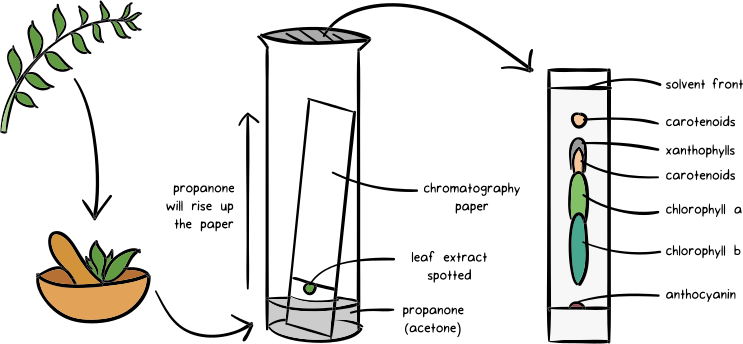
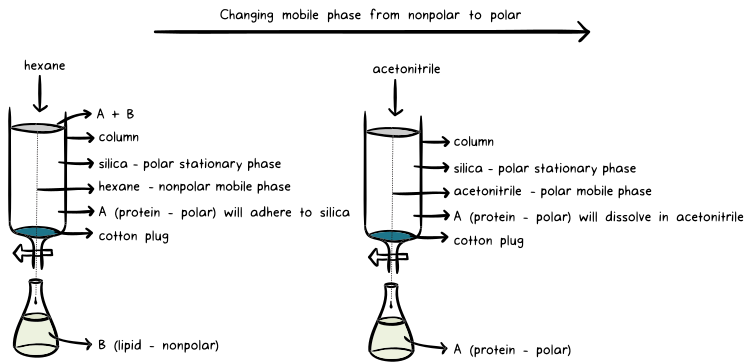
In normal-phase chromatography, a polar stationary phase retains polar molecules more strongly. A more polar mobile phase generally competes more effectively for those sites and moves retained compounds farther or elutes them sooner. Reversed-phase chromatography uses a nonpolar stationary phase and a polar mobile phase. Changing the mobile phase during a run is gradient elution.
Calculate the retention factor
Rf = distance traveled by the component ÷ distance traveled by the solvent front. Measure both from the starting line. Rf is dimensionless and normally lies between 0 and 1. Compare values only under matching stationary-phase and solvent conditions.

| Component | Distance travelled by the component (cm) | Distance travelled by the solvent (cm) | Retention factor (Rf) of the component |
|---|---|---|---|
| C | 1 | 5 | RfC = 1/5 = 0.2 |
| A | 2 | 5 | RfA = 2/5 = 0.4 |
| B | 3 | 5 | RfB = 3/5 = 0.6 |
In this example, B travels farthest and has the largest Rf; C is retained most strongly and has the smallest Rf. A larger TLC Rf usually corresponds to faster elution in a comparable column system.