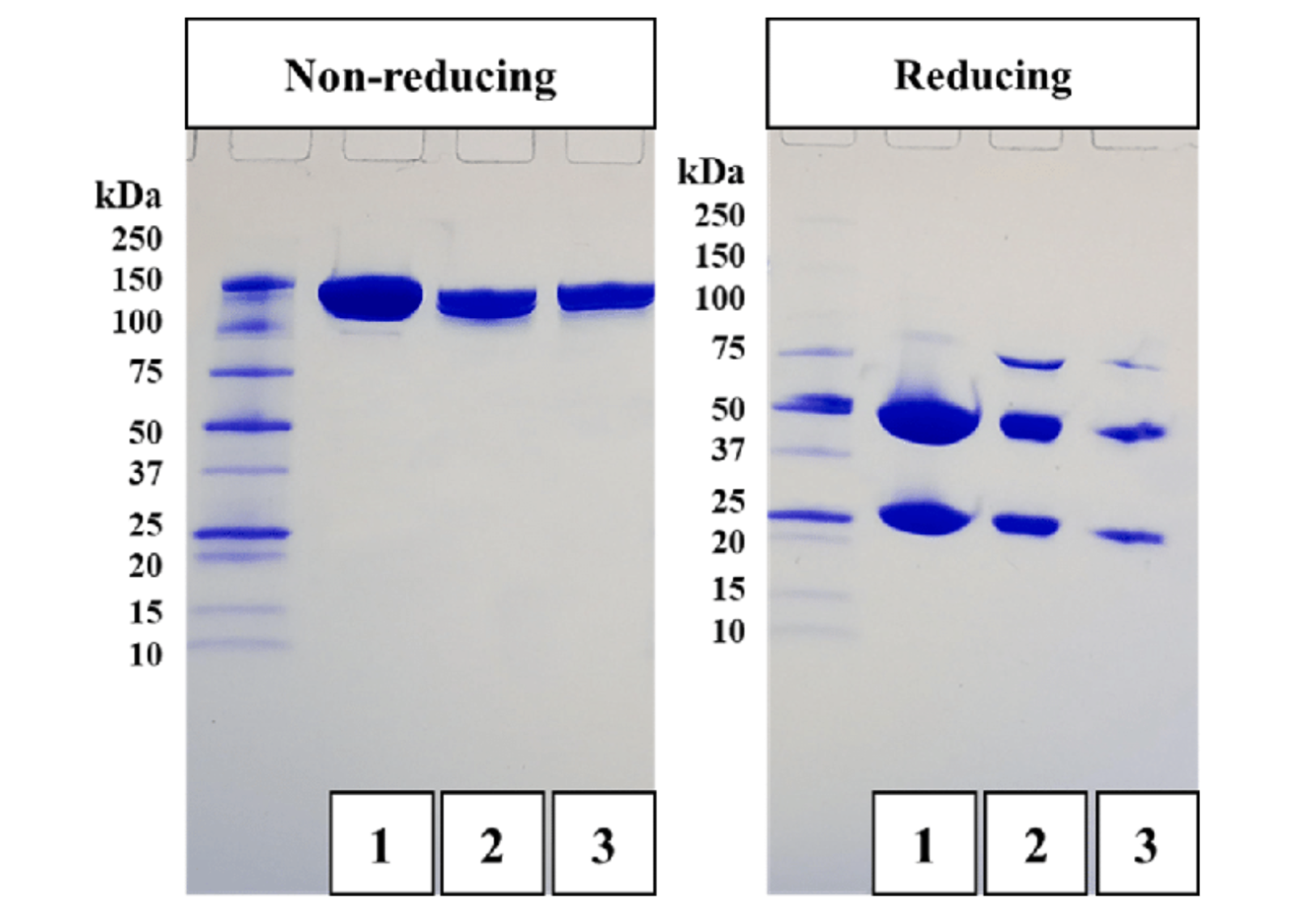
SDS standardizes charge relative to mass; a reducing agent separately breaks disulfide bonds.
What makes proteins move?
Electrophoresis moves charged molecules through a gel in an electric field. Migration depends on charge, size, shape, and the gel’s pores. Native PAGE retains much of a protein’s native structure, so mobility is not a simple measure of molecular mass.
Separate mainly by molecular mass
SDS-PAGE uses the anionic detergent SDS to unfold proteins and coat them with negative charge. A roughly uniform charge-to-mass ratio makes the gel separate polypeptides mainly by molecular mass. Smaller chains pass through the pores more readily and usually migrate farther toward the positive anode.
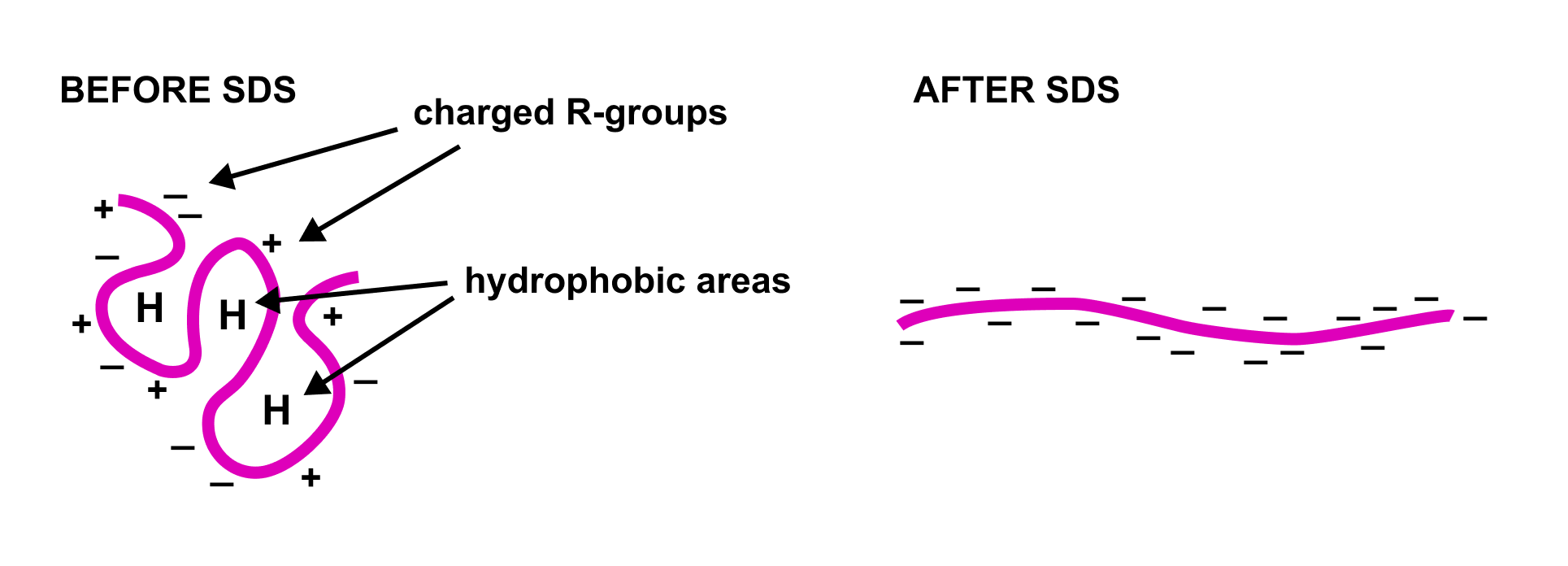
Reducing and non-reducing conditions
SDS disrupts noncovalent interactions but does not itself reduce disulfide bonds. Adding beta-mercaptoethanol (BME) or dithiothreitol (DTT) converts disulfides to separate thiols, allowing disulfide-linked chains to separate.
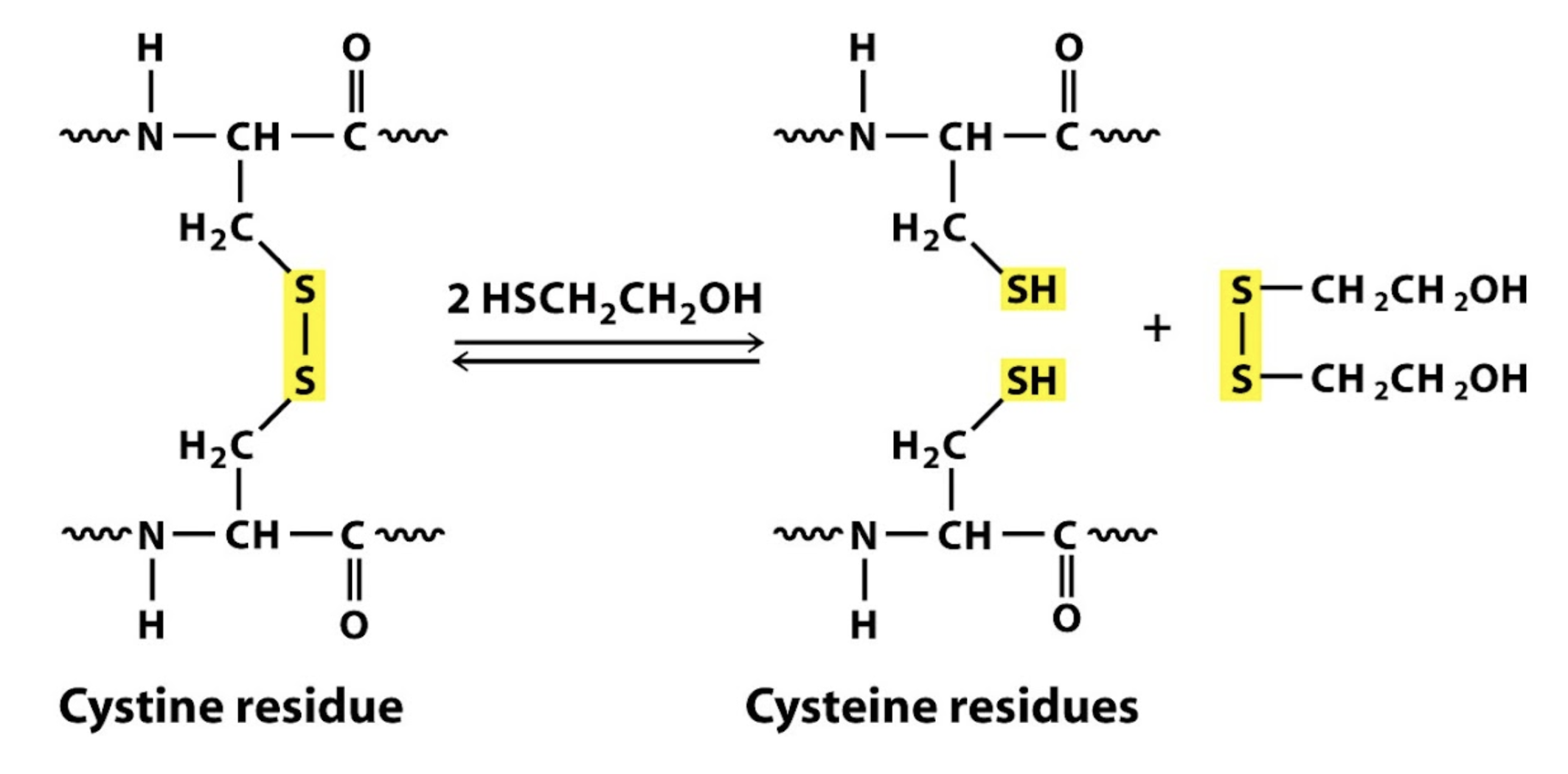
Non-reducing still denatures. Non-reducing SDS-PAGE preserves disulfide-linked chains. It does not preserve all protein complexes: subunits held together only by noncovalent interactions can dissociate even without a reducing agent.
From sample to bands
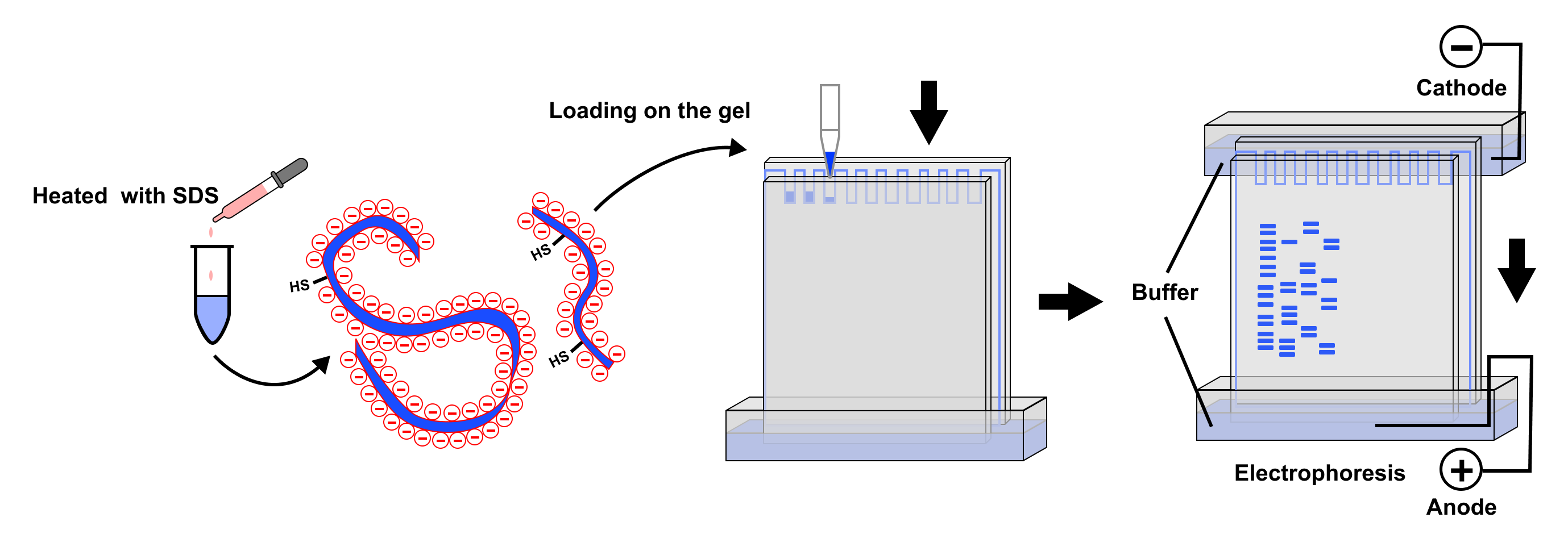
- Mix proteins with SDS sample buffer; add a reducing agent when needed. Heating commonly promotes unfolding.
- Load samples and a molecular mass ladder. The stacking gel concentrates the samples; the resolving gel separates them.
- Apply voltage, stain the proteins, and compare migration with known ladder bands. The ladder gives apparent molecular masses, usually reported in kDa.
Interpret the gel
A disulfide-linked antibody can appear near 150 kDa without reduction. After reduction, its heavy and light chains appear near 50 and 25 kDa. Each band can contain multiple chains of the same size; band count is not the number of subunits. A total-protein stain shows many proteins, so a band’s identity needs further evidence.