Amino acid structure & classification

Source ↗

The shared backbone builds the chain; the R group determines each residue’s chemistry.

The shared backbone

An alpha carbon carries an amino group, a carboxyl group, a hydrogen, and an R group. Near physiological pH, the backbone usually has NH₃⁺ and COO⁻ groups: a zwitterion. Glycine is achiral; the other standard amino acids have a chiral alpha carbon. Proteins use the L configuration.
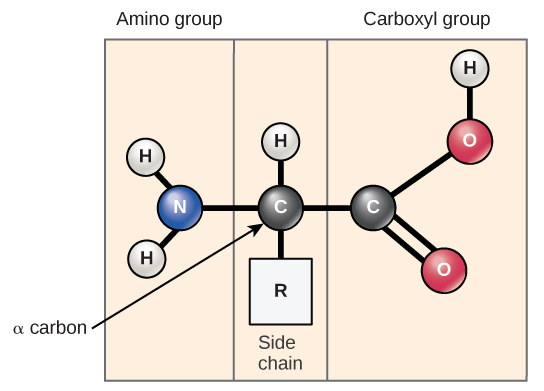
Neutral amino acid with amino, carboxyl, hydrogen, and R groups bonded to the alpha carbon.
Amino acid backbone OpenStax, via Khan Academy · CC BY-NC-SA 4.0 · Original image ↗

Classify the side chain

Polarity, charge, and aromaticity describe overlapping properties. Tyrosine, for example, is aromatic and also has a polar hydroxyl group. The original chart gives all 20 structures and codes.
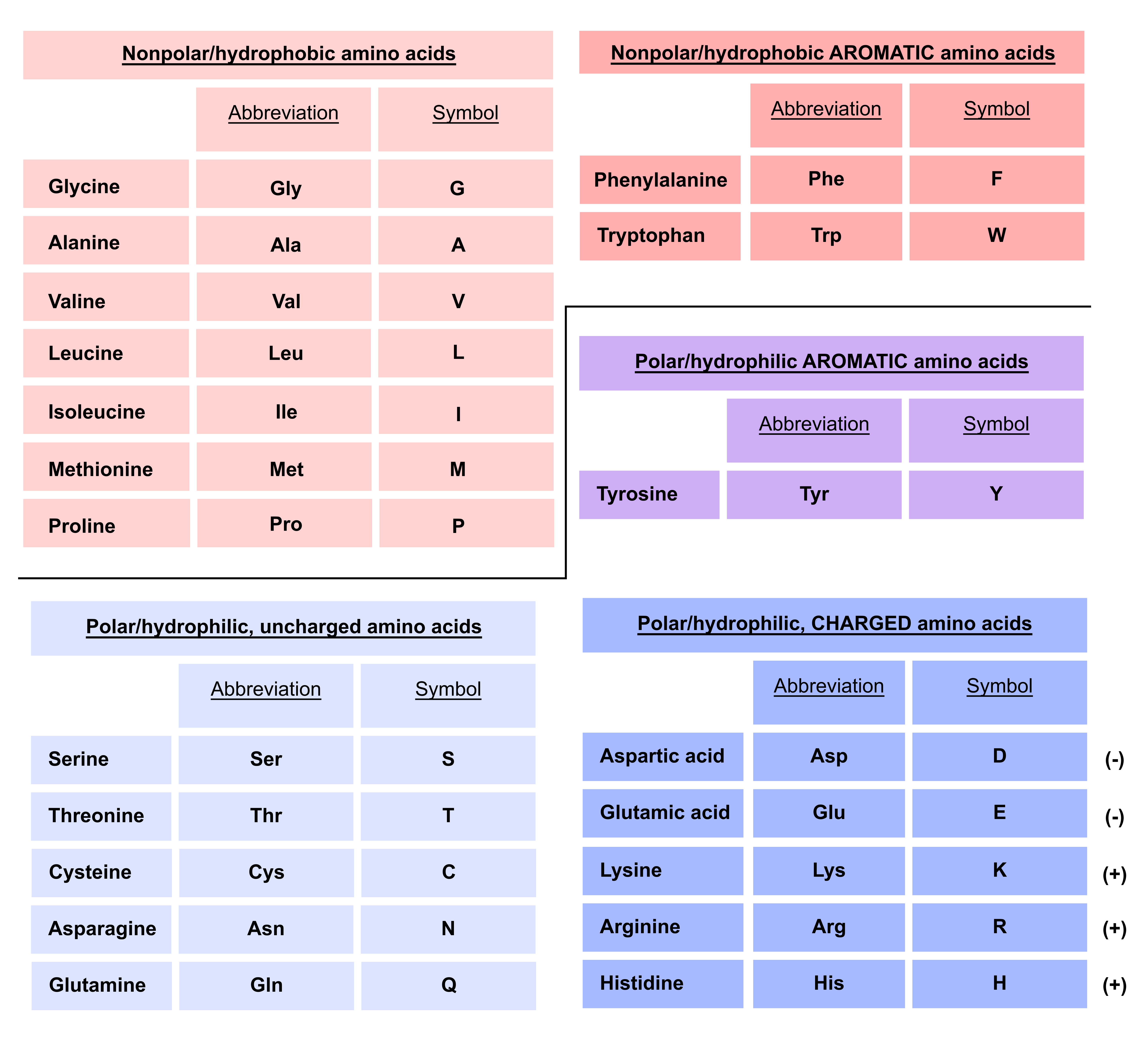
Original table of all 20 amino acid structures, names, three-letter and one-letter codes, grouped by side-chain properties.
The 20 amino acids: original classification chart OpenStax, via Khan Academy · CC BY-NC-SA 4.0 · Original image ↗
Amino acid code key 20 amino acids

Nonpolar residues

Glycine with a hydrogen side chain.
Glycine OpenStax, via Khan Academy · CC BY-NC-SA 4.0 · Original image ↗
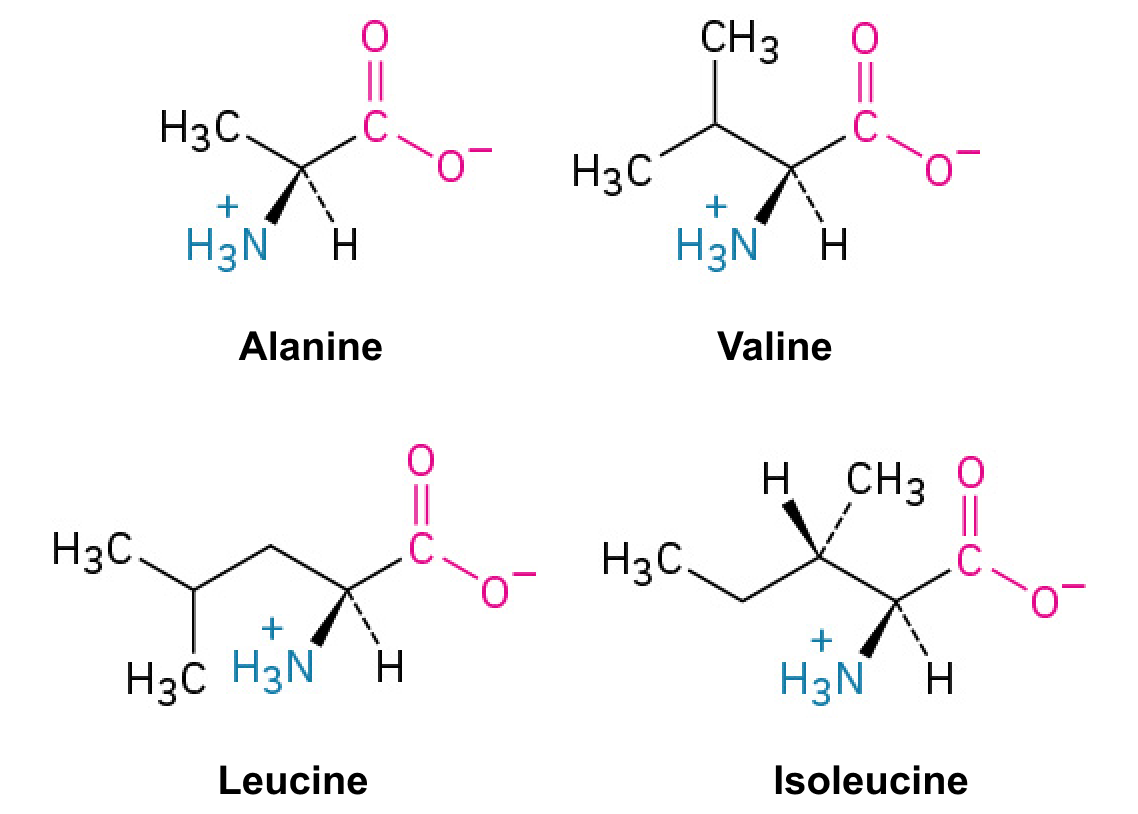
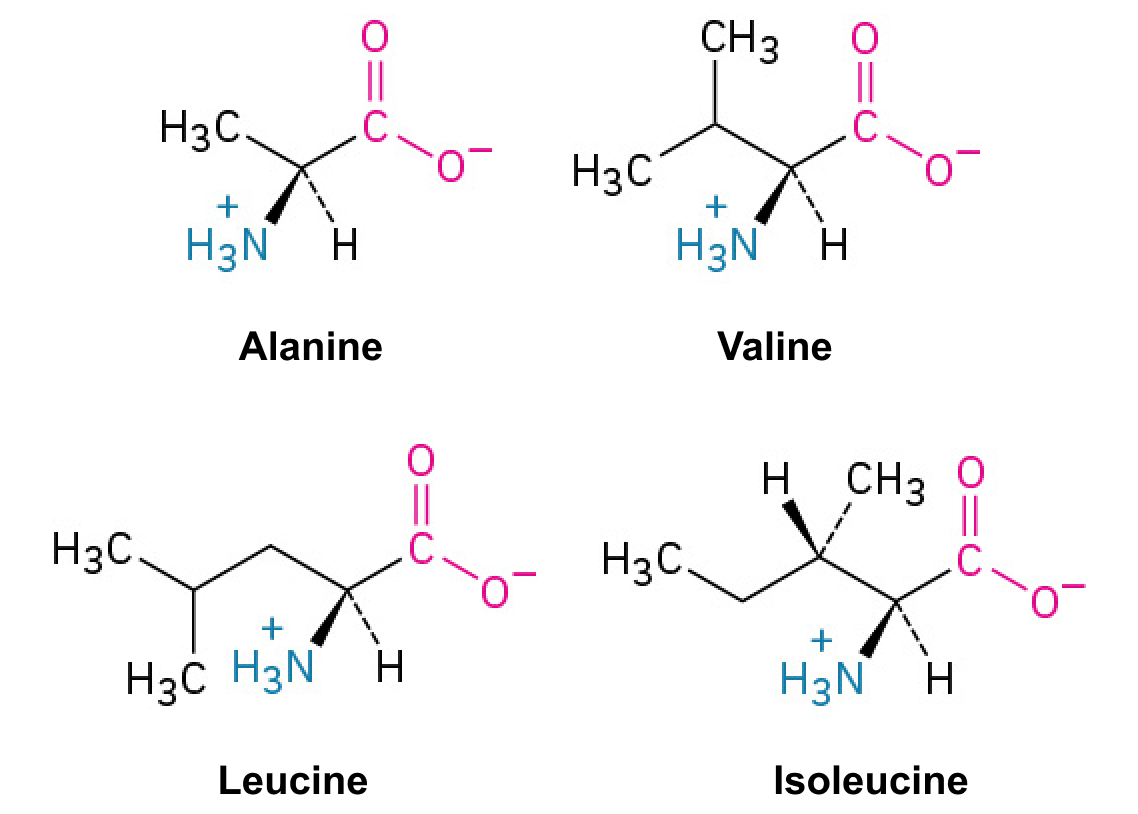
Four amino acid structures with nonpolar hydrocarbon side chains.
Alanine, valine, leucine, and isoleucine OpenStax, via Khan Academy · CC BY-NC-SA 4.0 · Original image ↗
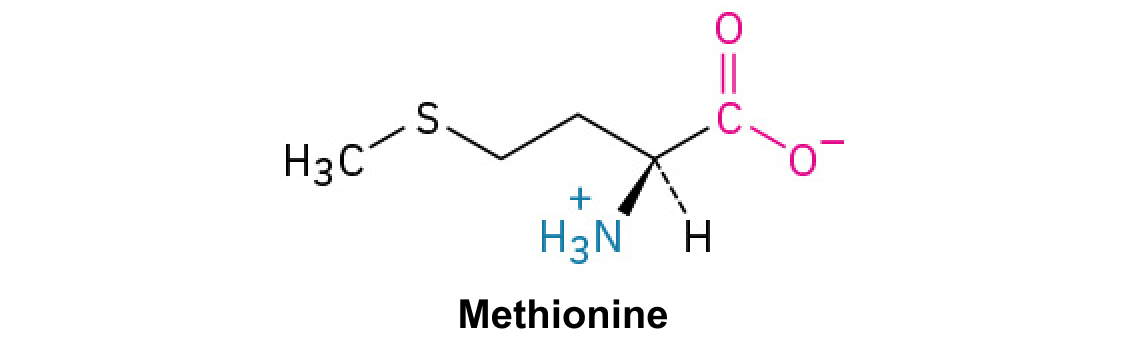
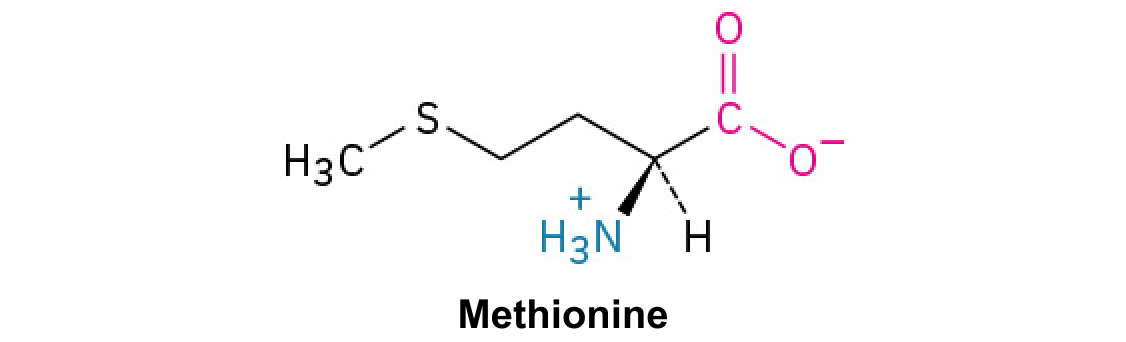
Methionine with sulfur in a thioether side chain.
Methionine OpenStax, via Khan Academy · CC BY-NC-SA 4.0 · Original image ↗
Proline with its side chain joined to the backbone nitrogen in a ring.
Proline OpenStax, via Khan Academy · CC BY-NC-SA 4.0 · Original image ↗

Aromatic residues

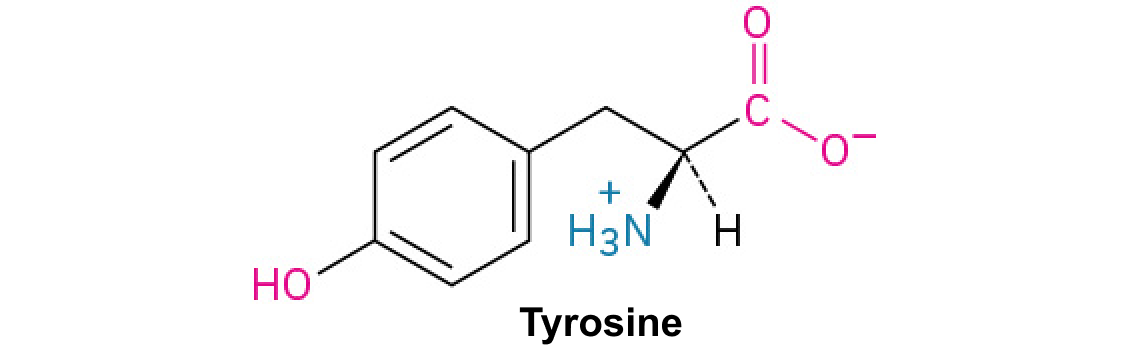
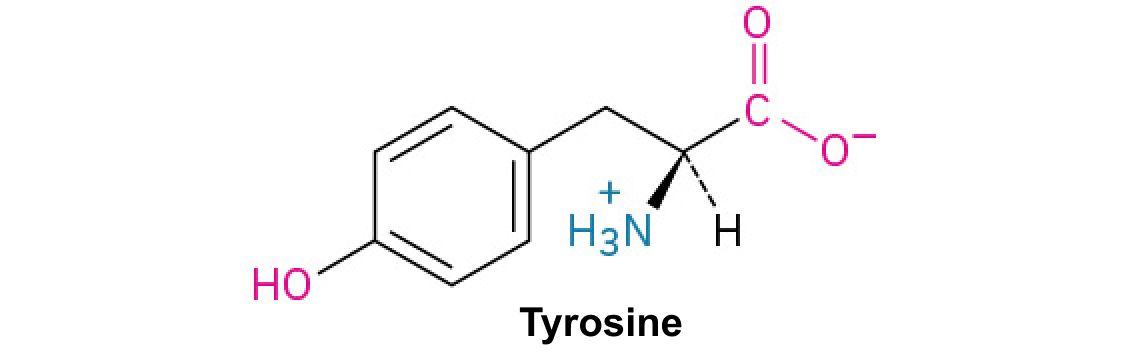
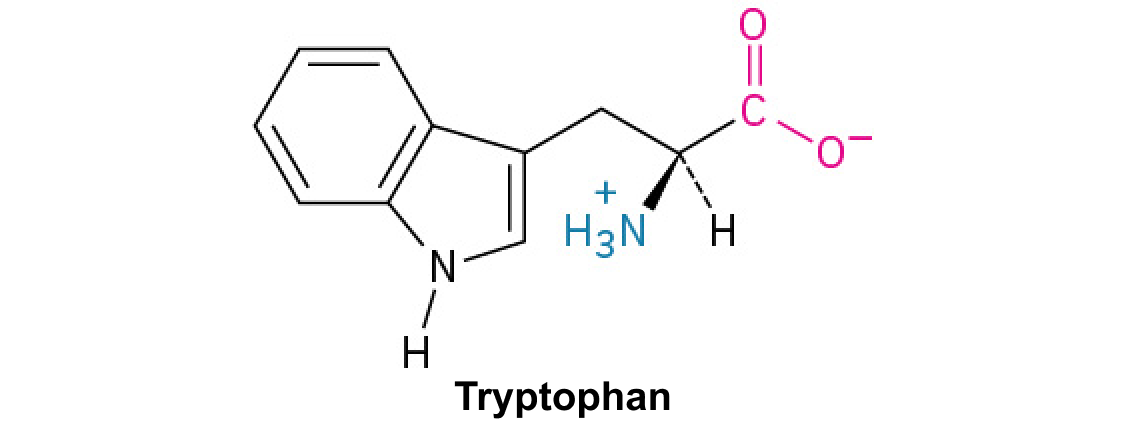
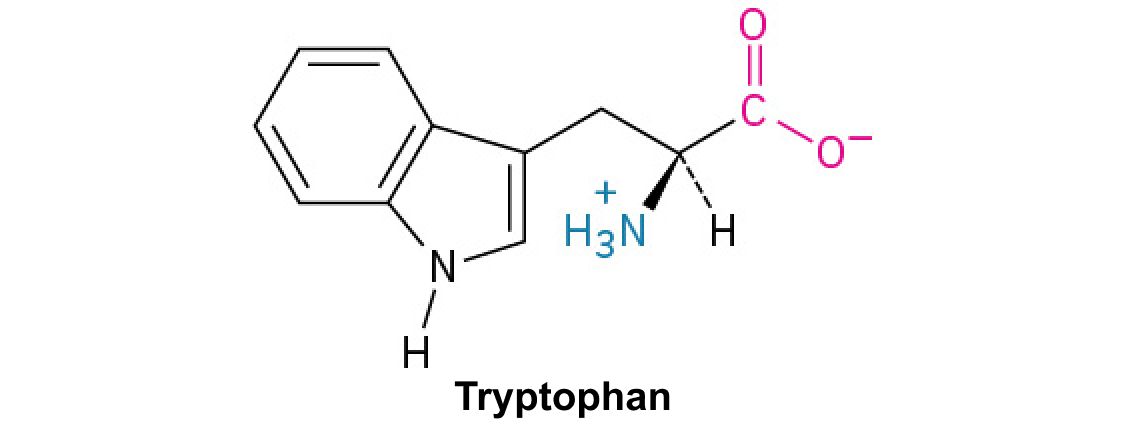
Phenylalanine has a benzene ring. Tyrosine adds a hydroxyl group, making it more polar and a phosphorylation site. Tryptophan has a bulky indole ring. Tryptophan and tyrosine dominate protein UV absorbance near 280 nanometers.
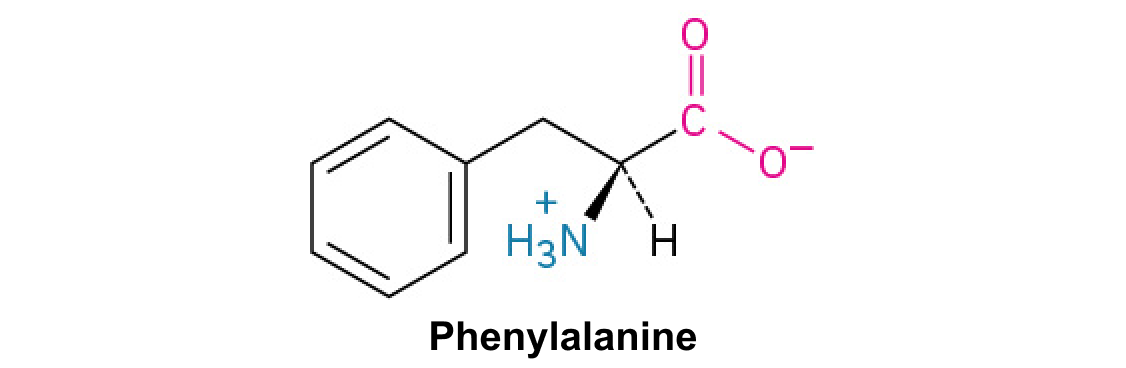
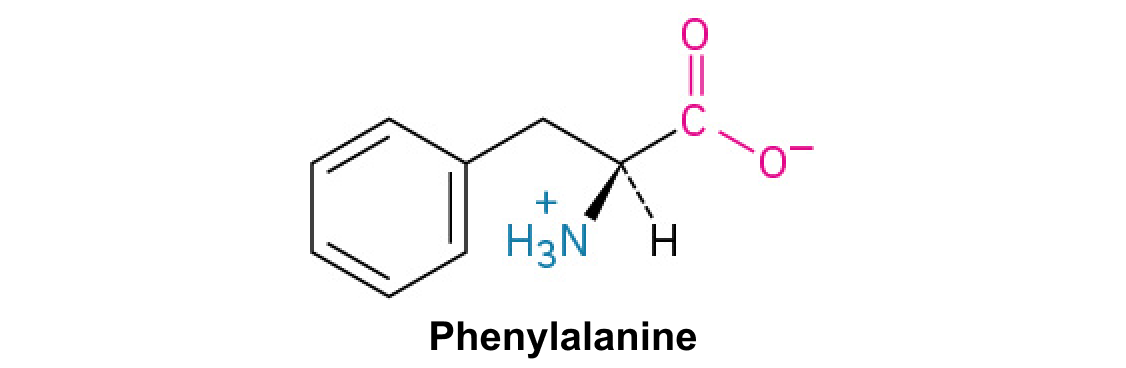
Phenylalanine with a benzyl side chain.
Phenylalanine OpenStax, via Khan Academy · CC BY-NC-SA 4.0 · Original image ↗
Tyrosine with a hydroxyl group on its aromatic ring.
Tyrosine OpenStax, via Khan Academy · CC BY-NC-SA 4.0 · Original image ↗
Tryptophan with an indole side chain.
Tryptophan OpenStax, via Khan Academy · CC BY-NC-SA 4.0 · Original image ↗

Polar, usually uncharged residues

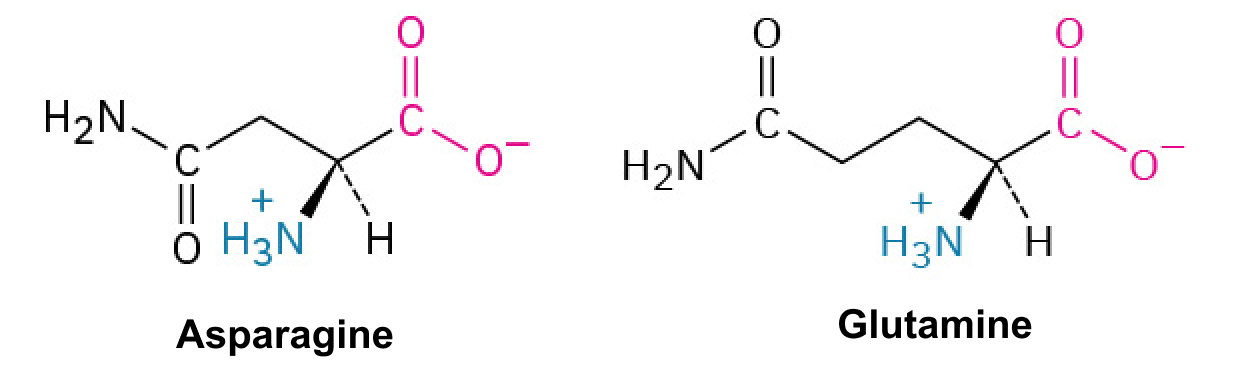
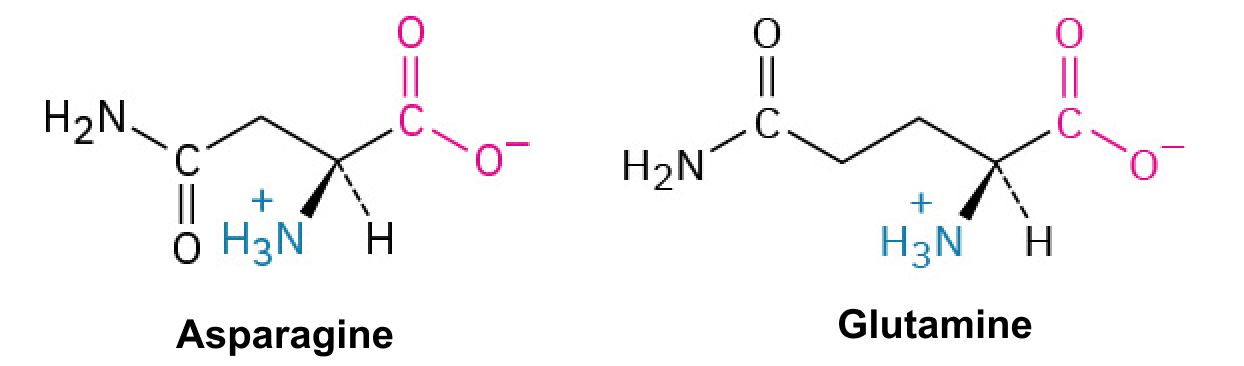
Serine and threonine have hydroxyl groups; both can undergo phosphorylation. Cysteine has a thiol that can oxidize to a disulfide bond. Asparagine and glutamine have amide side chains that hydrogen bond but are uncharged near physiological pH.
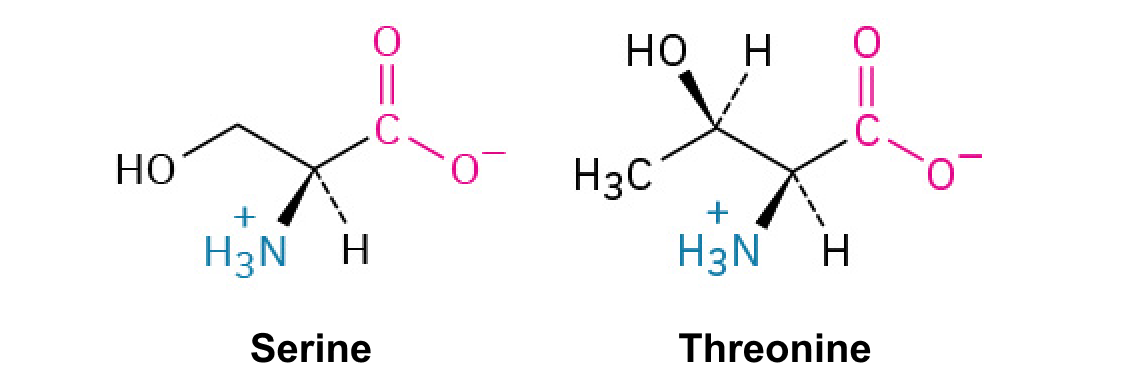
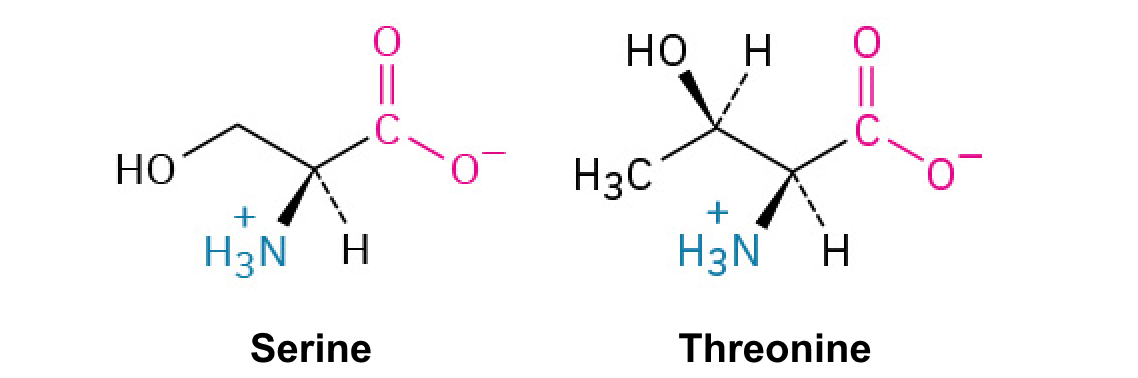
Serine and threonine with hydroxyl-containing side chains.
Serine and threonine OpenStax, via Khan Academy · CC BY-NC-SA 4.0 · Original image ↗
Cysteine with a sulfur-containing thiol side chain.
Cysteine OpenStax, via Khan Academy · CC BY-NC-SA 4.0 · Original image ↗
Asparagine and glutamine with uncharged amide side chains.
Asparagine and glutamine OpenStax, via Khan Academy · CC BY-NC-SA 4.0 · Original image ↗

Charged residues

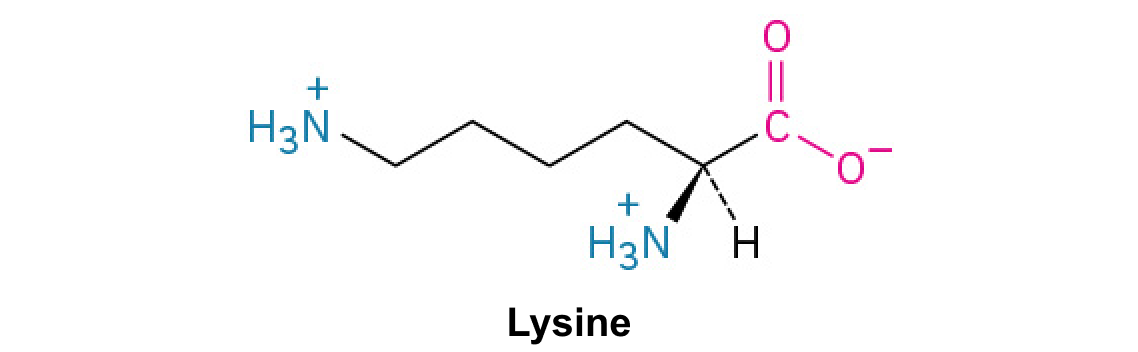
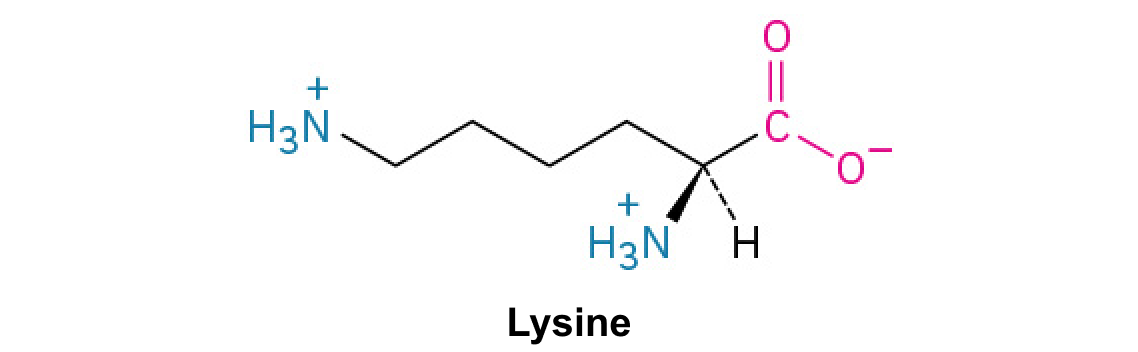
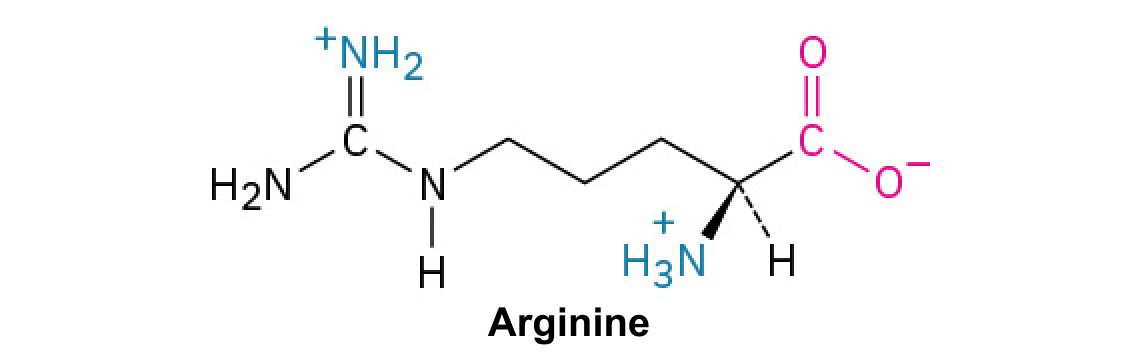
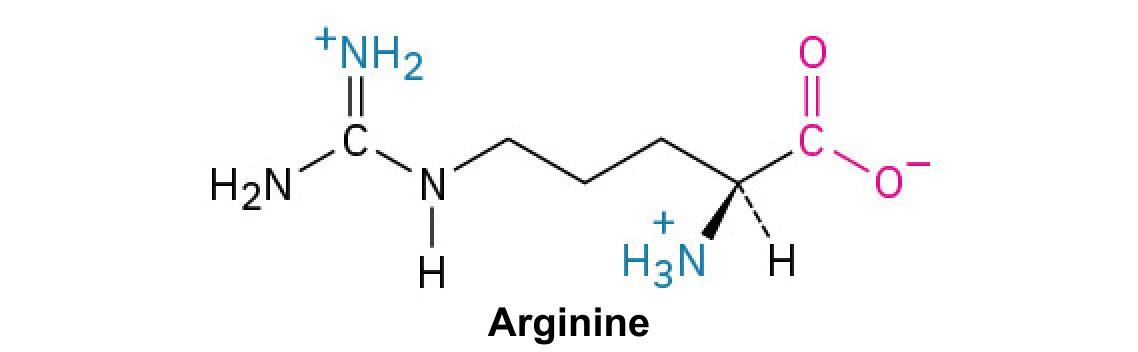
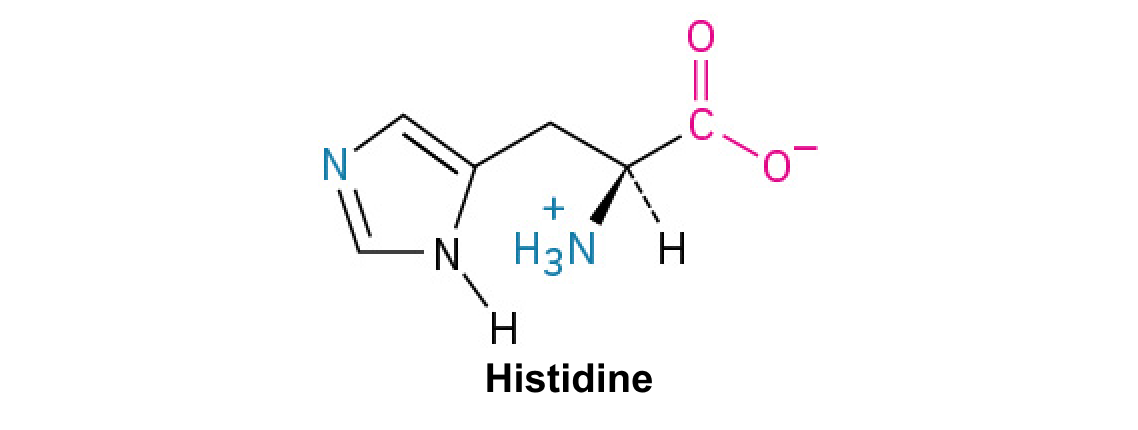
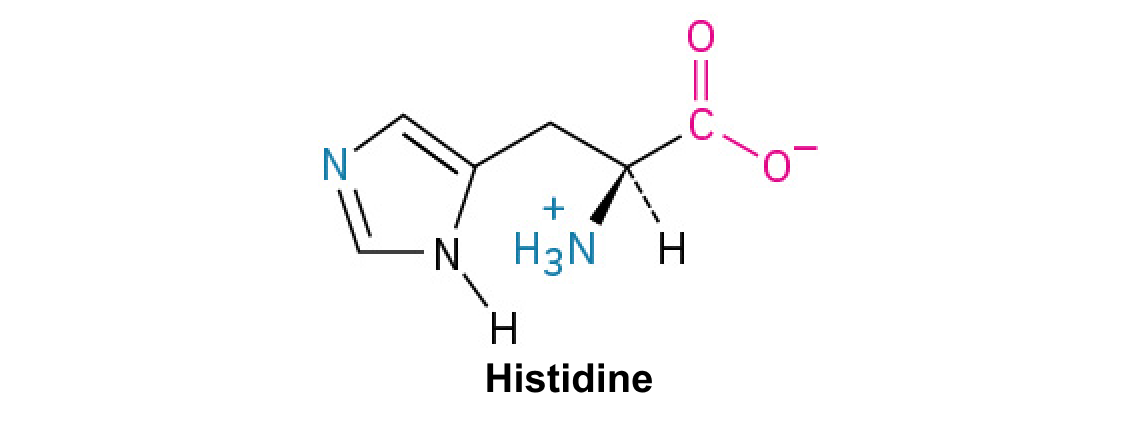
Aspartate and glutamate are generally negative near physiological pH. Lysine and arginine are generally positive. Histidine’s side chain can gain or lose a proton near biological pH, making it useful in enzyme catalysis; it is often neutral around pH 7.
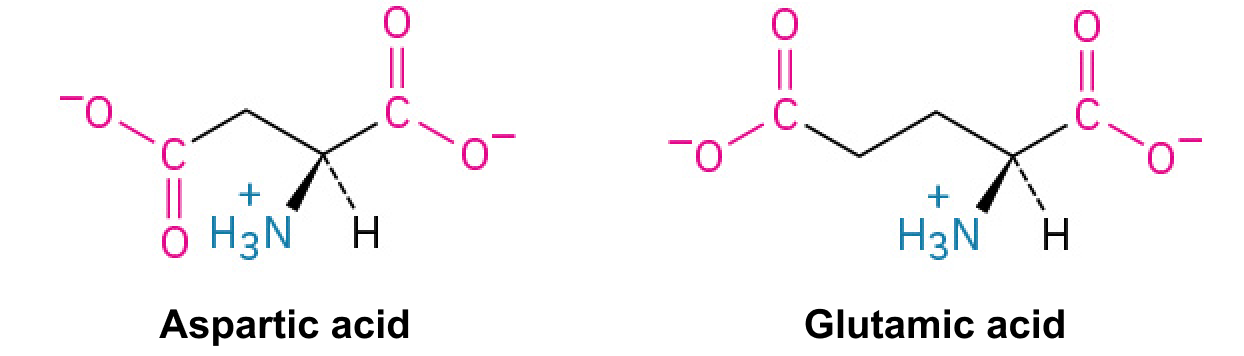
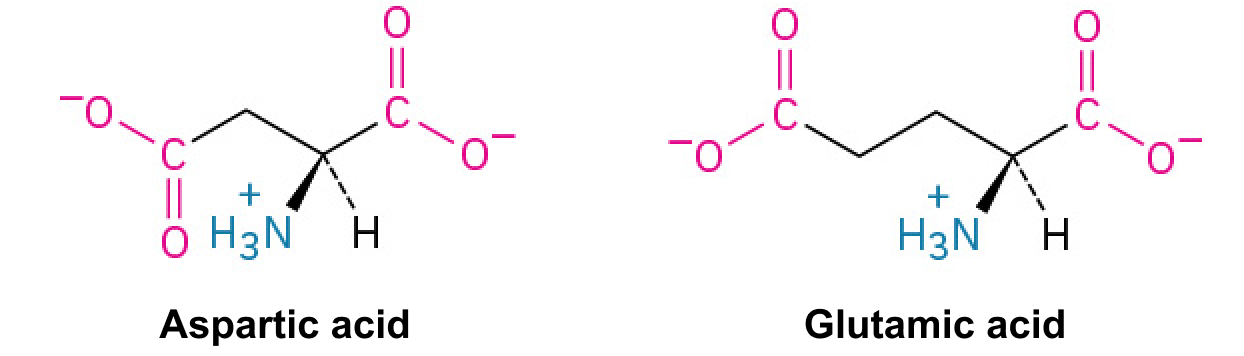
Structures of the acidic amino acids aspartic acid and glutamic acid.
Aspartic acid and glutamic acid OpenStax, via Khan Academy · CC BY-NC-SA 4.0 · Original image ↗
Lysine with a terminal amino group in its side chain.
Lysine OpenStax, via Khan Academy · CC BY-NC-SA 4.0 · Original image ↗
Arginine with a guanidino group in its side chain.
Arginine OpenStax, via Khan Academy · CC BY-NC-SA 4.0 · Original image ↗
Histidine with an imidazole ring in its side chain.
Histidine OpenStax, via Khan Academy · CC BY-NC-SA 4.0 · Original image ↗

Diet and modifications

The nine essential amino acids are histidine, isoleucine, leucine, lysine, methionine, phenylalanine, threonine, tryptophan, and valine. The body normally makes the others, although needs change during growth or illness.

After synthesis, phosphorylation, glycosylation, acetylation, methylation, and ubiquitination can change protein activity, interactions, location, or lifetime.

44 terms, alphabetically ordered

Acetylation
Addition of an acetyl group, often to a lysine amino group; can alter charge and protein interactions.
AlanineAla · A
A nonpolar amino acid with a methyl side chain.
Alpha carbonα-carbon
The central carbon next to the carboxyl carbon. In a standard amino acid it binds an amino group, hydrogen, and side chain.
Alpha helixα helix · alpha helices · α helices
A helical secondary structure stabilized by hydrogen bonds between a backbone carbonyl oxygen and an amide hydrogen four residues later.
Amino acidamino acids
A protein building block containing amino and carboxyl groups and a characteristic side chain.
Amino groupNH₃⁺ · NH₂
A nitrogen-containing functional group. A free amino acid’s amino group is typically protonated (NH₃⁺) near physiological pH; proline’s ring nitrogen is an exception to this formula.
ArginineArg · R
A basic amino acid with a guanidinium group, usually positively charged near physiological pH.
Aromatic
Containing a cyclic, conjugated ring system with delocalized electrons. Phenylalanine, tyrosine, and tryptophan have aromatic side chains.
AsparagineAsn · N
A polar, uncharged amino acid with an amide side chain.
AspartateAsp · aspartic acid · D
An acidic amino acid whose side chain is usually negatively charged near physiological pH.
Carboxyl groupCOO⁻ · COOH
An acidic functional group, COOH. In free amino acids it is usually deprotonated to COO⁻ near physiological pH.
Chiralitychiral
Having a structure that cannot be superimposed on its mirror image. Glycine is the only standard amino acid without a chiral alpha carbon.
CysteineCys · C
An amino acid with a thiol side chain. Two cysteines can form a disulfide bond.
Disulfide bond
A covalent sulfur–sulfur bond formed by oxidation of two cysteine thiol groups, which can stabilize protein structure.
Enzymeenzymes
A biological catalyst that speeds a reaction without being consumed. Most enzymes are proteins.
Essential amino acidessential amino acids
An amino acid that humans must obtain from food because it cannot be made in sufficient amounts.
GlutamateGlu · glutamic acid · E
An acidic amino acid whose side chain is usually negatively charged near physiological pH.
GlutamineGln · Q
A polar, uncharged amino acid with an amide side chain one carbon longer than asparagine’s.
GlycineGly · G
The smallest amino acid; its side chain is hydrogen. It is achiral and allows substantial backbone flexibility.
Glycosylation
Attachment of carbohydrate groups to a molecule, influencing protein folding, stability, trafficking, or recognition.
HistidineHis · H
A basic amino acid with an imidazole side chain. Mostly uncharged near physiological pH, it can accept or donate protons.
Hydrogen bondhydrogen bonds · hydrogen bonding
An attraction between a hydrogen bonded to an electronegative atom and another electronegative atom. Backbone hydrogen bonds stabilize protein secondary structure.
Hydrophobic
Interacting poorly with water. Nonpolar side chains often gather in a soluble protein’s interior.
IsoleucineIle · I
A nonpolar amino acid with a branched hydrocarbon side chain.
L configurationL amino acid · L amino acids
A stereochemical configuration assigned by comparison with L-glyceraldehyde. Most amino acids incorporated into proteins have this configuration; glycine is achiral. L does not specify the direction of optical rotation.
LeucineLeu · L
A nonpolar, hydrophobic amino acid with a branched hydrocarbon side chain.
LysineLys · K
A basic amino acid with a terminal amino group, usually positively charged near physiological pH.
MethionineMet · M
A nonpolar amino acid with sulfur in a thioether side chain. Unlike cysteine, it does not form disulfide bonds.
Methylation
Addition of a methyl group; modification of residues such as lysine can regulate protein interactions and gene expression.
Nonessential amino acidnonessential amino acids
An amino acid the body can normally synthesize. Some become conditionally essential during growth or illness.
pH
A measure of acidity, defined as the negative base-10 logarithm of hydrogen ion activity. Lower pH means greater acidity; pH influences amino acid charge.
PhenylalaninePhe · F
A nonpolar amino acid with an aromatic benzyl side chain.
Phosphorylation
Addition of a phosphate group, often to serine, threonine, or tyrosine in proteins; can regulate protein activity.
ProlinePro · P
An amino acid whose side chain loops back to the backbone nitrogen, restricting rotation and often creating bends.
R groupR groups · side chain · side chains
The variable side chain attached to an amino acid’s alpha carbon. It determines identity, polarity, charge, and chemical behavior.
SerineSer · S
A polar, uncharged amino acid with a hydroxyl-containing side chain.
ThreonineThr · T
A polar, uncharged amino acid with a hydroxyl group and a methyl group on its side chain.
TryptophanTrp · W
An amino acid with a bulky aromatic indole side chain; commonly grouped as nonpolar.
TyrosineTyr · Y
An aromatic amino acid with a phenolic hydroxyl group. Usually uncharged near physiological pH.
Ubiquitin
A small protein attached to other proteins to regulate their degradation, localization, or interactions.
Ubiquitination
Attachment of ubiquitin to a protein, commonly at a lysine residue. Certain ubiquitin chains signal proteasomal degradation.
UltravioletUV
Light with wavelengths shorter than visible light. Protein absorbance near 280 nm is mainly due to tryptophan and tyrosine.
ValineVal · V
A nonpolar, hydrophobic amino acid with a branched side chain.
Zwitterion
A molecule with both positive and negative formal charges and zero net charge. Amino acids with uncharged side chains commonly take this form near physiological pH.

View in terminology ↗