Protein folding & denaturation

Source ↗

A stable fold balances interactions and entropy; denaturation disrupts that balance.

What holds a protein together?

Primary structure is the amino acid sequence joined by peptide bonds. Secondary structure uses backbone hydrogen bonds. Tertiary structure describes one chain’s fold; quaternary structure describes interacting subunits.

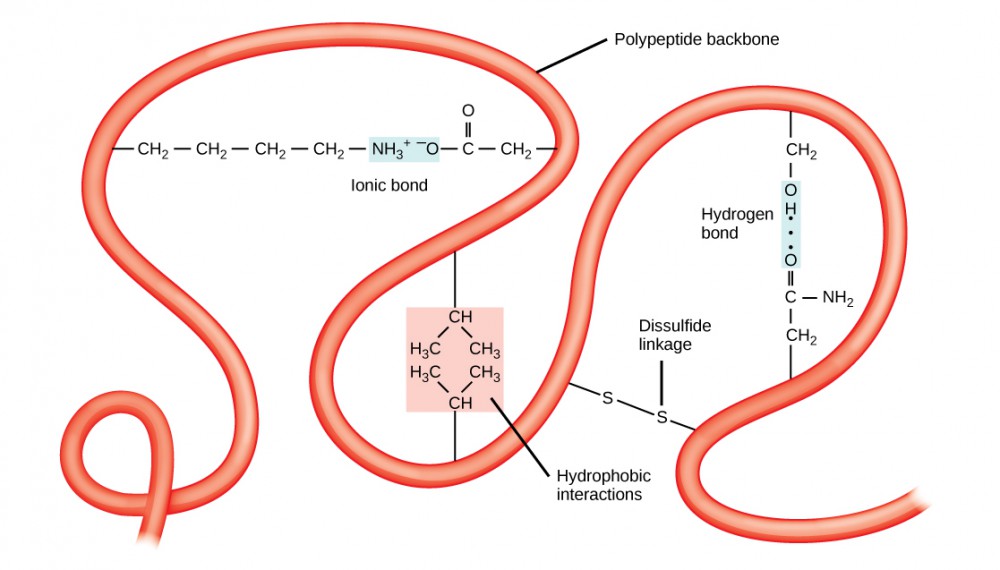
Protein chain stabilized by ionic and hydrogen bonds, a disulfide bond, and hydrophobic interactions.
Forces within a folded chain OpenStax Biology, via Khan Academy · CC BY 3.0 · Original image ↗

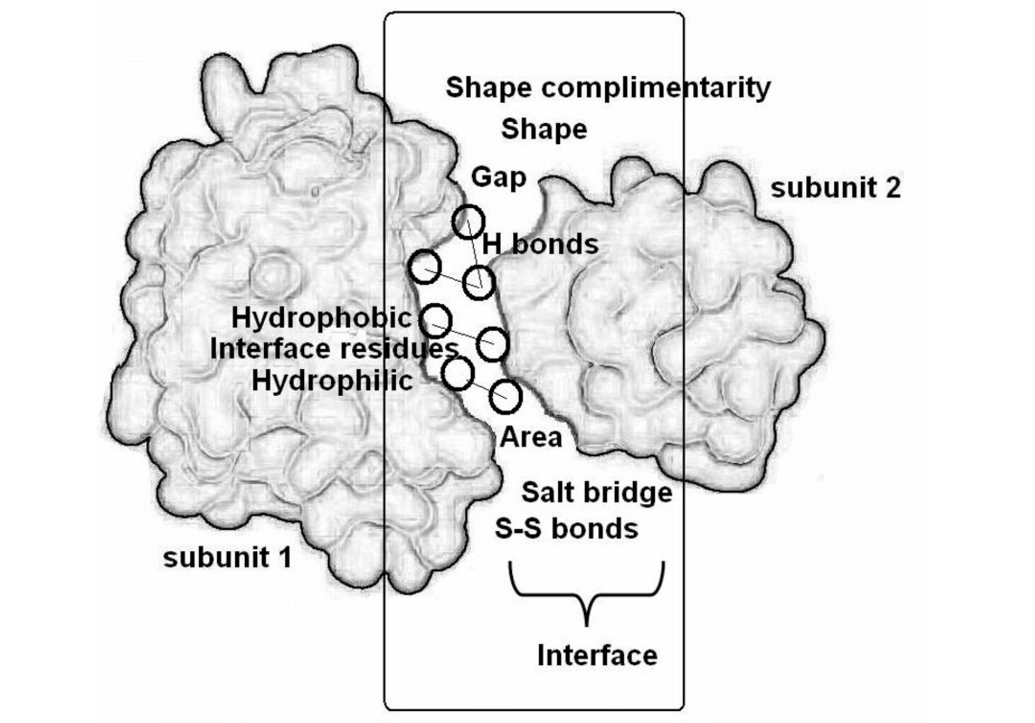
Interfaces between subunits use similar forces. Complementary shapes bring interacting groups together, but not every protein contains all four structural levels.

Two protein surfaces meet through complementary shape, hydrophobic and hydrophilic contacts, hydrogen bonds, salt bridges, and a disulfide link.
A protein–protein interface ResearchGate figure credited in the Khan Academy source · Source attribution · Original image ↗

Why folding can be favorable

Folding lowers a chain’s conformational entropy by restricting its possible shapes. Burying hydrophobic groups can increase solvent entropy by releasing water constrained around those groups. Favorable folding reflects the total free-energy change, including both protein–solvent interactions and entropy; the chain’s entropy alone does not decide it.

Help from chaperones

Molecular chaperones prevent inappropriate interactions and assist folding. Many are heat shock proteins (HSPs). HSP70 binds exposed hydrophobic regions, while the bacterial chaperonin GroEL and its GroES cap create a protected folding chamber. ATP-driven cycles help these systems bind and release their clients. The amino acid sequence still specifies the possible native fold.

What denaturation changes

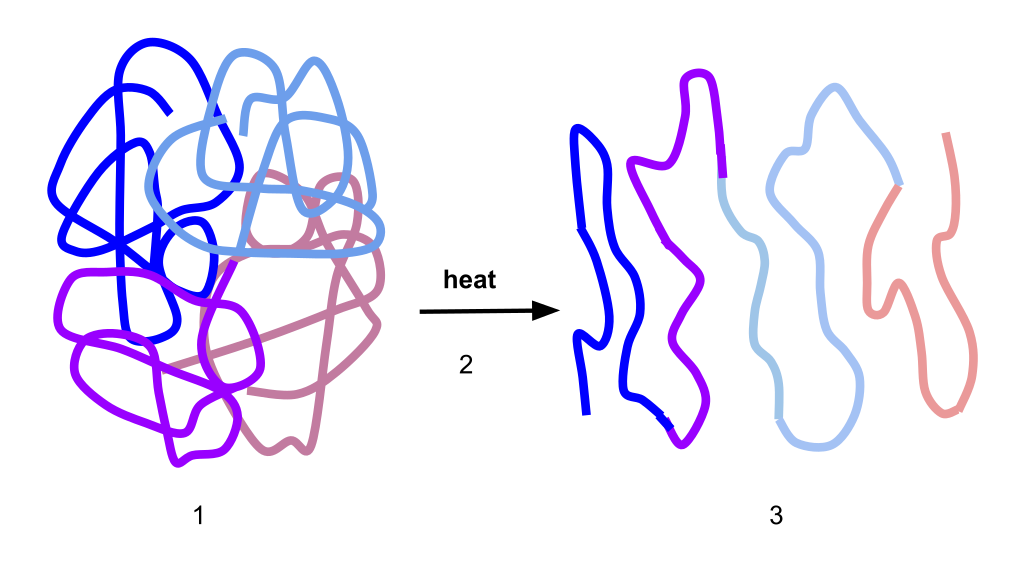
Heat increases molecular motion; extreme pH changes the charges on ionizable groups. Detergents, organic solvents, and other denaturants can disrupt the interactions supporting a fold. Reducing agents specifically break disulfide bonds. Loss of native structure often means loss of function.

A compact multichain protein becomes extended after heating.
Heat-induced unfolding Scurran15, via Wikimedia Commons and Khan Academy · CC BY-SA 4.0 · Original image ↗

Keep the distinction. Ordinary denaturation leaves peptide bonds and primary structure intact. Hydrolysis breaks peptide bonds. Refolding is possible for some proteins when conditions are restored, but aggregation can make the change irreversible.

26 terms, alphabetically ordered

Adenosine triphosphateATP
An energy-carrying nucleotide; its hydrolysis powers many cellular processes, including chaperone cycles.
Amino acidamino acids
A protein building block containing amino and carboxyl groups and a characteristic side chain.
Chaperoninchaperonins
A chaperone complex that provides an enclosed environment for protein folding; bacterial GroEL/GroES is an example.
Conformational entropy
The entropy associated with a molecule’s accessible shapes. Folding restricts a polypeptide’s shapes and usually lowers this entropy.
CysteineCys · C
An amino acid with a thiol side chain. Two cysteines can form a disulfide bond.
Denaturation
Loss of a protein’s native shape, often with loss of function. This usually preserves the chain’s peptide bonds.
Disulfide bond
A covalent sulfur–sulfur bond formed by oxidation of two cysteine thiol groups, which can stabilize protein structure.
GroEL
The large bacterial chaperonin that forms a folding chamber, working with the GroES cap.
GroES
The small bacterial co-chaperonin that caps the GroEL folding chamber.
Heat shock proteinHSP · HSPs · heat shock proteins
A protein family involved in stress responses; many members act as chaperones.
Heat shock protein 70HSP70
An ATP-dependent chaperone family that binds exposed hydrophobic segments in unfolded or newly synthesized proteins.
Hydrogen bondhydrogen bonds · hydrogen bonding
An attraction between a hydrogen bonded to an electronegative atom and another electronegative atom. Backbone hydrogen bonds stabilize protein secondary structure.
Hydrolysis
Breaking a chemical bond by adding water. Peptide bond hydrolysis separates amino acid residues.
Hydrophobic
Interacting poorly with water. Nonpolar side chains often gather in a soluble protein’s interior.
Hydrophobic effect
The tendency of nonpolar surfaces to cluster in water, reducing their exposure to water and helping stabilize folded proteins.
Molecular chaperonemolecular chaperones · chaperone · chaperones
A protein that assists other proteins in folding or prevents aggregation, without specifying their amino acid sequence.
Peptide bondpeptide bonds
A covalent amide linkage between the carboxyl carbon of one amino acid and the amino nitrogen of the next.
pH
A measure of acidity, defined as the negative base-10 logarithm of hydrogen ion activity. Lower pH means greater acidity; pH influences amino acid charge.
Primary structure
The amino acid sequence of a polypeptide, joined by covalent peptide bonds.
Quaternary structure
The arrangement and interactions of two or more polypeptide subunits in a protein complex.
Salt bridgesalt bridges · ionic bond · ionic bonds
An electrostatic attraction between oppositely charged groups, such as acidic and basic amino acid side chains.
Secondary structure
Local backbone folding, such as alpha helices and beta sheets, stabilized mainly by backbone hydrogen bonds.
Solvent entropy
The entropy of the surrounding solvent. Burying nonpolar surfaces can release constrained water molecules and increase this entropy.
Subunitsubunits
An individual polypeptide chain within a protein containing multiple chains.
Tertiary structure
The overall three-dimensional shape of one polypeptide chain.
Van der Waals forcesLondon dispersion forces
Short-range attractions between nearby atoms, including London dispersion interactions, that help stabilize close packing.

View in terminology ↗