At pH below pI, a protein is net positive; above pI, net negative. At pI, its net charge is zero.
Charge changes with pH
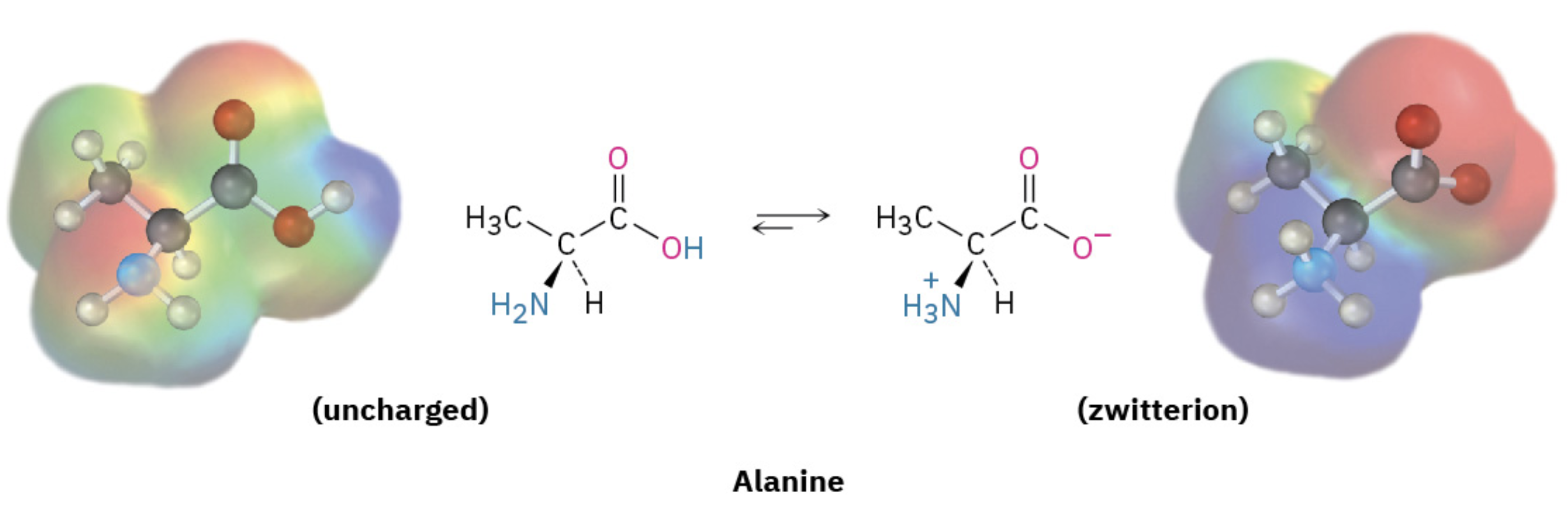
Amino acids have ionizable amino and carboxyl groups; some also have ionizable R groups. The zwitterion carries both positive and negative charges but can have zero net charge. Zero net charge does not mean that every group is uncharged.
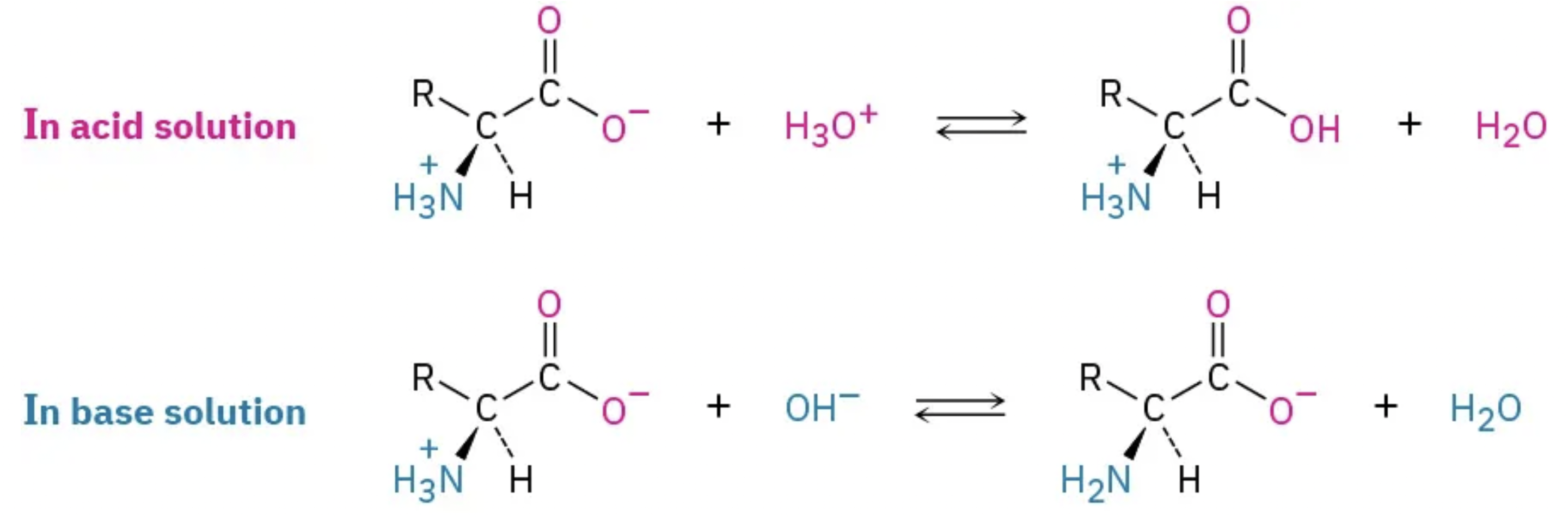
Low pH favors protonation; high pH favors deprotonation. At pH = pKa, an ionizable group is half protonated. Below its pKa it is mostly protonated; above its pKa it is mostly deprotonated.
Find the isoelectric point
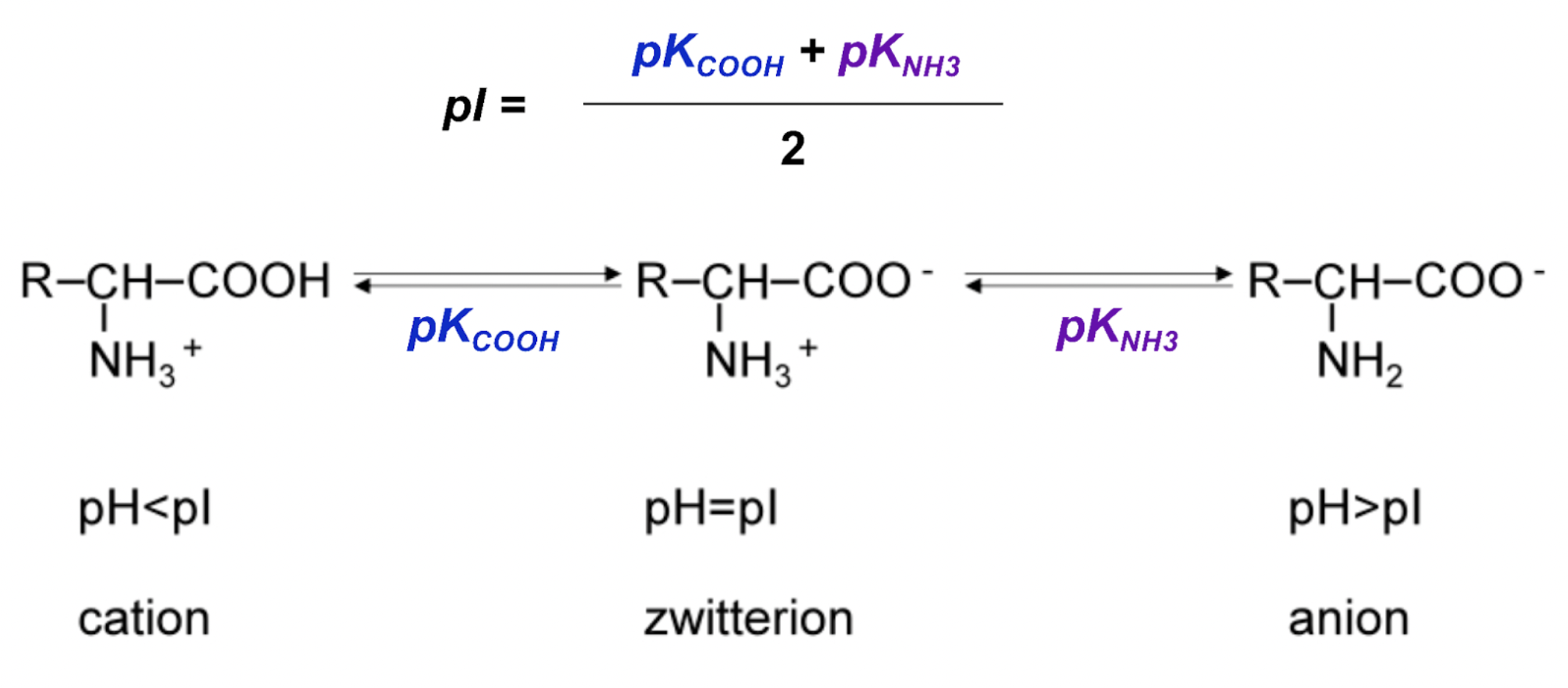
The isoelectric point (pI) is the pH of zero net charge. For a simple amino acid, average the two pKa values that bracket the neutral form. Do not automatically average every pKa.
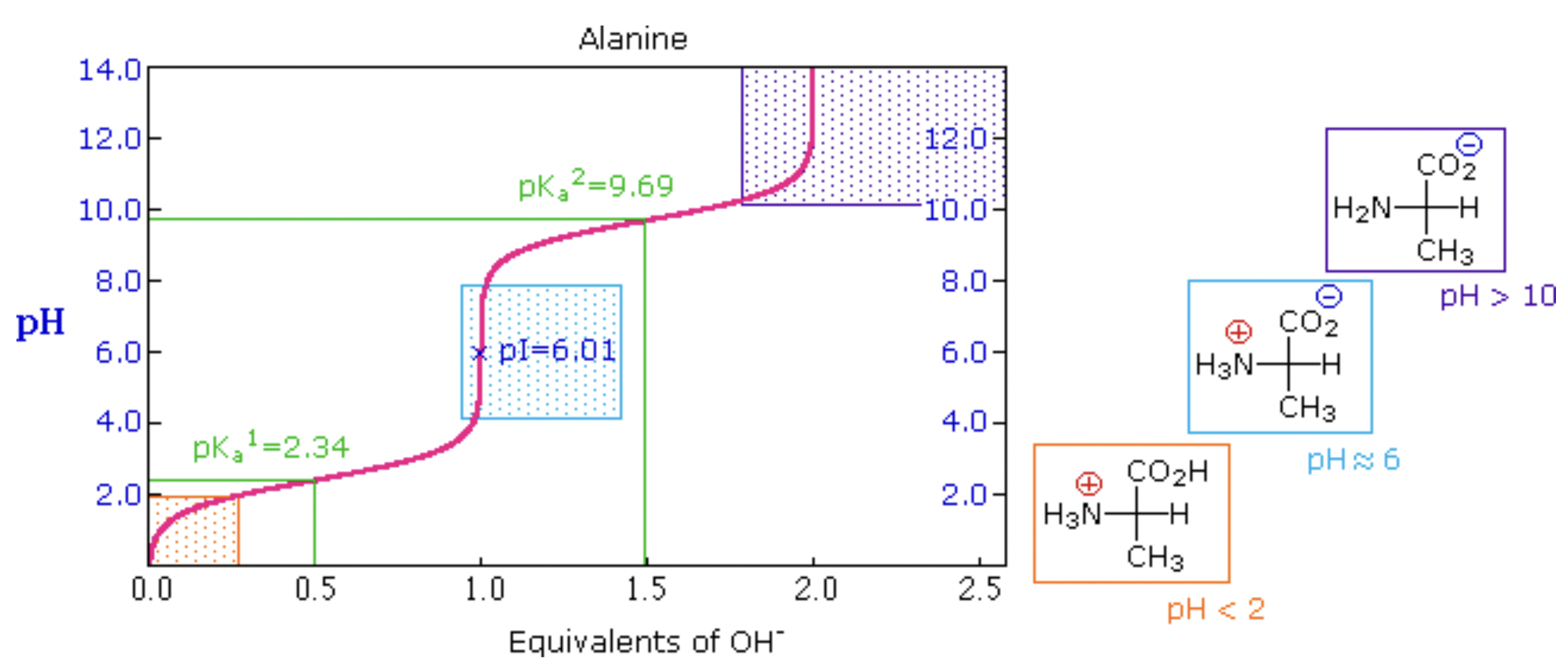
Alanine has no ionizable side chain. Its pI is (2.34 + 9.69) ÷ 2 ≈ 6.0. On its titration curve, buffering is greatest near either pKa.
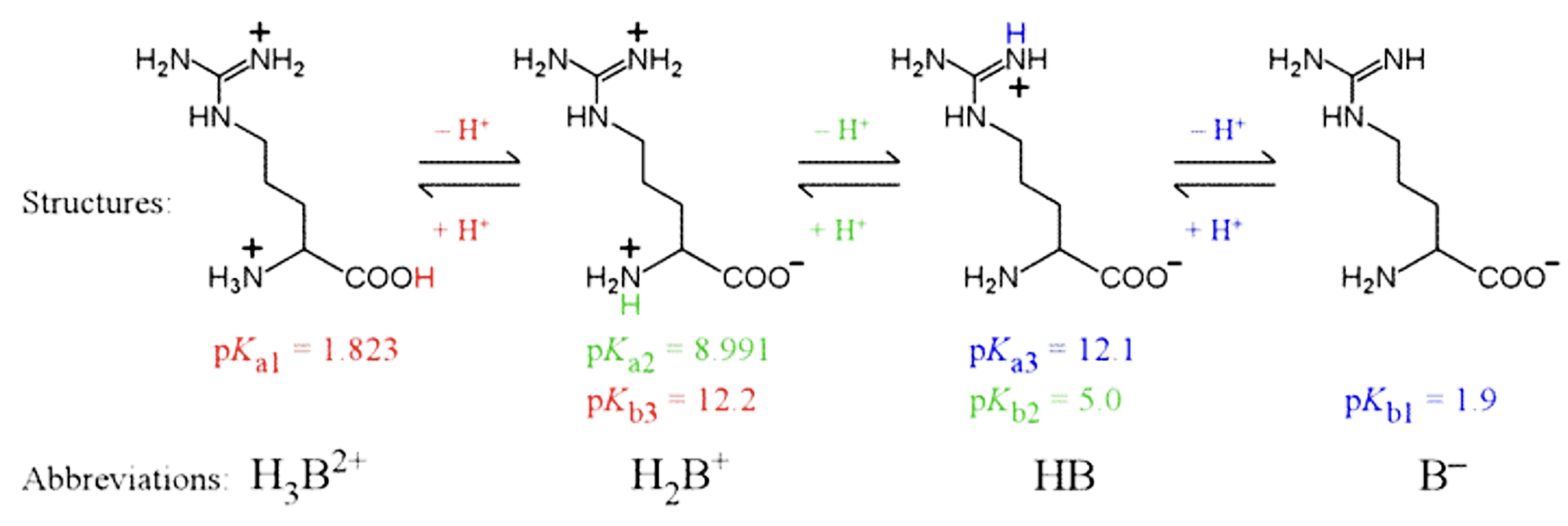
For arginine, the neutral form lies between loss of the alpha-amino proton and loss of the side-chain proton. Average those two higher pKa values: (8.991 + 12.1) ÷ 2 ≈ 10.55. Acidic side chains instead use the two values bracketing their neutral state, usually the lower pair. A protein’s pI depends on all its ionizable groups.
How focusing separates proteins
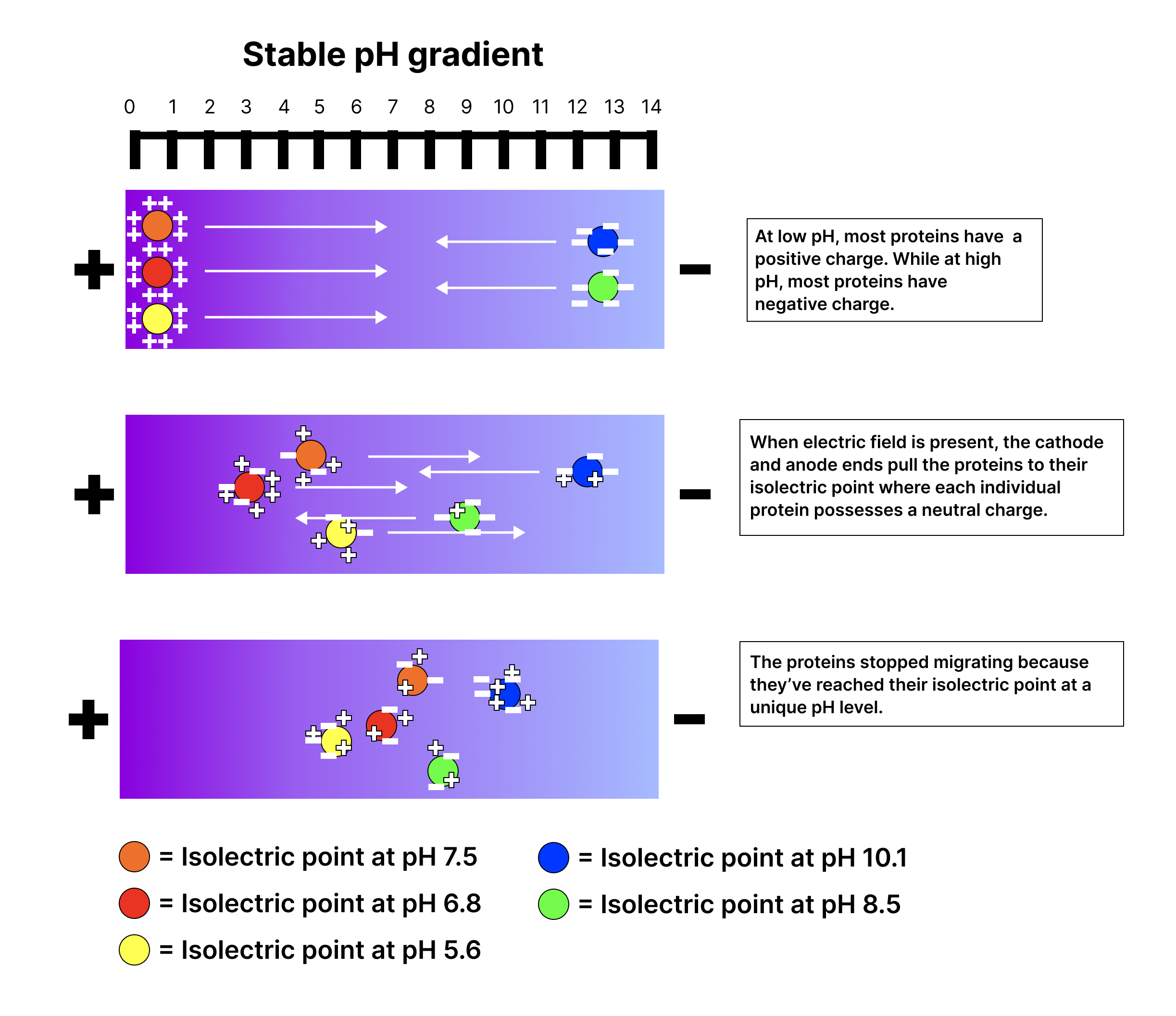
- Establish a stable pH gradient in a gel, with the acidic end near the positive anode and the basic end near the negative cathode.
- A protein in a region where pH < pI is positive and moves toward the cathode. Where pH > pI, it is negative and moves toward the anode.
- At pH = pI, net charge and electrical migration vanish. Diffusion away from this position changes the protein’s charge and drives it back, creating a focused band.
What IEF measures. Isoelectric focusing (IEF) separates by pI, not molecular mass. Two proteins with the same pI may focus together even if their sizes differ.