Additional protein analysis techniques
Choose the measurement first: sedimentation, mass-to-charge ratio , binding, abundance, or structure.
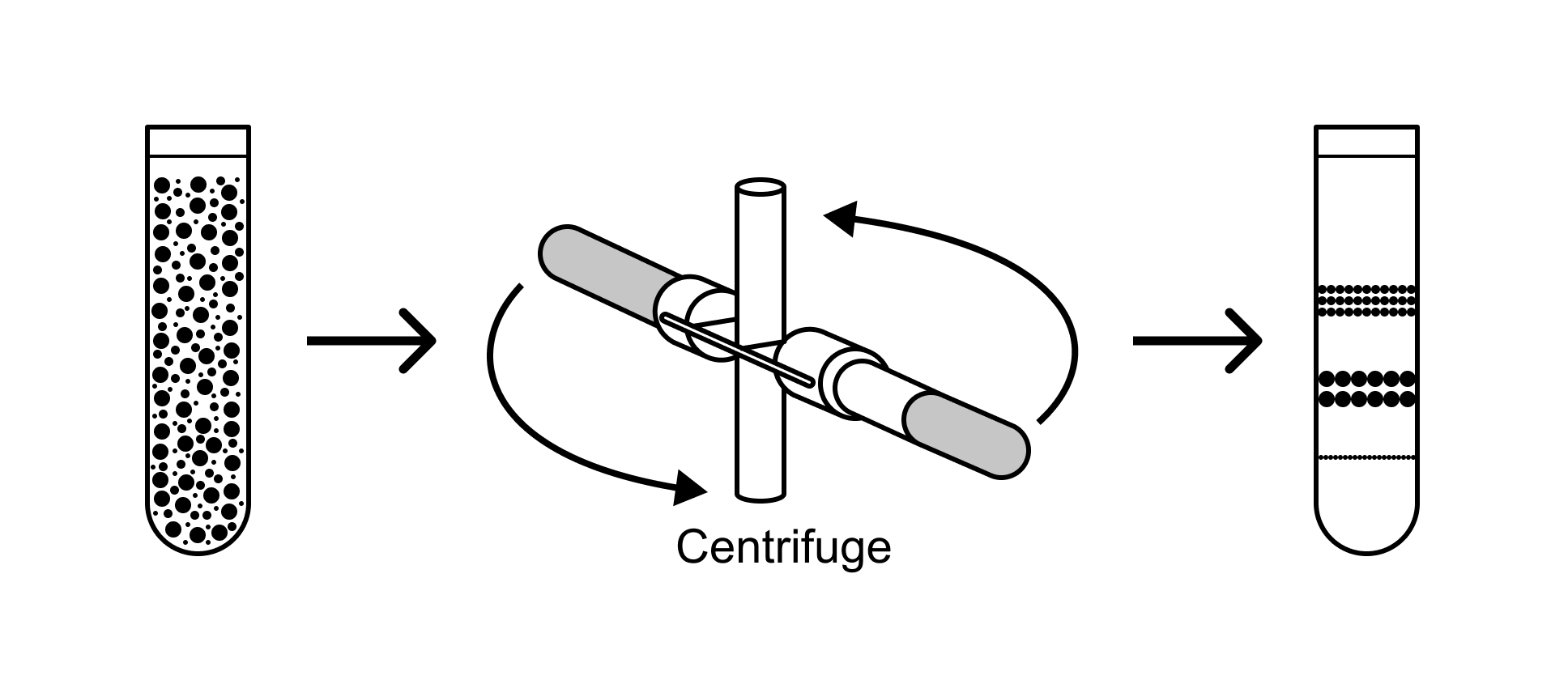
High-speed centrifugation separates particles by sedimentation behavior. Size, shape, density, and solvent conditions all matter. Differential centrifugation uses successive spins to collect different fractions; density gradients improve resolution and can separate particles by sedimentation or buoyant density, depending on the method.
Separation by centrifugation
Khan Academy · CC BY-NC-SA 4.0
· Original image ↗
The sedimentation coefficient describes velocity relative to centrifugal acceleration and is expressed in Svedberg units . One Svedberg unit equals 10⁻¹³ seconds. Values are not additive because combining particles changes both mass and frictional resistance.
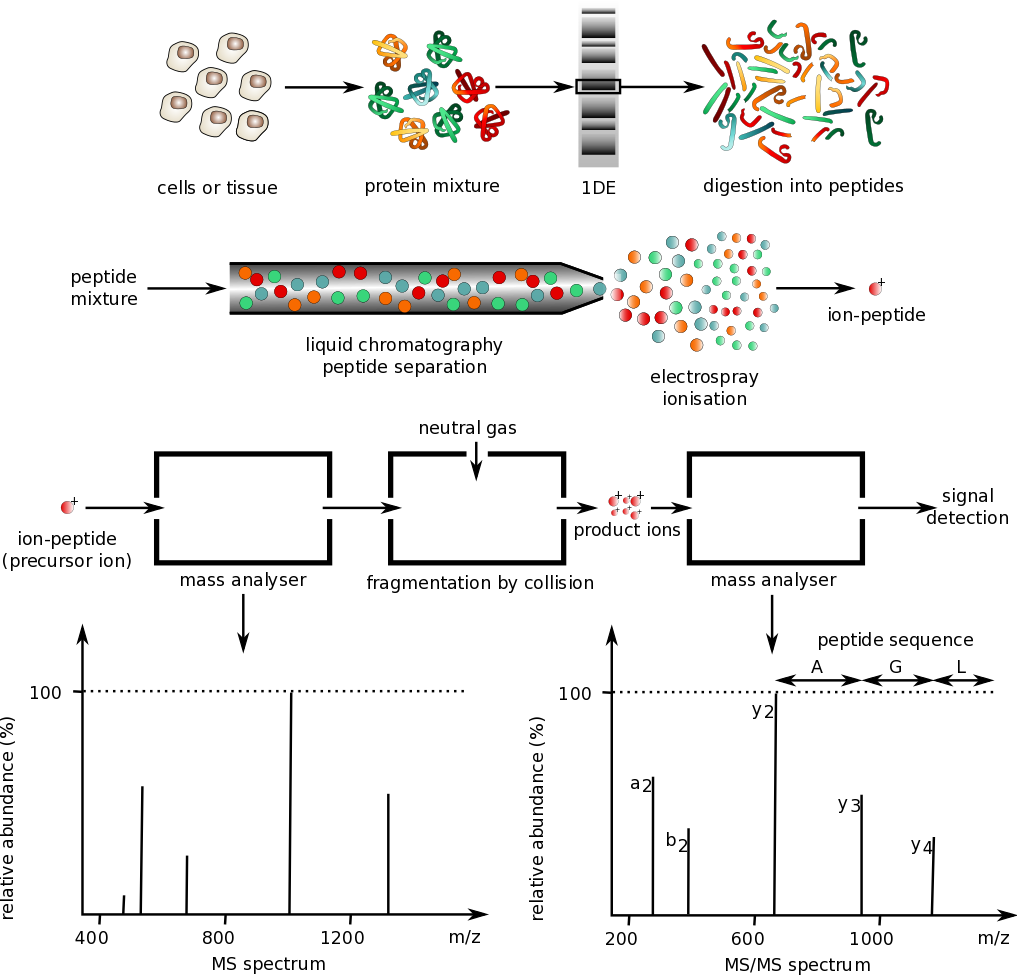
MS measures the mass-to-charge ratio (m/z ) of gas-phase ions. A typical protein workflow separates the sample, digests proteins with trypsin , ionizes the peptides, and analyzes the resulting spectra. Ionization methods include MALDI and ESI . ESI often produces several charge states, so a peak’s m/z is not automatically the molecule’s mass.
In MS/MS , select a precursor ion , fragment it, and measure its fragment ions. Their mass differences help infer the peptide sequence, identify a protein, or locate modifications. The selected precursor is not necessarily the peak with the largest m/z .
Protein identification by mass spectrometry
Philippe Hupé, Computational Systems Biology of Cancer (2012), via Wikimedia Commons and Khan Academy · CC BY-SA 3.0
· Original image ↗
Other methods and what they measure ICAT : light and heavy chemical tags support relative quantification of proteins by MS .SPR : follows molecular binding in real time, allowing analysis of association, dissociation, and affinity.2D-GE : first separates proteins by pI using IEF , then by apparent molecular mass using SDS-PAGE .Protein microarrays : test many immobilized proteins for interactions, activity, or abundance in parallel.FTIR : infrared absorption, including amide bands, reports on protein structure.NMR : nuclear spin signals reveal molecular structure and dynamics, often in solution.CD : differential absorption of circularly polarized light helps estimate secondary structure and follow folding changes.
Search terminology
24 terms, alphabetically ordered
Circular dichroism spectroscopyCD A method measuring the difference in absorption of left- and right-circularly polarized light, often used to assess protein secondary structure . Electrospray ionizationESI A soft ionization method producing gas-phase ions from charged liquid droplets; often gives multiply charged peptide or protein ions. Fourier-transform infrared spectroscopyFTIR A method that uses infrared absorption, including amide bands, to study protein secondary structure . Isoelectric focusingIEF Separation of proteins in a pH gradient by their isoelectric points . A protein stops migrating where it has no net charge. Isoelectric pointpI · isoelectric points The pH at which a molecule has zero net electrical charge. In isoelectric focusing , a protein accumulates where local pH equals its pI . Isotope-coded affinity tagsICAT Chemically related light and heavy tags used for relative protein quantification by mass spectrometry . Mass spectrometryMS · mass spectrometer Analysis of ionized molecules according to their mass-to-charge ratios, used to identify and quantify proteins or peptides. Mass-to-charge ratiom/z The mass of an ion divided by its charge number; this is the quantity measured by a mass spectrometer . Matrix-assisted laser desorption/ionizationMALDI A soft ionization method using a laser and a matrix to produce gas-phase ions from biomolecules. Nuclear magnetic resonance spectroscopyNMR A method using nuclear spin behavior in a magnetic field to study molecular structure and dynamics, including proteins in solution. pH A measure of acidity, defined as the negative base-10 logarithm of hydrogen ion activity. Lower pH means greater acidity; pH influences amino acid charge. Polyacrylamide gel electrophoresisPAGE · native PAGE Electrophoretic separation using a polyacrylamide gel. Native PAGE preserves much of a protein’s native structure. Precursor ionprecursor ions An ion selected for fragmentation in tandem mass spectrometry . The resulting fragment ions provide structural information. Protein microarrayprotein microarrays An array of immobilized proteins used to study interactions, abundance, or activity.
Secondary structure Local backbone folding, such as alpha helices and beta sheets, stabilized mainly by backbone hydrogen bonds.
Sedimentation coefficient A measure of sedimentation velocity relative to centrifugal acceleration. It depends on buoyant mass and frictional resistance. Sodium dodecyl sulfateSDS An anionic detergent that unfolds proteins and coats them with negative charge. It does not itself reduce disulfide bonds. Sodium dodecyl sulfate polyacrylamide gel electrophoresisSDS-PAGE A denaturing protein separation method. SDS gives proteins a similar negative charge-to-mass ratio so migration depends mainly on molecular mass. Surface plasmon resonanceSPR A label-free method that monitors molecular binding at a surface in real time. Svedberg unitSvedberg units A unit of sedimentation coefficient equal to 10⁻¹³ seconds. Svedberg values depend on particle shape and density and are not additive. Tandem mass spectrometryMS/MS Two stages of mass analysis separated by fragmentation of a selected precursor ion , often used to infer peptide sequences.
Trypsin A protease commonly used to digest proteins into peptides, usually cleaving after lysine or arginine unless followed by proline. Two-dimensional gel electrophoresis2D-GE · 2D electrophoresis Protein separation in two successive dimensions, usually isoelectric focusing followed by SDS-PAGE .
Ultracentrifugation High-speed centrifugation used to separate particles by sedimentation behavior, which depends on size, shape, density, and solvent conditions. No matching terms. Try a different name or abbreviation.